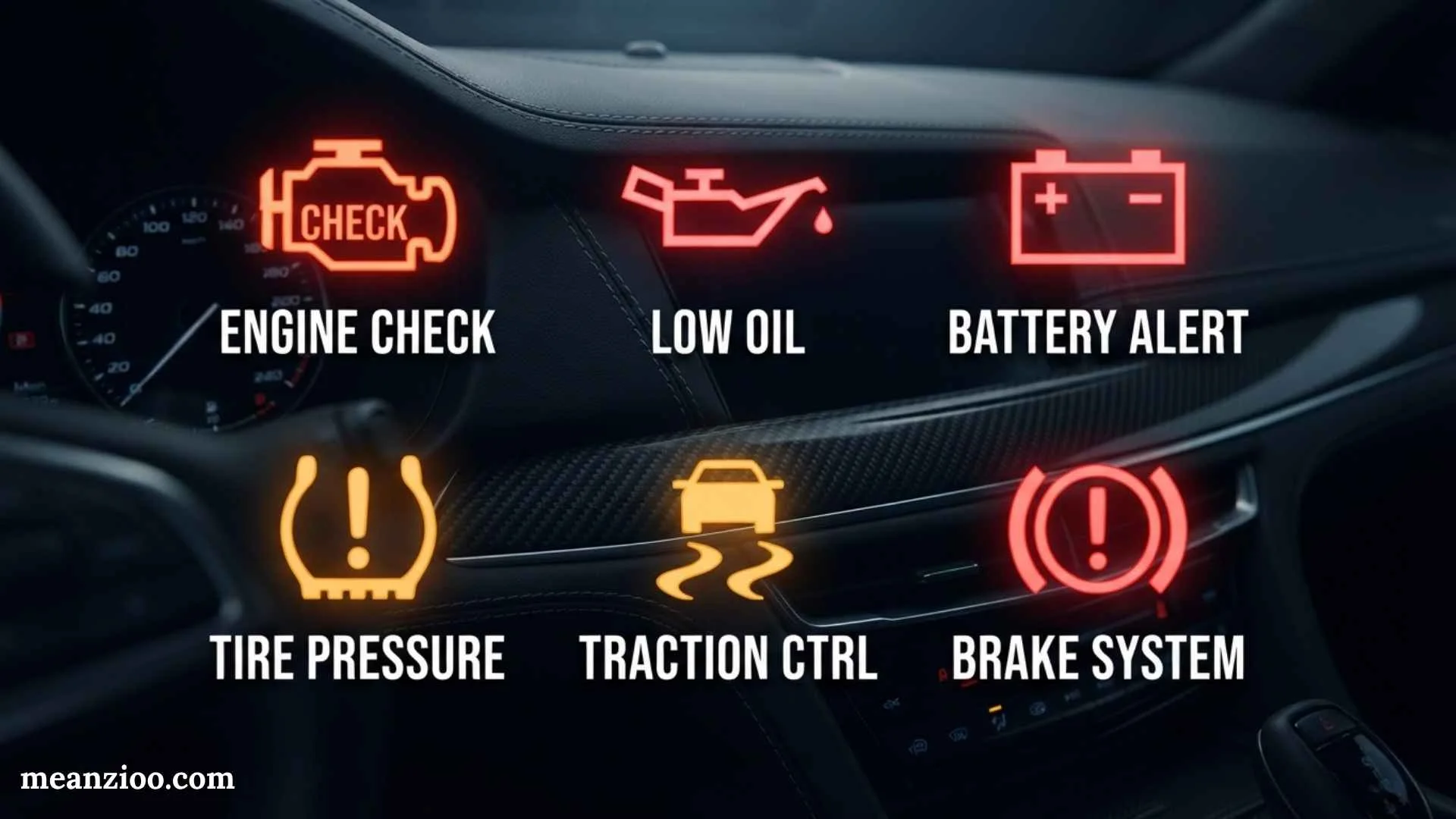
Dashboard car symbols are an important communication system between your vehicle and you. Every light or icon on the instrument cluster has a purpose. Some symbols simply tell you that a feature is working, while others warn you about a possible problem with the engine, brakes, tires, battery, safety systems, or other vehicle components.
Knowing common dashboard car symbols can help you understand your vehicle quickly and decide what action may be needed. A red warning light may require immediate attention, while a yellow or amber light often means that a system needs checking. Green and blue lights usually provide information about an active vehicle function.
Modern cars can have dozens of dashboard symbols, and their exact appearance can vary by manufacturer, model, trim level, and year. This guide explains the most common car dashboard symbols, their meanings, colors, warning levels, and what you should do when they appear.
What Are Dashboard Car Symbols?
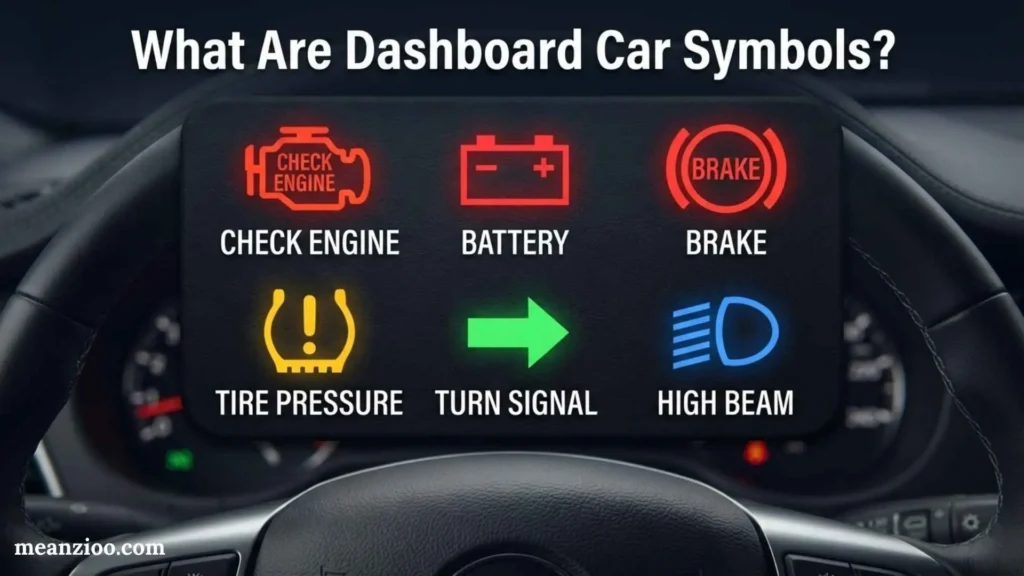
Dashboard car symbols are visual indicators displayed on a vehicle’s instrument cluster. They communicate information about the vehicle’s operating condition, safety systems, maintenance needs, and active features.
These symbols can represent systems such as:
- Engine and emissions
- Engine oil
- Brakes
- Battery and charging
- Tires
- Airbags
- Seat belts
- Traction control
- Stability control
- Headlights
- Fog lights
- Fuel level
- Coolant temperature
- Driver assistance systems
Some lights appear when you start the vehicle as part of a normal system check and then disappear. A warning that remains illuminated after the vehicle starts may require further attention.
Dashboard Warning Light Colors and What They Mean
The color of a dashboard symbol provides an important clue about its general purpose. However, the exact meaning always depends on the vehicle.
| Color | General Meaning | Typical Examples |
| Red | Serious warning or immediate attention may be needed | Oil pressure, brakes, overheating |
| Yellow/Amber | Warning, fault, or system requiring attention | Check engine, ABS, tire pressure |
| Green | System or feature is active | Turn signal, cruise control |
| Blue | Information about an active function | High-beam headlights |
| White | Information or system status on some vehicles | Driver-assistance or vehicle settings |
Red Dashboard Symbols
Red usually indicates a warning that should not be ignored. Depending on the symbol, you may need to stop the vehicle safely and investigate the problem.
Common red warnings include:
- Engine oil pressure
- Brake system
- Engine temperature
- Charging system
- Seat belt
- Door or hood open
A red light does not automatically mean the vehicle is about to fail, but it deserves more immediate attention than a typical informational indicator.
Yellow or Amber Dashboard Symbols
Yellow and amber lights generally indicate that a system has detected a condition or malfunction that needs attention.
Examples include:
- Check engine light
- ABS warning
- Tire pressure warning
- Traction control
- Stability control
- Maintenance-related warnings
The vehicle may still be drivable, depending on the specific warning, but the owner’s manual should be consulted.
Green Dashboard Symbols
Green symbols normally indicate that a feature is active or operating.
Examples include:
- Turn signals
- Cruise control
- Parking lights
- Certain driver-assistance features
These are generally informational rather than warnings.
Blue Dashboard Symbols
Blue is often used for information about a lighting or vehicle function. The high-beam indicator is one of the most familiar examples.
Always check your owner’s manual if you are unsure about a blue symbol.
Dashboard Car Symbols Quick Reference
The following table provides a quick overview of common dashboard symbols and their general meanings.
| Dashboard Symbol | General Meaning | Typical Action |
| Engine icon | Check engine/emissions fault | Arrange diagnosis |
| Oil can | Low oil pressure | Stop safely and check |
| Thermometer | High engine temperature | Stop safely and allow cooling |
| Battery | Charging-system problem | Have system checked |
| Circle with ! | Brake warning | Check brakes/parking brake |
| ABS | ABS system warning | Have system inspected |
| Tire with ! | Low tire pressure | Check and adjust tires |
| Car with wavy lines | Traction/stability control | Check system if persistent |
| Airbag icon | Airbag/SRS warning | Arrange inspection |
| Seat belt icon | Seat belt not fastened | Fasten seat belt |
| Fuel pump | Low fuel | Refuel |
| Headlamp | Headlights active | Informational |
| Blue headlamp | High beams active | Switch beams when appropriate |
| Windshield spray | Washer fluid low | Refill fluid |
| Door/car outline | Door or compartment open | Close securely |
The actual icon and behavior can vary between vehicles.
Check Engine Light
The check engine light usually appears as an engine-shaped icon. It is one of the most recognizable dashboard car symbols.
This warning can be triggered by problems involving the engine, emissions system, sensors, fuel system, ignition system, or other components monitored by the vehicle’s onboard diagnostics.
Possible causes include:
- Loose or faulty fuel cap
- Oxygen sensor problems
- Ignition or misfire issues
- Emissions-system faults
- Sensor problems
- Fuel-system issues
What Does a Flashing Check Engine Light Mean?
A flashing check engine light generally deserves more urgent attention than a steady light. It can be associated with an active engine misfire that may cause additional damage if the vehicle continues operating.
If the check engine light is flashing, avoid unnecessary driving and follow the vehicle manufacturer’s instructions.
Oil Pressure Warning Symbol
The oil pressure warning symbol commonly resembles an oil can.
This warning is different from a routine oil-change reminder. It may indicate that the engine is not receiving adequate oil pressure.
If the warning illuminates while the engine is running:
- Safely pull over when possible.
- Turn off the engine.
- Check the oil level if it is safe to do so.
- Follow the instructions in the owner’s manual.
- Seek professional assistance if the warning remains.
Continuing to operate an engine with inadequate oil pressure can result in severe engine damage.
Engine Temperature Warning Light
The engine temperature symbol commonly looks like a thermometer over waves.
It can indicate that the engine coolant temperature is too high. Overheating can result from several problems, including:
- Low coolant
- Cooling fan failure
- Radiator problems
- Thermostat problems
- Water-pump problems
- Cooling-system leaks
If the temperature warning appears, safely stop the vehicle and follow the manufacturer’s overheating instructions.
Never remove a hot radiator or coolant-system cap because pressurized coolant can cause serious burns.
Battery and Charging System Symbol
The battery warning symbol normally looks like a car battery with positive and negative signs.
Although it looks like a battery symbol, it can indicate a broader charging-system problem.
Possible causes include:
- Alternator problems
- Battery problems
- Loose electrical connections
- Damaged wiring
- Drive-belt problems
If the light remains on while driving, the vehicle may eventually lose electrical power. Arrange an inspection as soon as practical.
Brake Warning Symbol
The brake warning light may appear as an exclamation mark inside a circle or as another brake-related icon.
Depending on the vehicle, this symbol can indicate:
- The parking brake is engaged.
- Brake fluid is low.
- A brake-system fault has been detected.
- Another brake-related condition requires attention.
First check whether the parking brake is fully released. If the warning remains on, follow the vehicle’s instructions and have the brake system inspected.
Because braking is essential to vehicle safety, persistent brake warnings should not be ignored.
ABS Dashboard Symbol
ABS stands for Anti-lock Braking System.
The ABS warning commonly displays the letters “ABS” inside a circle.
If the ABS light remains illuminated, the vehicle’s anti-lock braking system may have detected a problem.
The normal braking system may continue to function on some vehicles, but the ABS feature may not operate correctly.
An ABS warning should be diagnosed according to the manufacturer’s recommendations.
Tire Pressure Warning Symbol
The tire pressure monitoring system, often called TPMS, commonly uses a symbol shaped like a tire with an exclamation mark.
This warning usually means that one or more tires have low pressure.
Low tire pressure can affect:
- Vehicle handling
- Braking
- Tire wear
- Fuel economy
- Driving stability
- Tire temperature
Check all tires and inflate them to the pressure recommended by the vehicle manufacturer.
Do not rely only on visual inspection because a tire can lose pressure without looking obviously flat.
Traction Control Symbol
The traction control symbol often shows a vehicle with wavy lines underneath it.
When the symbol flashes, it can mean the traction-control system is actively helping maintain traction.
A steady symbol may mean the system has been turned off or has detected a fault, depending on the vehicle.
Traction control is especially useful when driving on surfaces where the tires can lose grip.
Electronic Stability Control Symbol
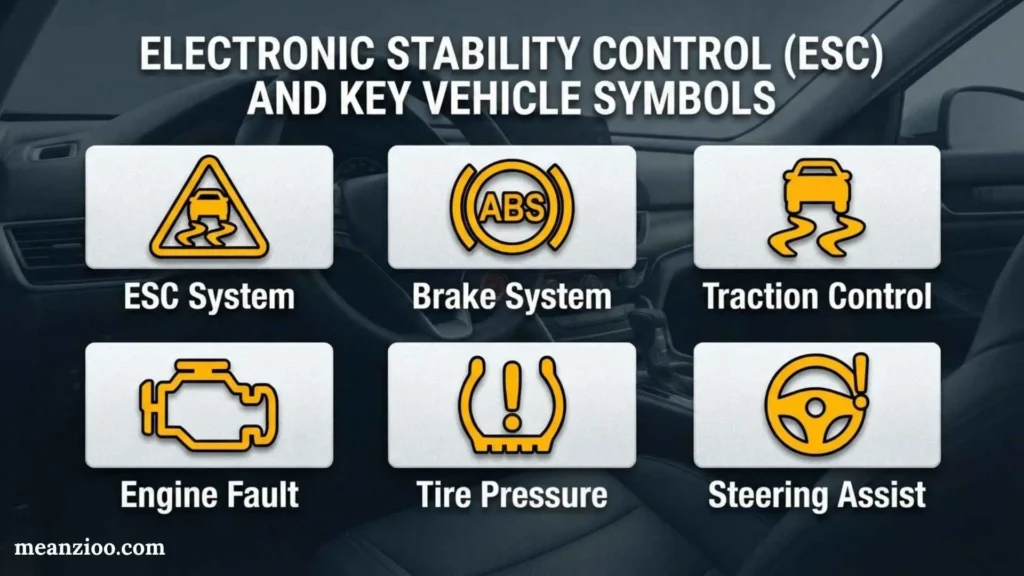
Electronic Stability Control, or ESC, helps a vehicle maintain directional stability when the system detects conditions such as wheel slip or loss of control.
Its symbol often looks like a car with curved or wavy lines beneath it.
The indicator may:
- Flash when the system is actively intervening.
- Remain on when the system is switched off.
- Remain illuminated when a fault is detected.
Because symbol behavior varies, consult the owner’s manual for your particular vehicle.
Airbag Warning Symbol
The airbag warning symbol commonly depicts a seated person with a circle representing an airbag.
A persistent airbag or SRS warning can indicate a problem with the supplemental restraint system.
Possible areas involved may include:
- Airbag components
- Sensors
- Wiring
- Seat-belt pretensioners
- Supplemental restraint system controls
Because airbags are important safety equipment, a persistent warning should be inspected by a qualified technician.
Seat Belt Warning Symbol
The seat belt symbol usually shows a person wearing a seat belt.
It may appear when a driver or passenger has not fastened their seat belt. Some vehicles also provide an audible warning.
Fasten the seat belt before driving and make sure passengers are properly restrained.
Door, Hood, or Trunk Open Symbol
A door-open warning may display an outline of a vehicle or a specific open-door icon.
It can indicate that:
- A door is not completely closed.
- The trunk or liftgate is open.
- The hood is open on some vehicles.
Check the vehicle before driving, especially if the warning appears immediately after starting.
Low Fuel Symbol
The low-fuel symbol usually looks like a fuel pump.
It indicates that the fuel level has reached a low point determined by the vehicle manufacturer.
The distance remaining after the warning appears can vary depending on:
- Vehicle model
- Driving conditions
- Speed
- Traffic
- Terrain
- Fuel level
Do not assume that every vehicle has the same reserve range.
Windshield Washer Fluid Symbol
Some vehicles display a windshield symbol with spray or fluid.
This commonly indicates that the washer-fluid level is low.
Refill the washer reservoir using a fluid appropriate for the vehicle and local weather conditions.
Washer fluid is especially useful for maintaining visibility when the windshield becomes dirty.
Headlight and Lighting Dashboard Symbols
Low Beam Headlight Symbol
The low-beam indicator usually resembles a headlamp with angled light rays.
It tells the driver that the low-beam headlights are active.
High Beam Symbol
The high-beam indicator is usually blue and resembles a headlamp with straight horizontal rays.
When high beams are active, remember to switch to low beams when required around other road users.
Fog Light Symbol
Fog-light indicators generally resemble headlamps with a curved line through the light rays.
Some vehicles have separate front and rear fog-light indicators.
Use fog lights appropriately because unnecessary use can reduce visibility for other road users.
Turn Signal Symbols
Left and right turn signals usually appear as green arrows.
They flash when the corresponding turn signal is activated.
If a turn signal suddenly flashes faster than usual, the vehicle may have a lighting-system problem, such as a failed bulb, depending on the vehicle.
Driver Assistance Dashboard Symbols
Modern cars can display many symbols related to advanced driver-assistance systems.
These can include:
- Adaptive cruise control
- Lane departure warning
- Lane keeping assistance
- Blind-spot monitoring
- Forward collision warning
- Automatic emergency braking
- Parking sensors
- Driver attention monitoring
These systems do not work identically across manufacturers. A symbol may indicate that a feature is active, unavailable, disabled, or experiencing a fault.
Always consult the vehicle’s manual when a driver-assistance warning is unfamiliar.
Dashboard Symbols With an Exclamation Mark
An exclamation mark appears in several different dashboard symbols, so its meaning depends on the surrounding shape.
For example:
- Exclamation mark inside a tire: tire-pressure warning
- Exclamation mark inside a brake circle: brake-system warning
- Exclamation mark inside a triangle: general warning on some vehicles
- Exclamation mark with other symbols: manufacturer-specific alert
The shape surrounding the exclamation mark is just as important as the mark itself.
Warning Lights vs. Indicator Lights
Not every dashboard light means that something is wrong.
Warning Lights
Warning lights alert you to a condition that may require action.
Examples include:
- Check engine
- Oil pressure
- ABS
- Brake system
- Tire pressure
- Engine temperature
Indicator Lights
Indicator lights generally tell you that a feature is active.
Examples include:
- Turn signals
- High beams
- Cruise control
- Parking lights
- Certain driver-assistance functions
Understanding this difference can prevent unnecessary concern when a normal feature indicator appears.
What Does a Flashing Dashboard Light Mean?
A flashing light can indicate a different condition from a steady light.
For example, a traction-control indicator may flash while the system is actively working. A flashing check engine light, however, can indicate a more serious engine problem.
When a dashboard symbol starts flashing:
- Identify the symbol.
- Check the owner’s manual.
- Look for other warning signs.
- Reduce unnecessary driving if appropriate.
- Stop safely if the vehicle indicates an immediate danger.
Never assume that flashing always means the same thing for every car.
Dashboard Symbols That May Require Immediate Attention
Some warning lights deserve particularly prompt attention because they can relate to vehicle safety or potential mechanical damage.
These may include:
- Red oil pressure warning
- Engine overheating warning
- Serious brake warning
- Persistent charging-system warning
- Flashing check engine light
- Severe tire-pressure warning
- Certain airbag or restraint-system warnings
The appropriate response depends on the vehicle and circumstances. If a warning indicates that you should stop, do so in a safe location and follow the manufacturer’s instructions.
What Should You Do When a Dashboard Symbol Appears?
When an unfamiliar dashboard car symbol appears, use a simple process.
1. Identify the Symbol
Look carefully at its shape rather than relying only on its color.
2. Check the Color
Determine whether it is red, yellow, amber, green, blue, or another color.
3. Check Whether It Is Flashing
A flashing warning can have a different meaning from a steady light.
4. Look for a Message
Many modern vehicles display an explanation alongside the symbol.
5. Check the Owner’s Manual
The manual provides model-specific information and recommended actions.
6. Look for Other Symptoms
Notice unusual sounds, smells, smoke, temperature changes, reduced power, vibration, or changes in braking.
7. Stop if Necessary
If the warning indicates overheating, low oil pressure, serious braking problems, or another immediate safety concern, safely stop the vehicle.
8. Arrange Professional Diagnosis
If the warning remains or you cannot identify the cause, have the vehicle inspected.
Common Reasons Dashboard Lights Come On
Dashboard warnings can appear for many reasons. Some are simple, while others require professional diagnosis.
Common causes include:
- Low fluid levels
- Low tire pressure
- Worn components
- Sensor faults
- Electrical problems
- Engine problems
- Brake-system problems
- Charging-system faults
- Emissions-system issues
- Driver-assistance system faults
A dashboard light tells you that a condition has been detected, but the symbol alone may not identify the exact failed component.
Why Dashboard Symbols Differ Between Cars
Dashboard symbols are not completely identical across all vehicles.
Different manufacturers may use:
- Different icons
- Different colors
- Different warning messages
- Different flashing patterns
- Different levels of urgency
Luxury vehicles, electric vehicles, hybrid vehicles, commercial vehicles, and older cars may also have additional symbols that are not found on every passenger vehicle.
This is why a vehicle’s owner’s manual is the most reliable source for a specific dashboard warning.
Dashboard Symbols in Older and Modern Cars
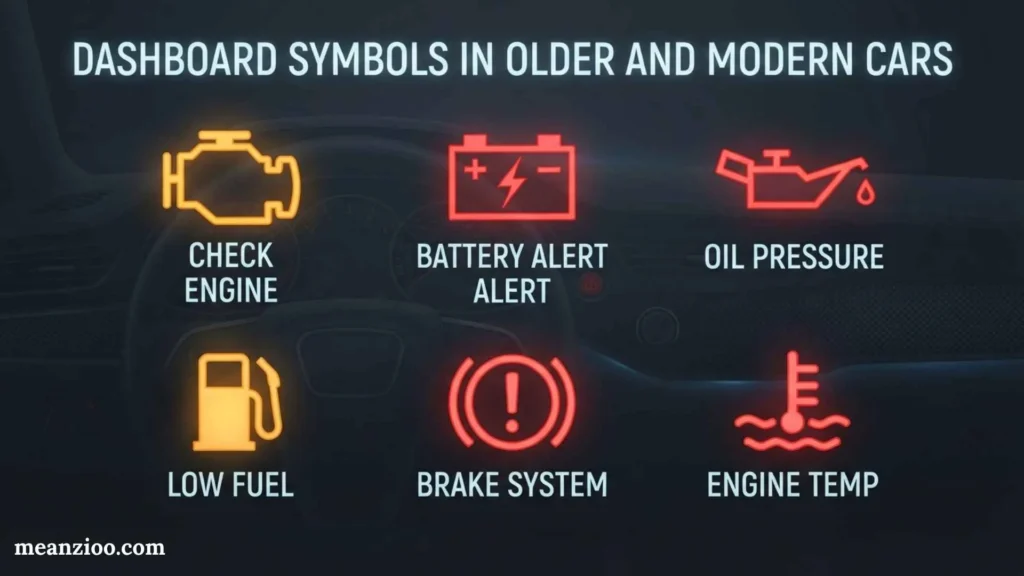
Older vehicles generally have fewer electronic warning systems than newer vehicles.
Modern vehicles can monitor a much larger number of functions, including:
- Battery condition
- Tire pressure
- Lane position
- Blind spots
- Collision risks
- Driver attention
- Adaptive cruise control
- Parking systems
- Hybrid or electric power systems
As vehicles become more electronically controlled, drivers may encounter dashboard symbols that were uncommon in older cars.
Electric and Hybrid Vehicle Dashboard Symbols
Hybrid and electric vehicles can have additional indicators related to their power systems.
These may include warnings or status indicators for:
- High-voltage systems
- Battery state
- Regenerative braking
- Charging
- Electric drive systems
- Reduced-power conditions
Because high-voltage vehicle systems require specialized safety procedures, unfamiliar warnings on hybrid or electric vehicles should be checked in the manufacturer’s manual and, when necessary, by a qualified technician.
How to Remember the Most Important Dashboard Symbols
You do not need to memorize every dashboard icon.
Start with these major categories:
- Oil can: engine oil pressure
- Thermometer: engine temperature
- Battery: charging system
- Engine: check engine/emissions
- Circle with !: brake warning
- ABS: anti-lock braking system
- Tire with !: tire pressure
- Person with circle: airbag
- Seat belt: restraint warning
- Fuel pump: low fuel
- Car with wavy lines: traction or stability control
- Blue headlamp: high beams
Learning these common symbols gives you a useful foundation for understanding your vehicle’s dashboard.
Frequently Asked Questions About Dashboard Car Symbols
What are the most common dashboard car symbols?
Common dashboard symbols include the check engine light, oil pressure warning, battery warning, engine temperature warning, brake warning, ABS, tire pressure, airbag, seat belt, low fuel, traction control, stability control, and headlight indicators.
What does a red dashboard light mean?
A red dashboard light generally indicates a serious warning or condition requiring attention. Depending on the symbol, you may need to stop safely and investigate the problem.
What does a yellow dashboard light mean?
A yellow or amber dashboard light generally indicates a warning, fault, or condition that needs attention. The vehicle may remain drivable, but the specific symbol should be checked.
What does a green dashboard symbol mean?
Green generally indicates that a vehicle feature is active or operating. Turn signals and some cruise-control indicators are common examples.
What does a blue dashboard symbol mean?
Blue is often used for informational indicators. The high-beam indicator is a common example.
Is a flashing dashboard light more serious than a solid light?
It depends on the specific symbol. Some systems flash when they are actively operating, while certain flashing warnings can indicate a serious fault. Always identify the symbol and consult the owner’s manual.
Can I drive with a dashboard warning light on?
It depends on the warning. Some informational or minor warnings may allow continued driving, while warnings involving oil pressure, overheating, brakes, or other critical systems may require you to stop safely.
Why did my dashboard warning light disappear?
Some warning lights can disappear when the condition is no longer detected. However, if a warning repeatedly returns, the underlying issue should be investigated.
Why are my car dashboard symbols different from another car?
Dashboard symbols vary by manufacturer, model, year, trim level, and vehicle technology. Always use the owner’s manual for model-specific information.
Where can I find the meaning of a dashboard symbol?
The owner’s manual is usually the best source. Many modern vehicles also display text explanations on the instrument cluster or infotainment screen.
Final Thoughts
Understanding dashboard car symbols helps you recognize what your vehicle is communicating while you drive. Some symbols are simple indicators showing that a feature is active, while others can warn about problems involving the engine, brakes, tires, battery, cooling system, or safety equipment.
Pay close attention to the symbol, color, and whether the light is flashing or steady. Red warnings and certain flashing lights may require immediate action, while yellow or amber warnings generally indicate that a system should be checked. Green and blue indicators are usually informational.
Because dashboard symbols can vary between makes and models, always use your vehicle’s owner’s manual for the exact meaning and recommended response. If a warning concerns an essential safety or mechanical system, professional inspection can help identify the underlying problem before it becomes more serious.

I’m Ryan Mitchell, and I write about modern English, trending slang, and online expressions. I enjoy explaining the meanings, origins, and real-life usage of popular words in a simple way. I believe learning slang is an important step toward understanding today’s English-speaking culture. Through my work, I aim to help readers speak more naturally and stay updated with the latest language trends.
 Charlotte Hayes