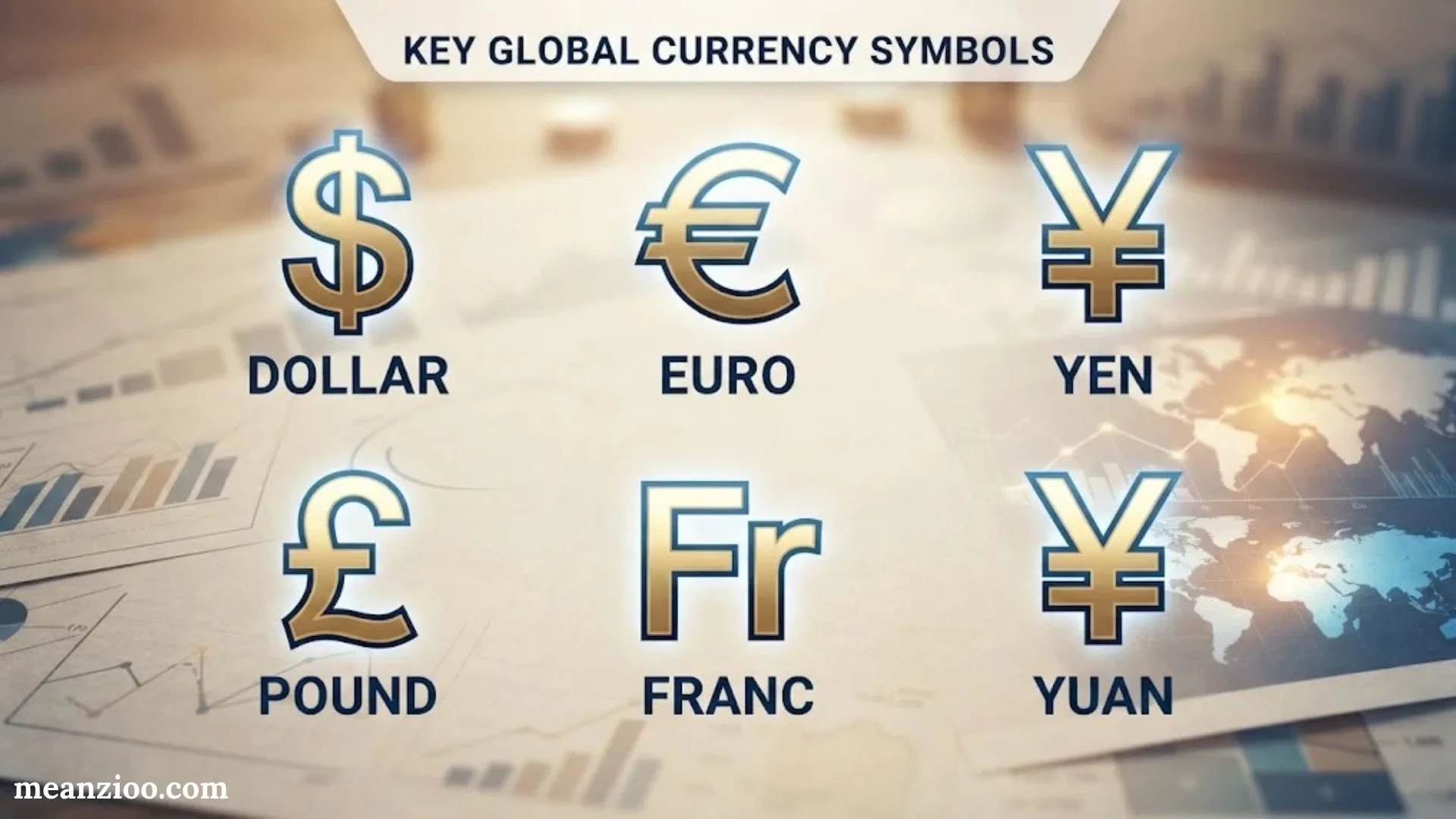
Money crosses borders every day, but its symbols aren’t always easy to recognize. The dollar sign ($), euro (€), pound (£), and yen (¥) are familiar examples. However, hundreds of monetary units have different names, signs, and international identifiers.
Understanding world currency symbols helps you identify foreign money, compare international prices, prepare financial documents, and make cross-border payments. It also prevents confusion when several countries use the same symbol.
This guide covers currency symbols around the world, including their names, ISO codes, regional differences, formatting rules, Unicode characters, and keyboard shortcuts. You’ll also find country-wise currency references and practical examples for everyday use.
Whether you’re researching international currencies, planning a trip, or looking for copy-and-paste money symbols, this reference brings the essential information together.
What Are Currency Symbols?
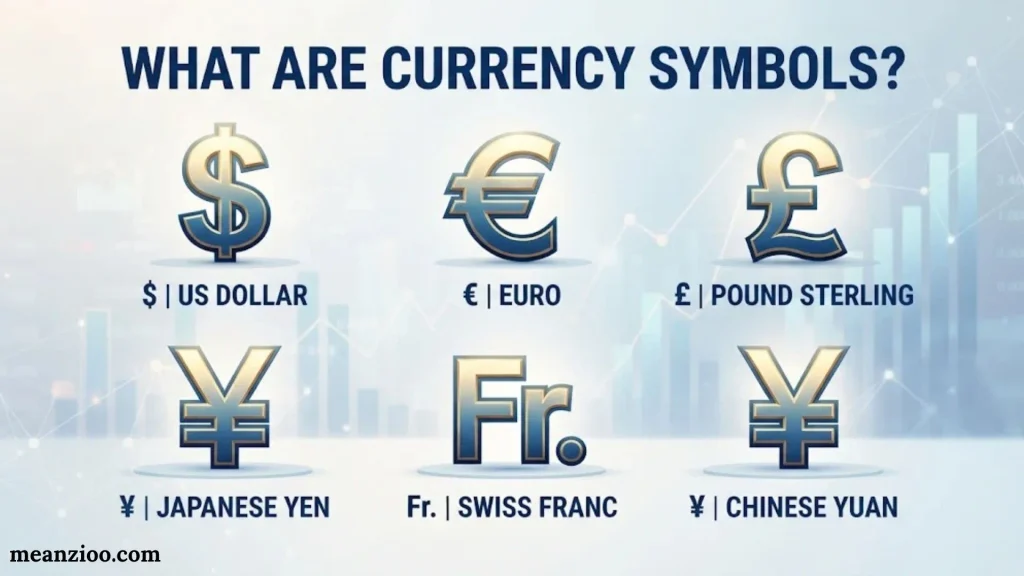
A currency symbol is a character or written sign that represents a particular monetary unit. People use these signs alongside numbers to show prices, payments, salaries, balances, and other financial amounts.
For example, the dollar sign ($) represents dollar-denominated currencies. The euro sign (€) identifies the euro, while the Indian rupee uses ₹.
Currency symbols make financial information easier to recognize without repeatedly writing the full currency name.
Consider these examples:
- $50 represents 50 units of a dollar-denominated currency.
- €100 represents 100 euros.
- £75 represents 75 British pounds.
- ₹2,000 represents 2,000 Indian rupees.
- ¥5,000 represents 5,000 yen or yuan, depending on the context.
A currency sign doesn’t always identify one country. Several nations use similar or identical monetary notation.
For example, the United States, Canada, Australia, and Singapore all use dollar-denominated currencies. Their symbols may include additional letters to distinguish them.
Why Do Countries Use Currency Symbols?
Currency signs provide a simple visual language for communicating monetary values. They also help businesses, governments, banks, and consumers recognize different currencies.
Here are their main purposes:
- Quick identification: A symbol makes it easier to recognize a currency in a price or financial statement.
- Shorter notation: Writing €100 takes less space than writing 100 euros.
- International communication: Currency signs help people understand prices across language barriers.
- Financial organization: Businesses use currency notation in invoices, budgets, and accounting documents.
- Digital transactions: Websites and payment applications display currency signs alongside monetary amounts.
A currency symbol identifies the monetary unit, while its code provides a more precise international reference.
Currency Symbol, Currency Name, and Currency Code
These three terms describe different parts of currency identification.
| Currency | Currency name | Symbol | ISO code |
| United States | US Dollar | $ | USD |
| European Union | Euro | € | EUR |
| United Kingdom | Pound Sterling | £ | GBP |
| Japan | Japanese Yen | ¥ | JPY |
| China | Chinese Yuan | ¥ | CNY |
| India | Indian Rupee | ₹ | INR |
| Pakistan | Pakistani Rupee | ₨ | PKR |
| Russia | Russian Ruble | ₽ | RUB |
| Nigeria | Nigerian Naira | ₦ | NGN |
| South Korea | South Korean Won | ₩ | KRW |
The currency name tells you what the money is called. Its symbol provides a recognizable visual sign, and its ISO code identifies it internationally.
For example, USD specifically identifies the United States dollar. The standalone $ sign could represent several different dollar currencies.
Complete World Currency Symbols List With Names and Codes
The following reference covers major international currencies and their commonly used symbols. It includes currencies from different continents, along with their three-letter ISO identifiers.
Some currencies have dedicated Unicode characters. Others rely on abbreviations or localized monetary notation.
Most Common Currency Symbols Around the World
These are among the most recognizable international currency symbols.
| Symbol | Currency | Country or region | Code |
| $ | US Dollar | United States | USD |
| € | Euro | Euro area | EUR |
| £ | Pound Sterling | United Kingdom | GBP |
| ¥ | Japanese Yen | Japan | JPY |
| ¥ | Chinese Yuan | China | CNY |
| ₹ | Indian Rupee | India | INR |
| ₨ | Pakistani Rupee | Pakistan | PKR |
| C$ | Canadian Dollar | Canada | CAD |
| A$ | Australian Dollar | Australia | AUD |
| NZ$ | New Zealand Dollar | New Zealand | NZD |
| CHF | Swiss Franc | Switzerland | CHF |
| ₽ | Russian Ruble | Russia | RUB |
| ₺ | Turkish Lira | Türkiye | TRY |
| ₩ | South Korean Won | South Korea | KRW |
| ₦ | Nigerian Naira | Nigeria | NGN |
| ₱ | Philippine Peso | Philippines | PHP |
| ฿ | Thai Baht | Thailand | THB |
| R | South African Rand | South Africa | ZAR |
| R$ | Brazilian Real | Brazil | BRL |
| ₪ | Israeli New Shekel | Israel | ILS |
| ₫ | Vietnamese Dong | Vietnam | VND |
| ₸ | Kazakhstani Tenge | Kazakhstan | KZT |
| ₴ | Ukrainian Hryvnia | Ukraine | UAH |
| ₵ | Ghanaian Cedi | Ghana | GHS |
| ৳ | Bangladeshi Taka | Bangladesh | BDT |
These signs aren’t equally common in every application. Some financial platforms use ISO codes instead of dedicated characters, particularly when processing international payments.
Currency Symbols by Country and Continent
Different regions have their own monetary systems. Some countries maintain independent national currencies, while others share a common currency.
The following sections organize major world currencies and symbols by region.
European Currency Symbols
Europe has one of the world’s most interconnected monetary systems. Many countries use the euro, while others maintain independent national currencies.
| Country | Currency | Symbol or notation | ISO code |
| Albania | Albanian Lek | L | ALL |
| Belarus | Belarusian Ruble | Br | BYN |
| Bosnia and Herzegovina | Convertible Mark | KM | BAM |
| Bulgaria | Euro | € | EUR |
| Czech Republic | Czech Koruna | Kč | CZK |
| Denmark | Danish Krone | kr | DKK |
| Hungary | Hungarian Forint | Ft | HUF |
| Iceland | Icelandic Króna | kr | ISK |
| Norway | Norwegian Krone | kr | NOK |
| Poland | Polish Złoty | zł | PLN |
| Romania | Romanian Leu | lei | RON |
| Russia | Russian Ruble | ₽ | RUB |
| Serbia | Serbian Dinar | дин. | RSD |
| Sweden | Swedish Krona | kr | SEK |
| Switzerland | Swiss Franc | CHF | CHF |
| Türkiye | Turkish Lira | ₺ | TRY |
| Ukraine | Ukrainian Hryvnia | ₴ | UAH |
| United Kingdom | Pound Sterling | £ | GBP |
Important: Bulgaria adopted the euro on January 1, 2026, replacing the Bulgarian lev as its national currency.
Aptdot+1
The euro is also used in several European countries and territories outside the euro area’s membership, including Andorra, Monaco, San Marino, and Vatican City.
North American Currency Symbols
North America includes several independent monetary systems. The US dollar is especially influential, but Canada, Mexico, and Caribbean countries also maintain their own currencies.
| Country | Currency | Symbol | ISO code |
| United States | US Dollar | $ | USD |
| Canada | Canadian Dollar | C$ | CAD |
| Mexico | Mexican Peso | $ / Mex$ | MXN |
| Bahamas | Bahamian Dollar | $ / B$ | BSD |
| Barbados | Barbadian Dollar | $ | BBD |
| Belize | Belize Dollar | BZ$ | BZD |
| Costa Rica | Costa Rican Colón | ₡ | CRC |
| Cuba | Cuban Peso | $ / CUP | CUP |
| Dominican Republic | Dominican Peso | RD$ | DOP |
| Guatemala | Guatemalan Quetzal | Q | GTQ |
| Haiti | Haitian Gourde | G | HTG |
| Honduras | Honduran Lempira | L | HNL |
| Jamaica | Jamaican Dollar | J$ | JMD |
| Nicaragua | Nicaraguan Córdoba | C$ | NIO |
| Panama | Panamanian Balboa | B/. | PAB |
| Trinidad and Tobago | Trinidad and Tobago Dollar | TT$ | TTD |
Several Caribbean countries share the East Caribbean dollar, which uses the code XCD.
These include Antigua and Barbuda, Dominica, Grenada, Saint Lucia, Saint Kitts and Nevis, Saint Vincent and the Grenadines, and several British overseas territories.
South American Currency Symbols
South America has a diverse range of currencies. Countries such as Brazil, Argentina, Chile, and Colombia maintain separate national monetary systems.
| Country | Currency | Symbol or notation | ISO code |
| Argentina | Argentine Peso | $ | ARS |
| Bolivia | Boliviano | Bs | BOB |
| Brazil | Brazilian Real | R$ | BRL |
| Chile | Chilean Peso | $ | CLP |
| Colombia | Colombian Peso | $ | COP |
| Guyana | Guyanese Dollar | G$ | GYD |
| Paraguay | Paraguayan Guaraní | ₲ | PYG |
| Peru | Peruvian Sol | S/ | PEN |
| Suriname | Surinamese Dollar | $ | SRD |
| Uruguay | Uruguayan Peso | $U | UYU |
| Venezuela | Venezuelan Bolívar | Bs. | VES |
The Brazilian real has a distinctive notation: R$. Meanwhile, several neighboring countries use the dollar sign for their peso currencies.
This makes ISO codes especially important when comparing South American prices.
Middle Eastern Currency Symbols
Middle Eastern currencies include dinars, rials, pounds, and dirhams. Several countries use currencies with similar names but different values and identifiers.
| Country | Currency | Symbol or notation | ISO code |
| Bahrain | Bahraini Dinar | BD | BHD |
| Iraq | Iraqi Dinar | ع.د | IQD |
| Iran | Iranian Rial | ﷼ | IRR |
| Israel | Israeli New Shekel | ₪ | ILS |
| Jordan | Jordanian Dinar | JD | JOD |
| Kuwait | Kuwaiti Dinar | KD | KWD |
| Lebanon | Lebanese Pound | ل.ل | LBP |
| Oman | Omani Rial | ر.ع. | OMR |
| Qatar | Qatari Riyal | ر.ق | QAR |
| Saudi Arabia | Saudi Riyal | ر.س | SAR |
| Syria | Syrian Pound | £S | SYP |
| United Arab Emirates | UAE Dirham | د.إ | AED |
| Yemen | Yemeni Rial | ﷼ | YER |
Arabic currency notation may look different from its English equivalent because Arabic uses a right-to-left writing system.
For international transactions, the three-letter codes provide a consistent reference regardless of writing direction.
African Currency Symbols
Africa has several national currencies and two major CFA franc monetary systems. Some countries also share monetary arrangements or maintain close currency relationships.
| Country | Currency | Symbol or notation | ISO code |
| Algeria | Algerian Dinar | DA | DZD |
| Angola | Angolan Kwanza | Kz | AOA |
| Botswana | Botswana Pula | P | BWP |
| Burundi | Burundian Franc | FBu | BIF |
| Egypt | Egyptian Pound | E£ | EGP |
| Eswatini | Swazi Lilangeni | L | SZL |
| Ethiopia | Ethiopian Birr | Br | ETB |
| Ghana | Ghanaian Cedi | ₵ | GHS |
| Kenya | Kenyan Shilling | KSh | KES |
| Libya | Libyan Dinar | LD | LYD |
| Madagascar | Malagasy Ariary | Ar | MGA |
| Malawi | Malawian Kwacha | MK | MWK |
| Mauritius | Mauritian Rupee | Rs | MUR |
| Morocco | Moroccan Dirham | د.م. | MAD |
| Mozambique | Mozambican Metical | MT | MZN |
| Namibia | Namibian Dollar | N$ | NAD |
| Nigeria | Nigerian Naira | ₦ | NGN |
| Rwanda | Rwandan Franc | FRw | RWF |
| Seychelles | Seychellois Rupee | Rs | SCR |
| Sierra Leone | Sierra Leonean Leone | Le | SLE |
| Somalia | Somali Shilling | Sh | SOS |
| South Africa | South African Rand | R | ZAR |
| Tanzania | Tanzanian Shilling | TSh | TZS |
| Tunisia | Tunisian Dinar | DT | TND |
| Uganda | Ugandan Shilling | USh | UGX |
| Zambia | Zambian Kwacha | K | ZMW |
Two regional currency arrangements deserve special attention.
West African CFA franc (XOF): Used by eight countries belonging to the West African Economic and Monetary Union.
Central African CFA franc (XAF): Used by six countries belonging to the Central African Economic and Monetary Community.
Both currencies share the CFA franc name but have separate ISO codes. They aren’t interchangeable merely because their names are similar.
Asian Currency Symbols
Asia contains some of the world’s most recognizable currencies, including the Chinese yuan, Japanese yen, Indian rupee, and South Korean won.
| Country | Currency | Symbol or notation | ISO code |
| Afghanistan | Afghan Afghani | ؋ | AFN |
| Armenia | Armenian Dram | ֏ | AMD |
| Azerbaijan | Azerbaijani Manat | ₼ | AZN |
| Bangladesh | Bangladeshi Taka | ৳ | BDT |
| Bhutan | Bhutanese Ngultrum | Nu. | BTN |
| Brunei | Brunei Dollar | B$ | BND |
| Cambodia | Cambodian Riel | ៛ | KHR |
| China | Chinese Yuan | ¥ / 元 | CNY |
| Georgia | Georgian Lari | ₾ | GEL |
| Hong Kong | Hong Kong Dollar | HK$ | HKD |
| India | Indian Rupee | ₹ | INR |
| Indonesia | Indonesian Rupiah | Rp | IDR |
| Japan | Japanese Yen | ¥ | JPY |
| Kazakhstan | Kazakhstani Tenge | ₸ | KZT |
| Kyrgyzstan | Kyrgyzstani Som | сом | KGS |
| Laos | Lao Kip | ₭ | LAK |
| Malaysia | Malaysian Ringgit | RM | MYR |
| Maldives | Maldivian Rufiyaa | Rf | MVR |
| Mongolia | Mongolian Tögrög | ₮ | MNT |
| Myanmar | Myanmar Kyat | K | MMK |
| Nepal | Nepalese Rupee | रू | NPR |
| North Korea | North Korean Won | ₩ | KPW |
| Pakistan | Pakistani Rupee | ₨ | PKR |
| Philippines | Philippine Peso | ₱ | PHP |
| Singapore | Singapore Dollar | S$ | SGD |
| South Korea | South Korean Won | ₩ | KRW |
| Sri Lanka | Sri Lankan Rupee | Rs | LKR |
| Taiwan | New Taiwan Dollar | NT$ | TWD |
| Tajikistan | Tajikistani Somoni | ЅМ | TJS |
| Thailand | Thai Baht | ฿ | THB |
| Turkmenistan | Turkmenistani Manat | m | TMT |
| Uzbekistan | Uzbekistani Som | so’m | UZS |
| Vietnam | Vietnamese Dong | ₫ | VND |
The Chinese yuan and Japanese yen both use ¥ in common international notation. Their ISO codes, CNY and JPY, distinguish them.
Oceania Currency Symbols
Oceania includes Australia, New Zealand, Pacific island nations, and several smaller territories.
| Country | Currency | Symbol or notation | ISO code |
| Australia | Australian Dollar | A$ | AUD |
| Fiji | Fijian Dollar | FJ$ | FJD |
| Kiribati | Australian Dollar | A$ | AUD |
| Marshall Islands | US Dollar | $ | USD |
| Micronesia | US Dollar | $ | USD |
| Nauru | Australian Dollar | A$ | AUD |
| New Zealand | New Zealand Dollar | NZ$ | NZD |
| Palau | US Dollar | $ | USD |
| Papua New Guinea | Papua New Guinean Kina | K | PGK |
| Samoa | Samoan Tala | WS$ | WST |
| Solomon Islands | Solomon Islands Dollar | SI$ | SBD |
| Tonga | Tongan Paʻanga | T$ | TOP |
| Tuvalu | Australian Dollar | A$ | AUD |
| Vanuatu | Vanuatu Vatu | VT | VUV |
Several Pacific countries use the Australian or US dollar rather than maintaining separate national currencies.
This arrangement makes international currency identification particularly important when comparing prices across the region.
Understanding ISO 4217 Currency Codes
A currency symbol provides a convenient visual reference. However, international financial systems need a standardized identification method.
The ISO 4217 currency code system solves this problem by assigning standardized identifiers to currencies.
According to the International Organization for Standardization, ISO 4217 establishes three-letter alphabetic codes and three-digit numeric codes. It also identifies the decimal relationship between currencies and their minor units.
Codes for the representation of currencies+1
How Three-Letter Currency Codes Work
Most ISO currency codes contain three letters.
The first two letters generally relate to the country code, while the third often represents the currency name.
Examples include:
| Code | Currency | Explanation |
| USD | US Dollar | US + Dollar |
| GBP | Pound Sterling | GB + Pound |
| INR | Indian Rupee | IN + Rupee |
| CAD | Canadian Dollar | CA + Dollar |
| AUD | Australian Dollar | AU + Dollar |
| CHF | Swiss Franc | CH + Franc |
This pattern has exceptions, particularly for shared currencies and special monetary units.
Major International Currency Codes
| Currency | ISO code | Numeric code |
| US Dollar | USD | 840 |
| Euro | EUR | 978 |
| British Pound | GBP | 826 |
| Japanese Yen | JPY | 392 |
| Chinese Yuan | CNY | 156 |
| Indian Rupee | INR | 356 |
| Pakistani Rupee | PKR | 586 |
| Canadian Dollar | CAD | 124 |
| Australian Dollar | AUD | 036 |
| Swiss Franc | CHF | 756 |
| Brazilian Real | BRL | 986 |
| Russian Ruble | RUB | 643 |
| Saudi Riyal | SAR | 682 |
| UAE Dirham | AED | 784 |
| South Korean Won | KRW | 410 |
Numeric codes are especially useful in automated financial systems and applications that need to work across different alphabets.
Why ISO Currency Codes Are Important

Currency codes remove uncertainty from international financial communication.
Imagine receiving an invoice containing the amount $10,000. Without additional context, you might not know which dollar currency the sender means.
Now compare that with:
- USD 10,000
- CAD 10,000
- AUD 10,000
The difference becomes clear immediately.
ISO identifiers are useful for:
- International banking.
- Foreign exchange trading.
- Global payment processing.
- Business accounting.
- Travel expense reports.
- Online shopping.
- Financial software.
- Cross-border remittances.
Shared Currency Symbols and Their Differences
Some currency symbols around the world look exactly alike. This happens because different countries developed monetary systems using similar names, historical influences, or regional traditions.
Although shared symbols make currency notation shorter, they can create confusion during international transactions.
Dollar Symbol Variations
The dollar sign ($) is among the most widely used monetary characters.
However, it represents several different currencies.
| Currency | Country | Common symbol |
| US Dollar | United States | US$ |
| Canadian Dollar | Canada | C$ |
| Australian Dollar | Australia | A$ |
| New Zealand Dollar | New Zealand | NZ$ |
| Singapore Dollar | Singapore | S$ |
| Hong Kong Dollar | Hong Kong | HK$ |
| Mexican Peso | Mexico | Mex$ |
| Jamaican Dollar | Jamaica | J$ |
| Trinidad and Tobago Dollar | Trinidad and Tobago | TT$ |
| Bahamian Dollar | Bahamas | B$ |
The dollar sign originally developed through historical monetary notation and became widely recognized through international trade.
Today, financial institutions use currency codes to distinguish individual dollar currencies.
Peso Symbol Variations
Several countries use the peso as their national monetary unit.
| Country | Currency | Symbol | Code |
| Mexico | Mexican Peso | $ | MXN |
| Argentina | Argentine Peso | $ | ARS |
| Chile | Chilean Peso | $ | CLP |
| Colombia | Colombian Peso | $ | COP |
| Philippines | Philippine Peso | ₱ | PHP |
| Uruguay | Uruguayan Peso | $U | UYU |
| Dominican Republic | Dominican Peso | RD$ | DOP |
The Philippine peso has a dedicated symbol, ₱. Several Latin American pesos commonly use the dollar sign with additional notation.
Rupee Symbol Variations
Rupee currencies appear across South Asia and several island nations.
| Country | Currency | Symbol or notation | Code |
| India | Indian Rupee | ₹ | INR |
| Pakistan | Pakistani Rupee | ₨ / Rs | PKR |
| Nepal | Nepalese Rupee | रू / Rs | NPR |
| Sri Lanka | Sri Lankan Rupee | Rs | LKR |
| Mauritius | Mauritian Rupee | Rs | MUR |
| Seychelles | Seychellois Rupee | Rs | SCR |
The Indian rupee’s dedicated symbol makes it easy to distinguish from other rupee currencies. However, abbreviations such as Rs can still appear in everyday financial writing.
Yen and Yuan Symbol Variations
Japan and China both use ¥ in common international notation.
However, their monetary units have different names and ISO codes.
| Feature | Japanese currency | Chinese currency |
| Currency name | Yen | Yuan |
| Official monetary system name | Japanese Yen | Renminbi |
| Common symbol | ¥ | ¥ |
| ISO code | JPY | CNY |
| Country | Japan | China |
Renminbi means “people’s currency,” while yuan is its principal unit.
This distinction matters when reading Chinese financial information. Renminbi refers to the currency system, while yuan identifies its main unit.
Currency Symbols Before and After Numbers
Currency formatting varies across languages and countries. Some place the symbol before the amount, while others put it afterward.
This difference reflects regional writing conventions rather than different monetary values.
Currency Symbols Before Monetary Amounts
English-language financial writing commonly places the symbol before the numerical amount.
Examples include:
| Currency | Example |
| US Dollar | $100 |
| Euro | €100 |
| British Pound | £100 |
| Indian Rupee | ₹1,000 |
| Japanese Yen | ¥500 |
| Russian Ruble | ₽1,000 |
| Nigerian Naira | ₦5,000 |
| Brazilian Real | R$250 |
This format works well in shopping displays, advertisements, and many everyday financial documents.
Currency Symbols After Monetary Amounts
Some European languages commonly place the currency sign after the number.
Examples include:
- 100 €
- 100 Kč
- 100 Ft
- 100 zł
The amount may also include a space between the digits and currency sign.
For example, a French-style amount might appear as 100,00 €.
Regional Number Formatting Differences
Currency formatting involves more than symbol placement. Thousands separators and decimal marks also vary.
| Format | Example |
| US English | $1,234.56 |
| German | 1.234,56 € |
| French | 1 234,56 € |
| Indian | ₹1,23,456.78 |
| British English | £1,234.56 |
These differences become important when working with international customers.
A comma can represent a decimal separator in one country and a thousands separator in another.
For example, 1.234 may represent one thousand two hundred thirty-four in some formats. In others, it represents one point two three four.
Always check the regional number format before interpreting an unfamiliar monetary amount.
Currency Symbols and Minor Units
Many currencies divide their main unit into smaller denominations.
| Currency | Main unit | Minor unit | Relationship |
| US Dollar | Dollar | Cent | 100 cents = 1 dollar |
| Euro | Euro | Cent | 100 cents = 1 euro |
| British Pound | Pound | Penny | 100 pence = 1 pound |
| Indian Rupee | Rupee | Paisa | 100 paise = 1 rupee |
| Pakistani Rupee | Rupee | Paisa | 100 paisa = 1 rupee |
| Japanese Yen | Yen | No commonly used minor unit | Generally displayed as whole amounts |
| South Korean Won | Won | No commonly used minor unit | Generally displayed as whole amounts |
Not every currency uses two decimal places.
The Bahraini dinar, Kuwaiti dinar, and Jordanian dinar use three decimal places in ISO 4217. The Japanese yen uses zero.
This matters when developing financial applications. Assuming every currency has two decimal places can produce incorrect calculations and displays.
Cryptocurrency Symbols and Their Digital Currency Codes
Traditional currency signs represent government-issued or shared monetary units. Cryptocurrency symbols identify digital assets that operate through blockchain technology or related systems.
Some digital assets have recognizable characters. Others use short ticker codes displayed by exchanges and cryptocurrency wallets.
Popular Cryptocurrency Symbols
| Cryptocurrency | Symbol or ticker | Code |
| Bitcoin | ₿ | BTC |
| Ethereum | Ξ | ETH |
| BNB | BNB | BNB |
| Solana | SOL | SOL |
| Tether | USDT | USDT |
| XRP | XRP | XRP |
| Litecoin | Ł | LTC |
| Dogecoin | Ð | DOGE |
| Cardano | ADA | ADA |
| Polkadot | DOT | DOT |
The Bitcoin symbol ₿ resembles a capital B with two vertical strokes. It has become a recognizable visual representation of Bitcoin.
Ethereum sometimes uses Ξ as a visual symbol. However, ETH is the more common ticker used on trading platforms.
Cryptocurrency Symbols vs. Traditional Money Symbols
| Feature | Traditional currencies | Cryptocurrencies |
| Examples | USD, EUR, GBP | BTC, ETH, SOL |
| Identification | ISO 4217 codes | Asset tickers |
| Issuance | Monetary authorities or governments | Blockchain protocols or issuing organizations |
| Physical cash | Often available | Generally digital |
| Price determination | Monetary policy and financial markets | Market supply and demand, among other factors |
| Transfers | Banks and payment networks | Blockchain networks and other digital infrastructure |
Cryptocurrency tickers also require careful identification.
Different digital assets can have similar names or tickers. Before transferring funds, verify the asset, destination address, and blockchain network.
A familiar-looking symbol alone isn’t enough to confirm that you’re using the correct digital asset.
Currency Symbols for Travel, Shopping, and International Payments
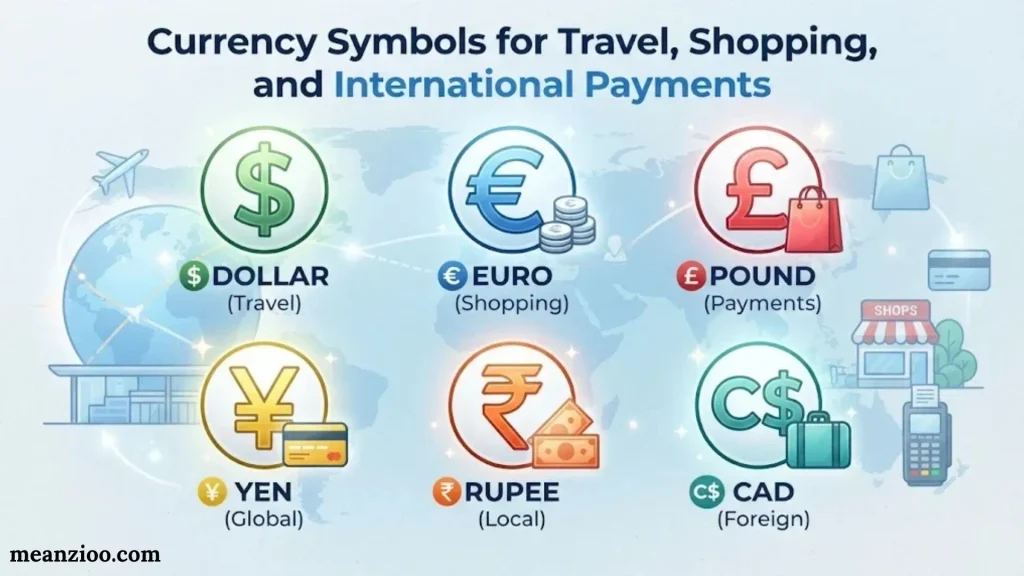
Currency recognition becomes particularly useful when you travel, shop internationally, or send money overseas.
A small symbol can tell you which monetary unit a seller uses. However, you should always confirm the actual currency before making a payment.
Currency Symbols While Traveling
Foreign currency signs appear on hotel bills, restaurant menus, transport tickets, and shopping receipts.
Here are some examples:
- Japan: ¥ represents Japanese yen.
- Thailand: ฿ represents Thai baht.
- India: ₹ represents Indian rupees.
- United Kingdom: £ represents British pounds.
- European euro-area countries: € represents euros.
- Türkiye: ₺ represents Turkish lira.
- South Africa: R represents South African rand.
When exchanging money, check the ISO code alongside the symbol. This becomes particularly important in countries where several currencies use similar signs.
Currency Symbols in Online Shopping
International stores sometimes let customers select their preferred display currency.
For example, the same product might appear as:
| Display currency | Example price |
| US Dollar | $50 |
| Euro | €46 |
| British Pound | £40 |
| Indian Rupee | ₹4,200 |
| Pakistani Rupee | ₨14,000 |
These are illustrative prices, not current exchange-rate equivalents.
A store may convert its displayed prices using its own pricing rules. The final card charge may also include foreign transaction fees or conversion charges.
Before purchasing, check the checkout currency and your payment provider’s terms.
Currency Symbols in International Money Transfers
International money transfers involve a sending currency and a receiving currency.
For example, someone sending funds from the United States to Pakistan may encounter the following information:
| Transfer detail | Example |
| Sending country | United States |
| Receiving country | Pakistan |
| Sending currency | USD |
| Receiving currency | PKR |
| Sending amount | USD 100 |
| Exchange rate | Depends on the provider and transaction time |
| Transfer fee | Depends on the service |
| Receiving amount | Calculated after conversion and applicable fees |
Services such as Western Union and international banking providers display currency information to help customers review their transactions.
Always examine the final receiving amount before confirming a payment.
How to Avoid Currency Confusion During Transactions
Follow these practical steps:
- Check the full currency name.
- Confirm the three-letter currency code.
- Review the exchange rate.
- Check conversion and transfer fees.
- Verify the receiving amount.
- Confirm the selected currency before submitting payment.
These checks are especially important when dealing with dollar, peso, and rupee currencies.
How to Type Currency Symbols on Windows and Mac
You don’t need a special keyboard to enter most monetary characters. Windows and macOS provide several ways to insert currency symbols using keyboard shortcuts.
Windows Currency Symbol Shortcuts
Windows supports numeric Alt codes for many common characters.
| Currency | Symbol | Windows Alt code |
| Dollar | $ | Alt + 36 |
| Cent | ¢ | Alt + 0162 |
| Pound | £ | Alt + 0163 |
| Yen | ¥ | Alt + 0165 |
| Euro | € | Alt + 0128 |
To use an Alt code:
- Turn on Num Lock.
- Hold down the Alt key.
- Enter the numeric code using the numeric keypad.
- Release Alt.
The euro shortcut uses the Windows-1252-compatible code 0128. Other input methods may behave differently.
Mac Currency Symbol Shortcuts
Mac keyboards provide several convenient combinations.
| Currency | Symbol | Mac shortcut |
| Dollar | $ | Shift + 4 |
| Pound | £ | Option + 3 |
| Euro | € | Option + Shift + 2 |
| Yen | ¥ | Option + Y |
These shortcuts apply to standard US keyboard layouts. Other keyboard languages may use different combinations.
You can also press Control + Command + Space to open Character Viewer.
Search for a currency name and select its character.
Copy and Paste Currency Symbols
If you don’t want to memorize keyboard shortcuts, use this ready-to-copy reference.
| Symbol | Currency |
| $ | Dollar |
| € | Euro |
| £ | Pound |
| ¥ | Yen / Yuan |
| ₹ | Indian Rupee |
| ₨ | Rupee |
| ₽ | Russian Ruble |
| ₺ | Turkish Lira |
| ₴ | Ukrainian Hryvnia |
| ₦ | Nigerian Naira |
| ₱ | Philippine Peso |
| ₩ | Korean Won |
| ฿ | Thai Baht |
| ₪ | Israeli New Shekel |
| ₫ | Vietnamese Dong |
| ₸ | Kazakhstani Tenge |
| ₵ | Ghanaian Cedi |
| ₲ | Paraguayan Guaraní |
| ৳ | Bangladeshi Taka |
| ₭ | Lao Kip |
| ₮ | Mongolian Tögrög |
| ₼ | Azerbaijani Manat |
| ֏ | Armenian Dram |
| ៛ | Cambodian Riel |
| ₡ | Costa Rican Colón |
Select any character and copy it into your document, website, message, or spreadsheet.
Unicode Currency Symbols and Character Codes
Unicode currency symbols allow computers to recognize and display monetary characters consistently across different operating systems and applications.
Every encoded character has a unique code point. Developers and content creators can use these identifiers when inserting special characters into websites, documents, and software.
Common Currency Symbols With Unicode Codes
| Currency | Symbol | Unicode code point |
| Dollar | $ | U+0024 |
| Cent | ¢ | U+00A2 |
| Pound | £ | U+00A3 |
| Yen | ¥ | U+00A5 |
| Euro | € | U+20AC |
| Indian Rupee | ₹ | U+20B9 |
| Russian Ruble | ₽ | U+20BD |
| Turkish Lira | ₺ | U+20BA |
| Ukrainian Hryvnia | ₴ | U+20B4 |
| Nigerian Naira | ₦ | U+20A6 |
| Philippine Peso | ₱ | U+20B1 |
| Korean Won | ₩ | U+20A9 |
| Israeli Shekel | ₪ | U+20AA |
| Vietnamese Dong | ₫ | U+20AB |
| Thai Baht | ฿ | U+0E3F |
| Kazakhstani Tenge | ₸ | U+20B8 |
| Ghanaian Cedi | ₵ | U+20B5 |
| Armenian Dram | ֏ | U+058F |
| Azerbaijani Manat | ₼ | U+20BC |
| Cambodian Riel | ៛ | U+17DB |
How to Use Unicode Currency Characters in HTML
HTML supports named entities and numeric character references.
For example:
| Symbol | HTML entity or reference |
| € | € |
| £ | £ |
| ¥ | ¥ |
| ₹ | ₹ |
| ₽ | ₽ |
| ₦ | ₦ |
| ₱ | ₱ |
You can also use hexadecimal references.
For example, the euro symbol can be inserted as:
For international websites, UTF-8 is the recommended character encoding.
Your website’s font must also support the characters you want to display. Otherwise, some visitors may see empty squares instead of currency signs.
How to Insert Currency Symbols in Microsoft Word and Google Docs
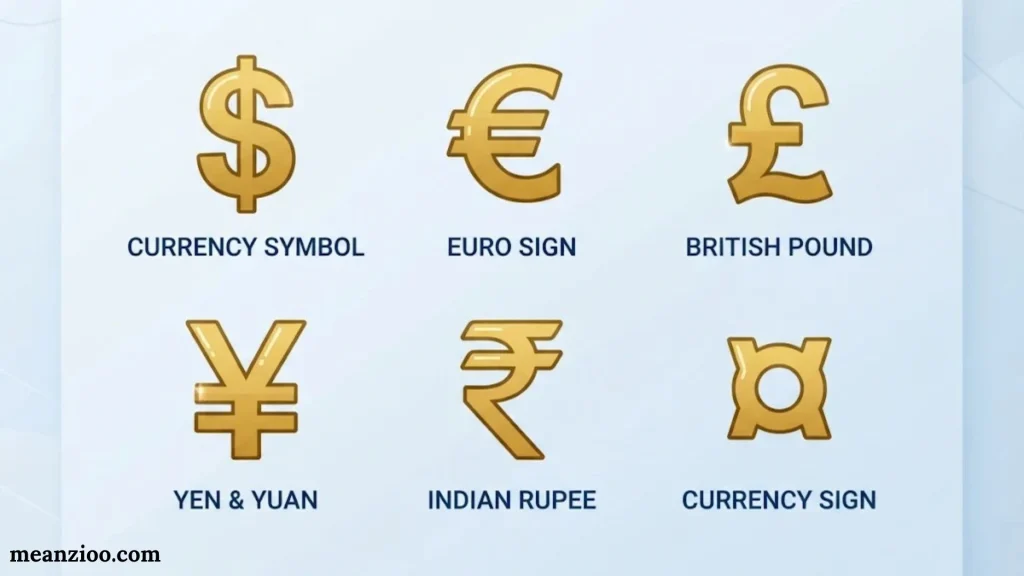
Word-processing applications make it easy to insert special monetary characters into documents.
You can use their built-in symbol menus instead of searching for individual characters online.
Microsoft Word
Follow these steps:
- Open Microsoft Word.
- Select the Insert tab.
- Choose Symbol.
- Click More Symbols.
- Find the currency character.
- Select Insert.
Word also supports Unicode hexadecimal conversion for many characters.
For example, type 20AC and press Alt + X to convert the code into €.
Google Docs
Google Docs includes a Special Characters menu.
- Open your document.
- Select Insert.
- Choose Special characters.
- Search for a currency name.
- Select the character you want.
You can search for terms such as euro, rupee, pound, or yen.
The selected symbol will appear at your cursor position.
How to Format Currency in Excel and Google Sheets
Spreadsheets often contain financial information from multiple countries. Applying the correct currency formatting keeps those figures organized and readable.
Microsoft Excel Currency Formatting
Excel provides Currency and Accounting number formats.
To apply a currency sign:
- Select the cells containing your amounts.
- Right-click and select Format Cells.
- Open the Number tab.
- Choose Currency or Accounting.
- Select your preferred currency symbol.
- Set the decimal places.
- Click OK.
For example, a numerical value of 2500 can appear as:
- $2,500.00
- €2,500.00
- £2,500.00
- ₹2,500.00
The underlying number remains unchanged.
Remember: Changing a currency symbol doesn’t convert the amount. Actual currency conversion requires an exchange rate and a calculation.
Google Sheets Currency Formatting
Google Sheets also provides built-in monetary formats.
Follow these steps:
- Highlight the required cells.
- Open the Format menu.
- Select Number.
- Choose a currency format.
- Select the appropriate currency.
- Adjust the decimal places if necessary.
Google Sheets uses spreadsheet locale settings to determine regional formatting.
These settings influence decimal separators, thousands separators, and other number-display conventions.
If your spreadsheet contains international prices, check its locale before sharing the document.
Frequently Asked Questions About Currency Symbols
What Is a Currency Symbol?
A currency symbol is a character that represents a monetary unit. Examples include $ for dollars, € for euros, £ for pounds, and ₹ for Indian rupees.
People use these signs to identify prices, payments, salaries, and financial amounts.
How Many Currency Symbols Are There in the World?
There isn’t one universally accepted number because countries use dedicated Unicode characters, abbreviations, and shared symbols.
The number of unique currency symbols also differs from the number of active ISO currency codes. For example, multiple dollar currencies use the same basic $ character.
What Are the Most Recognized Currency Symbols?
Some widely recognized currency signs include:
- $ — Dollar
- € — Euro
- £ — Pound Sterling
- ¥ — Japanese Yen and Chinese Yuan
- ₹ — Indian Rupee
- ₩ — Korean Won
- ₽ — Russian Ruble
- ₦ — Nigerian Naira
- ₱ — Philippine Peso
- ฿ — Thai Baht
These characters appear frequently in international financial information and online shopping.
What Is the Difference Between a Currency Symbol and a Currency Code?
A currency symbol is a visual character, while a currency code is a standardized identifier.
For example, $ represents a dollar sign, whereas USD specifically identifies the United States dollar.
Currency codes follow the international ISO 4217 standard.
Which Countries Use the Same Currency Symbol?
Several countries share common monetary signs.
Examples include:
- The United States, Canada, Australia, and Singapore use dollar signs.
- Mexico, Argentina, Chile, and Colombia use dollar notation for their pesos.
- India, Pakistan, Nepal, and Sri Lanka use rupee-related notation.
- Japan and China commonly use ¥.
Their ISO codes distinguish the individual currencies.
What Is the Symbol for the US Dollar?
The United States dollar uses $ as its currency symbol.
Its international currency code is USD. For clearer international communication, people often write US$.
What Is the Euro Currency Symbol?
The euro uses € and has the ISO code EUR.
The symbol represents the shared currency used by participating euro-area countries.
What Is the Japanese Yen Symbol?
The Japanese yen uses ¥ and has the ISO code JPY.
The same character also represents the Chinese yuan in common international notation.
What Is the British Pound Symbol?
The British pound sterling uses £ and has the ISO code GBP.
Its symbol has historical links to the Latin word libra.
What Is the Indian Rupee Symbol?
The Indian rupee uses ₹, a distinctive character adopted in 2010.
Its international currency code is INR.
What Is the Pakistani Rupee Symbol?
The Pakistani rupee commonly uses Rs or ₨.
Its ISO currency code is PKR. International banks and payment services generally use PKR for accurate identification.
Why Do Some Countries Use the Same Dollar Sign?
Several countries use dollar-denominated currencies because of historical monetary development and international trade.
The dollar sign became a widely recognized notation for these currencies. Country prefixes and ISO codes now distinguish them.
Why Are Some Currency Symbols Written After Numbers?
Currency placement depends on regional language and formatting conventions.
English-language formats often place signs before amounts, such as €100 or $100. Some European conventions place them afterward, such as 100 €.
Neither approach is universally correct.
How Do I Type Currency Symbols on Windows?
You can use numeric Alt codes, keyboard shortcuts, Unicode input, or Windows Character Map.
For example, Alt + 0128 inserts the euro sign (€) in supported Windows applications.
How Do I Type Currency Symbols on Mac?
Mac users can use Option-key combinations or Character Viewer.
For example, Option + 3 inserts £ on a standard US keyboard layout.
Can I Copy and Paste International Currency Symbols?
Yes. Most modern browsers, documents, and messaging applications support Unicode currency characters.
You can copy symbols such as ₹, €, ₦, ₺, and ₽ directly into your preferred application.
Are Cryptocurrency Symbols the Same as Traditional Currency Symbols?
No. Traditional currency signs represent national or shared monetary units, while cryptocurrency tickers identify digital assets.
For example, € represents the euro, whereas BTC identifies Bitcoin.
What Is the ISO 4217 Standard?
ISO 4217 is an international standard for identifying currencies using three-letter alphabetic codes and three-digit numeric codes.
It helps banks, businesses, payment processors, and financial software communicate currency information accurately.
Conclusion: Understanding World Currency Symbols
World currency symbols provide a simple way to recognize money across different countries and financial systems. From the familiar dollar ($) and euro (€) to distinctive characters such as ₹, ₦, ₽, and ₺, these signs make monetary information easier to understand.
However, recognizing a symbol is only the first step. Different countries sometimes share identical signs, while others use abbreviations instead of dedicated characters.
That’s why understanding currency symbols and codes together is important. ISO 4217 identifiers help distinguish currencies during international payments, banking, accounting, and foreign exchange transactions.
Whether you’re traveling abroad, shopping online, preparing invoices, or managing financial spreadsheets, this reference can help you identify the right currency.
Keep this world currency symbols list with names and codes available whenever you need a quick, reliable reference.

I’m Ryan Mitchell, and I write about modern English, trending slang, and online expressions. I enjoy explaining the meanings, origins, and real-life usage of popular words in a simple way. I believe learning slang is an important step toward understanding today’s English-speaking culture. Through my work, I aim to help readers speak more naturally and stay updated with the latest language trends.
 Charlotte Hayes