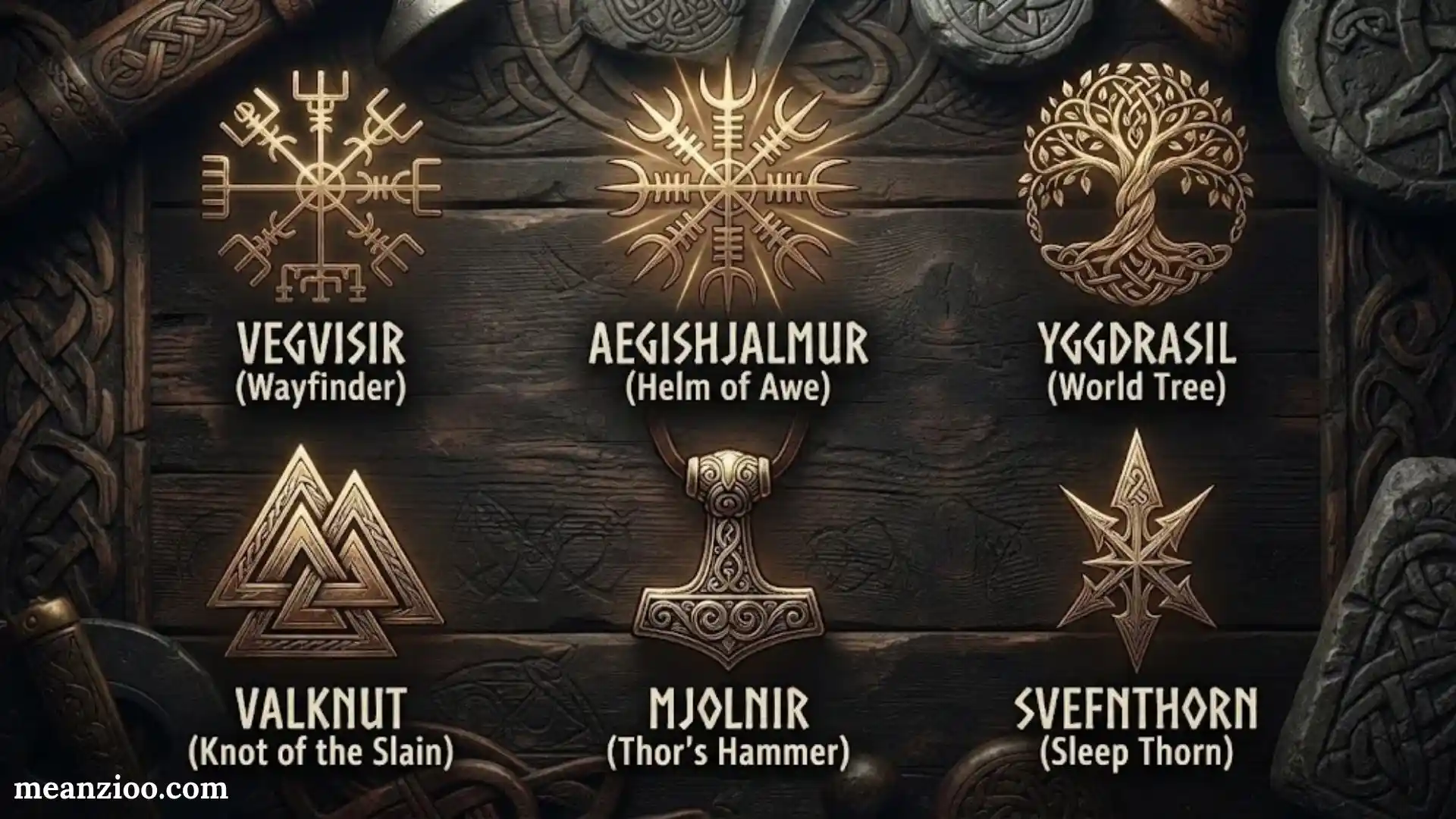
Viking symbols carry stories of gods, warriors, protection, death, nature, and the unseen world. From Thor’s hammer to mysterious interlocking triangles, these designs remain fascinating centuries after the Viking Age ended. Some appeared on jewelry, weapons, runestones, and everyday objects. Others survive through Old Norse poems, sagas, and medieval manuscripts.
However, not every symbol labeled “Viking” online comes from the Viking Age. Some originated in earlier Germanic cultures, others appeared in medieval Icelandic magical traditions, and several were created entirely in modern times. Understanding these differences makes Norse symbolism far more interesting.
Whether you’re researching authentic Viking symbols, exploring Norse mythology, or looking for meaningful Viking tattoo symbols, this guide explains their origins, historical evidence, cultural significance, and modern interpretations.
What Are Viking Symbols?
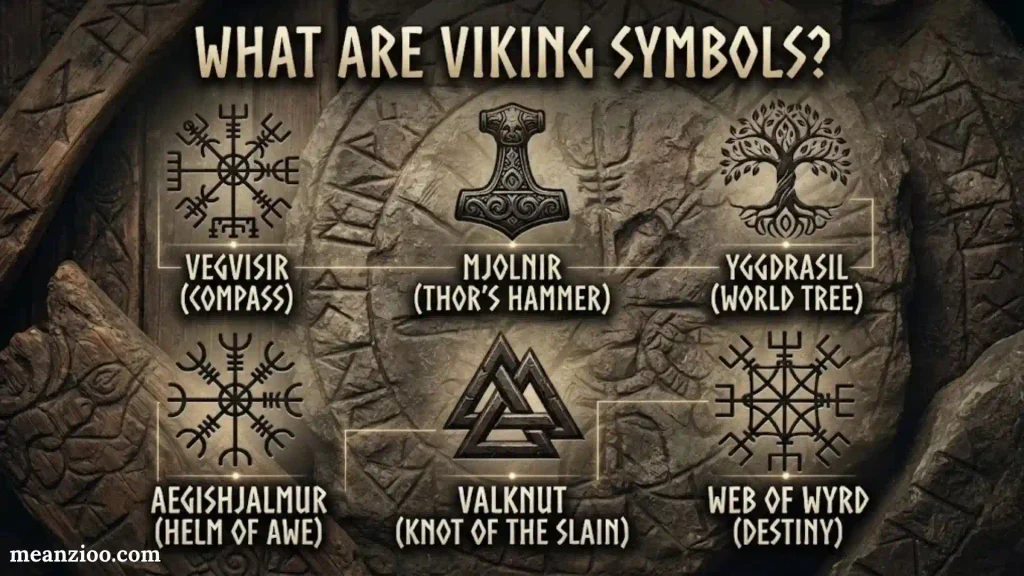
Viking symbols were visual designs, marks, and motifs associated with Scandinavian culture, religion, artistic traditions, and everyday life during the Viking Age. People carved them into stones, engraved them on
metal, embroidered them into textiles, and shaped them into jewelry.
The Viking Age generally spans approximately 793 to 1066 CE in conventional historical accounts. During this period, Scandinavian people traveled across Europe and beyond through trade, migration, raiding, settlement, and exploration.
Symbols served different purposes depending on their context. Some expressed religious beliefs, while others decorated objects, identified ownership, commemorated the dead, or carried protective associations.
Viking Symbols vs. Norse Symbols vs. Nordic Symbols
These terms overlap, but they don’t mean exactly the same thing.
| Term | Meaning |
| Viking symbols | Imagery and motifs associated with the Viking Age, including its art, religion, and material culture |
| Norse symbols | Symbols connected with Norse language, mythology, religious traditions, and cultural history |
| Nordic symbols | A broader term covering symbols and visual traditions from Nordic countries and cultures, including later periods |
| Scandinavian symbols | Motifs and cultural imagery associated with Scandinavia, potentially spanning many historical periods |
For example, Mjölnir is closely associated with Viking Age Norse religion. The Vegvísir, however, comes from a later Icelandic magical tradition. Both appear in modern Norse-inspired artwork, but their historical origins differ.
What Did Viking Symbols Represent?
Norse symbolism often reflected how people understood their world. Religion, nature, social relationships, death, and survival all influenced their imagery.
Common themes included:
- Protection: Amulets and religious objects may have offered spiritual reassurance or protection.
- Strength and courage: Warrior imagery reflected bravery, reputation, and martial identity.
- Wisdom: Odin-related stories emphasized knowledge, sacrifice, poetry, and magic.
- Fate: Norse literature frequently explores destiny, consequences, and the limits of human control.
- Nature: Animals, trees, serpents, and natural forces held important mythological associations.
- Identity: Jewelry, inscriptions, and ornamentation could express cultural affiliation, status, or personal relationships.
Historians interpret these objects through their physical context, inscriptions, artistic styles, and comparisons with contemporary sources. A symbol’s meaning often remains uncertain, especially when no written explanation survives.
Most Popular Viking Symbols and Their Meanings
Several ancient Norse symbols have become recognizable worldwide. Their popularity comes from a mix of historical artifacts, mythology, modern artwork, and tattoo culture.
However, their historical evidence varies. Some have clear archaeological connections, while others have uncertain meanings or complicated origins.
Mjölnir: Thor’s Hammer Symbol
Mjölnir, Thor’s hammer, is among the most recognizable Norse symbols. Thor wielded this powerful weapon to fight giants and protect the gods and their world.
The hammer appears throughout Norse mythology as a weapon with tremendous destructive power. Yet it also carried associations with protection, blessing, and sacred authority.
What Does Mjölnir Symbolize?
Mjölnir is commonly associated with:
- Protection against harmful forces
- Strength and courage
- Thor’s power over thunder and storms
- Religious identity and devotion
- Blessings and sacred ceremonies
Archaeologists have discovered numerous hammer-shaped pendants from Viking Age Scandinavia. These finds provide tangible evidence that people wore Thor’s hammer as jewelry and likely as a religious emblem.
Mjölnir pendants became particularly significant during the period when Christianity spread across Scandinavia. Some people continued wearing Thor’s hammer as an expression of traditional beliefs and cultural identity.
Mjölnir in Modern Culture
Today, Thor’s hammer appears in jewelry, artwork, clothing, fantasy media, and tattoos. Many people choose it to represent strength, resilience, protection, or a connection to Norse heritage.
Its historical foundation makes Mjölnir one of the strongest choices for anyone interested in an authentically Norse-inspired symbol.
Valknut: The Symbol of Three Interlocking Triangles
The Valknut consists of three interlocking triangles arranged in a distinctive geometric pattern. Its name is commonly interpreted through Old Norse elements associated with the slain and a knot, although the exact historical naming is uncertain.
The symbol appears in Scandinavian archaeological material, including imagery associated with death and figures interpreted as Odin-related. Researchers have proposed connections with warriors, the afterlife, sacrifice, and Odin’s power.
However, historians haven’t established one definitive meaning.
What Does the Valknut Mean?
Common interpretations include:
- Odin and his influence over warriors
- Death and the afterlife
- The transition between life and death
- Binding, unbinding, or supernatural power
- The relationship between fate and mortality
These interpretations remain theories rather than proven definitions.
The Valknut is often called Odin’s symbol online. Its historical imagery supports a possible Odin connection, but the exact meaning of the three triangles remains debated.
Is the Valknut an Authentic Viking Symbol?
Yes, the motif has historical evidence in Scandinavian material culture. Its interpretation, however, remains uncertain.
That distinction matters. The design itself is historically attested, but many specific meanings assigned to it today come from modern interpretation.
Yggdrasil: The Norse World Tree
Yggdrasil is the immense tree central to Norse cosmology. Old Norse literature describes it as a cosmic structure connecting different realms and sustaining the mythological universe.
The tree appears in important medieval Icelandic sources, including the Poetic Edda and Prose Edda. These works preserve mythological traditions that scholars use to understand Norse beliefs.
What Does Yggdrasil Symbolize?
Yggdrasil is commonly associated with:
- Life and interconnectedness
- Cosmic order
- Wisdom and knowledge
- Growth and renewal
- Fate and the cycle of existence
- Connections between different realms
In Norse mythology, the tree has roots and branches reaching through the cosmos. Various beings live near it or interact with it, including the dragon Níðhöggr, who gnaws at its roots.
The tree is not simply a symbol of peaceful nature. Its mythology also reflects struggle, decay, renewal, and the fragile balance of existence.
Yggdrasil and the Nine Worlds
Modern illustrations often show Yggdrasil connecting the nine worlds of Norse mythology. These include Asgard, Midgard, Jotunheim, Vanaheim, Alfheim, Svartalfheim, Nidavellir in some modern presentations, Hel, and Muspelheim.
The exact arrangement and interpretation of these realms vary between sources and modern reconstructions. Medieval texts don’t provide one universally agreed diagram of the nine worlds.
Yggdrasil tattoos and artwork often represent personal growth, family connections, wisdom, and the idea that every part of life connects to something larger.
The Triple Horn of Odin
The Triple Horn symbol features three drinking horns interlocked in a triangular arrangement. Modern Norse-inspired artwork often associates it with Odin, wisdom, poetry, and the acquisition of knowledge.
Its connection to Odin comes from the myth of the Mead of Poetry. In this story, Odin obtains a magical mead that grants poetic ability and wisdom.
What Does the Triple Horn Symbolize?
The Triple Horn commonly represents:
- Wisdom and knowledge
- Poetry and inspiration
- Odin’s pursuit of understanding
- Drinking traditions and fellowship
- Personal growth and intellectual strength
The design is frequently called the Horns of Odin. However, the exact symbol’s historical use and direct connection with the myth need careful distinction from modern interpretations.
The mythological story is ancient in literary tradition. That doesn’t automatically prove the interlocking three-horn design served as a Viking Age symbol with the same meaning.
The Triquetra: Three Interconnected Loops
The Triquetra consists of three interconnected loops forming a triangular shape. Its continuous lines create a design that resembles three joined leaves or rounded points.
The motif appears in historical European decorative art. Its presence in older artwork, however, doesn’t establish a uniquely Norse religious meaning.
What Does the Triquetra Mean?
Modern interpretations often connect the Triquetra with:
- Eternity and continuity
- Unity between three elements
- Life, death, and rebirth
- Spiritual balance
- Interconnectedness
The symbol also appears prominently in Celtic-inspired art and Christian visual traditions. Its origins and cultural meanings vary across historical settings.
Although people sometimes call it a Viking symbol, strong evidence linking the familiar Triquetra design to a specific Viking religious meaning remains limited.
Jörmungandr: The Midgard Serpent
Jörmungandr, also known as the Midgard Serpent, is one of the most famous creatures in Norse mythology. Loki and the giantess Angrboða are named as its parents in the mythological tradition.
Odin throws Jörmungandr into the ocean surrounding Midgard. The serpent grows so enormous that it encircles the world and bites its own tail.
The creature becomes closely connected with Thor, its legendary enemy. Their final encounter takes place during Ragnarök, the catastrophic conflict marking the destruction and renewal of the mythological world.
Jörmungandr Symbolism
The world serpent is often associated with:
- Chaos and destructive power
- The boundaries of the known world
- Cycles and circularity
- Fate and unavoidable conflict
- Transformation and renewal
Serpent and dragon motifs also appear in Viking Age Scandinavian art. Their exact meanings depend on the object, design, and historical context rather than one universal symbolic definition.
Viking Ship Symbols
Ships played a central role in Viking society. They carried people across oceans, connected distant settlements, supported trade, and enabled raids and exploration.
A ship could represent far more than transportation. Its image might evoke travel, wealth, status, adventure, power, or a journey into the unknown.
What Did Viking Ships Represent?
- Exploration and travel across unfamiliar waters
- Trade and commercial connections
- Warfare and military power
- Social status and wealth
- Journeys associated with death and burial
Ships appear on Scandinavian rock carvings, stones, coins, and other historical objects. Burial practices also reveal the cultural importance of boats and ships.
Not every ship carving had a religious meaning. Some probably celebrated maritime life, commemorated journeys, or reflected the practical importance of sailing.
Norse Wolf Symbols
Wolves occupy a powerful place in Norse mythology. They appear as dangerous creatures, supernatural beings, companions of gods, and forces associated with destruction.
Fenrir is the most famous mythological wolf. His story involves the gods’ fear of his growing strength and his eventual role in Ragnarök.
Odin also has two wolves named Geri and Freki. They appear in mythological descriptions as companions who share his food.
What Do Wolves Symbolize in Norse Culture?
Modern interpretations commonly associate wolves with:
- Strength and survival
- Loyalty and companionship
- Instinct and freedom
- War and aggression
- Chaos and destruction
These meanings draw from mythology and modern symbolism. They shouldn’t automatically be treated as fixed meanings attached to every historical wolf carving.
Ravens in Norse Symbolism
Ravens have a strong connection with Odin through the legendary birds Huginn and Muninn. Their names are commonly translated as Thought and Memory.
According to Norse mythology, Odin sends the ravens across the world. They return and report what they have seen and heard.
This story gives ravens a connection with intelligence, observation, knowledge, and awareness.
Raven Symbolism and Modern Interpretations
Ravens are often associated with:
- Wisdom and intelligence
- Memory and thought
- Observation
- Mystery and the supernatural
- War and death
Ravens also appear in Scandinavian animal ornament and modern Nordic artwork. Their popularity in Viking tattoos partly comes from their mythological association with Odin.
Norse Serpent and Dragon Symbols
Serpents and dragons appear in Norse mythology, legendary stories, and Scandinavian decorative art.
Níðhöggr, a dragon-like creature, gnaws at the roots of Yggdrasil. Other serpents appear in mythological stories involving gods, giants, and cosmic conflict.
In Viking Age ornamentation, animal forms sometimes become intertwined in elaborate patterns. These designs can include serpentine bodies, gripping beasts, and twisting creatures.
Modern interpretations often connect dragon and serpent symbols with:
- Power and strength
- Protection
- Chaos and destruction
- Transformation
- Wisdom and mystery
Those associations are popular today. However, individual historical motifs don’t always carry a clearly established meaning.
Viking Symbols and Runes: The Norse Writing System
Viking runes were letters used to write languages spoken by Germanic peoples. Scandinavian runes existed centuries before the Viking Age and continued in use long afterward.
Runes were carved into wood, stone, bone, metal, and personal belongings. They appear on memorial stones, jewelry, tools, weapons, and everyday objects.
The word Futhark comes from the first six runes in the runic sequence: F, U, Þ, A, R, and K.
According to the Swedish History Museum, the common Viking Age runic alphabet contained 16 characters. Runes served practical purposes such as recording names, memorializing people, and communicating messages.
Younger Futhark: The Viking Age Runic Alphabet
The Younger Futhark is the runic writing system most closely associated with the Viking Age. It developed from the earlier Elder Futhark and reduced the number of characters from 24 to 16.
This change created a compact writing system. Several runes represented more than one sound, which can make inscriptions challenging to interpret.
Younger Futhark appeared in long-branch and short-twig forms. These variations reflect different writing styles and regional practices.
What Were Younger Futhark Runes Used For?
Historical inscriptions reveal practical and commemorative uses, including:
- Memorials for deceased relatives
- Recording names and family relationships
- Marking ownership of objects
- Describing journeys and achievements
- Messages and short communications
- Religious or ritual expressions in some contexts
Runestones were often erected in visible locations. Their inscriptions communicated information about people, relationships, travel, wealth, and social standing.
The Swedish History Museum explains that runestones frequently served as memorials and public statements. Some inscriptions also preserve accounts of journeys and historical events.
Elder Futhark: The Earlier Runic Alphabet
Elder Futhark contains 24 runes and predates the Viking Age. It was used across earlier Germanic communities during the centuries before Younger Futhark became the dominant Scandinavian runic system.
The oldest surviving runic inscriptions date back to the early centuries CE. These inscriptions often contain personal names, brief messages, or marks on objects.
Elder Futhark remains popular in modern Norse-inspired jewelry, artwork, and tattoos. Its historical authenticity is genuine, but it isn’t the main runic alphabet used throughout the Viking Age.
Younger Futhark vs. Elder Futhark
| Feature | Elder Futhark | Younger Futhark |
| Number of runes | 24 | 16 |
| Historical period | Earlier Germanic period | Viking Age and later |
| Geographic use | Broad Germanic regions | Primarily Scandinavian |
| Main purpose | Writing and inscriptions | Writing and inscriptions |
| Tattoo popularity | High in modern designs | High for Viking Age inspiration |
| Historical relationship | Earlier system | Developed from Elder Futhark |
If you’re researching historically accurate Viking runes, Younger Futhark is usually the better starting point.
What Do Viking Runes Mean?
Runes had phonetic values and names. Some rune names also carried associations that appear in rune poems and related traditions.
Modern websites often assign each rune a fixed spiritual meaning, such as wealth, protection, love, or victory. Those interpretations may draw from historical rune names, later traditions, or modern esoteric practices.
A rune’s historical sound, name, and context should remain separate from modern symbolic meanings. That distinction helps prevent inaccurate translations and invented spiritual claims.
The Othala (Odal) Rune
The Othala rune, also known as Othila or Odal, belongs to Elder Futhark. Its sound is commonly reconstructed as representing an o sound.
Rune poems and later interpretations associate it with inherited property or ancestral possessions. Modern Norse-inspired artwork frequently connects Othala with family heritage, ancestry, homeland, and belonging.
However, the rune also carries politically sensitive modern associations.
Historical and Extremist Interpretations
The historical rune should not be confused with every modern variation of its shape. Certain modified Odal designs have appeared in Nazi and neo-Nazi movements.
Some extremist groups use altered forms to express racist ideas about ancestry, ethnicity, or belonging. Recognizing those variations matters when selecting jewelry, clothing, tattoos, or graphic designs.
The rune’s historical existence doesn’t make every modern use neutral. Context, shape, and associated imagery can change how people interpret it.
Bindrunes: Combined Runic Symbols
Bindrunes combine two or more runic characters into one design. The characters may share lines or overlap to create a compact inscription or decorative mark.
Some historical inscriptions contain combined or overlapping runes. Modern bindrune designs, however, often go beyond the historical evidence and combine letters to create personalized symbols.
Common Uses of Modern Bindrunes
- Personalized tattoo designs
- Names or initials represented through runes
- Decorative jewelry
- Norse-inspired artwork
- Contemporary spiritual or symbolic designs
Bindrunes can look striking. Still, a modern bindrune isn’t automatically an authentic Viking symbol simply because its components are historical runes.
Norse Gods and the Symbols Associated With Them
Norse mythology includes gods, giants, supernatural beings, and stories about the creation and destruction of the world. Many modern Norse symbols draw inspiration from these stories.
However, the relationship between a god and a symbol can come from different kinds of evidence. Some associations appear in medieval literature. Others come from archaeological objects or modern artistic interpretation.
Symbols Associated With Odin
Odin is associated with wisdom, poetry, war, magic, death, and the pursuit of knowledge. His mythology includes powerful symbols and creatures.
Common Odin-related imagery includes:
- Ravens: Huginn and Muninn, associated with thought and memory
- Valknut: A motif often interpreted as connected with Odin, death, or fallen warriors
- Gungnir: Odin’s legendary spear
- Runes: Knowledge, magical practices, and wisdom in mythological narratives
Odin’s mythology often explores sacrifice and the cost of knowledge. He willingly faces danger to gain wisdom and understand fate.
That makes Odin symbols popular among people drawn to intelligence, personal growth, mystery, leadership, and resilience.
Symbols Associated With Thor
Thor is the Norse god of thunder and one of the most recognizable figures in Norse mythology. His hammer, Mjölnir, is his most famous symbol.
Thor also appears in stories involving giants, dangerous creatures, storms, and the protection of gods and humans.
Common Thor associations include:
- Mjölnir and thunder
- Strength and protection
- Courage in battle
- Storms and powerful natural forces
- Defense against dangerous beings
Thor’s hammer pendants provide some of the clearest archaeological evidence for Viking religious symbolism.
Symbols Associated With Freyja
Freyja is associated with love, beauty, fertility, magic, wealth, and battle. She also has a connection with the dead, receiving a share of those who die in combat according to Norse mythological tradition.
Her famous necklace, Brísingamen, is associated with beauty and desire. Cats also appear in stories about her chariot.
Modern Freyja-inspired designs often feature:
- Cats
- Necklaces and jewelry
- Flowers and fertility imagery
- Seiðr and magical themes
- Love, independence, and feminine strength
These motifs offer meaningful tattoo inspiration. However, not every cat, flower, or necklace design is a historically documented Freyja symbol.
Symbols Associated With Tyr
Tyr is connected with courage, justice, agreements, and sacrifice. His story involving Fenrir is one of the most memorable examples of bravery in Norse mythology.
When the gods bind Fenrir with the magical chain Gleipnir, Tyr places his hand in the wolf’s mouth as a pledge. Fenrir bites it off when he realizes the gods have deceived him.
The Tiwaz rune is linguistically connected with the Germanic god Týr. Modern designs frequently use the rune to represent justice, courage, honor, and sacrifice.
Symbols Associated With Freyr
Freyr is associated with fertility, prosperity, peace, good harvests, and abundance. His mythology reflects the importance of agricultural life and favorable natural conditions.
The boar is a prominent animal in Freyr-related mythology. Gullinbursti, his golden-bristled boar, appears in Old Norse stories.
Modern Freyr-inspired imagery may include:
- Boars
- Sunlight and agricultural motifs
- Fertility imagery
- Prosperity and peace
- Natural abundance
These themes reflect mythological associations rather than one universal ancient symbol.
Viking Symbols of Protection, Strength, and Good Fortune
Protection was an important concern in Viking Age life. People faced dangerous journeys, harsh winters, illness, conflict, and uncertain harvests.
Religious objects and amulets could offer reassurance or express a person’s beliefs. Archaeological discoveries show that some people wore objects connected with gods and religious traditions.
Mjölnir as a Protection Symbol
Thor’s hammer is the clearest example of a Norse symbol commonly associated with protection.
Hammer pendants appear in Viking Age archaeological contexts. Their presence supports the idea that people used Thor-related objects as religious or identity markers.
People may have worn these amulets for spiritual protection, religious devotion, or a combination of reasons. The precise purpose of every pendant cannot be established.
Norse Symbols of Strength and Courage
Strength in Norse mythology wasn’t limited to physical power. Courage, endurance, loyalty, reputation, and the ability to face hardship also mattered.
Modern symbols associated with these qualities include:
| Symbol or motif | Common modern association |
| Mjölnir | Strength, protection, courage |
| Wolf | Survival, loyalty, instinct |
| Raven | Intelligence, observation, wisdom |
| Jörmungandr | Power, cycles, transformation |
| Tiwaz rune | Courage, honor, sacrifice |
These meanings can provide inspiration. They shouldn’t be mistaken for proven universal interpretations used by every Viking.
Viking Amulets and Protective Jewelry
Viking Age jewelry included pendants, brooches, beads, rings, and other personal objects. Some items carried religious or symbolic associations.
Thor’s hammer pendants are among the most recognizable examples. Other objects may have featured animals, geometric patterns, runes, or decorative designs.
The important distinction is that archaeologists study the objects themselves. Their material, location, dating, inscriptions, and burial context help researchers understand how people may have used them.
Viking Symbols of Fate, Death, and the Afterlife
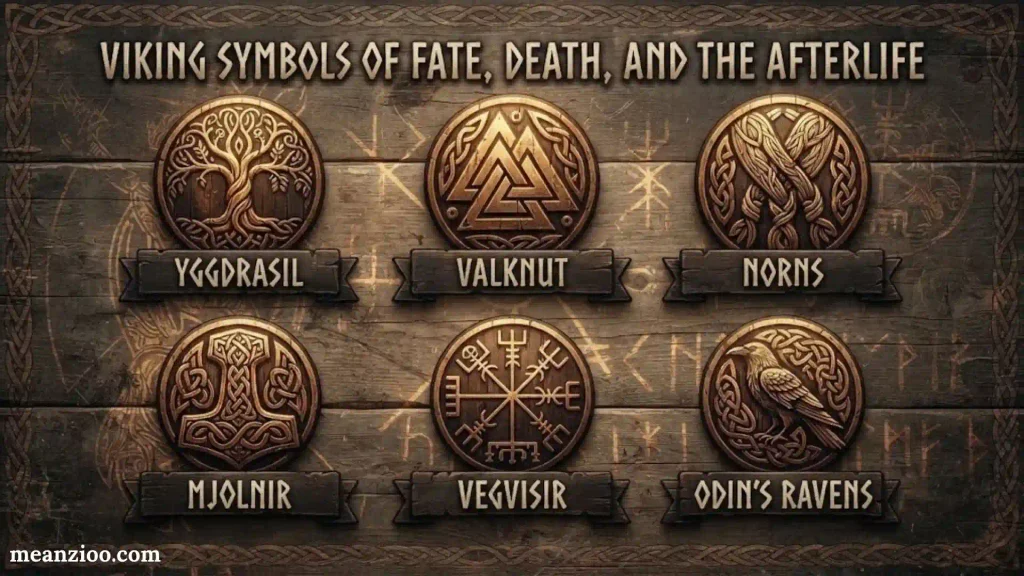
Norse mythology contains many stories about death, destiny, and what happens after life ends. These themes appear throughout poems and mythological narratives.
However, Norse beliefs about the afterlife were not limited to one destination. Different mythological sources describe multiple realms and different circumstances for the dead.
Valknut and Its Possible Connection With Death
The Valknut is often connected with death, Odin, and warriors who died in battle. This interpretation comes from its appearance alongside imagery that scholars associate with Odin and death.
Yet the symbol’s exact meaning remains uncertain. No surviving Viking Age text clearly explains the Valknut’s design or names it as we do today.
Odin, Fallen Warriors, and Valhalla
Valhalla is the hall associated with Odin where selected warriors who die in battle are believed to arrive. The mythology describes these warriors preparing for the events of Ragnarök.
Modern Viking artwork often uses Valhalla imagery to represent bravery, honor, and a warrior’s legacy. However, Norse ideas about the afterlife were more complex than the modern popular image of every warrior entering Valhalla.
Norse Burial Symbols and Grave Goods
Viking burials provide valuable evidence about social status, personal identity, religious practices, and cultural traditions.
Archaeologists have uncovered objects such as:
- Weapons and tools
- Jewelry and brooches
- Combs and household objects
- Beads and pendants
- Ships and boat remains
- Animal remains
These objects don’t always represent religious symbols. Some reflect practical needs, wealth, personal belongings, social status, or funeral customs.
Ship Burials and Their Symbolic Significance
Ship and boat burials are among the most striking archaeological discoveries associated with Scandinavian history.
Ships could reflect wealth, status, travel, and cultural identity. Their presence in burial settings also invites interpretations involving journeys after death.
Still, burial customs varied by region, period, and social position. A ship burial shouldn’t automatically be interpreted as a universal Viking belief about the afterlife.
Viking Symbols Found on Runestones and Archaeological Artifacts
Archaeology provides some of the strongest evidence for authentic Viking symbols. Unlike modern artwork, archaeological objects come from physical historical contexts that researchers can examine and date.
Runestones, pendants, weapons, graves, and carved objects reveal how Viking Age people used writing and visual imagery.
Viking Symbols on Runestones
Runestones are carved stones bearing runic inscriptions. Many were raised to commemorate deceased relatives or record family relationships and achievements.
Some feature intricate ornamentation, including animals, serpents, crosses, and interlaced patterns.
Runestones also served as public monuments. Their inscriptions could communicate memorial messages, family connections, travel accomplishments, property claims, and religious beliefs.
The Swedish History Museum notes that runestones often stood in visible places and could preserve memorials, personal histories, and accounts of journeys.
Historiska museet+1
The Ockelbo Runestone (Gs 2)
The Ockelbo stone is a Swedish runestone associated with the region of Ockelbo in Gästrikland.
Its carved imagery includes Viking Age animal ornamentation and intertwined forms. The stone offers an example of how decorative art, inscriptions, and historical imagery could coexist on a monument.
When studying the Ockelbo stone, focus on its actual carvings and inscription rather than assigning modern spiritual meanings to every pattern.
Runestone U 937
Runestone U 937 belongs to the runestone tradition of Uppland, Sweden. Uppland contains a large concentration of Scandinavian runic monuments.
Runestones from this region often preserve memorial inscriptions and complex ornamental designs. Their historical value lies in the names, language, social relationships, and visual traditions they record.
Runestone U 1163
U 1163 is another runestone reference associated with Swedish runic material. It belongs within the broader study of Scandinavian inscriptions and Viking Age monuments.
When using individual stones as examples, verify the inscription, location, date, and image against a reliable runestone catalog. Rune-stone identification numbers are easy to confuse when copied across websites.
Viking Symbols on Jewelry, Weapons, and Burial Objects
Historical symbols also appeared on objects people carried, wore, used, or buried.
Examples include:
- Hammer-shaped pendants
- Animal-patterned brooches
- Runic inscriptions on tools
- Decorative weapon fittings
- Carved wooden objects
- Metalwork with interlaced patterns
These artifacts help researchers connect Norse symbolism with ordinary life. They also show why context matters: the same motif might function as decoration, religious imagery, a marker of identity, or several things at once.
Viking Knotwork, Animal Motifs, and Norse Ornamentation
Viking artwork is famous for intricate carvings and interwoven animal shapes. These designs appear on jewelry, wooden objects, stones, weapons, and other decorative items.
Not every knot or animal motif represents a god or carries a hidden message. Some patterns primarily served artistic and decorative purposes.
Viking Knotwork and Interlaced Designs
Viking knotwork uses interwoven lines, ribbons, and animal bodies to create complex patterns. The designs often feature loops, crossings, spirals, and repeated shapes.
Common characteristics include:
- Interlocking lines that form continuous patterns
- Animal bodies woven into decorative compositions
- Symmetrical or repeating arrangements
- Curved and twisting forms
- Designs adapted to the shape of an object
Knotwork appears in modern Viking tattoos because it creates visually striking patterns. Historically inspired knotwork can also help a tattoo connect with Scandinavian art without relying on invented symbol meanings.
Urnes Style and Viking Animal Ornamentation
The Urnes style is a late Viking Age and early medieval Scandinavian art style. It features slender animals with elongated bodies, graceful curves, and tightly interwoven forms.
The style takes its name from the Urnes stave church in Norway. Its ornamentation demonstrates how Scandinavian animal art developed into increasingly refined and intricate designs.
Urnes-style artwork works well for modern designs that emphasize flowing lines, intertwined animals, and elegant detail.
Borre Style and Jelling Style
Borre and Jelling are names associated with distinct Scandinavian artistic styles.
| Art style | Common visual characteristics |
| Borre style | Interwoven animals, gripping forms, ring-chain patterns, compact ornamentation |
| Jelling style | Ribbon-like animals, flowing contours, animal bodies arranged within decorative frames |
| Urnes style | Slender animals, sweeping lines, intertwined forms, elegant curves |
These styles help historians identify and compare Viking Age decorative art. They also offer a more historically grounded source of tattoo and artwork inspiration than generic fantasy designs.
Viking Dragons, Serpents, and Gripping Beasts
Animal ornamentation frequently includes twisting bodies and interlocking forms. Some designs resemble dragons or serpents, while others feature gripping beasts with limbs intertwined around the main pattern.
These motifs can appear on objects without an identifiable mythological creature. A decorative animal doesn’t automatically represent Fenrir, Jörmungandr, or another named figure.
The best approach is to appreciate the artwork first. Interpret its symbolism only when the historical evidence supports that interpretation.
Icelandic Magical Symbols Often Mistaken for Viking Symbols
Icelandic magical symbols are among the most popular designs in modern Norse-inspired artwork. They often feature radial shapes, intersecting lines, and complex geometric arrangements.
Many are associated with protection, guidance, success, or magical intentions. However, these designs belong to later Icelandic magical traditions rather than the Viking Age.
The distinction is important. Iceland preserved medieval and early modern literary traditions that continued to develop long after the Viking Age ended.
Vegvísir: The Wayfinder Symbol
Vegvísir is a well-known Icelandic magical stave. Modern interpretations describe it as a symbol of guidance that helps a person find their way through difficult journeys.
It has become popular on tattoos, necklaces, clothing, and travel-inspired artwork.
Its historical source is much later than the Viking Age. The familiar Vegvísir design appears in Icelandic magical manuscript traditions, including the Huld manuscript from the nineteenth century.
It is a genuine historical Icelandic magical symbol. However, it isn’t an established Viking Age symbol.
What Does Vegvísir Mean?
Modern interpretations commonly connect Vegvísir with:
- Guidance during difficult journeys
- Finding direction when life becomes uncertain
- Protection from losing one’s way
- Perseverance and resilience
- Confidence during unfamiliar experiences
These meanings make Vegvísir appealing today. They reflect its later magical context and contemporary interpretations rather than verified Viking Age beliefs.
Ægishjálmr: Helm of Awe
Ægishjálmr, often translated as the Helm of Awe, appears in Icelandic magical traditions and has connections with older literary references.
The name evokes fear, awe, or intimidation. Modern artwork often depicts it as a radial symbol with arms extending from a central point.
What Does Ægishjálmr Symbolize?
Its modern interpretations include:
- Protection against enemies
- Courage and confidence
- Intimidation
- Strength during conflict
- Magical protection
The concept has roots in Old Norse literary material. However, the familiar graphic symbol belongs to later magical traditions and shouldn’t automatically be dated to the Viking Age.
Galdrastafir: Icelandic Magical Staves
Galdrastafir refers to Icelandic magical staves or magical signs found in later traditions.
These symbols appear in manuscripts and magical practices. Some were intended to bring protection, influence events, attract good fortune, or achieve specific goals.
Their designs vary widely. Many feature combinations of lines, crosses, branches, circles, and geometric elements.
Galdrastafir are fascinating parts of Icelandic cultural history. They deserve to be studied in their own historical context rather than grouped together with Viking Age symbols.
Viking Symbols That Are Modern, Misattributed, or Misunderstood
Modern books, websites, games, films, and tattoo shops often use the word “Viking” broadly. That makes it easy to confuse historical symbols with later designs.
Some symbols draw inspiration from Norse mythology without having a documented Viking Age origin. Others come from entirely different cultures or modern fiction.
Web of Wyrd
The Web of Wyrd is a modern symbol commonly associated with fate, destiny, and the interconnectedness of life.
Its design resembles a woven web or intersecting lines that form a geometric pattern. Modern Norse-inspired communities sometimes connect it with wyrd, an Old English concept related to fate.
However, the familiar Web of Wyrd design doesn’t have reliable evidence as an established Viking Age symbol.
The concept of fate appears throughout Germanic and Norse literary traditions. The modern graphic shouldn’t be confused with an ancient artifact.
Black Sun (Sonnenrad)
The Black Sun, also known as the Sonnenrad, is a modern symbol strongly associated with Nazi and neo-Nazi movements.
Its prominent historical association comes from the SS-era design at Wewelsburg Castle in Germany. The symbol became associated with Nazi occult interests and was later adopted by some far-right extremist groups.
It is not an established Viking Age symbol.
Although its circular design may resemble ancient solar motifs, resemblance alone doesn’t prove historical continuity. The Black Sun’s modern extremist associations are important to understand before using it in artwork, clothing, or tattoos.
Berserk Rune and the Brand of Sacrifice
The Brand of Sacrifice is a fictional symbol from the manga Berserk, created by Kentaro Miura.
It represents characters marked for sacrifice within the story’s dark fantasy world. The symbol appears throughout the series and has become recognizable among manga and anime fans.
Some websites incorrectly market it as a Viking rune or ancient Norse symbol. It isn’t.
The Brand of Sacrifice may carry powerful personal meaning for fans of Berserk. Its origin is modern fiction rather than Viking history.
The Odal Rune and Its Extremist Variations
The historical Odal or Othala rune has connections with inheritance and ancestral property in rune-poem traditions.
However, certain modified forms have been adopted by Nazi and neo-Nazi groups. Some extremist variations include added shapes or altered features that distinguish them from the historical rune.
If you’re choosing an Odal-inspired tattoo, jewelry, or graphic, examine the exact design rather than relying only on its name.
Horned Viking Helmets
The familiar horned Viking helmet is a popular image in movies, costumes, sports logos, and fantasy artwork. Yet archaeologists haven’t found evidence that Viking warriors commonly wore horned helmets in battle.
The famous horned design largely comes from later artistic imagination, theatrical costumes, and romanticized depictions of Vikings.
Historical Viking helmets were designed for practical protection. The Gjermundbu helmet, discovered in Norway, is one of the most important surviving examples of Viking Age helmet construction.
If historical accuracy matters, choose a helmet inspired by archaeological finds rather than the familiar horned costume design.
Viking Symbols and Norse Imagery in Modern Culture
Norse imagery has become popular in movies, television, video games, clothing, jewelry, and fantasy artwork. Modern creators often combine historical motifs with imaginative designs.
This creative freedom isn’t necessarily a problem. It becomes misleading when fictional artwork is presented as an authentic ancient symbol.
Viking Symbols in Movies and TV Shows
Modern Viking television shows have influenced how people picture Scandinavian warriors. Clothing, hairstyles, weapons, tattoos, runes, and symbols often blend historical research with dramatic storytelling.
The television series Vikings, for example, helped popularize Norse-inspired imagery worldwide. Ragnar Lothbrok, portrayed by Travis Fimmel, became one of its most recognizable characters.
However, television designs aren’t archaeological evidence. Costume symbols and tattoo patterns may be created for storytelling, visual impact, or character identity.
When researching an image from a show, look for its historical source separately.
Norse Symbols in Modern Norse Paganism
Modern Norse pagan traditions draw inspiration from historical beliefs, mythology, and cultural sources. Some practitioners use runes, Mjölnir pendants, animal motifs, and other Norse imagery.
Contemporary religious practices can differ from historical traditions. People may interpret symbols personally or use them in ways that reflect modern beliefs.
It’s important to respect these living traditions while recognizing that modern interpretations aren’t necessarily identical to Viking Age practices.
How Viking Symbols Became Popular Worldwide
Several factors helped Norse symbols spread far beyond Scandinavia:
- Popular television shows and films
- Fantasy novels and video games
- Tattoo culture
- Historical documentaries and museum exhibitions
- Social media and online communities
- Jewelry, clothing, and graphic design trends
- Modern spiritual and cultural interest
The result is a mix of historical symbolism and contemporary creativity. Learning where a design comes from helps you appreciate both.
Viking Symbols for Tattoos and Their Meanings
Viking tattoos remain popular because Norse artwork offers striking patterns and meaningful mythology. People often choose symbols associated with strength, protection, wisdom, family, courage, or personal transformation.
However, the historical evidence for Viking tattooing is limited. Some historical accounts describe tattooed people among northern groups, but the surviving archaeological evidence doesn’t establish the exact designs worn by Viking Age Scandinavians.
Modern Norse tattoos should therefore be described as Viking-inspired unless a specific design can be historically verified.
Mjölnir Tattoo
A Mjölnir tattoo is a popular choice for people who connect with Thor’s mythology.
Common design ideas include:
- Simple hammer outlines
- Detailed metalwork and knotwork
- Runestone-inspired hammer designs
- Thor’s hammer with lightning imagery
- Small wrist or forearm tattoos
Its associations with protection, strength, and courage make it a recognizable design with historical inspiration.
Valknut Tattoo
The Valknut tattoo features three interlocking triangles. People often choose it for its connection with Odin, warriors, death, and the afterlife.
However, the meaning remains debated. The symbol also has modern associations that may be relevant depending on its design and context.
Before choosing one, understand both its historical uncertainty and modern interpretations.
Yggdrasil Tattoo
Yggdrasil tattoos often feature a tree with spreading branches, tangled roots, and interconnected shapes.
Popular interpretations include:
- Personal growth
- Family connections
- Wisdom
- Life and renewal
- Spiritual interconnectedness
A tree design can incorporate runes, animals, or knotwork. However, adding these elements doesn’t make the tattoo historically authentic automatically.
Viking Rune Tattoos
Rune tattoos deserve special attention because they involve a historical writing system.
If you choose a rune for your name, a word, or a personal meaning, verify the character, sound, and inscription carefully. Younger Futhark is generally the more appropriate runic system for Viking Age inspiration.
Avoid combining random runes based on internet meaning charts. A design may look beautiful but contain an incorrect spelling or misleading translation.
Jörmungandr and Norse Serpent Tattoos
Serpent tattoos can represent transformation, power, cycles, mystery, or the struggle between opposing forces.
Jörmungandr-inspired designs often feature a circular serpent wrapping around a body part. Some incorporate Thor, waves, ships, or Ragnarök imagery.
A serpent design can draw from historical animal ornamentation without claiming that every detail reproduces an ancient religious symbol.
Norse Knotwork and Viking Sleeve Tattoos
Knotwork works particularly well for larger tattoos because its lines can follow the shape of an arm, shoulder, chest, or leg.
Common design ideas include:
- Interwoven animal patterns
- Borre-inspired ornament
- Jelling-style ribbons
- Urnes-inspired slender creatures
- Runestone borders
- Mythological animals
- Historically inspired decorative bands
A cohesive tattoo usually works better than a collection of unrelated symbols. Choose an art style first, then build the design around a few meaningful elements.
Viking Symbols and Norse Women
Viking history wasn’t only about male warriors and kings. Archaeological evidence reveals women participated in household life, textile production, trade, social networks, and other activities.
Women’s graves contain jewelry, brooches, keys, textile tools, and personal objects. These discoveries provide clues about social roles, wealth, identity, and everyday life.
Viking Women’s Jewelry and Symbolic Objects
Jewelry could serve practical, decorative, and social purposes. Brooches often fastened clothing while displaying craftsmanship and wealth.
Some women wore beads, pendants, rings, and other objects that reflected personal style or status. Their designs sometimes featured animals, geometric patterns, or interlaced ornamentation.
Keys, Brooches, and Household Status
Keys found in some women’s graves have often been interpreted as symbols of household authority. However, their meaning could vary by individual and context.
Brooches, textile tools, and other grave goods also reveal aspects of women’s material culture.
Archaeologists study these objects alongside skeletal evidence, burial placement, regional customs, and historical sources. This approach avoids reducing every object to a simple symbol of gender or status.
Freyja and Female Norse Symbolism
Freyja is one of the most prominent female figures in Norse mythology. She is associated with love, fertility, beauty, magic, and battle.
Modern designs inspired by Freyja often feature cats, jewelry, flowers, and magical imagery. These motifs can represent independence, confidence, feminine power, and spiritual connection.
However, it’s important to distinguish mythological associations from symbols that archaeologists can directly identify as Freyja-related.
What Women’s Graves Reveal About Viking Culture
Women’s graves help researchers understand Viking society beyond warfare and political power.
They can reveal:
- Clothing and fashion
- Jewelry and craftsmanship
- Textile production
- Household roles
- Social status and wealth
- Regional differences in burial practices
These findings challenge simplified images of Viking women. Their lives involved varied responsibilities, relationships, and social experiences.
How to Identify Authentic Viking Symbols
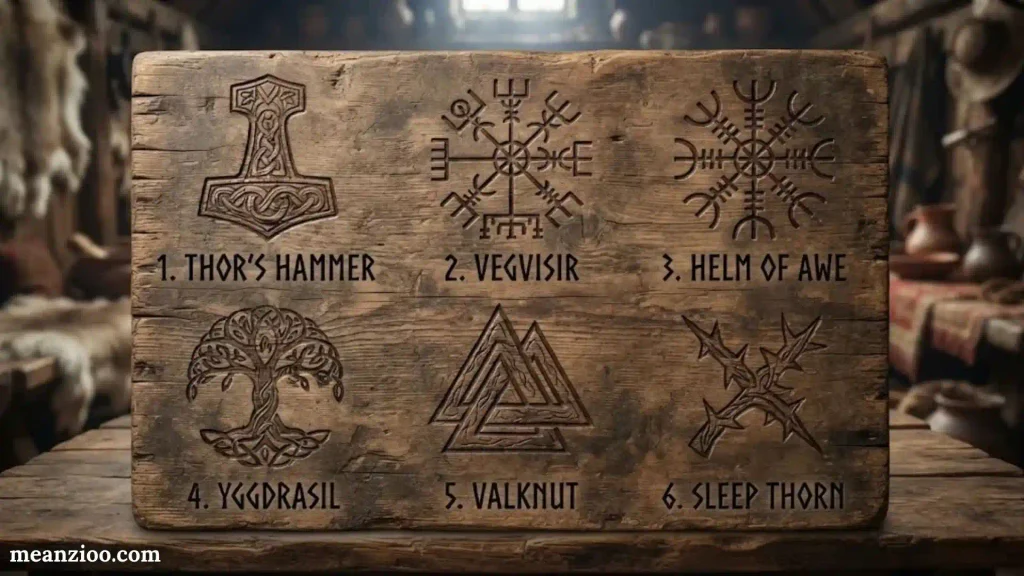
The easiest way to verify a symbol is to investigate its earliest known appearance. A symbol’s historical origin, name, and meaning are three separate questions.
A design may be ancient even if its modern name is incorrect. A historical symbol may also have a meaning that researchers can’t confidently identify.
Check the Symbol’s Historical Origin
Start by asking:
- What is the earliest known example of this design?
- Does it appear on a dated archaeological artifact?
- Is it found in a Viking Age context?
- Does it come from a later manuscript?
- Was it created by a modern artist or fictional franchise?
These questions can quickly reveal whether a symbol is genuinely ancient or simply inspired by Norse culture.
Archaeological Evidence vs. Modern Interpretations
Archaeological evidence includes physical objects, inscriptions, burial finds, and carved monuments.
Modern interpretations include spiritual meanings, tattoo symbolism, and personal associations assigned to historical designs.
Both can be valuable. The key is not presenting modern interpretation as established historical fact.
Viking Age vs. Medieval Icelandic Symbols
The Viking Age ended long before many Icelandic magical manuscripts were created.
For example, the Vegvísir and familiar Ægishjálmr designs belong to later Icelandic magical traditions. Their modern popularity doesn’t make them Viking Age symbols.
Historical timelines help prevent the most common mistakes in Norse symbolism.
Common Mistakes When Researching Viking Symbols
- Treating every Norse-inspired design as ancient
- Assuming each rune has one fixed spiritual meaning
- Confusing Elder Futhark with the Viking Age Younger Futhark
- Giving the Valknut a definitive meaning without evidence
- Calling Vegvísir a Viking Age compass
- Treating the Web of Wyrd as a documented ancient symbol
- Confusing fictional symbols with historical runes
- Ignoring modern extremist associations of certain designs
The best research starts with evidence rather than attractive artwork or bold claims.
Viking Symbols Compared: Origins, Meanings, and Authenticity
The following table provides a quick reference to the most popular Viking and Norse symbols, their common interpretations, and their historical context.
| Symbol | Common meaning | Historical context |
| Mjölnir | Protection, strength, Thor | Viking Age hammer amulets are documented |
| Valknut | Odin, death, fallen warriors | Historical motif; meaning remains uncertain |
| Yggdrasil | Life, cosmic connection, renewal | Norse mythological tree described in medieval literature |
| Triple Horn | Wisdom, poetry, Odin | Modern Odin association; historical meaning needs caution |
| Younger Futhark | Norse writing | Runic alphabet used during the Viking Age |
| Elder Futhark | Early Germanic writing | Predates the Viking Age |
| Triquetra | Unity, eternity, interconnectedness | Historical European motif; direct Viking meaning uncertain |
| Vegvísir | Guidance, finding one’s way | Later Icelandic magical symbol |
| Ægishjálmr | Awe, protection, intimidation | Later magical symbol tradition |
| Web of Wyrd | Fate, interconnectedness | Modern Norse-inspired symbol |
| Black Sun | Solar imagery | Modern symbol associated with Nazi and neo-Nazi movements |
| Brand of Sacrifice | Sacrifice, suffering, survival | Fictional symbol from Berserk |
Frequently Asked Questions About Viking Symbols
What is the most famous Viking symbol?
Mjölnir, Thor’s hammer, is one of the most recognizable Viking symbols. Archaeologists have discovered hammer-shaped pendants from Viking Age Scandinavia. These objects provide strong evidence of Thor-related religious imagery and the hammer’s cultural significance.
What are the real Viking symbols?
Historically documented Viking Age symbols and motifs include Thor’s hammer pendants, runic inscriptions, ship imagery, animal ornamentation, and various carved motifs.
The Valknut also appears in historical Scandinavian imagery. However, its name and exact meaning aren’t securely established in Viking Age sources.
Which Norse symbols are historically authentic?
Symbols and motifs with historical evidence include:
- Mjölnir hammer pendants
- Younger Futhark runes
- Valknut-like geometric motifs
- Viking ship imagery
- Animal ornamentation
- Serpent and dragon motifs
- Scandinavian knotwork
Their historical authenticity doesn’t mean every modern interpretation of their meaning is correct.
What is the Viking symbol for protection?
Mjölnir is the strongest historical example of a Norse symbol commonly associated with protection. Thor’s hammer pendants have been found in Viking Age archaeological contexts.
People today also use Vegvísir and Ægishjálmr as protection symbols. However, these belong to later Icelandic magical traditions rather than the Viking Age.
What is Odin’s symbol?
Odin is often associated with ravens, Gungnir, and the Valknut.
Huginn and Muninn represent thought and memory in Norse mythology. The Valknut appears in historical Scandinavian imagery and is often interpreted as Odin-related. However, its precise meaning remains uncertain.
What is Thor’s symbol?
Thor’s symbol is Mjölnir, his hammer. It represents his mythological power and is commonly associated with thunder, strength, protection, and courage.
Is the Valknut a real Viking symbol?
The Valknut-like design is historically attested in Scandinavian imagery. However, the name Valknut is a modern term, and scholars haven’t established its exact original meaning.
Its association with Odin, death, and warriors comes from interpretation of historical imagery rather than a surviving Viking explanation.
Is Vegvísir an authentic Viking symbol?
Vegvísir is a genuine Icelandic magical symbol from a later historical period. It isn’t a confirmed Viking Age symbol.
Its familiar meaning involves guidance and protection against losing one’s way. Its historical origins belong to Icelandic magical manuscript traditions rather than Viking Age archaeology.
Are Viking runes and Norse symbols the same thing?
No. Runes are characters in a writing system, while Norse symbols can include religious imagery, decorative motifs, animals, geometric designs, and mythological representations.
Some runes also carry symbolic associations. However, their original function as letters remains important.
Did Vikings use Elder Futhark or Younger Futhark?
Viking Age Scandinavians primarily used Younger Futhark. Elder Futhark belonged to an earlier period of Germanic runic writing.
Although Elder Futhark remains popular in modern Norse artwork, Younger Futhark is generally more appropriate for Viking Age inscriptions.
What Viking symbols represent strength and courage?
Modern interpretations commonly connect Mjölnir with strength and protection. Wolves can represent courage, loyalty, and survival. Tyr-related imagery and the Tiwaz rune often represent bravery and sacrifice.
These meanings draw from mythology and contemporary symbolism. They don’t necessarily represent fixed meanings shared by all Viking Age people.
Which Norse symbols are good for tattoos?
Popular options include Mjölnir, Yggdrasil, Valknut, Jörmungandr, Younger Futhark runes, and historically inspired knotwork.
Choose a symbol based on its historical context, personal meaning, and visual style. If you want a historically grounded tattoo, research its origin before finalizing the design.
Are horned helmets authentic Viking symbols?
Horned helmets are popular in modern Viking imagery. However, archaeologists haven’t found evidence that Viking warriors commonly wore horned helmets in battle.
The familiar horned design largely comes from later artistic and theatrical representations.
What Viking symbols have uncertain meanings?
The Valknut is a prominent example. Its historical appearance is known, but its exact meaning remains debated.
Other animal motifs, knotwork patterns, and carved designs may also have uncertain meanings. Their interpretation often depends on the artifact, inscription, date, and archaeological context.
Are some Norse symbols associated with extremist groups?
Yes. Some symbols with historical or Norse-inspired forms have been appropriated by extremist movements.
The Odal rune has extremist-associated variations. The Black Sun is strongly associated with Nazi and neo-Nazi imagery. The meaning of a symbol can change depending on its design, context, and use.
Conclusion: Understanding the Real Meaning of Viking Symbols
Viking symbols offer a window into Norse mythology, religion, art, social identity, and everyday life. Their stories connect gods, warriors, animals, nature, death, and the mysteries of fate.
Some symbols have strong archaeological foundations. Mjölnir, Younger Futhark runes, runestones, ship imagery, and Viking animal ornamentation provide valuable evidence of Scandinavian history.
Others require more careful interpretation. The Valknut has historical examples but an uncertain meaning. Vegvísir and Ægishjálmr come from later Icelandic magical traditions. The Web of Wyrd is a modern symbol, while the Brand of Sacrifice belongs to fictional manga.
Understanding these distinctions doesn’t make Norse symbolism less fascinating. It makes the subject richer and more meaningful.
If you’re exploring Viking history, researching Norse mythology, or choosing a tattoo, start with the evidence. Learn the stories behind the symbols and respect their historical context. That way, you’re not simply choosing an attractive design. You’re connecting with a cultural tradition that deserves to be understood.
I’m Ryan Mitchell, and I write about modern English, trending slang, and online expressions. I enjoy explaining the meanings, origins, and real-life usage of popular words in a simple way. I believe learning slang is an important step toward understanding today’s English-speaking culture. Through my work, I aim to help readers speak more naturally and stay updated with the latest language trends.
 Charlotte Hayes