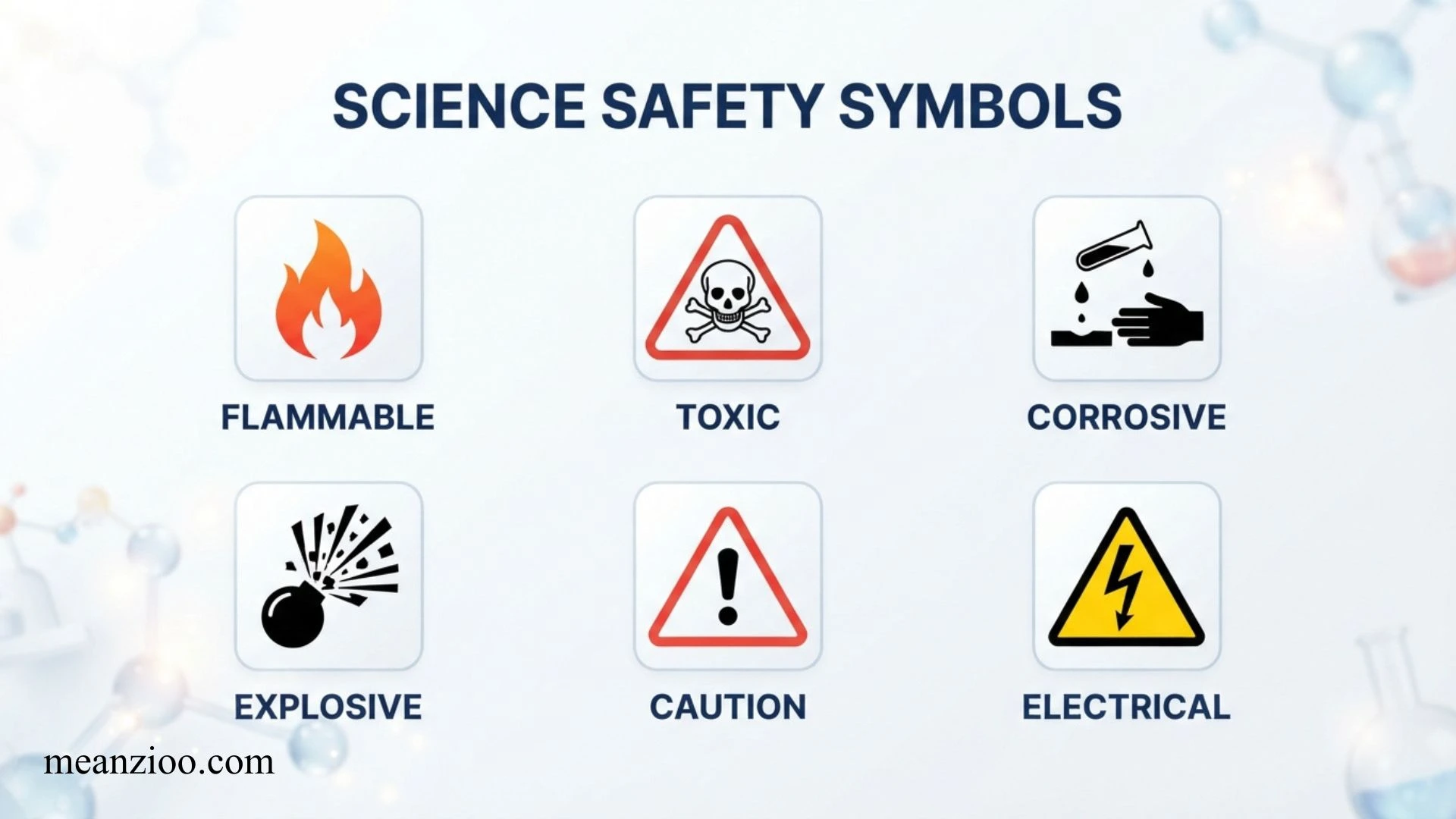
Science safety symbols are visual warnings that help people identify hazards in laboratories, classrooms, research facilities, and other scientific environments. They can warn about chemicals, biological materials, radiation, lasers, electricity, ultraviolet light, fire, and other potential dangers.
Learning these symbols is important because a quick look at a pictogram can alert you to a hazard before you handle a substance or enter a restricted area. However, a symbol is only part of the safety message. Chemical labels can also include signal words, hazard statements, precautionary statements, and other information that explains what the hazard is and how to work safely.
This guide explains the most common science safety symbols, what they mean, where they are used, how GHS chemical symbols differ from other laboratory warnings, and how students and laboratory workers should interpret them.
What Are Science Safety Symbols?
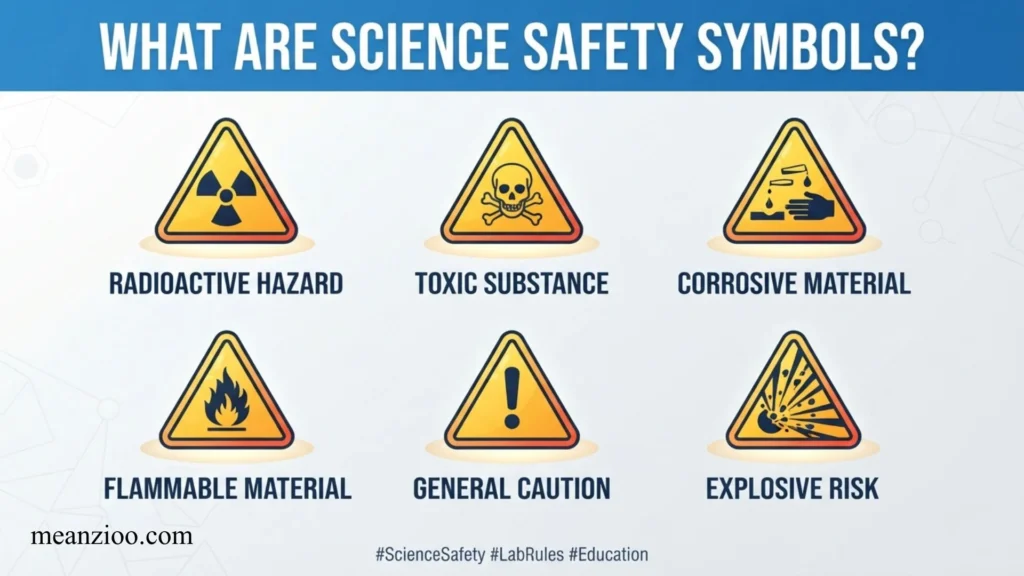
Science safety symbols are pictograms or visual signs used to communicate potential hazards and safety requirements.
You may find them on:
- Chemical containers and bottles
- Laboratory doors
- Chemical storage cabinets
- Laboratory equipment
- Radiation-controlled areas
- Biological research areas
- Laser equipment
- Safety posters
- Waste containers
- Safety Data Sheets and chemical documentation
The term science safety symbols is broader than chemical hazard pictograms. A science laboratory can contain chemical, biological, radioactive, laser, physical, animal, and ultraviolet-light hazards, each of which may have its own warning symbol. CDC laboratory-safety guidance identifies several of these categories as common laboratory hazards.
Why Are Science Safety Symbols Important?
Safety symbols provide information quickly. In a laboratory, people may not have time to read a long paragraph before recognizing a potential danger.
A good safety symbol can help someone:
- Recognize a hazard before exposure.
- Identify dangerous chemicals.
- Understand whether a substance can burn, explode, or cause health effects.
- Notice radiation or biological hazards.
- Determine whether special precautions may be necessary.
- Recognize restricted or hazardous laboratory areas.
- Find appropriate safety information.
However, recognizing a symbol does not replace laboratory training. OSHA notes that GHS pictograms are part of a larger hazard communication system, and workers must understand what the symbols mean and how to respond to the hazards they identify.
Laboratory Safety Symbols with Names
Laboratory safety symbols are visual warnings that help people recognize hazards before handling chemicals, equipment, biological materials, or other laboratory substances. A symbol can communicate a risk much faster than a long written warning.
Common laboratory safety symbols include flammable, corrosive, toxic, oxidizing, explosive, compressed gas, irritant or harmful, health hazard, environmental hazard, biohazard, and radioactive symbols. The exact symbols used depend on the laboratory and the hazard classification system.
Learning the symbol together with its name and meaning makes it easier for students and laboratory workers to follow appropriate safety procedures.
Science Safety Symbols and Meanings
Science safety symbols help students understand potential risks in classrooms, laboratories, and practical experiments. Some symbols warn about chemical hazards, while others indicate physical or biological risks.
For example, the flame symbol warns about flammable materials, the corrosion symbol indicates substances that can cause serious skin or eye damage or corrode metals, and the skull and crossbones indicates acute toxicity in applicable hazard classifications.
A safety symbol does not replace safety instructions. It is a quick visual warning that should prompt the reader to check the relevant label, procedure, or teacher’s instructions.
Laboratory Signs and Symbols PDF
A laboratory signs and symbols PDF can be useful as a printable classroom reference or revision sheet. A good guide can include the symbol, official or commonly used name, meaning, and a short example of where the warning may appear.
For students, organizing the symbols into categories such as chemical, biological, radiation, fire, and general laboratory hazards makes the information easier to memorize.
If you create a downloadable PDF for educational use, use original graphics or properly licensed images and keep the explanations simple enough for the intended grade level.
Laboratory Safety Symbols with Names and Pictures
Pictures make laboratory safety symbols much easier to recognize because many warnings are designed to be understood visually. A useful reference sheet can place the symbol beside its name and a one-sentence explanation.
Examples include:
- Flame — flammable or certain other fire-related hazards.
- Corrosion — corrosive substances.
- Skull and crossbones — acute toxicity.
- Flame over circle — oxidizing materials.
- Exploding bomb — explosive or unstable explosive hazards.
- Gas cylinder — gases under pressure.
- Health hazard — certain serious or long-term health hazards.
- Exclamation mark — certain less-severe health hazards or irritation.
- Biohazard — biological hazards.
- Radiation trefoil — ionizing radiation.
The exact meaning should always be checked against the applicable safety standard and label.
Lab Safety Symbols Worksheet
A lab safety symbols worksheet can turn memorization into an active learning exercise. Students can match symbols with names, complete missing definitions, identify hazards from pictures, or classify symbols into different safety groups.
A simple worksheet might show ten symbols on one side and ten descriptions on the other. Students then connect each symbol with the correct meaning.
For younger students, adding examples such as “flammable liquid” or “biological material” can make the activity easier to understand.
20 Safety Signs and Symbols with Names
Here is a useful list of twenty common safety signs and symbols encountered in science or laboratory settings:
- Flammable — indicates a fire-related hazard.
- Corrosive — warns of corrosive substances.
- Acute Toxicity — represented by the skull and crossbones.
- Oxidizing — represented by a flame over a circle.
- Explosive — represented by an exploding bomb.
- Gas Under Pressure — represented by a gas cylinder.
- Health Hazard — indicates certain serious health effects.
- Exclamation Mark — warns of certain health or irritation hazards.
- Environmental Hazard — indicates hazards to aquatic environments.
- Biohazard — identifies biological hazards.
- Radiation — identifies ionizing radiation.
- Laser Warning — warns of laser radiation.
- High Voltage — warns of dangerous electrical voltage.
- General Warning — indicates a potential hazard requiring attention.
- Hot Surface — warns that a surface may cause burns.
- Eye Protection Required — indicates the need for protective eyewear.
- Protective Gloves Required — indicates hand protection is needed.
- Protective Clothing Required — indicates appropriate protective clothing.
- No Open Flames — warns against using flames in the area.
- Emergency Exit — identifies a safe evacuation route.
Not every sign uses the same international symbol system. Workplace and laboratory signage can vary according to the relevant standard or institution.
Chemistry Lab Safety Symbols
Chemistry laboratories use safety symbols to identify risks associated with chemicals and laboratory equipment. The most familiar chemical hazard pictograms include flammable, corrosive, oxidizing, toxic, explosive, gas under pressure, irritant or harmful, serious health hazard, and environmental hazard.
These symbols are particularly important when reading chemical container labels. A symbol should be considered together with the chemical’s signal word, hazard statements, precautionary statements, and laboratory procedures.
Students should never rely on a symbol alone when deciding how to handle an unfamiliar chemical.
7th Grade Science Safety Symbols
For 7th grade science students, safety symbols should be introduced in a simple and memorable way. Students commonly learn symbols related to fire, chemicals, glassware, electricity, biological materials, protective equipment, and general warnings.
A useful lesson can teach students three things for every symbol:
- What does the symbol look like?
- What hazard does it identify?
- What safety action should you take?
This approach helps students understand that safety symbols are not just vocabulary terms. They are instructions to recognize risk and act carefully.
Science Safety Symbols with Names
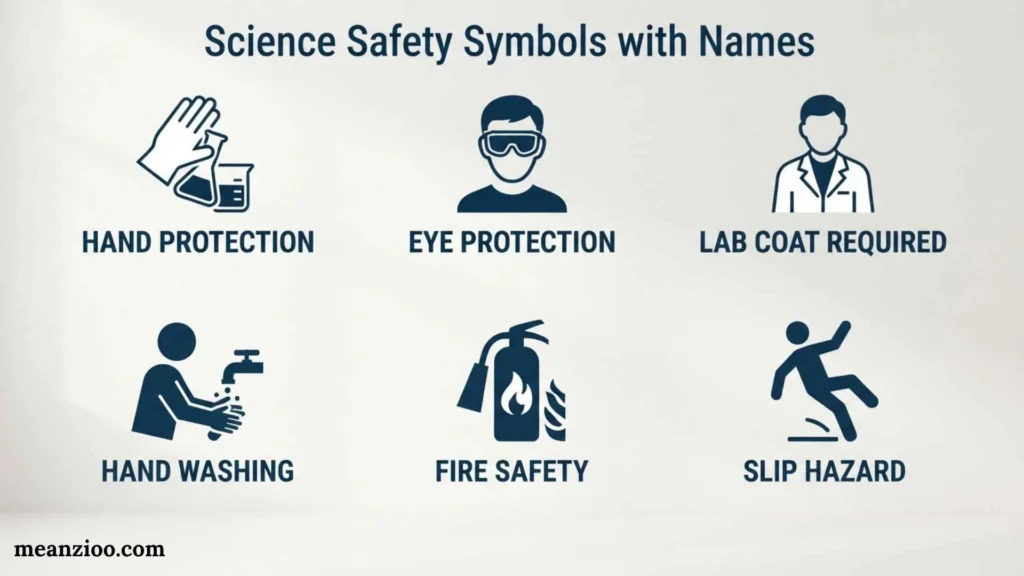
Science safety symbols with names are especially useful for students who are learning laboratory vocabulary. The name tells students what the symbol represents, while the visual shape helps them recognize it quickly.
For example, students should be able to distinguish the corrosive symbol from the flammable symbol, and the biohazard symbol from the radiation symbol.
A classroom reference chart can include the symbol, name, meaning, and one example of where it may be found.
Science Safety Symbols Quiz
A science safety symbols quiz can test whether students can identify hazards rather than simply memorize definitions. Questions can include pictures of symbols followed by multiple-choice answers.
For example, a quiz might ask:
- Which symbol represents a corrosive hazard?
- What does the skull and crossbones indicate?
- Which symbol identifies ionizing radiation?
- What does the biohazard symbol warn about?
- Which symbol represents an oxidizing substance?
A stronger quiz can also include scenario-based questions, such as asking which warning should be checked before handling a particular type of material.
Science Safety Symbols Corrosive
The corrosive symbol is used to warn about substances capable of causing serious damage to skin or eyes and, under applicable classifications, corrosion of metals. In the Globally Harmonized System (GHS), the pictogram shows test tubes dripping onto a hand and a metal surface.
Corrosive chemicals require appropriate precautions, including suitable protective equipment and careful handling according to laboratory procedures. Students should never assume that a chemical is safe simply because it is stored in a small container.
Glencoe Science Safety Symbols
Glencoe science textbooks and educational materials have been used widely in school science education, and students may encounter laboratory safety symbols in associated science lessons and activities.
When studying symbols from a particular Glencoe textbook or worksheet, the exact terminology and illustrations should be checked against that edition. Textbook safety graphics may include both hazard symbols and procedural safety icons.
This is important because a classroom safety symbol can communicate an action, such as wearing goggles, rather than a chemical hazard classification.
Middle School Science Safety Symbols
Middle school science safety symbols should focus on practical recognition and safe behavior. Students need to understand common warnings before performing experiments involving chemicals, heat, glassware, electricity, or biological materials.
A simple chart can group symbols into:
- Chemical hazards
- Fire and heat hazards
- Biological hazards
- Radiation hazards
- Electrical hazards
- Personal protective equipment
- Emergency and warning signs
This organization makes a large collection of symbols easier for students to learn.
Printable Science Safety Symbols
Printable science safety symbols are useful for classroom posters, laboratory walls, worksheets, revision cards, and student notebooks. A good printable chart should use clear graphics, large labels, and short explanations.
For younger students, avoid filling the page with complicated technical language. A symbol followed by its name, basic meaning, and safety action is often more useful than a long paragraph.
Teachers can also turn printable symbols into matching exercises or classroom quizzes.
Physical Science Safety Symbols
Physical science laboratories can involve chemicals, heat, electricity, pressure, glassware, and specialized equipment. Safety symbols help students recognize these hazards before beginning an experiment.
Common warnings include general hazard signs, high voltage, hot surfaces, flammable materials, corrosive substances, compressed gases, and required protective equipment.
Because physical science experiments can involve several types of hazards at once, students should read the complete experimental procedure and follow the teacher’s safety instructions rather than relying only on individual symbols.
All Science Safety Symbols
There is no single universal list containing every science safety symbol used in every country, school, workplace, and laboratory. Different standards use different symbols for chemical hazards, workplace risks, equipment warnings, emergency procedures, and personal protective equipment.
The most useful approach is to organize symbols by purpose. Chemical hazard pictograms can be studied separately from laboratory action signs, emergency signs, radiation warnings, and biological hazard symbols.
This distinction helps prevent students from confusing a hazard identification symbol with a required safety action.
General Warning Symbol in Science
The general warning symbol is commonly shown as a black exclamation mark inside a yellow warning triangle in many safety-sign systems. It indicates that a hazard or potentially hazardous condition requires attention.
Unlike a chemical pictogram that identifies a specific hazard class, a general warning sign may simply tell people to be alert and check the accompanying information.
In a science classroom, the exact meaning should be determined from the text or instructions placed beside the sign.
Hazard Symbols in Science
Hazard symbols in science provide visual information about risks associated with materials, equipment, or environments. Chemical hazard pictograms under GHS include symbols for explosive, flammable, oxidizing, compressed gas, corrosive, acute toxicity, serious health hazard, irritant or harmful effects, and environmental hazards.
Other scientific environments may use specialized signs for radiation, lasers, biological materials, electricity, or other physical hazards.
Understanding the category of a symbol is important because different hazards require different precautions.
Science Hazard Signs
Science hazard signs can be found on chemical containers, laboratory doors, equipment, storage areas, and instructional materials. They may warn about specific substances or about conditions such as high voltage, heat, radiation, biological materials, or fire.
A good safety sign should be easy to recognize from a distance and should communicate enough information for the user to take the correct precaution.
Students should also learn that a warning sign does not mean an experiment cannot be performed. It means the associated safety procedures must be followed.
Toxic Symbol Science
The skull and crossbones is the familiar symbol for acute toxicity in the GHS pictogram system. It indicates that exposure to a substance can cause serious toxic effects under the relevant hazard classification.
The symbol should never be interpreted as meaning that every exposure will produce the same result. The actual risk depends on factors such as the substance, route of exposure, concentration, and applicable hazard classification.
Chemical labels and safety data sheets provide more detailed information than the pictogram alone.
Radioactive Symbol vs Biohazard
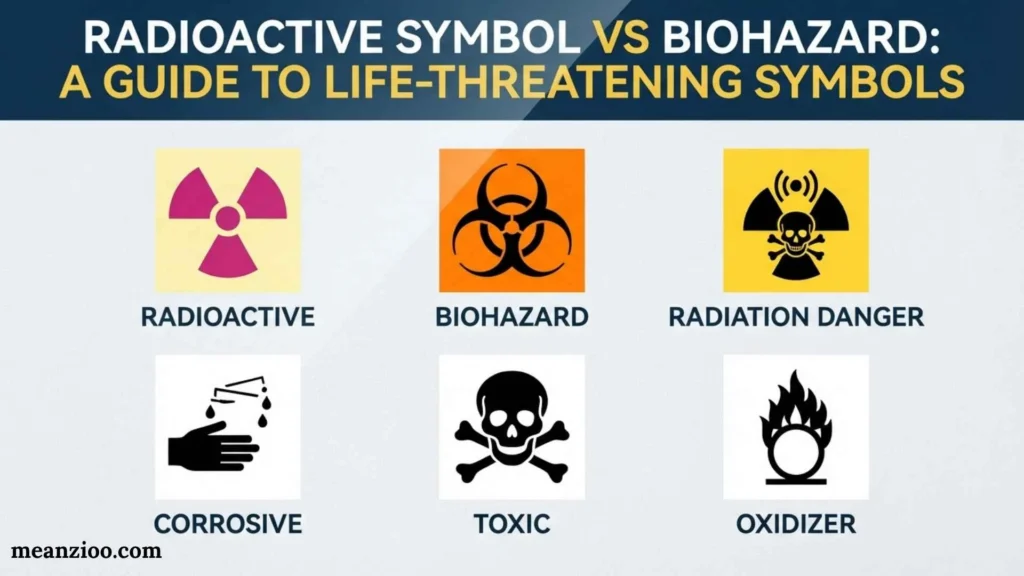
The radioactive and biohazard symbols identify two very different categories of hazard.
The radiation trefoil is associated with ionizing radiation and is used to identify areas, equipment, or materials where radiation hazards may be present.
The biohazard symbol identifies biological materials or agents that may pose a biological hazard, such as certain infectious materials.
They are easy to confuse at a glance because both are bold, three-part symbols, but their shapes and meanings are different. Recognizing the distinction is essential when working in scientific, medical, or laboratory environments.
Biology Lab Safety Symbols
Biology laboratories may use symbols for biological hazards, chemicals, sharps, glassware, heat, electrical equipment, and personal protective equipment. The biohazard symbol is particularly important when biological materials may present an infection or contamination risk.
Other symbols can indicate the need for gloves, eye protection, protective clothing, or special handling procedures.
Biology students should learn to connect each symbol with a practical safety behavior. Recognizing a biohazard sign, for example, should prompt attention to the laboratory’s procedures for handling, containment, and disposal.
Reactive Symbol
“Reactive” can describe materials that may undergo dangerous chemical reactions under particular conditions. There is not one universal GHS pictogram simply called the “reactive symbol” for every reactive substance.
Depending on the specific hazard, a chemical may carry an explosive, oxidizing, corrosive, or other hazard pictogram. The appropriate classification depends on the substance’s properties and the applicable safety standard.
For this reason, students should identify the exact hazard described on the chemical label rather than assuming that every reactive material uses one generic symbol.
Pyrophoric Symbol
Pyrophoric substances are materials that can ignite spontaneously when exposed to air under specified conditions. Because pyrophoric materials can present a serious fire hazard, laboratories use specific handling and storage procedures for them.
Under GHS classification, pyrophoric liquids and solids fall within the broader category of flammable substances, so the flame pictogram is relevant to their hazard labeling. Additional wording on the label provides more specific information about the substance’s properties.
Pyrophoric materials should only be handled using the procedures, equipment, and supervision appropriate for the laboratory and the specific chemical.
Science Safety Symbols at a Glance
Here is a quick-reference guide to some of the most common symbols:
| Symbol | Name | Basic Meaning | Common Location |
| 💥 | Exploding bomb | Explosive hazard | Chemical labels |
| 🔥 | Flame | Flammable or related fire hazard | Chemical containers |
| 🔥⭕ | Flame over circle | Oxidizing hazard | Chemical labels |
| 🛢️ | Gas cylinder | Gas under pressure | Gas cylinders |
| 🧪 | Corrosion | Corrosive hazard | Chemical containers |
| ☠️ | Skull and crossbones | Severe acute toxicity | Chemical labels |
| ❗ | Exclamation mark | Irritant or harmful hazard | Chemical labels |
| 👤 | Health hazard | Serious or long-term health hazard | Chemical labels |
| 🌳🐟 | Environment | Aquatic/environmental hazard | Chemical labels |
| ☣️ | Biohazard | Biological hazard | Laboratories |
| ☢️ | Radiation | Ionizing radiation/radioactive hazard | Controlled areas |
| ⚡ | Electrical warning | Electrical hazard | Equipment and rooms |
| Laser warning | Laser hazard | Potential laser exposure | Laser laboratories |
| UV warning | Ultraviolet hazard | UV radiation exposure | UV equipment/areas |
Important: The emoji above are only convenient illustrations. Official GHS pictograms use standardized graphical designs, including a black symbol on a white background surrounded by a red diamond-shaped frame.
What Are the Nine GHS Safety Symbols?
The Globally Harmonized System of Classification and Labelling of Chemicals (GHS) uses nine hazard pictograms for communicating chemical hazards. They are coded GHS01 through GHS09.
These symbols cover physical, health, and environmental hazards.
1. Exploding Bomb Symbol
GHS code: GHS01
The exploding-bomb pictogram represents certain explosive hazards, including applicable explosive substances, self-reactive substances, and organic peroxides.
It is one of the most visually obvious science safety symbols because the graphic resembles an explosion.
What it tells you: The material may present an explosion-related hazard under specified conditions.
Where you may see it: Chemical labels, laboratory storage areas, or documentation for appropriately classified substances.
Never treat an exploding-bomb symbol as a general instruction to handle the material carefully without further information. The complete label and relevant safety procedures determine the appropriate precautions.
2. Flame Symbol
GHS code: GHS02
The flame pictogram identifies several fire-related chemical hazards. Depending on the classification, these can include flammables, pyrophoric materials, self-heating substances, substances that emit flammable gas, self-reactive substances, and certain organic peroxides.
What it tells you: The material may ignite or present another specified fire hazard.
Common examples of where you may see it:
- Flammable chemical containers
- Chemical storage cabinets
- Laboratory reagent bottles
- Chemical safety documentation
The exact precaution depends on the substance and its classification.
3. Flame Over Circle Symbol
GHS code: GHS03
The flame-over-circle symbol represents oxidizing hazards.
Oxidizing substances can contribute to combustion or intensify a fire under certain conditions.
What it tells you: The substance can act as an oxidizer and may increase fire risk when it interacts with combustible materials.
This symbol should not be confused with the ordinary flame pictogram. The ordinary flame represents various fire-related hazards, while the flame-over-circle specifically identifies oxidizing substances.
4. Gas Cylinder Symbol
GHS code: GHS04
The gas-cylinder pictogram indicates gases under pressure.
Pressurized gases can present physical hazards associated with pressure and the condition of the container. Some gases may also have additional chemical hazards, so a cylinder can display more than one relevant warning.
What it tells you: The container holds gas under pressure or another applicable pressure-related chemical hazard.
Common locations include:
- Laboratory gas cylinders
- Compressed-gas storage areas
- Chemical labels
- Gas supply systems
Always follow the laboratory’s procedures for transporting, securing, storing, and using compressed-gas cylinders.
5. Corrosion Symbol
GHS code: GHS05
The corrosion pictogram shows a substance affecting a hand and a metal surface.
It identifies specified corrosive hazards, including substances that can cause serious skin burns or eye damage and substances that can corrode metals.
What it tells you: The substance may severely damage tissue, eyes, or certain materials.
This symbol is commonly found on containers of appropriately classified corrosive chemicals.
6. Skull and Crossbones Symbol
GHS code: GHS06
The skull-and-crossbones pictogram identifies specified categories of acute toxicity.
This is a serious hazard symbol because appropriately classified substances can cause severe toxic effects following exposure.
What it tells you: The chemical presents a significant acute toxicity hazard within the applicable classification.
Do not use the symbol alone to determine exactly how exposure can occur or what protective equipment is necessary. Read the complete label and Safety Data Sheet.
7. Exclamation Mark Symbol
GHS code: GHS07
The exclamation-mark pictogram can identify several hazards, including certain categories of:
- Skin irritation
- Eye irritation
- Skin sensitization
- Acute toxicity classified as harmful
- Narcotic effects
- Respiratory tract irritation
The exact hazard depends on the chemical’s classification.
What it tells you: The substance can produce specified harmful or irritating effects.
Because the exclamation mark covers multiple hazard categories, always read the accompanying hazard statement rather than assuming it means only “irritant.”
8. Health Hazard Symbol
GHS code: GHS08
The health-hazard pictogram shows a human silhouette with a star-like mark in the chest.
It identifies certain serious health hazards, including applicable categories of:
- Carcinogenicity
- Germ-cell mutagenicity
- Reproductive toxicity
- Respiratory sensitization
- Target-organ toxicity
- Aspiration toxicity
What it tells you: The chemical may present a specified serious or longer-term health hazard.
This symbol is particularly important because some hazards represented by it may not cause immediate symptoms.
9. Environment Symbol
GHS code: GHS09
The environment pictogram shows a dead tree and fish.
It identifies hazards to the aquatic environment under the GHS classification system.
What it tells you: The substance may pose a specified environmental hazard, particularly to aquatic life.
The environment pictogram is part of the nine-pictogram GHS system. In the United States, OSHA’s Hazard Communication Standard does not require the environmental pictogram because environmental hazards are outside OSHA’s jurisdiction, although the symbol may appear as supplementary information.
Also Check This Post: Swinger Symbols: Meanings, Common Signs, Myths, and What They Really Mean
What Do GHS Symbols Look Like?
Official GHS hazard pictograms have a recognizable design.
They generally contain:
- A black hazard symbol
- A white background
- A red diamond-shaped frame
- A standardized pictogram corresponding to the hazard
OSHA specifies that its required chemical pictograms have the shape of a square set at a point, with the black hazard symbol on a white background and a sufficiently wide red frame.
This standardized appearance helps people recognize chemical hazard labels across different products and workplaces.
Why Do Safety Symbols Use Red Diamonds?
The red diamond frame is part of the standardized GHS pictogram design.
The visual format separates the hazard pictogram from ordinary text and makes it easier to identify a warning on a chemical label.
The symbol itself communicates the particular hazard. The surrounding red diamond provides a consistent visual format for GHS chemical hazard communication.
Science Lab Symbols Beyond GHS
Not every laboratory safety symbol is a GHS chemical pictogram.
A laboratory may contain several other types of hazards, including biological, radioactive, laser, ultraviolet, physical, chemical, and animal-related hazards. CDC laboratory-safety materials specifically identify these categories.
Biohazard Symbol
Symbol: ☣️
The biohazard symbol warns about biological hazards.
It can be used in areas where potentially hazardous biological materials are handled, stored, or processed.
Biological hazards may include infectious organisms, human blood or body fluids, and other biological materials that can present health risks.
Where you may see it:
- Microbiology laboratories
- Clinical laboratories
- Biological research facilities
- Certain waste containers
- Restricted laboratory areas
Radiation Symbol
Symbol: ☢️
The radiation trefoil warns about ionizing radiation or radioactive materials.
It can be found around controlled radiation areas, radioactive-material storage locations, or equipment that produces ionizing radiation.
Important: A radiation warning is not equivalent to a chemical hazard pictogram. It belongs to a different safety communication context.
Laser Warning Symbol
Laser warning signs identify areas or equipment where laser radiation may present a hazard.
Laser exposure can potentially damage the eyes or skin, and some lasers can also create fire hazards. CDC laboratory guidance identifies laser hazards as a specific laboratory hazard category.
Appropriate controls depend on the laser and its classification.
Ultraviolet Hazard Symbol
UV warning signs indicate potential exposure to ultraviolet radiation.
UV sources may be used in scientific and laboratory equipment. Depending on the source and procedure, exposure controls can include shielding, restricted access, and appropriate protective equipment.
Electrical Hazard Symbol
Symbol: ⚡
An electrical warning symbol indicates a potential electrical hazard.
It may be used on:
- High-voltage equipment
- Electrical panels
- Laboratory instruments
- Power supplies
- Restricted electrical areas
Never open or service electrical equipment unless you are trained and authorized to do so.
Physical Hazard Symbols
Laboratories can also contain physical hazards involving:
- Heat
- Cold
- Pressure
- Moving machinery
- Sharp equipment
- Noise
- Cryogenic materials
- Other specialized equipment
The exact warning sign depends on the hazard and facility.
Chemical Safety Symbols vs. Laboratory Safety Symbols
These terms are related, but they are not identical.
Chemical safety symbols generally refer to symbols used to communicate chemical hazards, especially GHS pictograms.
Laboratory safety symbols is a broader term that can include warnings for:
- Chemicals
- Biological materials
- Radiation
- Lasers
- UV radiation
- Electricity
- Physical hazards
- Animal hazards
Therefore, GHS symbols are an important part of laboratory safety, but they do not represent every possible hazard found in a science laboratory.
GHS Symbols vs. NFPA 704 Symbols
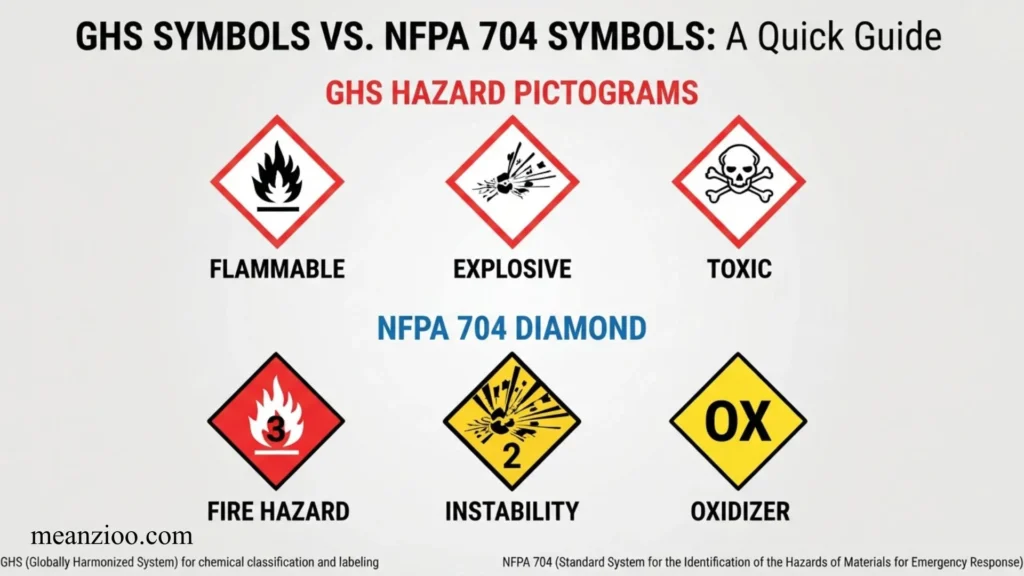
Another common source of confusion is the difference between GHS pictograms and the NFPA 704 hazard diamond.
They are different systems with different purposes.
GHS
GHS focuses on communicating classified chemical hazards through standardized labels and pictograms.
A GHS label can include:
- Pictograms
- Signal words
- Hazard statements
- Precautionary statements
- Product identification
- Supplier information
NFPA 704
NFPA 704 uses a four-section diamond with numerical ratings intended to communicate specific hazards, particularly for emergency response.
Because the systems have different purposes and rating approaches, an NFPA number should not simply be treated as though it were a GHS hazard category.
GHS Safety Symbols and Signal Words
A chemical label may contain both a pictogram and a signal word.
The two GHS signal words are:
- Danger
- Warning
The signal word communicates the relative severity associated with the applicable hazard classification.
This means you should not stop after identifying a pictogram.
For example, a label may provide:
Pictogram → Signal word → Hazard statement → Precautionary statement
Together, these elements provide much more information than the symbol alone.
Hazard Statements and Precautionary Statements
Hazard Statements
A hazard statement explains the nature of the hazard.
It tells the reader what kind of danger the substance presents.
Precautionary Statements
A precautionary statement explains measures intended to prevent or minimize harmful effects.
These can address:
- Prevention
- Response
- Storage
- Disposal
The GHS framework uses these components as part of its broader chemical hazard communication system.
How to Read a Science Safety Symbol Correctly
Knowing the symbol is useful, but knowing what to do with the information is even more important.
Step 1: Identify the Symbol
First determine what type of hazard is represented.
Is it:
- Chemical?
- Biological?
- Radiation?
- Laser?
- Electrical?
- UV?
- Fire?
- Another physical hazard?
Step 2: Read the Entire Label
Never rely on a pictogram alone.
For chemical products, look for the product identifier, signal word, hazard statements, precautionary statements, and other applicable information.
Step 3: Check the Safety Data Sheet
If you are working with a hazardous chemical, consult its Safety Data Sheet when you need detailed information about hazards, handling, storage, exposure controls, first aid, accidental release, and disposal.
Step 4: Follow Laboratory Procedures
Your school, university, workplace, or research institution may have specific procedures for the substance or equipment.
Step 5: Use Appropriate PPE
The required PPE depends on the actual hazard and procedure. Do not choose protective equipment simply because a symbol looks dangerous.
Step 6: Ask Before Handling an Unfamiliar Hazard
If you do not understand a symbol, label, or procedure, ask the responsible instructor, laboratory supervisor, or safety professional before proceeding.
Also Check This Post: Vampire Symbols: Meanings, Origins, and the Dark Imagery Behind Them
Where Are Science Safety Symbols Commonly Used?
You can encounter science safety symbols in many settings.
School Science Laboratories
Students may see warning symbols on:
- Chemical bottles
- Storage cabinets
- Laboratory doors
- Demonstration equipment
- Waste containers
University Laboratories
Research laboratories may use a wider range of symbols because they can involve specialized chemical, biological, radiation, laser, or physical hazards.
Medical and Clinical Laboratories
Clinical environments may use biological, chemical, radiation, and other hazard warnings.
Industrial Laboratories
Industrial research and testing facilities can use chemical, pressure, electrical, machinery, fire, and other safety signs.
Chemical Storage Areas
Chemical storage rooms commonly use hazard communication labels and signs to identify specific risks and restricted areas.
How Students Can Learn Science Safety Symbols
The easiest way to learn science safety symbols is to connect each symbol with its hazard and appropriate response, rather than memorizing the picture alone.
For example:
| Symbol | Remember It As | What to Learn |
| 💥 | Explosion | Explosive hazard |
| 🔥 | Fire | Flammable/fire-related hazard |
| 🔥⭕ | Oxidizer | Can intensify combustion |
| 🛢️ | Pressure | Gas under pressure |
| 🧪 | Corrosion | Can damage tissue/materials |
| ☠️ | Toxic | Severe acute toxicity |
| ❗ | Irritant | Certain harmful/irritating effects |
| 👤 | Long-term health | Serious specified health hazards |
| 🌳🐟 | Environment | Aquatic hazard |
| ☣️ | Biological | Biological hazard |
| ☢️ | Radiation | Radiation hazard |
| ⚡ | Electricity | Electrical hazard |
A student should also learn that the exact meaning and required precaution can depend on the label, classification, equipment, and laboratory procedure.
Common Mistakes When Interpreting Safety Symbols
Mistake 1: Assuming Every Warning Symbol Means the Same Thing
Different symbols communicate different hazards.
A flame, skull-and-crossbones, corrosion, and radiation symbol should never be treated as interchangeable.
Mistake 2: Looking Only at the Picture
A pictogram provides a quick warning, but the written information provides additional details.
Mistake 3: Confusing the Flame With the Flame-Over-Circle
The ordinary flame and flame-over-circle pictograms represent different hazard categories.
Mistake 4: Confusing GHS With NFPA
GHS pictograms and NFPA 704 ratings are separate systems.
Mistake 5: Assuming “Warning” Means Safe
The word Warning is a formal signal word. It does not mean that the substance is harmless.
Mistake 6: Ignoring a Symbol Because You Have Seen It Before
A familiar symbol should still be interpreted in the context of the specific substance, equipment, or location.
Mistake 7: Assuming One Chemical Has Only One Hazard
A chemical can have multiple classified hazards and may therefore require multiple pictograms or hazard statements.
Why Can a Chemical Have More Than One Safety Symbol?
A single chemical can have several different hazards.
For example, a substance may have:
- A fire-related hazard
- A health hazard
- An irritation hazard
The label can communicate multiple applicable hazards using different pictograms and written hazard statements.
This is why reading only one symbol can give you an incomplete understanding of the material.
What Is the Difference Between a Symbol and a Pictogram?
These terms are sometimes used interchangeably, but there is a useful distinction.
A symbol is the visual image representing a particular hazard.
A pictogram can include the symbol together with additional graphic elements such as its standardized frame and background.
Under GHS, the pictogram is the complete graphical composition used to communicate hazard information.
Are Science Safety Symbols Universal?
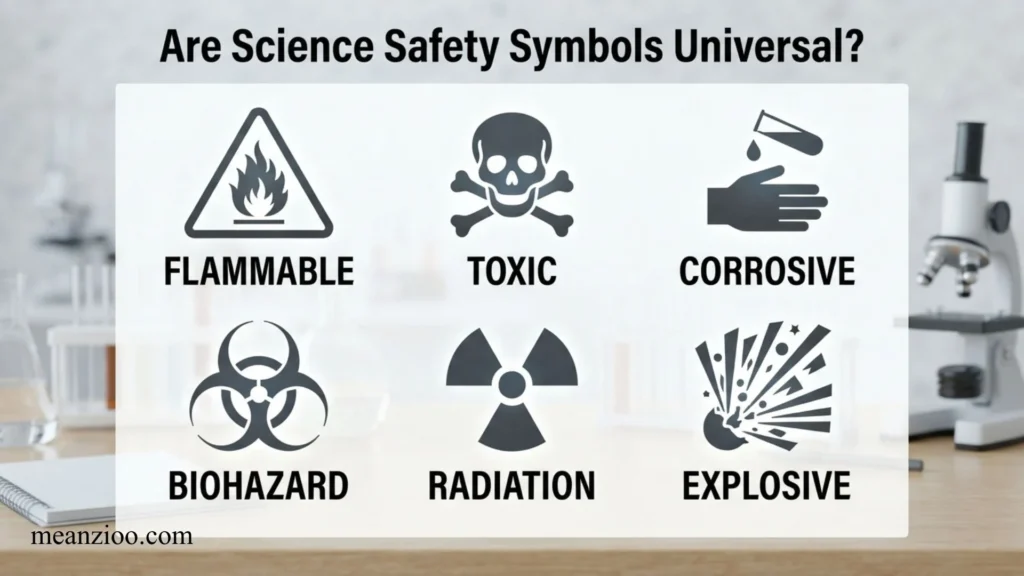
Not every science safety sign is universal.
GHS chemical pictograms are designed as a harmonized international system, while individual countries, institutions, industries, and laboratories can have additional safety signs and procedures.
The United Nations GHS framework provides standardized chemical hazard communication, while laboratory-specific hazards such as radiation, biological materials, and lasers can use other established warning systems.
Therefore, students and workers should learn both the commonly recognized symbols and the specific safety signs used by their facility.
Frequently Asked Questions About Science Safety Symbols
What are science safety symbols?
Science safety symbols are visual signs and pictograms that communicate hazards in laboratories and scientific environments. They can identify chemical, biological, radiation, laser, electrical, UV, and other hazards.
How many GHS safety symbols are there?
The GHS has nine hazard pictograms, coded GHS01 through GHS09. They cover physical, health, and environmental hazards.
What are the nine GHS symbols?
The nine are:
- Exploding bomb
- Flame
- Flame over circle
- Gas cylinder
- Corrosion
- Skull and crossbones
- Exclamation mark
- Health hazard
- Environment
What does the skull-and-crossbones symbol mean?
It identifies specified categories of acute toxicity and indicates that a chemical can cause serious toxic effects under the applicable exposure conditions.
What does the flame symbol mean?
The GHS flame pictogram identifies several fire-related chemical hazards, including applicable flammable, pyrophoric, self-heating, self-reactive, and related classifications.
What does the corrosion symbol mean?
The corrosion pictogram identifies applicable corrosive hazards, including chemicals that can cause serious skin or eye damage or corrode metals.
What does the biohazard symbol mean?
The biohazard symbol identifies a biological hazard. It can be used in laboratory environments where biological materials may pose a risk.
What does the radiation symbol mean?
The radiation symbol warns about ionizing radiation or radioactive materials in an appropriate controlled area.
Are GHS symbols the same as laboratory safety symbols?
No. GHS symbols specifically address chemical hazard communication, while laboratory safety symbols can cover a broader range of hazards, including biological, radiation, laser, UV, and physical hazards.
What should I do when I see an unfamiliar science safety symbol?
Do not guess. Read the associated warning or label, consult the relevant safety documentation, and ask a qualified instructor, supervisor, or safety professional before handling the material or entering a hazardous area.
Key Takeaways About Science Safety Symbols
The most important things to remember are:
- Science safety symbols communicate hazards quickly.
- GHS provides nine chemical hazard pictograms.
- Not every laboratory warning is a GHS symbol.
- Biohazard and radiation symbols represent different hazard systems.
- A chemical can have more than one applicable pictogram.
- GHS pictograms are only one part of a chemical label.
- Signal words, hazard statements, and precautionary statements provide additional information.
- GHS and NFPA 704 are different systems.
- Always follow your laboratory’s specific safety procedures.
- Never handle an unfamiliar hazardous substance based on the symbol alone.
Final Thoughts
Understanding science safety symbols is one of the foundations of safe laboratory behavior. Whether you are a student learning basic science, a teacher preparing a laboratory lesson, or someone working in a research environment, recognizing common hazard symbols can help you identify potential risks before beginning an activity.
The nine GHS pictograms are especially important for chemical safety, but they are only part of the larger laboratory safety picture. Biological, radiation, laser, UV, electrical, and physical hazards may require different warning symbols and controls.
The safest habit is simple: recognize the symbol, read the complete warning, check the appropriate safety information, and follow the required procedure. A symbol is designed to get your attention, but proper training and complete hazard information tell you what the warning actually means and how to respond.
Also Check This Post: Lutheran Symbols: Meanings, History, Colors, and Christian Significance

I’m Ryan Mitchell, and I write about modern English, trending slang, and online expressions. I enjoy explaining the meanings, origins, and real-life usage of popular words in a simple way. I believe learning slang is an important step toward understanding today’s English-speaking culture. Through my work, I aim to help readers speak more naturally and stay updated with the latest language trends.