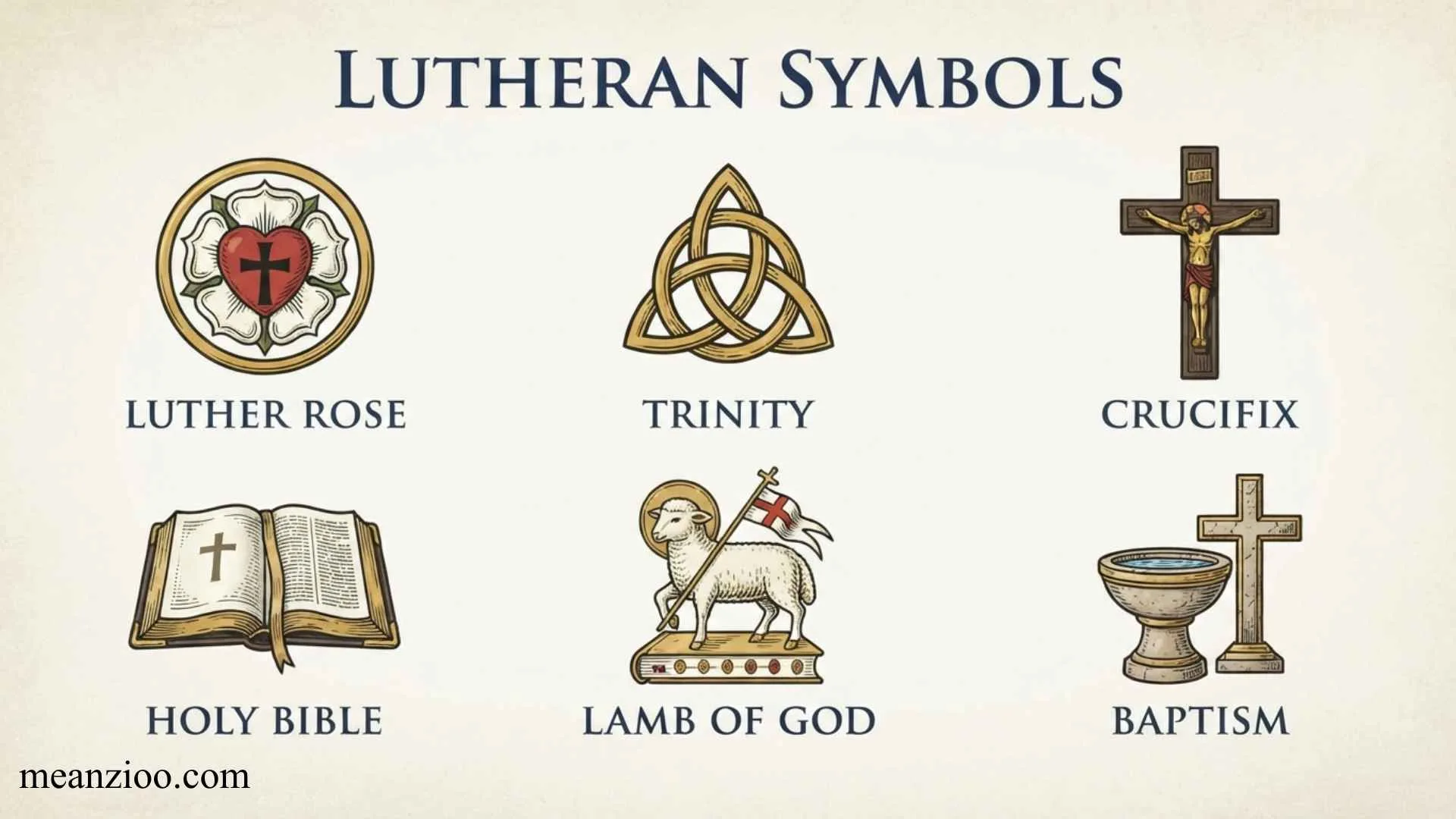
Lutheran symbols communicate important ideas about Christian faith, worship, Scripture, baptism, salvation, and the Lutheran Reformation. Some symbols are strongly associated with Lutheranism, while others belong to the wider Christian tradition and are also commonly used by Lutheran churches.
The most recognizable symbol of Lutheranism is the Luther Rose, also known as Luther’s seal. Martin Luther used the design as a personal seal, and it later became an enduring symbol of Lutheran identity around the world.
Other important Lutheran and Christian symbols include the cross, crucifix, dove, fish, water, bread and wine, Bible, ship, baptismal font, altar, pulpit, candles, and liturgical colors.
Quick List of Lutheran Symbols and Their Meanings
| Symbol | Common meaning | Significance in Lutheranism |
| Luther Rose | Faith in Christ, joy, peace, eternal hope | Most distinctive Lutheran symbol |
| Cross | Christ’s crucifixion and salvation | Central symbol of Christian faith |
| Crucifix | Christ’s suffering and sacrifice | Used in some Lutheran traditions |
| Dove | Holy Spirit and God’s covenant | Represents the Spirit and proclamation |
| Fish | Jesus Christ and Christian identity | Shared Christian symbol |
| Water | Baptism and new life | Connected with Holy Baptism |
| Bread and wine | Holy Communion | Central sacramental symbols |
| Bible | God’s Word and Scripture | Central to Lutheran teaching |
| Ship | Church and Christian journey | Traditional Christian symbol |
| Altar | Worship and Communion | Important church feature |
| Pulpit | Proclamation of God’s Word | Central to Lutheran worship |
| Baptismal font | Baptism and God’s promise | Important sacramental symbol |
| Candles | Christ, light, worship | Common in Lutheran worship |
| Green | Growth and life | Common liturgical color |
| Purple | Preparation and repentance | Used during certain seasons |
| White | Joy, celebration, resurrection | Used on major festivals |
| Red | Holy Spirit, fire, martyrdom | Used on Pentecost and other occasions |
What Are Lutheran Symbols?
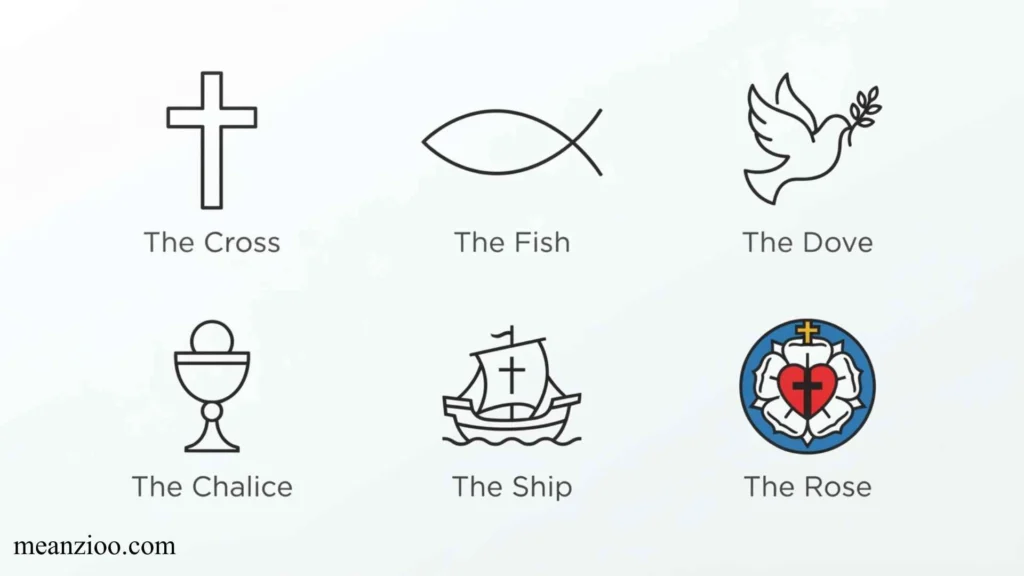
Lutheran symbols are visual representations that help communicate Christian beliefs and Lutheran heritage. They can be found in church architecture, stained glass, artwork, vestments, banners, books, logos, seals, and worship spaces.
It is important to distinguish between Lutheran-specific symbols and general Christian symbols.
The Luther Rose is particularly associated with Lutheran identity. By contrast, the cross, fish, dove, water, and other images are used by many Christian traditions.
This distinction matters because Lutheranism developed within the wider Christian tradition rather than creating an entirely separate system of religious symbolism.
The Luther Rose
The Luther Rose is the best-known symbol associated with Lutheranism.
The design contains several elements:
- A black cross
- A red or natural-colored heart
- A white rose
- A blue background
- A golden ring
Martin Luther explained the meaning of these elements in a 1530 letter to Lazarus Spengler. His explanation connected the symbol with Christ, faith, joy, heavenly hope, and eternal blessedness.
Black Cross
The black cross sits inside the heart.
It represents Jesus Christ and his crucifixion. Luther explained that the cross points believers toward Christ as the crucified Savior and emphasizes faith in Christ.
For Lutheran theology, the cross is not merely an historical reference. It points to the heart of the Christian message: salvation through Christ.
Red Heart
The heart surrounds the cross and represents faith.
Its placement at the center of the rose emphasizes the importance of faith in Christ. The heart and cross together show that Christian faith is centered on the crucified Christ.
White Rose
The white rose surrounds the heart.
Luther associated the white rose with the joy, comfort, peace, and blessedness that come through faith. The color white also carries associations with purity, heavenly joy, and the angels in his explanation.
Blue Background
The blue field surrounding the rose represents heavenly hope.
Luther described the joy experienced through faith as a beginning of the heavenly joy that is still to come. The blue background therefore connects present faith with future hope.
Golden Ring
The golden ring surrounding the design represents the endless nature of heavenly blessedness.
Gold also conveys value and preciousness. In Luther’s explanation, the ring points toward a joy and blessedness that does not end.
The Word “Vivit”
Some historical versions of the Luther Rose include the Latin word Vivit, meaning “He lives.”
This emphasizes the resurrection and living Christ and adds another layer of meaning to the symbol.
Why Is the Luther Rose Important?
The Luther Rose is important because it connects Lutheran identity with the theology and history of Martin Luther.
It is not simply a decorative flower. Its elements were deliberately arranged to communicate Christian teaching.
The symbol has also continued into modern Lutheran organizations. The Lutheran World Federation describes its own emblem as a reinterpretation of Martin Luther’s seal, incorporating the Luther Rose alongside a cross, circle, dove, and hand.
The Cross
The cross is perhaps the most important Christian symbol found in Lutheran churches.
It represents:
- Jesus Christ
- The crucifixion
- Christ’s sacrifice
- Salvation
- God’s grace
- Christian faith
- Hope and victory
The cross is at the center of Lutheran theology and worship because it points directly to Christ.
The Lutheran World Federation describes the cross in its visual identity as representing faith in the crucified Christ and the content of its proclamation.
Also Check This Post: Dishwasher Symbols: Complete Guide to Every Common Symbol and Meaning
The Crucifix
A crucifix is a cross that includes an image of Jesus on it.
Some Lutheran churches use a crucifix, while others emphasize an empty cross. The difference can reflect local tradition, denominational practice, or theological emphasis.
A crucifix visually emphasizes Christ’s suffering and death. An empty cross can emphasize the resurrection and Christ’s victory over death.
Neither image should automatically be assumed to identify a church as Catholic or Lutheran. Crucifixes have a history of use within Lutheran Christianity as well.
The Dove
The dove is a traditional Christian symbol of the Holy Spirit.
In Lutheran symbolism, it can represent:
- The Holy Spirit
- God’s presence
- God’s covenant
- Proclamation of the Gospel
- Reconciliation
- Spiritual guidance
The Lutheran World Federation uses a dove in its visual identity and explains that it represents the Holy Spirit and proclamation. The branch carried by the dove also represents reconciliation and care for creation.
The Fish or Ichthys
The fish, often called the Ichthys, is an ancient Christian symbol.
It is associated with Jesus Christ and Christian identity. The Greek word ichthys means “fish,” and early Christians used the fish as a recognizable Christian sign.
The fish is not specifically Lutheran. Catholics, Orthodox Christians, Protestants, and other Christians may use it.
Its presence in a Lutheran context therefore usually represents broader Christian faith rather than a uniquely Lutheran teaching.
Water as a Lutheran Symbol
Water has a special place in Lutheran worship because of Holy Baptism.
Water can symbolize:
- Baptism
- Cleansing
- New life
- God’s promise
- Forgiveness
- Christian identity
In Lutheran worship, baptism is not merely a symbolic ceremony. It is a sacramental practice connected with God’s promise and the Christian life.
This is why baptismal fonts are important visual elements in many Lutheran churches.
The Baptismal Font
The baptismal font is the place where baptism takes place.
It can serve as a visual reminder that Christian life is connected with baptism and God’s promises.
Fonts may have different shapes and designs. Some are simple stone or wooden structures, while others are elaborate works of art.
The exact appearance varies between churches, but its purpose remains connected with Holy Baptism.
Bread and Wine
Bread and wine are important Lutheran symbols because they are used in Holy Communion.
They point to Jesus’ institution of the sacrament and to the Lutheran understanding of Christ’s presence and promise in Communion.
In church architecture and artwork, bread and wine may appear on an altar, in stained glass, on banners, or in other visual forms.
These symbols are not uniquely Lutheran because Communion is central to many Christian traditions.
The Chalice
The chalice is a cup associated with Holy Communion.
It can represent:
- The Lord’s Supper
- Christ’s blood
- Communion
- God’s grace
- Christian fellowship
A chalice may be displayed near the altar or incorporated into church artwork.
The Paten
A paten is a plate or shallow dish used in the celebration of Holy Communion.
Together, the chalice and paten visually represent the sacramental meal.
The Lutheran World Federation specifically connects the circle in its visual identity with sacramental elements including the baptismal font, chalice, and paten.
The Bible and the Word of God
The Bible is one of the most important objects in Lutheran worship.
Lutheran identity places a strong emphasis on Scripture and the proclamation of God’s Word. The Bible may therefore be represented visually by:
- An open Bible
- A lectern
- A pulpit
- Scripture inscriptions
- Bible verses in stained glass
- Books used during worship
An open Bible can symbolize God’s Word being read, taught, proclaimed, and heard.
The Pulpit
The pulpit is an important feature of many Lutheran churches because it is associated with preaching and the proclamation of God’s Word.
Its visual importance reflects the central role of preaching and Scripture in Lutheran worship.
Some churches place the pulpit prominently near the altar or sanctuary area to visually connect Word and Sacrament.
The Altar
The altar is another major feature of Lutheran church architecture.
It is associated particularly with Holy Communion and Christian worship.
Depending on the congregation and architectural tradition, the altar may be simple or highly decorated. It may include a cross, candles, flowers, paraments, or other Christian artwork.
The altar, pulpit, and baptismal font together can help visually communicate the major elements of Lutheran worship.
Candles
Candles are common in Lutheran churches and broader Christian worship.
They can symbolize:
- Christ as light
- God’s presence
- Prayer
- Worship
- Hope
- Celebration
Candles may be placed on or near the altar and may be used differently according to the congregation’s worship tradition.
The candle itself is not exclusively Lutheran, but it can contribute to the symbolic atmosphere of Lutheran worship.
The Ship
The ship is an ancient Christian symbol sometimes found in Lutheran churches.
It can represent the Church and the Christian community traveling together through life.
The image can also connect with biblical stories involving Jesus and his disciples on the water.
The ship is therefore best understood as a broader Christian symbol that can take on meaning within Lutheran worship and artwork.
Lutheran Liturgical Colors
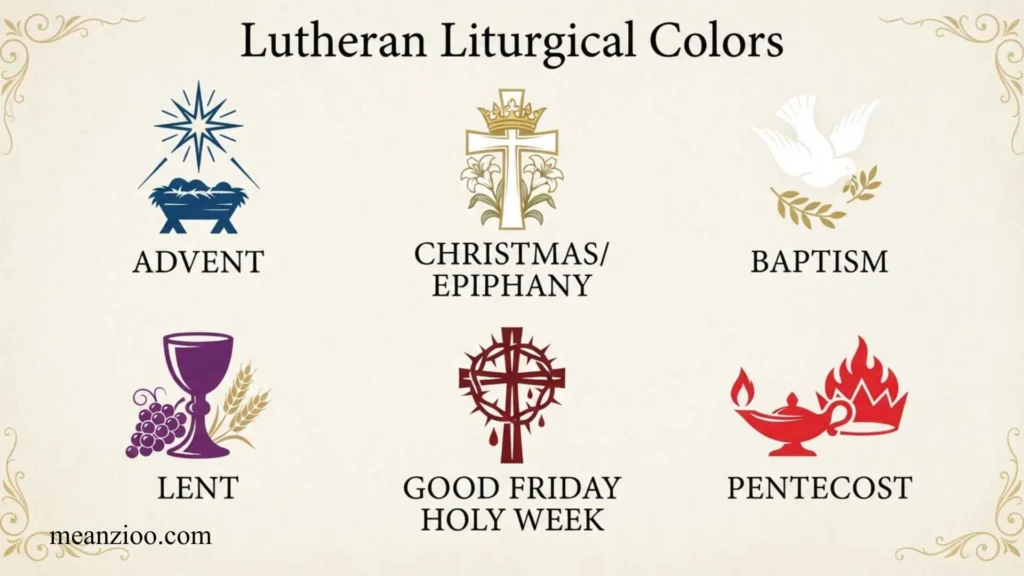
Colors are another important part of Lutheran visual symbolism.
Lutheran churches commonly use different colors on altar cloths, banners, stoles, and other liturgical items according to the season or occasion.
However, exact practices can vary among Lutheran churches and jurisdictions.
White
White commonly represents:
- Joy
- Celebration
- Purity
- Resurrection
- Christ’s glory
It is commonly associated with major celebrations such as Christmas and Easter.
Red
Red can represent:
- The Holy Spirit
- Fire
- Martyrdom
- The Church
- Important celebrations
It is especially associated with Pentecost and certain commemorations.
Purple or Violet
Purple is commonly associated with:
- Repentance
- Preparation
- Reflection
- Advent
- Lent
It creates a more solemn visual atmosphere during seasons of preparation and penitence.
Green
Green is associated with:
- Growth
- Life
- Renewal
- Christian discipleship
It is commonly used during periods of the church year that focus on ongoing Christian life and growth.
Blue
Blue can be used in some Lutheran traditions, particularly during Advent.
It can also carry symbolic associations with hope and heaven. In the Lutheran World Federation’s visual identity, blue represents eternal hope, heavenly joy, and baptismal water.
Also Check This Post: Cat Symbols: Meanings, Symbolism, Cultural Significance, and Common Designs
Lutheran Church Architecture and Symbols
Lutheran church buildings can contain many symbols beyond individual images.
Altar
The altar is associated with worship and Holy Communion.
Pulpit
The pulpit represents the proclamation and teaching of God’s Word.
Baptismal Font
The font points to Holy Baptism.
Cross
The cross keeps Christ at the visual center of worship.
Stained Glass
Stained-glass windows may depict biblical events, Christ, apostles, saints, symbols, or scenes from Christian history.
Paraments
Paraments are colored cloths used to decorate the altar, pulpit, lectern, or other parts of the worship space. Their colors often correspond to the church year.
Together, these features can create a visual language that communicates Lutheran beliefs even before a service begins.
Lutheran Reformation Symbols
Lutheran symbolism is closely connected with the Protestant Reformation and Martin Luther.
The Luther Rose is the clearest example.
Other Reformation-related visual elements may include:
- Martin Luther’s seal
- Crosses
- Scripture
- Bibles
- Reformation anniversary emblems
- Church seals
- Historical Luther imagery
Modern Lutheran organizations sometimes combine these traditional symbols with contemporary designs.
The Lutheran World Federation’s visual identity, for example, combines the Luther Rose with the cross, circle, dove, hand, and branch to communicate Lutheran identity and its wider mission.
The Lutheran World Federation Symbol
The Lutheran World Federation (LWF) has a modern visual identity based on a reinterpretation of the Luther Rose.
Its major elements include:
- Cross — faith in the crucified Christ
- Circle — communion and unity
- Rose — Lutheran confessional identity
- Dove — Holy Spirit and proclamation
- Hand — service to others
- Branch — reconciliation and care for creation
The LWF explains these meanings as part of its official visual identity.
This is a useful example of how traditional Lutheran symbols can be adapted to express contemporary Christian mission.
Lutheran Symbols vs. Catholic Symbols
Lutheran and Catholic churches share many Christian symbols because both traditions are part of historic Christianity.
For example, both may use:
- Crosses
- Crucifixes
- Bibles
- Candles
- Water
- Bread and wine
- Biblical imagery
- Saints and historical Christian figures
The major difference is not necessarily the presence or absence of these symbols.
Instead, the traditions may differ in how they understand particular teachings, worship practices, sacramental theology, church authority, and the role of tradition.
The Luther Rose, however, provides a much clearer visual connection to Lutheran identity than most of these shared Christian symbols.
Are Lutheran Symbols the Same in Every Lutheran Church?
No.
Lutheranism includes different church bodies and traditions, and congregations can vary in worship style, architecture, artwork, and use of symbols.
One Lutheran church may have a highly traditional sanctuary with stained glass, crucifixes, candles, and elaborate paraments. Another may use a simpler worship space with fewer visual elements.
Therefore, the absence of a particular symbol does not necessarily mean a church is not Lutheran.
Lutheran Symbols vs. General Christian Symbols
Understanding this distinction makes Lutheran symbolism easier to recognize.
| Symbol | Lutheran connection | Shared with other Christians? |
| Luther Rose | Very strong | Less common outside Lutheran contexts |
| Cross | Very strong | Yes |
| Crucifix | Strong in some traditions | Yes |
| Dove | Strong Christian symbolism | Yes |
| Fish | Christian identity | Yes |
| Water | Baptism | Yes |
| Bread and wine | Holy Communion | Yes |
| Bible | Scripture | Yes |
| Ship | Christian community | Yes |
| Candle | Christ/light/worship | Yes |
| Altar | Worship/Communion | Yes |
| Baptismal font | Baptism | Yes |
The most important takeaway is that Lutheran symbolism is not a completely separate category from Christian symbolism. Instead, Lutheran churches use many historic Christian symbols while giving special importance to symbols connected with the Reformation and Lutheran identity.
Why Do Lutherans Use Symbols?
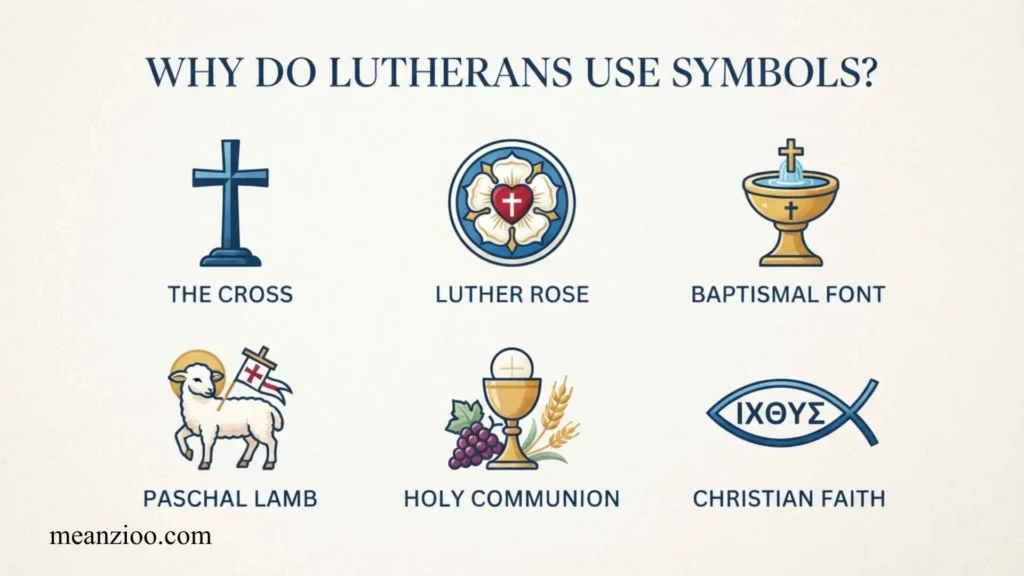
Symbols can communicate ideas quickly and visually.
A cross can immediately remind a worshipper of Christ. Water can point toward baptism. Bread and wine can recall Holy Communion. A Bible can represent Scripture. The Luther Rose can communicate Lutheran heritage.
Symbols can therefore support teaching, worship, remembrance, and identity.
They can also help people who are unfamiliar with a church understand some of its beliefs simply by looking at the worship space.
Frequently Asked Questions About Lutheran Symbols
What is the main symbol of Lutheranism?
The Luther Rose is generally considered the symbol most closely associated with Lutheranism. It originated as Martin Luther’s seal and became an important symbol of Lutheran identity.
What does the Luther Rose mean?
The Luther Rose represents Christian faith centered on Christ. Its cross, heart, white rose, blue background, and golden ring have meanings connected with Christ, faith, joy, heavenly hope, and eternal blessedness.
What does the black cross in the Luther Rose mean?
The black cross represents Christ crucified and points to faith in Jesus Christ as Savior.
What does the white rose mean in Lutheranism?
The white rose represents the joy, comfort, peace, and blessedness associated with faith in Christ.
What does the blue background of the Luther Rose mean?
The blue background represents heavenly joy and hope that begins in Christian faith but points toward the future.
What does the gold ring around the Luther Rose mean?
The golden ring represents the endless and precious nature of heavenly blessedness.
Do Lutherans use the cross?
Yes. The cross is one of the central symbols of Lutheran Christianity and represents Christ’s crucifixion, salvation, and Christian faith.
Do Lutherans use crucifixes?
Some Lutheran churches use crucifixes, while others primarily use empty crosses. The use of a crucifix is not exclusive to Roman Catholic Christianity.
What does the dove mean in Lutheran symbolism?
The dove commonly represents the Holy Spirit. In Lutheran World Federation symbolism, it also connects with proclamation and reconciliation.
Is the fish a Lutheran symbol?
The fish is a Christian symbol that Lutherans may use, but it is not uniquely Lutheran. It is an ancient symbol associated with Jesus Christ and Christian identity.
What does water symbolize in Lutheranism?
Water is closely connected with Holy Baptism and can represent baptism, God’s promise, cleansing, and new life.
What do bread and wine symbolize in Lutheran worship?
Bread and wine are used in Holy Communion and point to Christ’s institution of the sacrament and God’s gifts to believers.
What colors are used in Lutheran churches?
Common liturgical colors include white, red, purple or violet, and green. Some Lutheran traditions also use blue, particularly during Advent. Practices can vary between churches.
What is the difference between Lutheran and Catholic symbols?
Many symbols are shared because both traditions belong to historic Christianity. The major distinction is that some symbols, such as the Luther Rose, have a particularly strong connection with Lutheran history and identity.
Are Lutheran symbols biblical?
Many Lutheran symbols are based on biblical themes, such as the cross, dove, water, bread, wine, and light. Some symbols, such as the Luther Rose, were developed later as visual expressions of Christian teaching rather than being symbols directly prescribed in the Bible.
Final Thoughts
Lutheran symbols provide a visual way to understand the history, worship, and beliefs of Lutheran Christianity.
The Luther Rose remains the clearest symbol of Lutheran identity, with its cross, heart, white rose, blue background, and golden ring representing different aspects of Christian faith and hope.
At the same time, Lutheran churches use many symbols shared with other Christian traditions. The cross, crucifix, dove, fish, water, bread and wine, Bible, altar, pulpit, baptismal font, candles, and liturgical colors can all contribute to the visual language of Lutheran worship.
The most useful way to understand these symbols is not simply to ask what each picture represents, but to consider how it points toward larger Christian themes: Christ, faith, grace, Scripture, baptism, Communion, service, hope, and eternal life.
Lutheran symbolism ultimately connects historic Christian imagery with the particular history and identity of the Lutheran Reformation.
Also Check This Post: Health Symbols: Meanings, Names, and What They Represent

Hi, I’m Charlotte Hayes. I love writing about the newest English slang, pop culture phrases, and digital communication. I spend my time exploring how language evolves across social media, gaming, and everyday conversations. I enjoy sharing easy-to-understand guides that help learners keep up with modern English. My goal is to make every article useful, accurate, and enjoyable for readers around the world.
Books:
- Everyday Slang Dictionary
- Fluent Through Informal English
 Ryan Mitchell