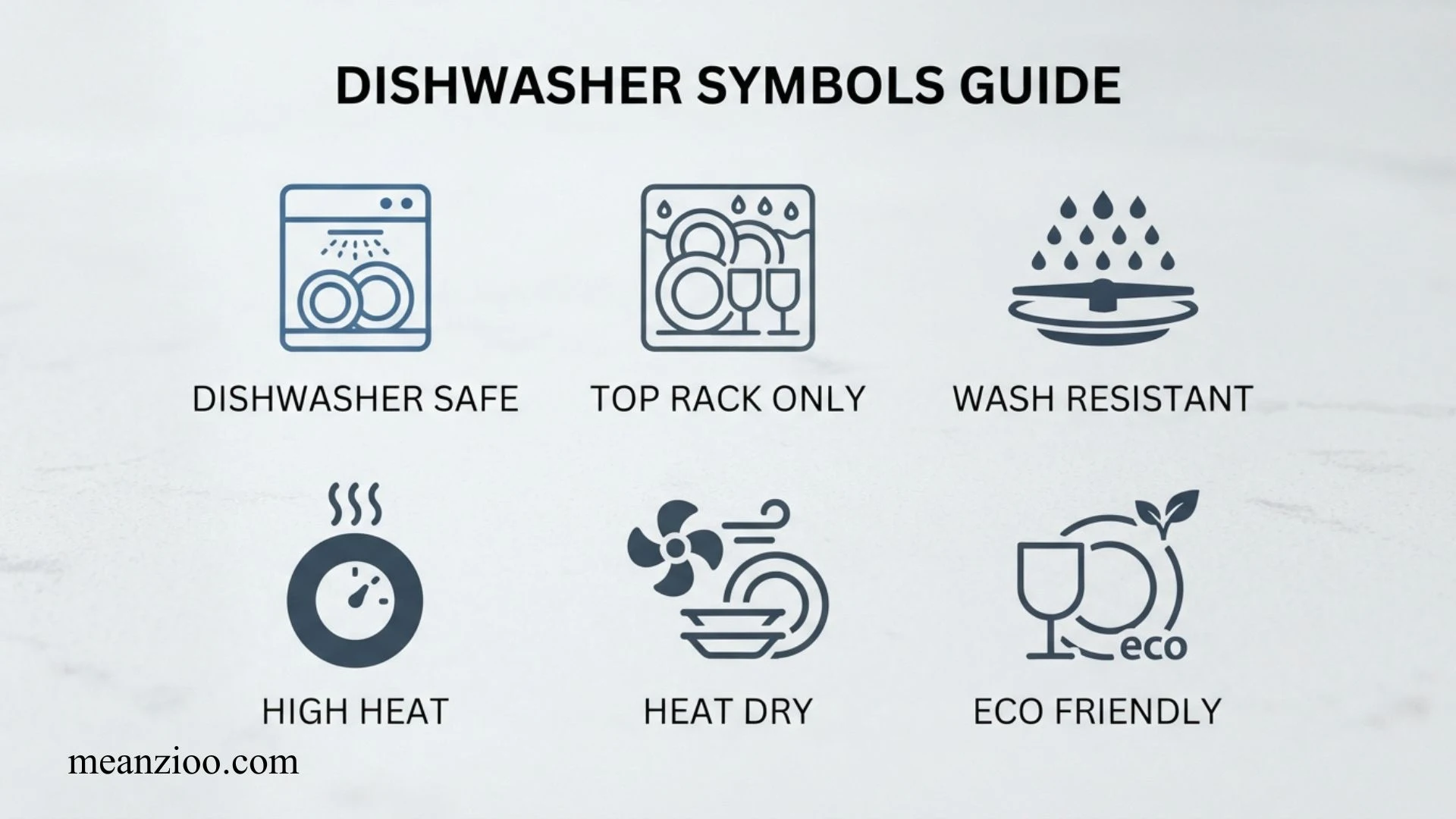
Dishwasher symbols can seem confusing when you are faced with unfamiliar icons on the control panel, detergent compartment, or the bottom of a plate or container. A small symbol can tell you whether a dishwasher is washing, rinsing, drying, using an intensive cycle, or asking you to refill salt or rinse aid.
The important thing to remember is that dishwasher symbols are not completely universal. Some functions have widely recognized icons, while manufacturers can use different symbols for programs and features. AEG, for example, notes that indicators and programs can vary between dishwasher models.
This guide explains the most common dishwasher symbols, what they look like, what they mean, and what you should do when an indicator appears.
Dishwasher Symbols at a Glance
Here is a quick reference for the most common dishwasher symbols:
| Symbol or appearance | Common meaning | What it tells you |
| Eco / leaf-like icon | Eco wash | Uses an efficiency-focused program |
| Pot or pan | Intensive wash | For heavily soiled cookware |
| Auto | Automatic wash | Adjusts the cycle automatically |
| Glass | Glass/delicate | For suitable delicate glassware |
| Stopwatch/clock | Quick or timed cycle | Shorter or scheduled washing |
| Water drops | Rinse/pre-rinse | Rinsing or pre-rinsing |
| Wavy lines | Drying | Drying phase or drying option |
| Star/sparkle | Rinse aid | Rinse-aid refill indicator |
| S-shaped arrows | Dishwasher salt | Salt needs replenishing |
| Faucet/tap | Water supply | Check the water connection |
| Key/lock | Child lock | Controls are locked |
| Brush | Washing | Cleaning phase is running |
| Half-load icon | Half load | Smaller load option |
| Sparkle/extra-dry icon | Extra Dry | Enhanced drying |
| Plates under water drops | Dishwasher safe | Item is intended for dishwasher cleaning |
| Hand in water | Hand wash | Wash the item by hand |
The exact icon can look different from one manufacturer or model to another.
What Do Dishwasher Symbols Mean?
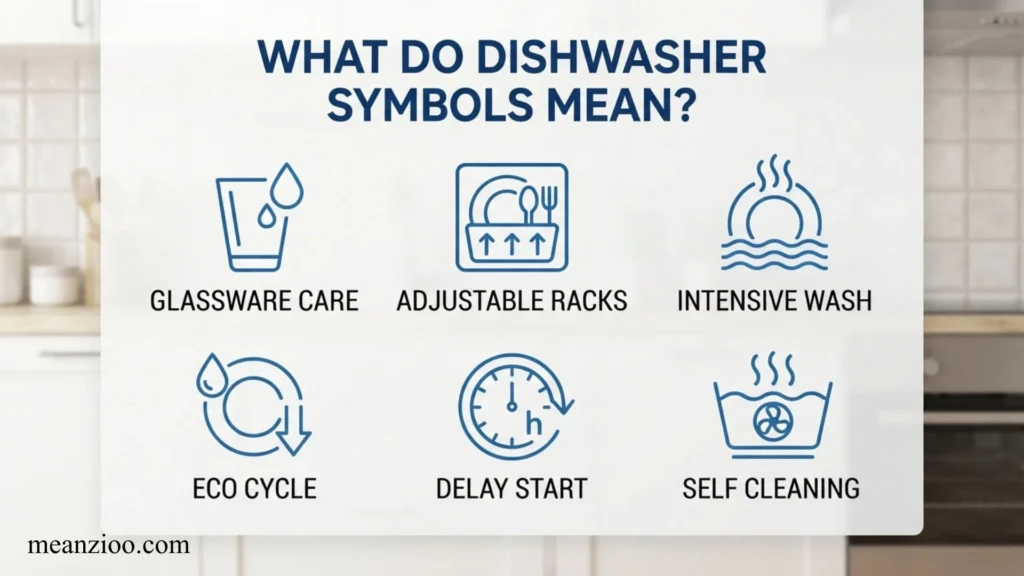
Dishwasher symbols generally fall into four groups:
- Wash-program symbols — tell you which cycle you are selecting.
- Option symbols — add features such as extra drying or half load.
- Status and warning symbols — tell you what the machine is doing or whether it needs attention.
- Tableware symbols — appear on dishes, glasses, cookware, and containers to explain care instructions.
Knowing which category a symbol belongs to makes it much easier to understand.
Dishwasher Symbols and Meanings
Dishwasher symbols help you understand which cycle to select, when to refill essential products, and how to care for your dishes. These small icons appear on dishwasher control panels, detergent containers, glasses, plates, and other kitchen items. Learning their meanings makes everyday dishwashing easier and helps prevent accidental damage.
Although some symbols look similar across brands, their functions can vary by manufacturer and model. Always check your appliance manual if an icon is unfamiliar.
Common dishwasher symbols include:
- Water spray or droplets: Often indicate a washing or rinsing function.
- A wine glass: Usually represents a delicate or glassware cycle.
- A clock: Commonly indicates a delay timer or remaining cycle time.
- A half-load icon: May indicate a program designed for a smaller load.
- Salt indicator: Usually looks like an S-shaped mark, salt crystals, or a similar warning symbol.
- Rinse aid indicator: Often resembles a sparkle, star, or stylized droplet.
- Eco symbol: Commonly identifies an energy- and water-efficient washing program.
Understanding these icons helps you choose the right settings, maintain your dishwasher, and protect delicate kitchenware.
Dishwasher Symbols Salt
The dishwasher salt symbol tells you when the appliance needs more dishwasher salt. On many models, it resembles a small S, two curved arrows, or a salt-crystal indicator. The exact design depends on the manufacturer.
Dishwasher salt is used by dishwashers with a water-softening system to reduce the effects of hard water. This helps prevent limescale buildup and can improve cleaning results.
What you should know about the salt symbol:
- When it lights up: The salt reservoir may need refilling.
- Where to add salt: Usually through a dedicated cap at the bottom of the dishwasher tub.
- Which product to use: Use dishwasher salt specifically designed for the appliance.
- When the light goes off: It may take a short time or another wash cycle for the indicator to reset.
Do not confuse dishwasher salt with ordinary table salt. Table salt may contain additives and is not a suitable substitute. If your dishwasher does not have a water-softening system, it may not use dishwasher salt at all.
Dishwasher Symbols on Cups
Dishwasher symbols on cups help you determine whether a cup can safely go through a dishwasher. These markings are particularly useful for glassware, ceramic mugs, travel cups, and reusable drinkware.
However, there is no single universal symbol that guarantees every cup is dishwasher-safe. Some manufacturers use a glass with water droplets, while others print text or provide care instructions on the base.
Look for these common markings:
- Glass with water droplets: May indicate dishwasher suitability when specified by the manufacturer.
- Dishwasher-safe wording: Provides a direct indication that the item is suitable for dishwasher cleaning under the stated conditions.
- Crossed-out dishwasher icon: Usually warns against dishwasher use.
- Hand washing symbol: Indicates that the item should be washed manually.
- Temperature information: May specify limits for heat exposure.
Before washing a cup, consider its material and construction. Thin crystal, hand-painted ceramics, insulated travel mugs, and cups with metallic decorations may require special care. Always follow the manufacturer’s instructions rather than relying on an icon’s appearance alone.
Dishwasher Symbols Bosch
Bosch dishwashers use a combination of program icons, indicator lights, and control-panel symbols. Their appearance varies across Series 2, Series 4, Series 6, Series 8, and older models.
Common Bosch dishwasher symbols include:
- Eco 50°: An energy-efficient program, commonly intended for normally soiled dishes.
- Auto: Adjusts washing conditions according to the program’s sensors and design.
- Intensive: Intended for heavily soiled pots, pans, and dishes.
- Quick or express: Provides a shorter wash for suitable loads, depending on the model.
- Glass or delicate: Designed for appropriate fragile items.
- Machine Care: Helps clean and maintain the dishwasher itself.
- Salt indicator: Alerts you when the salt reservoir may need refilling.
- Rinse aid indicator: Indicates that the rinse aid reservoir may need attention.
- Tap or water-supply symbol: Can indicate a water intake problem or another water-related issue, depending on the model.
Some Bosch dishwashers also have extra-drying, half-load, remote-start, and delay-start options.
If an icon appears alongside a warning light, check the exact model number and consult the corresponding Bosch manual. This is especially important when the symbol relates to an error or water-supply problem.
Dishwasher Symbols AEG
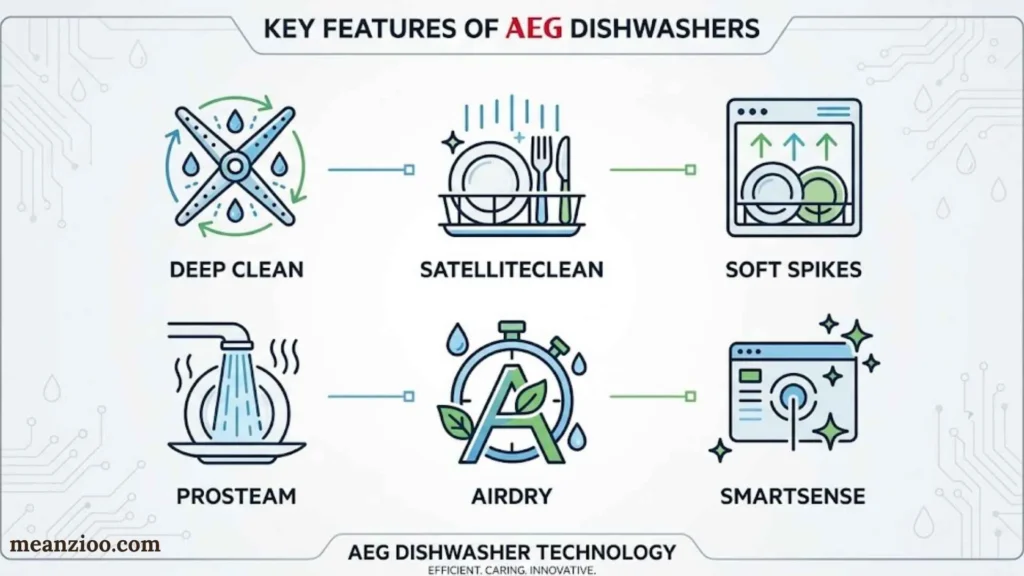
AEG dishwasher symbols identify wash programs, additional functions, and maintenance alerts. While the symbols differ between models, many AEG appliances use recognizable labels or pictograms for their main programs.
Common symbols and functions include:
- Eco: A program designed to reduce energy and water consumption under specified test conditions.
- AutoSense or Auto: Adjusts the wash according to the selected program’s sensing capabilities.
- Intensive: Suitable for heavily soiled cookware when the model offers this cycle.
- Glass: Provides a suitable program for compatible delicate glassware.
- Quick: Reduces washing time for appropriate loads.
- ExtraPower: Available on selected models to improve cleaning performance.
- Machine Care: Supports cleaning and maintenance of the appliance.
- Salt and rinse aid indicators: Alert you when the relevant reservoirs may need refilling.
AEG models do not all offer the same programs. Some functions appear as text on the control panel, while others use small icons or touch controls.
For accurate identification, search for the model’s user manual using the product number on the appliance label.
Old Bosch Dishwasher Symbols
Older Bosch dishwashers may have mechanical buttons, rotary program selectors, printed temperatures, and indicator lights rather than modern digital displays. Their symbols can look different from those on newer appliances.
Common markings on older models include:
- A pot or heavily soiled dish: Often indicates an intensive washing program.
- A plate or dish symbol: May identify a normal or standard wash.
- A glass symbol: Commonly refers to a delicate program.
- Eco or an economy marking: Indicates a program intended to save energy and water.
- A clock: May identify a timer or delayed start on supported models.
- Salt indicator: Warns that the water-softening salt may need replenishing.
- Rinse aid indicator: Signals that rinse aid may need attention.
- Brush or cleaning-related icon: May indicate a washing phase or maintenance function, depending on the model.
On older appliances, the same-looking symbol may have a different meaning depending on its position on the program dial.
To identify an old Bosch dishwasher correctly, locate its E-Nr. model number, usually printed on the door edge or inner door area. Use that number to find the matching manual instead of relying on a guide for a newer model.
Asko Dishwasher Symbols
ASKO dishwashers use program icons and status indicators to help users manage washing, drying, and maintenance. The available symbols depend on the model and generation.
Common ASKO dishwasher functions may include:
- Eco: A program intended for efficient everyday dishwashing.
- Auto: Adjusts the wash process on models equipped with an automatic program.
- Intensive: Designed for heavily soiled cookware and dishes.
- Quick: Offers a shorter program for suitable loads.
- Glass: Provides a gentler option for compatible glassware.
- Time or delay icon: May represent a time-related setting.
- Salt indicator: Signals that dishwasher salt may need replenishing.
- Rinse aid indicator: Alerts you when the rinse aid reservoir may need attention.
- Self-cleaning or maintenance program: Available on selected models for appliance care.
Some ASKO dishwashers use touch displays, while others have physical buttons and simple indicator lights.
If an icon flashes, remains illuminated, or appears alongside a fault code, check the exact ASKO manual before taking action. The meaning of warning lights can differ between product generations.
Whirlpool Dishwasher Symbols
Whirlpool dishwasher symbols indicate the selected washing program, extra functions, and the operating status of the appliance. The control panel may use pictures, text labels, or a combination of both.
Typical Whirlpool dishwasher symbols include:
- Normal: A general-purpose program for everyday dishes.
- Heavy or intensive: Designed for pots, pans, and heavily soiled items.
- Eco: A more efficient option on models that include this program.
- Quick wash: Intended for suitable loads when a shorter cycle is needed.
- Rinse only: Rinses dishes without completing a full detergent wash on supported models.
- Heated dry or extra dry: Adds or adjusts the drying process, depending on the appliance.
- Delay: Allows you to schedule the wash to begin later.
- Control lock: Helps prevent accidental changes to the settings.
- Clean or end indicator: Shows that the program has finished on supported models.
- Salt or rinse aid warning: Appears on models equipped with the relevant reservoirs and indicators.
Whirlpool dishwasher controls differ by region and model. If the appliance beeps, flashes, or displays an error code, use its model-specific troubleshooting instructions.
Bosch Dishwasher Symbols Arrows
Arrow symbols on Bosch dishwashers can be confusing because several different icons may contain arrows or curved lines. Their meanings depend on the complete design and where the symbol appears.
Possible interpretations include:
- Circular arrows: May indicate a repeating, circulation, or regeneration-related function, depending on the appliance.
- Two curved arrows: Can appear on salt-related indicators or other manufacturer-specific symbols.
- Arrow pointing toward a plate or spray area: May represent a washing function on a particular control panel.
- Arrow beside a clock: May be associated with delayed start or a time-related option.
- Arrows around a symbol: May indicate a process or additional function rather than a warning.
Do not assume that every arrow symbol means dishwasher salt. Check whether the icon appears beside a refill light, a program button, or an error indicator.
For the most reliable answer, compare the symbol with the diagram in your Bosch dishwasher manual. A clear photograph of the icon and the model number can also help identify it.
Thermador Dishwasher Symbols
Thermador dishwasher symbols identify wash cycles, drying functions, and appliance alerts. Their designs and available features vary across Thermador product lines.
Common functions may include:
- Auto: Selects an automatic washing program on compatible models.
- Normal: Provides a standard wash for everyday dishwashing.
- Pots and pans or intensive: Handles heavily soiled cookware.
- Glass care: Offers a program or setting for suitable delicate glassware.
- Speed or quick wash: Reduces cycle time for appropriate loads.
- Extra drying: Enhances drying on supported models.
- Delay start: Schedules the wash to begin later.
- Salt and rinse aid indicators: Provide refill alerts where these systems are fitted.
- Machine cleaning: Supports maintenance on models with a dedicated cleaning program.
Thermador is part of the BSH family of appliance brands, but its controls and program labels are not necessarily identical to Bosch models.
Use the Thermador model number to find the correct manual. This is particularly important when troubleshooting warning symbols, because a light can represent a specific fault rather than a routine refill reminder.
Icon Bosch Dishwasher Symbols
Bosch dishwasher icons can be grouped into three main categories: wash programs, additional functions, and maintenance indicators. Knowing which category an icon belongs to makes it easier to understand the control panel.
Here are some common examples:
- Eco icon: Identifies an energy-efficient program.
- Auto icon: Represents an automatic wash program on supported models.
- Pot icon: Often indicates an intensive cycle.
- Wine glass icon: Commonly identifies a glass or delicate program.
- Clock icon: May indicate a delay timer or time-related setting.
- Sparkle or drying icon: Can represent a drying-related feature on certain models.
- Salt warning icon: Signals that the salt reservoir may need refilling.
- Rinse aid icon: Alerts you to check the rinse aid reservoir.
- Tap icon: May indicate a water-supply issue.
- Machine Care icon: Identifies a maintenance program on models that include one.
An icon’s location matters just as much as its shape. A symbol beside a button may identify a selectable function, while the same or similar design illuminated on the display may communicate status.
Always check the model-specific manual before interpreting a flashing warning light.
Suitable for Dishwasher Symbol
A suitable-for-dishwasher symbol indicates that an item can be cleaned in a dishwasher under the manufacturer’s recommended conditions. It may appear on cups, plates, cookware, storage containers, and reusable kitchen accessories.
There is no single universal pictogram used by every manufacturer. Common representations include a dishwasher outline, dishes inside a machine, water droplets, or written instructions.
Before placing an item in the dishwasher, look for:
- A dishwasher-safe marking: Confirms suitability when provided by the manufacturer.
- Temperature guidance: Helps you understand any heat limitations.
- Top-rack instructions: May apply to lightweight plastic items.
- Material restrictions: Some products are safe only on specific cycles.
- Care instructions: May identify whether detergent, high temperatures, or heated drying should be avoided.
If no marking is present, check the item’s packaging or manufacturer’s care guide. Avoid assuming that an item is dishwasher-safe simply because it looks sturdy.
Not Dishwasher Safe Symbol
The not-dishwasher-safe symbol warns that an item should not be placed in a dishwasher. It may appear as a dishwasher pictogram with a diagonal line or cross through it, although designs vary.
Manufacturers may use this warning for items that can warp, crack, discolor, corrode, or lose their protective finish during machine washing.
Items that often need special care include:
- Wooden spoons, cutting boards, and utensils that can split or warp.
- Cast-iron cookware that may lose its seasoning or develop rust.
- Fine crystal that is not approved for dishwasher use.
- Hand-painted dishes with delicate decorations.
- Antique tableware with gold or silver detailing.
- Insulated drinkware that is not rated for dishwasher cleaning.
- Certain nonstick pans whose coatings or handles require hand washing.
If the symbol is unclear, read the care instructions before washing the item. Hand washing is usually the safer option when the manufacturer explicitly prohibits dishwasher use.
Dishwasher Friendly Symbol
The term “dishwasher friendly” generally means that a product is suitable for dishwasher cleaning. However, it is not a universal symbol with one standardized design.
You may find a dishwasher-friendly label on food containers, cups, plates, utensils, and kitchen accessories. Some products use a small dishwasher illustration, while others provide written instructions.
A dishwasher-friendly item may still have specific restrictions:
- It may need to be placed on the top rack.
- It may tolerate only certain temperatures.
- It may require a low-temperature or delicate program.
- It may not be suitable for heated drying.
- Its lid, seal, handle, or decorative parts may need to be removed.
Always check the product’s instructions for these limitations. A dishwasher-friendly label does not automatically mean that every component can withstand every wash cycle.
Symbol for Dishwasher Safe UK
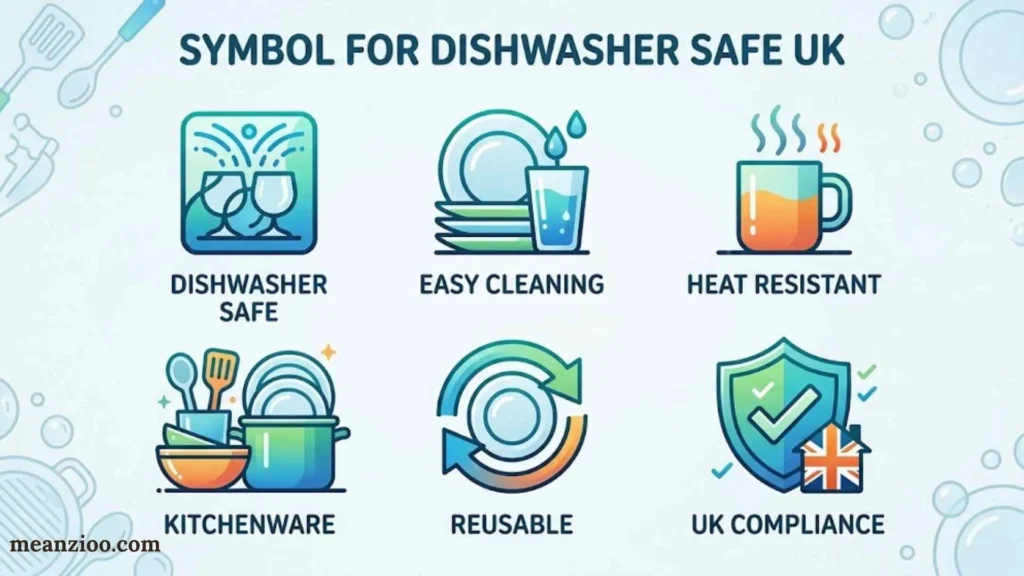
In the United Kingdom, consumers may encounter dishwasher-safe markings on ceramics, glassware, plastics, and other kitchen products. These markings can help identify suitable items, but their appearance is not always standardized across product categories.
A common design shows dishes or glasses inside a stylized dishwasher, sometimes with water droplets. Other products use a written statement such as “dishwasher safe.”
When checking a dishwasher-safe symbol in the UK, remember these points:
- Look for the manufacturer’s official care instructions.
- Check whether the product is suitable for all racks or only the top rack.
- Follow any stated temperature or cycle restrictions.
- Treat crossed-out dishwasher images as a warning against machine washing when that meaning is confirmed by the manufacturer.
- Do not assume that a generic water-droplet symbol means dishwasher-safe; it may refer to another cleaning or water-resistance property.
If you’re unsure about a particular cup, plate, or container, check the product packaging or manufacturer’s website before washing it.
International Dishwasher Symbols
Dishwasher symbols appear on products sold around the world, but their designs and labeling practices can differ by manufacturer, product category, and market.
Some symbols are easy to recognize, while others depend on the accompanying text or product instructions. A dishwasher pictogram may communicate machine-washing suitability, but not every country or manufacturer uses exactly the same design.
When interpreting international dishwasher symbols, consider the following:
- Dishwasher-safe icon: Usually indicates that machine washing is permitted when confirmed by the product instructions.
- Crossed-out dishwasher icon: Commonly communicates that machine washing should be avoided.
- Glass and fork symbol: Often relates to food-contact suitability rather than dishwasher safety.
- Temperature marking: Indicates a specific temperature limit or test condition when used for that purpose.
- Hand-washing icon: Usually means that manual washing is required or recommended.
- Food-contact markings: Identify suitability for contact with food under the relevant labeling rules, not necessarily resistance to dishwasher heat.
A key distinction is that symbols can communicate different properties. Food-safe does not automatically mean dishwasher-safe, and microwave-safe does not guarantee suitability for high-temperature machine washing.
For products sold internationally, follow the instructions provided by the original manufacturer for the specific item.
Hand Wash Symbol Dishes
The hand-wash symbol indicates that dishes or kitchen items should be cleaned manually rather than in a dishwasher. It often shows a hand in water or a hand washing a dish, although the exact design varies.
Manufacturers may recommend hand washing for items that are sensitive to heat, strong detergent, prolonged moisture, or mechanical contact.
Common examples include:
- Delicate crystal glasses.
- Hand-painted ceramics.
- Wooden utensils and boards.
- Certain insulated travel mugs.
- Cookware with specific nonstick coatings.
- Antique or decorative dishes.
- Items with delicate metallic finishes.
To wash these items safely, use warm water, a suitable dishwashing liquid, and a soft sponge. Avoid abrasive pads that could scratch delicate surfaces.
If an item has both dishwasher and hand-wash instructions, follow the manufacturer’s specific guidance for that product. When the label explicitly says “hand wash only,” do not place it in the dishwasher.
Dishwasher Safe Symbol Australia
In Australia, dishwasher-safe markings appear on products such as glassware, ceramic dishes, reusable containers, and kitchen utensils. The design varies by manufacturer, so consumers should not rely on one icon alone.
A dishwasher-safe symbol may depict a machine containing dishes, water jets, or droplets. Some Australian products instead use written care instructions.
For reliable identification:
- Check the manufacturer’s dishwasher-safe statement.
- Look for any top-rack-only instruction.
- Confirm that the product can withstand the intended wash temperature.
- Check whether the lid or removable parts require separate cleaning.
- Follow any warnings about heated drying or delicate cycles.
Do not confuse dishwasher-safe markings with food-contact or microwave-safe symbols. These indicate different product properties.
If you’re buying kitchenware in Australia, the product’s packaging or official care guide is the best place to confirm whether machine washing is permitted.
Dishwasher Safe Icons
Dishwasher-safe icons help consumers identify products that can withstand machine washing. Although the designs differ, many feature a dishwasher outline, dishes, water droplets, or a combination of these elements.
These icons are particularly useful when comparing reusable containers, mugs, plates, and cookware. However, a symbol’s appearance alone may not reveal every cleaning restriction.
Here are the main details to check:
- Dishwasher pictogram: Look for a clear indication that the item is approved for machine washing.
- Crossed-out dishwasher: Check whether the manufacturer explicitly prohibits dishwasher use.
- Top-rack icon: Indicates that the item should be placed on the upper rack when the marking’s meaning is confirmed.
- Temperature marking: Follow any stated maximum temperature.
- Care label: Read additional instructions for coatings, lids, seals, and decorative components.
- Manufacturer guidance: Use the official product instructions whenever a symbol is unfamiliar.
The safest approach is to combine the icon with the product’s written care instructions. This helps prevent damage and makes it easier to choose the correct wash cycle.
Common Dishwasher Cycle Symbols
Eco Symbol
The Eco symbol identifies an energy- and water-efficient washing program.
An Eco program can take longer than a quick or standard cycle. The longer duration is intentional: the dishwasher can clean normally soiled dishes while using resources efficiently. Bosch describes its Eco program as a longer cycle that uses less water and electricity.
Best for: Normally soiled plates, cups, cutlery, and cookware.
Remember: Eco does not necessarily mean the fastest program. It is designed around efficiency rather than speed.
Auto Symbol
The Auto or AutoSense symbol represents an automatic washing program.
On compatible models, sensors can help determine appropriate washing conditions based on the load and how dirty the dishes are. AEG describes AutoSense as using sensors to tailor settings to the load.
Best for: Mixed loads when you are unsure which standard cycle to choose.
Intensive or Heavy Wash Symbol
A pot, pan, or heavily soiled cookware icon commonly represents an intensive program.
Intensive cycles generally use stronger spray pressure and higher temperatures. Bosch’s Intensive 70°C program, for example, is intended for stubborn, burned, or dried-on food residue.
Best for:
- Pots
- Pans
- Baking dishes
- Heavily soiled cookware
- Dishes with dried-on food
Always check whether your cookware is dishwasher-safe before using a high-temperature cycle.
Glass or Delicate Symbol
A wine glass or glassware icon usually represents a delicate or glassware program.
These programs are designed for suitable sensitive glassware and may use gentler temperatures or washing conditions. Bosch’s Glass 40°C program, for example, is designed for sensitive glass items.
Best for: Dishwasher-safe glasses and delicate tableware.
Quick or Express Wash Symbol
A stopwatch or clock-like symbol can indicate a quick, express, or short-duration program.
These programs are useful when you need clean dishes quickly, although the exact cleaning and drying performance depends on the model.
Some Bosch models, for example, have Express programs specifically designed to wash dishes or glasses more quickly.
Best for: Lightly or normally soiled dishes when saving time is important.
Pre-Rinse or Rinse Symbol
A symbol showing water drops, a spray, or dishes being rinsed can indicate a rinse or pre-rinse function.
A pre-rinse can be useful when dishes have been sitting for some time or when you want to rinse food residue before running a complete program. AEG describes its pre-wash program as a quick rinse intended to remove food residue and prevent odors when a full program is not being started immediately.
Important: A pre-rinse program may not require detergent. Follow your model’s instructions.
Dishwasher Option Symbols
Some symbols do not represent complete washing programs. Instead, they modify the selected program.
Half-Load Symbol
The half-load symbol usually represents a smaller load option.
It is useful when you do not have enough dishes to fill the dishwasher. Depending on the model, the machine may adjust water, energy, time, or the washing area.
Bosch, for example, describes its Half Load option as being designed for smaller quantities of dishes and intended to save resources.
Best for: A partially filled dishwasher when your model specifically supports the feature.
Delay Start or Timer Symbol
A clock or timer symbol commonly represents delayed start.
It allows you to schedule the dishwasher to begin or finish later, depending on the model.
For example, some Bosch dishwashers offer timer settings for different completion times.
Useful when: You want to run the dishwasher later rather than immediately.
Extra Dry Symbol
An extra-dry symbol may use wavy lines, heat waves, or another drying-related icon.
The Extra Dry option increases drying performance. Bosch describes its Extra Dry function as using higher temperatures during the rinse stage and a longer drying phase.
Best for: Plastic containers, cups, and other items that tend to retain water.
Hygiene or Hygiene+ Symbol
Some dishwashers have a Hygiene or Hygiene+ option.
This function can increase the temperature of the final rinse for a more hygienic wash. Bosch, for example, describes Hygiene+ as using an extra-hot final rinse and identifies uses such as chopping boards and baby bottles.
Always follow the care instructions for the particular items being washed.
IntensiveZone Symbol
Some advanced dishwashers have an IntensiveZone option.
It is designed to provide stronger washing conditions in a particular basket or zone, allowing heavily soiled cookware to be washed while more delicate items remain in another area.
Bosch describes IntensiveZone as increasing spray pressure and temperature in the lower basket on compatible machines.
Dishwasher Status Symbols
Status symbols tell you what the dishwasher is currently doing.
Brush Symbol
A brush-shaped icon can indicate that the dishwasher is actively washing or cleaning.
On Bosch models, the brush symbol means the machine is cleaning the dishes.
You normally do not need to take action when this symbol is displayed.
Rinsing Symbol
A water-spray or shower-like symbol can indicate the rinsing phase.
The dishwasher has moved beyond the main washing stage and is rinsing the dishes.
AEG lists a dedicated rinsing-phase indicator on compatible models.
Drying Symbol
A wavy-line or heat-related symbol may indicate that the dishwasher is drying the dishes.
The symbol can appear while the drying phase is active or when a drying option has been selected.
AEG identifies a drying-phase indicator that can flash while drying is taking place.
Machine Care Symbol
Some modern dishwashers include a Machine Care or self-cleaning program.
This is intended to clean the dishwasher itself rather than simply wash dishes.
Bosch explains that its Machine Care program can help clean the appliance and reduce the buildup of grease, limescale, and odors when used according to the manufacturer’s instructions.
Dishwasher Warning Symbols
Warning symbols deserve particular attention because they may indicate that the dishwasher needs something from you.
Rinse Aid Symbol
The rinse-aid symbol often looks like a star, sparkle, or sun with small rays or dots.
If this indicator lights up, the rinse-aid reservoir usually needs to be refilled.
Rinse aid helps water run off dishes more effectively during the final rinse, improving drying and reducing water marks.
What to do: Open the rinse-aid dispenser and refill it with the appropriate dishwasher rinse aid according to your manual.
Dishwasher Salt Symbol
The dishwasher salt symbol commonly looks like an S or two curved arrows forming an S-like shape.
It indicates that the dishwasher salt reservoir needs attention.
Dishwasher salt is used by compatible machines to soften hard water and help reduce limescale buildup.
What to do: Refill the dishwasher salt reservoir with purpose-made dishwasher salt if your dishwasher uses a salt-softening system.
Do not automatically substitute ordinary table salt. Follow the manufacturer’s instructions.
Tap or Faucet Symbol
The tap/faucet symbol generally indicates a water-supply or water-inlet problem.
Possible causes include:
- The water tap is closed.
- The inlet hose is kinked.
- A hose or filter is blocked.
- The dishwasher is not receiving enough water.
- There is another water-inlet or appliance problem.
Bosch recommends checking the water connection and hoses when its tap symbol appears.
What to do:
- Check that the water supply is turned on.
- Inspect the inlet hose for kinks.
- Check accessible filters or connections according to the manual.
- Restart the dishwasher if the manufacturer’s instructions allow it.
- Contact service if the warning remains.
Do not dismantle water or electrical components unless you are qualified to do so.
Child Lock Symbol
A key or padlock icon generally indicates that the child-lock function is active.
The controls may not respond normally while the lock is enabled.
The method for activating or disabling it varies by model, so use the manufacturer’s instructions rather than trying random button combinations.
Dishwasher Detergent Symbols
The detergent symbol is usually found inside the dishwasher door near the detergent dispenser.
Main Wash Detergent Symbol
The main-wash detergent symbol commonly resembles stylized lines or something being sprayed or showered.
It identifies the compartment intended for dishwasher detergent. CHOICE describes this commonly used symbol as a standardized main-wash detergent indication.
Depending on the dishwasher, you may use:
- Dishwasher tablets
- Dishwasher pods
- Dishwasher powder
- Dishwasher detergent gel
Always follow the dishwasher and detergent manufacturer’s directions.
Dishwasher-Safe Symbols on Plates and Containers
The phrase dishwasher symbols can also refer to symbols printed or stamped on dishes, glasses, cookware, and food containers.
These symbols answer a different question:
Can this item safely go into the dishwasher?
Is There One Universal Dishwasher-Safe Symbol?
No. There is no single universally recognized dishwasher-safe symbol.
Different manufacturers use different designs. Whirlpool explains that several symbols can indicate dishwasher suitability, including designs showing dishes or glasses being exposed to water.
This distinction is important because people often search for “the dishwasher-safe symbol” as though there is only one official icon.
Dishwasher-Safe Symbol: Glass With Water Drops
One common design shows a glass or wine glass with water droplets falling onto it.
This generally indicates that the item is intended to be dishwasher-safe.
Dishwasher-Safe Symbol: Plates Under Water
Another common design shows one or more plates inside a dishwasher-like box with water droplets or spray above them.
This is another commonly used dishwasher-safe marking. Whirlpool and Bosch both show variations of this type of symbol.
Dishwasher-Safe Symbol: Single Dish With Water Drops
Some products show a single plate or dish with water droplets falling onto it.
Again, the precise design varies by manufacturer.
Top-Rack-Only Symbol
A dishwasher-safe symbol may include wording such as “Top Rack Only.”
This means the item should be placed on the dishwasher’s upper rack rather than the bottom rack.
The reason is that the upper rack can be farther from the heating element or other intense heat sources in some dishwasher designs. Maytag and Finish both explain the significance of top-rack-only markings.
This marking is particularly common on some plastic items.
Dishwasher-Proof Symbol
A dishwasher-proof symbol is not exactly the same as an ordinary dishwasher-safe marking.
Bosch explains that the term “dishwasher proof” applies to tableware and utensils certified under EN 12875, with a number indicating how many dishwasher cycles the item can withstand without damage.
For example, a dishwasher-proof symbol containing 500 can indicate resistance to 500 dishwasher cycles under the applicable test conditions.
This is different from simply seeing a general dishwasher-safe marking.
Hand-Wash Symbol
A hand with water is generally associated with hand washing.
If an item carries a clear hand-wash instruction, it should not automatically be placed in the dishwasher.
This is particularly important for:
- Delicate glassware
- Certain wooden items
- Hand-painted ceramics
- Some insulated containers
- Certain nonstick cookware
- Items with sensitive finishes
When in doubt, follow the product manufacturer’s care instructions.
Food-Safe Symbol vs. Dishwasher-Safe Symbol
These symbols are easy to confuse.
Food-Safe Symbol
The fork and wine-glass symbol indicates that a material is intended for contact with food.
It does not mean that the item is dishwasher-safe.
Bosch identifies the stylized fork-and-wine-glass icon as the international food-contact symbol.
Dishwasher-Safe Symbol
A dishwasher-safe symbol indicates that the item is intended to withstand dishwasher cleaning according to the manufacturer’s specifications.
Therefore:
Food safe ≠ dishwasher safe.
An item can be safe for food contact while still requiring hand washing.
Dishwasher Symbols by Material
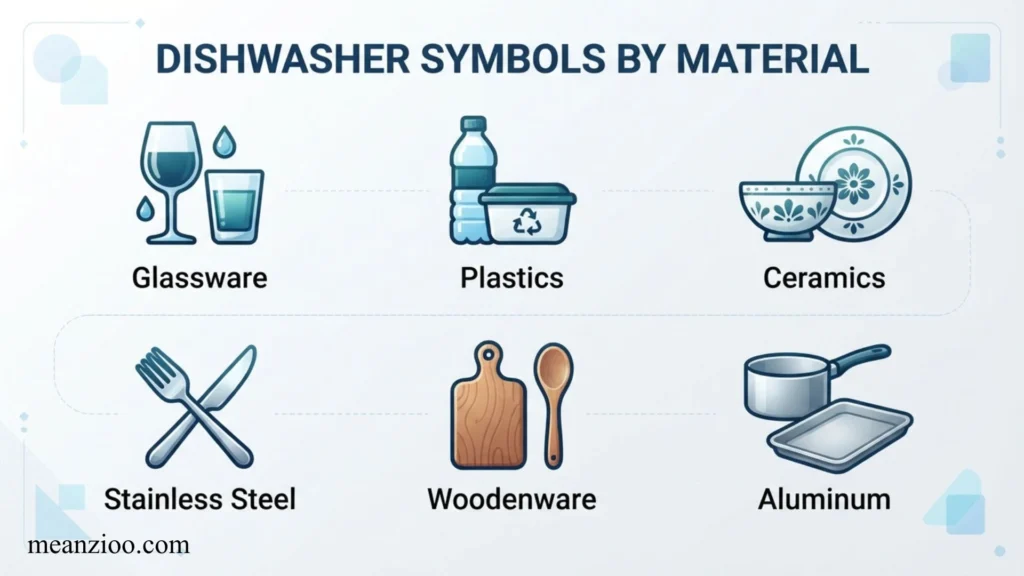
Understanding the symbol is only part of the equation. The material also matters.
Plastic
Check for a dishwasher-safe marking and any top-rack-only instruction.
Some plastics can deform or deteriorate under high heat, so do not assume every plastic container is dishwasher-safe.
Glass
Many everyday glasses are dishwasher-safe, but delicate crystal or specialty glassware may require a gentler program.
Use the manufacturer’s instructions and the appropriate glassware cycle when available.
Stainless Steel
Many stainless-steel utensils and cookware products are dishwasher-safe, but special coatings, finishes, handles, or attached components can change the care requirements.
Wood
Wooden cutting boards, utensils, and other wooden products often require special care.
Do not put them in the dishwasher simply because another item made from a similar material is dishwasher-safe.
Nonstick Cookware
Check the manufacturer’s instructions before putting nonstick pans in the dishwasher.
Even when an item is technically dishwasher-safe, repeated exposure to detergent, heat, and water can affect its finish over time.
What to Do When a Dishwasher Symbol Is Flashing
A flashing symbol does not always mean the same thing on every dishwasher.
Use this general approach:
If the Salt Symbol Is Flashing
Check the dishwasher salt reservoir and refill it if necessary.
If the Rinse-Aid Symbol Is Flashing
Check the rinse-aid dispenser and refill it according to the manufacturer’s instructions.
If the Tap Symbol Is Flashing
Check:
- Water supply
- Tap position
- Inlet hose
- Accessible filters
- Connections
If the problem continues, consult the manual or contact an authorized service provider.
If the Lock Symbol Is Showing
The child lock may be active.
Look in the manual for the correct procedure to disable it.
If You See an Unknown Warning
Do not assume what it means from the appearance alone.
Take note of:
- The exact symbol
- Whether it is steady or flashing
- Any error code on the display
- What the dishwasher is doing
- Your dishwasher’s brand and model
Then check the manufacturer’s documentation.
Why Dishwasher Symbols Are Different Between Brands
There is no guarantee that the same-looking symbol means exactly the same thing on every dishwasher.
For example, Bosch provides symbols for functions such as Eco, Auto, Intensive, Machine Care, Hygiene+, IntensiveZone, Extra Dry, and Half Load. AEG also has its own collection of program and status indicators.
Older models can also use different versions of symbols from newer models.
Bosch Dishwasher Symbols
Bosch commonly provides symbols for:
- Eco
- Auto
- Express
- Glass
- Intensive
- Machine Care
- Hygiene+
- IntensiveZone
- Extra Dry
- Half Load
- Timer
- Rinse aid
- Salt
- Tap/water supply
- Washing
- Rinsing
- Drying
- Child lock
AEG Dishwasher Symbols
AEG notes that its models can have different indicators and programs. Its documented examples include salt, rinse aid, cleaning, rinsing, drying, pre-wash, Eco, and Auto/AutoSense symbols.
For any brand, the exact model manual is the final authority.
How to Identify an Unknown Dishwasher Symbol
If you see a symbol you do not recognize, use these steps.
Step 1: Check Where the Symbol Appears
Is it:
- On the control panel?
- Inside the detergent compartment?
- On the display?
- On the bottom of a plate?
- On a plastic container?
Its location can immediately narrow down its meaning.
Step 2: Check Whether It Is Lit or Printed
A permanently printed icon may identify a button or compartment.
A light that appears during operation may be a status or warning indicator.
Step 3: Look for Nearby Numbers
A temperature such as 40°C, 50°C, 60°C, or 70°C can help identify a wash program.
Step 4: Check the Manual
Search for the exact dishwasher model rather than simply searching for the brand.
This matters because the same brand can use different symbols across different models.
Step 5: Check Whether the Symbol Is Flashing
A flashing indicator may represent a warning or a current phase rather than a selectable program.
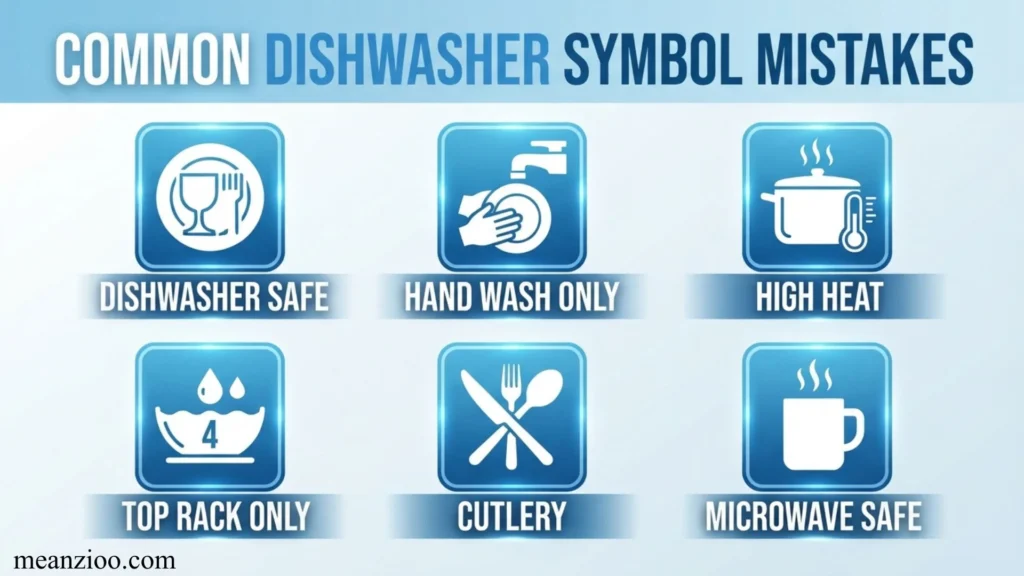
Common Dishwasher Symbol Mistakes
Mistaking the Salt Symbol for a Warning of a Broken Dishwasher
The salt indicator normally means the salt reservoir needs attention. It does not automatically mean the dishwasher is broken.
Assuming a Star Means “Favorite”
A star or sparkle can have different meanings depending on the location and model. On many dishwashers it is associated with rinse aid, while some smart dishwasher systems may use a star for a favorite function.
Always consider the context.
Confusing Food Safe With Dishwasher Safe
The fork-and-glass symbol means food contact suitability, not necessarily dishwasher compatibility.
Assuming Every Plastic Container Is Dishwasher-Safe
Plastic should be checked individually. Look for the manufacturer’s dishwasher-care instructions and any top-rack-only warning.
Assuming Dishwasher-Safe Means Indestructible
“Dishwasher safe” does not necessarily mean an item will remain unchanged forever. Bosch notes that dishwasher-safe labeling does not rule out long-term effects such as discoloration.
Dishwasher Symbols vs. Dishwasher-Safe Symbols
Although the terms sound similar, they refer to different things.
| Feature | Dishwasher Symbols | Dishwasher-Safe Symbols |
| Found on | Dishwasher | Plates, cookware, containers |
| Main purpose | Explain machine functions | Explain item-care instructions |
| Examples | Eco, Auto, Intensive | Dishwasher-safe, top rack |
| Can indicate a warning? | Yes | Usually no |
| Manufacturer differences | Common | Common |
| Best reference | Dishwasher manual | Product manufacturer’s instructions |
Frequently Asked Questions About Dishwasher Symbols
What is the symbol for dishwasher safe?
There is no single universal dishwasher-safe symbol. Common designs show plates or glasses with water drops or spray.
What does the star symbol mean on a dishwasher?
A star, sparkle, or sun-like icon commonly indicates rinse aid when it appears as a refill indicator. However, the exact meaning depends on the dishwasher model and where the symbol appears.
What does the S symbol mean on a dishwasher?
An S-shaped symbol commonly indicates dishwasher salt. If it lights up, the salt reservoir may need to be refilled.
What does the tap symbol mean on a dishwasher?
The tap or faucet symbol generally means the dishwasher is having a water-supply or water-inlet problem. Check the water connection, hose, and manual.
What does the Eco symbol mean?
The Eco symbol normally represents an energy- and water-efficient wash program. It can take longer than faster programs.
What does the pot symbol mean on a dishwasher?
A pot or pan icon generally represents an intensive or heavy-duty wash cycle for heavily soiled cookware.
What does the glass symbol mean on a dishwasher?
A glass icon commonly represents a delicate or glassware program intended for suitable dishwasher-safe glassware.
What does the clock symbol mean on a dishwasher?
A clock or stopwatch can represent a quick cycle, timed program, or delay-start function, depending on the dishwasher.
What does the lock symbol mean?
A lock or key symbol usually means the child lock or control lock is active.
Is the fork and glass symbol dishwasher-safe?
No. The fork-and-glass symbol is a food-contact symbol. It does not by itself mean that an item is dishwasher-safe.
Are dishwasher symbols universal?
No. Some symbols are widely recognized, but manufacturers and models can use different icons and programs. AEG specifically advises checking the user manual because indicators and programs vary by model.
Where can I find the dishwasher salt symbol?
It is commonly displayed on the dishwasher’s control panel as an S-shaped icon or two curved arrows forming an S.
Where is the rinse-aid symbol?
The rinse-aid symbol is often found on the dispenser and may also appear as an illuminated indicator on the control panel. A star, sparkle, or sun-like icon is common.
What should I do if I cannot identify a symbol?
Check the dishwasher’s model number and consult the manufacturer’s manual. Do not rely solely on the appearance of an unfamiliar warning symbol because icons can differ between models.
Final Thoughts
Understanding dishwasher symbols makes everyday dishwasher use much easier. The most important icons to recognize include Eco, Auto, Intensive, Glass, Quick, Pre-Rinse, Half Load, Extra Dry, rinse aid, dishwasher salt, tap, child lock, washing, rinsing, and drying.
You should also know the difference between symbols on the dishwasher and symbols printed on tableware. A dishwasher control-panel icon tells you what the appliance is doing or which function you have selected, while a dishwasher-safe symbol on a plate or container provides information about how that item should be cleaned.
Most importantly, remember that there is no single universal dishwasher-safe symbol, and dishwasher programs can vary between brands and models. When an unfamiliar symbol appears—especially a warning or flashing indicator—the manufacturer’s manual for your exact model is the most reliable source.
Also Check This Post: Health Symbols: Meanings, Names, and What They Represent

I’m Ryan Mitchell, and I write about modern English, trending slang, and online expressions. I enjoy explaining the meanings, origins, and real-life usage of popular words in a simple way. I believe learning slang is an important step toward understanding today’s English-speaking culture. Through my work, I aim to help readers speak more naturally and stay updated with the latest language trends.
 Charlotte Hayes