When you think of ancient Greek mythology, you might picture Zeus throwing thunderbolts, Athena carrying her shield, or Aphrodite emerging from the sea. Yet one of the most important Greek goddesses represented something much quieter: the warmth of the hearth and the sacred fire that brought people together.
Hestia, the Greek goddess of the hearth, home, and sacred fire, held a special place in ancient Greek religious life. Her symbolism centered on the household flame, the spiritual significance of the home, and the shared hearths that served ancient communities. Unlike many other Greek deities, Hestia rarely appeared in dramatic myths or conflicts. Her importance came from the everyday rituals and sacred traditions that helped households and communities maintain continuity.
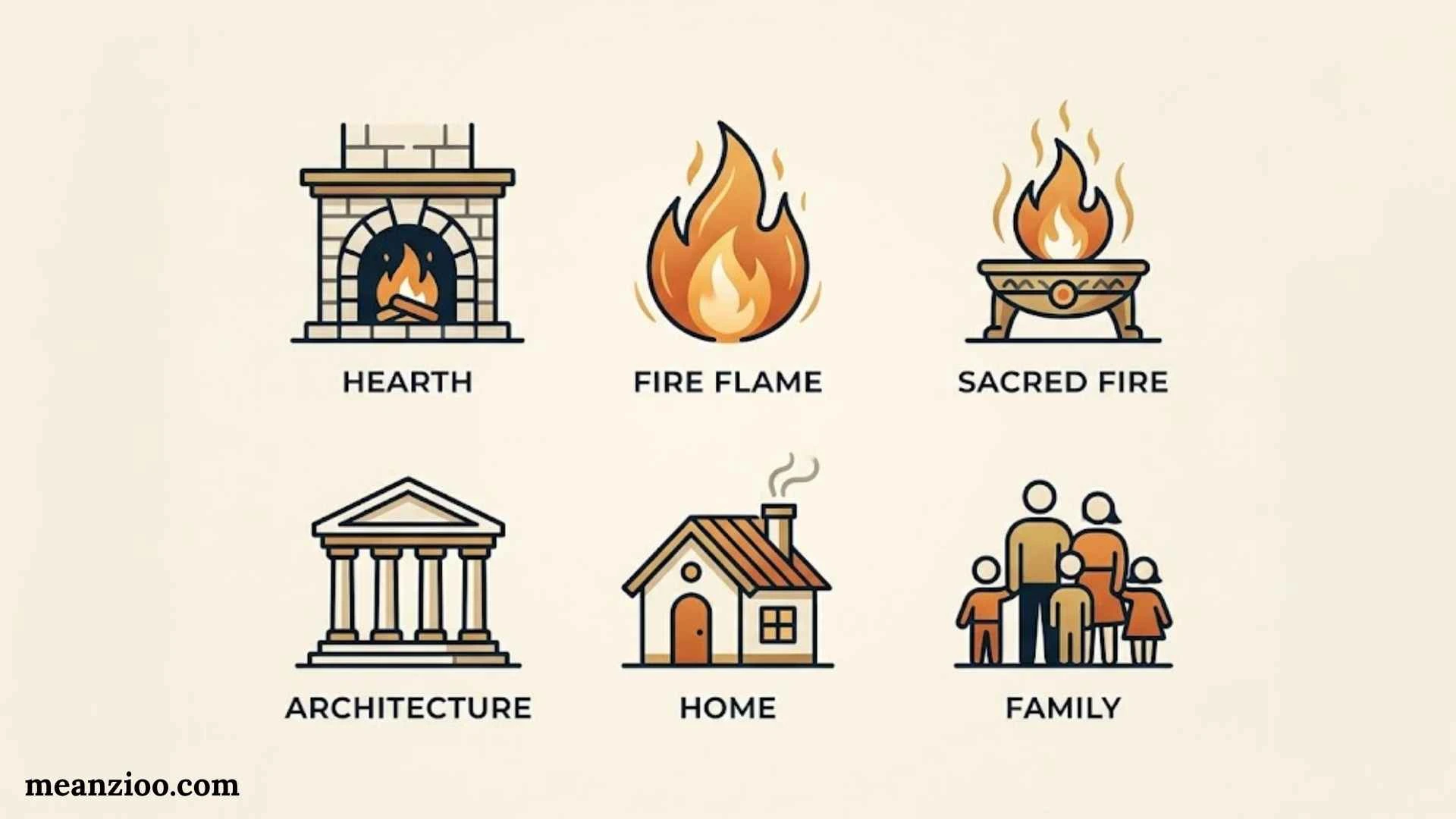
The main Hestia symbols are the hearth and sacred fire. These symbols connect her with household life, religious devotion, hospitality, and the communal bonds that shaped ancient Greek society. Modern spiritual writers also interpret Hestia as a symbol of inner peace, self-awareness, simplicity, and emotional grounding.
However, it’s important to separate historical mythology from modern spiritual interpretations. Ancient Greek sources establish Hestia’s connection to the hearth and sacred fire. Ideas about the Hestia feminine archetype, personal boundaries, and inner awakening represent later ways of interpreting her mythology.
This guide explores Hestia’s symbols, their historical meanings, her role in Greek religion, and the ways her symbolism continues to inspire people today.
What Are the Main Symbols of Hestia?
The hearth is Hestia’s clearest symbol, while sacred fire expresses her close connection to household and communal religious life. Ancient Greek traditions also associated her with ritual offerings and public hearths.
Some modern articles list circles, candles, flowers, or particular animals as Hestia’s symbols. These associations need more careful treatment because not every item has the same historical support. The strongest starting point is the hearth itself.
| Hestia symbol or association | Historical meaning | Common modern interpretation |
| Hearth | The center of household life and religious activity | Home, belonging, stability |
| Sacred fire | Fire associated with domestic and civic worship | Continuity, devotion, inner strength |
| Communal hearth | A shared religious and civic center | Community, shared identity |
| Ritual offerings | Acts of worship connected with the hearth and sacrifices | Gratitude and reverence |
| Kettle | An object associated with Hestia in some mythological reference traditions | Domestic care and nourishment |
| Veil or head covering | Clothing sometimes shown in artistic representations of Hestia | Modesty, privacy, dignity |
The final column describes modern symbolic readings, not a list of meanings formally defined by ancient Greek worshippers.
The Hearth: Hestia’s Primary Symbol
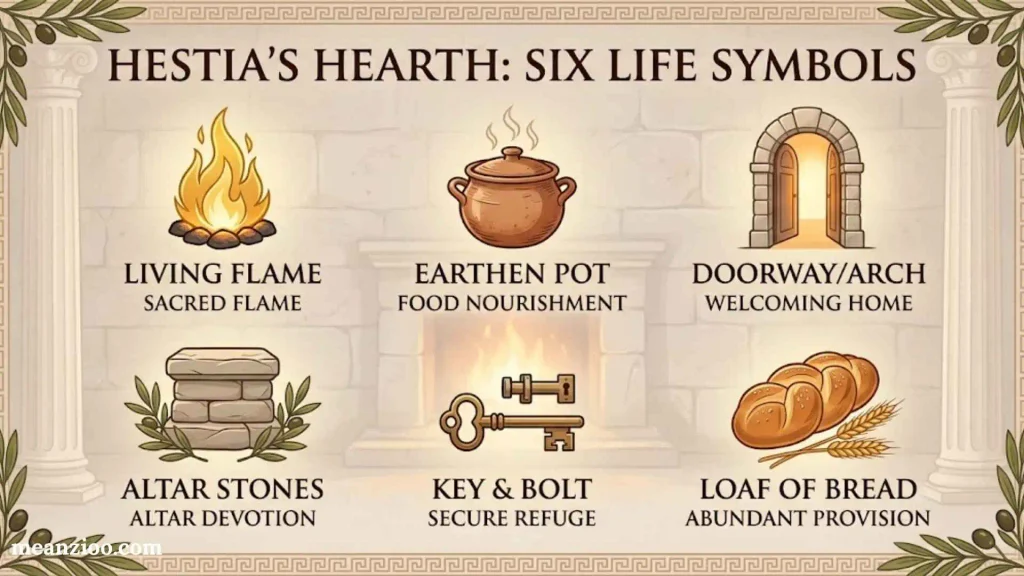
Historical association: household life and sacred worship
The hearth was much more than a place to cook food. In ancient Greek homes, it provided warmth, supported daily meals, and served as a focal point for household religious practices.
Hestia’s name was closely connected to the Greek word for the hearth. This relationship made the goddess unusual because her identity was closely tied to a physical feature of everyday life. The hearth could represent both a practical household fixture and a sacred center.
The importance of this symbol becomes clearer when you consider how ancient Greek families organized their lives. Meals, hospitality, household rituals, and important family events could all connect with the hearth. It helped give the home a recognizable center.
What the hearth symbolizes today:
- Home: A place where people live, gather, and share daily life.
- Belonging: The bonds that connect members of a household.
- Stability: A dependable center amid changing circumstances.
- Hospitality: The willingness to welcome and care for guests.
- Continuity: Traditions that connect one generation with another.
These modern meanings grow naturally from the hearth’s historical role, although their precise wording reflects contemporary interpretation.
Sacred Fire: The Flame of Hestia
Historical association: domestic and civic religious fire
The sacred flame is closely linked to Hestia because fire stood at the center of her religious domain. Households used fire for essential daily tasks, while public hearths carried broader religious and civic importance.
In some ancient Greek communities, a central public fire was maintained as a symbol of the community’s continuing life. Certain civic traditions also connected the fire of an established city with the founding of a new settlement. Colonists could carry fire from their original community to kindle a new hearth.
This practice gives the flame a concrete historical meaning. It was not simply an abstract image of hope or inspiration. It could help express continuity between a community’s past and its future.
Modern spiritual interpretations often extend this meaning to personal life. A steady flame may remind someone to remain focused, preserve important values, or maintain a sense of inner direction.
Common modern interpretations of Hestia’s flame include:
- Continuity: Keeping important traditions alive.
- Devotion: Giving consistent attention to meaningful responsibilities.
- Inner strength: Maintaining personal values through difficult periods.
- Awareness: Paying attention to everyday experiences.
- Renewal: Beginning again while carrying forward what matters.
These are useful contemporary interpretations, but they should not be confused with a single, universal ancient Greek doctrine.
The Communal Hearth: A Symbol of Shared Life
The communal hearth extended Hestia’s significance beyond individual households. Ancient Greek communities maintained public spaces where civic and religious activities took place, and some of these spaces included a central hearth associated with Hestia.
This association shows that Hestia was not merely a goddess of private domestic duties. Her religious significance could also extend to public hospitality, civic identity, and the continuity of the community.
A public hearth offered a shared focal point. It connected people through common traditions rather than individual ownership.
In modern symbolic language, the communal hearth can represent:
- Cooperation and shared responsibility.
- A sense of belonging within a community.
- Hospitality toward visitors and strangers.
- Traditions that preserve collective identity.
- The relationship between private homes and public life.
The Circular Hearth or Round Temple
You may encounter claims that the circle is one of Hestia’s main symbols. This association usually draws on the shape of certain ancient hearths or buildings rather than a universally recognized personal emblem.
Round hearths existed in ancient Greek architectural settings. The Oxford Classical Dictionary describes a central round hearth in the Mycenaean palace’s great hall, illustrating the hearth’s importance as an architectural center.
However, that evidence does not establish the circle as an independent, universally recognized symbol of Hestia.
In modern symbolic interpretation, a circle may suggest wholeness, unity, or a stable center. You can use that interpretation when discussing contemporary spirituality, provided you identify it as an interpretation rather than a proven ancient belief.
Ritual Offerings and the Hearth
Offerings provide another important part of Hestia’s symbolism. Ancient Greek households could make small offerings at the hearth during ordinary religious observances. Hestia also had a recognized place in sacrificial traditions.
Her association with the beginning of religious acts was especially significant. Some traditions gave Hestia the first portion of a sacrifice or the first libation, while others also honored her at the conclusion.
These practices reflected the hearth’s central role in religious life.
For a modern reader, offerings may suggest gratitude, care, and reverence. Historically, however, they were acts of religious observance rather than simply exercises in positive thinking.
What Does Hestia Represent in Greek Mythology?
Hestia represents the hearth and the sacred fire that supported household and civic life. Her mythology emphasizes an enduring presence rather than dramatic adventures or frequent conflicts.
While Zeus is associated with sovereignty and thunder, Athena with wisdom and strategic warfare, and Poseidon with the sea, Hestia’s domain is quieter. She occupies the center of the home and, through civic hearths, the center of community life.
Who Is Hestia, the Greek Goddess?
Hestia is one of the principal deities of ancient Greek mythology. She is traditionally known as the Greek goddess of the hearth, home, and sacred fire.
Her importance came from the everyday activities that depended on the hearth. Fire made cooking and warmth possible, while the household hearth also had religious significance.
Hestia’s role extended into public life. In communities with civic hearths, her presence connected religious traditions with the identity and continuity of the city.
Unlike many Greek gods and goddesses, Hestia appears in relatively few dramatic myths. Her limited involvement in legendary conflicts does not mean she was unimportant. Her place in everyday religious practice gave her a distinctive role.
Hestia’s Parents and Family
According to Greek mythological tradition, Hestia was the daughter of Cronus and Rhea, two Titans.
Her siblings were:
- Zeus: King of the Olympian gods.
- Poseidon: God associated with the sea and earthquakes.
- Hades: Ruler of the underworld.
- Hera: Goddess associated with marriage and queenship.
- Demeter: Goddess associated with agriculture and grain.
Hestia belonged to the generation that followed the Titans. In the familiar myth, Cronus swallowed his children because he feared that one would overthrow him. Zeus escaped this fate and eventually forced Cronus to release his swallowed siblings.
This family background places Hestia within the central group of Greek deities, even though her stories often focus on domestic and religious life.
Why Is Hestia Called the Goddess of the Hearth?
The hearth was essential to household survival and religious practice. It supplied heat, supported cooking, and offered a focal point for family activities.
Hestia became closely associated with this central place. Her domain connected practical household needs with sacred observance, making her an important presence in ordinary life.
The hearth also had a social meaning. A household could welcome guests, provide refuge, and share meals around its central space. These activities help explain Hestia’s association with hospitality and the protection of the home.
Is Hestia One of the Twelve Olympians?
Yes, Hestia is traditionally counted among the Twelve Olympians, although lists of the twelve are not identical across every source or artistic tradition.
In some accounts and representations, Dionysus occupies the place otherwise assigned to Hestia. The scholarly discussion of Hestia’s position among the Olympians reflects these variations.
The variation matters because Greek mythology developed through different literary, artistic, and local religious traditions. It is more accurate to acknowledge those differences than to insist that every ancient source presents one fixed list.
Hestia Hearth Symbolism and Its Deeper Meaning
Hestia’s hearth symbolism connects the physical center of the home with household relationships and religious observance. Understanding this connection helps explain why the hearth mattered beyond its practical use.
The Hearth as the Center of the Home
In many ancient Greek domestic settings, the hearth served as an important center for household activity. Fire supported cooking and warmth, while the surrounding space could also accommodate everyday rituals.
The hearth helped organize ordinary life. People prepared food, gathered for meals, and performed religious acts within the household environment.
Its central position also offered a powerful image of continuity. The home remained a recognizable place even as its occupants grew older, welcomed visitors, or passed traditions to younger generations.
Today, people often associate the home with security and familiarity. These ideas provide a natural bridge to Hestia’s symbolism, even though modern ideas about home differ from ancient Greek household structures.
The Hearth as a Sacred Space
The sacred hearth demonstrates how ancient Greek religion could exist within everyday surroundings. Religious observance did not always require a monumental temple or a distant sanctuary.
Households could honor deities through small offerings and regular practices. The hearth’s connection to Hestia brought religious significance into the setting where people prepared meals and maintained their homes.
This does not mean every household performed identical rites. Ancient religious practices varied by region, period, and family tradition.
The broader lesson is that domestic and religious life often overlapped in ancient Greece. The hearth could be both useful and sacred.
The Hearth as a Symbol of Belonging
A hearth gave the household a shared focal point. Family members depended on the same space for warmth, food preparation, and many daily activities.
That shared use helps explain the hearth’s connection with belonging. Its meaning extended beyond the structure itself to the people whose lives gathered around it.
The public hearth expanded this association to the community. In that context, the fire could stand for a collective identity rather than one family’s private life.
In contemporary interpretations, the hearth can remind us that belonging often develops through small, repeated acts of care. Sharing meals, welcoming guests, and maintaining family traditions can build connections over time.
Hestia Sacred Flame Meaning and Spiritual Symbolism
The Hestia sacred flame meaning has two distinct layers. Historically, fire belonged to her religious domain and played a role in household and civic worship. In modern spirituality, the flame often serves as a metaphor for personal values, reflection, and emotional steadiness.
Keeping these layers separate makes the symbolism more meaningful. You can appreciate the ancient goddess without assuming that every modern spiritual interpretation comes directly from Greek religion.
Sacred Fire in Ancient Greek Religion
Fire was essential to everyday life in ancient Greece. It provided warmth, helped prepare meals, and served as a medium for certain religious offerings.
Hestia’s association with fire connected these practical activities with religious observance. The household hearth could become a place where ordinary life and devotion met.
Public hearths carried additional significance. Some ancient Greek communities maintained communal fires in civic buildings, linking the hearth with the life of the city. The prytaneion, in particular, could house a civic hearth associated with Hestia.
This historical background explains why Hestia’s flame is more than a decorative symbol. It reflects the relationship between domestic routines, religious practices, and communal identity.
The Flame as a Symbol of Continuity
A fire must receive attention if it is to keep burning. In modern interpretations, this simple fact makes the flame a useful image of continuity and commitment.
Ancient Greek civic traditions sometimes reinforced this connection. When a colony was established, its founders could carry fire from the parent city’s hearth to kindle a new one. The practice linked the new settlement with its place of origin.
The historical practice offers a clear example of how fire could communicate continuity between communities.
In personal reflection, the same image might represent:
- Family traditions that connect generations.
- Personal values that remain important during change.
- Daily responsibilities that require steady attention.
- Community ties that preserve shared identity.
- Long-term commitments that develop through repeated effort.
These interpretations draw on the flame’s practical qualities without claiming that ancient Greeks assigned every meaning to Hestia.
The Flame as a Symbol of Devotion
Hestia’s connection to ritual offerings makes devotion an important theme in discussions of her mythology. Religious practices at the hearth brought sacred observance into everyday life.
For modern readers, this connection can suggest that devotion does not always require dramatic gestures. Sometimes it involves caring for a responsibility consistently or giving thoughtful attention to something meaningful.
This interpretation works especially well when discussing Hestia because her mythology emphasizes the hearth rather than conquest or competition.
A useful modern lesson: Meaningful commitments often depend on ordinary actions repeated over time.
That lesson is a contemporary reflection inspired by Hestia’s symbolism, not a direct quotation from an ancient Greek religious text.
What Does Hestia’s Sacred Flame Mean Spiritually?
In modern spiritual writing, the Hestia spiritual meaning often includes inner peace, grounding, devotion, and self-awareness.
The image of a steady flame can encourage reflection on what gives your life direction. It may also prompt you to consider whether your daily routines support your priorities.
For example, someone who feels overwhelmed by constant demands might use the flame as a reminder to slow down and focus on essential responsibilities. Another person might interpret it as a symbol of maintaining personal values during a difficult transition.
Common contemporary interpretations include:
- Inner peace: Making space for reflection rather than reacting to every demand.
- Emotional grounding: Returning attention to practical needs and personal priorities.
- Spiritual devotion: Giving consistent attention to beliefs or practices that matter to you.
- Self-awareness: Recognizing your needs, values, and habits.
- Personal renewal: Revisiting your priorities when circumstances change.
These meanings belong to modern spiritual interpretation. Ancient Greek religion did not provide one standardized psychological definition of Hestia’s flame.
Hestia’s Civic Symbolism and the Public Hearth
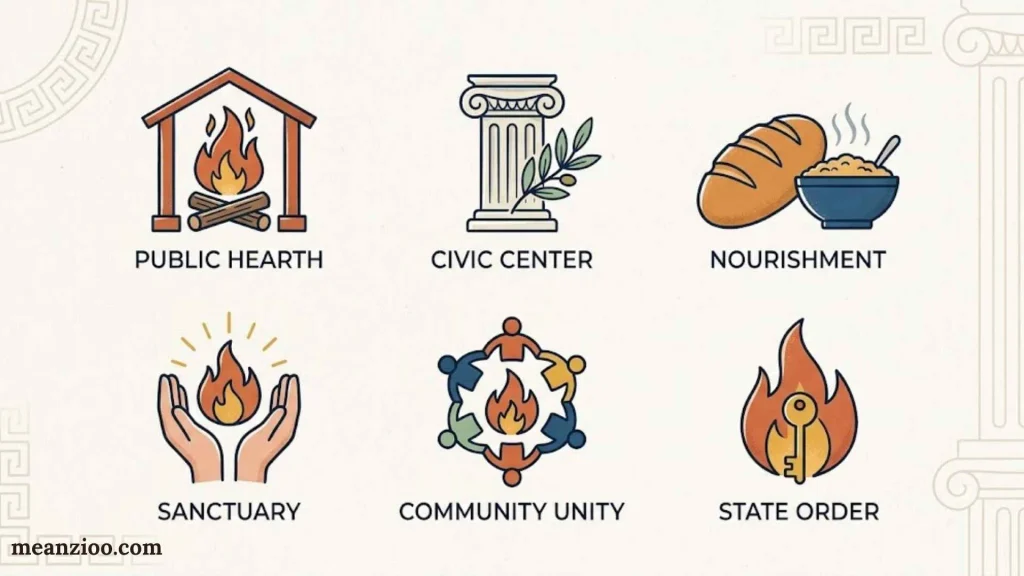
One of the most overlooked aspects of Hestia’s mythology is her connection with public life. Her symbolism extended beyond the home into the civic spaces where communities organized religious and political activities.
Hestia and the Prytaneion
The prytaneion was a civic building associated with public administration and communal life in ancient Greek cities. In some cities, it housed the community’s central hearth.
This hearth had religious and civic importance. It could represent the shared identity of the city and provide a focal point for public observances.
The Oxford Classical Dictionary explains that public state hearths succeeded earlier royal hearths as centers of civic activity. It also describes the practice of carrying fire from an established community to a newly founded colony.
These details reveal a broader side of Hestia’s symbolism. Her importance was not limited to private households. She could also represent the shared center of a community.
The Public Flame and Community Identity
A communal hearth offered a visible connection between religious tradition and civic life. Its fire represented more than a practical source of heat.
In some ancient Greek traditions, maintaining the public fire helped express the continuity of the community. The hearth could also have a role in hospitality and the reception of visitors.
The precise customs differed across cities. Therefore, it’s best to avoid claiming that every Greek settlement maintained its fire in exactly the same way.
For modern readers, the public hearth provides a useful example of shared identity. A community can develop a sense of continuity through common spaces, recurring traditions, and collective responsibilities.
Hestia’s Role in Religious Offerings
Hestia’s connection to the hearth also shaped her place in sacrificial traditions. Ancient sources associate her with offerings made at the beginning of religious observances and with libations connected to sacrificial meals.
A libation involved pouring a liquid offering as part of a religious act. Wine was used in many ancient Greek libation practices, although the specific circumstances and offerings varied.
Hestia’s role in these traditions reflected the hearth’s importance within religious life.
This association also helps explain why her symbolism emphasizes continuity and centrality. The hearth was not an incidental detail in worship. It could occupy a central place in the ritual structure itself.
Hestia’s Spiritual Meaning and Symbolism Today
The Hestia goddess spiritual meaning has expanded in contemporary spiritual writing. Readers often connect her with calmness, home life, self-reflection, and the value of creating a peaceful environment.
These interpretations can provide useful prompts for personal reflection. However, they should remain distinct from historically documented Greek religious practices.
Hestia as a Symbol of Inner Peace
Hestia’s mythology offers a different image of divine importance from stories centered on conflict or ambition. Her connection to the hearth places her at the center of ordinary life.
Modern writers often interpret this image as a reminder that peace does not require constant excitement or recognition. It can develop through meaningful routines, quiet attention, and a clear sense of priorities.
Consider a person who spends every day rushing between work, family responsibilities, and digital distractions. Creating a few moments of quiet may help that person reflect on what deserves attention.
The practice itself is modern. The connection to Hestia comes from the symbolic association between the hearth and a stable center.
Hestia and Emotional Stability
The image of a maintained hearth can represent steadiness in contemporary interpretations. A stable center offers a useful metaphor for responding thoughtfully when circumstances become difficult.
However, emotional stability is a modern psychological concept, not an official ancient Greek attribute or a guaranteed effect of engaging with Hestia’s symbolism.
You might use her imagery as a reminder to:
- Pause before responding during a stressful moment.
- Maintain routines that support your well-being.
- Identify the responsibilities that genuinely matter.
- Recognize when you need rest or assistance.
- Accept that stability does not mean avoiding every difficult emotion.
The central idea is balance, not emotional suppression. A peaceful life can include disagreement, grief, uncertainty, and change.
Hestia and Personal Boundaries
Modern interpretations sometimes connect Hestia with personal boundaries because the hearth represents a defined household space.
A home can offer privacy, rest, and a place to recover from external demands. In that sense, Hestia’s symbolism can prompt reflection on how you protect your time and energy.
Healthy boundaries might involve limiting unnecessary commitments, making room for rest, or communicating your needs clearly.
However, boundaries should not become an excuse for avoiding every difficult interaction. Maintaining privacy and building close relationships are compatible goals.
This distinction becomes especially important when people use the Hestia archetype to describe their personalities. A preference for solitude does not automatically mean someone fears intimacy or struggles with relationships.
Hestia and Inner Wholeness
The concept of inner wholeness appears frequently in modern discussions of Hestia. Writers use her central position at the hearth as a metaphor for finding a sense of direction within yourself.
This interpretation may encourage you to examine your values rather than relying entirely on outside approval. It can also support a more thoughtful relationship with your routines, home, and responsibilities.
Inner wholeness does not mean that you never need other people. Human connection remains important, and self-understanding often grows through relationships.
A balanced interpretation of Hestia emphasizes self-connection without treating independence as complete isolation.
What Is the Hestia Feminine Archetype?
The Hestia feminine archetype is a modern interpretive framework inspired by the Greek goddess’s association with the hearth, inward focus, and devotion.
An archetype is a recurring pattern or image used to understand human experiences. In modern spiritual and psychological writing, Greek goddesses sometimes serve as symbolic frameworks for discussing personality, motivation, and identity.
The Hestia archetype is not an official category from ancient Greek religion. Nor is it a scientifically validated personality type.
Understanding the Hestia Archetype
Modern writers often describe the Hestia archetype through themes of inward attention, simplicity, and a preference for meaningful activities over constant recognition.
The image of the hearth provides the central metaphor. Just as the hearth anchors the home, the archetype represents someone who finds meaning through personal reflection, steady routines, or quiet devotion.
This framework may resonate with people who prefer smaller gatherings, enjoy time alone, or value a peaceful home environment.
Still, no single description fits everyone. People can share some of these traits without identifying with Hestia, and an interest in the goddess does not establish a particular personality.
Common Hestia Archetype Personality Traits
The Hestia archetype personality traits commonly described in contemporary interpretations include:
- Calmness: A preference for measured responses rather than unnecessary conflict.
- Introversion: Enjoying solitude or smaller social settings.
- Self-sufficiency: Feeling comfortable managing many tasks independently.
- Reflection: Taking time to consider experiences and decisions.
- Devotion: Giving consistent attention to meaningful responsibilities.
- Simplicity: Preferring a manageable lifestyle over unnecessary complexity.
- Independence: Maintaining personal interests and values.
- Quiet strength: Acting consistently without seeking constant recognition.
These are illustrative traits from modern archetype interpretations. They are not a standardized checklist or a reliable way to assess someone’s personality.
Signs You May Relate to the Hestia Archetype
You may relate to the modern Hestia archetype if several of the following descriptions feel familiar:
- You appreciate quiet time after a busy day.
- You find satisfaction in creating a welcoming home.
- You prefer meaningful conversations to constant social activity.
- You value consistency and practical care.
- You enjoy reflection, reading, or other quiet pursuits.
- You can work independently without needing frequent recognition.
- You value personal space while maintaining important relationships.
You do not need to identify with every trait. Archetypes work best as tools for reflection rather than rigid labels.
Hestia Archetype vs. Ancient Greek Hestia
The distinction between mythology and modern archetype writing is essential.
| Topic | Ancient Greek Hestia | Modern Hestia archetype |
| Main focus | Hearth, sacred fire, household and civic worship | Inward focus, simplicity, and reflection |
| Evidence | Ancient literary, religious, and artistic traditions | Modern interpretive writing |
| Virginity | A feature of traditional mythological accounts | Sometimes interpreted as independence or self-possession |
| Home | A setting for domestic and religious life | A symbol of personal sanctuary |
| Solitude | Not a complete ancient personality classification | Often emphasized as a modern archetypal trait |
| Psychological role | A deity within Greek religion | A framework for personal reflection |
The modern framework can be meaningful without being historically identical to the goddess who inspired it.
Hestia Energy and Its Modern Interpretation
The phrase Hestia energy appears in contemporary spiritual discussions about calmness, inward focus, and intentional living. It describes an interpretation of Hestia’s symbolism rather than a measurable energy or a formal concept from ancient Greek religion.
For people who find the goddess meaningful, her imagery offers a way to think about everyday life. Instead of focusing on dramatic transformation, Hestia-inspired reflection often emphasizes small, consistent actions.
What Does Hestia Energy Mean?
In modern spiritual language, Hestia energy commonly refers to a quiet, grounded approach to life. Its central image is the hearth: a place that remains important through ordinary routines and changing circumstances.
People may use this idea to explore:
- Inner peace: Making room for quiet reflection.
- Self-sufficiency: Developing confidence in your ability to handle everyday responsibilities.
- Spiritual devotion: Maintaining practices that reflect your personal beliefs.
- Intentional living: Choosing routines and commitments with care.
- Personal grounding: Returning your attention to practical needs and priorities.
These ideas can help organize personal reflection. They should not be presented as supernatural effects or scientifically established personality traits.
How to Embody Hestia Energy in Daily Life
You don’t need elaborate ceremonies to explore the modern meaning of Hestia’s symbolism. Simple habits can reflect the same themes of care, continuity, and attention.
Create a peaceful environment. Keep the spaces you use most often comfortable and functional. You might organize your reading area, clear a kitchen counter, or create a quiet corner for reflection.
Build consistent routines. Choose a few manageable habits that support your priorities. A regular meal, a short walk, or an evening reading session can offer structure without overwhelming your schedule.
Practice mindful attention. Give ordinary activities your full attention when possible. Preparing a meal or caring for your home can become an opportunity to slow down.
Protect time for yourself. Set reasonable limits on unnecessary commitments. Use some of that time for rest, hobbies, or personal reflection.
Stay connected to others. Hestia’s domestic symbolism also connects with hospitality and communal life. A balanced interpretation includes caring relationships rather than treating independence as the only virtue.
Hestia Sacred Home Rituals
Some contemporary practitioners use simple activities to express their connection with Hestia. These Hestia sacred home rituals are modern adaptations unless a particular practice has historical evidence.
Here are a few optional examples:
- Candle lighting: Light a candle briefly as a personal reminder to pause and reflect. Never leave an open flame unattended.
- Gratitude journaling: Write down a few things you appreciate about your home, relationships, or daily life.
- Mindful housekeeping: Approach one small household task with care rather than rushing through everything.
- Quiet reflection: Spend a few minutes considering what deserves your attention.
- Shared meals: Use a meal as an opportunity to welcome others and strengthen relationships.
These practices don’t guarantee spiritual benefits. Their value depends on the meaning you give them and whether they support your daily life.
It’s also important to distinguish these contemporary activities from documented ancient Greek worship. Candle rituals, modern journaling, and goddess tarot should not automatically be described as traditional Hestia ceremonies.
The Shadow Side of the Hestia Archetype
Every archetype can become limiting when someone interprets its qualities too rigidly. The modern Hestia archetype emphasizes solitude, independence, and inward focus, but those qualities can become unbalanced.
The goal isn’t to treat introversion as a problem. Instead, consider whether your habits support your well-being or prevent you from meeting important needs.
When Solitude Becomes Isolation
Solitude can provide space to rest, reflect, and enjoy personal interests. However, isolation may leave someone feeling disconnected or unsupported.
The difference often depends on choice and outcome. Enjoying an evening alone can be restorative. Avoiding every invitation because social interaction feels uncomfortable may create a different pattern.
If you relate to the Hestia archetype, consider asking yourself:
- Do I choose solitude because I enjoy it?
- Do I still maintain relationships that matter to me?
- Can I ask others for support when I need it?
- Does my time alone leave me refreshed or increasingly disconnected?
These questions encourage self-awareness without assuming that a quiet personality needs fixing.
Excessive Self-Sufficiency
Independence can be valuable, especially when it helps you make decisions and manage responsibilities confidently.
However, excessive self-sufficiency can become restrictive when you feel unable to accept help. You might take on every responsibility yourself or avoid asking for support because you fear appearing dependent.
A balanced approach recognizes that independence and cooperation can exist together.
For example, you can maintain your own routines while allowing a friend to help during a difficult week. Accepting support doesn’t erase your independence.
Emotional Withdrawal and Fear of Vulnerability
Some modern descriptions of the Hestia shadow archetype connect excessive inward focus with emotional withdrawal. This is an interpretive framework, not an established diagnosis associated with the goddess.
Emotional withdrawal can occur when someone avoids difficult conversations, conceals important feelings, or distances themselves whenever a relationship becomes challenging.
Privacy is different from avoidance. You can choose not to discuss every personal detail while still communicating honestly with people you trust.
A useful balance involves recognizing your need for space while remaining willing to address important issues.
Finding Balance Between Solitude and Connection
A healthy interpretation of Hestia’s symbolism doesn’t require choosing between independence and intimacy.
Instead, consider these practical approaches:
- Schedule time alone without abandoning important relationships.
- Communicate your boundaries clearly and respectfully.
- Ask for help when a responsibility becomes overwhelming.
- Make room for conversations that require emotional honesty.
- Notice when a familiar routine supports you and when it limits you.
- Allow trusted people to understand your needs and concerns.
The central lesson is balance. Quiet strength doesn’t require emotional distance, and a peaceful home can coexist with an active social life.
Hestia Compared With Other Greek Goddesses
Hestia becomes easier to understand when you compare her traditional domain with those of other Greek goddesses. These comparisons also help distinguish historical mythology from modern archetype interpretations.
| Goddess | Traditional associations | Main distinction from Hestia |
| Hestia | Hearth, sacred fire, household and civic worship | The hearth as a center of domestic and communal life |
| Athena | Wisdom, crafts, and strategic warfare | Intelligence, skilled action, and strategy |
| Hera | Marriage and queenship | Marriage and divine sovereignty |
| Demeter | Agriculture and grain | Cultivation and harvest |
| Aphrodite | Love and desire | Attraction and erotic love |
| Artemis | Hunting, wilderness, and childbirth in various traditions | Wilderness, hunting, and protection |
| Vesta | Roman goddess associated with the hearth and sacred fire | Roman counterpart to Hestia |
These associations summarize major traditional domains. They don’t capture every aspect of each deity’s worship or mythology.
Hestia vs. Athena
Hestia and Athena represent different domains in Greek mythology. Hestia is associated with the hearth and sacred fire, while Athena is associated with wisdom, crafts, and strategic warfare.
In modern archetype writing, Athena is often used to explore analytical thinking, competence, and purposeful action. Hestia, by contrast, is frequently interpreted through reflection, simplicity, and inward focus.
These personality comparisons are contemporary interpretations rather than formal classifications from ancient Greek religion.
The two goddesses also need not represent opposing ways of life. A person can value quiet reflection while using careful reasoning and practical skills.
Hestia vs. Hera
The distinction between Hestia and Hera centers on their traditional domains.
Hestia represents the hearth and its domestic and civic significance. Hera is strongly associated with marriage and queenship.
Modern archetype writers sometimes contrast Hestia’s inward focus with Hera’s emphasis on partnership and commitment. That comparison can help readers explore different symbolic themes, but it shouldn’t reduce either goddess to a single personality trait.
Their mythological identities are broader than these modern summaries.
Hestia vs. Vesta
Vesta is the Roman counterpart of Hestia. Both goddesses are associated with the hearth and sacred fire.
Their similarities reflect a close connection between Greek and Roman religious traditions. However, Roman worship developed its own institutions and customs.
The Roman cult of Vesta became particularly associated with the sacred fire maintained by the Vestal Virgins. These priestesses held a distinctive place in Roman public religion. Their institution should not be treated as identical to the worship of Hestia in ancient Greece.
The comparison highlights a useful distinction: two related deities can share a religious domain without having identical traditions.
Hestia’s Virginity and Its Mythological Meaning
Hestia’s virginity is an important feature of traditional Greek mythology. In the Homeric Hymn to Aphrodite, she swears an oath to remain a virgin, and Zeus grants her a central place in the household and honor in religious offerings.
Some later summaries also describe Poseidon and Apollo seeking to marry her. These accounts help explain the tradition of Hestia’s unmarried status, although the details vary across sources.
The ancient concept of a virgin goddess shouldn’t be interpreted only through modern assumptions about sexuality. In Greek mythological traditions, divine virginity could express a goddess’s distinctive status and relationship to marriage.
For Hestia, this status accompanies her role as the enduring center of the household rather than a goddess defined by romantic relationships.
Modern archetype writers sometimes interpret her virginity as a symbol of independence, self-possession, or personal integrity. Those ideas may be useful to readers, but they represent contemporary interpretations.
Hestia’s mythology does not establish that every woman should remain unmarried, avoid romantic relationships, or pursue a particular lifestyle.
The more historically grounded point is that Hestia occupies a distinctive place among Greek goddesses. Her identity centers on the hearth and sacred fire rather than marriage or romantic desire.
How to Honor Hestia in a Modern Spiritual Practice
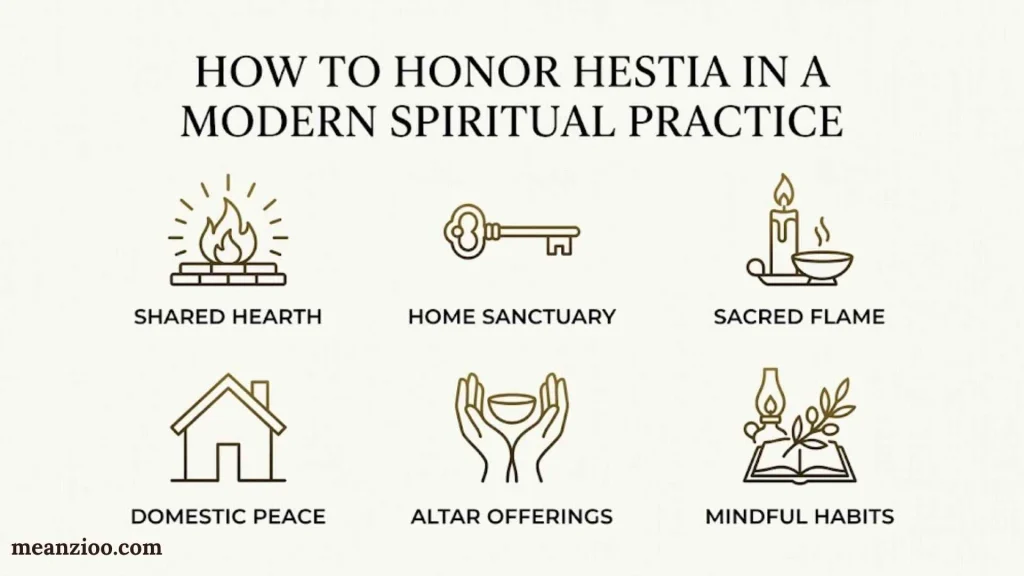
People interested in Hestia goddess symbolism may choose to explore her mythology through reading, reflection, or simple activities inspired by the hearth. These practices are personal choices, not requirements of ancient Greek religion.
If you want to connect with Hestia’s symbolism, start by learning about her historical role. Then decide whether any modern interpretations offer a useful way to reflect on your own life.
Creating a Space Inspired by Hestia
A space inspired by Hestia doesn’t need elaborate decorations or expensive spiritual objects. The central idea is to create an environment that reflects care, hospitality, and thoughtful attention.
You might:
- Keep a small area clean and comfortable for reading or reflection.
- Display a picture of an ancient Greek hearth or a historical depiction of Hestia.
- Arrange your living space to make shared meals and conversation easier.
- Keep a journal nearby for recording thoughts and personal goals.
- Choose a few meaningful objects that remind you of family traditions or personal values.
These choices represent contemporary applications of Hestia’s symbolism. They aren’t prescribed elements of historical Greek worship.
A Simple Hestia-Inspired Reflection Practice
You can use the hearth as a starting point for a short period of reflection. The following practice draws on modern interpretations of Hestia rather than claiming to reproduce an ancient ritual.
A five-minute reflection
An optional modern practice inspired by Hestia’s symbolism
Reflect on your home
Consider what makes your living space feel welcoming, comfortable, and safe.
Identify what matters
Think about the people, responsibilities, and values that deserve your attention.
Write one observation
Record a thought about something you appreciate or want to improve.
Choose one small action
Decide on a practical step that supports your priorities today.
You can adapt this exercise to your own beliefs or leave it as a simple reflection activity. You don’t need to follow a particular spiritual tradition to appreciate the historical meaning of Hestia’s symbols.
Using Journaling or Meditation
Journaling and meditation can provide additional ways to explore the themes associated with Hestia in modern spiritual writing.
Consider these prompts:
- What makes a place feel like home to me?
- Which routines help me maintain a sense of balance?
- Do I make enough room for rest and reflection?
- How can I protect my personal boundaries without withdrawing from others?
- Which family or community traditions do I want to preserve?
- Where would greater simplicity help me focus on what matters?
These questions connect the hearth’s symbolism with everyday experiences. They are contemporary reflection prompts, not questions preserved from ancient Greek rituals.
What Can We Learn From Hestia’s Symbols?
Hestia’s mythology offers a different perspective on what makes a deity important. Her defining associations involve the hearth, sacred fire, and the religious life of households and communities.
Her symbolism also offers several useful themes for modern reflection.
The hearth represents a center. Historically, it supported household life and religious observance. Today, it can remind us to pay attention to the places and relationships that give life structure.
The sacred flame represents continuity. Ancient Greek civic traditions sometimes connected public fire with a community’s identity and its relationship to newly founded settlements. Modern readers may extend this idea to traditions and commitments.
The communal hearth represents shared life. Hestia’s civic associations show that her significance extended beyond the private home. Community, hospitality, and collective responsibility also belonged to her sphere.
The goddess reminds us that importance doesn’t always require spectacle. Hestia appears in fewer dramatic myths than many Olympians, yet her religious role was closely connected with ordinary life.
These ideas offer a balanced understanding of Hestia. Her historical significance comes first, while modern spiritual interpretations provide additional ways to explore her symbolism.
Frequently Asked Questions About Hestia Symbols
What Are the Main Symbols of Hestia?
The hearth is Hestia’s principal symbol, and sacred fire is closely associated with her domain. Communal hearths and ritual offerings also help explain her role in ancient Greek household and civic religion.
Other items sometimes listed as her symbols, including kettles or veils, have different levels of support and should not be treated as equally established emblems.
What Does Hestia’s Sacred Flame Symbolize?
Historically, sacred fire was connected with household and civic religious practices. In some communities, public hearths represented continuity and collective identity.
Modern interpretations often associate Hestia’s flame with devotion, stability, and personal reflection. These additional meanings are contemporary readings rather than a single official ancient doctrine.
What Does Hestia’s Hearth Symbolize?
The hearth represents the center of domestic life and an important setting for household religious practices. It also connects Hestia with meals, hospitality, and the continuity of the household.
Modern interpretations extend these associations to belonging, comfort, and a sense of stability.
Is the Circular Temple a Symbol of Hestia?
Not in the same well-established sense as the hearth. Round hearths existed in ancient Greek architectural settings, but that doesn’t make every circular temple a symbol of Hestia.
The circle may suggest unity or wholeness in modern spiritual interpretation. Those meanings should be identified as interpretations rather than established ancient Greek beliefs.
What Is Hestia the Goddess Of?
Hestia is the Greek goddess of the hearth and sacred fire. Her domain includes household life and, in relevant religious traditions, the communal hearth of the city.
Her importance comes from the role of the hearth in daily life and religious observance.
Is Hestia One of the Twelve Olympians?
Yes. Hestia appears among the traditional Twelve Olympians, although some lists and artistic representations include Dionysus in her place.
This variation reflects differences in the ancient traditions used to identify the twelve deities.
What Is the Spiritual Meaning of Hestia?
In modern spirituality, Hestia is often associated with inner peace, reflection, simplicity, and intentional living.
These ideas draw on her connection to the hearth as a stable center. They should remain distinct from historically documented aspects of her worship.
What Is the Hestia Feminine Archetype?
The Hestia feminine archetype is a modern interpretive framework inspired by the goddess’s association with the hearth and inward focus.
It commonly emphasizes reflection, independence, simplicity, and quiet strength. It is not an ancient Greek personality classification or a scientifically validated psychological type.
What Are the Main Traits of a Hestia Woman?
Modern archetype descriptions often associate a Hestia woman with introversion, self-sufficiency, reflection, and a preference for quieter environments.
These descriptions are interpretive rather than diagnostic. People can relate to some traits without fitting a complete archetype.
How Can You Connect With Hestia’s Symbolism?
Start by learning about her mythology and the historical significance of the hearth. If you want a personal practice, consider journaling, quiet reflection, or creating a welcoming home environment.
These activities are contemporary options inspired by her symbolism, not required religious rituals.
Is Hestia the Same as the Roman Goddess Vesta?
Hestia and Vesta are corresponding Greek and Roman goddesses associated with the hearth and sacred fire.
Their religious roles share important similarities, but Roman traditions developed distinctive institutions, including the cult of the Vestal Virgins.
Conclusion: Understanding the Meaning of Hestia Symbols
The most important Hestia symbols are the hearth and sacred fire. Both reveal how closely the goddess was connected with household life, religious observance, and the shared identity of ancient Greek communities.
Her symbolism extends beyond the private home. Public hearths connected Hestia with civic traditions, communal life, and continuity between established communities and new settlements.
Today, modern spiritual writers interpret her mythology through themes such as inner peace, emotional grounding, simplicity, and self-awareness. These ideas can offer meaningful prompts for reflection, provided they remain distinct from historical evidence.
Ultimately, Hestia’s enduring significance lies in the importance of the hearth itself. It reminds us that ordinary spaces and everyday practices can hold deep cultural, religious, and personal meaning.

I’m Ryan Mitchell, and I write about modern English, trending slang, and online expressions. I enjoy explaining the meanings, origins, and real-life usage of popular words in a simple way. I believe learning slang is an important step toward understanding today’s English-speaking culture. Through my work, I aim to help readers speak more naturally and stay updated with the latest language trends.