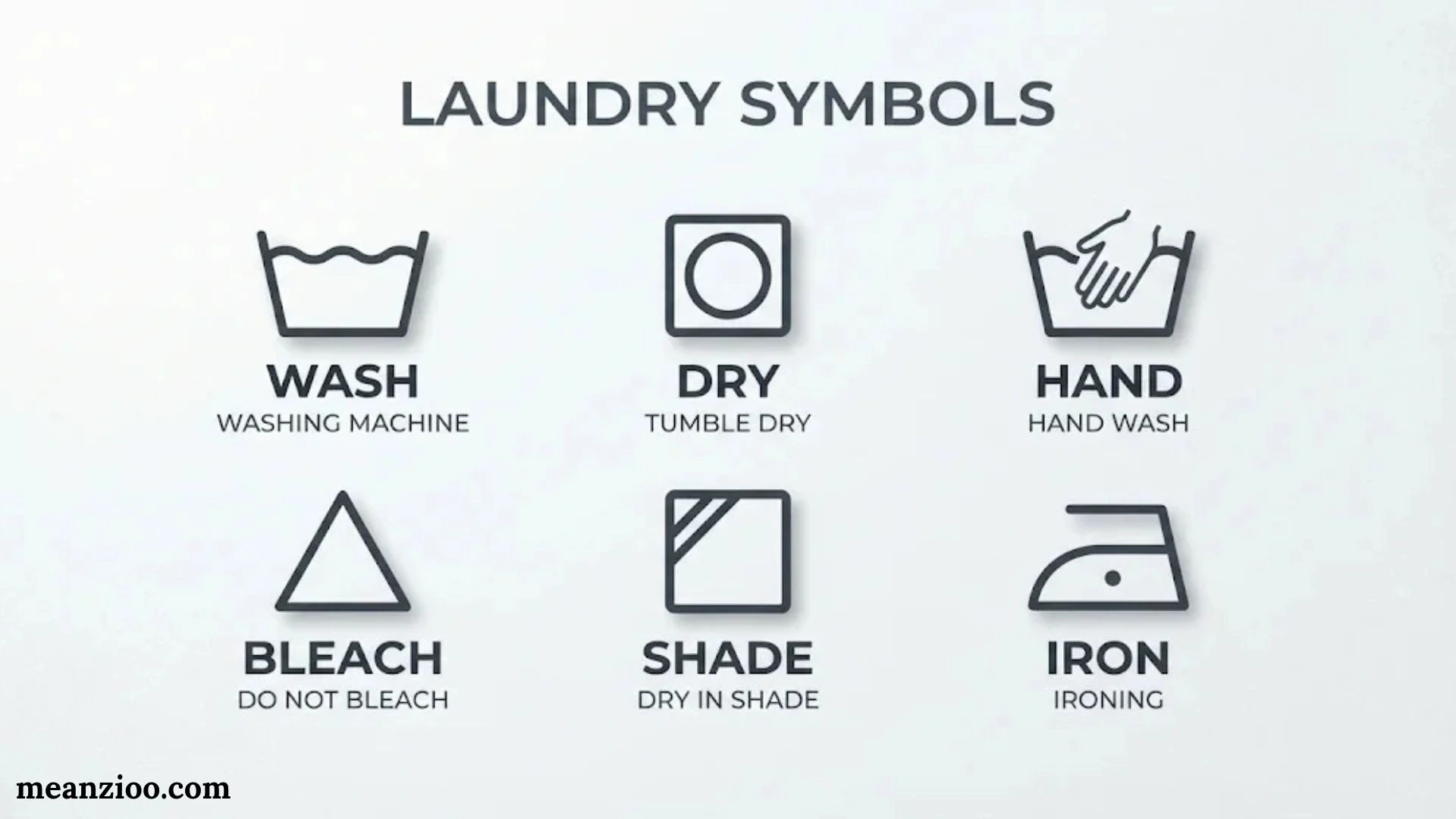
Have you ever looked at a clothing tag and wondered what those tiny symbols actually mean? You’re not alone. A simple wash tub, triangle, square, or iron can tell you how to care for your clothes properly.
These small illustrations are laundry symbols, also called clothing care symbols or laundry care symbols. They provide essential instructions for washing, bleaching, drying, ironing, and professional cleaning. Understanding them helps you avoid common laundry problems, including shrinking, fading, stretching, and fabric damage.
However, reading a clothing label isn’t always straightforward. Some symbols contain dots, horizontal lines, diagonal marks, or letters. Each detail changes the instruction.
This complete laundry symbols guide explains what the symbols mean, how to recognize them, and how to follow their instructions. You’ll also find practical charts, fabric-care tips, and answers to common questions.
What Are Laundry Symbols?
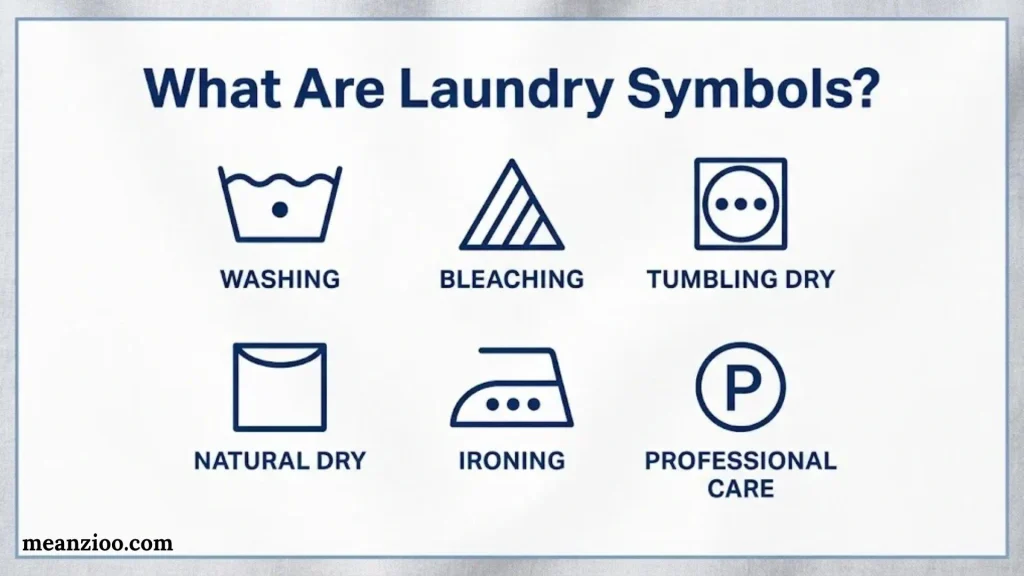
Laundry symbols are standardized graphic instructions printed or attached to clothing and textile care labels. They tell you how to clean, dry, iron, and maintain different fabrics without damaging them.
Instead of writing lengthy instructions on every garment, manufacturers use simple illustrations. For example, a wash tub represents washing, while a triangle represents bleaching. A square provides drying instructions, an iron indicates ironing, and a circle represents professional cleaning.
These care label symbols make garment maintenance easier, especially when clothing comes from different countries.
The international care-labeling system follows the ISO 3758 standard. Its symbols communicate recommended care procedures through recognizable shapes and markings.
Why Are Laundry Symbols Important?
A garment might look sturdy but still contain delicate fibers that react badly to heat, water, or aggressive washing.
Following the correct laundry care instructions helps you:
- Prevent shrinkage: Suitable temperatures help protect fabrics from excessive heat and agitation.
- Maintain colors: Appropriate washing methods reduce fading and unwanted color transfer.
- Protect fabric fibers: Gentle cycles help prevent stretching, pilling, and weakening.
- Avoid heat damage: Dryer and ironing restrictions protect sensitive materials.
- Preserve garment shape: Correct drying methods prevent unnecessary stretching and distortion.
- Extend clothing lifespan: Proper maintenance helps clothes remain wearable for longer.
For example, washing a wool sweater in hot water can cause shrinkage and felting. Similarly, applying excessive heat to polyester can damage its fibers.
A quick look at the care label can prevent these problems.
Where Can You Find Laundry Symbols?
Manufacturers usually place garment care labels inside clothing. Their location depends on the garment’s design.
Common locations include:
- Inside the side seam of shirts and dresses.
- Along the waistband of trousers and skirts.
- Inside the back neckline of shirts.
- Along the inner seams of jackets and coats.
- On labels attached to towels, bedding, and other household textiles.
You may also find written instructions beside the symbols. These can include fabric composition, washing temperatures, and additional precautions.
What Are the Five Main Laundry Symbol Categories?
Most textile care symbols belong to five major categories.
| Symbol shape | Category | What it tells you |
| Wash tub | Washing | How to wash the garment |
| Triangle | Bleaching | Whether bleach is permitted |
| Square | Drying | How to dry the garment |
| Iron | Ironing | Whether and how to iron |
| Circle | Professional cleaning | Which professional cleaning methods are permitted |
Remembering these five shapes makes clothing labels much easier to understand.
Complete Laundry Symbols Chart With Meanings
If you need a quick reference, this laundry symbol chart covers the most common clothing care instructions.
The following descriptions represent common ISO-based care-label conventions. Actual symbols should be checked against their complete markings, including dots, lines, and crosses.
| Laundry symbol | Meaning |
| Wash tub | Machine washing permitted |
| Wash tub with hand | Hand washing |
| Crossed-out wash tub | Do not wash |
| Wash tub with one dot | Maximum 30°C washing |
| Wash tub with two dots | Maximum 40°C washing |
| Wash tub with three dots | Maximum 50°C washing |
| Wash tub with four dots | Maximum 60°C washing |
| Wash tub with five dots | Maximum 70°C washing |
| Wash tub with six dots | Maximum 95°C washing |
| Empty triangle | Bleaching permitted |
| Triangle with diagonal lines | Non-chlorine bleaching only |
| Crossed-out triangle | Do not bleach |
| Square with circle | Tumble drying permitted |
| Square with crossed-out circle | Do not tumble dry |
| Square with curved line | Line drying |
| Square with horizontal line | Dry flat |
| Square with vertical lines | Drip drying |
| Iron with one dot | Low-temperature ironing |
| Iron with two dots | Medium-temperature ironing |
| Iron with three dots | High-temperature ironing |
| Crossed-out iron | Do not iron |
| Circle with P | Professional dry cleaning with specified solvents |
| Circle with F | Professional petroleum-solvent cleaning |
| Circle with W | Professional wet cleaning |
| Crossed-out circle | Do not dry clean |
Important: A symbol’s dots and lines matter just as much as its main shape. Always read the complete illustration before choosing a washing or drying method.
Washing Symbols and Their Meanings
Washing symbols are among the most important clothing washing symbols because they tell you whether a garment can handle machine washing, hand washing, or no water-based washing at all.
The wash tub is the main visual feature. Numbers, dots, horizontal lines, and crosses provide additional instructions.
Machine Wash Symbol
The machine wash symbol looks like a small tub filled with water. It indicates that you can wash the garment using a washing machine.
However, the symbol alone doesn’t tell you which cycle or temperature to choose. You must check its additional markings.
For example:
- A plain wash tub indicates normal machine washing.
- A wash tub containing a temperature number sets the maximum washing temperature.
- One horizontal line underneath indicates a mild washing process.
- Two horizontal lines indicate a very mild washing process.
- A crossed-out wash tub means you shouldn’t wash the garment.
Always consider the complete symbol rather than its basic shape.
Hand Wash Symbol
The hand wash symbol shows a hand inside a water-filled tub. It means the garment requires gentle hand washing instead of an ordinary machine cycle.
Manufacturers commonly use this instruction for delicate textiles that could stretch, shrink, or lose their shape during aggressive washing.
To hand-wash clothing correctly:
- Fill a clean basin with water at the recommended temperature.
- Dissolve a suitable mild detergent in the water.
- Submerge the garment gently.
- Move it carefully without rubbing or pulling.
- Rinse thoroughly with clean water.
- Press out excess water without twisting.
- Follow the garment’s drying instructions.
Wool, silk, and certain delicate garments may require this treatment. However, always follow the actual care label because not every wool or silk item requires hand washing.
Do Not Wash Symbol
A crossed-out wash tub means do not wash.
This instruction indicates that ordinary water-based washing could damage the garment. Certain materials, decorative finishes, linings, and construction methods cannot tolerate household washing.
For example, structured suits may contain internal components that lose their shape when soaked. Some delicate garments also react poorly to water.
If you see this symbol:
- Don’t put the garment in your washing machine.
- Don’t assume hand washing is automatically safe.
- Check the professional cleaning instructions.
- Ask a qualified cleaner if you’re unsure.
Normal Machine Wash Symbol
A plain wash tub without an underline generally indicates a normal washing process.
This method allows standard mechanical action suitable for garments designed to withstand ordinary machine washing.
Common examples include many cotton T-shirts, socks, everyday towels, and durable clothing.
Nevertheless, the temperature marking still matters. A garment may tolerate normal washing action but require a relatively low water temperature.
Permanent Press Wash Symbol
One horizontal line underneath a wash tub indicates a mild washing process.
This setting reduces mechanical action compared with a normal cycle. It can help protect easy-care garments and reduce excessive creasing.
Permanent press cycles commonly combine gentler washing with a controlled spin and, on many machines, a cooling or reduced-wrinkle approach.
Suitable garments may include:
- Wrinkle-resistant shirts.
- Certain synthetic fabrics.
- Polyester-blend clothing.
- Easy-care trousers.
- Some blended-fabric dresses.
Delicate or Gentle Wash Symbol
Two horizontal lines underneath the wash tub indicate a very mild washing process.
This setting uses reduced mechanical action to protect sensitive textiles. It’s especially useful for garments that could stretch, become misshapen, or suffer damage during ordinary washing.
Examples include certain wool garments, fine knitwear, and delicate clothing.
Use a dedicated delicate or wool program when your washing machine provides one. Also avoid overloading the drum because garments need enough space to move gently.
Reduced Spin and Washing Intensity
Washing intensity and spin speed are related but different concepts.
Washing intensity describes how strongly the machine moves clothing during the wash. Spin speed describes how quickly the drum rotates to remove water.
A gentle washing process doesn’t necessarily mean the machine must use zero spin. However, delicate garments often benefit from reduced spinning.
Follow these practical guidelines:
- Use a normal cycle for sturdy garments with a normal-wash instruction.
- Choose a permanent press cycle for suitable easy-care fabrics.
- Select a delicate cycle when the label specifies very mild treatment.
- Reduce spin speed when garments need gentler handling.
- Avoid wringing delicate fabrics by hand.
Water Temperature Symbols Explained
Water temperature affects how effectively detergent works and how fabrics respond during washing.
Too much heat can cause shrinkage, fading, and fiber damage. Very low temperatures may also be unsuitable for some heavily soiled items.
Understanding washing temperature symbols helps you select the right setting without guessing.
What Do the Dots or Numbers on Washing Symbols Mean?
Care-label systems can use different temperature markings.
Many international ISO-based labels show a number inside the wash tub. This number represents the maximum permitted washing temperature in degrees Celsius.
Some regional and older labeling conventions use dots instead.
For example, a single dot generally indicates a lower temperature than two dots. Always interpret the markings according to the labeling system used.
The important rule is simple:
The indicated temperature is a maximum limit, not a temperature you must use every time.
Cold Water Wash Symbol
A washing symbol indicating 30°C (86°F) sets a relatively low maximum temperature.
This setting works well for many everyday garments, especially when they’re not heavily soiled.
Cold or cool washing can help:
- Reduce color fading.
- Limit shrinkage in susceptible fabrics.
- Protect certain delicate fibers.
- Reduce energy consumption.
- Minimize color transfer when garments are washed appropriately.
Dark clothing, lightweight synthetic garments, and some cotton items commonly use low-temperature washing instructions.
Warm Water Wash Symbol
A 40°C (104°F) wash instruction allows a warmer washing process.
Many everyday garments can tolerate this temperature when their care labels permit it.
Examples include certain cotton clothing, synthetic blends, and everyday washable textiles.
However, fabric composition alone doesn’t determine the correct setting. Always follow the garment’s maximum temperature.
Hot Water Wash Symbols
Higher washing temperatures are suitable for some durable textiles, but they aren’t appropriate for every garment.
Here are common ISO-based washing temperature markings:
| Temperature marking | Maximum temperature | Fahrenheit equivalent |
| 30 | 30°C | 86°F |
| 40 | 40°C | 104°F |
| 50 | 50°C | 122°F |
| 60 | 60°C | 140°F |
| 70 | 70°C | 158°F |
| 95 | 95°C | 203°F |
A 95°C instruction is intended for textiles that can withstand very hot washing. It isn’t a routine recommendation for ordinary clothing.
How to Choose the Correct Washing Temperature
Choosing the right temperature involves more than checking the fabric color.
Consider these factors:
- Care label: Never exceed the maximum temperature printed on the garment.
- Fabric composition: Wool, silk, cotton, and polyester respond differently to heat.
- Color: Dark and brightly colored garments may benefit from cooler washing.
- Soil level: Heavily soiled textiles may need a suitable detergent and wash program.
- Detergent: Check whether your detergent works effectively at the selected temperature.
When in doubt, follow the garment’s care label and choose the gentlest suitable option.
Washing Machine Cycle Symbols Explained
Your washing machine offers several programs designed for different fabrics and cleaning requirements.
Although control-panel icons vary between manufacturers, the care-label symbols communicate the mechanical treatment your clothing can tolerate.
Normal Wash Cycle
The normal cycle uses standard washing action and is suitable for sturdy, everyday clothing.
Depending on your machine, it may include:
- Regular drum movement.
- Standard rinsing.
- Ordinary spin settings.
- A complete washing program.
Cotton shirts, socks, and durable everyday clothing often tolerate this cycle when their care labels permit it.
Permanent Press Cycle
The permanent press cycle generally uses reduced agitation and a gentler spin than a standard heavy-duty program.
Many machines also include a cooling phase to help reduce wrinkles.
This program suits suitable wrinkle-resistant and blended fabrics. It isn’t a universal solution for every synthetic garment, so check the label first.
Delicate or Gentle Cycle
A delicate cycle protects garments that cannot tolerate strong mechanical movement.
It usually uses gentler drum action and may reduce spinning.
Choose this setting for clothing with a very mild washing instruction. Dedicated wool programs can provide additional protection for compatible wool garments.
Understanding Lines Under Washing Symbols
Horizontal lines underneath the wash tub indicate how gently the garment should be washed.
| Marking | Washing process | Recommended machine setting |
| No line | Normal process | Normal cycle |
| One line | Mild process | Permanent press or suitable gentle cycle |
| Two lines | Very mild process | Delicate or wool cycle |
These lines describe the permitted mechanical action, not the washing temperature.
A low-temperature wash can still damage a garment if the machine uses excessive agitation.
Spin Cycle and Spin Speed
The spin cycle removes water from clothing after washing.
Higher spin speeds extract more moisture, which can shorten drying time. However, they can also increase stress on delicate textiles.
For sensitive garments, consider:
- Lower spin speeds.
- Shorter spinning periods.
- A reduced-spin program.
- Gentle manual water removal when permitted.
Don’t confuse reduced spin with reduced washing temperature. They control different parts of the laundry process.
Bleaching Symbols and Their Meanings
Bleaching symbols tell you whether a garment can tolerate bleaching products.
The triangle laundry symbol is easy to recognize. Its markings explain whether you can use chlorine bleach, oxygen bleach, or no bleach at all.
What Does the Triangle Laundry Symbol Mean?
The triangle represents bleaching instructions on a clothing care label.
Bleaching products help remove certain stains and brighten suitable textiles. However, they can also damage fibers, remove dyes, or cause discoloration.
The three main bleaching instructions are:
- Empty triangle: Any permitted bleaching agent may be used.
- Triangle with two diagonal lines: Oxygen or non-chlorine bleach only.
- Crossed-out triangle: Do not bleach.
Empty Triangle: Bleaching Allowed
An empty triangle indicates that bleaching is permitted.
Depending on the garment and product directions, this includes chlorine-based and oxygen-based bleaching agents.
However, permission to bleach doesn’t mean every product is suitable for every fabric.
Always check the bleach manufacturer’s instructions and follow the recommended concentration.
Triangle With Two Diagonal Lines: Non-Chlorine Bleach Only
Two diagonal lines inside the triangle indicate that only non-chlorine bleaching agents are permitted.
This usually means oxygen-based bleach.
Oxygen bleach works differently from chlorine bleach. It uses oxygen-releasing ingredients to help remove stains and brighten suitable washable fabrics.
It’s commonly available in powdered and liquid laundry products.
You might use an appropriate oxygen bleach product for:
- Certain colored cotton fabrics.
- Suitable synthetic garments.
- Washable household textiles.
- Fabrics that specifically permit non-chlorine bleaching.
Never assume oxygen bleach is safe for every delicate or colored garment. Check the product directions and care label.
Crossed-Out Triangle: Do Not Bleach
A triangle marked with an X means bleaching isn’t permitted.
This restriction applies even when a stain seems difficult to remove.
Bleaching may weaken fibers, damage dyes, or permanently alter the fabric’s appearance.
Instead, consider:
- Using a suitable color-safe detergent.
- Treating stains with a fabric-compatible product.
- Washing according to the care label.
- Seeking professional advice for stubborn stains.
Chlorine Bleach vs. Oxygen Bleach
These two products have different chemical properties and uses.
| Feature | Chlorine bleach | Oxygen bleach |
| Common ingredient | Sodium hypochlorite | Hydrogen peroxide or oxygen-releasing compounds |
| Main use | Whitening and disinfecting suitable materials | Stain removal and brightening |
| Color compatibility | Can remove dyes | Often suitable for some colored fabrics |
| Fabric restrictions | More restrictive | Still requires label checks |
| Care-label permission | Empty triangle | Empty triangle or triangle with two diagonal lines |
Never use chlorine bleach when the garment specifically permits only non-chlorine bleach.
Drying Symbols and Their Meanings
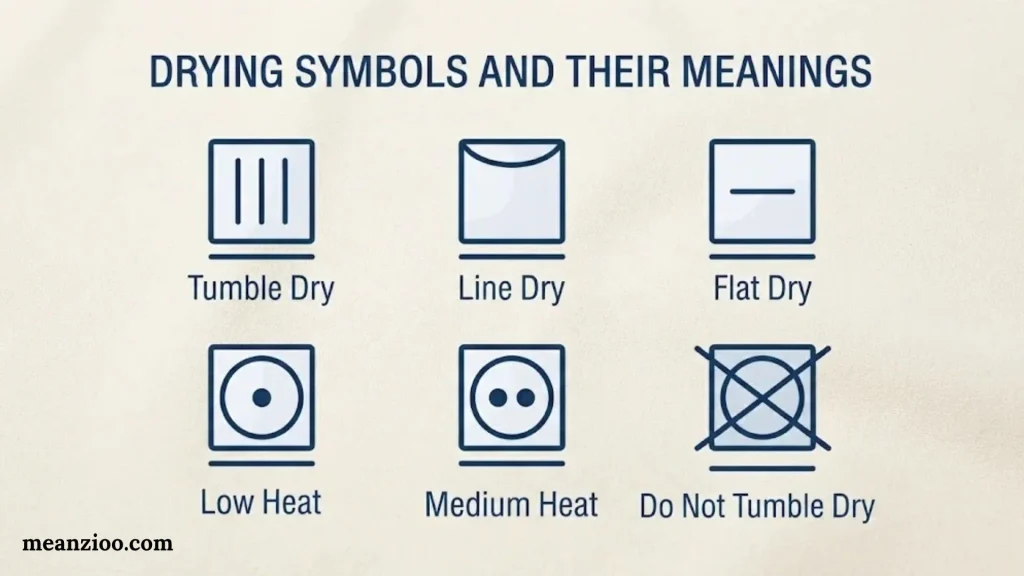
Drying is just as important as washing. Incorrect drying can shrink clothing, stretch knitwear, damage elastic, and cause permanent fabric distortion.
The square laundry symbol provides information about the correct drying method.
What Does the Square Laundry Symbol Mean?
A square represents drying instructions.
Its internal markings indicate whether you can use a tumble dryer or should dry the garment naturally.
For example:
- A circle inside the square indicates tumble drying.
- A crossed-out square with a circle means no tumble drying.
- A curved line indicates line drying.
- A horizontal line indicates flat drying.
- Vertical lines indicate drip drying.
- Diagonal lines in the corner indicate drying in the shade.
These details help you choose the safest drying method.
Tumble Dry Symbol
A square containing a circle indicates that tumble drying is permitted.
A tumble dryer uses heated or unheated air while rotating clothing inside a drum.
This method can dry garments quickly, but the permitted heat level depends on the dots inside the circle.
Always check the complete symbol before choosing a dryer setting.
Do Not Tumble Dry Symbol
A crossed-out square containing a circle means do not tumble dry.
The garment may be sensitive to heat, mechanical movement, or both.
For example, certain wool garments can shrink in a tumble dryer. Some elastic materials and delicate decorations can also deteriorate under unsuitable drying conditions.
Instead, use the natural drying method indicated by the care label.
Line Dry Symbol
The line-dry symbol shows a curved line inside a square.
It means you should hang the garment to dry naturally, usually on a clothesline or suitable hanger.
Line drying offers several benefits:
- Doesn’t require tumble-dryer heat.
- Reduces energy consumption.
- Works well for many everyday garments.
- Can help preserve suitable fabrics.
However, heavy wet garments may stretch when hung. Check whether the manufacturer specifies flat drying instead.
Dry Flat Symbol
A horizontal line inside a square indicates that you should dry the garment flat.
Place the item on a clean, flat surface or suitable drying rack.
This method is particularly useful for knitwear because wet fibers can stretch under their own weight.
Suitable garments may include:
- Wool sweaters.
- Delicate knitwear.
- Certain silk garments.
- Stretch-sensitive clothing.
Reshape the garment gently while it’s damp, then allow it to dry completely.
Drip Dry Symbol
Vertical lines inside a square indicate drip drying.
This means you should hang the garment while allowing excess water to drain naturally.
The symbol may appear with additional markings that specify line drying or flat drying.
Drip drying is useful for garments that shouldn’t undergo aggressive spinning or wringing.
Dry in Shade Symbol
Diagonal lines in the corner of a drying square indicate that the garment should dry in the shade.
Direct sunlight can fade certain dyes and damage sensitive materials over time.
Shade drying is particularly useful for delicate and color-sensitive clothing.
Choose a well-ventilated area so moisture can escape naturally.
Do Not Wring Symbol
The crossed-out twisted-garment symbol means you shouldn’t wring the clothing.
Wringing involves twisting fabric tightly to remove water. This action can distort fibers, stretch seams, and damage delicate construction.
Instead:
- Support the garment with both hands.
- Press gently to remove excess water.
- Place it between clean towels if appropriate.
- Roll the towels carefully to absorb moisture.
- Follow the specified drying method.
This approach is especially useful for delicate knitwear and certain hand-washable garments.
Tumble Dryer Symbols and Their Meanings
Tumble-drying instructions provide more specific information about machine drying.
The square with a circle identifies the dryer. Dots inside the circle indicate the permitted temperature level.
What Do Dots Inside a Dryer Symbol Mean?
Dots indicate the permitted heat level for tumble drying.
In the commonly used international symbol convention:
| Dryer symbol | Meaning |
| Square with circle and one dot | Low-temperature tumble drying |
| Square with circle and two dots | Normal-temperature tumble drying |
| Square with circle and three dots | Higher-temperature tumble drying |
| Crossed-out square with circle | Do not tumble dry |
The dots don’t represent exact temperatures in the same way numerical wash-tub markings do.
Low Heat Tumble Dry Symbol
One dot indicates low-temperature tumble drying.
This setting is suitable for garments that can tolerate machine drying but need reduced heat.
Examples may include certain synthetic garments and heat-sensitive textiles.
Low heat can help reduce the risk of excessive shrinkage and heat-related damage. However, it doesn’t guarantee that every delicate garment can safely enter a dryer.
Medium Heat Tumble Dry Symbol
Two dots indicate normal-temperature tumble drying.
This instruction permits a standard tumble-drying heat level under the applicable care-label system.
Many durable washable garments may tolerate this setting.
Still, follow the manufacturer’s instructions rather than assuming that cotton or polyester always needs the same dryer treatment.
High Heat Tumble Dry Symbol
Three dots indicate a higher-temperature tumble-drying process.
Only use this setting when the garment’s care label explicitly permits it.
High heat can damage elastic, certain synthetic fibers, and heat-sensitive finishes. Even garments that tolerate high temperatures should not remain in the dryer unnecessarily.
No Heat or Air-Only Drying
Some dryers offer an air-only or no-heat program.
This setting circulates air without using the ordinary heating element. It can help refresh certain garments or remove moisture without additional heat.
However, an air-only setting isn’t identical to natural air drying.
If the label says do not tumble dry, don’t assume an air-only dryer program is automatically permitted.
Permanent Press and Gentle Dryer Settings
Some tumble-drying symbols include lines underneath the square.
These markings indicate reduced or very reduced mechanical action.
They help distinguish ordinary tumble drying from gentler drying treatments.
Choose a matching machine program when available. If your dryer doesn’t provide an appropriate setting, use a permitted natural drying method instead.
Ironing Symbols and Their Meanings
Ironing symbols tell you whether a garment can tolerate direct heat and which temperature setting you should use.
The iron laundry symbol looks like a traditional clothes iron. Dots inside the illustration indicate the permitted temperature range.
What Does the Iron Symbol Mean?
A plain iron symbol generally indicates that ironing is permitted.
Additional dots provide temperature guidance. Some labels also include a crossed-out steam feature, which means you must avoid steam ironing.
Always check the complete illustration before pressing a garment.
One-Dot Iron Symbol: Low Temperature
One dot indicates low-temperature ironing.
Under the current GINETEX interpretation of ISO-based care symbols, the maximum soleplate temperature is 120°C (248°F).
This setting is suitable for certain heat-sensitive fabrics, including:
- Acrylic.
- Nylon (polyamide).
- Acetate.
- Some synthetic blends.
Use gentle pressure and avoid leaving the iron in one place for too long.
Some fabrics may also require ironing inside out or using a protective pressing cloth.
Two-Dot Iron Symbol: Medium Temperature
Two dots indicate moderate-temperature ironing.
The maximum soleplate temperature under the current GINETEX guidance is 160°C (320°F).
Suitable materials may include certain:
- Wool fabrics.
- Silk garments.
- Polyester textiles.
- Viscose fabrics.
However, not every garment made from these materials tolerates the same treatment. Follow the care label rather than relying on fiber composition alone.
Three-Dot Iron Symbol: High Temperature
Three dots indicate high-temperature ironing.
The maximum soleplate temperature under the current GINETEX guidance is 210°C (410°F).
This setting may be appropriate for suitable cotton and linen garments.
For better results:
- Check whether the garment permits steam.
- Iron inside out when appropriate.
- Use a pressing cloth for sensitive finishes.
- Avoid excessive pressure on decorative details.
- Follow any additional manufacturer instructions.
Crossed-Out Iron Symbol: Do Not Iron
A crossed-out iron means ironing isn’t permitted.
Heat may cause irreversible damage, melting, flattening, or changes in the fabric’s appearance.
This restriction commonly appears on garments with heat-sensitive materials, special coatings, or delicate decorative details.
If wrinkles develop, consider a suitable alternative:
- Hang the garment properly after washing.
- Allow bathroom steam to loosen minor wrinkles without exposing the garment to direct heat.
- Use an approved garment steamer only if the care instructions permit it.
- Ask a professional cleaner for advice.
Iron Symbol With Steam Crossed Out
Some care labels show an iron with crossed-out steam.
This means you must not use steam when ironing the garment.
It doesn’t necessarily prohibit dry ironing. You can use the permitted temperature setting without steam.
This distinction matters because moisture and heat can affect certain fibers differently.
Fabric Types and Ironing Temperature
Different fibers respond differently to heat. However, the garment’s care label always takes priority.
| Fabric | General ironing considerations |
| Cotton | Often tolerates higher heat when permitted |
| Linen | Commonly requires moderate or higher heat |
| Wool | Usually benefits from controlled heat and gentle pressure |
| Silk | Requires careful, low-heat treatment |
| Polyester | Often needs lower heat |
| Acrylic | Sensitive to excessive heat |
| Nylon | Requires low-temperature treatment |
Never assume that every cotton shirt can tolerate the highest iron setting. Blends, dyes, finishes, and garment construction can change the recommended treatment.
Dry Cleaning Symbols and Their Meanings
Some garments need specialized cleaning instead of ordinary household washing.
Dry cleaning symbols help professional cleaners identify suitable cleaning methods and solvent restrictions.
The circle is the main symbol for professional textile care.
What Does the Circle Laundry Symbol Mean?
A circle on a clothing care label indicates professional textile cleaning.
It can provide instructions for professional dry cleaning or professional wet cleaning.
Dry cleaning isn’t completely water-free in every aspect of the process. Instead, professional dry cleaning uses suitable cleaning solvents rather than ordinary water-based washing.
Professional cleaners also use specialized equipment and finishing techniques to protect garments.
Circle With P: Professional Dry Cleaning
A circle containing the letter P is a familiar dry-cleaning instruction.
On traditional care labels, P identifies a permitted class of professional dry-cleaning solvents, including perchloroethylene and certain hydrocarbons.
The exact cleaning process depends on the applicable labeling standard and any additional markings.
A professional cleaner uses this information to select a suitable solvent and cleaning program.
Circle With F: Petroleum-Based Solvent Cleaning
A circle containing F traditionally indicates professional cleaning with petroleum-based solvents.
This instruction differs from P because it specifies a more restricted solvent category.
The distinction matters for garments that may react badly to particular cleaning chemicals.
Don’t try to reproduce professional solvent cleaning at home. These processes require suitable equipment, handling procedures, and professional expertise.
Circle With W: Professional Wet Cleaning
The letter W is associated with wet cleaning.
Professional wet cleaning uses water, specialized detergents, controlled mechanical action, and professional finishing equipment.
It differs from ordinary home washing because professional cleaners control the cleaning process carefully.
Wet cleaning can be suitable for certain delicate garments that require more specialized treatment than a household washing machine provides.
Circle With A: Understanding Older Dry-Cleaning Instructions
Some older care-label references use the letter A to describe a broad permitted solvent category.
However, don’t assume that A appears in every current care-label system or that it authorizes every conceivable cleaning chemical.
Solvent designations have evolved. ISO 3758:2023 includes revised professional-care symbol conventions.
When you encounter an unfamiliar letter, ask a professional cleaner to interpret the complete label.
Crossed-Out Circle: Do Not Dry Clean
A crossed-out circle means professional dry cleaning isn’t permitted.
This restriction may appear on garments that could suffer damage from cleaning solvents or the dry-cleaning process.
However, it doesn’t automatically mean that ordinary household washing is safe.
Check the wash tub and other care instructions before selecting another cleaning method.
Dry Cleaning vs. Wet Cleaning
Both methods involve professional garment care, but their cleaning processes differ.
| Feature | Professional dry cleaning | Professional wet cleaning |
| Main cleaning medium | Organic cleaning solvent | Water |
| Equipment | Specialized dry-cleaning machines | Specialized wet-cleaning equipment |
| Detergents | Solvent-compatible cleaning products | Specialized water-based detergents |
| Mechanical action | Carefully controlled | Carefully controlled |
| Common purpose | Cleaning garments requiring solvent-based treatment | Cleaning garments suitable for specialized water-based treatment |
The professional cleaner should follow the exact instructions on the garment’s care label.
International Laundry Symbols: US and European Differences
Laundry labels look similar across many countries, but their standards and labeling practices aren’t always identical.
Understanding these differences is useful when purchasing clothing from international brands.
What Is the International Laundry Symbol Standard?
The International Organization for Standardization publishes ISO 3758, titled Textiles — Care labelling code using symbols.
The current edition, ISO 3758:2023, establishes graphic symbols for textile care instructions.
It covers:
- Domestic washing.
- Bleaching.
- Domestic drying.
- Ironing.
- Professional dry cleaning.
- Professional wet cleaning.
The standard communicates the most severe permitted treatment that shouldn’t cause irreversible damage to the textile article.
American Laundry Symbols
In the United States, consumers commonly encounter care labels using words, symbols, or a combination of both.
American labels may include instructions such as:
- Machine wash cold.
- Machine wash warm.
- Tumble dry low.
- Do not bleach.
- Iron on low heat.
- Dry clean only.
Some labels use temperature dots rather than numerical temperatures.
The Federal Trade Commission’s Care Labeling Rule requires covered apparel and certain textile products to carry care instructions or provide an appropriate warning when regular care methods could damage them.
European Laundry Symbols
European garment labels commonly use the international care-symbol system.
These labels frequently include:
- A wash tub with a temperature in Celsius.
- A triangle for bleaching.
- A square for drying.
- An iron with temperature dots.
- A circle for professional textile care.
The symbols communicate instructions without relying entirely on written language.
How to Read Laundry Symbols From Different Countries
When buying clothing internationally, don’t assume every label follows identical conventions.
Use these guidelines:
- Identify the five main symbol categories.
- Check whether the wash tub contains dots or a numerical temperature.
- Look for horizontal lines indicating reduced mechanical action.
- Check the complete drying symbol.
- Pay attention to letters inside professional-cleaning symbols.
- Consult the manufacturer’s instructions when a symbol is unfamiliar.
How to Read Laundry Symbols on Clothing Labels
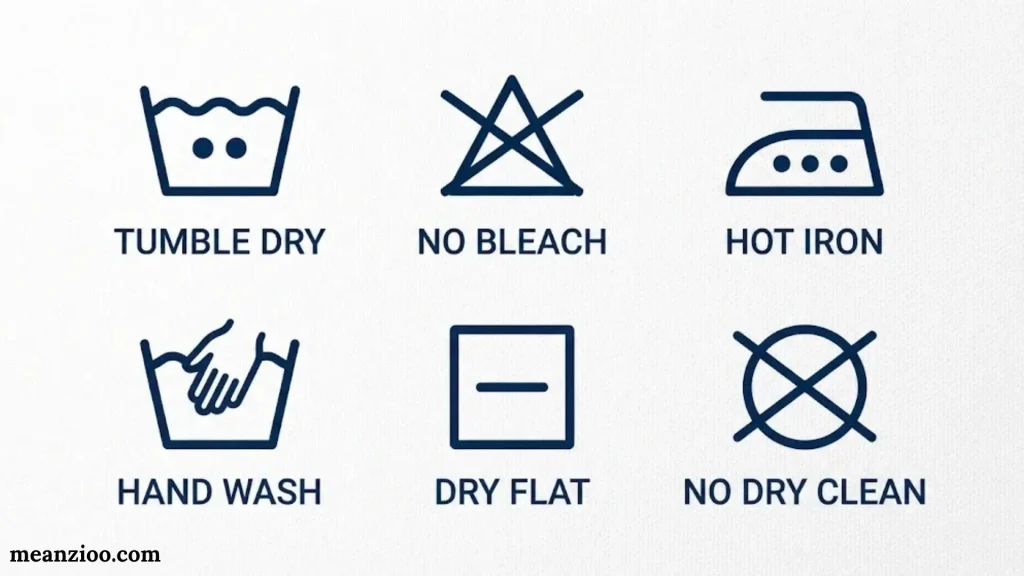
Understanding individual symbols is useful, but you also need to know how they work together.
A clothing label usually presents several instructions in a particular order. Reading them correctly helps you choose a complete care routine.
Step 1: Find the Garment Care Label
Start by locating the care label inside the garment.
Check the side seams, waistband, neckline, or inner lining.
Look for additional information such as:
- Fabric composition.
- Washing instructions.
- Bleaching restrictions.
- Drying methods.
- Ironing temperature.
- Professional cleaning requirements.
Some garments have multiple labels. Read all relevant instructions before washing.
Step 2: Read the Washing Instructions
Find the wash tub symbol first.
Check whether it permits machine washing or requires hand washing.
Then examine its additional markings.
For example, a wash tub containing 30 indicates a maximum washing temperature of 30°C. One horizontal line underneath means you need a mild washing process.
Choose a machine program that respects both instructions.
Step 3: Check the Bleaching Instructions
Find the triangle immediately after the washing symbol in the traditional five-symbol sequence.
Determine whether the garment allows bleaching.
- Empty triangle: Bleaching permitted.
- Triangle with diagonal lines: Non-chlorine bleach only.
- Crossed-out triangle: Do not bleach.
If the garment prohibits bleaching, choose a bleach-free cleaning product.
Step 4: Understand the Drying Instructions
Next, locate the square symbol.
Check whether the garment permits tumble drying or requires natural drying.
Look for additional markings that specify:
- Dryer heat.
- Line drying.
- Flat drying.
- Drip drying.
- Shade drying.
Don’t assume that machine washing automatically means machine drying is safe.
Step 5: Check the Ironing Instructions
Find the iron symbol.
Count its dots and check for any crossed-out markings.
Use the permitted temperature setting. If the label prohibits steam, don’t use a steam iron.
For delicate garments, use gentle pressure and a suitable pressing cloth when appropriate.
Step 6: Review Professional Cleaning Instructions
Finally, check the circle symbol.
Look for letters or other markings that indicate the permitted professional cleaning process.
If the label specifies dry cleaning, don’t replace it with ordinary machine washing without confirming that the alternative is safe.
What If a Clothing Label Contains Multiple Instructions?
Every symbol describes a different part of the garment’s care routine.
For example, a shirt might have these instructions:
| Care category | Example instruction |
| Washing | Machine wash at 30°C |
| Bleaching | Do not bleach |
| Drying | Do not tumble dry |
| Ironing | Iron at low temperature |
| Professional cleaning | Professional cleaning permitted only as specified |
These instructions don’t contradict one another. They work together to describe the garment’s complete care requirements.
Always follow every applicable instruction, not just the washing symbol.
Laundry Symbols for Different Fabric Types
Fabric composition influences how clothing reacts to washing, drying, and ironing. However, the care label remains the most reliable guide because manufacturers also consider dyes, finishes, blends, and garment construction.
Here are common fabric types and their care considerations.
Cotton
Cotton is a natural fiber commonly used in T-shirts, shirts, towels, underwear, and bedding.
Many cotton garments tolerate machine washing. However, washing temperature depends on the fabric construction, dye, and manufacturer’s instructions.
Important cotton care tips:
- Check the recommended washing temperature.
- Separate dark and light-colored clothing.
- Avoid excessive heat when drying.
- Check whether tumble drying is permitted.
- Follow ironing temperature restrictions.
Cotton can shrink when exposed to unsuitable heat, particularly during washing and drying.
Linen
Linen comes from the flax plant and is valued for its breathable, lightweight texture.
It’s commonly used in summer clothing, shirts, trousers, dresses, and household textiles.
Linen wrinkles easily, so careful washing and drying can help maintain its appearance.
Follow these guidelines:
- Use the recommended washing temperature.
- Avoid unnecessary mechanical stress.
- Choose suitable drying methods.
- Iron according to the label.
- Avoid excessive pressure on delicate finishes.
Wool
Wool is a natural animal fiber commonly used in sweaters, coats, scarves, and knitwear.
It requires careful handling because unsuitable heat, agitation, and moisture conditions can cause felting and shrinkage.
Some wool garments support machine washing on a dedicated wool cycle. Others require hand washing or professional cleaning.
For suitable wool garments:
- Use an approved wool detergent.
- Follow the specified washing temperature.
- Avoid vigorous rubbing.
- Don’t wring the garment.
- Dry flat when instructed.
- Reshape gently while damp.
Silk
Silk is a delicate natural protein fiber known for its smooth surface and soft appearance.
It’s commonly used in scarves, blouses, dresses, and other lightweight clothing.
Some silk garments permit gentle washing, while others require professional cleaning.
Protect silk by following these precautions:
- Check whether hand washing is permitted.
- Avoid excessive rubbing.
- Use a suitable detergent.
- Avoid direct heat.
- Follow the specified drying method.
- Iron only at the permitted temperature.
Polyester
Polyester is a synthetic fiber widely used in sportswear, shirts, trousers, jackets, and blended fabrics.
It generally resists wrinkling better than many natural fibers. However, excessive heat can damage polyester.
For suitable polyester garments:
- Follow the recommended washing temperature.
- Use an appropriate washing cycle.
- Avoid excessive dryer heat.
- Check ironing restrictions.
- Remove garments promptly when drying finishes.
Acrylic and Nylon
Acrylic and nylon are synthetic fibers used in sweaters, sportswear, hosiery, and lightweight garments.
Both require attention to heat exposure.
Acrylic can become damaged under excessive ironing temperatures. Nylon can also lose its shape or develop heat-related damage.
Use the following precautions:
- Follow the specified low-temperature washing instructions.
- Avoid high dryer temperatures unless permitted.
- Never exceed the recommended ironing setting.
- Keep garments away from direct heat sources.
- Check the label before using steam.
Mixed and Synthetic Fabrics
Many garments combine several fibers to achieve particular qualities.
For example, a shirt might contain cotton and polyester. A sweater could combine wool with acrylic.
Blended fabrics don’t always follow the care requirements of their strongest or most prominent fiber.
Manufacturers consider the complete garment when assigning care instructions.
When a garment contains multiple fibers, follow its care label rather than choosing instructions based on one material alone.
Common Laundry Symbol Mistakes to Avoid
Even when you recognize the symbols, small mistakes can damage your clothing.
Here are common problems worth avoiding.
Confusing Washing Symbols With Dryer Symbols
A wash tub and a square with a circle represent different processes.
The wash tub tells you how to clean the garment. The square provides drying instructions.
A machine-washable garment isn’t automatically suitable for tumble drying.
Ignoring Temperature Dots
Dots communicate temperature restrictions for specific processes.
One dot inside an iron doesn’t mean the same thing as one dot inside a dryer.
Always interpret dots according to the symbol containing them.
Overlooking Lines Under Washing Symbols
Horizontal lines indicate reduced mechanical action.
Ignoring them can expose delicate garments to excessive agitation.
Check whether the label requires a normal, mild, or very mild washing process.
Using Chlorine Bleach When Only Non-Chlorine Bleach Is Allowed
A triangle with two diagonal lines specifically restricts bleaching to non-chlorine products.
Using chlorine bleach can damage dyes and fibers.
Choose a suitable oxygen-based product instead.
Tumble Drying Clothes That Require Air Drying
Some fabrics cannot tolerate tumble-dryer heat or mechanical movement.
Follow the natural drying instructions and avoid placing restricted garments in a dryer.
Ironing Heat-Sensitive Fabrics
Excessive heat can melt, flatten, scorch, or permanently alter certain textiles.
Check the iron symbol before pressing clothing.
Ignoring the Do Not Wring Symbol
Twisting wet clothing can stretch fibers and distort garment construction.
Press excess water out gently instead.
Assuming All Circle Symbols Mean the Same Thing
A circle represents professional cleaning, but letters and markings provide additional instructions.
Check the complete symbol before choosing a cleaning method.
Treating a Maximum Temperature as a Required Temperature
A wash tub marked 40 doesn’t mean you must always wash at 40°C.
It means you must not exceed that temperature.
A lower suitable setting may also be appropriate.
What Should You Do When a Laundry Label Is Missing or Unclear?
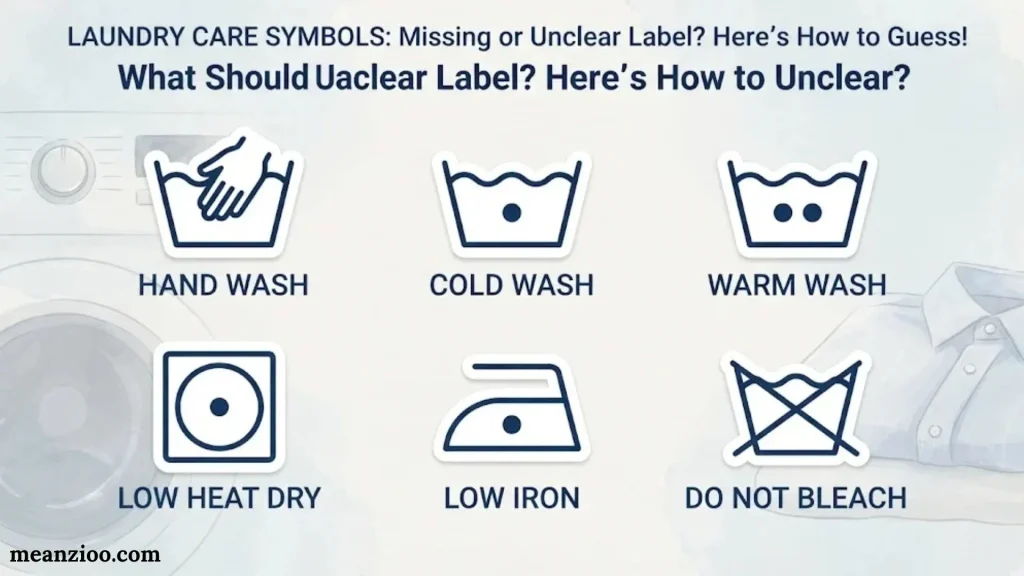
Sometimes clothing labels become faded, damaged, or detached. You might also purchase secondhand clothing without its original care instructions.
In these situations, take a cautious approach.
Check the Manufacturer’s Care Instructions
Look for the garment’s product page or official care information.
Some manufacturers publish detailed washing and drying recommendations online.
Use the garment’s exact model or product identification when possible.
Identify the Fabric Composition
Check whether the garment contains cotton, wool, silk, polyester, or a blend.
This information can help you understand potential risks. However, it doesn’t replace the original care instructions.
Choose a Conservative Washing Method
If the garment is washable but its exact instructions are unavailable, choose a suitable gentle approach.
Consider:
- Cool water.
- A mild detergent.
- Reduced mechanical action.
- A lower spin speed.
- Natural drying when appropriate.
Don’t use this approach on garments that may require professional cleaning.
Test Colorfastness Before Washing When Appropriate
A simple colorfastness test can help identify whether a dye transfers during washing.
Dampen an inconspicuous area with a clean white cloth and gently press it.
If color transfers, avoid washing the garment with other clothing.
This test isn’t foolproof, but it can reveal potential dye problems.
Consult a Professional Cleaner for Valuable or Delicate Garments
For expensive suits, wedding dresses, delicate silk, and structured garments, professional advice is often worthwhile.
A cleaner can assess the fabric, construction, decoration, and possible cleaning risks.
Frequently Asked Questions About Laundry Symbols
What Do Laundry Symbols Mean?
Laundry symbols are graphic instructions that explain how to care for clothing and textiles. They cover washing, bleaching, drying, ironing, and professional cleaning. Their markings indicate permitted temperatures, mechanical action, heat levels, and cleaning restrictions.
What Are the Five Basic Laundry Symbols?
The five basic laundry symbols represent different garment-care processes:
- Wash tub: Washing instructions.
- Triangle: Bleaching instructions.
- Square: Drying instructions.
- Iron: Ironing instructions.
- Circle: Professional textile cleaning instructions.
These shapes form the foundation of the international textile care-labeling system.
What Does a Washing Tub Symbol Mean?
A wash tub indicates that the garment has washing instructions. A plain tub generally permits normal machine washing. Additional markings can specify maximum temperature, hand washing, reduced mechanical action, or a prohibition against washing.
What Do the Dots on Laundry Symbols Mean?
Dots indicate temperature levels, but their meaning depends on the symbol.
For example, dots inside an iron indicate ironing temperature. Dots inside a tumble-dryer symbol indicate drying heat. Some washing labels also use dots to represent water temperature, particularly in certain regional labeling conventions.
What Does One Line Under a Washing Symbol Mean?
One horizontal line underneath a wash tub indicates a mild washing process. It means the garment needs reduced mechanical action compared with a normal washing cycle.
What Do Two Lines Under a Washing Symbol Mean?
Two horizontal lines indicate a very mild washing process. This instruction is commonly associated with delicate textiles and suitable wool garments that need extra-gentle treatment.
What Does a Triangle Mean on a Clothing Label?
A triangle represents bleaching instructions.
An empty triangle permits bleaching. Two diagonal lines indicate non-chlorine bleach only. A crossed-out triangle means bleaching isn’t permitted.
What Does a Square With a Circle Mean?
A square containing a circle represents tumble drying.
Dots inside the circle indicate the permitted dryer temperature. A crossed-out version means you shouldn’t tumble dry the garment.
What Does a Crossed-Out Tumble Dryer Symbol Mean?
It means the garment shouldn’t be dried in a tumble dryer. Use an appropriate natural drying method instead, such as line drying or flat drying, depending on the other markings.
What Does the Hand Wash Symbol Mean?
A hand inside a wash tub means the garment requires gentle hand washing.
Use suitable water and detergent, avoid excessive rubbing, and press out excess water without twisting the fabric.
What Does the P Mean on a Dry Cleaning Label?
A circle containing P is a familiar professional dry-cleaning symbol. It traditionally indicates cleaning with specified professional solvents, including perchloroethylene and certain hydrocarbons. The exact process depends on the applicable standard and additional markings.
What Does the F Mean on a Laundry Label?
A circle containing F traditionally indicates professional cleaning with petroleum-based solvents. It tells the cleaner that the garment requires a particular solvent category rather than unrestricted cleaning.
What Does the W Mean on a Clothing Label?
W is associated with professional wet cleaning. This process uses water, specialized detergents, controlled mechanical action, and professional equipment.
It isn’t the same as ordinary household machine washing.
How Can You Tell If Clothes Are Safe to Iron?
Check the iron symbol on the garment’s care label.
- One dot indicates low heat.
- Two dots indicate moderate heat.
- Three dots indicate high heat.
- A crossed-out iron means do not iron.
Also check for a crossed-out steam feature.
Can You Wash Clothes Marked Do Not Tumble Dry?
Yes, provided their washing instructions permit it.
The do-not-tumble-dry symbol only prohibits tumble drying. You can use a suitable natural drying method, such as line drying or flat drying, according to the remaining instructions.
Are Laundry Symbols the Same in Every Country?
Many countries use internationally recognized care symbols based on ISO 3758. However, regional labeling requirements and conventions can differ.
Some labels use numerical temperatures in Celsius, while others use temperature dots and written instructions.
Final Thoughts on Understanding Laundry Symbols
Understanding laundry symbols makes clothing care easier and helps prevent avoidable damage.
The five basic shapes provide most of the information you need. The wash tub explains washing, the triangle covers bleaching, the square describes drying, the iron provides pressing instructions, and the circle indicates professional cleaning.
Pay attention to the smaller details, too. Dots indicate temperature levels, horizontal lines describe gentler treatment, and crossed-out symbols prohibit specific actions.
Before putting any garment into your washing machine, take a moment to read its care label. Choose the correct temperature, select an appropriate cycle, and follow the recommended drying method.
A few seconds of attention can help preserve your favorite clothes, protect delicate fabrics, and keep your wardrobe looking better for longer.

I’m Ryan Mitchell, and I write about modern English, trending slang, and online expressions. I enjoy explaining the meanings, origins, and real-life usage of popular words in a simple way. I believe learning slang is an important step toward understanding today’s English-speaking culture. Through my work, I aim to help readers speak more naturally and stay updated with the latest language trends.
 Charlotte Hayes