Money symbols appear everywhere, from online shopping carts and bank statements to international invoices and travel budgets. The familiar dollar sign ($), euro sign (€), British pound (£), and Indian rupee (₹) help people recognize monetary values quickly.
However, not every currency has a unique symbol. Several countries use the same dollar sign, while others rely on abbreviations or local currency notation. That’s where currency codes become important.
This guide covers money symbols from around the world, including their names, countries, and international currency codes. You’ll also find a convenient copy-and-paste collection, regional currency lists, cryptocurrency symbols, keyboard shortcuts, and instructions for using currency signs in documents.
Whether you’re identifying foreign money, preparing an invoice, writing an article, or simply looking for a symbol to copy, you’ll find the information here.
Money Symbols Copy and Paste
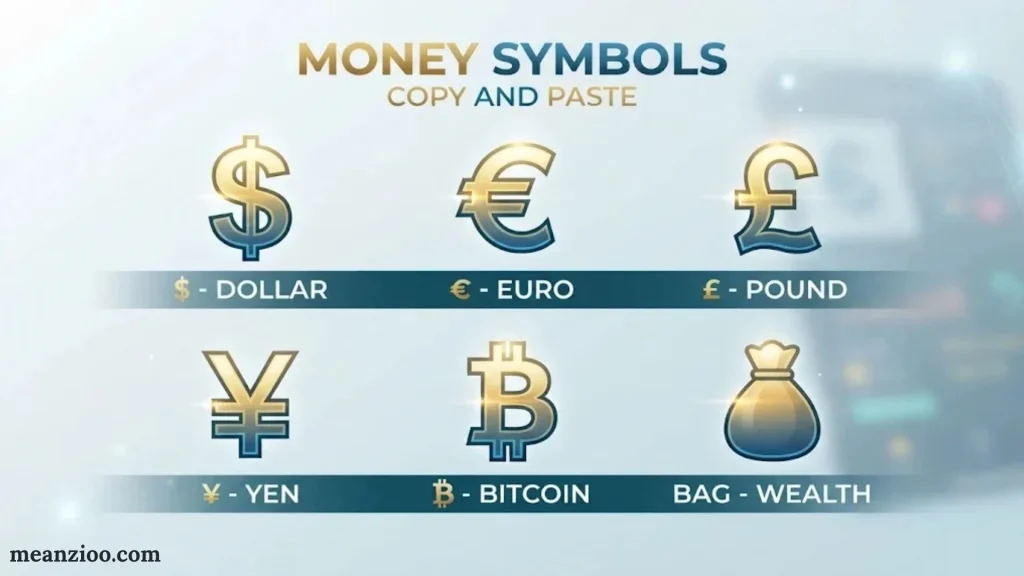
Looking for a particular money symbol? Use this collection to copy the character you need. Each symbol includes its currency name and commonly used three-letter code.
Common Money Symbols
$
Dollar
Copy
€
Euro
Copy
£
Pound
Copy
¥
Yen / Yuan
Copy
₹
Indian Rupee
Copy
₨
Rupee
Copy
₩
Won
Copy
₽
Ruble
Copy
₺
Turkish Lira
Copy
₱
Philippine Peso
Copy
฿
Baht
Copy
₫
Dong
Copy
₦
Naira
Copy
₴
Hryvnia
Copy
₡
Colon
Copy
₲
Guarani
Copy
₵
Cedi
Copy
₸
Tenge
Copy
₮
Tögrög
Copy
₭
Kip
Copy
₼
Manat
Copy
֏
Dram
Copy
৳
Taka
Copy
៛
Riel
Copy
₿
Bitcoin
Copy
Money Symbols with Names and Currency Codes
| Symbol | Currency name | ISO code |
| $ | US Dollar | USD |
| € | Euro | EUR |
| £ | British Pound | GBP |
| ¥ | Japanese Yen | JPY |
| ¥ | Chinese Yuan | CNY |
| ₹ | Indian Rupee | INR |
| ₨ | Pakistani Rupee | PKR |
| ₩ | South Korean Won | KRW |
| ₽ | Russian Ruble | RUB |
| ₺ | Turkish Lira | TRY |
| ₱ | Philippine Peso | PHP |
| ฿ | Thai Baht | THB |
| ₦ | Nigerian Naira | NGN |
| ₫ | Vietnamese Dong | VND |
| ₴ | Ukrainian Hryvnia | UAH |
| R | South African Rand | ZAR |
| R$ | Brazilian Real | BRL |
| ₡ | Costa Rican Colón | CRC |
| zł | Polish Złoty | PLN |
| ₸ | Kazakhstani Tenge | KZT |
| ₮ | Mongolian Tögrög | MNT |
| ₭ | Lao Kip | LAK |
| ₵ | Ghanaian Cedi | GHS |
| ₼ | Azerbaijani Manat | AZN |
| ֏ | Armenian Dram | AMD |
| ৳ | Bangladeshi Taka | BDT |
| ៛ | Cambodian Riel | KHR |
| ₿ | Bitcoin | BTC |
Note: Some currencies use different symbols or abbreviations depending on the country, language, and financial application. The table shows commonly encountered forms rather than a claim that every notation is an official standalone Unicode symbol.
How to Copy and Paste Money Symbols
Copying a currency sign takes only a few seconds.
- Find the symbol you want in the collection above.
- Select the character.
- Press Ctrl + C on Windows or Command + C on Mac.
- Open your document, message, or spreadsheet.
- Press Ctrl + V or Command + V to paste it.
For example, you can copy € and paste it into a shopping list, invoice, email, or social media post.
If a symbol appears as an empty square, your device or application may not support the required character font. Try updating the application or choosing a font with broader Unicode coverage.
What Are Money Symbols?
Money symbols, also called currency symbols or currency signs, are characters used to represent monetary units. They usually appear beside numerical amounts to show which currency a price or financial value represents.
For example:
- $50 represents fifty dollars.
- €100 represents one hundred euros.
- £25 represents twenty-five British pounds.
- ₹500 represents five hundred Indian rupees.
- ¥1,000 can represent Japanese yen or Chinese yuan, depending on context.
These symbols make financial information easier to read. Instead of writing a complete currency name every time, people can use a short character.
Why Do Different Countries Use Currency Symbols?
Every country needs a way to identify its money. Currency symbols provide a familiar visual reference for prices, payments, and financial records.
They serve several practical purposes:
- Price identification: Customers can recognize the currency used for products and services.
- Financial communication: Businesses can display monetary values more clearly.
- International trade: Currency signs help identify amounts in commercial documents.
- Banking: Financial institutions use currency identifiers when processing payments.
- Online shopping: E-commerce websites display prices in the selected currency.
- Travel: Visitors can recognize local money when checking menus, receipts, and store prices.
Consider an online store selling a product for $75. A customer in Canada might assume the price means Canadian dollars. Someone in the United States could interpret it as US dollars.
The symbol alone doesn’t always settle the question. A currency code makes the distinction clearer.
How Money Symbols Differ from Currency Names and Codes
A currency symbol, currency name, and currency code describe the same monetary unit in different ways.
| Type | Example | Meaning |
| Symbol | $ | Visual currency sign |
| Currency name | US Dollar | Name of the monetary unit |
| Currency code | USD | International identifier |
For example, the euro uses the symbol €, the name Euro, and the code EUR.
Similarly, Pakistan’s national currency is the Pakistani rupee. Its commonly used notation includes Rs and ₨, while its international code is PKR.
This distinction matters when dealing with international payments. A familiar symbol may represent several currencies, but a three-letter code identifies the intended currency much more precisely.
World Currency Symbols and Their Codes
There are hundreds of monetary units used across the world, but they don’t all have unique graphical symbols. Some countries share a currency, while others use similar signs with different international codes.
The ISO 4217 standard provides internationally recognized three-letter and numeric currency identifiers. For example, USD identifies the US dollar, EUR identifies the euro, and PKR identifies the Pakistani rupee. These codes help banks, businesses, and payment providers distinguish currencies accurately.
ISO 4217 — Currency codes+1
The following sections organize major world currencies by geographical region.
European Currency Symbols
Europe uses several national currencies alongside the euro. The euro is the official currency of the euro area, while countries such as Switzerland, Poland, and the United Kingdom maintain separate currencies.
European currencies and commonly used symbols
| Country | Currency | Symbol / notation | Code |
| Albania | Albanian Lek | L | ALL |
| Belarus | Belarusian Ruble | Br | BYN |
| Bosnia and Herzegovina | Convertible Mark | KM | BAM |
| Bulgaria | Euro | € | EUR |
| Czechia | Czech Koruna | Kč | CZK |
| Denmark | Danish Krone | kr | DKK |
| Hungary | Hungarian Forint | Ft | HUF |
| Iceland | Icelandic Króna | kr | ISK |
| Liechtenstein | Swiss Franc | CHF | CHF |
| Moldova | Moldovan Leu | L | MDL |
| North Macedonia | Macedonian Denar | ден | MKD |
| Norway | Norwegian Krone | kr | NOK |
| Poland | Polish Złoty | zł | PLN |
| Romania | Romanian Leu | lei | RON |
| Russia | Russian Ruble | ₽ | RUB |
| Serbia | Serbian Dinar | дин. | RSD |
| Sweden | Swedish Krona | kr | SEK |
| Switzerland | Swiss Franc | CHF | CHF |
| Ukraine | Ukrainian Hryvnia | ₴ | UAH |
| United Kingdom | Pound Sterling | £ | GBP |
| Turkey | Turkish Lira | ₺ | TRY |
An important 2026 update: Bulgaria adopted the euro on January 1, 2026, replacing the Bulgarian lev. Its conversion rate was fixed at €1 = 1.95583 lev. Therefore, the euro—not the lev—is Bulgaria’s current currency.
SIX
The euro is also used in several countries outside the European Union, including Andorra, Monaco, San Marino, and Vatican City under monetary agreements.
North American and Caribbean Currency Symbols
North America and the Caribbean contain numerous dollar-based currencies. Although many use the $ sign, their monetary values and exchange rates differ.
| Country or territory | Currency | Symbol / notation | Code |
| United States | US Dollar | $ | USD |
| Canada | Canadian Dollar | C$ | CAD |
| Mexico | Mexican Peso | $ / MX$ | MXN |
| Bahamas | Bahamian Dollar | B$ | BSD |
| Barbados | Barbadian Dollar | $ | BBD |
| Belize | Belize Dollar | BZ$ | BZD |
| Bermuda | Bermudian Dollar | $ | BMD |
| Cayman Islands | Cayman Islands Dollar | CI$ | KYD |
| Jamaica | Jamaican Dollar | J$ | JMD |
| Dominican Republic | Dominican Peso | RD$ | DOP |
| Trinidad and Tobago | Trinidad and Tobago Dollar | TT$ | TTD |
| Aruba | Aruban Florin | ƒ | AWG |
| Curaçao | Caribbean Guilder | Cg / NAf | XCG |
| Haiti | Haitian Gourde | G | HTG |
| Costa Rica | Costa Rican Colón | ₡ | CRC |
| Guatemala | Guatemalan Quetzal | Q | GTQ |
| Honduras | Honduran Lempira | L | HNL |
| Nicaragua | Nicaraguan Córdoba | C$ | NIO |
| Panama | Panamanian Balboa | B/. | PAB |
| Eastern Caribbean States | East Caribbean Dollar | EC$ | XCD |
| El Salvador | US Dollar | $ | USD |
The East Caribbean dollar is shared by several Caribbean economies. These include Antigua and Barbuda, Dominica, Grenada, Saint Kitts and Nevis, Saint Lucia, Saint Vincent and the Grenadines, Anguilla, and Montserrat.
El Salvador uses the US dollar as its official currency alongside its Bitcoin-related legal framework, although Bitcoin’s monetary role differs from ordinary fiat currency.
South American Currency Symbols
South America has a diverse collection of currencies. Several countries use peso-based names, while Brazil, Peru, and Paraguay have distinct monetary units.
| Country | Currency | Symbol / notation | Code |
| Argentina | Argentine Peso | $ | ARS |
| Bolivia | Boliviano | Bs | BOB |
| Brazil | Brazilian Real | R$ | BRL |
| Chile | Chilean Peso | $ | CLP |
| Colombia | Colombian Peso | $ | COP |
| Guyana | Guyanese Dollar | G$ | GYD |
| Paraguay | Paraguayan Guaraní | ₲ | PYG |
| Peru | Peruvian Sol | S/ | PEN |
| Suriname | Surinamese Dollar | $ / SRD$ | SRD |
| Uruguay | Uruguayan Peso | $U | UYU |
| Venezuela | Venezuelan Bolívar | Bs. | VES |
The Brazilian real uses the distinctive R$ notation. This helps distinguish it from other currencies that use a simple dollar sign.
Likewise, Peru uses S/ for the sol. These prefixes make currency identification easier in regional commerce and international shopping.
Middle Eastern Currency Symbols
Middle Eastern countries use a combination of Arabic-script currency notation and Latin-letter abbreviations. Some currencies also have internationally recognized symbols.
| Country | Currency | Symbol / notation | Code |
| United Arab Emirates | UAE Dirham | د.إ | AED |
| Saudi Arabia | Saudi Riyal | ر.س | SAR |
| Bahrain | Bahraini Dinar | .د.ب | BHD |
| Kuwait | Kuwaiti Dinar | د.ك | KWD |
| Oman | Omani Rial | ر.ع. | OMR |
| Qatar | Qatari Riyal | ر.ق | QAR |
| Jordan | Jordanian Dinar | د.ا | JOD |
| Iraq | Iraqi Dinar | ع.د | IQD |
| Iran | Iranian Rial | ﷼ | IRR |
| Israel | Israeli New Shekel | ₪ | ILS |
| Lebanon | Lebanese Pound | ل.ل | LBP |
| Syria | Syrian Pound | ل.س | SYP |
| Yemen | Yemeni Rial | ﷼ | YER |
Arabic currency notation can appear differently depending on the writing system and local formatting conventions.
For example, Arabic text generally follows a right-to-left direction. However, currency amounts may contain Latin digits, Arabic digits, and currency abbreviations together.
When international payment systems process these amounts, they rely on currency codes rather than visual symbols alone.
African Currency Symbols
Africa has several regional monetary systems, including national currencies and shared CFA franc currencies.
| Country | Currency | Symbol / notation | Code |
| Algeria | Algerian Dinar | دج | DZD |
| Angola | Angolan Kwanza | Kz | AOA |
| Botswana | Botswana Pula | P | BWP |
| Burundi | Burundian Franc | FBu | BIF |
| Cabo Verde | Cape Verdean Escudo | CVE | CVE |
| Comoros | Comorian Franc | CF | KMF |
| Democratic Republic of Congo | Congolese Franc | FC | CDF |
| Djibouti | Djiboutian Franc | Fdj | DJF |
| Egypt | Egyptian Pound | E£ | EGP |
| Eritrea | Eritrean Nakfa | Nfk | ERN |
| Eswatini | Swazi Lilangeni | L | SZL |
| Ethiopia | Ethiopian Birr | Br | ETB |
| Gambia | Gambian Dalasi | D | GMD |
| Ghana | Ghanaian Cedi | GH₵ | GHS |
| Guinea | Guinean Franc | FG | GNF |
| Kenya | Kenyan Shilling | KSh | KES |
| Lesotho | Lesotho Loti | L | LSL |
| Liberia | Liberian Dollar | L$ | LRD |
| Libya | Libyan Dinar | LD | LYD |
| Madagascar | Malagasy Ariary | Ar | MGA |
| Malawi | Malawian Kwacha | MK | MWK |
| Mauritania | Mauritanian Ouguiya | UM | MRU |
| Mauritius | Mauritian Rupee | Rs | MUR |
| Morocco | Moroccan Dirham | DH | MAD |
| Mozambique | Mozambican Metical | MT | MZN |
| Namibia | Namibian Dollar | N$ | NAD |
| Nigeria | Nigerian Naira | ₦ | NGN |
| Rwanda | Rwandan Franc | FRw | RWF |
| São Tomé and Príncipe | Dobra | Db | STN |
| Seychelles | Seychellois Rupee | Rs | SCR |
| Sierra Leone | Leone | Le | SLE |
| Somalia | Somali Shilling | Sh.So. | SOS |
| South Africa | South African Rand | R | ZAR |
| South Sudan | South Sudanese Pound | SS£ | SSP |
| Sudan | Sudanese Pound | ج.س. | SDG |
| Tanzania | Tanzanian Shilling | TSh | TZS |
| Tunisia | Tunisian Dinar | د.ت | TND |
| Uganda | Ugandan Shilling | USh | UGX |
| Zambia | Zambian Kwacha | K | ZMW |
| Zimbabwe | Zimbabwe Gold | ZiG | ZWG |
Two regional currency systems deserve special attention.
The West African CFA franc (XOF) serves eight West African countries: Benin, Burkina Faso, Côte d’Ivoire, Guinea-Bissau, Mali, Niger, Senegal, and Togo.
The Central African CFA franc (XAF) serves six Central African countries: Cameroon, Central African Republic, Chad, Republic of the Congo, Equatorial Guinea, and Gabon.
Although both currencies are called CFA francs, they have separate ISO codes and aren’t interchangeable at par in the same way as a single shared currency.
Zimbabwe also requires careful treatment. Its currency arrangements have changed over time. Zimbabwe Gold, commonly called ZiG, was introduced in 2024 and received the ISO code ZWG. Other currencies may also circulate under the country’s monetary arrangements.
Asian Currency Symbols
Asia contains some of the world’s most recognizable currency signs, including the Indian rupee, Japanese yen, Chinese yuan, and South Korean won.
| Country or territory | Currency | Symbol / notation | Code |
| Afghanistan | Afghan Afghani | ؋ | AFN |
| Armenia | Armenian Dram | ֏ | AMD |
| Azerbaijan | Azerbaijani Manat | ₼ | AZN |
| Bangladesh | Bangladeshi Taka | ৳ | BDT |
| Bhutan | Bhutanese Ngultrum | Nu. | BTN |
| Brunei | Brunei Dollar | B$ | BND |
| Cambodia | Cambodian Riel | ៛ | KHR |
| China | Chinese Yuan | ¥ / 元 | CNY |
| Georgia | Georgian Lari | ₾ | GEL |
| Hong Kong | Hong Kong Dollar | HK$ | HKD |
| India | Indian Rupee | ₹ | INR |
| Indonesia | Indonesian Rupiah | Rp | IDR |
| Japan | Japanese Yen | ¥ | JPY |
| Kazakhstan | Kazakhstani Tenge | ₸ | KZT |
| Kyrgyzstan | Kyrgyzstani Som | сом | KGS |
| Laos | Lao Kip | ₭ | LAK |
| Macau | Macanese Pataca | MOP$ | MOP |
| Malaysia | Malaysian Ringgit | RM | MYR |
| Maldives | Maldivian Rufiyaa | Rf | MVR |
| Mongolia | Mongolian Tögrög | ₮ | MNT |
| Myanmar | Myanmar Kyat | K | MMK |
| Nepal | Nepalese Rupee | Rs | NPR |
| North Korea | North Korean Won | ₩ | KPW |
| Pakistan | Pakistani Rupee | Rs / ₨ | PKR |
| Philippines | Philippine Peso | ₱ | PHP |
| Singapore | Singapore Dollar | S$ | SGD |
| South Korea | South Korean Won | ₩ | KRW |
| Sri Lanka | Sri Lankan Rupee | Rs | LKR |
| Taiwan | New Taiwan Dollar | NT$ | TWD |
| Tajikistan | Tajikistani Somoni | SM | TJS |
| Thailand | Thai Baht | ฿ | THB |
| Timor-Leste | US Dollar | $ | USD |
| Turkmenistan | Turkmenistani Manat | m | TMT |
| Uzbekistan | Uzbekistani Som | soʻm | UZS |
| Vietnam | Vietnamese Đồng | ₫ | VND |
Some Asian currencies have unique Unicode symbols. Others use familiar Latin abbreviations such as Rp, RM, and Rs.
Pakistan’s rupee, for instance, is commonly written as Rs. Its international code is PKR, which is especially useful for international transfers and financial records.
Oceanian Currency Symbols
Oceania includes Australia, New Zealand, and several Pacific island nations. Many use independent currencies, while some smaller countries use the Australian dollar.
| Country | Currency | Symbol / notation | Code |
| Australia | Australian Dollar | A$ | AUD |
| New Zealand | New Zealand Dollar | NZ$ | NZD |
| Fiji | Fijian Dollar | FJ$ | FJD |
| Papua New Guinea | Papua New Guinean Kina | K | PGK |
| Samoa | Samoan Tālā | WS$ | WST |
| Tonga | Tongan Paʻanga | T$ | TOP |
| Vanuatu | Vanuatu Vatu | VT | VUV |
| Solomon Islands | Solomon Islands Dollar | SI$ | SBD |
| Kiribati | Australian Dollar | A$ | AUD |
| Tuvalu | Australian Dollar | A$ | AUD |
| Nauru | Australian Dollar | A$ | AUD |
The Australian dollar is shared by several Pacific island countries. This makes AUD an important currency beyond Australia’s own borders.
Major Currency Symbols and Their Meanings
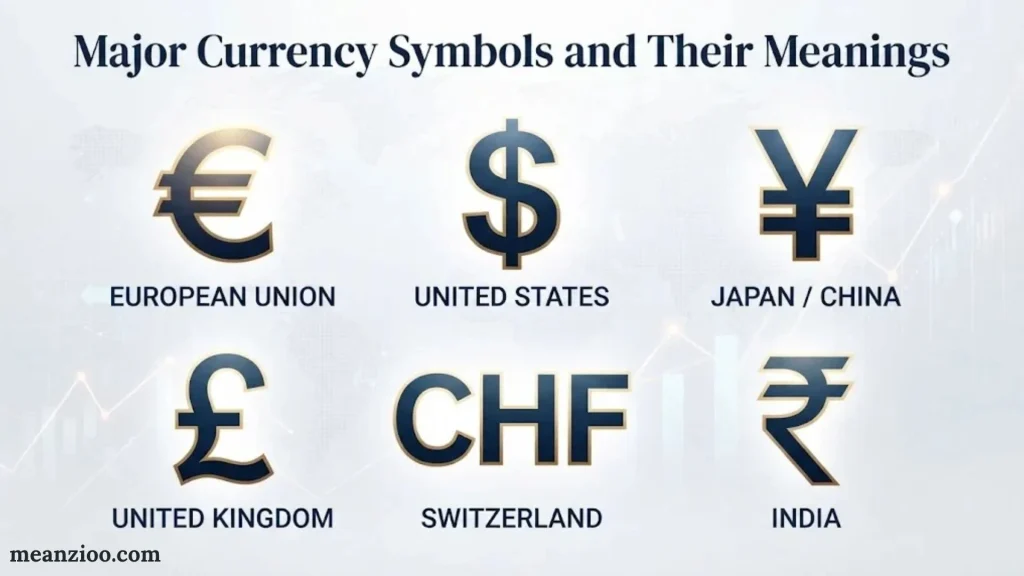
Some money symbols appear much more frequently than others. Understanding their backgrounds helps explain why they look different and how people use them.
Dollar Sign ($)
$
Dollar Sign
Commonly associated with USD, CAD, AUD, and other dollar currencies.
The dollar sign is among the most recognizable money symbols worldwide. It appears in prices, business documents, financial reports, and online stores.
The United States uses $ for its dollar. However, several other countries also use the same basic character.
Examples include:
- United States: USD ($)
- Canada: CAD (C$)
- Australia: AUD (A$)
- New Zealand: NZD (NZ$)
- Singapore: SGD (S$)
- Mexico: MXN ($ or MX$)
The sign’s historical development is linked to the Spanish-American peso, which circulated widely in international trade. Its exact origin remains debated.
Euro Sign (€)
€
Euro Sign
International currency code: EUR
The euro sign represents the common currency used by euro-area countries.
Its design features a stylized letter E with two parallel horizontal lines. The design refers to Europe and symbolizes stability.
The euro was introduced for electronic financial transactions in 1999. Euro banknotes and coins entered circulation in 2002.
Today, the symbol appears on shopping websites, travel prices, invoices, and international financial documents.
British Pound Sign (£)
£
British Pound Sign
International currency code: GBP
The British pound sterling uses the £ symbol. Its historical connection comes from the Latin word libra, referring to a unit of weight.
The pound is one of the world’s oldest currencies still in use. It remains the official currency of the United Kingdom.
You may see amounts written as:
- £10
- £50
- £100
- £1,000
The symbol usually appears before the amount without a separating space in standard English-language UK formatting.
Japanese Yen and Chinese Yuan Sign (¥)
¥
Yen and Yuan Sign
Japanese Yen: JPY · Chinese Yuan: CNY
The yen and yuan share the ¥ symbol in many international contexts.
Japan uses the yen, while China uses the yuan as its basic unit of currency.
Although their symbols look identical, their currency codes differ. That’s why financial systems use JPY and CNY to distinguish them.
For example:
- ¥5,000 JPY means five thousand Japanese yen.
- ¥5,000 CNY means five thousand Chinese yuan.
The country or currency code provides the necessary context.
Indian Rupee Sign (₹)
₹
Indian Rupee Sign
International currency code: INR
India introduced the modern rupee symbol in 2010. Its design combines elements associated with the Devanagari letter र and the Latin letter R.
The symbol represents India’s national currency and distinguishes it from other rupee-denominated currencies.
Examples include:
- ₹100
- ₹500
- ₹1,000
- ₹10,000
The Indian rupee sign is also included in the Unicode character standard, making it available in modern operating systems and digital applications.
Other Recognizable Currency Symbols
Several other currency signs are worth recognizing:
| Symbol | Currency | Country |
| ₩ | Won | South Korea |
| ₽ | Ruble | Russia |
| ₺ | Lira | Turkey |
| ₦ | Naira | Nigeria |
| ₱ | Peso | Philippines |
| ฿ | Baht | Thailand |
| ₴ | Hryvnia | Ukraine |
| ₫ | Đồng | Vietnam |
| ₡ | Colón | Costa Rica |
| ₲ | Guaraní | Paraguay |
| ₵ | Cedi | Ghana |
| ₸ | Tenge | Kazakhstan |
| ₮ | Tögrög | Mongolia |
| ₭ | Kip | Laos |
| ₼ | Manat | Azerbaijan |
| ֏ | Dram | Armenia |
| ৳ | Taka | Bangladesh |
| ៛ | Riel | Cambodia |
These characters are especially useful when you need to identify foreign prices without writing out the complete currency name.
Currency Symbols vs. Currency Codes
Currency symbols and codes are closely related, but they aren’t interchangeable in every situation.
A symbol makes a price visually recognizable. A code identifies the currency precisely.
What Is a Currency Symbol?
A currency symbol is a character or commonly used notation representing a monetary unit.
Examples include:
- $ for dollars.
- € for euros.
- £ for pounds.
- ₹ for Indian rupees.
- ₦ for Nigerian naira.
A symbol is convenient for everyday pricing. However, it may not uniquely identify the currency.
What Is an ISO 4217 Currency Code?
ISO 4217 is an international standard that defines three-letter alphabetic currency codes and corresponding three-digit numeric codes.
The standard is used in banking, commerce, financial software, and international transactions.
ISO 4217 — Currency codes+1
Here are some examples:
| Currency | Alphabetic code | Numeric code |
| US Dollar | USD | 840 |
| Euro | EUR | 978 |
| British Pound | GBP | 826 |
| Japanese Yen | JPY | 392 |
| Indian Rupee | INR | 356 |
| Pakistani Rupee | PKR | 586 |
| Canadian Dollar | CAD | 124 |
| Australian Dollar | AUD | 036 |
| Swiss Franc | CHF | 756 |
| Chinese Yuan | CNY | 156 |
Currency Symbol vs. Currency Code: Key Differences
| Feature | Currency Symbol | Currency Code |
| Format | Character or notation | Three letters |
| Example | $ | USD |
| Main purpose | Displaying prices | Identifying currencies |
| International clarity | Sometimes ambiguous | More precise |
| Common use | Receipts and price tags | Banking and transfers |
| Standardization | Varies by locale | ISO 4217 |
The numeric codes also help computer systems and international applications identify currencies without depending on language-specific characters.
Why Are Currency Codes Important in International Payments?
Imagine sending 500 units of money to another country. If you write only $500, the recipient may not know which dollar currency you mean.
The amount could represent USD, CAD, AUD, or another dollar-based currency.
Writing USD 500 removes that uncertainty.
Currency codes help with:
- International bank transfers.
- Foreign exchange transactions.
- Cross-border invoices.
- Online payment processing.
- Accounting software.
- Financial reporting.
- Currency conversion.
For international financial communication, always prefer the correct ISO code when the symbol could cause confusion.
Currency Symbols Shared by Different Countries
One of the most confusing aspects of international money is that several currencies use identical or nearly identical signs.
A dollar sign doesn’t automatically mean US dollars. Likewise, a rupee abbreviation doesn’t always identify Indian money.
Countries That Use Dollar Signs ($)
Many countries use the dollar sign as their primary currency notation.
| Country | Currency | Code | Common notation |
| United States | US Dollar | USD | $ |
| Canada | Canadian Dollar | CAD | C$ |
| Australia | Australian Dollar | AUD | A$ |
| New Zealand | New Zealand Dollar | NZD | NZ$ |
| Singapore | Singapore Dollar | SGD | S$ |
| Hong Kong | Hong Kong Dollar | HKD | HK$ |
| Mexico | Mexican Peso | MXN | MX$ |
| Jamaica | Jamaican Dollar | JMD | J$ |
| Bahamas | Bahamian Dollar | BSD | B$ |
| Belize | Belize Dollar | BZD | BZ$ |
These prefixes distinguish different monetary units while preserving the familiar dollar character.
Countries That Use the Peso Sign ($)
The peso sign appears in several countries with independent currencies.
- Mexico – Mexican Peso (MXN)
- Argentina – Argentine Peso (ARS)
- Chile – Chilean Peso (CLP)
- Colombia – Colombian Peso (COP)
- Philippines – Philippine Peso (PHP)
- Uruguay – Uruguayan Peso (UYU)
Although these currencies share a name and symbol, their exchange rates and purchasing power differ.
Countries That Use Rupee Symbols or Notation
Several countries use currencies called rupees.
| Country | Currency | Code | Common notation |
| India | Indian Rupee | INR | ₹ |
| Pakistan | Pakistani Rupee | PKR | Rs / ₨ |
| Nepal | Nepalese Rupee | NPR | Rs |
| Sri Lanka | Sri Lankan Rupee | LKR | Rs |
| Mauritius | Mauritian Rupee | MUR | Rs |
| Seychelles | Seychellois Rupee | SCR | Rs |
India has its own distinctive rupee symbol, ₹. Other countries frequently use Rs or related notation.
Countries That Use the Yen and Yuan Sign (¥)
China and Japan are the best-known users of the ¥ sign.
- Japan: Japanese Yen (JPY).
- China: Chinese Yuan (CNY).
The shared sign can create confusion when reading international prices. Always check the country, currency name, or ISO code.
Countries That Use Won Symbols (₩)
The won is used in both North Korea and South Korea.
| Country | Currency | Code | Symbol |
| South Korea | South Korean Won | KRW | ₩ |
| North Korea | North Korean Won | KPW | ₩ |
The currencies have different values and aren’t interchangeable. Their ISO codes provide clear identification.
How to Identify Similar Currency Symbols
Use these simple checks when you encounter an unfamiliar monetary amount:
- Check the country: Identify where the price or transaction originates.
- Look for prefixes: C$, A$, and HK$ provide additional information.
- Find the currency code: USD, CAD, and AUD identify specific currencies.
- Check the payment details: Bank statements and invoices usually specify the currency.
- Confirm before converting: Never assume two currencies with identical symbols have equal values.
Cryptocurrency Symbols and Their Meanings
Traditional money isn’t the only type of currency-related value you’ll encounter online. Cryptocurrencies also use symbols, abbreviations, and trading tickers.
Unlike national currencies, cryptocurrencies operate through digital networks and blockchain technology. Their symbols help users identify digital assets on exchanges, wallets, and payment platforms.
However, cryptocurrency tickers aren’t governed by the same ISO 4217 currency-code system used for national currencies.
Popular Cryptocurrency Symbols and Codes
| Cryptocurrency | Symbol or ticker | Common identifier |
| Bitcoin | ₿ | BTC |
| Ethereum | Ξ / ETH | ETH |
| Tether | ₮ / USDT | USDT |
| BNB | BNB | BNB |
| Solana | SOL | SOL |
| XRP | XRP | XRP |
| Dogecoin | Ð / DOGE | DOGE |
| Litecoin | Ł / LTC | LTC |
| Cardano | ADA | ADA |
| USD Coin | USDC | USDC |
| Polkadot | DOT | DOT |
| Avalanche | AVAX | AVAX |
| Chainlink | LINK | LINK |
Some cryptocurrencies have recognizable graphical logos rather than dedicated currency characters. Their ticker abbreviations are generally more useful for identifying them across exchanges.
Bitcoin Symbol (₿)
₿
Bitcoin
Ticker: BTC
Bitcoin uses the ₿ symbol, which resembles a capital B with two vertical strokes.
It represents the Bitcoin network’s native digital asset. The ticker BTC appears on cryptocurrency exchanges, trading charts, and digital wallets.
For example:
- ₿0.01 represents one-hundredth of a bitcoin.
- 1 BTC represents one bitcoin.
- 0.5 BTC represents half a bitcoin.
Bitcoin transactions take place on a decentralized blockchain rather than through a conventional central bank.
Ethereum Symbol (Ξ)
Ξ
Ethereum
Ticker: ETH
Ethereum is a blockchain platform that supports smart contracts and decentralized applications.
Its native cryptocurrency is Ether, commonly identified by the ticker ETH. The diamond-shaped Ethereum logo is widely recognized, while Ξ is sometimes used as a text-style representation.
When discussing transactions or exchange prices, ETH is the clearer identifier.
Tether Symbol (₮)
₮
Tether
Ticker: USDT
Tether issues USDT, a stablecoin designed to maintain a value close to one US dollar.
Unlike Bitcoin, which experiences market price fluctuations, USDT aims to maintain a relatively stable price through its reserve and redemption arrangements.
Its ticker, USDT, is more precise than the ₮ character because that character can also represent the Mongolian tögrög in traditional currency notation.
Cryptocurrency Symbols vs. Traditional Currency Symbols
| Feature | Traditional Currency | Cryptocurrency |
| Examples | USD, EUR, PKR | BTC, ETH, SOL |
| Issuance | Usually central banks or monetary authorities | Blockchain protocols or issuing organizations |
| Representation | Symbols and ISO codes | Logos, symbols, and tickers |
| Transaction system | Banks and payment networks | Blockchain networks and platforms |
| Regulation | National financial frameworks | Varies by country and asset |
| Value | Depends on monetary and economic conditions | Depends on asset design and market conditions |
Cryptocurrency symbols are useful for recognition, but tickers and network details matter more when transferring digital assets. Sending a token to the wrong blockchain address can cause serious losses.
How to Type Money Symbols on a Keyboard
You don’t need to search for a special character every time you want to write a currency sign. Most computers and smartphones offer built-in ways to enter common monetary symbols.
How to Type Currency Symbols on Windows
Windows supports several currency characters through keyboard shortcuts and numeric Alt codes.
| Currency symbol | Keyboard shortcut |
| Dollar ($) | Shift + 4 |
| Euro (€) | Alt + 0128 |
| British Pound (£) | Alt + 0163 |
| Yen (¥) | Alt + 0165 |
| Cent (¢) | Alt + 0162 |
To use an Alt code:
- Turn on Num Lock if your keyboard requires it.
- Hold the Alt key.
- Enter the numeric code using the numeric keypad.
- Release Alt to insert the character.
Important: Alt-code behavior depends on Windows configuration, keyboard layout, and application. The numeric keypad is generally required for these decimal Alt codes.
You can also open Windows Character Map to find and copy less common currency characters.
How to Type Currency Symbols on Mac
Mac keyboards provide Option-key combinations for several currency signs.
| Currency symbol | Common US Mac shortcut |
| Dollar ($) | Shift + 4 |
| Euro (€) | Option + Shift + 2 |
| British Pound (£) | Option + 3 |
| Yen (¥) | Option + Y |
These combinations apply to common US keyboard layouts. Other layouts may assign different shortcuts.
You can also use the macOS Character Viewer:
- Open the application where you want the symbol.
- Press Control + Command + Space.
- Search for the currency name.
- Select the character to insert it.
How to Type Money Symbols on Android
Android smartphones usually provide currency signs through their virtual keyboards.
Follow these steps:
- Open a messaging application or document.
- Tap the text field.
- Open the keyboard’s numbers and symbols layout.
- Find the required currency character.
- Tap it to insert it.
Some keyboards display additional currency signs when you press and hold the dollar sign.
The exact options depend on your keyboard application and language settings.
How to Type Money Symbols on iPhone
iPhone users can also enter currency signs through the standard iOS keyboard.
- Open Messages, Notes, or another writing application.
- Tap the text field.
- Select the numbers and symbols keyboard.
- Find the desired currency sign.
- Tap the character to insert it.
If a particular currency symbol isn’t visible, use the search or character insertion options available through your device’s supported input methods.
Using Unicode and HTML Codes for Currency Symbols
Unicode assigns unique code points to many currency characters. These identifiers help computers store and display symbols consistently across applications.
Here are some useful examples:
| Character | Unicode code point | HTML entity |
| $ | U+0024 | $ |
| € | U+20AC | € |
| £ | U+00A3 | £ |
| ¥ | U+00A5 | ¥ |
| ₹ | U+20B9 | ₹ |
| ₩ | U+20A9 | ₩ |
| ₦ | U+20A6 | ₦ |
| ₽ | U+20BD | ₽ |
| ₺ | U+20BA | ₺ |
| ₿ | U+20BF | ₿ |
Unicode code points and HTML entities serve different purposes. A Unicode identifier describes the character itself, while an HTML entity provides a way to represent it in HTML source code.
The Unicode currency-symbol block includes characters such as ₦, ₨, ₹, ₩, €, ₺, and ₿. However, many other currency signs are encoded elsewhere in Unicode.
Unicode+1
How to Insert Money Symbols in Documents and Spreadsheets
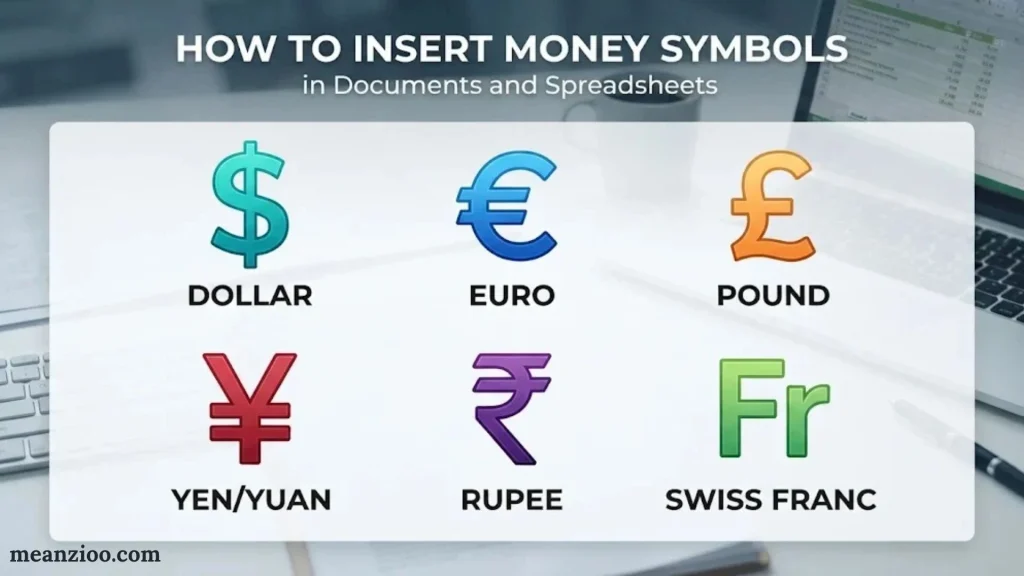
Currency signs are common in business documents, budgets, invoices, and spreadsheets. Most popular office applications provide dedicated formatting and insertion tools.
How to Insert Currency Symbols in Microsoft Word
Microsoft Word includes a built-in symbol library.
Follow these instructions:
- Open your Word document.
- Place the cursor where the symbol should appear.
- Select Insert from the top menu.
- Choose Symbol.
- Select the desired currency character.
- Click Insert.
If you can’t find the symbol immediately, select More Symbols and search through the available characters.
For frequently used characters, keyboard shortcuts and Unicode conversion can save time.
How to Insert Currency Symbols in Google Docs
Google Docs offers a Special Characters tool.
- Open your document.
- Select Insert.
- Click Special characters.
- Search for the currency name or draw the character.
- Select the matching symbol.
The character will appear wherever your cursor is positioned.
This method works well when writing international reports or documents that contain multiple currency types.
How to Add Currency Symbols in Microsoft Excel
Excel offers currency and accounting formats that automatically display monetary symbols.
For example, if you enter 2500 into a cell and apply a dollar format, Excel can display $2,500.00.
Follow these steps:
- Select the cells containing monetary values.
- Right-click and choose Format Cells.
- Open the Number tab.
- Select Currency or Accounting.
- Choose the appropriate symbol.
- Set the number of decimal places.
- Click OK.
Currency formatting doesn’t automatically convert money. Changing a cell from USD to EUR changes its displayed currency notation, not the underlying exchange value.
For accurate financial reports, convert the actual amount using an appropriate exchange rate before changing the currency label.
How to Add Currency Symbols in Google Sheets
Google Sheets also provides built-in currency formatting.
- Select the cells you want to format.
- Open the Format menu.
- Choose Number.
- Select the required currency format.
- Use custom currency options when available.
You can also apply different formats to different columns.
For example, one column can display USD amounts while another shows EUR amounts. This makes international budgets easier to read and compare.
How to Use Currency Symbols Correctly
Knowing the right symbol is only part of writing monetary amounts correctly. Different countries follow different conventions for number formatting, decimal separators, and currency placement.
Currency Symbols Before or After Numbers
Some currencies usually place their symbols before the amount. Others place the symbol or abbreviation after the number.
| Currency | Common example | Placement |
| US Dollar | $100 | Before |
| Euro | €100 | Before in common English formatting |
| British Pound | £100 | Before |
| Indian Rupee | ₹100 | Before |
| Japanese Yen | ¥100 | Before |
| Pakistani Rupee | Rs 100 | Before |
| Swedish Krona | 100 kr | After |
| Danish Krone | 100 kr | After |
| Polish Złoty | 100 zł | After |
| Hungarian Forint | 100 Ft | After |
These are common examples rather than universal rules. Local language and regional formatting preferences can affect symbol placement.
Currency Symbol Placement Around the World
Currency formatting also differs in the way countries display decimal and thousands separators.
Consider these examples:
| Formatting style | Example |
| US English | $1,234.56 |
| German | 1.234,56 € |
| French | 1 234,56 € |
| British English | £1,234.56 |
| Japanese | ¥1,234 |
| Indian numbering style | ₹1,23,456.00 |
Notice the Indian numbering system. It groups digits differently from the Western system.
For example, 1000000 is commonly written as 10,00,000 in Indian-style grouping rather than 1,000,000.
These formatting differences matter when preparing invoices, financial reports, and international price lists.
Using Currency Symbols in Financial Documents
Use consistent currency notation throughout your financial documents.
Here are a few practical examples:
- Invoices: Write the currency code beside the total when clients operate internationally.
- Receipts: Display the local currency symbol clearly.
- Budgets: Keep the same currency format throughout each financial column.
- Business reports: Identify the currency in the heading or table label.
- International contracts: Specify the currency code instead of relying on an ambiguous symbol.
For example, writing USD 5,000 is clearer than simply writing $5,000 in an international contract.
Why You Should Use Currency Codes for International Transactions
International payments involve several currencies, financial institutions, and payment networks. A small identification mistake can create unnecessary confusion.
Always verify the following information before completing a transfer:
- Recipient’s country.
- Destination currency.
- Three-letter ISO currency code.
- Amount being transferred.
- Applicable exchange rate and fees.
For instance, USD and CAD both use dollar notation, but they represent different monetary units.
Using the correct code helps payment providers identify the intended currency and reduces avoidable errors.
Frequently Asked Questions About Money Symbols
How many money symbols are there in the world?
There isn’t one fixed number of money symbols because currencies use different graphical characters, abbreviations, and regional notations. Unicode also contains dedicated currency characters, while many currencies rely on combinations such as S$, C$, and Rs.
The number of currencies and the number of currency symbols aren’t the same.
What are the most common money symbols?
Some of the most recognizable money symbols include:
- $ – Dollar
- € – Euro
- £ – British Pound
- ¥ – Yen or Yuan
- ₹ – Indian Rupee
- ₩ – Korean Won
- ₽ – Russian Ruble
- ₦ – Nigerian Naira
- ₱ – Philippine Peso
- ฿ – Thai Baht
These symbols appear frequently in international shopping, financial documents, and online transactions.
What is the difference between a money symbol and a currency code?
A money symbol is a character used to display a monetary amount. A currency code is a standardized identifier used to identify a particular currency.
For example, $ represents a dollar sign, while USD specifically identifies the US dollar. Similarly, € represents the euro, and EUR is its international code.
Which countries share the same currency symbol?
Several countries share similar or identical currency symbols.
For example, the United States, Canada, Australia, and New Zealand use dollar signs. Japan and China use ¥ for the yen and yuan, respectively.
India, Pakistan, Nepal, and Sri Lanka also use rupee-related notation. Currency codes distinguish these monetary units.
What is the symbol for the US dollar?
The US dollar uses the $ symbol. Its international currency code is USD, and its numeric ISO 4217 code is 840.
You can write amounts as $10, $50, $100, or USD 1,000.
What is the symbol for the euro?
The euro uses the € symbol, and its international code is EUR. It is the official currency of euro-area countries.
You can write common amounts as €10, €50, and €100.
What is the symbol for the British pound?
The British pound sterling uses the £ symbol. Its international currency code is GBP.
Examples include £10, £50, £100, and £1,000.
What is the symbol for the Japanese yen?
The Japanese yen uses the ¥ symbol, and its ISO currency code is JPY.
China also uses ¥ for the yuan, but its international code is CNY.
What is the symbol for the Indian rupee?
The Indian rupee uses the ₹ symbol. Its international currency code is INR.
India officially adopted the modern rupee symbol in 2010.
How can I copy and paste money symbols?
Find the desired currency character in a symbol collection, select it, and copy it.
Use Ctrl + C on Windows or Command + C on Mac. Then paste it with Ctrl + V or Command + V.
You can also use the copy buttons in the collection near the beginning of this guide.
How do I type currency symbols on Windows and Mac?
Windows supports numeric Alt codes for several common currency characters. For example, Alt + 0128 inserts € in supported configurations.
Mac users can use Option-key combinations. Common US keyboard shortcuts include Option + 3 for £ and Option + Y for ¥.
Keyboard layouts and application support can affect these shortcuts.
Why do some currencies have similar symbols?
Similar currency symbols often reflect shared historical naming traditions, monetary relationships, or regional conventions.
For example, several countries use dollar signs because their currencies share the dollar name. Japan and China use the same yen-yuan character in many international contexts.
However, similar symbols don’t mean the currencies have equal values.
Where should currency symbols be placed?
Currency symbol placement depends on local writing conventions.
US dollars, euros, British pounds, and Indian rupees commonly appear before amounts. Some European currencies use abbreviations after numbers.
Examples include $100, £100, ₹100, and 100 kr.
What are the symbols for popular cryptocurrencies?
Bitcoin uses ₿, while Ethereum is commonly identified by ETH and sometimes Ξ. Tether uses USDT, and other popular cryptocurrency tickers include SOL, XRP, DOGE, and LTC.
Remember that cryptocurrency tickers are not the same as ISO 4217 currency codes.
Should I use a currency symbol or ISO code for international payments?
Use the ISO currency code whenever accuracy matters.
For example, write USD 500 rather than $500 when communicating an international payment. The code identifies the exact currency and avoids confusion with other dollar-denominated currencies.
Conclusion
Money symbols make financial information easier to recognize, understand, and communicate. From the familiar dollar sign ($) to the distinctive Indian rupee (₹) and Bitcoin (₿), each character represents an important part of modern monetary communication.
However, a symbol doesn’t always identify a currency uniquely. Countries such as the United States, Canada, Australia, and New Zealand share dollar notation. That’s why ISO 4217 currency codes remain essential for international payments and financial records.
This guide brings together world currency symbols, country names, currency codes, cryptocurrency tickers, keyboard shortcuts, and practical formatting instructions.
Keep the copy-and-paste collection handy whenever you need a particular currency sign. And when dealing with international money, always check the three-letter currency code before completing a transaction.

Hi, I’m Charlotte Hayes. I love writing about the newest English slang, pop culture phrases, and digital communication. I spend my time exploring how language evolves across social media, gaming, and everyday conversations. I enjoy sharing easy-to-understand guides that help learners keep up with modern English. My goal is to make every article useful, accurate, and enjoyable for readers around the world.
Books:
- Everyday Slang Dictionary
- Fluent Through Informal English
 Ryan Mitchell