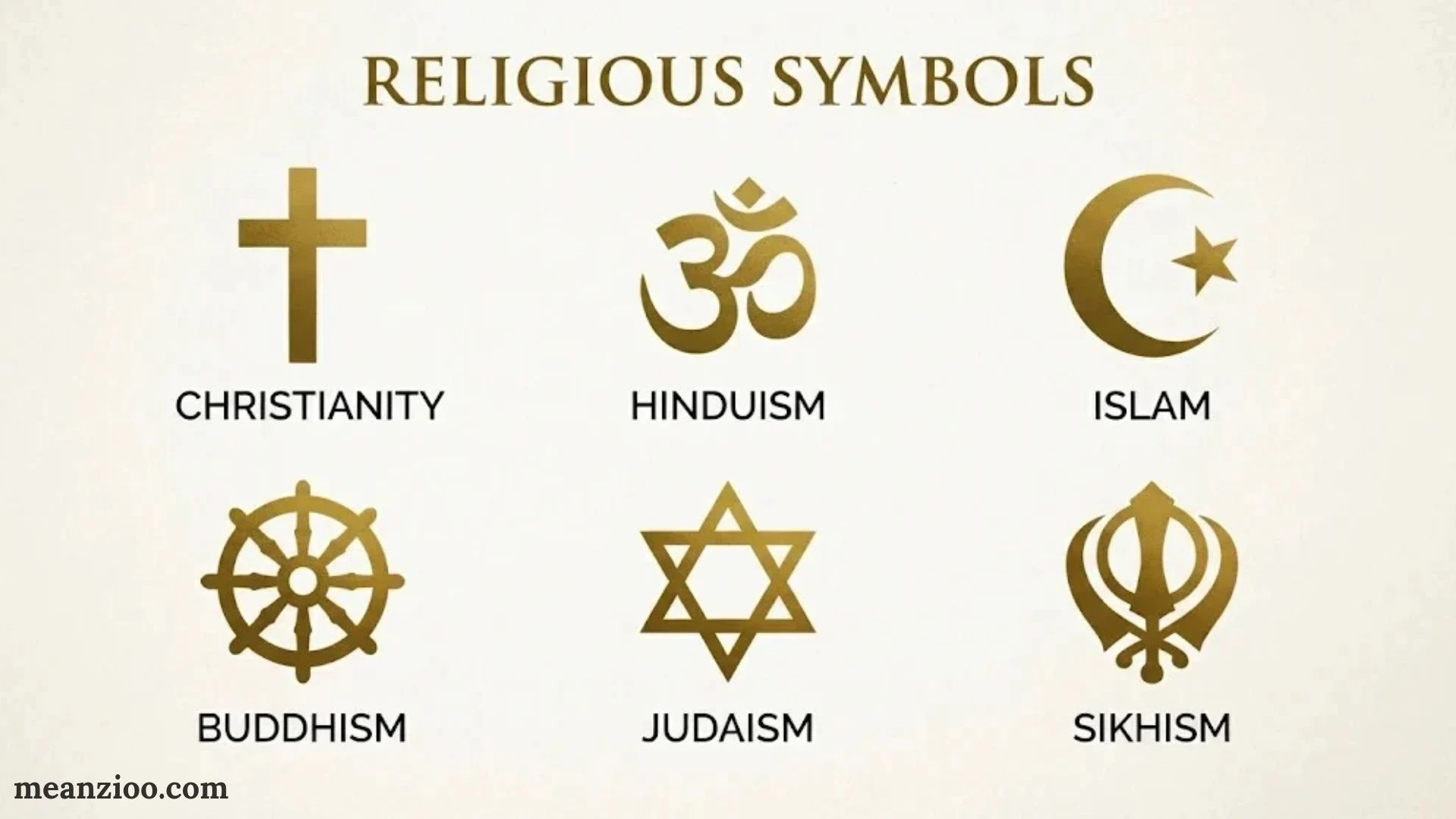
Religious symbols have a remarkable way of expressing ideas that words sometimes struggle to explain. A simple cross, a sacred syllable, or a geometric shape can represent centuries of belief, devotion, history, and cultural identity. These symbols connect people with their faith and remind them of teachings that continue to shape their lives.
Across the world, religions use symbols to represent God, spiritual truth, creation, compassion, wisdom, sacrifice, and the journey toward enlightenment. Some symbols appear in sacred buildings and religious ceremonies. Others accompany people through daily life as jewelry, prayer objects, artwork, or personal reminders of faith.
However, not every religious symbol carries the same meaning everywhere. A symbol may hold a deeply sacred place in one tradition while serving as a cultural emblem in another. Understanding its history helps you appreciate its significance without confusing different beliefs.
This guide explores the most recognized religious symbols and meanings, their origins, spiritual significance, historical development, and uses in modern society.
What Are Religious Symbols?
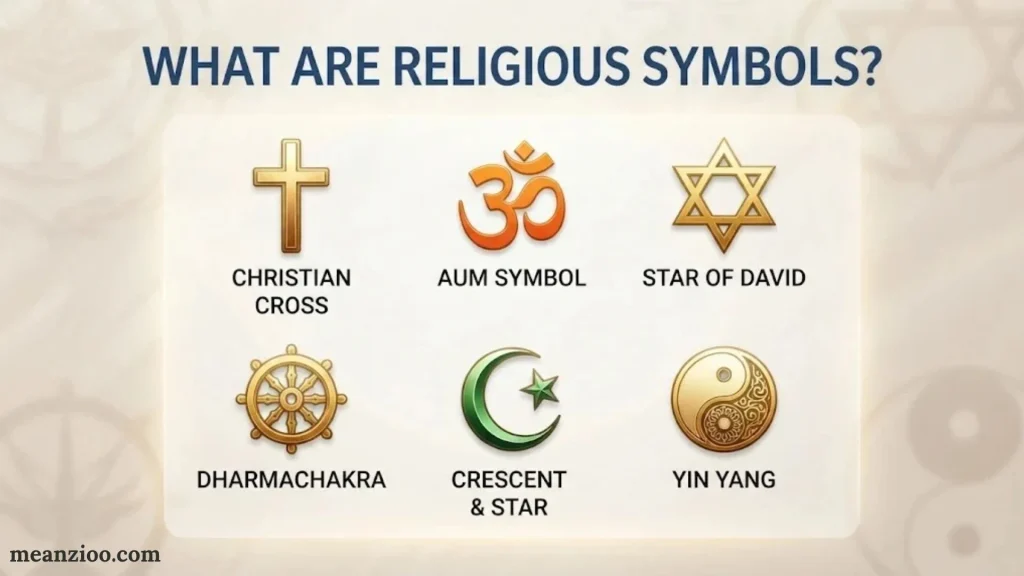
Religious symbols are signs, images, objects, shapes, or visual representations connected to religious beliefs, spiritual teachings, sacred traditions, and worship. They help people express ideas about the divine, understand religious principles, and recognize their connection to a faith community.
Some symbols represent a particular deity or religious figure. Others communicate abstract ideas such as eternity, compassion, salvation, purity, or the relationship between humanity and the spiritual world.
For example, Christians recognize the cross as a reminder of Jesus Christ’s crucifixion and resurrection. Hindus use Om as a sacred syllable associated with spiritual reality. Buddhists recognize the Dharma wheel as a representation of the Buddha’s teachings.
Religious symbols can take several forms:
- Sacred signs: Visual marks or shapes with religious significance.
- Religious objects: Items used during prayer, ceremonies, or worship.
- Sacred imagery: Paintings, statues, icons, and illustrations representing religious figures or teachings.
- Architectural symbols: Structures or decorative features connected to sacred spaces.
- Written symbols: Sacred words, calligraphy, inscriptions, and religious lettering.
Unlike ordinary decorative images, sacred symbols often carry layers of meaning shaped by religious history, tradition, and the beliefs of their followers.
Why Are Religious Symbols Important?
Religious symbols do more than decorate temples or identify a particular faith. They help people connect with beliefs, traditions, communities, and spiritual practices that shape their lives.
Expressing Faith and Devotion
A religious symbol can communicate a person’s beliefs without requiring an explanation. Wearing a cross, displaying an Om symbol, or carrying prayer beads may express devotion and remind someone of their spiritual commitments.
For many believers, these objects provide a meaningful connection to religious teachings. They can also serve as personal reminders to practice kindness, patience, humility, or gratitude.
Preserving Religious Heritage
Symbols carry stories from one generation to another. They preserve traditions, historical events, sacred teachings, and cultural memories.
A menorah, for instance, connects Jewish communities with religious history and traditions. Likewise, the Khanda represents important Sikh principles and serves as a recognizable expression of Sikh identity.
Creating Community and Belonging
Religious symbols help people recognize shared beliefs and cultural backgrounds. They appear during festivals, ceremonies, public gatherings, and religious celebrations.
When people see familiar sacred imagery, they may feel connected to a wider community. That sense of belonging can strengthen relationships and help preserve traditions.
Supporting Prayer and Meditation
Symbols can help believers focus their minds during prayer, meditation, or contemplation. Prayer beads, sacred images, and religious inscriptions often serve as visual or physical reminders of spiritual teachings.
They don’t replace prayer or religious practice. Instead, they can support concentration and encourage reflection.
Communicating Spiritual Ideas
Many spiritual concepts are difficult to explain through ordinary language. Symbols make these ideas easier to recognize and remember.
For example, a circle may represent wholeness in a particular context. A lotus may represent spiritual growth. A wheel may communicate the movement of teachings or the structure of a spiritual path.
Main Religious Symbols and Their Meanings
Many religious symbols have become recognizable across countries and cultures. However, their meanings depend on the traditions that use them.
The following symbols represent some of the world’s major religious and spiritual traditions.
The Cross – A Symbol of Christianity
Religion: Christianity
The cross is one of the most recognizable symbols of faith in the world. It represents the crucifixion of Jesus Christ and carries deep meaning for Christians.
In Christian belief, Jesus’ death on the cross represents sacrifice, redemption, and God’s love for humanity. Christians also connect the cross with resurrection, forgiveness, salvation, and the hope of eternal life.
Although Roman authorities used crucifixion as a form of punishment, Christians gradually adopted the cross as a central religious emblem. Over time, it became a visual expression of Christian identity and devotion.
What Does the Cross Symbolize?
- Sacrifice: Jesus gave his life according to Christian belief.
- Redemption: The cross represents the possibility of reconciliation with God.
- Forgiveness: It reminds Christians of God’s mercy and forgiveness of sins.
- Hope: The resurrection gives the cross a meaning beyond death.
- Love: It represents divine love and the relationship between God and humanity.
- Salvation: It connects with the Christian belief that Jesus offers salvation.
Different Types of Christian Crosses
| Cross | Description and significance |
| Latin cross | A vertical beam with a shorter horizontal beam near the top; widely recognized in Western Christianity |
| Orthodox cross | Often features additional crossbars and variations associated with Eastern Orthodox traditions |
| Celtic cross | A cross with a circle around the intersection, associated with Celtic Christian art and heritage |
| Greek cross | Four arms of equal length |
| Crucifix | A cross displaying the body of Jesus, particularly important in Catholic traditions |
The cross appears in churches, cemeteries, religious artwork, necklaces, prayer spaces, and Christian ceremonies. Its meaning remains closely connected to the central story of Christianity.
Crescent and Star – Islamic and Cultural Symbolism
Association: Muslim cultural identity and historical symbolism
The crescent and star is widely associated with Islam, although it isn’t a universal symbol of the religion. Its use developed through historical and cultural influences rather than a single religious command.
Crescent imagery existed in ancient civilizations long before Islam. It appeared in different cultural settings, including ancient Near Eastern traditions. The symbol later became strongly associated with Ottoman history and appeared on flags, architecture, and other cultural objects.
Today, many people recognize the crescent and star as a symbol associated with Muslim communities. It also appears on national flags, including those of several countries with Muslim-majority populations.
Common Associations of the Crescent
- Lunar cycles and the passage of time
- Historical Islamic cultural identity
- Religious and national symbolism
- Ottoman heritage
- Decorative elements in mosques and Islamic architecture
The Islamic calendar follows lunar months. The sighting of the new crescent has traditionally helped determine the beginning of important months, including Ramadan and Shawwal.
However, the crescent and star doesn’t represent all Muslims or all Islamic traditions. Islamic art also uses Arabic calligraphy, geometric patterns, and floral designs extensively.
Om (Aum) – The Sacred Symbol of Hinduism
Religion: Hinduism and related Indian spiritual traditions
Om, also written as Aum, is one of the most sacred sounds and symbols in Hinduism. Its written form, ॐ, represents a sacred syllable associated with spiritual reality, consciousness, and the ultimate truth.
Om appears in Hindu prayers, mantras, meditation, philosophical texts, and religious ceremonies. The syllable holds an important place in the Upanishads, where it receives philosophical and spiritual interpretations.
Many Hindu traditions connect Om with Brahman, the ultimate reality that underlies existence. Its significance goes beyond a simple sound or decorative symbol.
What Does Om Represent?
- Brahman: The ultimate reality in Hindu philosophical traditions.
- Consciousness: Awareness and the nature of existence.
- Sacred sound: A syllable used in prayer and spiritual practice.
- Meditation: A focus for concentration and contemplation.
- Spiritual unity: The relationship between individual existence and ultimate reality.
Some interpretations of Om’s three main sounds, A, U, and M, associate them with waking, dreaming, and deep sleep. These interpretations appear in particular philosophical traditions, especially discussions connected to the Mandukya Upanishad.
Om is commonly used in mantra chanting and meditation. It also appears in temples, religious artwork, sacred texts, and Hindu homes.
Wheel of Dharma (Dharmachakra) – A Buddhist Symbol of Teachings
Religion: Buddhism
The Wheel of Dharma, also called the Dharmachakra, represents the Buddha’s teachings and the path toward awakening. Its circular shape and spokes communicate ideas about spiritual practice, wisdom, and the movement of the Dharma.
Buddhist tradition associates the turning of the Dharma wheel with the Buddha’s teaching. The first sermon at Deer Park near Varanasi is often described as the first turning of the wheel of Dharma.
The wheel’s eight spokes commonly represent the Noble Eightfold Path, a practical guide to overcoming suffering and cultivating wisdom.
The Eight Spokes of the Dharma Wheel
| Path | Meaning |
| Right understanding | Seeing reality clearly |
| Right intention | Developing wholesome intentions |
| Right speech | Speaking truthfully and compassionately |
| Right action | Acting ethically |
| Right livelihood | Earning a living without causing harm |
| Right effort | Cultivating wholesome states and abandoning harmful ones |
| Right mindfulness | Developing awareness of body, feelings, mind, and experience |
| Right concentration | Training the mind through focused meditation |
The Dharma wheel appears in Buddhist temples, flags, sculptures, paintings, and teaching materials. It reminds followers of the teachings that guide the path toward liberation from suffering.
Star of David (Magen David) – A Symbol of Jewish Identity
Religion: Judaism
The Star of David, or Magen David, is a six-pointed star formed by two overlapping triangles. It has become one of the most recognizable symbols of Jewish identity and heritage.
The symbol’s history is more complex than many popular explanations suggest. The six-pointed star appeared in different cultures before it became a widely recognized Jewish emblem. Its association with Jewish communities grew over centuries.
Today, the Star of David represents Jewish identity, solidarity, cultural heritage, and community. It appears on synagogues, Jewish artwork, ceremonial objects, jewelry, and the flag of Israel.
What Does the Star of David Mean?
- Jewish identity: A recognizable expression of Jewish heritage.
- Community: A symbol shared by Jewish communities around the world.
- Tradition: A connection to Jewish history and cultural continuity.
- Solidarity: A symbol of unity and remembrance.
- Heritage: An emblem of Jewish religious and cultural identity.
Although people sometimes assign meanings such as harmony, heaven and earth, or divine protection to the star, those interpretations aren’t universal Jewish teachings.
Khanda – The Symbol of Sikhism
Religion: Sikhism
The Khanda is an important Sikh emblem that combines several weapons into one design. It reflects Sikh religious principles, spiritual commitment, justice, and the responsibility to protect others.
The emblem contains a double-edged sword called the Khanda, a circular weapon called the chakkar, and two curved swords called kirpans.
Each component has symbolic significance within Sikh tradition. Together, they express ideas related to spiritual devotion, courage, justice, and the balance between spiritual and worldly responsibilities.
The Khanda appears on Sikh flags, in gurdwaras, religious artwork, and community displays. It serves as an important marker of Sikh identity and heritage.
Jain Ahimsa Hand – A Symbol of Nonviolence
Religion: Jainism
The Jain Ahimsa symbol features an open hand with a wheel in its center. It represents nonviolence, restraint, and respect for all living beings.
Jainism teaches Ahimsa, or nonviolence, as a central ethical principle. Followers seek to avoid harming living beings through their actions, words, and intentions.
The wheel in the palm is often associated with the cycle of rebirth and the importance of stopping harmful actions. The word Ahimsa written in the center reinforces the principle of nonviolence.
The symbol reminds followers that spiritual progress requires compassion, self-discipline, and careful consideration of how their actions affect others.
Ichthys – The Christian Fish Symbol
Religion: Christianity
The Ichthys, commonly known as the Christian fish, consists of two curved lines that form a fish shape. Early Christians used the fish as a recognizable religious symbol.
The Greek word ichthys means fish. Early Christians connected the fish with Jesus and Christian belief. The Greek letters of the word also became associated with a Christian confession identifying Jesus as Christ, the Son of God, and Savior.
Today, the fish appears on car stickers, jewelry, church decorations, and other Christian objects. It remains a simple yet meaningful symbol of faith.
Eye of Providence – Divine Watchfulness
Association: Christian religious art and providential symbolism
The Eye of Providence depicts an eye, often surrounded by rays of light and enclosed within a triangle. It represents divine watchfulness, knowledge, and God’s providential care in certain Christian artistic traditions.
The eye symbolizes God’s awareness, while the triangle may connect with Trinitarian interpretations in Christian contexts. The rays of light often emphasize divine glory or illumination.
The symbol appears in religious paintings, architectural decoration, historical artwork, and some civic imagery. It also appears on the reverse of the US Great Seal, which is printed on the one-dollar bill.
Its appearance in different settings has produced various interpretations. Not every use carries the same religious meaning.
Lotus – A Symbol of Purity and Spiritual Growth
Religious traditions: Hinduism and Buddhism
The lotus flower holds deep spiritual significance in several Asian religious traditions. Its ability to grow in muddy water while producing a beautiful flower makes it a powerful image of purity, spiritual development, and awakening.
In Buddhism, the lotus often represents the possibility of awakening despite the difficulties of ordinary life. Its imagery appears in Buddhist scriptures, statues, paintings, and temple decorations.
In Hinduism, the lotus is associated with several deities, including Lakshmi and Brahma. It can represent beauty, purity, divine creation, and spiritual qualities.
The lotus carries different meanings across traditions, but its symbolism often emphasizes growth beyond difficult circumstances.
Yin and Yang – Balance in Chinese Philosophy
Tradition: Chinese philosophy, including Daoist contexts
The Yin and Yang symbol, known as the Taijitu, depicts two complementary forces within a circular shape. Its black and white sections flow into one another, and each contains a small dot of the opposite color.
Yin and Yang represent complementary aspects of existence. Traditionally, Yin is associated with qualities such as darkness, coolness, receptivity, and inwardness. Yang is associated with brightness, warmth, activity, and outward movement.
Neither force represents absolute good or evil. Instead, the symbol emphasizes how seemingly opposite qualities depend on and interact with one another.
What Yin and Yang Represent
- Balance between complementary forces
- Interdependence rather than complete separation
- Change and transformation
- Relationships between contrasting qualities
- Harmony within the natural world
The symbol appears in Chinese philosophy, traditional medicine, martial arts, art, and popular culture. Its modern use sometimes oversimplifies the original philosophical ideas.
Hamsa – The Protective Hand Symbol
Cultural associations: Jewish, Muslim, and wider Middle Eastern traditions
The Hamsa is a hand-shaped symbol often associated with protection, blessings, and the evil eye. It has a long history across the Middle East and North Africa, appearing within different cultural and religious communities.
People often display the Hamsa in homes, wear it as jewelry, or use it in decorative artwork. Some designs include an eye in the center of the palm.
Its meaning varies across communities. In certain settings, people associate it with protection from harmful intentions or misfortune. Others emphasize blessings, good fortune, or spiritual security.
The Hamsa is an example of a symbol that crosses religious boundaries. Its meaning cannot be limited to one faith or interpreted identically everywhere.
Ankh – The Ancient Egyptian Symbol of Life
Origin: Ancient Egyptian religion
The Ankh is an ancient Egyptian hieroglyph shaped like a cross with a loop at the top. It is widely associated with life, vitality, and the concept of eternal life.
Ancient Egyptian artwork often depicts gods holding the Ankh or presenting it to kings. These scenes connect the symbol with divine life and the relationship between gods and human rulers.
The Ankh appears in temples, tombs, religious inscriptions, and depictions of Egyptian deities. Its meaning extends beyond ordinary physical life in many religious contexts.
Today, people use the Ankh in jewelry, historical artwork, and contemporary spiritual expression. However, its original meaning comes from ancient Egyptian religious beliefs.
Torii – The Sacred Entrance in Shinto
Religion: Shinto
A Torii is a traditional Japanese gate found at the entrances to or within Shinto shrine grounds. It marks a transition between ordinary surroundings and a sacred area associated with kami.
Torii gates often consist of two upright pillars supporting horizontal beams. Some have simple wooden designs while others feature bright red or vermilion paint.
Passing through a Torii can mark the beginning of a visit to a shrine. Visitors may pause, bow, or follow local customs as they enter the sacred grounds.
The Torii is both a physical structure and a meaningful element of Shinto religious practice. Its presence reminds visitors that the shrine is a place associated with sacred relationships and spiritual reverence.
Other Important Religious Symbols and Their Meanings
Religious symbolism extends far beyond the symbols people see most often. Many traditions use sacred objects, written signs, animals, geometric forms, and ritual imagery.
| Symbol | Religion or tradition | Common meaning or significance |
| Trishula | Hinduism | Associated with Shiva and divine power |
| Vajra | Buddhism | Indestructibility, spiritual power, and awakening |
| Dove | Christianity | The Holy Spirit and peace in biblical imagery |
| Bodhi tree | Buddhism | The Buddha’s awakening |
| Menorah | Judaism | Jewish religious tradition, sacred history, and worship |
| Shofar | Judaism | Ritual instrument used during sacred observances |
| Ik Onkar | Sikhism | Oneness of God |
| Faravahar | Zoroastrian heritage | Religious identity and ethical ideals in modern interpretations |
| Nine-pointed star | Baháʼí Faith | Unity and associations with the number nine |
| Endless knot | Tibetan Buddhism | Interdependence and interconnectedness |
| Sacred flame | Several traditions | Light, devotion, sacred presence, or ritual |
| Prayer beads | Multiple religions | Prayer, remembrance, chanting, or meditation |
These symbols demonstrate how religions use different visual forms to express beliefs, teachings, and values. Some traditions emphasize a recognizable emblem while others rely more heavily on sacred writing, ritual objects, architecture, or calligraphy.
Religious Symbols Across Major Religions
Religious traditions don’t all use symbols in the same way. Some emphasize sacred images and objects. Others place greater importance on written teachings, ritual practices, or sacred spaces.
Religious Symbols in Christianity
Christianity has a rich tradition of sacred imagery. Symbols help communicate biblical stories, theological teachings, and the beliefs surrounding Jesus Christ.
Common Christian symbols include:
- Cross: Crucifixion, sacrifice, redemption, and resurrection.
- Crucifix: Jesus’ body shown on the cross.
- Ichthys: Christian faith and identity.
- Dove: The Holy Spirit in biblical imagery.
- Alpha and Omega: God as the beginning and the end.
- Chi-Rho: A monogram formed from the Greek letters associated with Christ.
- Sacred Heart: Christ’s love and compassion in Catholic devotion.
- Lamb: Jesus Christ, often represented as the Lamb of God.
Christian symbols appear in churches, stained-glass windows, paintings, prayer books, religious clothing, and ceremonies. Their use varies among Catholic, Orthodox, Protestant, and other Christian communities.
Religious Symbols in Islam
Islamic religious expression includes sacred writing, calligraphy, geometric patterns, architectural features, and objects connected with worship.
Common Islamic imagery and religious features include:
- Arabic calligraphy: Artistic writing used to express sacred texts, names, and religious phrases.
- Allah’s name: Arabic representation of the name of God.
- Shahada: The Islamic declaration of faith, often represented in calligraphic form.
- Mihrab: A niche in a mosque indicating the direction of prayer.
- Kaaba imagery: Representation of the sacred structure toward which Muslims face during prayer.
- Geometric patterns: Repeating designs used extensively in Islamic decorative art.
- Crescent imagery: A cultural and historical association found in some Muslim communities.
Islamic art often emphasizes calligraphy and geometric decoration. Religious imagery varies across regions, artistic traditions, and interpretations.
Religious Symbols in Hinduism
Hinduism includes a wide range of sacred symbols connected with deities, philosophical ideas, ritual practices, and spiritual teachings.
Common Hindu symbols include:
- Om: Sacred sound and spiritual reality.
- Lotus: Purity, beauty, and spiritual development.
- Swastika: Auspiciousness and well-being in traditional Hindu contexts.
- Trishula: Trident associated with Shiva.
- Tilak: Mark worn on the forehead with religious or devotional significance.
- Shri Yantra: Sacred geometric diagram used in particular Hindu traditions.
- Nandi: Sacred bull associated with Shiva.
- Sacred cow: A symbol of reverence for cattle within Hindu cultural and religious contexts.
These symbols appear in temples, religious ceremonies, homes, festivals, sacred artwork, and devotional practices.
Religious Symbols in Buddhism
Buddhist symbolism often communicates teachings about suffering, mindfulness, compassion, wisdom, and liberation.
Common Buddhist symbols include:
- Dharma wheel
- Lotus
- Bodhi tree
- Buddha footprints
- Vajra
- Endless knot
- Stupa
- Prayer flags
These symbols appear in monasteries, temples, meditation spaces, sculptures, and religious art. Their meanings may differ between Theravada, Mahayana, Vajrayana, and other Buddhist traditions.
Religious Symbols in Judaism
Judaism uses symbols connected to religious observance, sacred history, community, and identity.
Common Jewish symbols include:
- Star of David: Jewish identity and heritage.
- Menorah: A sacred lampstand with historical and religious importance.
- Chai: Hebrew letters associated with the word “life.”
- Mezuzah: A case containing a sacred parchment attached to the doorpost of a Jewish home.
- Hamsa: Protective hand imagery used in some Jewish cultural settings.
- Shofar: A ram’s horn used during specific religious observances.
- Torah scroll: The sacred text used in Jewish worship and study.
These symbols connect Jewish communities with their traditions, religious teachings, historical experiences, and cultural heritage.
Religious Symbols in Sikhism
Sikh symbolism reflects devotion to one God, equality, courage, justice, service, and commitment to religious principles.
Important Sikh symbols include:
- Khanda: An emblem associated with Sikh identity and principles.
- Ik Onkar: Represents the oneness of God.
- Nishan Sahib: The Sikh flag displayed at gurdwaras.
- Kirpan: A ceremonial sword carried by initiated Sikhs as one of the Five Ks.
These symbols represent faith and identity while reminding followers of their spiritual and ethical responsibilities.
Religious Symbols in Jainism
Jain symbolism emphasizes nonviolence, spiritual discipline, liberation, and respect for living beings.
Important Jain symbols include:
- Ahimsa hand
- Swastika
- Siddhachakra
- Jain emblem
The Ahimsa hand is especially recognizable. It reminds followers to avoid harming living beings and to practice compassion in their thoughts, words, and actions.
Religious Symbols in Shinto
Shinto symbolism connects sacred places, nature, kami, and ritual purity.
Common Shinto symbols and sacred objects include:
- Torii: Gate marking a shrine’s sacred area.
- Shimenawa: Sacred rope used to mark or surround sacred spaces and objects.
- Shide: Zigzag paper streamers used in Shinto ritual settings.
- Sacred mirror: A ritual object with important associations in Shinto tradition.
These objects appear at shrines, during ceremonies, and in religious settings throughout Japan.
Religious Symbols in Indigenous and Traditional Spiritualities
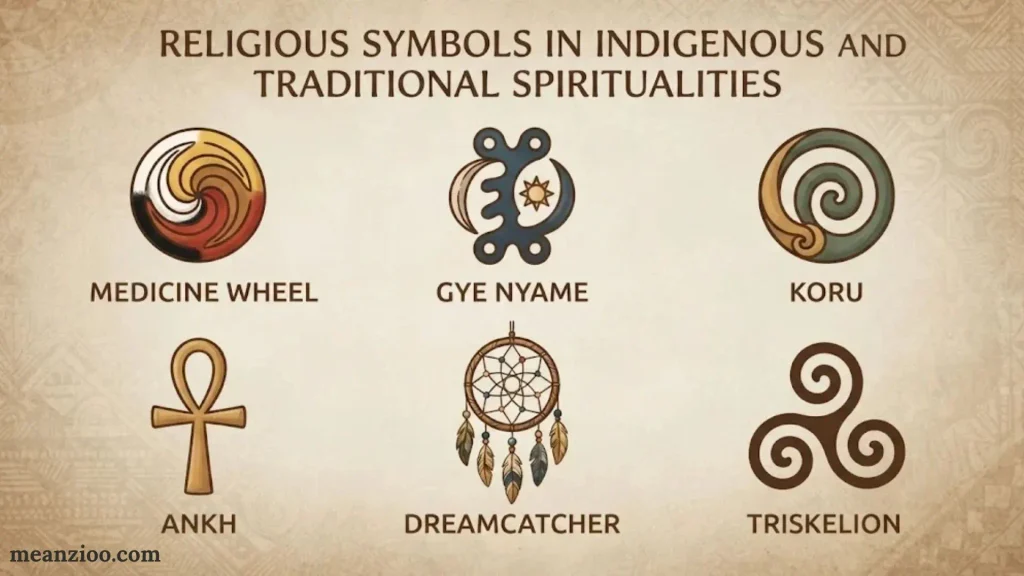
Indigenous religious traditions around the world include distinctive symbols associated with ancestral teachings, nature, sacred places, and community identity.
Examples may include:
- Sacred animals
- Ceremonial objects
- Sacred plants
- Sun and moon imagery
- Medicine wheels in specific Indigenous traditions
- Ancestral and clan imagery
These symbols must be understood within the traditions that use them. Indigenous communities are diverse, and their beliefs can’t be reduced to a single set of universal symbols.
Ancient Religious Symbols and Their Origins
Religious symbols have developed over thousands of years. Some began as representations of gods, natural forces, or sacred objects. Others evolved through religious teachings, cultural exchange, migration, and historical events.
Understanding their origins helps explain why symbols sometimes carry multiple meanings today.
Religious Symbols in Ancient Egypt
Ancient Egyptian religion used symbols extensively in temples, tombs, religious texts, and royal artwork.
Important examples include:
- Ankh: Life and vitality.
- Eye of Horus: Protection and restoration.
- Scarab: Transformation and associations with renewal.
- Djed pillar: Stability.
- Was scepter: Power and authority in divine and royal imagery.
Egyptian religious symbols often appeared alongside hieroglyphs and images of gods. Their meanings were connected to the afterlife, kingship, divine protection, and the relationship between gods and humans.
Religious Symbols in Mesopotamia
Mesopotamian civilizations used sacred emblems to represent gods, divine authority, and cosmic order.
Symbols appeared on seals, temple objects, monuments, and carved reliefs. Some represented particular deities while others communicated royal authority or religious identity.
Examples include:
- Crescent imagery associated with the moon god Sin.
- Star imagery associated with divine figures, including Ishtar.
- Winged and celestial motifs in religious and royal art.
- Sacred tree imagery in some ancient Near Eastern artistic traditions.
These symbols provide insight into how ancient societies understood nature, divine power, and the organization of their world.
Religious Symbols in Ancient Greece
Ancient Greek religion used objects, animals, plants, and distinctive attributes to identify gods and communicate their powers.
| Symbol | Associated deity | Common association |
| Owl | Athena | Wisdom |
| Trident | Poseidon | Sea and divine power |
| Thunderbolt | Zeus | Sky, authority, and power |
| Laurel wreath | Apollo | Victory, honor, and sacred associations |
| Caduceus-like imagery | Hermes | Messenger and divine attributes |
These symbols appeared on coins, pottery, temples, sculptures, and ceremonial objects. They helped people recognize gods and understand their roles within Greek mythology and religious life.
Religious Symbols in Ancient Rome
Roman religious symbolism included imagery associated with gods, public authority, military traditions, and household worship.
The eagle, laurel, and sacred objects appeared in religious ceremonies and imperial imagery. Romans also adopted and adapted religious traditions from other cultures, including Greek and Egyptian influences.
This cultural exchange helped religious symbols travel across regions and acquire new meanings.
Religious Symbols in Ancient India
Ancient Indian traditions developed rich symbolic systems connected with spiritual teachings, deities, rituals, and philosophical ideas.
Symbols such as Om, the lotus, and the swastika appear across Hindu traditions and related Indian religions. Their meanings depend on their context and historical use.
Some symbols represent auspiciousness, sacred sound, spiritual knowledge, or the nature of existence. Others appear in rituals, temple designs, and philosophical teachings.
Religious Symbols in Ancient China
Chinese religious and philosophical traditions developed symbols connected with nature, cosmology, harmony, and the relationship between complementary forces.
Examples include:
- Yin and Yang
- Bagua
- Dragon imagery
- Phoenix imagery
- Sacred mountains and natural landscapes
These symbols appear in Daoist traditions, Chinese philosophical systems, art, architecture, and cultural practices. Their interpretations differ depending on the tradition and setting.
Religious Symbols and Their Spiritual Meanings
Many readers search for symbols connected with specific qualities such as peace, wisdom, protection, hope, and spiritual growth. These meanings often come from particular religious traditions rather than universal rules.
Symbols of Faith and Devotion
Religious symbols often remind believers of their commitments, teachings, and relationship with the divine.
Examples include:
- Cross in Christianity
- Om in Hinduism
- Khanda in Sikhism
- Star of David in Judaism
- Ik Onkar in Sikhism
These symbols may appear on jewelry, clothing, religious objects, or in places of worship.
Symbols of Protection
Protective symbols appear in many religious and cultural traditions. People have used them in homes, clothing, amulets, and ceremonial objects.
Examples include:
- Hamsa in several Middle Eastern traditions
- Eye of Horus in ancient Egyptian contexts
- Protective inscriptions
- Sacred objects used in religious rituals
People may believe these symbols offer blessings, protection, or spiritual reassurance. Their meanings depend on the specific traditions involved.
Symbols of Peace and Compassion
Peace and compassion are central ideas in many religions. Some symbols express these values directly or through associated religious teachings.
- Dove in Christian imagery
- Ahimsa hand in Jainism
- Lotus in Buddhist and Hindu traditions
- Religious imagery associated with compassion and mercy
These symbols can remind people to practice kindness, respect, and nonviolence.
Symbols of Wisdom and Enlightenment
Several religious symbols represent knowledge, spiritual understanding, or the path toward awakening.
- Dharma wheel in Buddhism
- Bodhi tree in Buddhism
- Om in Hindu traditions
- Sacred light in various religious contexts
They can represent the pursuit of wisdom, the importance of spiritual discipline, and the effort to understand deeper truths.
Symbols of Life, Death, and Rebirth
Many religions use symbols to express the mystery of life, death, renewal, and spiritual transformation.
Examples include:
- Ankh in ancient Egyptian religion
- Lotus in Hindu and Buddhist traditions
- Phoenix in various cultural and mythological traditions
- Sacred trees connected with life and renewal
These symbols often appear in religious artwork, stories, ceremonies, and teachings about existence.
Symbols of Unity and Harmony
Some religious and philosophical symbols emphasize relationships, interconnectedness, and balance.
Examples include:
- Yin and Yang
- Mandalas
- Endless knot
- Interlocking circles
They may represent relationships between different aspects of existence, spiritual completeness, or the interconnected nature of life.
Symbols of Purification and Renewal
Purification plays an important role in many religious practices. Water, fire, sacred ash, and ritual objects may represent cleansing, renewal, or preparation for worship.
Examples include:
- Water in baptism and ritual washing
- Fire in religious ceremonies
- Sacred ash in Hindu traditions
- Cleansing rituals in different faiths
These practices carry distinct meanings within their traditions and shouldn’t be interpreted as identical across religions.
Religious Symbols, Shapes, and Natural Elements
Basic shapes and natural elements often become sacred through religious teachings, stories, rituals, and artistic traditions.
| Shape or element | Common symbolic associations | Examples of religious context |
| Circle | Unity, completeness, cycles | Mandalas, sacred diagrams |
| Triangle | Triadic ideas, sacred geometry | Christian Trinitarian artwork, geometric religious designs |
| Tree | Life, growth, wisdom | Bodhi tree, sacred trees |
| Water | Purification, renewal, life | Baptism, ritual washing |
| Fire | Sacred presence, transformation | Ritual lamps, ceremonial fires |
| Light | Knowledge, guidance, divine presence | Candles, lamps, halos |
| Sun | Life, power, time | Ancient solar worship and religious imagery |
| Moon | Cycles, time, change | Lunar calendars and historical crescent imagery |
| Animals | Divine attributes, virtues, sacred relationships | Dove, lion, elephant, eagle |
These associations are not universal. A circle may represent eternity in one setting while functioning as a geometric design in another. An animal may be sacred in one tradition and simply part of ordinary imagery elsewhere.
Religious Symbols in Rituals, Worship, and Daily Life
Religious symbols often become part of everyday routines. They help believers remember teachings, participate in ceremonies, and express their connection with a faith community.
Religious Symbols in Prayer
Prayer often involves objects or visual symbols that help people focus.
Examples include:
- Rosaries used in Catholic prayer
- Prayer beads used in various religious traditions
- Prayer rugs in Muslim worship
- Sacred texts
- Religious images
- Prayer gestures
These objects support particular practices. Their use and significance vary between traditions.
Symbols in Religious Ceremonies
Ceremonies often include sacred objects that mark important life events or religious commitments.
Examples include:
- Water used in Christian baptism
- Wedding rings in many marriage traditions
- Sacred lamps during Hindu ceremonies
- Torah scrolls in Jewish worship
- Ceremonial swords in Sikh contexts
These objects can represent commitments, blessings, religious responsibilities, or transitions in life.
Symbols in Meditation and Spiritual Practice
Meditation practices sometimes use symbols as objects of concentration or contemplation.
Examples include:
- Mandalas
- Om
- Buddhist imagery
- Yantras
- Prayer beads
Symbols may help practitioners focus attention or reflect on spiritual teachings. Their roles differ between meditation systems.
Symbols in Religious Festivals
Religious festivals often include symbolic objects, decorations, and ritual imagery.
| Festival or observance | Symbol or object | Common context |
| Diwali | Lamps and diyas | Light, celebration, and religious significance |
| Christmas | Nativity imagery, stars, trees | Christian celebration and cultural traditions |
| Ramadan | Lanterns in cultural settings | Decorative and cultural associations |
| Vesak | Lanterns and Buddhist imagery | Celebrations honoring the Buddha |
| Hanukkah | Menorah or Hanukkiah | Jewish commemorative observance |
Not every object listed is a universal religious requirement. Some are traditional decorations or regional customs that developed around religious celebrations.
Symbols in Sacred Places
Places of worship contain distinctive imagery, objects, and architectural features.
- Crosses in churches
- Mihrabs in mosques
- Torah scrolls in synagogues
- Dharma wheels and stupas in Buddhist spaces
- Deity images in Hindu temples
- Torii gates at Shinto shrines
These symbols help establish the identity and function of sacred spaces.
Religious Symbols Worn on the Body
People often wear sacred symbols to express faith, heritage, devotion, or personal connection.
Common examples include:
- Cross pendants
- Star of David necklaces
- Om jewelry
- Khanda pendants
- Hamsa bracelets
- Religious rings
- Prayer beads
Some people wear these items as visible expressions of belief. Others use them as private reminders of spiritual teachings or family traditions.
Religious Symbols in Art, Architecture, and Sacred Spaces
Religious symbolism plays a major role in architecture and visual art. Artists and builders use sacred imagery to communicate beliefs, tell religious stories, and create meaningful spaces for worship.
Christian Church Art
Christian churches often contain crosses, stained-glass windows, paintings, sculptures, and biblical scenes. These images may represent Jesus, Mary, saints, angels, or important events from Christian scripture.
Stained-glass windows can also tell biblical stories through colorful images. In earlier periods, they helped communicate religious teachings to people who couldn’t read.
Islamic Architecture
Islamic architecture frequently features Arabic calligraphy, geometric patterns, floral motifs, and decorative designs. Many mosques use these elements to create beautiful spaces for worship and contemplation.
Calligraphy can feature Quranic verses, religious phrases, or the names of God. Geometric patterns create repeating designs that emphasize order, symmetry, and visual harmony.
Hindu Temple Art
Hindu temples often contain sculptures, deity images, sacred animals, lotus motifs, and carved religious scenes. Their artwork can communicate stories, philosophical teachings, and relationships between deities.
Temple imagery may include Shiva’s trident, Vishnu’s attributes, Lakshmi’s lotus, or representations of sacred stories.
Buddhist Architecture
Buddhist temples and monasteries often contain stupas, Buddha statues, Dharma wheels, lotus imagery, and murals. These elements may remind visitors of the Buddha’s teachings and the path toward awakening.
Stupas are especially important in Buddhist architecture. They can serve as sacred structures associated with relics, remembrance, devotion, and Buddhist teachings.
Jewish Sacred Spaces
Synagogues may contain menorahs, Hebrew inscriptions, Torah scrolls, and other religious objects. These features connect worshippers with Jewish scripture, tradition, and community life.
The placement and use of sacred objects often follow religious customs rather than purely decorative choices.
Religious Symbols and Cultural Identity
Religious symbols can become powerful markers of identity. They connect people with shared traditions, family histories, communities, and experiences.
For many people, a religious symbol represents more than belief. It can also communicate where they come from, what values they hold, and which traditions they want to preserve.
How Religious Symbols Strengthen Identity
- Community belonging: People recognize symbols shared within their religious community.
- Cultural heritage: Symbols preserve traditions and historical memories.
- Family connections: Religious objects may pass between generations.
- Public identity: People may wear or display symbols to express their beliefs.
- Resilience: Some symbols become important reminders of survival, solidarity, or historical struggle.
- Celebration: Symbols appear during religious festivals, weddings, and community gatherings.
For example, the Star of David has become an important expression of Jewish identity. The Khanda similarly represents Sikh identity and religious principles. The cross remains an important symbol of Christian faith and heritage.
However, religious identity and national identity don’t always overlap. A symbol may appear on a national flag while also having religious or cultural associations.
Religious Symbols in Modern Society
Religious symbols continue to appear in everyday life. Their use has expanded into jewelry, fashion, tattoos, digital communication, artwork, and home decoration.
Religious Jewelry and Accessories
Religious jewelry allows people to carry meaningful symbols wherever they go. Cross necklaces, Om pendants, Hamsa bracelets, Khanda jewelry, and Star of David necklaces are common examples.
People may wear them to express faith, honor family traditions, remember loved ones, or feel connected to their spiritual beliefs.
Religious Symbols in Tattoos
Religious tattoos often represent devotion, identity, remembrance, or personal commitment. Some people choose sacred symbols because they want a permanent reminder of their beliefs.
Before choosing a religious tattoo, it’s worth learning its history and cultural significance. Some symbols have sacred or restricted uses. Others carry meanings that differ greatly across cultures.
Religious Symbols in Fashion and Design
Sacred imagery appears on clothing, accessories, decorative products, and graphic designs. Some uses reflect genuine religious expression. Others treat symbols primarily as visual elements.
That distinction matters. A symbol may be deeply sacred to a community even when a designer sees it as an attractive pattern.
Religious Symbols on Social Media
Digital platforms make religious imagery easy to share. People use symbol characters, emojis, profile pictures, digital art, and religious quotes to express faith.
Popular examples include:
- ✝ Christian cross
- ☪ Crescent and star
- 🕉 Om
- ☸ Dharma wheel
- ✡ Star of David
- ☬ Khanda
- ☯ Yin and Yang
The digital character may look different depending on the device or platform. Its visual appearance also doesn’t necessarily capture its full religious significance.
Cultural Appropriation and Respect
Using religious symbols without understanding their cultural context can create misunderstandings. Some symbols carry histories of worship, sacred ceremonies, persecution, or cultural identity.
Before using a symbol in fashion, artwork, tattoos, or commercial products, consider:
- Where did the symbol originate?
- Which communities consider it sacred?
- Does it have a specific ceremonial use?
- Could its use offend or misrepresent the people connected to it?
- Are you using it respectfully or simply for decoration?
Learning the background of a symbol helps you appreciate its meaning and avoid careless use.
Do Religious Symbols Have Universal Meanings?
Not all religious symbols have universal meanings. Their interpretation depends on religious teachings, historical context, cultural traditions, and how communities use them.
A symbol may carry several meanings at once. Its significance can also change across centuries.
Why Symbolic Meanings Differ
- Religions interpret sacred imagery through their own teachings.
- Cultures adopt and adapt symbols over time.
- Historical events can change a symbol’s public meaning.
- Different communities may use similar shapes for different purposes.
- Personal interpretations may differ from traditional religious teachings.
Examples of Symbols With Different Interpretations
| Symbol | Traditional context | Why meanings differ |
| Crescent and star | Muslim cultural associations and Ottoman history | Not a universal Islamic emblem |
| Lotus | Hindu and Buddhist traditions | Different teachings and religious associations |
| Hamsa | Jewish, Muslim, and regional traditions | Protective meanings vary by community |
| Swastika | Hindu, Jain, and Buddhist traditions | Traditional auspicious meanings differ from its Nazi appropriation |
| Yin and Yang | Chinese philosophical traditions | Modern interpretations sometimes oversimplify the concept |
Understanding context is essential when interpreting sacred imagery. A symbol’s popularity doesn’t automatically make its meaning universal.
Religious Symbols vs. Spiritual Symbols vs. Cultural Symbols
These three categories overlap, but they aren’t identical. Understanding the difference helps you interpret symbols more accurately.
| Symbol type | Meaning | Examples |
| Religious symbols | Connected to a specific faith, doctrine, or religious tradition | Cross, Dharma wheel, Khanda |
| Spiritual symbols | Represent spiritual concepts or practices, sometimes beyond one organized religion | Mandala, sacred light imagery |
| Cultural symbols | Represent shared heritage, identity, history, or customs | Cultural emblems, traditional motifs |
| Ritual symbols | Used in ceremonies and religious observances | Shofar, prayer beads, ceremonial lamps |
| Sacred symbols | Recognized as holy or spiritually significant within a tradition | Om, Torah scroll, sacred images |
A symbol can belong to more than one category. The lotus, for example, is both a religious and spiritual symbol in several traditions.
Similarly, the Hamsa can serve as a religious, cultural, and protective symbol depending on the community and setting.
How Religious Symbols Have Evolved Throughout History
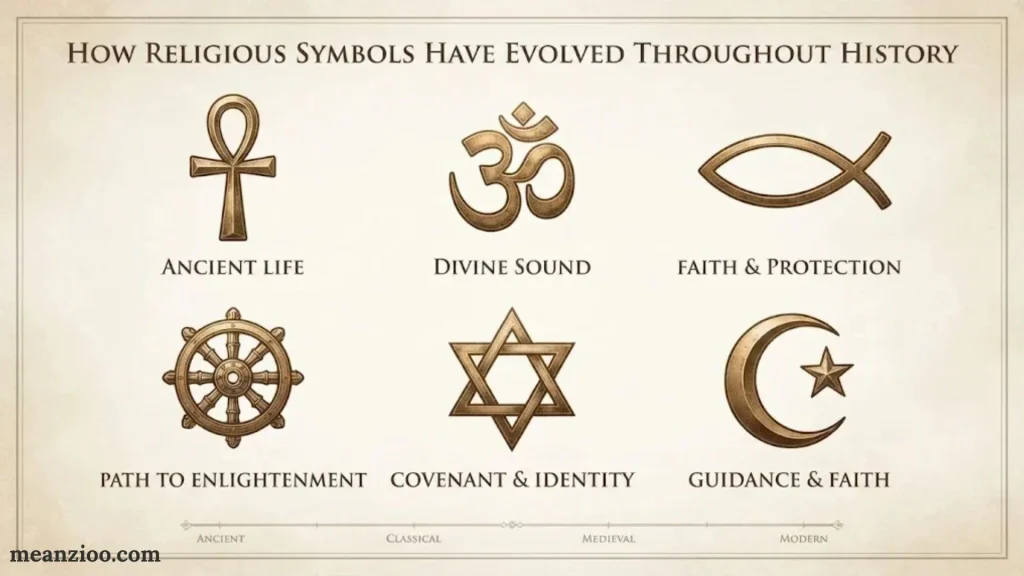
Religious symbols rarely remain unchanged. Their meanings develop as religions spread, communities interact, and historical events influence cultural interpretation.
Early Religious Symbolism
Early societies used objects, animals, natural forms, and markings in ritual and sacred settings. Archaeologists sometimes identify these as religious, although the original purpose of certain prehistoric objects remains uncertain.
Early symbolism often connected with nature, fertility, death, ancestry, and the cycles of life.
Ancient Civilizations
Ancient Egyptian, Mesopotamian, Greek, Roman, Indian, and Chinese civilizations developed rich symbolic traditions.
Their symbols appeared on temples, monuments, pottery, coins, tombs, religious objects, and sacred texts. Many represented gods, rulers, natural forces, or ideas about the afterlife.
The Spread of Religions
As religions traveled through trade routes, migration, political expansion, and missionary activity, symbols moved between cultures.
Some symbols remained closely connected to their original traditions. Others gained new meanings or became associated with different communities.
Religious Symbols During the Middle Ages
The Middle Ages saw the growth of religious art, sacred architecture, manuscripts, and ceremonial objects.
Christian crosses and icons, Islamic calligraphy, Jewish manuscript traditions, Buddhist temple imagery, and Hindu temple sculpture all developed within changing cultural and historical settings.
Religious Symbols in the Modern Era
Today, religious symbols appear in public life, national flags, jewelry, art, digital media, and commercial products.
Some retain their traditional religious meaning. Others have acquired political, cultural, or personal associations.
Understanding this evolution explains why the same symbol can look familiar while carrying different meanings in different places.
Common Misconceptions About Religious Symbols
Religious symbols are often misunderstood because people encounter them outside their original cultural or historical settings. Popular interpretations don’t always match traditional religious meanings.
Here are some common misconceptions worth correcting.
- The crescent and star is the official symbol of Islam. It has historical and cultural associations with Muslim communities, but Islam doesn’t have one universal emblem.
- Every ancient symbol belongs to one religion. Many symbols existed across different civilizations and were adapted over time.
- Religious symbols have only one meaning. Their interpretation can vary across traditions, communities, regions, and historical periods.
- Om is simply a yoga logo. Om has deep religious and philosophical significance in Hindu traditions.
- The swastika originated with Nazi Germany. The symbol existed long before Nazism and remains sacred in Hinduism, Buddhism, and Jainism.
- The Star of David has always been the universal Jewish symbol. Its association with Jewish communities developed historically over time.
- Every geometric design is sacred geometry. Some geometric patterns have religious significance while others are simply decorative or artistic.
- All spiritual symbols provide protection. Some symbols represent teachings, identity, devotion, or philosophical ideas rather than protection.
A symbol’s true meaning depends on its history, religious context, and community. Taking time to understand these details prevents misinformation.
How to Understand the Meaning of a Religious Symbol
If you encounter an unfamiliar sacred symbol, don’t rely on its appearance alone. A little research can reveal its history, religious connection, and purpose.
Identify the Symbol
Examine its shape, colors, components, and distinctive features. Determine whether it represents a religious figure, sacred object, geometric design, or written sign.
Find Its Religious or Cultural Origin
Identify the tradition, community, region, or historical period associated with it. Similar symbols may have developed independently in different cultures.
Explore Its History
Look for its earliest documented appearance and historical use. Learn whether it changed meaning through cultural exchange, religious development, or political events.
Understand Its Traditional Meaning
Explore how religious teachings, sacred texts, historical records, or practitioners explain the symbol.
Examine How People Use It Today
Look at its use in worship, ceremonies, jewelry, clothing, architecture, and public identity. Modern uses may differ from older religious interpretations.
Respect Its Cultural Context
Some symbols have sacred, ceremonial, or restricted meanings. Understanding these boundaries helps you discuss or use religious imagery respectfully.
Frequently Asked Questions About Religious Symbols
What are the most common religious symbols?
Some of the most recognizable religious symbols include the Christian cross, Om, Dharma wheel, Star of David, Khanda, crescent and star, lotus, Hamsa, and Ichthys. Their recognition varies across countries and religious communities.
What is the oldest religious symbol?
There isn’t one universally accepted oldest religious symbol. Archaeologists have discovered prehistoric markings, figurines, ritual objects, and sacred imagery dating back thousands of years. However, their exact religious meanings can be difficult to establish.
Which religious symbols represent peace?
Peace-related imagery includes the dove in Christian contexts and the Ahimsa hand in Jainism. Other religious symbols may express compassion, harmony, or nonviolence within their own traditions.
Which religious symbols represent protection?
The Hamsa and Eye of Horus are commonly associated with protection in particular cultural and historical contexts. Other communities use protective inscriptions, sacred objects, and ritual practices.
What is the difference between religious and spiritual symbols?
Religious symbols connect with established faiths, teachings, communities, or rituals. Spiritual symbols may represent broader ideas about consciousness, inner growth, meaning, or the sacred.
Are religious symbols the same across all religions?
No. Different religions have distinct symbols, teachings, and traditions. Some symbols appear in several cultures, but their meanings and uses may differ significantly.
Why do people wear religious symbols?
People wear religious symbols to express faith, devotion, cultural identity, family heritage, or personal commitment. Some also use them as reminders of spiritual teachings and values.
Can the same symbol belong to multiple religions?
Yes. Some symbols appear in several religious and cultural traditions. Their interpretations can differ depending on their historical development and community context.
What are some ancient religious symbols?
Examples include the Ankh and Eye of Horus from ancient Egyptian religion, sacred symbols from Mesopotamia, and symbols such as Om and the swastika from Indian religious traditions.
Are religious symbols still important today?
Yes. Religious symbols remain important in worship, cultural celebrations, personal identity, religious art, jewelry, architecture, and community life. They continue to connect people with beliefs and traditions passed down through generations.
Conclusion: Understanding the Meaning Behind Religious Symbols
Religious symbols carry stories, teachings, and beliefs that have shaped civilizations for centuries. From the Christian cross and Hindu Om to the Buddhist Dharma wheel and Jewish Star of David, each symbol offers a glimpse into a religion’s history and spiritual worldview.
Some symbols represent sacrifice and salvation. Others communicate nonviolence, enlightenment, unity, protection, or sacred life. Their meanings often extend beyond their physical appearance, connecting people with religious traditions, communities, and shared experiences.
However, symbols don’t always mean the same thing everywhere. Their significance depends on the history, teachings, and cultural context in which people use them.
When you explore religious symbols and meanings, look beyond the shape itself. Learn about the people who use it, the traditions that preserve it, and the beliefs it represents. That deeper understanding turns a simple sign into a meaningful connection with the world’s diverse spiritual heritage.
The religious symbol associations discussed above are also represented in educational materials from the University of Wyoming, Arizona Geographic Alliance, and Manitoba’s world religions curriculum.

Hi, I’m Charlotte Hayes. I love writing about the newest English slang, pop culture phrases, and digital communication. I spend my time exploring how language evolves across social media, gaming, and everyday conversations. I enjoy sharing easy-to-understand guides that help learners keep up with modern English. My goal is to make every article useful, accurate, and enjoyable for readers around the world.
Books:
- Everyday Slang Dictionary
- Fluent Through Informal English
 Ryan Mitchell