When people search for card symbols meaning, they are usually looking for more than the names of the four suits. They may want to know what ♠, ♥, ♦, and ♣ represent, why playing cards use these symbols, whether the suits have traditional or hidden meanings, and how their meanings differ between card games, history, tattoos, design, and fortune-telling.
The four familiar symbols are Spades (♠), Hearts (♥), Diamonds (♦), and Clubs (♣). In a standard 52-card deck, each suit contains 13 cards, giving the deck its familiar four-suit structure. Hearts and Diamonds are red, while Spades and Clubs are black.
Although the suits have developed many symbolic associations, it is important to separate historical facts from later interpretations. In ordinary card games, a suit is primarily a way of classifying cards. The additional meanings—such as Hearts representing love or Diamonds representing wealth—are cultural and symbolic rather than universal rules.
Quick Answer: What Do Card Symbols Mean?
Here is the simplest explanation of the four major card symbols:
| Symbol | Suit | Color | Common Symbolic Meaning |
| ♠ | Spades | Black | Strength, challenge, authority |
| ♥ | Hearts | Red | Love, emotion, relationships |
| ♦ | Diamonds | Red | Wealth, value, prosperity |
| ♣ | Clubs | Black | Work, action, growth |
These are common symbolic associations, not fixed meanings that apply to every card game or culture.
In a standard deck, the suits have a practical purpose. They distinguish four groups of cards, with each group containing the same 13 ranks: Ace, 2 through 10, Jack, Queen, and King.
What Are the Four Card Symbols?
The four symbols in the modern French-suited playing-card system are:
- ♠ Spades
- ♥ Hearts
- ♦ Diamonds
- ♣ Clubs
The designs became standardized in French playing cards during the 15th century. Their simplified shapes were particularly practical for printing, helping the French pattern spread widely.
Today, these four suits are familiar throughout much of the world, particularly in standard English-language decks.
♠ Spade Symbol Meaning
The spade (♠) is a black suit and one of the most recognizable playing-card symbols.
The shape is often described as resembling a spearhead or stylized leaf. Historically, the French name pique relates to a pike or spearhead.
What Does the Spade Symbol Represent?
In popular symbolic interpretations, Spades are associated with:
- Strength
- Power
- Authority
- Determination
- Challenges
- Conflict
- Seriousness
- Transformation
These associations should not be confused with the actual function of the suit in card games.
For example, the Ace of Spades does not automatically mean danger or death simply because the spade has sometimes been given darker symbolic associations. Its meaning depends on the context.
Why Is the Spade Sometimes Seen as a Negative Symbol?
Popular culture has sometimes portrayed the spade as mysterious, serious, or ominous. This has contributed to associations with difficulty, death, or conflict.
However, these are cultural interpretations, not an inherent meaning of the symbol.
In Poker, Bridge, or another ordinary card game, ♠ is simply the Spades suit.
♥ Heart Symbol Meaning
The heart (♥) is a red suit and perhaps the easiest card symbol to associate with a particular idea.
The heart shape is widely used as a symbol of affection, which is why Hearts commonly represent:
- Love
- Romance
- Friendship
- Emotion
- Compassion
- Relationships
- Feelings
- Connection
What Does the Heart Suit Mean in Cards?
In a normal card game, Hearts simply identify one of the four suits.
For example, 10♥ means the ten of Hearts. It does not automatically mean romance or love.
The emotional interpretation becomes more relevant when card symbols are used in art, tattoos, decorative designs, storytelling, or divination.
Why Is the Heart Red?
Hearts belong to the two red suits in a standard deck. Diamonds are the other red suit, while Clubs and Spades are black.
The red color makes the suit visually distinct from the two black suits and should not automatically be interpreted as a separate symbolic message.
♦ Diamond Symbol Meaning
The diamond (♦) is a red suit with a geometric shape resembling a diamond or square.
Because diamonds are associated with precious gemstones and monetary value, the suit has developed common associations with:
- Wealth
- Money
- Prosperity
- Success
- Material value
- Luxury
- Possessions
- Opportunity
What Does the Diamond Suit Mean?
In ordinary playing cards, ♦ simply identifies the Diamond suit.
The association between Diamonds and wealth is mainly a symbolic and cultural interpretation. It is not a special rule of the standard deck.
For example, the King of Diamonds does not universally represent a wealthy person. Such interpretations depend on the particular symbolic system being used.
♣ Club Symbol Meaning
The club (♣) is a black suit whose symbol has a three-lobed appearance.
The French name for this suit is trèfle, meaning clover. Historical accounts connect the French suit designs with earlier European suit systems, although the exact evolution of each symbol is more complicated than a simple one-to-one translation.
What Does the Club Symbol Represent?
In popular interpretations, Clubs can represent:
- Work
- Action
- Energy
- Growth
- Effort
- Achievement
- Practical matters
- Ambition
Again, these meanings are symbolic rather than universal.
In a card game, ♣ simply identifies the Clubs suit.
Card symbols meaning in english
In a standard deck of playing cards, the four main symbols are called card suits: hearts, diamonds, clubs, and spades. Each suit contains 13 cards, from Ace through King, making 52 cards in a complete standard deck.
The four symbols are visually distinct: ♥ represents hearts, ♦ represents diamonds, ♣ represents clubs, and ♠ represents spades. Their meanings can change depending on whether you are discussing traditional playing cards, games, fortune-telling, or symbolic art.
Card symbols meaning love
Card symbols can take on romantic meanings when used in love readings, tattoos, artwork, or personal messages. The heart is the clearest symbol of love, affection, emotional connection, and relationships.
Other suits can also be given symbolic interpretations. Diamonds may suggest value, attraction, or material stability; clubs can represent energy and action; and spades may symbolize challenges, transformation, or deeper emotions. These interpretations are symbolic rather than universal rules.
Club card symbol meaning
The club (♣) is one of the four suits in a standard deck of playing cards. In traditional playing-card symbolism, clubs are sometimes associated with energy, action, growth, ambition, and practical achievement.
The club symbol is shaped somewhat like a three-leaf clover with a stem. Its familiar black design makes it easy to distinguish from the red heart and diamond suits.
Spiritual meaning behind playing cards
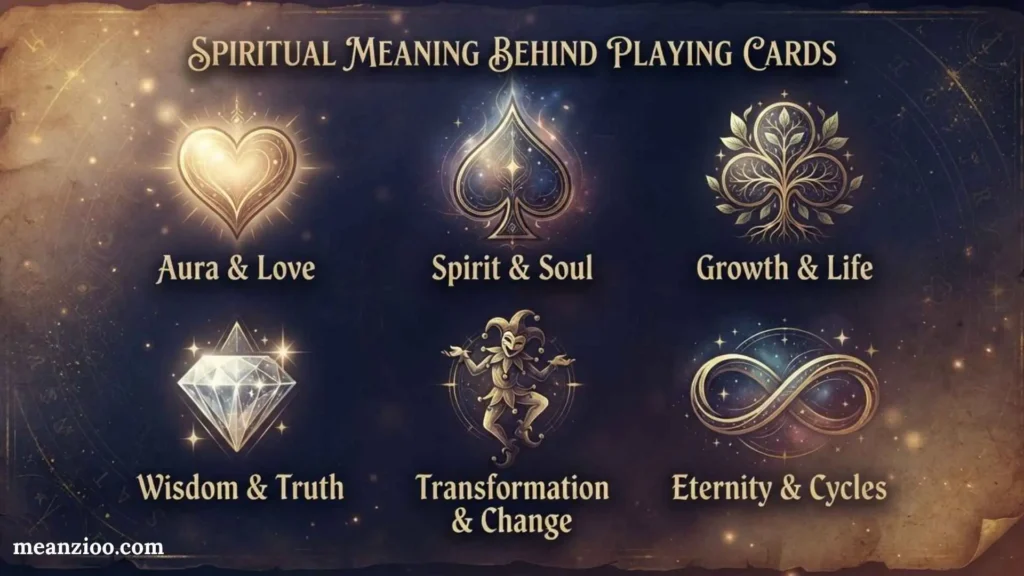
Playing cards can have spiritual meanings when they are used as symbolic tools rather than simply for games. In cartomancy and other traditions, the four suits may be interpreted as representing different areas of human experience.
A common symbolic approach connects hearts with emotions and relationships, diamonds with resources and material matters, clubs with action and ambition, and spades with challenges, transformation, or intellect.
These meanings are not universally fixed. Spiritual interpretations depend on the particular tradition, reader, and context in which the cards are used.
Card symbols in english
The four standard card symbols in English are:
- ♥ Heart — Hearts
- ♦ Diamond — Diamonds
- ♣ Club — Clubs
- ♠ Spade — Spades
The symbols themselves are called suit symbols, while the four categories are called card suits. Individual cards also have ranks, including Ace, 2 through 10, Jack, Queen, and King.
Card suits symbolism
The four card suits have accumulated different symbolic associations throughout history and popular culture. A commonly used modern interpretation is:
| Suit | Symbol | Common symbolic associations |
|---|---|---|
| Hearts | ♥ | Love, emotions, relationships |
| Diamonds | ♦ | Wealth, value, resources |
| Clubs | ♣ | Action, work, growth |
| Spades | ♠ | Challenges, intellect, transformation |
These associations are useful for understanding symbolism, but they should not be treated as official meanings of the suits. In ordinary card games, suits primarily serve a practical role in identifying cards and determining game rules.
Card symbols names
The four symbols in a standard deck are named heart, diamond, club, and spade. Their plural suit names are hearts, diamonds, clubs, and spades.
The symbols are:
♥ Hearts
♦ Diamonds
♣ Clubs
♠ Spades
The cards themselves also have ranks. For example, Ace of Hearts, Queen of Diamonds, and King of Spades combine the card’s rank with its suit.
Poker cards symbolism
Poker cards can carry symbolic meanings beyond their role in the game. The four suits are often interpreted as representing different aspects of life, especially in tattoos, movies, artwork, and popular culture.
Hearts commonly suggest love and emotion, diamonds can represent wealth and value, clubs may suggest action and ambition, and spades can symbolize difficulty, power, mystery, or transformation.
In actual poker, however, the suits usually have limited importance compared with the rank and combination of cards. Their symbolic meaning is primarily cultural rather than a formal poker rule.
What are the shapes on cards called?
The small shapes printed on playing cards are called suit symbols, and the four groups they represent are called suits.
The four standard suit symbols are:
♥ Heart
♦ Diamond
♣ Club
♠ Spade
So, if someone asks what the shapes on playing cards are called, the simplest answer is card suits or suit symbols.
Opposite of spades card
There is no officially recognized “opposite” of the spades suit in a standard deck. However, people sometimes describe hearts as its symbolic opposite because spades are often associated with darker or more challenging themes in popular interpretations, while hearts are commonly linked with love and positive emotions.
In terms of card color, spades are black, while hearts are red. But this does not make hearts an official opposite of spades; it is simply a symbolic comparison.
What are the 4 suits in cards?
The four suits in a standard deck of playing cards are:
- Hearts (♥)
- Diamonds (♦)
- Clubs (♣)
- Spades (♠)
Hearts and diamonds are traditionally red, while clubs and spades are black. Each suit normally contains 13 cards, producing 52 cards in a standard deck.
Card suits meaning
Card suit meanings depend on the context. In symbolic interpretations, hearts are commonly connected with love and emotions, diamonds with wealth and material matters, clubs with action and achievement, and spades with challenges, thought, or transformation.
In card games, however, suits may have completely different functions. Some games assign values to suits, while others use them mainly to determine whether cards match or follow a required suit.
Playing cards symbolism
Playing cards have become powerful symbols in art, literature, fashion, tattoos, magic, and popular culture. Their symbolism can represent chance, luck, risk, strategy, fate, competition, mystery, and decision-making.
The symbolism of an individual card can also come from its rank. An Ace may represent beginnings or potential, a Queen can suggest authority or femininity, and a King may represent leadership or power. These meanings vary depending on the cultural or artistic context.
Deck of cards symbols meanings
A standard deck combines four suits and 13 ranks. Symbolically, this structure has inspired many interpretations, although not every traditional or historical interpretation agrees on one fixed meaning.
The four suits are often interpreted as:
- Hearts: emotions, love, relationships
- Diamonds: money, possessions, value
- Clubs: action, work, creativity
- Spades: challenges, intellect, change
The complete deck can therefore be viewed as a symbolic representation of different parts of human experience, from relationships and ambition to resources and difficult decisions.
Disney Lorcana card symbols meaning
Disney Lorcana uses a custom system of symbols and icons rather than the four traditional playing-card suits. Its cards contain symbols that communicate gameplay information such as card type, ink color, abilities, costs, and other game mechanics.
Because Lorcana’s symbols are tied to specific gameplay rules, their meaning should be interpreted according to the current official rules and card text rather than assuming that they have the same symbolism as hearts, diamonds, clubs, and spades.
Rider Waite The Fool card symbols meaning
In the Rider-Waite-Smith Tarot, The Fool is traditionally numbered 0 and represents themes such as beginnings, possibility, freedom, exploration, and taking a leap into the unknown.
Several visual elements contribute to the card’s symbolism. The figure’s position near a cliff can suggest risk or stepping into unfamiliar territory, while the small dog can be interpreted as companionship, instinct, or a warning to pay attention. The white rose is often associated with innocence and purity, while the small bundle represents what the traveler carries into the journey.
The exact interpretation can change depending on whether The Fool appears upright or reversed and how it relates to the surrounding cards in a reading.
Credit card symbols meaning
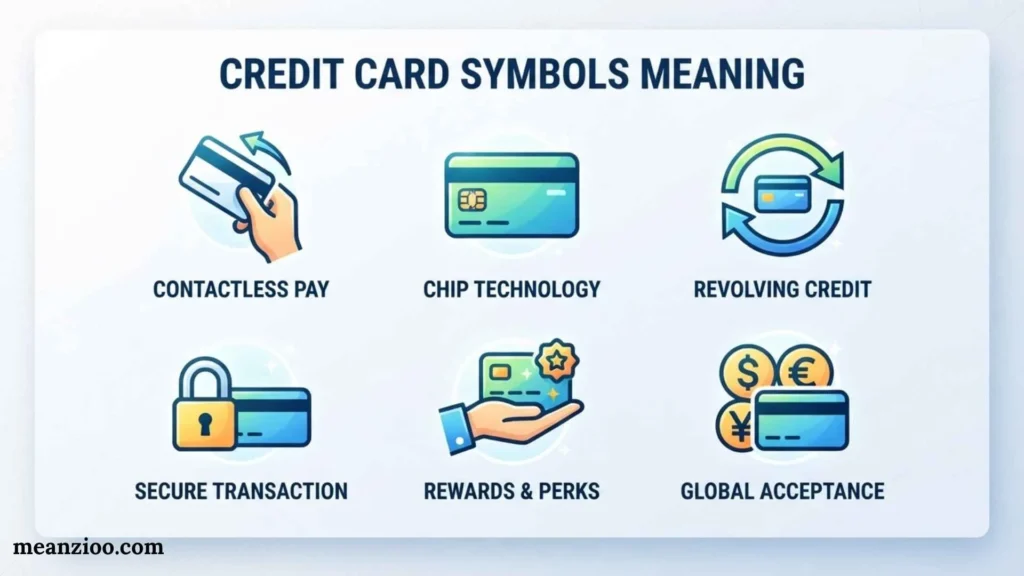
Credit cards contain several symbols that identify the payment network, security features, contactless functionality, and other card capabilities. Their exact appearance can vary by issuer and card design.
For example, the contactless symbol looks similar to a sideways Wi-Fi signal and indicates that the card can generally be tapped at a compatible payment terminal. Network logos identify the payment system through which transactions are processed.
Other marks may relate to security, chip technology, or the issuing financial institution. If you need to identify a particular symbol, its meaning depends on the exact symbol and the card issuer.
Debit card symbols meaning
Debit cards can display many of the same types of symbols found on credit cards. Common examples include the card network logo, contactless payment symbol, EMV chip, and bank or financial institution branding.
The EMV chip is the small metallic-looking chip embedded in the card and is used for chip-based transactions. The contactless symbol indicates that the card supports tap-to-pay at compatible terminals.
Because banks can use different designs and additional marks, a symbol’s exact meaning should be confirmed from the issuing bank when it is unfamiliar.
Skylander card symbols meaning
Skylanders cards and related collectible products can contain symbols that identify characters, attributes, game information, or collectible details. The exact meaning depends on the particular Skylanders game, card set, or product series.
Unlike the traditional four playing-card suits, Skylanders symbols are part of the franchise’s own visual and gameplay system. When identifying one, the card’s specific series and the symbol’s surrounding information are important.
MTG card symbols meaning
Magic: The Gathering (MTG) uses a detailed system of symbols to communicate gameplay information. One of the most recognizable groups is the five mana symbols, representing the game’s five colors: White, Blue, Black, Red, and Green.
Cards may also contain symbols for generic mana, colorless mana, hybrid mana, Phyrexian mana, tap abilities, and other game mechanics. The meaning of a particular symbol depends on where it appears on the card and the rules associated with that symbol.
Because MTG has evolved over many sets and editions, some symbols represent specific mechanics or card abilities. For accurate gameplay interpretation, the card’s rules text and the current official rules are more important than treating the symbol as a general-purpose icon.
What Do the Four Card Suits Represent?
A common modern symbolic interpretation looks like this:
♠ Spades → strength and challenges
♥ Hearts → love and emotions
♦ Diamonds → wealth and material value
♣ Clubs → work, action, and growth
This makes the four symbols easy to remember. However, there is no single universal system that assigns these meanings to every playing-card deck.
That distinction matters because people often encounter different explanations online.
Card Symbols Meaning in Different Contexts
The meaning of a card symbol can change depending on where you see it.
In Playing Card Games
In card games, suits are primarily functional.
They can determine whether cards match, affect scoring, identify a trump suit, or influence the rules of a particular game.
For example, a game might require players to follow the suit that was led. Another game might rank one suit above the others.
Therefore, there is no need to assign emotional or spiritual meaning to a suit when simply playing cards.
In Tattoos
Card suit symbols are popular tattoo designs because they are simple, recognizable, and easy to combine.
Someone might choose:
- ♥ for love or relationships
- ♠ for strength or overcoming difficulty
- ♦ for ambition or success
- ♣ for growth or determination
A tattoo’s meaning is ultimately personal. The same symbol can represent completely different things to different people.
In Usernames and Social Media
The symbols ♠ ♥ ♦ ♣ are also commonly used in usernames, bios, captions, gaming names, and decorative text.
In these situations, they may simply be chosen because they look attractive or because the person likes playing cards.
A heart might suggest affection, while a spade might create a bold or mysterious appearance, but there is no universal rule.
In Logos and Graphic Design
Card symbols are frequently used to communicate ideas associated with:
- Games
- Casinos
- Competition
- Luck
- Strategy
- Poker
- Entertainment
- Risk
Using all four symbols together—♠ ♥ ♦ ♣—often creates an immediate visual connection with playing cards.
Are Card Symbols Secret or Hidden Symbols?
There are many theories about hidden meanings in playing cards.
Some interpretations claim that the four suits represent things such as:
- The four seasons
- Social classes
- Elements
- Stages of life
- Different areas of human experience
Some of these interpretations are interesting as cultural traditions, but they should not automatically be presented as historical facts.
The safest way to understand card symbolism is to distinguish between documented history, popular symbolism, and later theories.
The modern four suits developed from European playing-card traditions rather than being created as a universally agreed symbolic code.
History of the Four Card Symbols
The history of playing cards is much older than the modern 52-card deck.
Early European playing cards developed different suit systems. Italian cards, for example, used suits including cups, swords, batons, and coins, while German traditions developed their own suit symbols. The familiar French suits eventually became one of the most influential systems.
French Influence
French cardmakers developed the familiar combination of:
- Spades
- Hearts
- Diamonds
- Clubs
during the 15th century.
One important reason these symbols became so successful was their simplicity.
Earlier playing cards could feature detailed, expensive artwork. The simplified French suit symbols could be printed efficiently in only a small number of colors, making mass production easier.
This helped the French pattern spread through Europe and eventually become dominant in many parts of the world.
Why Are There Four Suits?
The exact origins and symbolism of the four-suit structure are part of a longer history of playing cards.
European decks had already developed four-suit systems before the modern French symbols became standardized. The French system retained the basic four-suit structure while changing the designs.
The four-suit system provides a convenient way to organize cards into equal groups.
In a standard 52-card deck:
4 suits × 13 cards = 52 cards
Each suit contains:
- Ace
- 2
- 3
- 4
- 5
- 6
- 7
- 8
- 9
- 10
- Jack
- Queen
- King
This structure is characteristic of the standard French-suited deck.
Why Are Some Card Symbols Red and Others Black?
The four suits are divided into two colors.
Red Suits
- ♥ Hearts
- ♦ Diamonds
Black Suits
- ♠ Spades
- ♣ Clubs
The color system provides a quick visual distinction between the suits.
It is tempting to interpret red as positive and black as negative, but that is not how standard playing cards work.
For example, black Spades are not inherently bad, and red Hearts are not inherently good.
In a card game, color usually has a practical purpose rather than a moral one.
French, German, Italian, and Spanish Card Suits
One of the most important facts about card symbols is that not every country historically used the same four suits.
French-Suited Cards
The familiar French suits are:
- ♠ Spades
- ♥ Hearts
- ♦ Diamonds
- ♣ Clubs
These are the suits most people recognize from modern international decks.
Italian-Suited Cards
Traditional Italian decks use suits such as:
- Cups
- Coins
- Swords
- Batons
The Metropolitan Museum of Art notes that Italian suits were already established during roughly the same period when French suits were developing.
German-Suited Cards
Traditional German cards developed a different system, including symbols such as:
- Hearts
- Bells
- Acorns
- Leaves
This demonstrates that the four French suits were not the only way European cultures organized playing cards.
Spanish-Suited Cards
Spanish-suited decks traditionally use:
- Cups
- Coins
- Swords
- Clubs
They remain distinct from the French-suited deck commonly used in English-speaking countries.
Are Playing Card Suits Connected to Tarot?

Playing cards and Tarot have historical connections worth discussing, but they should not be treated as exactly the same system.
Modern Tarot has four Minor Arcana suits:
- Cups
- Swords
- Wands
- Pentacles
Playing cards have:
- Hearts
- Spades
- Clubs
- Diamonds
Some modern cartomancy traditions create correspondences between them. A common comparison is:
| Playing Card Suit | Tarot Suit Often Compared With | Common Theme |
| ♥ Hearts | Cups | Emotions and relationships |
| ♠ Spades | Swords | Thought, conflict, decisions |
| ♣ Clubs | Wands | Action, energy, ambition |
| ♦ Diamonds | Pentacles | Money, material matters |
These are interpretive correspondences, not a universal rule that every Tarot or playing-card tradition follows.
Do Card Symbols Have Spiritual Meanings?
Card symbols can be given spiritual or mystical meanings in certain traditions, especially in cartomancy, which involves interpreting playing cards for divination.
For example, a particular system might associate:
- Hearts with emotions
- Diamonds with finances
- Clubs with activity
- Spades with challenges
But these interpretations vary between systems and practitioners.
There is no scientifically established evidence that a playing-card suit has an objective supernatural meaning.
Therefore, if you are researching card symbols for spiritual purposes, it is useful to identify which tradition or interpretation system you are using.
Card Symbols and Fortune-Telling
Ordinary playing cards are sometimes used for fortune-telling, commonly called cartomancy.
In such systems, the suit can be interpreted as representing a broad area of life.
A simplified example might be:
- Hearts: feelings and relationships
- Diamonds: finances and material matters
- Clubs: work and activity
- Spades: difficulties, decisions, or challenges
The individual card’s rank may then be combined with the suit to produce a more specific interpretation.
These meanings are part of a divination tradition rather than the standard rules or historical definition of playing-card suits.
Do Card Symbols Represent the Four Seasons?
You may see claims that the four suits represent the four seasons.
This is a popular symbolic interpretation because there are four suits and four seasons.
However, the existence of four suits does not by itself prove that the suits were historically designed to represent spring, summer, autumn, and winter.
Similar claims are sometimes made about the 52 cards representing the 52 weeks of the year or the 13 cards in each suit representing lunar cycles.
These theories are interesting, but they should be treated as symbolic interpretations rather than established historical explanations.
Do the Four Suits Represent Social Classes?
Another popular explanation connects the suits to different social groups or classes.
You may find interpretations claiming that:
- Hearts represented the clergy
- Diamonds represented merchants
- Clubs represented peasants
- Spades represented nobility or soldiers
There is some historical discussion around symbolic associations of suit designs, but simplified internet explanations often present these theories with more certainty than the evidence supports.
The safer conclusion is that the French suits have historical relationships to earlier European suit designs, while later cultures developed additional symbolic interpretations.
Card Symbols in Popular Culture
The four suits have become recognizable symbols far beyond traditional card games.
They appear in:
- Movies
- Television
- Music
- Video games
- Fashion
- Tattoos
- Jewelry
- Posters
- Logos
- Casino imagery
- Playing-card artwork
Because ♠ ♥ ♦ ♣ are instantly recognizable, designers can use them to communicate ideas about cards, games, luck, strategy, or competition without showing an entire deck.
Why Are Card Symbols So Popular?
There are several reasons the symbols remain popular.
They Are Simple
Each symbol has a distinctive shape that can be recognized quickly.
They Are Easy to Combine
Designers can place the four symbols together:
♠ ♥ ♦ ♣
or use one symbol individually.
They Have Strong Cultural Associations
Centuries of playing-card use have made the symbols familiar around the world.
They Have Multiple Interpretations
Depending on context, the same symbol can suggest cards, gambling, love, wealth, strength, competition, or mystery.
Card Symbols vs. Card Ranks
It is also important to understand the difference between a suit and a rank.
The suit tells you which group the card belongs to.
The rank tells you which card it is within that suit.
For example:
7♥
means:
- 7 = rank
- ♥ = suit
Similarly:
K♠
means:
- K = King
- ♠ = Spades
The combination of rank and suit uniquely identifies the card within a standard deck.
How Many Cards Are in Each Suit?
Each suit has 13 cards:
- Ace
- 2 through 10
- Jack
- Queen
- King
There are therefore:
13 Hearts
13 Diamonds
13 Clubs
13 Spades
Together, these make:
52 cards
Jokers are often included with commercially sold decks, but they are additional cards rather than one of the four standard suits.
Are All Standard Card Decks the Same?
No.
The term standard deck usually refers to the familiar 52-card French-suited deck, but card decks vary considerably around the world.
Differences can include:
- Number of cards
- Suit symbols
- Court-card designs
- Number of Jokers
- Card size
- Regional artwork
- Rank structure
The 52-card French-suited deck is particularly common internationally, but it is only one part of the broader history of playing cards.
What Does ♠ ♥ ♦ ♣ Mean Together?
When all four symbols appear together:
♠ ♥ ♦ ♣
they generally represent the four suits of a standard deck of playing cards.
The combination can therefore symbolize:
- Playing cards
- Card games
- Poker
- Casinos
- Luck
- Gambling
- Strategy
- Competition
- Entertainment
Unlike an individual suit, the four symbols together usually have a broad and straightforward meaning: playing cards and card culture.
Are Card Symbols Good or Bad?
There is no universal good-versus-bad system for the four suits.
A common mistake is to assume:
- Hearts = good
- Diamonds = good
- Clubs = neutral
- Spades = bad
That is not how standard playing cards work.
In a card game, the suit’s importance depends entirely on the game’s rules.
Even in symbolic systems, a Spade does not necessarily mean something negative, and a Heart does not necessarily guarantee something positive.
The interpretation depends on context.
Common Card Symbol Meanings at a Glance
For quick reference:
♠ Spades
Basic meaning: A playing-card suit
Common symbolic associations: Strength, authority, challenge, determination
♥ Hearts
Basic meaning: A playing-card suit
Common symbolic associations: Love, emotion, affection, relationships
♦ Diamonds
Basic meaning: A playing-card suit
Common symbolic associations: Wealth, money, value, prosperity
♣ Clubs
Basic meaning: A playing-card suit
Common symbolic associations: Work, action, growth, energy
Frequently Asked Questions About Card Symbols Meaning
What are the four card symbols?
The four symbols are ♠ Spades, ♥ Hearts, ♦ Diamonds, and ♣ Clubs.
What does ♠ mean?
♠ is the symbol for Spades. It is a black playing-card suit commonly associated symbolically with strength, authority, challenges, and determination.
What does ♥ mean?
♥ represents Hearts. It is a red suit commonly associated with love, emotions, affection, and relationships.
What does ♦ mean?
♦ represents Diamonds. It is a red suit commonly associated with wealth, money, prosperity, and material value.
What does ♣ mean?
♣ represents Clubs. It is a black suit commonly associated symbolically with work, action, energy, and growth.
Which card symbol represents love?
The Heart (♥) is the card symbol most commonly associated with love, romance, affection, and emotional relationships.
Which card symbol represents money?
The Diamond (♦) is commonly associated with money, wealth, prosperity, and material value.
What does a spade symbolize?
A spade can symbolize strength, authority, challenge, determination, or seriousness in popular interpretations. Its meaning changes depending on the context.
What does a club symbolize?
A club is often associated with work, action, energy, growth, and achievement in symbolic interpretations.
Are card suit meanings universal?
No. The meanings associated with card suits vary across cultures, historical periods, games, and symbolic traditions.
Why are Hearts and Diamonds red?
Hearts and Diamonds are the two red suits in the standard French-suited deck, while Clubs and Spades are black. The color distinction makes the suits easier to identify.
Why are Spades and Clubs black?
In a standard deck, Spades and Clubs are the two black suits. Their color primarily distinguishes them from the two red suits.
How many suits are in a standard deck?
A standard 52-card French-suited deck has four suits: Spades, Hearts, Diamonds, and Clubs. Each suit contains 13 cards.
How many cards are in each suit?
There are 13 cards in each suit: Ace, 2 through 10, Jack, Queen, and King.
Are playing-card symbols the same as Tarot suits?
No. Tarot traditionally uses Cups, Swords, Wands, and Pentacles for its four Minor Arcana suits. Some systems compare these with the four playing-card suits, but they are not identical.
Do the four suits represent the four seasons?
Some popular theories connect the four suits with the four seasons, but this is better understood as a symbolic interpretation than as an established historical fact.
Do card symbols have secret meanings?
There is no single secret code shared by all playing-card traditions. Some symbolic and divination systems assign additional meanings to the suits, but those meanings vary.
Final Thoughts on Card Symbols Meaning
The card symbols meaning is easiest to understand when you separate their practical purpose from their symbolic associations.
The four familiar symbols are:
♠ Spades — commonly associated with strength and challenges
♥ Hearts — commonly associated with love and emotions
♦ Diamonds — commonly associated with wealth and value
♣ Clubs — commonly associated with work and action
Historically, these symbols belong to the French-suited playing-card tradition, which became highly influential because its simplified suit designs were easy to reproduce and distribute. Earlier European card systems used different suits, including cups, swords, coins, batons, bells, acorns, and leaves.
So, if someone asks “What do the card symbols mean?”, the most accurate short answer is that ♠ ♥ ♦ ♣ are the four suits of a standard playing-card deck. Their additional meanings—love, wealth, strength, work, and so on—come from cultural symbolism and particular interpretive traditions rather than from one universal rule.

Hi, I’m Charlotte Hayes. I love writing about the newest English slang, pop culture phrases, and digital communication. I spend my time exploring how language evolves across social media, gaming, and everyday conversations. I enjoy sharing easy-to-understand guides that help learners keep up with modern English. My goal is to make every article useful, accurate, and enjoyable for readers around the world.
Books:
- Everyday Slang Dictionary
- Fluent Through Informal English
 Ryan Mitchell