
Pakistan’s national symbols tell the story of a country shaped by independence, cultural diversity, ancient civilizations, and remarkable natural beauty. From the green-and-white national flag to the majestic markhor roaming the mountains, each symbol helps explain what makes Pakistan distinctive.
The national symbols of Pakistan include official state emblems and widely recognized representations of the country’s identity. Some have a clear constitutional or historical foundation, while others, such as traditional foods, clothing, and famous landscapes, reflect popular culture rather than a formal government designation.
Understanding this distinction matters. A national flag or anthem has an established official status, whereas a famous dish or mountain may represent Pakistan in the public imagination without having an equivalent legal designation.
This guide explores Pakistan’s official symbols, national animal, bird, flower, tree, language, currency, historical personalities, monuments, cultural traditions, and natural landmarks. It also explains their meanings, historical backgrounds, and importance in everyday Pakistani life.
Quick List of National Symbols of Pakistan
The following table provides a quick overview of the most widely recognized Pakistan national symbols and related national identifiers.
| Symbol or identifier | Name or designation |
| National flag | Green-and-white flag with crescent and star |
| National anthem | Qaumi Tarana |
| State emblem | State Emblem of Pakistan |
| National animal | Markhor |
| National bird | Chukar partridge |
| National flower | Jasmine |
| National tree | Deodar cedar |
| National language | Urdu |
| National currency | Pakistani rupee (PKR) |
| National motto | Unity, Faith, Discipline |
| Founder of Pakistan | Muhammad Ali Jinnah |
| National poet | Allama Muhammad Iqbal |
| National monument associated with independence | Minar-e-Pakistan |
| National sport, commonly identified | Field hockey |
| Traditional national dress, commonly identified | Shalwar kameez |
The table includes a mixture of official designations, historical titles, and widely accepted cultural associations. That distinction is important when preparing school assignments or factual reference material.
Official National Symbols of Pakistan
National Flag of Pakistan
The national flag of Pakistan is one of the country’s most recognizable symbols. The Constituent Assembly approved its design on August 11, 1947, shortly before Pakistan gained independence. The flag’s design is credited to Syed Amir-uddin Kedwaii.
The flag has a dark green field, a vertical white stripe along the left side, a white crescent, and a five-pointed star. Its proportions follow a width-to-length ratio of 2:3.
Each element carries symbolic meaning.
- Green field: Represents Pakistan’s Muslim majority and its Islamic identity.
- White stripe: Represents religious alternative and their place in the country.
- White crescent: Symbolizes progress.
- Five-pointed star: Represents light and knowledge.
The white stripe is especially significant because it appears directly beside the green field. It visually connects the country’s religious identity with the presence of minority communities.
Pakistan’s flag appears on government buildings, schools, public institutions, and homes. People raise it prominently on August 14, Independence Day, and March 23, Pakistan Day.
The flag also appears during international sporting events. When Pakistani athletes represent their country abroad, it becomes a visible expression of national pride.
National Anthem of Pakistan: Qaumi Tarana
Pakistan’s national anthem, known as Qaumi Tarana, expresses loyalty to the country, hope for its future, and a desire for national unity. The government approved the anthem in August 1954.
Two individuals played central roles in its creation:
- Ahmad G. Chagla: Composed the music in 1949.
- Hafeez Jullundhri: Wrote the Urdu lyrics that were officially approved in 1954.
The anthem contains three stanzas. Its language draws heavily on Persian-influenced vocabulary, giving it a formal, poetic style that differs from everyday conversational Urdu.
The opening words, Pak Sarzameen Shad Bad, express a wish for the prosperity and happiness of the sacred land. Throughout the composition, the lyrics emphasize faith, strength, unity, and the enduring well-being of the country.
You hear the anthem at major state functions, official ceremonies, and international sporting events. Schools also play it during assemblies and national celebrations.
Why it matters: A national anthem gives people a shared expression of belonging. Even when citizens speak different languages or come from different regions, they can recognize the same melody and words as a representation of their country.
State Emblem of Pakistan
The State Emblem of Pakistan is an official national identifier used by government institutions. It combines Islamic imagery, agricultural symbols, and a reference to the principles associated with Muhammad Ali Jinnah.
Its main features include:
- A crescent and star at the top.
- A central shield divided into sections.
- Images representing major agricultural crops.
- A floral wreath surrounding the shield.
- A scroll carrying the national motto.
The agricultural imagery commonly represents cotton, wheat, tea, and jute, reflecting the importance of farming and agricultural production in the country’s history.
The wreath surrounding the shield represents Pakistan’s cultural heritage. The crescent and star connect the emblem with the country’s Islamic identity, while the motto reinforces its guiding principles.
The emblem differs from the national flag in both appearance and purpose. The flag represents Pakistan in public life and international settings, while the emblem identifies the state and its official institutions.
National Motto of Pakistan: Unity, Faith, Discipline
Pakistan’s national motto is Unity, Faith, Discipline. Muhammad Ali Jinnah, widely known as Quaid-e-Azam, emphasized these principles as essential to building a strong country.
Each word communicates a distinct idea.
- Unity: Encourages cooperation across regional, linguistic, and cultural differences.
- Faith: Reflects conviction, purpose, and the values associated with Pakistan’s founding vision.
- Discipline: Emphasizes responsibility, commitment, and respect for shared rules.
The motto remains closely connected with Pakistan’s national identity. It also offers a useful way to understand the responsibilities involved in building a country after independence.
For example, unity requires citizens to work across provincial boundaries. Discipline matters when public institutions deliver services, while faith in a shared purpose can help communities pursue long-term goals.
The motto is often associated with Jinnah’s leadership and appears on official educational and informational materials.
National Animal of Pakistan: Markhor
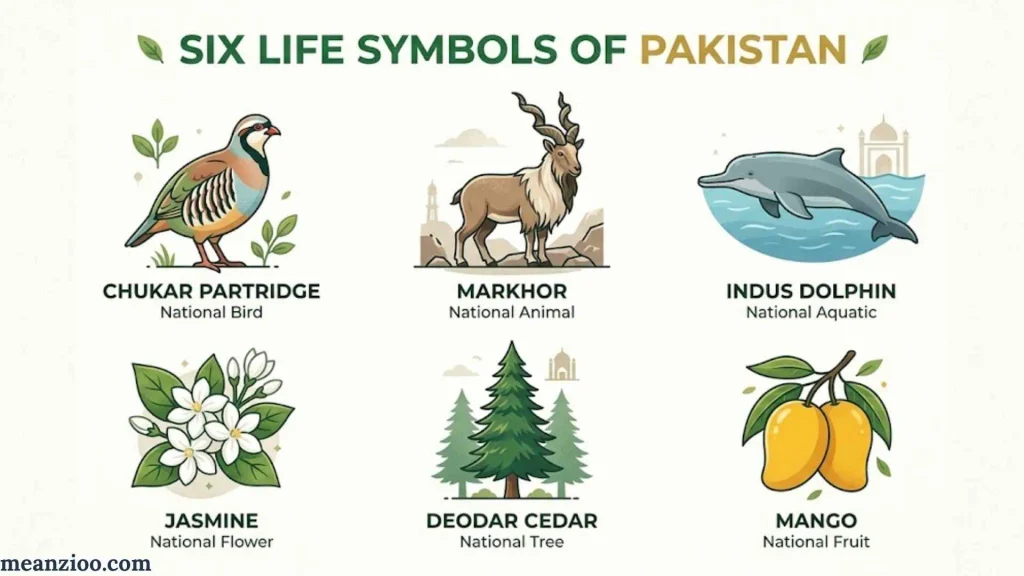
The markhor (Capra falconeri) is Pakistan’s national animal. This wild goat is known for its impressive spiral-shaped horns, sturdy body, and ability to navigate steep, rocky terrain.
The name markhor is often associated with snake-catching in regional folklore. However, its defining biological features are its specialized mountain adaptations and distinctive horns.
Markhors inhabit mountainous areas of northern and western Pakistan, including parts of Khyber Pakhtunkhwa, Gilgit-Baltistan, and Balochistan. They use rocky slopes and rugged terrain to find food and avoid predators.
Their diet consists mainly of grasses, leaves, shoots, and other vegetation. Depending on the season, they move between different elevations to find suitable food and shelter.
Why the markhor represents Pakistan
The markhor is an important symbol of Pakistani wildlife and biodiversity. Its natural habitat reflects the country’s rugged mountain landscapes, while its distinctive appearance makes it easily recognizable.
The species has also faced pressure from habitat loss, illegal hunting, and changes in land use. Conservation programs and community-managed wildlife initiatives have helped improve protection in some areas.
Protecting the markhor means more than preserving one animal. It also helps conserve mountain ecosystems that support many other species.
National Bird of Pakistan: Chukar Partridge
The chukar partridge (Alectoris chukar), commonly called chakor in Pakistan, is widely recognized as the country’s national bird.
It is a ground-dwelling bird with a rounded body, grayish-brown back, pale underside, red bill, and red legs. A distinctive black band runs from the forehead around the eyes and down toward the throat.
Chukars prefer dry, rocky hillsides, scrubland, and open mountain slopes. They feed on seeds, grasses, and other plant material, although insects can also form part of their diet.
The bird’s strong legs help it move across uneven ground. Rather than relying entirely on flight, it often runs between patches of vegetation and uses short flights when necessary.
Cultural importance of the chakor
The chakor has a place in South Asian poetry and folklore. Traditional stories sometimes associate it with the moon, longing, and devotion.
These literary associations have helped make the bird familiar beyond the world of wildlife. It appears in cultural references that connect nature with human emotions.
The chukar’s status as a national bird also creates an opportunity to discuss Pakistan’s natural heritage. Preserving its habitats supports wider biodiversity, especially in dry and mountainous regions.
National Flower of Pakistan: Jasmine
Jasmine is Pakistan’s widely recognized national flower. The name refers to flowering plants in the genus Jasminum, many of which are valued for their delicate white or yellow flowers and strong fragrance.
The species commonly cited in national-symbol lists is Jasminum officinale, although the precise species should be checked when an article makes a botanical claim.
Jasmine plants grow in gardens and landscaped spaces across Pakistan. Depending on the species and local climate, they can grow as shrubs or climbing plants.
Their flowers are popular in traditional decoration, garlands, and celebrations. Jasmine’s fragrance also makes it valuable in perfumery and other scented products.
What jasmine symbolizes
Jasmine is commonly associated with beauty, purity, affection, and grace. Its simple white flowers have a strong cultural presence despite their small size.
The plant also connects national symbolism with everyday life. Unlike a monument that people may visit only occasionally, jasmine can grow in a home garden or appear in a local flower market.
That familiarity helps explain why it remains an enduring part of Pakistan’s cultural identity.
National Tree of Pakistan: Deodar Cedar
The deodar cedar (Cedrus deodara) is widely identified as Pakistan’s national tree. It is a large evergreen conifer native to the western Himalayas and surrounding mountain regions.
Deodar trees can grow tall and develop broad, spreading branches. Their needle-like leaves and distinctive shape make them recognizable features of mountain forests.
In Pakistan, deodar forests occur in parts of Khyber Pakhtunkhwa, Azad Jammu and Kashmir, and other suitable northern mountain environments.
Ecological and cultural significance
Deodar forests provide habitat for wildlife, help stabilize mountain soils, and contribute to watershed health. Their roots and forest cover can reduce erosion, while the trees help maintain ecological balance in mountain landscapes.
The wood has historically been valued for construction and carpentry. However, excessive logging and forest degradation can threaten long-term regeneration.
Protecting deodar forests supports both biodiversity and local communities. Healthy mountain forests help preserve the natural systems on which downstream communities also depend.
Other Commonly Listed National Symbols of Pakistan
Not every symbol that appears on popular national-symbol lists has equally clear official recognition. The following examples deserve careful treatment.
| Category | Commonly cited name | Important clarification |
| National fish | Mahseer | Confirm the intended species; several fish are called mahseer. |
| National fruit | Mango | Widely associated with Pakistan, but distinguish cultural recognition from formal designation. |
| National vegetable | Okra | A commonly repeated claim that needs authoritative confirmation. |
| National reptile | Mugger crocodile | Do not assume official national status without reliable evidence. |
| National amphibian | Indus Valley toad | A species designation needs independent verification. |
| National butterfly | Peacock butterfly | Check the species and the basis for its claimed status. |
| National marine animal | Indus River dolphin | The dolphin is an important conservation species, but its national-symbol designation should be verified. |
| National mineral | Rock salt | Pakistan has major salt resources, including the Khewra Salt Mine, but resource importance is not proof of official national status. |
This approach prevents a common factual problem: repeating an internet list until an unverified claim begins to look official.
National Language of Pakistan: Urdu
Urdu is Pakistan’s national language, as stated in Article 251 of the Constitution of Pakistan. The same article addresses the use of English for official purposes and allows provincial assemblies to promote provincial languages.
Urdu plays an important role in education, literature, broadcasting, public communication, and national culture. Its vocabulary and literary traditions reflect centuries of interaction among languages and cultures across South Asia and beyond
Urdu developed through a long history of linguistic contact. It draws much of its everyday grammar from Indo-Aryan language traditions while incorporating vocabulary from Persian, Arabic, and other languages.
Pakistan’s linguistic diversity
Although Urdu serves as the national language, Pakistan has many other major languages. Punjabi, Pashto, Sindhi, Balochi, Saraiki, Hindko, Brahui, and several languages spoken in northern areas form part of the country’s rich linguistic landscape.
These languages carry their own poetry, stories, oral traditions, and regional identities. Sindhi has a long literary history, Punjabi has extensive folk-poetry traditions, and Pashto and Balochi have distinctive bodies of oral and written literature.
English also remains important in government, higher education, law, and professional settings.
Recognizing Urdu’s national status shouldn’t mean overlooking the country’s other languages. Pakistan’s cultural strength comes partly from the many communities that contribute to its shared national identity.
National Currency of Pakistan: Pakistani Rupee

The Pakistani rupee (PKR) is Pakistan’s official currency. It is used for everyday purchases, salaries, savings, business transactions, and domestic trade.
The State Bank of Pakistan is the country’s central bank and plays a major role in monetary policy, currency management, and financial stability.
The rupee’s symbol is commonly written as ₨, while PKR is its widely used international currency code.
Why currency matters as a national identifier
Currency notes and coins are more than payment tools. They can also carry national imagery, historical references, and recognizable cultural features.
Pakistani banknotes have featured Muhammad Ali Jinnah and other designs connected with the country’s history and architecture. Such imagery helps connect economic life with national heritage.
The value of the rupee changes against other currencies as exchange rates respond to economic conditions. However, its role as Pakistan’s domestic currency remains constant.
National Dress of Pakistan: Shalwar Kameez
The shalwar kameez is widely recognized as Pakistan’s national dress. It consists of a loose-fitting pair of trousers, called shalwar, and a tunic, called kameez.
People across Pakistan wear different versions of this outfit. The cut, fabric, color, embroidery, and accessories often reflect local customs, climate, and personal preferences.
- In Punjab, shalwar kameez may feature simple cotton fabrics or elaborate embroidery.
- In Sindh, traditional clothing can include the ajrak shawl and embroidered caps.
- In Khyber Pakhtunkhwa, regional styles often feature distinctive cuts and waistcoats.
- In Balochistan, traditional outfits may include detailed needlework and regional headwear.
These differences show why Pakistani cultural heritage cannot be reduced to one uniform style.
Shalwar kameez works well in warm weather when made from lightweight cotton. Heavier fabrics and layered garments provide warmth in colder regions.
People also wear it at weddings, religious celebrations, government events, and everyday gatherings. Its widespread use makes it one of the most visible expressions of Pakistani identity.
National Dish of Pakistan and Traditional Cuisine
Pakistan does not have one universally agreed national dish with the same clear status as its flag or anthem. Several dishes have strong national recognition, but regional cuisine remains central to the country’s food culture.
Nihari, biryani, karahi, haleem, sajji, and chapli kebab are among the dishes frequently associated with Pakistani cooking.
Popular Pakistani dishes
| Dish | Regional or cultural association |
| Nihari | Slow-cooked meat stew popular in major cities, especially in Punjab and Karachi |
| Biryani | Rice dish with regional variations and a particularly strong following in Karachi |
| Lahori chargha | Whole chicken prepared with spices and fried or roasted |
| Sajji | Meat preparation strongly associated with Balochistan |
| Chapli kebab | Spiced minced-meat patty associated with Pashtun cuisine |
| Sindhi biryani | A regional biryani known for its distinctive spices and flavor |
| Haleem | Slow-cooked mixture of grains, lentils, and meat, popular during religious occasions |
Food traditions reflect geography, trade, farming, migration, and historical cultural exchange. Wheat-based breads are common in many regions, while rice dishes have a prominent place in others.
Spices, herbs, lentils, vegetables, meat, and dairy products all contribute to the variety of Pakistani cooking.
Why Pakistani cuisine matters
Food often communicates identity more directly than formal symbols. Families pass down recipes, communities preserve regional specialties, and festivals bring people together around shared meals.
However, it is more accurate to describe nihari or biryani as iconic Pakistani dishes than to claim that either one has an undisputed official national designation.
National Sport of Pakistan: Field Hockey
Field hockey is traditionally recognized as Pakistan’s national sport. Pakistan has a proud history in international hockey, including major victories at the Olympic Games and the Hockey World Cup.
The national men’s hockey team won Olympic gold medals in 1960, 1968, and 1984. Pakistan also won the men’s Hockey World Cup in 1971, 1978, 1982, and 1994.
These achievements helped establish Pakistan as one of the sport’s historic powers.
Hockey and national pride
International hockey success brought attention to Pakistani athletes and created memorable moments for sports fans. The team’s achievements became part of the country’s sporting heritage.
Pakistan’s hockey history also demonstrates how national recognition can grow through achievement rather than formal designation alone.
Cricket’s enormous popularity
Cricket is arguably the most popular sport in Pakistan today. The national team has won major international competitions, including the 1992 Cricket World Cup and the 2009 ICC Men’s T20 World Cup.
The Pakistan men’s cricket team also won the 2017 ICC Champions Trophy. Cricket attracts large television audiences and brings communities together during major matches.
Hockey and cricket therefore occupy different but important places in Pakistan’s identity. Hockey has a strong claim to the traditional national-sport label, while cricket holds a particularly powerful place in contemporary popular culture.
National Poet of Pakistan: Allama Muhammad Iqbal
Allama Muhammad Iqbal is widely known as Pakistan’s national poet and the Poet of the East. Born on November 9, 1877, in Sialkot, he became one of the most influential philosophical poets in South Asian literature.
Iqbal wrote extensively in Urdu and Persian. His poetry explores selfhood, personal growth, spirituality, knowledge, freedom, and the challenges facing Muslim societies.
His ideas influenced political thinking among Muslims in British India. In his 1930 presidential address to the All-India Muslim League, he discussed the political future of Muslim-majority regions in northwestern India.
Although Iqbal did not live to see Pakistan’s independence in 1947, his writings later became closely associated with the intellectual history of the Pakistan Movement.
Important works and ideas
Iqbal’s well-known works include Bang-e-Dra, Bal-e-Jibril, Asrar-e-Khudi, and Zarb-e-Kalim.
His poetry frequently encourages readers to develop courage, knowledge, self-respect, and a sense of responsibility. These themes help explain why his work continues to appear in educational curricula and national commemorations.
Iqbal’s mausoleum, known as Mazar-e-Iqbal, stands near Badshahi Mosque in Lahore. It serves as a place of remembrance for a writer whose ideas remain influential in Pakistan’s cultural and intellectual life.
Founder of Pakistan: Muhammad Ali Jinnah
Muhammad Ali Jinnah, commonly called Quaid-e-Azam, is recognized as the founder of Pakistan and the Father of the Nation.
Born in Karachi on December 25, 1876, Jinnah trained as a lawyer and became a major political leader in British India. He eventually led the All-India Muslim League’s campaign for a separate homeland for Muslims in the region.
The Lahore Resolution of March 23, 1940, became a major milestone in this political movement. The resolution called for independent political arrangements in Muslim-majority regions, helping shape the campaign that led to Pakistan’s creation.
Pakistan became independent in August 1947, and Jinnah served as its first governor-general. He died on September 11, 1948.
Jinnah’s place in national identity
Jinnah’s leadership is closely associated with the struggle for independence and the creation of a sovereign state. His speeches also addressed constitutional government, citizenship, public service, and the position of religious alternative .
His mausoleum, Mazar-e-Quaid, stands in Karachi. The white marble structure is one of the city’s best-known landmarks and an important destination for national ceremonies.
Jinnah’s image also appears on Pakistani currency and in many public institutions, keeping his historical role visible in everyday life.
Fatima Jinnah: Mother of the Nation
Fatima Jinnah, the younger sister of Muhammad Ali Jinnah, played an important role in the Pakistan Movement. She supported her brother’s political work and became a prominent public figure in her own right.
Known as Māder-e-Millat, or Mother of the Nation, she is remembered for her contribution to independence and her involvement in public affairs after 1947.
Fatima Jinnah was also a dental surgeon, an unusual professional achievement for a woman in the social context of her early life. Later, she became an important voice in Pakistani politics and civic debate.
Her legacy represents women’s participation in national life and the contribution of individuals beyond the country’s best-known political leaders.
National Monuments of Pakistan and Their Historical Importance
Pakistan’s monuments preserve important moments from its political, religious, architectural, and archaeological history. They are powerful national landmarks, although not every famous monument has a formal designation as an official national symbol.
Minar-e-Pakistan
Minar-e-Pakistan stands in Greater Iqbal Park in Lahore, near the site associated with the Lahore Resolution of March 23, 1940.
Construction began in 1960 and the monument was completed in 1968. Its design combines modern structural elements with architectural influences drawn from Islamic and South Asian traditions.
The monument commemorates the political movement that helped lead to Pakistan’s creation. Its location gives it a direct connection to one of the defining events in the country’s national history.
Pakistan Day ceremonies and public visits reinforce its role as a place of remembrance.
Mazar-e-Quaid
Mazar-e-Quaid is the mausoleum of Muhammad Ali Jinnah in Karachi. Its white marble exterior and geometric design make it one of Pakistan’s most recognizable modern monuments.
The complex also contains the graves of other important figures from the country’s early political history.
Visitors attend official ceremonies there, particularly on national days and anniversaries associated with Jinnah. The mausoleum represents both respect for the founder and remembrance of the independence movement.
Pakistan Monument
The Pakistan Monument stands in Islamabad’s Shakarparian area. Its large petal-shaped structure represents the unity of the country’s regions and communities.
The monument’s design draws inspiration from traditional architectural forms while using a modern visual style. Its museum helps visitors explore Pakistan’s political history, cultural heritage, and path to independence.
Because Islamabad serves as the federal capital, the monument has a prominent place in national commemorations and public education.
Mazar-e-Iqbal
Mazar-e-Iqbal is the tomb of Allama Muhammad Iqbal, located near Badshahi Mosque in Lahore.
The structure blends architectural influences from different periods of South Asian history. Visitors come to pay tribute to Iqbal’s poetry and philosophical contributions.
Its setting near important Mughal-era landmarks also connects Pakistan’s modern intellectual history with the older architectural heritage of Lahore.
Badshahi Mosque and Lahore Fort
Badshahi Mosque and Lahore Fort are among the most important surviving examples of Mughal architecture in Pakistan.
Emperor Aurangzeb commissioned Badshahi Mosque in the seventeenth century. The mosque is known for its expansive courtyard, red sandstone exterior, and monumental domes.
Lahore Fort contains palaces, halls, gates, and decorative structures built or expanded by several Mughal rulers. Together with Shalamar Gardens, it forms part of a UNESCO World Heritage property.
These sites show how architecture can preserve the political ambitions, artistic skills, and religious traditions of an earlier era.
Faisal Mosque
Faisal Mosque stands at the foot of the Margalla Hills in Islamabad. Its distinctive modern design uses a large tent-like prayer hall rather than the conventional central dome found in many mosques.
The mosque was designed by Turkish architect Vedat Dalokay and completed in the 1980s. Its scale and unusual form have made it one of Pakistan’s most recognizable religious landmarks.
Faisal Mosque is an active place of worship as well as a destination for visitors interested in modern Islamic architecture.
Mohenjo-daro
Mohenjo-daro is one of the most important archaeological sites associated with the Indus Valley Civilization. Located in Sindh, it flourished during the Bronze Age, particularly around the third millennium BCE.
Archaeologists have uncovered evidence of planned streets, drainage systems, residential structures, and public buildings. These features demonstrate a high level of urban organization in one of the ancient world’s major civilizations.
Mohenjo-daro is part of a UNESCO World Heritage property. Its significance extends beyond Pakistan because it provides evidence of early urban life and long-distance cultural connections across South Asia.
Other important heritage sites
Pakistan’s historical landscape includes many other significant locations:
- Katas Raj Temples: A historic Hindu temple complex in Punjab.
- Lahore Museum: A major museum containing archaeological, artistic, and historical collections.
- Quaid-e-Azam House Museum: A historic Karachi residence associated with Muhammad Ali Jinnah.
- Sacred Heart Cathedral: An important Catholic church in Lahore.
- Baba Farid’s shrine: A major Sufi heritage site in Pakpattan.
- Khewra Salt Mine: A historic salt-mining site known for its extensive underground workings.
These sites represent different communities, historical periods, and cultural traditions. Together, they provide a more complete picture of Pakistan than any single monument could offer.
Natural Landmarks That Represent Pakistan
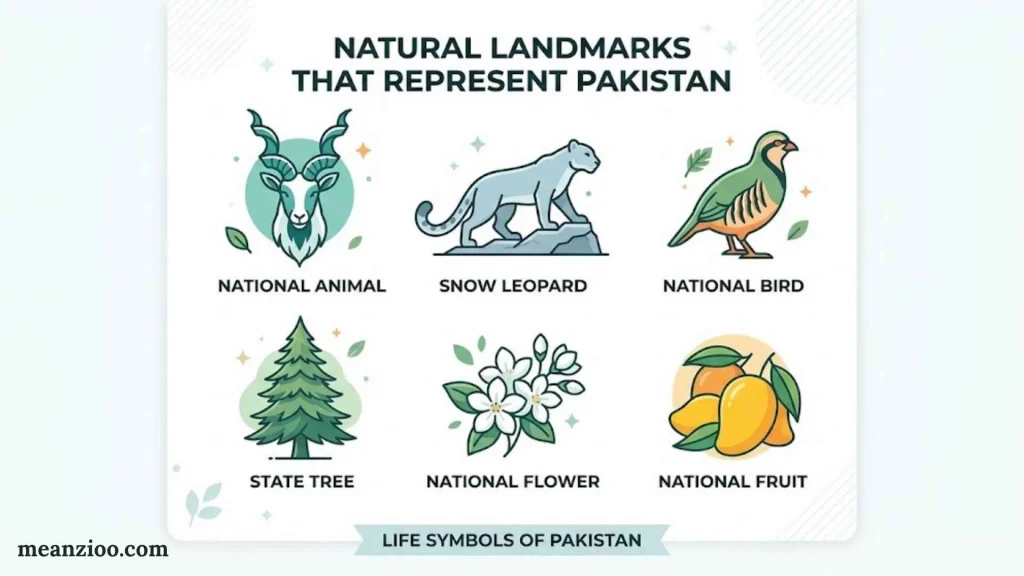
Pakistan’s geography ranges from the Arabian Sea coastline to some of the world’s highest mountains. Its rivers, forests, deserts, lakes, and valleys support communities and ecosystems while shaping the country’s image abroad.
These landmarks are often included in discussions of Pakistan’s natural symbols, although being famous or nationally significant does not automatically make a location an officially designated national symbol.
K2: Pakistan’s Most Famous High Mountain
K2, also known as Mount Godwin-Austen, rises to approximately 8,611 meters (28,251 feet) above sea level. It lies in the Karakoram Range near Pakistan’s border with China and ranks as the world’s second-highest mountain after Mount Everest.
K2 is famous for its steep slopes, severe weather, and technical climbing challenges. Its reputation among mountaineers reflects the risks involved in climbing one of the world’s most demanding high peaks.
The mountain also represents the spectacular geography of Gilgit-Baltistan. The surrounding Karakoram landscape includes glaciers, rugged peaks, and remote valleys that attract climbers, trekkers, and researchers.
Although K2 is sometimes described as Pakistan’s national mountain, that designation should not be confused with a verified formal national symbol.
Indus River: A Lifeline of Pakistan
The Indus River is central to Pakistan’s geography, agriculture, and history. It flows through the country toward the Arabian Sea, supporting an extensive network of canals, tributaries, farms, wetlands, and settlements.
The Indus River system supplies water for irrigation and supports major agricultural regions. Farmers depend on its waters to grow crops such as wheat, rice, cotton, and sugarcane.
The river also has deep historical significance. The ancient Indus Valley Civilization developed along the river system and produced major urban centers, including Mohenjo-daro and Harappa.
Today, the river faces challenges related to water demand, pollution, infrastructure, and changing climate conditions. Protecting it requires careful water management and conservation of its surrounding ecosystems.
Khyber Pass: A Historic Gateway
The Khyber Pass lies in the mountainous region connecting Pakistan with Afghanistan. For centuries, it has served as a route for trade, migration, military movement, and cultural exchange.
Its strategic position made it an important passage through the Hindu Kush mountain system. Traders and travelers used regional routes to connect South Asia with areas farther west.
The pass remains a powerful historical reference in discussions of Pakistan’s geography. It illustrates how mountain corridors can influence commerce, political relationships, and the movement of people.
Lake Saiful Muluk and the Northern Valleys
Lake Saiful Muluk lies near Naran in Kaghan Valley, Khyber Pakhtunkhwa. Situated at roughly 3,224 meters above sea level, the lake is surrounded by mountain slopes and is known for its clear water and dramatic scenery.
Local folklore associates the lake with the romantic story of Prince Saiful Malook and a fairy princess. The story has become part of the region’s cultural identity and adds a literary dimension to the landscape.
Other celebrated destinations include Swat Valley, Hunza, Skardu, and the mountain areas of Gilgit-Baltistan. Each has its own combination of natural scenery, local traditions, and tourism attractions.
National Parks and Wildlife Conservation
Pakistan’s protected areas preserve habitats ranging from high mountain ecosystems to deserts, forests, wetlands, and coastal environments.
Notable examples include:
- Khunjerab National Park: Protects high-altitude habitats and wildlife in Gilgit-Baltistan.
- Central Karakoram National Park: Contains major mountain landscapes and extensive glaciers.
- Deosai National Park: Protects a high-altitude plateau known for its distinctive landscape and Himalayan brown bears.
These parks are important to wildlife conservation in Pakistan. They also support research, responsible tourism, and the protection of endangered or vulnerable species.
Cultural Symbols of Pakistan
A country’s identity extends beyond government emblems. Clothing, food, music, literature, and craftsmanship help people express their shared history and regional backgrounds.
Pakistan’s cultural symbols are especially diverse because the country includes many languages, ethnic communities, and local traditions.
Shalwar Kameez and Traditional Clothing
Shalwar kameez is widely worn throughout Pakistan and is commonly identified as its national dress. However, regional clothing styles differ in embroidery, fabrics, accessories, and construction.
Sindhi ajrak and embroidered caps, Balochi needlework, Punjabi traditional outfits, and Pashtun clothing styles all contribute to the country’s textile heritage.
These traditions also support local artisans. Hand embroidery, weaving, block printing, and other techniques pass between generations, preserving skills that mass-produced clothing cannot fully replace.
Folk Music, Dance, and Instruments
Pakistan’s musical traditions include classical music, qawwali, folk songs, regional performance styles, and modern popular music.
Punjabi Bhangra is associated with energetic dance and dhol rhythms. Pashtun communities have distinctive dance traditions, while Sindhi music often features regional instruments and poetic forms.
The dhol, dafli, and other traditional instruments accompany celebrations, weddings, festivals, and local performances.
No single dance or instrument captures the entire country’s musical identity. Regional traditions are part of what makes Pakistani culture so varied.
Traditional Foods and Hospitality
Pakistani cuisine reflects agricultural conditions, regional ingredients, and centuries of cultural exchange.
Wheat-based breads are staples in many areas, while rice plays a major role in numerous dishes. Lentils, vegetables, meat, yogurt, herbs, and spices contribute to regional cooking.
Hospitality is another widely valued cultural tradition. Guests often receive tea, snacks, or a meal, depending on the household and occasion.
Food traditions connect families and communities. Recipes passed between generations preserve memories of local ingredients, seasonal celebrations, and family gatherings.
Literature, Poetry, and Folklore
Pakistan has a rich literary heritage in Urdu, Punjabi, Sindhi, Pashto, Balochi, Persian, and other languages.
Allama Iqbal’s philosophical poetry remains influential, while regional poets and storytellers preserve local histories and values. Folk narratives also carry themes of love, sacrifice, courage, and social responsibility.
The Hamzanama, a celebrated narrative tradition associated with the adventures of Amir Hamza, belongs to a broader Persianate literary and artistic heritage. It should not automatically be described as Pakistan’s official national epic.
Literature matters because it gives people a way to examine history, question social ideas, and preserve experiences that formal records may overlook.
Religious Heritage and Diversity in Pakistan
Pakistan’s constitutional identity includes Islam as the state religion, as stated in Article 2 of the Constitution. The country is also home to religious alternative and heritage sites associated with several faith traditions.
Mosques, Sufi shrines, Hindu temples, Sikh gurdwaras, and Christian churches form part of Pakistan’s historical landscape.
Islamic Architecture and Sufi Traditions
Pakistan contains many important examples of Islamic architecture. Badshahi Mosque, Faisal Mosque, and numerous historic mosques illustrate different architectural periods and design approaches.
Sufi shrines also play a significant role in religious and cultural life. The shrine of Baba Farid in Pakpattan is associated with the Chishti Sufi tradition and a long history of devotional poetry.
These sites attract worshippers, pilgrims, historians, and visitors. They also demonstrate how spiritual traditions influence local customs, literature, music, and community gatherings.
Hindu, Sikh, and Christian Heritage
Pakistan’s heritage includes important sites associated with Hinduism, Sikhism, and Christianity.
Katas Raj Temples in Punjab preserve a historic Hindu religious complex. Sikh heritage sites across the country connect with the life and history of Sikh communities. Churches such as Sacred Heart Cathedral in Lahore reflect the presence and history of Christian communities.
These places contribute to the country’s architectural and cultural record. Preserving them helps protect historical evidence and supports a more complete understanding of Pakistan’s diverse past.
National Days, Patriotic Songs, and Public Ceremonies
National celebrations bring symbols into public life. Flags appear on buildings, the national anthem plays at ceremonies, and communities gather to remember important historical events.
Pakistan Day: March 23
Pakistan Day is observed on March 23. It commemorates the Lahore Resolution of 1940 and is also associated with Pakistan’s transition to a republic in 1956.
The Lahore Resolution marked a major turning point in the political movement that eventually led to Pakistan’s independence.
Public observances may include official ceremonies, speeches, cultural programs, and military displays. Minar-e-Pakistan remains a particularly important landmark because of its connection to the resolution.
Independence Day: August 14
Pakistan celebrates Independence Day on August 14 to mark its independence in 1947.
People display national flags, decorate streets, organize school events, and attend public gatherings. Television and radio stations broadcast patriotic programs, historical documentaries, and national songs.
For many families, the day provides an opportunity to discuss independence, the sacrifices associated with the Pakistan Movement, and the country’s future.
Patriotic Songs and National Slogans
Pakistan’s national anthem is distinct from the many patriotic songs performed during national celebrations. These songs, often called milli naghmay, express love for the country, honor its people, or commemorate important historical events.
Songs such as Is Parcham Ke Saye Talay Hum Aik Hain are widely associated with national pride.
Expressions such as Pakistan Zindabad also appear at public gatherings and celebrations. However, popular slogans should not be confused with the country’s formal national motto, Unity, Faith, Discipline.
Wagah Border Ceremony
The Wagah border ceremony takes place at the Pakistan–India border near Lahore and Amritsar. It features coordinated flag-lowering drills performed by Pakistan Rangers and India’s Border Security Force.
The ceremony draws visitors who watch the marching, synchronized movements, and formal closing of the border gates.
It has become a recognizable public spectacle associated with national identity and border symbolism. At the same time, its daily ritual reflects the formal relationship between two neighboring states.
Frequently Asked Questions About National Symbols of Pakistan
What are the national symbols of Pakistan?
Pakistan’s widely recognized national symbols include its national flag, anthem, state emblem, markhor, chukar partridge, jasmine, and deodar cedar. Other important national identifiers include Urdu, the Pakistani rupee, and the motto Unity, Faith, Discipline.
Some commonly listed symbols have less clearly documented official status, so individual designations should be verified.
What is the national animal of Pakistan?
The markhor (Capra falconeri) is Pakistan’s national animal. It is a wild goat recognized by its long, spiral-shaped horns and its ability to live on steep, rocky mountain slopes.
What is the national bird of Pakistan?
The chukar partridge (Alectoris chukar), also called chakor, is widely recognized as Pakistan’s national bird. It lives in dry, rocky habitats and has a distinctive black band around its throat and face.
What is the national flower of Pakistan?
Jasmine is Pakistan’s national flower. Its fragrant flowers are popular in gardens and traditional decoration. Jasminum officinale is a species commonly associated with this designation.
What is the national tree of Pakistan?
The deodar cedar (Cedrus deodara) is widely recognized as Pakistan’s national tree. It grows naturally in western Himalayan mountain regions and contributes to forest ecosystems, soil stability, and wildlife habitats.
What is Pakistan’s national anthem called?
Pakistan’s national anthem is called Qaumi Tarana. Ahmad G. Chagla composed its music in 1949, while Hafeez Jullundhri wrote the lyrics that were officially approved in 1954.
What do the crescent and star on Pakistan’s flag mean?
The crescent symbolizes progress, while the five-pointed star represents light and knowledge. The flag’s green field represents the Muslim majority, and its white stripe represents religious alternative .
What is Pakistan’s national motto?
Pakistan’s national motto is Unity, Faith, Discipline. These principles are associated with Muhammad Ali Jinnah’s vision for the country and emphasize cooperation, conviction, and responsibility.
Who is known as the Father of the Nation in Pakistan?
Muhammad Ali Jinnah is known as the Father of the Nation and Quaid-e-Azam. He led the political movement that resulted in Pakistan’s independence in August 1947 and became its first governor-general.
Who is Pakistan’s national poet?
Allama Muhammad Iqbal is widely known as Pakistan’s national poet and the Poet of the East. His Urdu and Persian poetry explores selfhood, spirituality, knowledge, and the political and intellectual questions of his time.
What is Pakistan’s national language?
Urdu is Pakistan’s national language under Article 251 of the Constitution. English also remains important in official and professional settings, while Punjabi, Sindhi, Pashto, Balochi, Saraiki, and other languages contribute to the country’s linguistic diversity.
What is Pakistan’s national sport?
Field hockey is traditionally identified as Pakistan’s national sport. The country won Olympic men’s hockey gold medals in 1960, 1968, and 1984 and secured four men’s Hockey World Cup titles. Cricket, meanwhile, is exceptionally popular throughout Pakistan.
What is Pakistan’s national dress?
Shalwar kameez is widely recognized as Pakistan’s national dress. Regional variations in embroidery, fabrics, cuts, and accessories reflect the country’s diverse cultural traditions.
What is Pakistan’s national dish?
Pakistan does not have one universally agreed national dish with the same clearly established status as its national flag or anthem. Nihari, biryani, karahi, sajji, and other regional dishes are widely associated with Pakistani cuisine.
Is K2 Pakistan’s official national mountain?
K2 is Pakistan’s most famous high mountain and the world’s second-highest peak, at approximately 8,611 meters. It is an important geographical landmark, but its popularity should not be taken as proof of a formal national-mountain designation.
Why are national symbols important?
National symbols provide shared reference points for a country’s history, identity, and values. They appear in public ceremonies, education, cultural traditions, and international representation. They can also encourage people to preserve historic sites, wildlife, languages, and artistic traditions.
Conclusion: The Meaning Behind Pakistan’s National Symbols
The national symbols of Pakistan reflect a country with a complex history and a rich cultural identity. The national flag, anthem, state emblem, and motto represent the state’s identity and founding ideals. The markhor, chukar partridge, jasmine, and deodar cedar connect that identity with Pakistan’s natural environment.
Historical figures such as Muhammad Ali Jinnah, Fatima Jinnah, and Allama Muhammad Iqbal also occupy important places in the country’s national story. Meanwhile, monuments such as Minar-e-Pakistan, Mazar-e-Quaid, and Pakistan Monument preserve memories of political struggle and independence.
Beyond these familiar symbols, Pakistan’s languages, regional clothing, traditional cuisine, literature, religious heritage, and natural landscapes reveal the depth of its national identity.
One distinction remains essential: an official national symbol is not the same as a popular cultural icon. Understanding the difference makes any list of Pakistan’s national symbols more accurate and meaningful.
Learning about these symbols helps students understand the country’s history, gives travelers a deeper appreciation of its heritage, and reminds readers that national identity grows from both shared ideals and the many traditions that make a country unique.

I’m Ryan Mitchell, and I write about modern English, trending slang, and online expressions. I enjoy explaining the meanings, origins, and real-life usage of popular words in a simple way. I believe learning slang is an important step toward understanding today’s English-speaking culture. Through my work, I aim to help readers speak more naturally and stay updated with the latest language trends.
 Charlotte Hayes