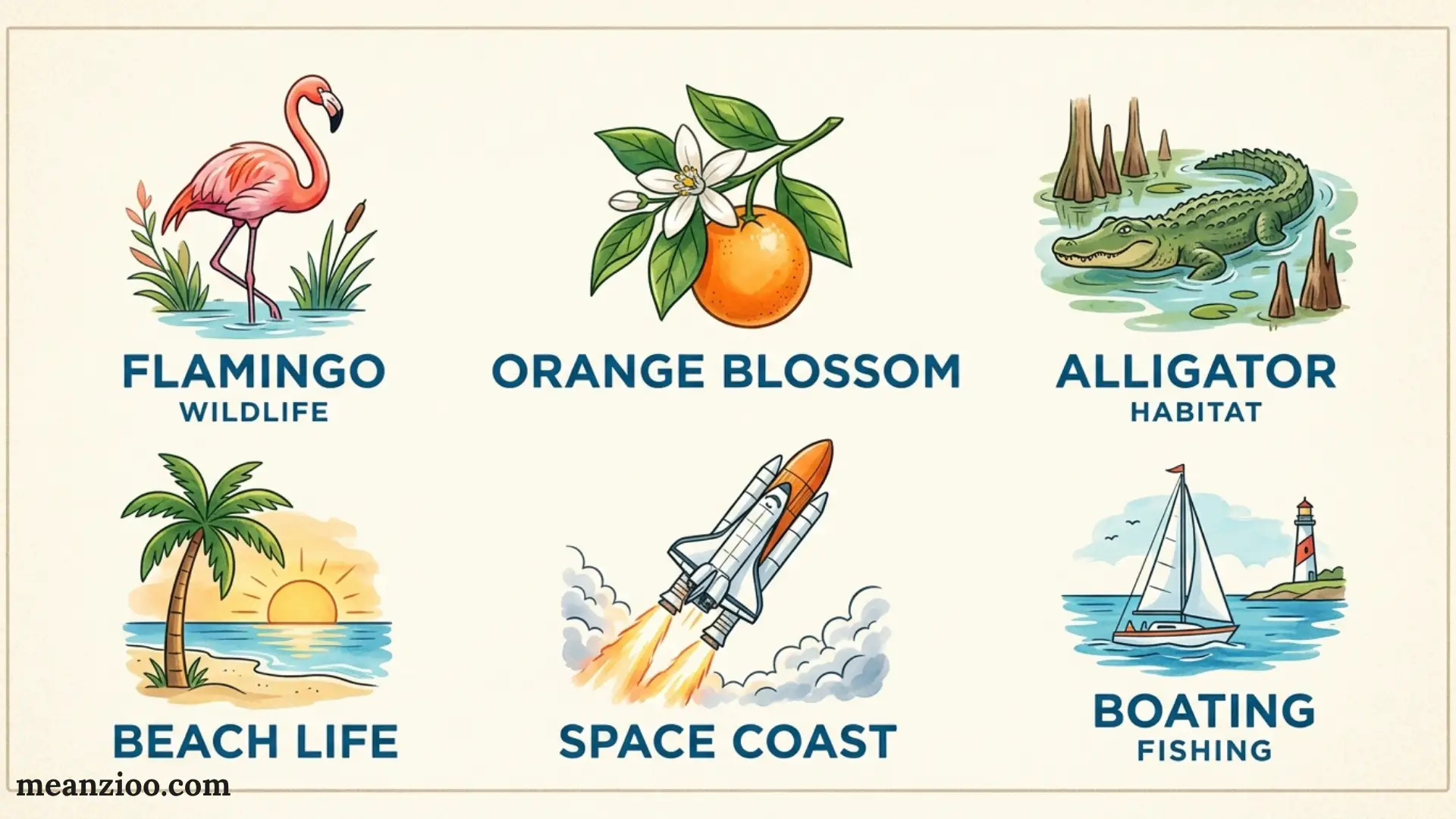
Florida is famous for its sunny beaches, orange groves, tropical wildlife, and colorful coastal landscapes. However, the state has much more to offer than sunshine and palm trees. Its official state symbols tell stories about Florida’s natural environment, agricultural traditions, cultural history, and connection to space exploration.
From the powerful Florida panther to the fragrant orange blossom, each designation represents a different part of the Sunshine State’s identity. Some symbols celebrate native wildlife, while others recognize the state’s citrus industry, geological features, music, and heritage.
Florida also has official designations that many people overlook, including its state soil, horse, heritage cattle breed, and official play.
This guide covers the major Florida state symbols, explains what makes each one special, and explores the history behind these distinctive emblems. Whether you’re researching a school assignment, planning a visit, or simply curious about Florida, you’ll find the essential facts in one place.
What Are the Official Symbols of Florida?
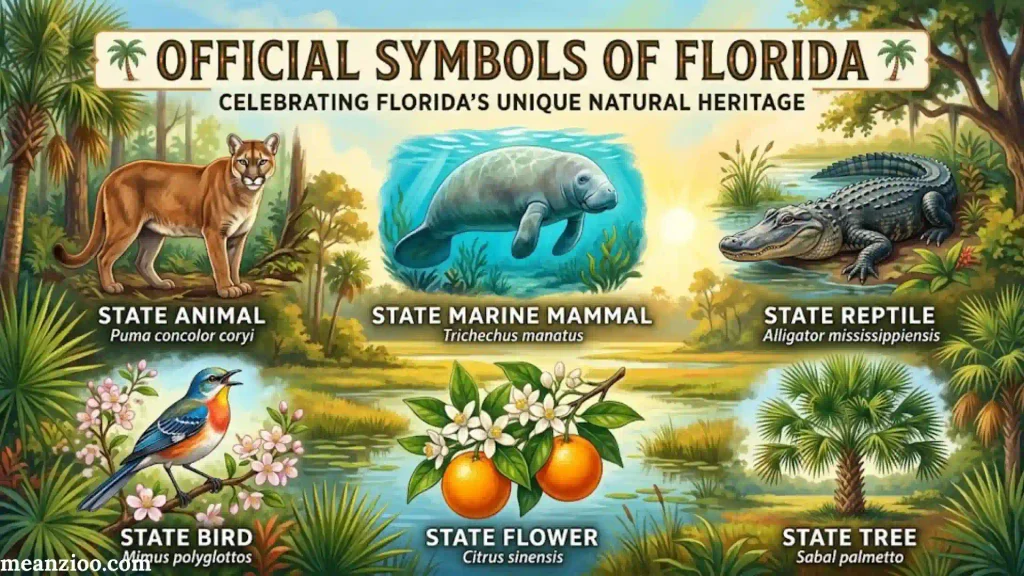
Florida state symbols are officially recognized emblems, plants, animals, objects, and cultural designations that represent the state. The Florida Legislature establishes many of these designations through laws recorded in Chapter 15 of the Florida Statutes.
These symbols reflect the state’s geography, wildlife, agriculture, history, and traditions. For example, the Florida panther represents native wildlife, orange juice highlights the citrus industry, and the sabal palm reflects Florida’s subtropical landscape.
The Florida Department of State maintains an official reference list of many of these symbols. The state also recognizes additional designations beyond the familiar bird, flower, and tree. You can consult the Florida Department of State’s official symbols guide for the published list.
Florida’s symbols generally fall into several categories:
- Animals and wildlife: The Florida panther, mockingbird, manatee, and American alligator.
- Plants and agriculture: The orange blossom, Coreopsis, sabal palm, and orange.
- Fish and marine life: The Florida largemouth bass, Atlantic sailfish, and loggerhead sea turtle.
- Natural materials: The horse conch, agatized coral, and moonstone.
- Government and identity: The state flag, Great Seal, and official motto.
- Cultural heritage: The state song, anthem, and play.
- Agricultural heritage: The Florida Cracker Horse and Florida Cracker cattle.
These designations don’t all serve the same purpose. Some identify a native species, while others recognize a cultural tradition or an important part of Florida’s economy.
Complete List of Florida State Symbols
The following table summarizes Florida’s major official symbols and several additional state designations.
| Category | Official Florida symbol |
| State flag | Florida state flag |
| State seal | Great Seal of the State of Florida |
| State motto | In God We Trust |
| State animal | Florida panther |
| State bird | Mockingbird |
| State reptile | American alligator |
| State saltwater reptile | Loggerhead sea turtle |
| State tortoise | Gopher tortoise |
| State marine mammal | Manatee |
| State saltwater mammal | Porpoise, commonly called dolphin in the statute |
| State freshwater fish | Florida largemouth bass |
| State saltwater fish | Atlantic sailfish |
| State butterfly | Zebra longwing |
| State flower | Orange blossom |
| State wildflower | Coreopsis |
| State tree | Sabal palm |
| State fruit | Orange |
| State beverage | Orange juice |
| State shell | Horse conch |
| State stone | Agatized coral |
| State gem | Moonstone |
| State soil | Myakka fine sand |
| State song | “Old Folks at Home” |
| State anthem | “Florida (Where the Sawgrass Meets the Sky)” |
| State play | Cross and Sword |
| State horse | Florida Cracker Horse |
| State heritage cattle breed | Florida Cracker cattle |
Florida recognizes other official designations as well, including an official citrus archive, air fair, rodeo, festival, and several cultural or historical institutions. Chapter 15 of the 2026 Florida Statutes provides the legal framework for these designations.
Important distinction: There isn’t one universal total that covers every Florida designation without qualification. The number depends on whether you count only traditional state symbols or include additional official designations established by law.
Florida’s Official Animal and Wildlife Symbols
Florida’s wildlife reflects an unusually varied environment. Wetlands, pine forests, rivers, coastal marshes, and warm offshore waters provide habitats for animals that have become important state symbols.
Florida State Animal: Florida Panther
Scientific name: Puma concolor coryi
The Florida panther is Florida’s official state animal and one of its best-known conservation symbols. This large wild cat belongs to the cougar family and represents the state’s native terrestrial wildlife.
Florida panthers typically have tawny coats, long tails, powerful legs, and compact, muscular bodies. They hunt deer, wild hogs, raccoons, and other suitable prey. Like other large cats, they generally avoid people and need extensive habitat to survive.
Today, the panther’s remaining breeding population is concentrated in South Florida. Habitat loss, vehicle collisions, and the fragmentation of natural areas remain major threats.
The panther received its official state designation in 1982. Its status also makes it a powerful reminder of the importance of wildlife corridors and protected land.
Why it represents Florida: The Florida panther symbolizes the state’s natural heritage and the work required to protect threatened wildlife.
Florida State Bird: Mockingbird
Scientific name: Mimus polyglottos
The mockingbird is Florida’s official state bird. This gray-and-white songbird is known for its remarkable ability to imitate the calls of other birds and a variety of environmental sounds.
Mockingbirds have slender bodies, long tails, and white patches on their wings that become especially noticeable during flight. They adapt well to residential neighborhoods, parks, open fields, and woodland edges.
A single mockingbird may repeat different songs throughout the day. Its varied vocalizations make it one of the most recognizable birds in many Florida communities.
Florida’s choice reflects a bird that thrives around people while remaining closely connected to the state’s natural environment.
Why it represents Florida: The mockingbird symbolizes the familiar birdlife found throughout the state, from quiet rural properties to busy neighborhoods.
Florida State Reptile: American Alligator
Scientific name: Alligator mississippiensis
The American alligator is Florida’s official state reptile. Its broad snout, armored body, powerful tail, and dark scales make it one of the state’s most recognizable animals.
Alligators inhabit freshwater marshes, swamps, lakes, ponds, and slow-moving rivers. They often create or maintain wetland depressions called alligator holes, which can provide refuge for other animals during dry periods.
Although alligators look similar to crocodiles, the two animals differ in several ways. American alligators usually have broader, U-shaped snouts, while American crocodiles tend to have narrower, more V-shaped snouts.
Florida officially designated the American alligator as its state reptile in 1987. Conservation measures helped the species recover after decades of excessive hunting and habitat loss.
However, alligators remain powerful wild animals. Never feed one, approach it closely, or assume that a seemingly calm alligator poses no danger.
Why it represents Florida: The alligator reflects the importance of freshwater wetlands and the state’s history of wildlife conservation.
Florida State Saltwater Reptile: Loggerhead Sea Turtle
Scientific name: Caretta caretta
The loggerhead sea turtle is Florida’s official state saltwater reptile. It spends most of its life in marine environments but returns to sandy beaches to lay eggs.
Loggerheads have large heads, reddish-brown shells, and strong jaws suited to crushing hard-shelled prey. Their diet can include crabs, mollusks, and other marine animals.
Florida’s beaches provide important nesting habitat for loggerheads. Females dig nests in the sand, deposit their eggs, and return to the ocean. Hatchlings later emerge and make their way toward the water.
Artificial lighting, coastal development, fishing gear, and marine debris can threaten sea turtles. Visitors can help by keeping beaches clean, avoiding disturbances around nests, and following local wildlife guidance.
Why it represents Florida: The loggerhead highlights the importance of Florida’s beaches, coastal ecosystems, and marine conservation.
Florida State Tortoise: Gopher Tortoise
Scientific name: Gopherus polyphemus
The gopher tortoise is Florida’s official state tortoise. Unlike the loggerhead, which lives in the ocean, this land-dwelling reptile occupies dry habitats such as sandy uplands, pine flatwoods, and scrub.
Gopher tortoises dig deep burrows that provide shelter from extreme temperatures, fires, and predators. These burrows also support numerous other species, making the tortoise an important part of Florida’s ecological communities.
Habitat destruction and development have contributed to declines in many populations. Protecting suitable sandy habitats helps both tortoises and the wildlife that depends on their burrows.
Why it represents Florida: The gopher tortoise demonstrates how one native species can support an entire community of animals.
Florida State Marine Mammal: Manatee
Scientific name: Trichechus manatus
The manatee, sometimes called the sea cow, is Florida’s official state marine mammal. This large aquatic herbivore feeds mainly on aquatic plants and moves slowly through rivers, estuaries, coastal waters, and warm-water refuges.
Manatees often gather around natural springs and warm-water discharges during colder months. Their sensitivity to cold helps explain why warm-water habitat is so important to their survival.
Boat strikes, habitat changes, and losses of aquatic vegetation have harmed manatee populations. Observers should maintain a safe distance and never chase, touch, or feed these animals.
Florida designated the manatee as its state marine mammal in 1975.
Why it represents Florida: The manatee reflects the state’s rich aquatic environments and the need to protect vulnerable marine wildlife.
Florida State Saltwater Mammal: Porpoise or Dolphin
Official statutory wording: Porpoise, commonly called dolphin in the statute
Florida’s official state saltwater mammal is listed in state law as the porpoise, described there as also commonly known as the dolphin. The distinction matters because dolphins and porpoises are scientifically different groups of cetaceans.
Dolphins are frequently spotted in Florida’s coastal waters, bays, and estuaries. Bottlenose dolphins, in particular, often swim near shore and may be seen from boats or beaches.
These intelligent marine mammals use sound to communicate, navigate, and locate prey. They eat fish and other marine animals, depending on the species and habitat.
Dolphins face threats from entanglement in fishing gear, pollution, boat interactions, and disturbance from people.
Why it represents Florida: This designation recognizes the state’s strong connection to marine ecosystems and coastal wildlife.
Florida’s Official Fish Symbols
Florida’s extensive waterways make fish important to both its ecology and recreational culture. The state recognizes one freshwater fish and one saltwater fish as official symbols.
Florida State Freshwater Fish: Florida Largemouth Bass
Scientific name: Micropterus salmoides floridanus
The Florida largemouth bass is the official state freshwater fish. Anglers prize this fish for its size, strength, and energetic response when hooked.
It inhabits lakes, ponds, rivers, and reservoirs, especially waters with vegetation, submerged structures, and suitable prey. Its large mouth helps it capture smaller fish, frogs, and other aquatic animals.
Florida’s warm climate supports a popular bass-fishing culture. Fishing attracts residents and visitors while supporting guides, tackle shops, boat rentals, and related businesses.
The Florida largemouth bass is closely related to other largemouth bass populations, but the Florida subspecies has characteristics that make it particularly notable to anglers.
Why it represents Florida: It connects the state’s freshwater ecosystems with outdoor recreation and fishing traditions.
Florida State Saltwater Fish: Atlantic Sailfish
Scientific name: Istiophorus platypterus
The Atlantic sailfish is Florida’s official state saltwater fish. It is a fast-moving marine predator known for its long bill and large, sail-like dorsal fin.
Sailfish inhabit warm ocean waters, including parts of the Atlantic near Florida. They hunt smaller fish and squid, using their bills and swimming ability to help capture prey.
Their striking appearance makes them popular among sportfishing enthusiasts. However, responsible fishing practices remain important to protect marine ecosystems and reduce unnecessary harm to wildlife.
The sailfish’s designation highlights Florida’s relationship with the Atlantic Ocean and the Gulf region’s broader fishing culture.
Why it represents Florida: The sailfish symbolizes the state’s saltwater fishing traditions and marine biodiversity.
Florida’s Official Plant and Flower Symbols
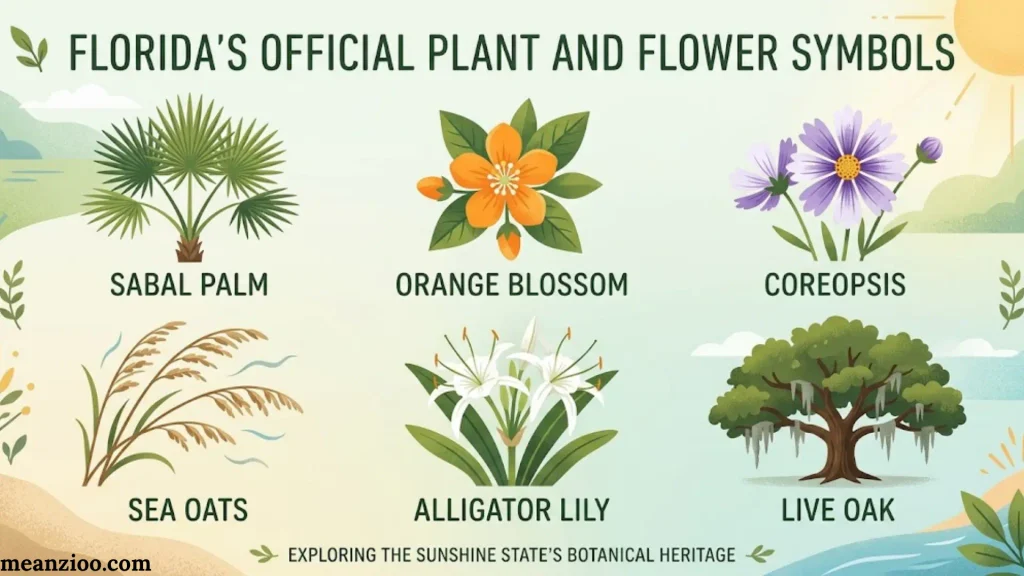
Florida’s plant symbols reflect its subtropical climate, native vegetation, and agricultural history. Three particularly important designations are the orange blossom, Coreopsis, and sabal palm.
Florida State Flower: Orange Blossom
Associated plant: Citrus trees, including sweet orange
The orange blossom is Florida’s official state flower. These small white flowers grow on citrus trees and produce a sweet fragrance that often fills orange groves during flowering season.
Orange blossoms typically appear before the fruit develops. Their presence signals an important stage in the citrus-growing cycle, connecting the flower to one of Florida’s best-known agricultural industries.
Citrus cultivation has shaped Florida’s rural landscapes, commercial activity, and public image for generations. Although citrus production has faced serious challenges from disease, weather, and other pressures, the orange blossom remains a recognizable emblem of the state.
The flower also appears in descriptions of Florida’s springtime scenery, particularly in citrus-growing regions.
Why it represents Florida: The orange blossom celebrates citrus agriculture and the state’s longstanding connection to orange cultivation.
Florida State Wildflower: Coreopsis
Coreopsis is Florida’s official state wildflower. Often recognized by its bright yellow, daisy-like flowers, this group of plants adds color to open landscapes and roadside plantings.
Different Coreopsis species vary in appearance, but many produce cheerful flowers that attract bees, butterflies, and other pollinators. Some species are native to Florida and grow in habitats such as dry sandy areas and open fields.
Florida adopted Coreopsis as its state wildflower in 1991. The designation recognizes its widespread presence and use in highway beautification.
Unlike the orange blossom, which grows on cultivated citrus trees, Coreopsis represents the state’s wildflower heritage.
Why it represents Florida: Coreopsis symbolizes native plant diversity, pollinator habitat, and the natural beauty of Florida’s roadsides and open spaces.
Florida State Tree: Sabal Palm
Scientific name: Sabal palmetto
The sabal palm, also called the cabbage palm or cabbage palmetto, is Florida’s official state tree. Despite its name, it is a palm rather than a typical broadleaf tree.
Its fan-shaped leaves and tall trunk make it a familiar sight throughout Florida. The species tolerates heat and can grow in a range of coastal and inland conditions.
People have historically used different parts of the sabal palm for practical purposes. Its growing tip is known as the cabbage, although harvesting it kills the palm. The tree also appears frequently in landscaping and natural coastal vegetation.
Florida designated the sabal palm as its state tree in 1953. It also appears on the state’s Great Seal.
Why it represents Florida: The sabal palm reflects the state’s native vegetation, warm climate, and recognizable landscape.
Florida’s Citrus Symbols: Orange and Orange Juice
Florida’s citrus industry has played a major role in shaping the state’s public image. That connection appears in two separate official designations: the orange as the state fruit and orange juice as the state beverage.
Florida State Fruit: Orange
Scientific name: Citrus sinensis and its hybrids
The orange is Florida’s official state fruit. Sweet oranges grow on evergreen citrus trees and are valued for their juicy flesh, fragrant peel, and refreshing flavor.
Florida’s warm climate historically supported extensive commercial orange cultivation. Citrus groves became an important part of the state’s agricultural identity, particularly in central and southern regions.
Oranges serve several purposes beyond fresh consumption. Producers use them for juice, flavorings, food products, and other citrus-based goods.
Florida officially designated the orange as its state fruit in 2005. The designation reinforces the relationship between the fruit, the state’s agricultural history, and its well-known citrus image.
However, Florida’s citrus industry has faced major challenges, including citrus greening disease and severe weather. The orange remains a state symbol even as production patterns and agricultural conditions change.
Florida State Beverage: Orange Juice
Orange juice is Florida’s official state beverage. State law defines it as juice obtained from mature sweet oranges and their hybrids.
The designation recognizes the importance of citrus processing and orange juice to Florida’s agricultural identity. The drink became strongly associated with the state through decades of orange-growing traditions, commercial production, and marketing.
Orange juice also provides a simple way to distinguish two related symbols:
- Orange: Florida’s official state fruit.
- Orange blossom: Florida’s official state flower.
- Orange juice: Florida’s official state beverage.
Although all three relate to citrus trees, each represents a different aspect of Florida’s natural or agricultural heritage.
Florida’s Official Shell, Stone, and Gem
Some Florida state symbols represent the state’s marine environment and geological history rather than living animals or plants. The horse conch, agatized coral, and moonstone each have a distinct story.
Florida State Shell: Horse Conch
Scientific name: Triplofusus giganteus; also known historically as Pleuroploca gigantea
The horse conch is Florida’s official state shell. This large marine gastropod produces a distinctive shell that can display orange, reddish, brown, or cream tones.
Horse conchs live in marine waters around Florida, where they hunt other mollusks and marine invertebrates. Their shells can grow impressively large, making them recognizable among Florida’s coastal shell life.
The species is a living sea snail, not simply an empty shell found on the beach. Responsible shell collecting matters because removing living animals can affect local populations.
Florida’s official designation recognizes the horse conch’s connection to the state’s surrounding waters and coastal natural heritage.
Why it represents Florida: The horse conch reflects Florida’s marine biodiversity and longstanding interest in seashells and coastal life.
Florida State Stone: Agatized Coral
Agatized coral is Florida’s official state stone. It forms when silica-rich material replaces or fills ancient coral structures, preserving details of their original shapes.
The resulting specimens may contain chalcedony, agate, or quartz crystals. Their colors and patterns vary, and some display structures that resemble the coral’s original skeletal framework.
The process is a form of mineral replacement. Over geological time, mineral-rich fluids interact with coral material and create stone that preserves aspects of the earlier structure.
Agatized coral is associated with Florida’s geological past, when environmental conditions supported coral growth and later mineralization.
Collectors value attractive specimens for their patterns, textures, and scientific interest. However, the stone’s significance extends beyond appearance: it provides clues about ancient environments and geological change.
Why it represents Florida: Agatized coral connects the state to its ancient marine environments and distinctive geological formations.
Florida State Gem: Moonstone
Mineral group: Feldspar
Moonstone is Florida’s official state gem. It is a variety of feldspar recognized for its soft, glowing appearance, which may create a pearly or bluish sheen under suitable lighting.
Unlike the horse conch and agatized coral, moonstone does not represent a material commonly found naturally in Florida. Its designation reflects a historical connection to the state’s role in America’s space program.
Florida adopted moonstone as its state gem in 1970, around the period of the Apollo lunar missions. Kennedy Space Center and Cape Canaveral played central roles in launching American spacecraft toward the Moon.
This makes moonstone an unusual state symbol. Rather than representing a local natural resource, it recalls a major scientific and technological chapter in Florida’s history.
Why it represents Florida: Moonstone symbolizes the state’s connection to space exploration and the launches that carried astronauts toward the Moon.
Florida’s Official Flag, Seal, and Motto
Florida’s government symbols represent the state’s identity in official documents, public buildings, and civic ceremonies. The flag, Great Seal, and motto each have a distinct purpose.
Florida State Flag
The Florida state flag features a white field crossed by a red diagonal saltire, with the state seal displayed in the center.
The red diagonal cross distinguishes the flag from a plain white banner. The seal adds imagery connected to Florida’s landscape, history, and government.
Florida’s flag developed through several historical versions. The modern design incorporates the central seal and diagonal red bars, creating a recognizable state emblem.
The flag is displayed at government offices, public institutions, and official events. Its design brings together Florida’s government identity and a visual representation of the state.
Great Seal of the State of Florida
The Great Seal of the State of Florida is an official government emblem used to authenticate state documents and represent Florida’s authority.
Its design includes sunlight, a landscape, a steamboat, a sabal palm, and a Seminole woman scattering flowers. The imagery reflects the state’s natural environment and historical development.
Florida established the seal’s basic design in 1868. The seal has since undergone revisions, including a significant update in 1985 that corrected historical and visual inaccuracies.
The sabal palm replaced the earlier reference to a cocoa palm in the official description. The revised design also made the steamboat more accurate and changed the depiction of the Indigenous woman.
The seal is not simply decorative. Its official use is regulated by state law, and the Florida Department of State oversees authorization for its use.
Florida State Motto: In God We Trust
Florida’s official state motto is “In God We Trust.” The state adopted it as its official motto in 2006.
The phrase also appears on the Great Seal, connecting the motto with Florida’s official government identity.
A motto differs from a flag or seal because it expresses an idea through words rather than a physical design. In Florida’s case, the phrase serves as a formal statement associated with the state’s civic symbolism.
The motto is established in Section 15.0301 of the Florida Statutes.
Florida’s Official Song, Anthem, and Play
Florida’s cultural designations recognize music and theatrical traditions that contribute to the state’s identity. These symbols differ from animals and plants because they represent artistic works rather than natural features.
Florida State Song: “Old Folks at Home”
Florida’s official state song is “Old Folks at Home,” a song written by Stephen Foster. It is also commonly associated with the title “Swanee River.”
The song became linked to Florida through its references to the Suwannee River and its place in American popular music. Florida adopted it as the state song in 1935.
However, the song’s original lyrics include racial stereotypes and language associated with minstrel performances. Florida later adopted revised lyrics, which remain part of the official designation.
This history is important when discussing the song. Its official status reflects a historical tradition, but its origins also require honest attention to the cultural context in which it was written and performed.
Florida State Anthem: “Florida (Where the Sawgrass Meets the Sky)”
Florida’s official state anthem is “Florida (Where the Sawgrass Meets the Sky),” written by Jan Hinton.
The anthem offers a separate musical representation of Florida. Its title evokes the state’s wetlands, open landscapes, and distinctive natural scenery.
Florida officially designated the song as its state anthem in 2008. It is separate from “Old Folks at Home,” which retains the designation of state song.
This distinction matters because the two titles serve different official roles. The state song carries a longer historical association, while the anthem provides another musical expression of Florida’s identity.
Florida State Play: Cross and Sword
Florida’s official state play is Cross and Sword, a historical pageant written by Paul Green.
The work explores Florida’s colonial history, particularly the Spanish settlement of St. Augustine. Founded in 1565, St. Augustine is widely recognized as the oldest continuously inhabited European-established settlement in the contiguous United States.
The pageant connects theatrical storytelling with the history of early European settlement in Florida. Its subject matter reflects the state’s Spanish colonial heritage and the conflicts that shaped its development.
Florida designated Cross and Sword as its official state play in 1973.
Florida’s Official Horse, Cattle Breed, and Soil
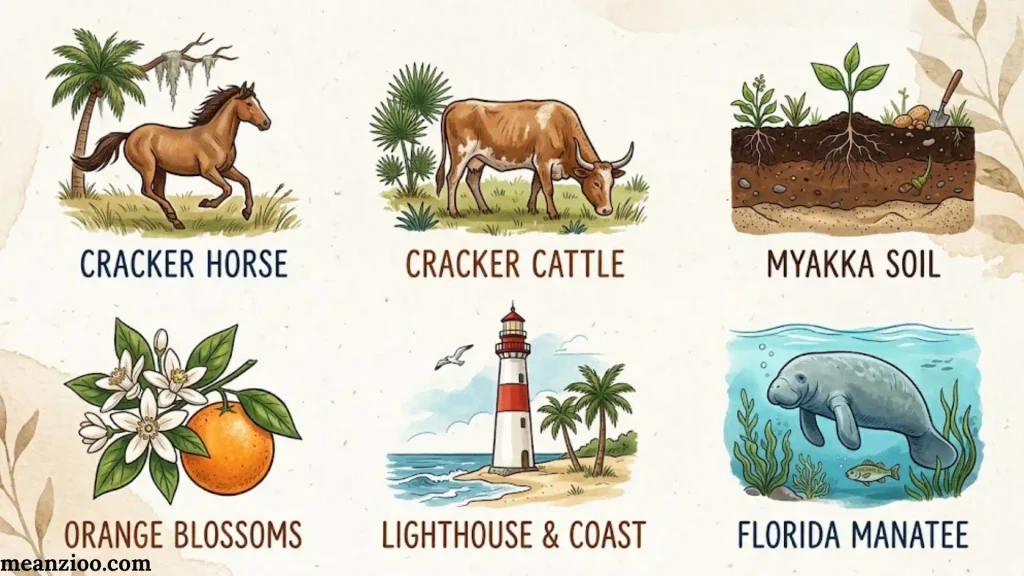
Florida’s official designations extend beyond familiar plants, animals, and government emblems. The state also recognizes agricultural heritage and a characteristic soil type.
Florida State Horse: Florida Cracker Horse
The Florida Cracker Horse is Florida’s official state horse. This heritage breed developed from horses brought to the Americas by Spanish explorers and settlers.
Over generations, the horses adapted to Florida’s climate and working conditions. Ranchers used them to manage cattle and carry out other livestock-related tasks.
The breed is known for its agility, endurance, and suitability for traditional cattle work. Its historical role connects it to the state’s ranching culture, especially before modern transportation and equipment became widespread.
Florida’s recognition of the breed helps preserve an important part of its agricultural heritage.
Florida State Heritage Cattle Breed: Florida Cracker Cattle
Florida Cracker cattle are the state’s official heritage cattle breed. Like the Florida Cracker Horse, these cattle trace their history to livestock brought to the Americas by Spanish settlers.
Over time, the animals adapted to Florida’s heat, humidity, and local environmental conditions. They became part of the state’s traditional cattle industry.
The breed represents an older style of ranching that relied on animals suited to local conditions. Preserving these cattle helps maintain genetic diversity and keeps historic livestock traditions alive.
Although Florida has a much broader modern cattle industry, the Cracker breed holds a special place in the state’s agricultural history.
Florida State Soil: Myakka Fine Sand
Myakka fine sand is Florida’s official state soil. It is a sandy soil associated with many areas of Florida, particularly landscapes that support pine flatwoods and other native vegetation.
Its characteristics influence drainage, plant growth, and land management. Sandy soils often allow water to move through them relatively quickly, although local conditions and underlying layers affect how well the soil retains moisture.
Myakka soils matter to agriculture, forestry, habitat management, and environmental planning. Understanding soil characteristics helps land managers choose suitable plants and protect natural ecosystems.
Florida’s designation recognizes the importance of soil as a foundation for the state’s landscapes and land-based industries.
Why Are Florida’s State Symbols Important?
The official symbols of Florida do more than identify the state. They preserve stories about its natural resources, cultural traditions, and historical development.
Each category offers a different way to understand Florida.
- Natural heritage: The Florida panther, American alligator, manatee, and loggerhead sea turtle represent the state’s varied wildlife and habitats.
- Agricultural history: The orange, orange blossom, and orange juice reflect the importance of citrus cultivation.
- Marine environments: The horse conch, Atlantic sailfish, and saltwater mammals connect Florida to its coastal waters.
- Geological history: Agatized coral represents ancient marine environments, while moonstone recalls the state’s connection to space exploration.
- Cultural identity: The flag, seal, motto, song, anthem, and play reflect Florida’s civic and artistic traditions.
- Agricultural heritage: The Florida Cracker Horse and Cracker cattle preserve connections to historic ranching.
- Environmental education: Symbols provide an accessible way for students and visitors to learn about native species, ecosystems, and conservation.
These designations also help make state history easier to remember. A student learning about the orange blossom can explore citrus agriculture, while someone researching the Florida panther can learn about habitat protection.
The symbols connect facts with stories. That makes them useful educational tools rather than simply a list of official names.
Frequently Asked Questions About Florida Symbols
What are the official symbols of Florida?
Florida’s official symbols include the Florida panther, mockingbird, American alligator, manatee, orange blossom, sabal palm, Coreopsis, orange, orange juice, Florida largemouth bass, Atlantic sailfish, horse conch, agatized coral, and moonstone. Other designations include the state flag, seal, motto, song, anthem, and soil.
How many official state symbols does Florida have?
Florida has numerous official state symbols and designations. The exact total depends on whether you count only traditional symbols or include additional designations, such as the state soil, horse, cattle breed, cultural institutions, and official events.
Chapter 15 of the Florida Statutes provides the legal basis for many of these designations.
What is Florida’s state animal?
The Florida panther is Florida’s official state animal. This large wild cat lives primarily in South Florida and represents the state’s native wildlife and conservation efforts.
What is Florida’s state bird?
The mockingbird is Florida’s official state bird. It is known for imitating the songs and calls of other birds.
What is Florida’s state flower?
The orange blossom is Florida’s official state flower. Its fragrant white flowers grow on citrus trees and symbolize the state’s citrus-growing heritage.
What is Florida’s state tree?
The sabal palm, also called the cabbage palm, is Florida’s official state tree. It is native to the state and appears on the Great Seal of Florida.
What is Florida’s state fruit?
The orange is Florida’s official state fruit. Its designation reflects the state’s long association with citrus cultivation.
What is Florida’s state beverage?
Orange juice is Florida’s official state beverage. The designation recognizes the importance of citrus production to the state’s agricultural identity.
What are Florida’s state freshwater and saltwater fish?
Florida’s official freshwater fish is the Florida largemouth bass. Its official saltwater fish is the Atlantic sailfish.
The two designations reflect the state’s freshwater fishing traditions and its connection to Atlantic marine life.
What is Florida’s state reptile?
The American alligator is Florida’s official state reptile. The state also recognizes the loggerhead sea turtle as its official saltwater reptile and the gopher tortoise as its official tortoise.
What is Florida’s state butterfly?
The zebra longwing is Florida’s official state butterfly. Its black-and-yellow striped wings make it distinctive, and its larvae feed on passionflower plants.
What is Florida’s state wildflower?
Coreopsis is Florida’s official state wildflower. These daisy-like flowers are valued for their bright colors and use in roadside plantings.
What are Florida’s state shell, stone, and gem?
Florida’s official state shell is the horse conch, its state stone is agatized coral, and its state gem is moonstone.
Each represents a different aspect of Florida’s natural or historical identity, from coastal marine life to ancient geological processes and space exploration.
Why is moonstone Florida’s state gem if it isn’t found there naturally?
Florida designated moonstone as its state gem in 1970. The choice reflects the state’s connection to America’s space program and the lunar missions launched from the Cape Canaveral and Kennedy Space Center area.
Moonstone therefore represents a historical and technological connection rather than a locally abundant mineral resource.
What is Florida’s state motto?
Florida’s official state motto is “In God We Trust.” The state formally adopted it in 2006.
What is the difference between Florida’s state song and state anthem?
Florida’s official state song is “Old Folks at Home,” while its official state anthem is “Florida (Where the Sawgrass Meets the Sky).” They are separate legal designations with different histories.
What is Florida’s state soil?
Florida’s official state soil is Myakka fine sand. It is associated with many Florida landscapes and plays a role in vegetation, drainage, and land management.
Final Thoughts on Florida State Symbols
Florida’s official symbols reveal a state shaped by wildlife, citrus agriculture, coastal environments, cultural traditions, and scientific achievement. From the Florida panther and sabal palm to orange juice and moonstone, each designation tells a different part of the story.
The familiar symbols are only the beginning. Florida also recognizes its heritage horse, cattle breed, soil, music, and theater, creating a broader picture of the state’s identity.
For the most accurate and current information, consult the Florida Department of State’s official state symbols list and Chapter 15 of the Florida Statutes. These primary sources help distinguish legally recognized symbols from popular images commonly associated with the Sunshine State.

I’m Ryan Mitchell, and I write about modern English, trending slang, and online expressions. I enjoy explaining the meanings, origins, and real-life usage of popular words in a simple way. I believe learning slang is an important step toward understanding today’s English-speaking culture. Through my work, I aim to help readers speak more naturally and stay updated with the latest language trends.