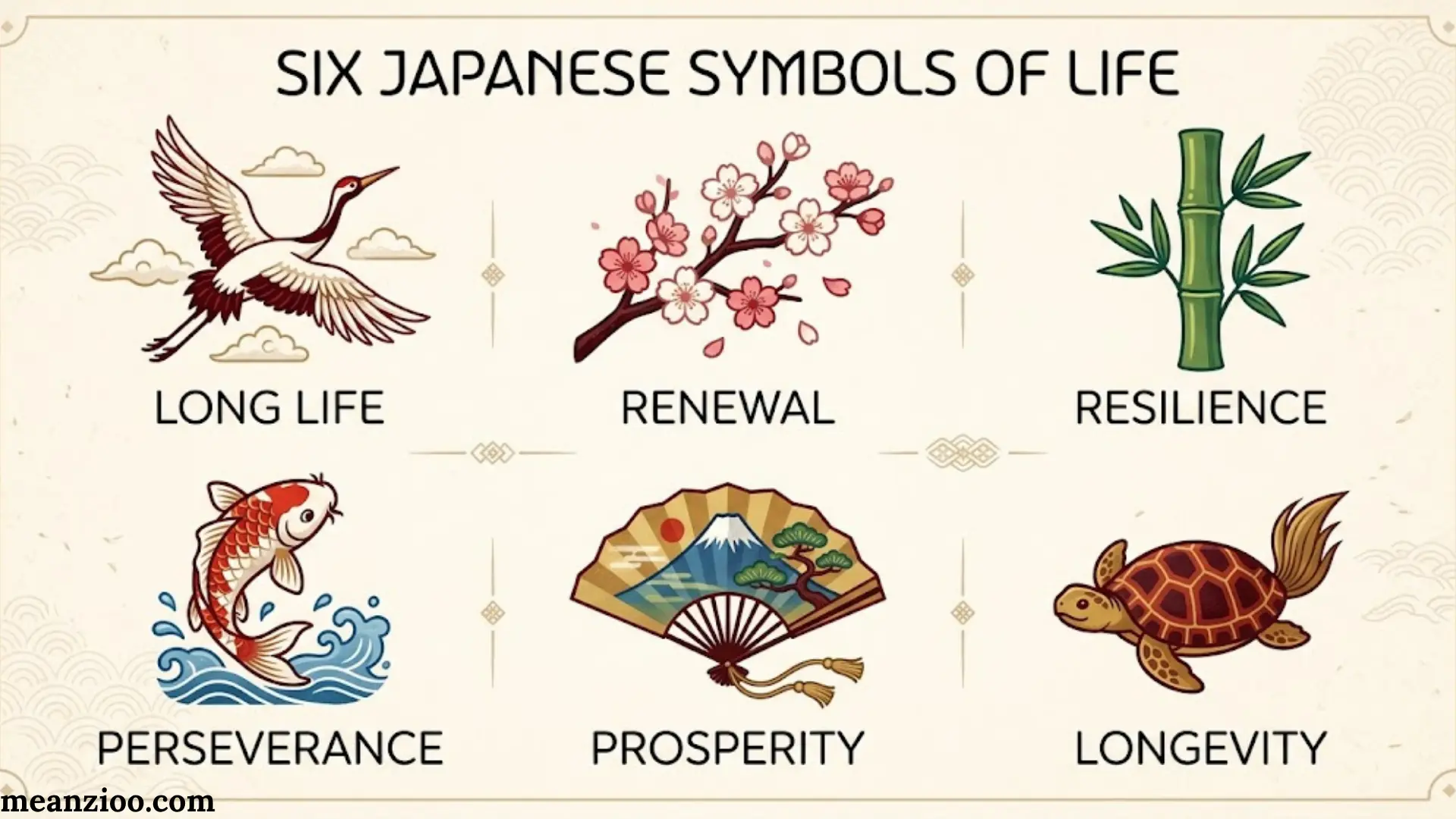
Japanese symbols have a fascinating connection to language, history, spirituality, art, and everyday life. From elegant Japanese characters and meaningful kanji symbols to the famous Japanese flag, cherry blossoms, koi fish, and traditional crests, each symbol can communicate an idea or represent an important part of Japanese culture.
However, the phrase Japan symbols can mean several different things. Some people want to learn the Japanese writing system, while others are looking for traditional Japanese symbols and their meanings. You might also be interested in symbols for love, peace, strength, happiness, nature, or tattoos.
This guide explores these meanings in detail. You’ll discover the main Japanese writing systems, common characters, cultural icons, traditional motifs, special punctuation marks, and the stories behind some of Japan’s most recognizable symbols.
What Are Japanese Symbols?
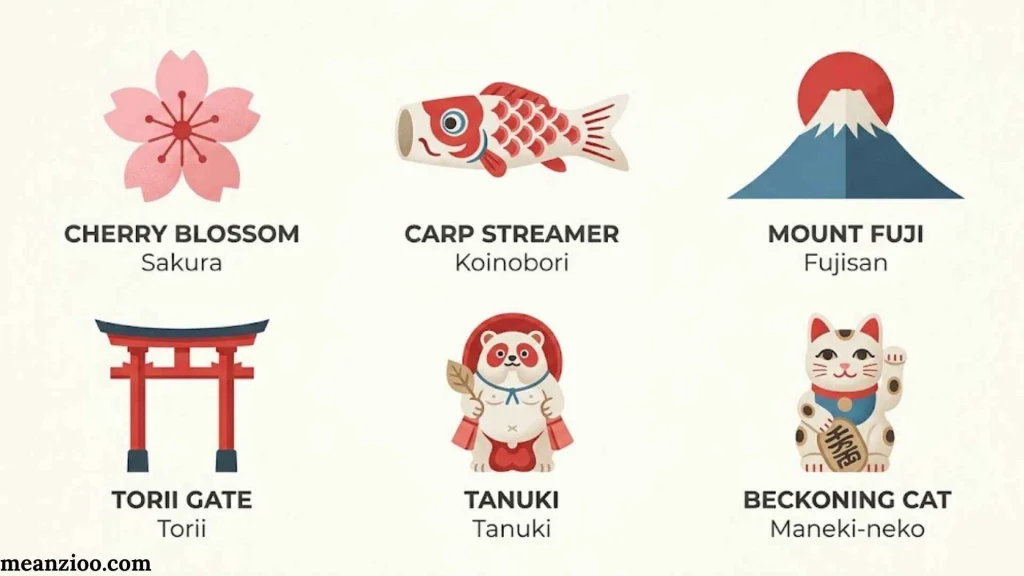
Japanese symbols include written characters, punctuation marks, official emblems, religious objects, and cultural images. Their meanings depend on where and how people use them.
For example, the character 愛 means love, while 桜 represents cherry blossoms. A torii gate marks the entrance to a Shinto shrine, and Japan’s red sun on a white background represents the country’s national flag.
Japanese symbols generally fall into several categories:
- Japanese writing symbols: Hiragana, katakana, kanji, and other written characters.
- Traditional Japanese symbols: Cherry blossoms, koi fish, Mount Fuji, and other recognizable cultural motifs.
- National symbols of Japan: The national flag, the Imperial Seal, and other official emblems.
- Spiritual symbols: Torii gates, Buddhist imagery, and symbols associated with Shinto beliefs.
- Decorative symbols: Characters and motifs used in calligraphy, tattoos, clothing, architecture, and artwork.
- Digital Japanese symbols: Unicode characters, punctuation marks, and typographic signs used in electronic communication.
It’s important to remember that not every traditional motif is an official national symbol. Some images have historical or spiritual associations, while others are popular because of their beauty, artistic value, or place in Japanese folklore.
Japanese Writing Systems and Their Meanings
Japanese uses several writing systems together. Unlike English, which primarily uses an alphabet, Japanese combines syllabic characters with kanji that can represent words or meaningful parts of words.
The four main systems are hiragana, katakana, kanji, and romaji.
Hiragana Symbols
Hiragana symbols are rounded Japanese characters used to write native Japanese words, grammatical endings, particles, and words that don’t use kanji in a particular context.
Modern Japanese has 46 basic hiragana characters. Each represents a sound or sound combination, usually a vowel or a consonant followed by a vowel.
Some common hiragana characters include:
| Hiragana | Pronunciation | Example or use |
| あ | a | A basic vowel sound |
| い | i | A basic vowel sound |
| う | u | A basic vowel sound |
| え | e | A basic vowel sound |
| お | o | A basic vowel sound |
| か | ka | Used in words such as かさ |
| さ | sa | Used in words such as さくら |
| の | no | A common grammatical particle |
| ん | n | A standalone nasal sound |
Hiragana is often the first writing system Japanese children learn. It also helps readers understand how to pronounce unfamiliar kanji through a system called furigana, which places small phonetic characters beside or above kanji.
For example, the Japanese word for cherry blossom is 桜, commonly read as sakura. Its hiragana form is さくら.
Hiragana characters generally represent sounds rather than individual symbolic ideas. Their meaning usually comes from the word or grammatical structure in which they appear.
Katakana Symbols
Katakana symbols form another Japanese syllabary with 46 basic characters. Their sounds correspond to the basic hiragana sounds, but their shapes are usually more angular.
Katakana commonly appears in:
- Foreign words and loanwords.
- Names of people and places from other languages.
- Scientific and technical terminology.
- Animal and plant names in certain contexts.
- Sound effects in manga.
- Words that writers want to emphasize.
For example, the English word coffee is written as コーヒー, pronounced kōhī. The word hotel becomes ホテル, pronounced hoteru.
Katakana is also widely used in Japanese comics and animation. Bold or unusual katakana can make a sound effect stand out or suggest a dramatic impact.
Like hiragana, katakana primarily represents sounds. It isn’t a collection of independent symbols with universal meanings such as love or courage.
Kanji Symbols
Kanji symbols are characters historically adopted from Chinese writing. Many represent a meaning-bearing word or part of a word, although their readings and meanings can change depending on context.
Kanji is especially important when people search for Japanese symbols and meanings, because individual characters can express ideas such as love, peace, strength, nature, and wisdom.
Here are some common Japanese kanji characters:
| Japanese symbol | Common meaning | Japanese reading example |
| 愛 | Love | Ai |
| 平和 | Peace | Heiwa |
| 力 | Power or strength | Chikara |
| 勇 | Courage or bravery | Yū |
| 幸 | Happiness or good fortune | Kō or sachi, depending on context |
| 夢 | Dream | Yume |
| 希望 | Hope | Kibō |
| 心 | Heart, mind, or spirit | Kokoro |
| 光 | Light | Hikari |
| 水 | Water | Mizu |
| 火 | Fire | Hi |
| 木 | Tree or wood | Ki |
| 山 | Mountain | Yama |
| 川 | River | Kawa |
| 空 | Sky or emptiness | Sora or other readings |
A kanji character can have several pronunciations. For instance, 山 can be read as yama when used independently, but it may have another reading in a compound word.
This is why a Japanese character should never be interpreted only by its English translation. The surrounding words, grammatical context, and intended usage all matter.
Romaji: Japanese Written in Latin Letters
Romaji means Japanese written with the Latin alphabet. It helps people who don’t yet read Japanese characters pronounce Japanese words.
For example:
- ありがとう — arigatō — thank you.
- さくら — sakura — cherry blossom.
- 日本 — Nihon or Nippon — Japan.
- こんにちは — konnichiwa — hello.
Romaji is useful for beginners, travel signs, language learning, and computer input. However, it doesn’t replace the Japanese writing system in ordinary Japanese writing.
How Many Japanese Characters Are There?
There isn’t one simple number for all Japanese symbols because the answer depends on what you count.
- Hiragana: 46 basic modern characters.
- Katakana: 46 basic modern characters.
- Kanji: Thousands of characters exist, with 2,136 designated as the standard-use kanji (Jōyō kanji) for general literacy in modern Japanese.
- Romaji: Uses Latin letters to represent Japanese sounds.
- Punctuation and typographic marks: Include additional signs for sentence structure, repetition, emphasis, and other writing functions.
The 46 basic characters in each kana system don’t include every possible written form. Modified characters, combinations, small kana, and extended katakana spellings add more possibilities.
Japanese Symbols and Their Meanings
Some of the most searched Japanese symbols and meanings are kanji associated with emotions, personal values, and natural elements. These characters often appear in artwork, jewelry, calligraphy, and personal designs.
However, meanings can vary by context. A single character may have several readings, and a compound can express a more specific idea than either character alone.
Japanese Symbols for Love
The best-known Japanese kanji for love is 愛 (ai). It represents love, affection, and deep emotional attachment.
Other characters and words related to love include:
| Symbol | Meaning | Notes |
| 愛 | Love | A common character for affection and love |
| 恋 | Romantic love or longing | Often associated with romantic feelings |
| 心 | Heart, mind, or spirit | Can express emotional or inner life |
| 絆 | Bond or connection | Often used for meaningful relationships |
| 愛情 | Affection or love | A compound expressing loving feelings |
愛 and 恋 are not interchangeable in every situation. 恋 often emphasizes romantic longing, while 愛 can describe deeper affection, love, or care.
The word 絆 (kizuna) is also popular because it refers to a bond between people. It can describe family ties, friendships, or connections built through shared experiences.
If you want a Japanese symbol for love, choose a word that matches the meaning you intend rather than selecting a character based only on its appearance.
Japanese Symbols for Peace
Peace is another common theme in Japanese kanji symbols. The character 平和 (heiwa) means peace and is widely understood in modern Japanese.
| Symbol | Meaning | Context |
| 平和 | Peace | Peaceful conditions or harmony |
| 和 | Harmony | Social balance, cooperation, or traditional Japanese culture |
| 安 | Safety or peace of mind | Often appears in compounds related to security |
| 静 | Quiet or calm | Can suggest stillness or tranquility |
The character 和 has a particularly broad cultural role. It can mean harmony and also appears in words connected with Japanese traditions, such as 和食 (washoku), meaning Japanese cuisine.
A Japanese peace symbol doesn’t always refer to one particular character. Depending on the context, it might mean 平和, 和, or a visual design associated with peace.
Japanese Symbols for Strength and Courage
People often search for Japanese symbols that represent strength, bravery, determination, and resilience.
| Symbol | Meaning | Common association |
| 力 | Strength or power | Physical or personal ability |
| 強 | Strong | Strength or intensity |
| 勇 | Courage or bravery | Facing difficulty with courage |
| 忍 | Endurance or perseverance | Patience and bearing hardship |
| 武 | Martial or military | Martial traditions and combat |
| 不屈 | Unyielding | Refusing to give up |
The character 忍 (nin or shinobu, depending on context) is associated with enduring difficulty or exercising patience. It appears in words connected with perseverance and also forms part of 忍者 (ninja).
The compound 不屈 (fukutsu) means unyielding or indomitable. It expresses determination more directly than a single character can.
When choosing a Japanese symbol for strength, consider whether you mean physical power, emotional resilience, bravery, or persistence. Japanese offers different words for these ideas.
Japanese Symbols for Happiness and Good Fortune
Japanese culture includes many characters associated with happiness, luck, prosperity, and positive outcomes.
| Symbol | Meaning | Common use |
| 幸 | Happiness or good fortune | Names and words associated with happiness |
| 福 | Good fortune or blessing | Lucky decorations and traditional motifs |
| 喜 | Joy or delight | Words associated with happiness |
| 笑 | Laughter or smiling | Cheerfulness and humor |
| 希望 | Hope | Positive expectations for the future |
| 吉 | Good luck or auspiciousness | Fortune-related contexts |
The character 福 is especially recognizable in East Asian decorative traditions. It can appear on festive decorations and objects associated with prosperity.
The word 幸福 (kōfuku) means happiness. It combines characters associated with good fortune and well-being.
These characters are useful to know if you’re researching Japanese symbols for happiness, but they don’t function as magical guarantees of luck. Their significance comes from language, cultural traditions, and personal interpretation.
Japanese Symbols for Wisdom and Knowledge
Japanese characters can also express intelligence, understanding, and wisdom.
- 知 — knowledge or knowing.
- 智 — wisdom or intelligence in many compounds.
- 学 — learning or study.
- 真 — truth or genuineness.
- 道 — road, path, or way.
The character 道 (dō or michi, depending on context) has a wide range of meanings. It can describe a physical road or a figurative path of practice and personal development.
You’ll see it in words such as 柔道 (jūdō), the martial art, and 茶道 (sadō or chadō), the Japanese tea ceremony tradition.
The word Japanese symbols for wisdom can therefore refer to individual kanji, compounds, or traditional practices that emphasize knowledge and self-cultivation.
Japanese Symbols for Fire, Water, Earth, and Nature
Nature has a strong presence in Japanese writing, art, and cultural imagery. Several basic kanji represent natural elements.
| Symbol | Meaning | Reading example |
| 火 | Fire | Hi |
| 水 | Water | Mizu |
| 木 | Tree or wood | Ki |
| 土 | Earth or soil | Tsuchi |
| 金 | Gold, metal, or money | Kin or other readings |
| 風 | Wind | Kaze |
| 雨 | Rain | Ame |
| 雪 | Snow | Yuki |
| 花 | Flower | Hana |
| 月 | Moon or month | Tsuki or other readings |
| 日 | Sun, day, or date | Hi or other readings |
| 星 | Star | Hoshi |
These are ordinary Japanese characters rather than universal pictograms. Their precise meaning depends on the word in which they appear.
For example, 火 means fire, but 火山 (kazan) means volcano. Similarly, 水 means water, while 水道 (suidō) can refer to a water supply system.
The character 木 means tree or wood. Combining it with other tree-related characters can create words connected with forests and wooded areas.
Japanese Special Characters and Punctuation Marks
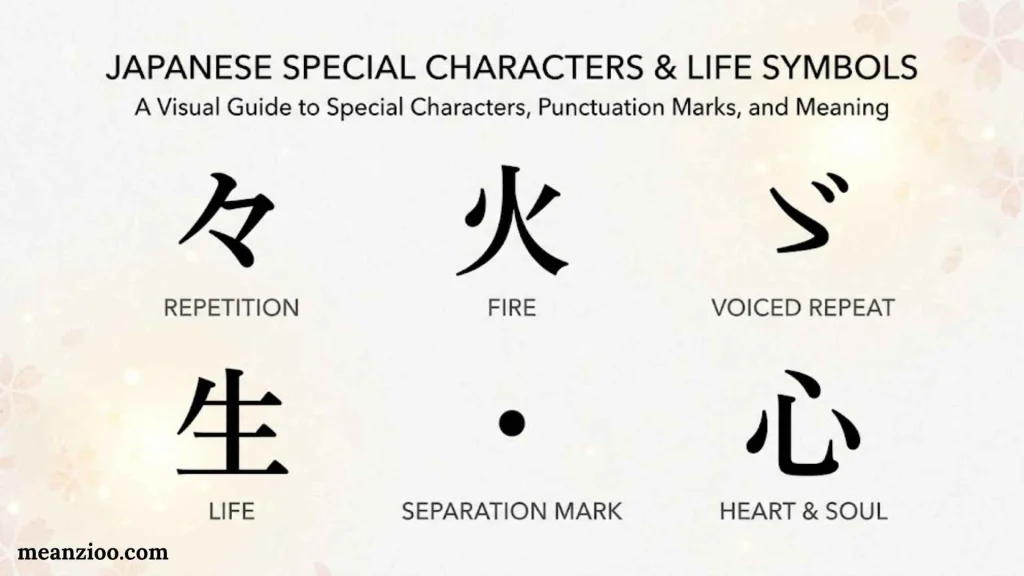
Japanese writing includes many marks that help readers understand pronunciation, sentence structure, repetition, and emphasis. Some look unusual to people who are familiar only with English punctuation.
Dakuten and Handakuten
Dakuten and handakuten are small marks placed beside certain kana characters to change their pronunciation.
Dakuten looks like two short strokes: ゛. Handakuten looks like a small circle: ゜.
Examples of dakuten include:
- か becomes が (ka becomes ga).
- さ becomes ざ (sa becomes za).
- た becomes だ (ta becomes da).
- は becomes ば (ha becomes ba).
Handakuten changes the h-row sounds into p-row sounds:
- は becomes ぱ (ha becomes pa).
- ひ becomes ぴ (hi becomes pi).
- ふ becomes ぷ (fu becomes pu).
These marks are important parts of Japanese orthography. They aren’t decorative symbols, even though they may look like small accents.
The Small っ Character
The small hiragana っ is called sokuon. Katakana uses its equivalent, ッ.
It usually indicates a doubled consonant or a brief pause before the next consonant. For example, きって (kitte) means a postage stamp.
The small character changes how the word is pronounced, so it can also change the word’s meaning. Readers must distinguish it from the full-size つ character.
The Long Vowel Mark ー
The mark ー is called the chōonpu or long vowel mark. It appears most often in katakana words to indicate a prolonged vowel sound.
Examples include:
- コーヒー — coffee.
- ケーキ — cake.
- スーパー — supermarket.
This mark is especially common in loanwords and names borrowed from other languages. It isn’t normally used in the same way in standard hiragana spelling.
Japanese Repetition Marks
Japanese uses special marks to repeat characters or parts of words without writing them again.
| Symbol | Name or description | Function |
| 々 | Kanji repetition mark | Repeats the preceding kanji |
| ゝ | Hiragana iteration mark | Repeats a hiragana character in certain writing |
| ゞ | Voiced hiragana iteration mark | Repeats a hiragana character with voicing |
| ヽ | Katakana iteration mark | Repeats a katakana character |
| ヾ | Voiced katakana iteration mark | Repeats a katakana character with voicing |
The character 々 appears in familiar words such as 時々 (tokidoki), meaning sometimes, and 人々 (hitobito), meaning people.
These repetition marks help shorten written forms, although some are more common in historical or specialized writing than in everyday modern Japanese.
Japanese Punctuation Symbols
Japanese punctuation differs from English in appearance and, sometimes, usage.
Common examples include:
| Symbol | Name | Purpose |
| 。 | Japanese period | Marks the end of a sentence |
| 、 | Japanese comma | Separates phrases or items |
| 「 」 | Corner brackets | Marks quoted speech or titles in many contexts |
| 『 』 | Double corner brackets | Often marks titles or quotations within quotations |
| ・ | Middle dot | Separates names or terms in some contexts |
| ? | Full-width question mark | Marks a question, especially in informal writing |
| ! | Full-width exclamation mark | Shows emphasis or strong emotion |
| … | Ellipsis | Indicates a pause or omitted material |
| 〜 | Wave dash | Can indicate ranges or a drawn-out tone, depending on context |
The Japanese period 。 and comma 、 are standard punctuation marks. Question marks and exclamation points are also widely used, especially in informal writing, although sentence-final punctuation conventions differ across genres.
Corner brackets are particularly recognizable in Japanese books, articles, and dialogue. They help readers identify quoted speech without relying on English quotation marks.
Traditional Japanese Symbols and Their Cultural Meanings
Beyond written characters, Japan has a rich collection of traditional symbols. These include national emblems, flowers, animals, landscapes, and objects connected with religion or folklore.
Their meanings often reflect changing historical traditions rather than one fixed interpretation.
The Japanese Flag: Hinomaru
The Japanese flag, known as the Hinomaru, features a red circle on a white background. The red circle represents the sun, connecting the flag with Japan’s longstanding association with the rising sun.
The official flag is called Nisshōki in Japanese, while Hinomaru is the familiar name used in everyday conversation.
The sun has a deep place in Japanese culture and mythology. Japan is often called the Land of the Rising Sun, a name associated with its position east of the Asian mainland.
The flag’s simple design makes it one of the most recognizable national symbols of Japan. You’ll see it at official ceremonies, international sporting events, government buildings, and national celebrations.
The Chrysanthemum Crest
The chrysanthemum crest, known as the Kikumon, is closely associated with Japan’s Imperial House.
Its familiar design features a stylized chrysanthemum with overlapping petals. The Imperial Seal of Japan traditionally uses a 16-petal chrysanthemum design.
The chrysanthemum has been associated with the Japanese imperial institution for centuries. It also appears in Japanese art, seasonal displays, and cultural traditions.
However, not every chrysanthemum image represents the Imperial Seal. Flowers appear in many decorative contexts, so their meaning depends on the design and setting.
The Paulownia Crest
The paulownia crest, called Kiri-mon, is another important Japanese emblem. Its design typically features paulownia leaves and flower clusters arranged in a balanced pattern.
Paulownia crests have appeared in historical settings associated with authority and government. Different versions have been connected with influential families and institutions.
The paulownia motif is also found in decorative art and traditional designs. As with other Japanese family crests, its meaning depends on the particular version and historical context.
Cherry Blossom: Sakura
The cherry blossom, known as sakura, is one of Japan’s most recognizable cultural symbols.
Cherry blossoms bloom for a relatively short period, making them a powerful image of seasonal change. Their brief beauty is often connected with impermanence, renewal, and the passing of time.
During spring, people gather for hanami, the tradition of viewing blossoms with friends, relatives, or colleagues. Parks, gardens, riversides, and castle grounds become popular viewing locations.
Cherry blossoms also appear in Japanese poetry, paintings, clothing, ceramics, and contemporary designs.
Their meanings can include:
- Renewal: Spring blossoms signal the arrival of a new season.
- Beauty: Their delicate appearance makes them a popular artistic motif.
- Impermanence: Their short flowering period reminds people that beauty and life change.
- National identity: Sakura has a strong association with Japanese culture, although it isn’t the country’s official national flower under a single formal designation.
The cherry blossom is also represented by the kanji 桜. In hiragana, the word is さくら.
Koi Fish: Perseverance and Determination
The koi fish is a popular Japanese cultural motif associated with perseverance, determination, and good fortune.
Koi are ornamental varieties of carp raised for their distinctive colors and patterns. They often appear in gardens, ponds, paintings, tattoos, and decorative objects.
Stories about carp swimming upstream and transforming into dragons are part of a broader East Asian tradition. This imagery has helped connect koi with overcoming obstacles and achieving ambitious goals.
In Japan, koi also appear in koinobori, colorful carp-shaped streamers displayed around Children’s Day on May 5. The streamers express hopes for children’s health, growth, and success.
A koi design may represent different things depending on its colors, arrangement, and setting. It’s better to understand it as a flexible cultural symbol than to assign one universal meaning to every koi image.
Mount Fuji: Beauty and Spiritual Significance
Mount Fuji is one of Japan’s most recognizable natural landmarks. Its nearly symmetrical volcanic shape has inspired generations of artists, writers, pilgrims, and travelers.
Mount Fuji holds religious and cultural importance, especially in traditions connected with mountain worship. People have climbed the mountain for spiritual reasons as well as recreation.
Its image appears in famous Japanese artworks, including woodblock prints, as well as on souvenirs, posters, calendars, and everyday products.
Mount Fuji can symbolize natural beauty, endurance, national identity, and spiritual aspiration. The exact meaning depends on how artists or communities use its image.
The Japanese Crane
The Japanese crane, often identified as the red-crowned crane, is associated with longevity, good fortune, and elegance in Japanese cultural imagery.
Its white body, black wing feathers, and red crown make it distinctive. Cranes appear in paintings, textiles, wedding decorations, and other traditional designs.
Cranes also feature in the custom of folding origami cranes. The paper crane has become an international symbol of hope and peace, although individual interpretations vary.
A group of 1,000 folded cranes is commonly called senbazuru. People may fold them to express wishes for recovery, happiness, or peace.
The crane is not unique to Japan, and its symbolism appears in other East Asian cultures as well. Its Japanese significance is part of a wider regional tradition.
The Japanese Maple
Japanese maple trees are admired for their distinctive leaves and vivid autumn colors. The maple leaf, called momiji in many contexts, appears in seasonal art, poetry, textiles, and decorative designs.
Autumn leaves often represent the changing seasons and the beauty of nature. Like cherry blossoms, they can suggest the passage of time.
The maple leaf is also associated with autumn outings and seasonal foods. Its appearance in artwork may simply indicate fall rather than a deeper symbolic message.
Other Important Japanese Nature Symbols
Nature supplies many additional motifs used throughout Japanese culture.
| Symbol | Japanese name | Common associations |
| Pine tree | Matsu | Longevity, resilience, and evergreen life |
| Bamboo | Take | Flexibility, strength, and growth |
| Plum blossom | Ume | Early spring, perseverance, and renewal |
| Turtle | Kame | Longevity and good fortune |
| Butterfly | Chō | Transformation and beauty |
| Fox | Kitsune | Folklore, mystery, and associations with Inari |
| Dragon | Ryū | Power, protection, and water-related traditions |
| Waves | Nami | The sea, movement, and natural power |
These associations aren’t universal rules. A pine tree may represent longevity in a traditional design, but it may simply be a tree in a landscape painting.
When researching traditional Japanese symbols, consider the artwork’s historical period, the artist’s intention, and the setting in which the symbol appears.
Japanese Religious and Mythological Symbols
Japan’s religious traditions include Shinto, Buddhism, and practices influenced by several philosophical and cultural systems. Their symbols appear in shrines, temples, festivals, stories, and everyday life.
Understanding the background of these symbols helps prevent common misunderstandings.
Torii Gate: Entrance to a Shinto Shrine
A torii gate is one of the most recognizable symbols associated with Shinto, Japan’s indigenous religious tradition.
Torii gates commonly stand at the entrance to Shinto shrine grounds. They mark a transition into a sacred space associated with kami, which are spirits, sacred presences, or revered forces in Shinto belief.
Many torii gates are red or vermilion, but their colors and designs vary. Some are made of wood, while others use stone or other materials.
A torii gate is not simply a decorative Japanese arch. It has a religious and cultural context, particularly when located at a shrine.
Kami: Sacred Spirits and Presences
Kami is a central concept in Shinto. The word can refer to deities, spirits, or sacred presences associated with natural features, ancestors, or other aspects of the world.
Mountains, waterfalls, trees, and other natural places may have spiritual significance in Shinto traditions. However, kami should not be reduced to a simple category of ghosts or supernatural characters.
The concept reflects a particular way of understanding sacredness and relationships between people, nature, and spiritual life.
Kitsune: The Japanese Fox
In Japanese folklore, kitsune means fox. Foxes appear in many traditional stories and may be portrayed as intelligent, mysterious, protective, or mischievous beings.
Kitsune are especially associated with Inari, a kami connected with rice, agriculture, prosperity, and other aspects of life. Fox statues are commonly found at Inari shrines.
The fox itself is not identical to Inari. Instead, foxes are traditionally understood as messengers or associated figures within many Inari-related settings.
Kitsune stories also include supernatural foxes that can change shape or deceive humans. Their role varies from one tale to another.
Maneki-Neko: The Beckoning Cat
The maneki-neko is a familiar Japanese figurine depicting a cat with one paw raised in a beckoning gesture.
It is commonly displayed in shops, restaurants, and businesses. Many people associate it with good fortune, prosperity, or welcoming customers.
Different figurine designs use different colors and accessories. Popular interpretations assign meanings to some of these features, but those meanings can vary by tradition and seller.
The maneki-neko is a cultural good-luck figure, not a formal religious symbol shared by every Japanese person.
Daruma Dolls: Persistence and Goals
Daruma dolls are traditional figures associated with perseverance and goal-setting. They are inspired by Bodhidharma, a Buddhist figure traditionally connected with the development of Zen Buddhism.
Many Daruma dolls have rounded bodies designed to return upright after being tipped over. This feature supports their association with persistence and recovery after setbacks.
A common custom involves coloring one eye when setting a goal and filling in the other after achieving it. Practices differ, and people may use the dolls in several ways.
Daruma figures often appear around the New Year or during personal and business goal-setting rituals.
Yokai: Creatures of Japanese Folklore
Yokai is a broad term for supernatural beings, strange creatures, and unusual phenomena found in Japanese folklore.
Some yokai are frightening, while others are humorous, helpful, or merely curious. Their stories developed through oral traditions, literature, religious beliefs, and visual art.
Examples include:
- Kappa: Water-associated beings that appear in folklore.
- Tengu: Supernatural figures connected with mountains and religious traditions.
- Tanuki: Animals that feature in stories about transformation and trickery.
- Oni: Powerful ogre-like beings that appear in myths and festivals.
- Yuki-onna: A snow-associated figure in Japanese ghost stories.
Yokai have also influenced modern anime, manga, films, games, and character design. Their contemporary appearances may differ significantly from older folklore.
Japanese Symbols in Calligraphy, Art, and Design
Japanese symbols have a long history in visual art. Their appearance can communicate meaning, but the style, materials, and surrounding imagery also influence how people interpret them.
Japanese Calligraphy: Shodō
Japanese calligraphy, known as shodō, is the traditional art of writing characters with a brush and ink.
Calligraphers pay attention to stroke order, balance, spacing, movement, and the relationship between empty space and ink. Two people can write the same kanji while producing very different artistic results.
Calligraphy often features kanji associated with meaningful concepts, including:
- 愛 — love.
- 夢 — dream.
- 心 — heart or mind.
- 道 — way or path.
- 和 — harmony.
- 光 — light.
However, calligraphy is more than writing a meaningful word beautifully. The quality of the brushwork and the overall composition are also important.
Japanese Symbols in Ukiyo-e
Ukiyo-e is a traditional Japanese art genre that includes woodblock prints and paintings. Many famous works depict landscapes, actors, historical scenes, and everyday life.
Artists used recognizable images such as Mount Fuji, waves, flowers, and animals to create visually memorable compositions.
For example, ocean waves can represent the power of nature in a landscape print. Cherry blossoms may establish a spring setting, while autumn leaves indicate seasonal change.
Not every object in ukiyo-e has a hidden symbolic meaning. Sometimes, a flower is simply part of the landscape. Understanding the historical context helps you interpret these images accurately.
Japanese Symbols in Manga and Anime
Modern manga and anime symbols combine traditional imagery with contemporary visual storytelling.
Manga often uses special lettering, exaggerated sound effects, and expressive visual signs. Japanese onomatopoeia can represent sounds such as footsteps, impacts, laughter, or even quiet emotional states.
Traditional motifs also appear frequently in modern media. Fox spirits, torii gates, cherry blossoms, dragons, and Daruma dolls can connect fictional stories with Japanese folklore and cultural history.
Their meanings depend on the story. A torii gate might establish a shrine setting, while a cherry blossom scene may suggest spring, change, or a character’s memories.
Japanese Symbols for Tattoos and Clothing
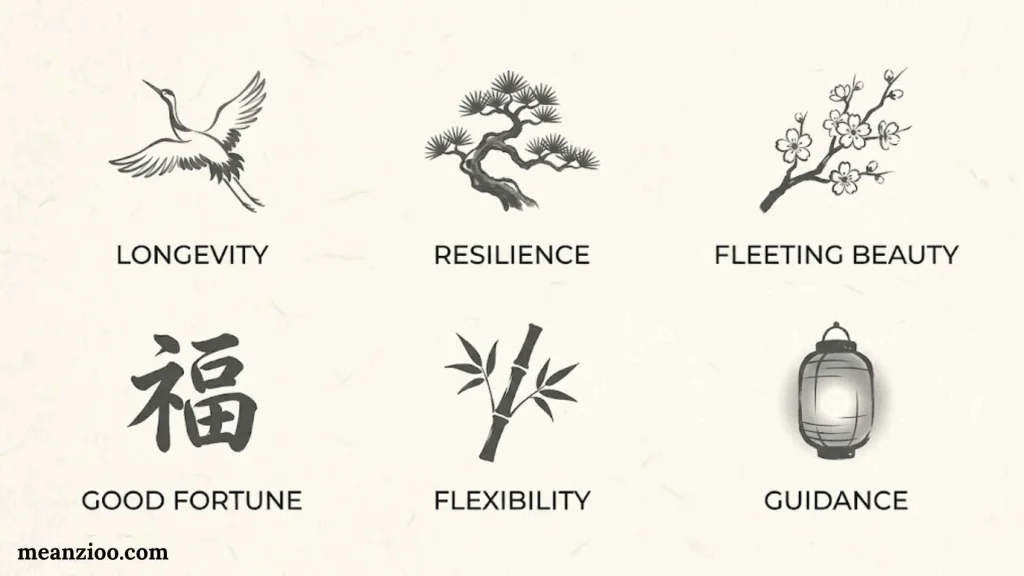
Japanese symbols are popular in tattoos, jewelry, accessories, and fashion. Kanji characters can appear striking because they combine visual complexity with compact written meaning.
However, Japanese tattoo symbols require careful selection. A character that looks attractive may have several readings or may sound unnatural when combined with other characters.
Before choosing a design, consider these points:
- Check the exact meaning: Confirm how the character is used in modern Japanese.
- Review the complete phrase: Several characters together may mean something different from their individual translations.
- Check the reading: A kanji character may have multiple pronunciations.
- Consider cultural context: Religious and historical imagery can carry meanings beyond its appearance.
- Verify the design: Ask a fluent Japanese speaker or qualified language professional to review the wording before making it permanent.
Popular choices include 愛 for love, 夢 for dream, 力 for strength, and 和 for harmony. These are real Japanese characters, but their suitability depends on your intended message.
Japanese symbols also appear on kimono, fabric patterns, ceramic designs, and accessories. Cherry blossoms, cranes, waves, bamboo, and geometric motifs are common examples.
Traditional Japanese clothing may use patterns associated with particular seasons or occasions. A design featuring plum blossoms, for instance, can evoke early spring.
How to Type Japanese Symbols on a Computer or Phone
You don’t need a Japanese keyboard with a separate key for every character. Most modern devices support Japanese input methods.
Typing Japanese on Windows
On Windows, you can add Japanese as an input language through the language settings.
A typical workflow is:
- Open your language settings.
- Add Japanese as an input language.
- Select the Japanese keyboard or Microsoft Japanese input method.
- Type a word using its pronunciation in Latin letters.
- Choose the correct hiragana, katakana, or kanji conversion from the suggestions.
For example, typing sakura may allow you to select さくら or 桜, depending on the conversion options.
Typing Japanese on a Phone
Most modern smartphones support Japanese keyboards.
After adding a Japanese keyboard, you can generally switch between languages using the keyboard’s language button or the device’s keyboard settings.
Some keyboards offer a kana layout, while others let you type Japanese pronunciation with Latin letters. The best option depends on your familiarity with Japanese writing.
Unicode and Japanese Digital Characters
Unicode is the standard that allows computers and phones to represent text from different writing systems.
Japanese characters have Unicode assignments, allowing software to store and display them across supported devices. However, the exact appearance may differ by font, operating system, and application.
This matters when copying Japanese symbols into websites, social media posts, documents, and design software. A character may display differently in different fonts even when the underlying text remains the same.
Common Mistakes to Avoid When Using Japanese Symbols
Japanese characters and cultural motifs can be meaningful, but several misunderstandings are common.
Assuming every character has only one meaning: Kanji often have multiple readings and meanings. Check the complete word and context before using a character.
Treating hiragana and katakana as symbolic pictures: These writing systems primarily represent sounds. Their characters don’t generally stand for abstract concepts such as courage or love.
Confusing cultural motifs with official national symbols: Cherry blossoms, koi fish, and Mount Fuji are important cultural images, but that doesn’t make every one of them an officially designated national emblem.
Choosing tattoo characters based only on appearance: A design may look attractive but communicate something different from what you intended. Verify the wording before using it permanently.
Assuming every traditional symbol has one fixed meaning: Symbols evolve over time. Their interpretations can differ across religious practices, historical periods, artistic styles, and personal experiences.
Mixing characters without checking grammar: Combining individual kanji doesn’t automatically create a natural Japanese word. Confirm that the complete expression is correct.
These precautions help you understand Japanese symbols and their meanings without confusing artistic interpretation with established language or cultural usage.
Frequently Asked Questions About Japanese Symbols
What is the most famous Japanese symbol?
The Japanese flag, known as the Hinomaru, is one of the country’s most recognizable symbols. Other widely recognized images include cherry blossoms, Mount Fuji, koi fish, and the torii gate.
What Japanese symbol means love?
The kanji 愛 (ai) commonly means love or affection. The character 恋 (koi) is often associated with romantic love or longing. The best choice depends on the intended meaning and context.
What Japanese symbol means peace?
平和 (heiwa) is the standard Japanese word for peace. The character 和 can express harmony, while 静 can suggest quietness or calm.
What Japanese symbol means strength?
力 means strength or power, while 強 means strong. The character 勇 relates to courage, and 忍 can express endurance or perseverance in certain words and contexts.
How many Japanese symbols are there?
There is no single total because Japanese uses several writing systems and additional punctuation marks. Hiragana has 46 basic modern characters, katakana has 46, and thousands of kanji exist. The standard-use kanji list contains 2,136 characters.
Are Japanese symbols and Chinese symbols the same?
Japanese uses kanji characters that originated in Chinese writing, so many characters look similar or identical. However, Japanese and Chinese have different languages, pronunciations, grammar, and writing conventions. Some characters have also developed different forms or uses.
What is the Japanese symbol for happiness?
幸 is associated with happiness or good fortune, while 福 commonly means good fortune or blessing. The word 幸福 (kōfuku) means happiness.
What is the meaning of the Japanese red sun?
The red circle on Japan’s national flag represents the sun. Its design connects with Japan’s traditional association with the rising sun.
What does the Japanese torii gate symbolize?
A torii gate generally marks the entrance to a sacred area associated with a Shinto shrine. It represents a transition into a space connected with Shinto worship and kami.
Which Japanese symbols are popular for tattoos?
Popular choices include 愛 for love, 夢 for dreams, 力 for strength, 和 for harmony, and 心 for heart or mind. Always verify the character, reading, and intended meaning before choosing a permanent tattoo.
Conclusion
Japanese symbols connect language, history, spirituality, nature, and artistic expression. Understanding them starts with recognizing the difference between written characters and cultural motifs.
Hiragana and katakana represent sounds, while kanji can communicate meanings through individual characters and compounds. Traditional symbols such as cherry blossoms, koi fish, the Japanese flag, and torii gates have their own cultural histories and associations.
Whether you’re researching Japanese characters and meanings, exploring traditional art, learning to type Japanese, or choosing a design for personal use, context matters. A little research helps you appreciate these symbols accurately and use them with greater confidence.

I’m Ryan Mitchell, and I write about modern English, trending slang, and online expressions. I enjoy explaining the meanings, origins, and real-life usage of popular words in a simple way. I believe learning slang is an important step toward understanding today’s English-speaking culture. Through my work, I aim to help readers speak more naturally and stay updated with the latest language trends.