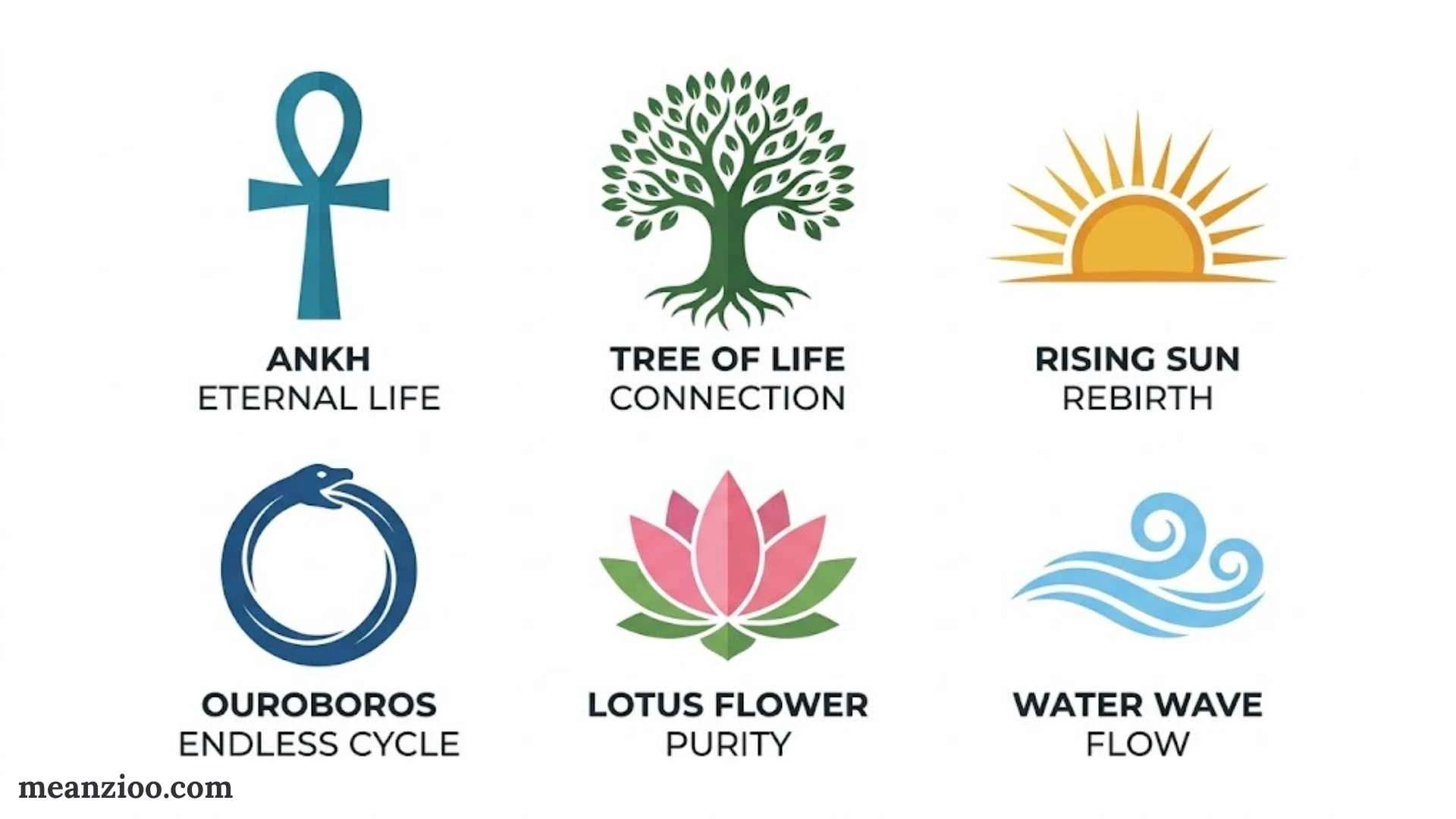
God symbols have helped people express faith, understand the divine, and explore life’s biggest questions for thousands of years. From the Christian cross to the Hindu Om and the lightning bolt of Zeus, these powerful images carry stories that connect religion, mythology, nature, and human experience.
Some religious symbols represent a specific deity, while others express broader ideas such as creation, wisdom, protection, and eternal life. Their meanings can also change across cultures and generations. A symbol that holds deep religious significance for one community might appear as a decorative motif in another.
Understanding these differences makes exploring God symbols and their meanings far more interesting. Whether you’re researching ancient mythology, looking for a meaningful tattoo, studying sacred art, or simply curious about spiritual traditions, this guide explains the origins and significance of some of the world’s best-known symbols.
What Are God Symbols?
God symbols are signs, objects, images, or patterns associated with a deity, a religious belief, or an idea about the divine. They help people express beliefs that can be difficult to explain through words alone.
Throughout history, communities have used sacred imagery in temples, manuscripts, sculptures, jewelry, ceremonial objects, and places of worship. Ancient Egyptians carved symbols into tomb walls, Greek artists depicted gods with recognizable attributes, and Christians developed visual traditions centered on the cross.
However, not every sacred symbol represents a god directly. Some represent an entire religion, while others communicate philosophical ideas or spiritual values.
What Do God Symbols Represent?
The meaning of a symbol depends on its history and the tradition that uses it. Several recurring themes appear across different cultures.
- Divine power and authority: Lightning bolts, scepters, and divine weapons often identify powerful deities.
- Faith and devotion: Religious signs help people express their beliefs and connection to a spiritual community.
- Protection and healing: Certain ancient amulets were believed to guard against harm or restore well-being.
- Creation and renewal: Plants, celestial objects, and sacred stories often represent life and transformation.
- Wisdom and knowledge: Animals such as owls and figures associated with learning can communicate intelligence or insight.
- Eternity and the afterlife: Some symbols express continuity, life beyond death, or the relationship between the living and the dead.
These meanings aren’t universal. A symbol associated with protection in one tradition may carry a different meaning elsewhere.
God Symbols vs. Religious and Spiritual Symbols
Although people often use these terms interchangeably, they describe different categories.
| Symbol category | What it represents | Example |
| God or deity symbol | A particular god or divine attribute | Zeus’s lightning bolt |
| Religious symbol | A faith, doctrine, or religious community | The Christian cross |
| Spiritual symbol | A broader spiritual or philosophical idea | The infinity symbol in modern spiritual contexts |
| Mythological symbol | A figure, object, or theme from traditional stories | Cerberus in Greek mythology |
| Sacred geometric symbol | A meaningful geometric design in a particular tradition | A Buddhist mandala |
Understanding these differences helps you explore religious symbols, divine symbols, and spiritual symbols and meanings without mixing unrelated beliefs together.
Is There a Universal Symbol for God?
There isn’t one universally accepted symbol for God across all religions.
Christianity commonly uses the cross to represent central beliefs about Jesus Christ. Hindu traditions include Om and deity-specific imagery. Islamic religious art often features Arabic calligraphy, including the name Allah (الله), alongside geometric and floral designs.
Judaism has recognizable symbols such as the Star of David and the menorah. However, neither represents the same theological concept as the Christian cross.
Some religious traditions also emphasize divine qualities, sacred words, or aniconic forms of expression rather than depicting God through a single image.
The key point is simple: a widely recognized spiritual symbol isn’t automatically a universal symbol for God.
God Symbols and Their Meanings at a Glance
The following table provides a quick reference to recognizable symbols and their traditional associations.
| God symbol | Cultural or religious association | Common meaning |
| Cross (✝) | Christianity | Sacrifice, redemption, faith |
| Om (ॐ) | Hindu traditions | Sacred sound and ultimate reality |
| Ankh (☥) | Ancient Egypt | Life and vitality |
| Eye of Horus | Ancient Egypt | Protection and restoration |
| Trident | Poseidon; Shiva in distinct traditions | Divine power and authority |
| Lightning bolt | Zeus | Thunder, sovereignty, and power |
| Mjolnir | Thor, Norse mythology | Strength, protection, consecration |
| Trishul | Shiva, Hindu traditions | Shiva’s divine attributes |
| Star of David (✡) | Judaism | Jewish identity and tradition |
| Crescent and star (☪) | Widely associated with Islam | Religious or cultural identification |
| Eye of Providence | Christian-influenced religious art | Divine providence |
| Dharma Wheel (☸) | Buddhism | Buddhist teachings and the path to liberation |
| Lotus | Several Asian traditions | Purity and spiritual development |
| Yin-yang (☯) | Chinese philosophical traditions | Complementary forces and balance |
These are introductory descriptions rather than fixed definitions. Historical evidence, religious teachings, and contemporary interpretations can differ.
Major Religious Symbols and Their Meanings
Religious symbols often carry meaning beyond their appearance. They can represent sacred stories, central teachings, community identity, and long-standing practices.
Christian Symbols for God and Jesus
Christian iconography includes symbols associated with Jesus Christ, the Holy Spirit, salvation, and the Christian understanding of God.
The cross is the most recognizable Christian symbol. It recalls Jesus’s crucifixion and represents sacrifice, redemption, and faith. Its significance comes from the central place of the crucifixion and resurrection in Christian belief.
This monogram combines the Greek letters chi and rho, the opening letters of Christos, meaning Christ. It appears in early Christian art and historical objects.
The fish became an important early Christian identifying sign. Its Greek name, ichthys, also became associated with a phrase describing Jesus as Christ, Son of God, and Savior.
These are the first and last letters of the Greek alphabet. In Christian scripture and art, they express the idea of the beginning and the end, emphasizing God’s eternal nature.
Other Christian symbols for God include the dove, which represents the Holy Spirit in many Christian depictions, and the Lamb of God, which represents Christ’s sacrificial role.
The Hand of God, sometimes called Manus Dei, also appears in Christian art as a visual representation of divine action. The Orthodox cross, meanwhile, has distinctive forms used in several Eastern Christian traditions.
Hindu God Symbols and Their Meanings
Hinduism has a rich tradition of sacred sounds, deity attributes, ritual objects, and symbolic images. Their meanings connect with religious stories, philosophical teachings, and devotional practices.
Om is a sacred syllable used in Hindu prayer, meditation, and religious recitation. It is associated with ultimate reality and the profound relationship between sound, consciousness, and existence. It also appears in some Buddhist and Jain contexts.
The trishul is Shiva’s distinctive three-pronged weapon. It appears throughout Hindu iconography and identifies Shiva in sculptures, paintings, temples, and devotional objects. Interpretations of its three prongs vary among traditions.
This discus is one of Vishnu’s principal attributes. It represents divine power and is associated with the maintenance of cosmic order in Hindu religious traditions.
The lotus appears in imagery associated with several Hindu deities, including Lakshmi and Brahma. Its emergence from muddy water makes it a fitting image for purity, spiritual unfolding, and the emergence of beauty from difficult conditions.
Other important Hindu symbols include Vishnu’s conch shell, Shiva’s third eye, and Nandi, the bull associated with Shiva.
Together, these examples show why Hindu God symbols shouldn’t be reduced to a generic list of spiritual icons. Each has a place within a living religious tradition.
Jewish Symbols and Their Meanings
Jewish religious symbolism includes ritual objects, sacred texts, and visual emblems that express religious history and communal identity.
- Star of David (✡): A six-pointed star widely recognized as a symbol of Jewish identity. Its modern prominence developed over time, and its meanings aren’t limited to divine protection.
- Menorah: The seven-branched lampstand is an ancient Jewish religious symbol associated with the Temple and Jewish tradition.
- Shofar: A ram’s horn sounded during particular religious observances, especially on Rosh Hashanah and Yom Kippur.
- Torah scroll: A sacred text central to Jewish religious life and learning.
These symbols demonstrate that religious meaning doesn’t always depend on a picture of God. Objects, written teachings, and ceremonial practices can also express a community’s relationship with the sacred.
Islamic Symbols and Representations of Allah
Islam emphasizes the oneness of Allah. Islamic visual traditions therefore include approaches to sacred representation that differ from those common in Christian religious art.
Arabic calligraphy holds an important place in Islamic art. The name Allah (الله) and Quranic passages appear in manuscripts, architecture, and decorative designs. Geometric patterns and floral motifs also feature prominently in many Islamic artistic traditions.
The crescent and star (☪) is widely associated with Islam today, particularly through flags and public imagery. However, it isn’t a universal symbol prescribed by Islamic scripture. Its prominence grew through historical and political developments, including its association with the Ottoman Empire. Read more about the crescent and star’s historical and religious context.
This distinction matters when discussing Islamic religious symbols. A familiar emblem can become closely linked with a religion without being an official symbol shared by all its followers.
Buddhist Symbols and Their Meanings
Buddhism uses sacred imagery to communicate teachings about suffering, awareness, ethical living, and liberation. Because Buddhism doesn’t generally center on a creator God, these are better described as Buddhist sacred symbols than universal God symbols.
| Symbol | Meaning or association |
| Dharma Wheel (☸) | The Buddha’s teachings and the path to liberation |
| Lotus | Spiritual development and awakening |
| Bodhi tree | The Buddha’s awakening |
| Mandala | Sacred order and contemplative practice in particular traditions |
| Buddha’s footprints | The Buddha’s presence and remembered teachings |
The Dharma Wheel is particularly important. Its eight spokes are commonly associated with the Noble Eightfold Path, which guides Buddhist practice toward the cessation of suffering.
Zoroastrian Symbols
Zoroastrianism is an ancient religion centered on the worship of Ahura Mazda and the importance of truth and righteous living.
Two prominent elements are:
- Faravahar: A recognizable emblem associated with Zoroastrian identity and heritage. Its interpretations vary, particularly between historical scholarship and modern community understandings.
- Sacred fire: Fire plays an important role in Zoroastrian worship as a focus of ritual purity and devotion. Zoroastrians do not simply worship fire as God.
This distinction prevents a common misunderstanding: an important sacred element isn’t necessarily the deity itself.
Greek God Symbols and Their Meanings
Greek mythology offers some of the most recognizable deity symbols in Western popular culture. Greek artists often identified gods through objects, animals, weapons, and plants linked to their stories.
| Greek god | Main symbol or attribute | Associated meaning |
| Zeus | Lightning bolt, eagle | Thunder and sovereignty |
| Poseidon | Trident, horse | Sea and earthquakes |
| Hades | Helm of Darkness, Cerberus | Underworld and the dead |
| Athena | Owl, aegis | Wisdom and strategic warfare |
| Apollo | Lyre, laurel | Music, prophecy, healing |
| Ares | Spear, helmet | War and combat |
| Hermes | Winged sandals, caduceus | Messages, travel, trade |
| Aphrodite | Dove, rose | Love and beauty |
| Artemis | Bow and arrows | Hunting and wilderness |
| Hephaestus | Hammer and anvil | Craftsmanship and fire |
| Pan | Panpipes, goat imagery | Wilderness and pastoral life |
| Demeter | Grain and wheat | Agriculture and fertility |
| Dionysus | Grape clusters, thyrsus | Wine and ritual celebration |
| Hera | Diadem, peacock imagery | Marriage and queenship |
These associations come from a combination of ancient texts, artistic traditions, and later interpretations. Not every symbol appeared in every period or in every depiction of a deity.
Zeus Symbols: Lightning Bolt, Eagle, and Oak
Zeus ruled the gods in Greek mythology and was associated with the sky, thunder, and divine authority.
His lightning bolt is his most recognizable attribute. Ancient art often depicts him holding or throwing it, reinforcing his command over thunder and the forces of the sky.
The eagle also appears in connection with Zeus. Oak trees held religious significance at Dodona, an ancient sanctuary associated with Zeus and prophetic traditions.
Today, the lightning bolt often represents strength, leadership, or raw power in jewelry, artwork, and tattoos. Those modern meanings draw inspiration from mythology, but they aren’t the only possible interpretations.
Poseidon’s Trident and Hades’s Helm of Darkness
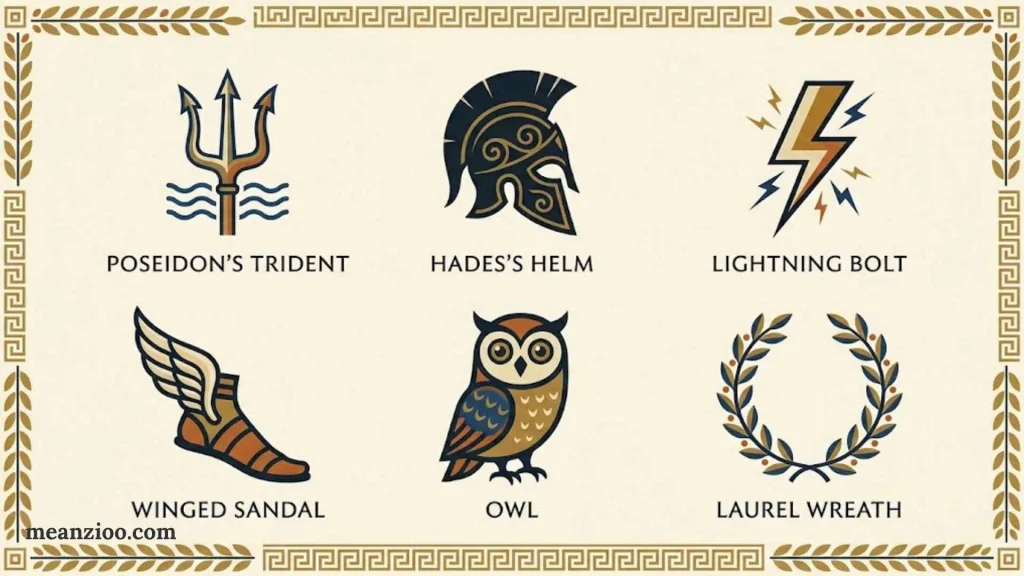
Poseidon’s trident identifies him as the Greek god of the sea. The three-pronged weapon appears in artistic depictions and has become shorthand for maritime power.
Hades, by contrast, rules the underworld. His Helm of Darkness is associated with invisibility, while Cerberus, the multiheaded guard dog, protects the entrance to the realm of the dead in Greek mythology.
The pomegranate also appears in the story of Persephone, whose connection to Hades helps explain the mythological relationship between the underworld and the changing seasons.
These symbols reflect particular stories. They shouldn’t be treated as generic signs of evil or danger.
Athena’s Owl, Apollo’s Lyre, and Hermes’s Caduceus
Athena’s owl represents her association with wisdom and strategic thinking. The bird also appeared on ancient Athenian coins, making the connection especially recognizable.
Apollo’s lyre identifies his relationship with music and the arts. His laurel wreath is associated with the god and with ancient Greek traditions of victory and achievement.
Hermes’s winged sandals reflect his role as a swift messenger. His caduceus, a staff with two entwined serpents and wings, is another recognizable attribute.
Important distinction: The caduceus is often confused with the Rod of Asclepius, a staff with one serpent that has a more direct historical connection to medicine.
Aphrodite, Artemis, Pan, and Other Greek Deities
Several other Greek gods have distinctive symbols worth knowing.
- Aphrodite: Doves and roses are commonly associated with love and beauty.
- Artemis: The bow and arrow reflect hunting and wilderness.
- Pan: Panpipes and goat imagery connect him with pastoral life and untamed nature.
- Hephaestus: Hammers, anvils, and the forge represent craftsmanship and metalworking.
- Demeter: Grain and wheat reflect agriculture and the fertility of the earth.
- Dionysus: Grape clusters and the thyrsus connect him with wine, festivity, and ritual.
These attributes are useful when identifying gods in paintings, sculptures, literature, and modern mythology-inspired designs.
Roman God Symbols and Their Meanings
Roman mythology shares many figures and attributes with Greek mythology, but Roman religion developed within its own historical and cultural setting.
| Roman deity | Greek counterpart | Recognizable attribute |
| Jupiter | Zeus | Lightning bolt, eagle |
| Neptune | Poseidon | Trident |
| Pluto | Hades | Underworld associations |
| Minerva | Athena | Owl, armor |
| Mars | Ares | Spear and shield |
| Mercury | Hermes | Winged sandals, caduceus |
| Venus | Aphrodite | Dove, mirror |
| Diana | Artemis | Bow and arrows |
| Vulcan | Hephaestus | Hammer, forge |
| Ceres | Demeter | Grain |
| Bacchus | Dionysus | Grape clusters, thyrsus |
How Greek and Roman God Symbols Differ
Many Roman deities inherited attributes from Greek counterparts, but their roles weren’t always identical.
Jupiter’s lightning bolt, for example, resembles Zeus’s emblem because the two gods share important sky-related characteristics. Mars, however, became especially significant in Roman public life and military identity.
Venus retained associations with love and beauty while acquiring additional importance in Roman political and ancestral traditions.
When researching Roman God symbols, it’s useful to consider how Rome adapted Greek stories rather than assuming the two cultures held identical beliefs.
Ancient Egyptian God Symbols and Their Meanings
Ancient Egyptian religion produced a rich collection of symbols associated with life, kingship, protection, and the afterlife. Gods often appear in art holding recognizable objects that communicate their roles.
| Egyptian symbol | Association | Traditional meaning or role |
| Ankh (☥) | Egyptian gods and religious imagery | Life |
| Eye of Horus | Horus | Protection and restoration |
| Eye of Ra | Ra | Solar power and divine agency |
| Djed pillar | Osiris | Stability |
| Was scepter | Gods and rulers | Authority and dominion |
| Scarab beetle | Khepri and solar imagery | Renewal and transformation |
| Shen ring | Egyptian religious art | Protection and eternity |
| Crook and flail | Osiris and kingship | Royal authority |
These symbols appeared in temples, tombs, amulets, and ceremonial objects. Their meanings came from a complex religious system rather than a single universal code.
What Does the Ankh Symbol Mean?
The ankh (☥) is one of ancient Egypt’s best-known symbols. Its distinctive shape resembles a cross topped by a loop.
The Egyptian word ankh means “life.” In ancient artwork, gods sometimes hold the ankh toward a king or another figure, representing the gift or presence of life. The symbol also appeared on amulets and other objects.
Today, the ankh appears in jewelry, decorative designs, and tattoos. Some modern interpretations associate it with eternal life, spiritual energy, or protection. These meanings may reflect contemporary beliefs, so it’s worth distinguishing them from its established ancient Egyptian role.
Eye of Horus vs. Eye of Ra
The Eye of Horus and the Eye of Ra are related to Egyptian religious imagery, but they aren’t identical symbols.
The Eye of Horus is associated with protection, restoration, and healing. Its mythology includes the conflict between Horus and Set and the restoration of Horus’s injured eye.
The Eye of Ra is associated with the sun god Ra and the exercise of divine power. In some Egyptian myths, the Eye acts as an independent and powerful force.
Although both symbols appear in modern jewelry and tattoo designs, their traditional associations differ. Calling both simply “protection symbols” misses much of their religious context.
Egyptian Symbols of Protection, Life, and Power
Three additional symbols help explain the breadth of Egyptian religious iconography.
- Djed pillar: Associated with stability and Osiris, it became an important sign in funerary and religious contexts.
- Was scepter: A staff associated with authority and dominion in depictions of gods and rulers.
- Scarab beetle: Linked with Khepri and solar imagery, it became a symbol of renewal and transformation.
Ancient Egyptians also used amulets in daily life and burial practices. Their shapes and inscriptions reflected religious beliefs about protection, well-being, and the afterlife.
Norse God Symbols and Their Meanings
Norse mythology includes distinctive weapons, animals, and cosmological images associated with gods and the structure of the universe.
| Symbol | Association | Common interpretation |
| Mjolnir | Thor | Strength, protection, consecration |
| Valknut | Often linked with Odin in modern interpretations | Possible connections with death and Odin-related imagery |
| Yggdrasil | Norse cosmology | The world tree |
| Gungnir | Odin | A powerful spear |
| Huginn and Muninn | Odin | Thought and memory |
| Sleipnir | Odin | The eight-legged horse |
| Vegvisir | Icelandic magical-stave tradition | Guidance in difficult conditions in its later textual context |
| Aegishjalmur | Icelandic magical traditions | Protection and power in later magical texts |
What Does Thor’s Hammer (Mjolnir) Mean?
Mjolnir is the hammer associated with Thor, the Norse god linked with thunder and the protection of gods and humans.
In surviving Norse traditions, the hammer is more than a weapon. It also has associations with consecration and religious practice. Archaeological finds of hammer-shaped pendants show that Mjolnir imagery had significance beyond storytelling.
Modern Norse-inspired jewelry and tattoos often use Mjolnir to express strength, resilience, or cultural identity. Those interpretations can be meaningful, although individual motivations differ.
What Do the Valknut and Yggdrasil Represent?
The Valknut consists of three interlocking triangles and appears in some archaeological contexts associated with Norse imagery. Scholars have proposed connections with Odin and death, but its exact historical meaning remains uncertain.
Yggdrasil, the world tree, plays a major role in Norse cosmology. Norse sources describe it as connecting different parts of the cosmos, including realms associated with gods and other beings.
Together, these symbols attract people interested in fate, interconnectedness, and the relationship between life and death. However, modern explanations sometimes claim more certainty than the surviving evidence supports.
Vegvisir and Aegishjalmur: What Is Their Historical Origin?
Vegvisir and Aegishjalmur have become popular in modern Norse-inspired tattoos, but their histories require care.
Vegvisir appears in nineteenth-century Icelandic magical-stave material. It isn’t supported as a Viking Age symbol by surviving evidence. Research published by Projekt Forlǫg examines its documented origins and later popularity.
Aegishjalmur, often called the Helm of Awe, belongs to a broader body of Icelandic magical-stave traditions. Modern descriptions frequently associate it with protection and invincibility, although interpretations depend on the specific historical text or contemporary use.
The takeaway? A symbol can have genuine cultural significance without originating in the Viking Age.
Aztec God Symbols and Their Meanings
Aztec, or more precisely Mexica, religious art featured complex imagery associated with deities, warfare, agriculture, and cosmology. These symbols are best understood within their historical setting.
The Aztec Sun Stone
The Sun Stone, often called the Aztec Calendar Stone, is a monumental Mexica carving featuring elaborate calendrical and cosmological imagery.
Its design includes a central face and surrounding motifs associated with Mexica understandings of time and the cosmos. Although popular descriptions often call it a calendar, its precise functions and interpretations have been debated.
It shouldn’t be reduced to a simple symbol of divine time. The carving reflects a complex worldview involving ritual, calendrical systems, and religious imagery.
Quetzalcoatl and the Feathered Serpent
Quetzalcoatl is widely associated with the Feathered Serpent, a major figure in Mesoamerican religious traditions. The combination of feathers and serpent imagery connects different aspects of the natural and supernatural worlds.
Quetzalcoatl’s associations include wind and learning in particular traditions, although his roles vary across historical periods and Mesoamerican cultures.
The symbol’s continued presence in books, museums, and modern artwork reflects its importance in Mesoamerican history. However, not every feathered-serpent depiction represents precisely the same deity or belief system.
Other Important Aztec Symbols
- Huitzilopochtli: A major Mexica deity associated with war and the sun.
- Tlaloc: A rain deity associated with water and agricultural fertility.
- Eagle imagery: Appears in military, political, and cultural contexts.
- Skull imagery: Relates to death and ritual themes, although meanings vary by object and setting.
These examples show why Aztec God symbols deserve historical context rather than broad labels that flatten their differences.
Other Sacred and Spiritual Symbols Around the World
Some symbols frequently appear in searches for powerful spiritual imagery even though they don’t represent a particular God. Their meanings often come from philosophy, religious practice, or modern spiritual interpretations.
Yin-Yang Symbol (☯)
The yin-yang symbol comes from Chinese philosophical traditions and represents complementary, interdependent forces.
Its familiar black-and-white design illustrates how opposing qualities can relate to one another. Yin and yang aren’t simply good and evil. They describe relationships between qualities that can change with context.
The symbol appears in Taoist contexts and has broader cultural recognition today. Its association with balance makes it popular in art and personal accessories, but it isn’t a universal symbol for God.
Mandalas and Sacred Geometry
Mandalas are structured designs used in particular Hindu and Buddhist traditions. Depending on the context, they can serve as aids for ritual, meditation, and contemplation.
Sacred geometry refers to geometric forms that carry religious, philosophical, or spiritual significance in particular systems of thought. Circles, triangles, and symmetrical patterns can appear in temples, manuscripts, and sacred art.
However, a geometric shape doesn’t automatically have a fixed religious meaning. A triangle may represent the Trinity in a particular Christian design, while the same shape can serve a different purpose elsewhere.
Celtic Knots and the World Tree
Celtic interlace designs feature intricate lines woven into repeating patterns. Modern audiences often interpret them as symbols of eternity, unity, or interconnectedness, although specific historical meanings can be difficult to establish.
Yggdrasil, by comparison, has a clearer place in Norse cosmology as the world tree.
These symbols can look similar in modern decorative settings, but their historical origins and cultural meanings shouldn’t be confused.
Sun, Moon, Spiral, and Infinity Symbols
Natural and geometric motifs appear in many religious and artistic traditions.
- Sun: Often associated with light, life, and solar deities.
- Moon and crescent: Carry different meanings across cultures, from lunar cycles to political and religious emblems.
- Spiral: Appears in ancient and modern art, sometimes interpreted through themes of movement, growth, or continuity.
- Infinity symbol (∞): Originally a mathematical notation, now also used to express endlessness and continuity in some spiritual contexts.
These motifs are useful examples of how ancient symbols can acquire new meanings over time.
Powerful God Symbols and Their Spiritual Meanings
People often search for powerful God symbols because they want an image that reflects a particular value. The word “powerful,” however, is subjective. Different religious communities understand spiritual power in different ways.
| Desired meaning | Symbols to explore | Traditional context |
| Faith and devotion | Cross, Om | Christianity and Hindu traditions |
| Protection | Eye of Horus, Mjolnir | Ancient Egyptian religion and Norse mythology |
| Strength and authority | Lightning bolt, trident, Was scepter | Greek mythology and Egyptian iconography |
| Wisdom | Athena’s owl | Greek mythology |
| Life and renewal | Ankh, scarab imagery | Ancient Egyptian religion |
| Spiritual awakening | Lotus, Dharma Wheel | Selected Hindu and Buddhist traditions |
| Balance | Yin-yang | Chinese philosophical traditions |
| Eternity | Shen ring, infinity symbol | Ancient Egyptian imagery and modern mathematical symbolism |
Which God Symbol Is the Most Powerful?
There is no objective ranking of the world’s most powerful sacred symbols. A symbol’s importance depends on its religious tradition, historical role, and personal significance.
For a Christian, the cross may represent the heart of their faith. A Hindu devotee may find deep meaning in Om or a deity’s sacred attributes. Someone studying Greek mythology may see Zeus’s lightning bolt as an unmistakable sign of authority.
Instead of asking which symbol is universally strongest, consider what it represents and why that meaning matters to you.
Symbols of Divine Protection and Healing
Protection and healing are recurring themes in religious history.
Ancient Egyptian amulets, for example, included the Eye of Horus and other signs believed to offer protection. Mjolnir had religious significance in Norse contexts, while different faiths use prayers, objects, and sacred imagery within their own practices.
These historical beliefs are important to understand. However, a symbol’s religious significance doesn’t establish that wearing it will produce a measurable medical or protective effect.
Symbols of Creation, Destruction, and Rebirth
Some sacred symbols are closely tied to transformation.
- Shiva’s trishul: Identifies Shiva and appears in religious interpretations involving his divine power and cosmic role.
- Egyptian scarab: Connects with renewal and solar imagery.
- Lotus: Represents spiritual development in several Asian traditions.
- Hades’s attributes: Relate to the underworld and the Greek understanding of the dead.
The meanings vary, but these examples demonstrate how religious imagery can address life’s major transitions.
God Symbols for Tattoos and Their Meanings
A tattoo can serve as a personal reminder of faith, heritage, strength, or a meaningful story. Before choosing a design, make sure you understand its origins and traditional associations.
Best God Symbols for Strength and Protection
The right choice depends on the meaning you’re looking for.
- Zeus’s lightning bolt: A mythological emblem associated with thunder and authority.
- Mjolnir: A symbol connected with Thor, strength, and protection in Norse traditions.
- Shiva’s trishul: A distinctive Hindu religious symbol associated with Shiva.
- Eye of Horus: An ancient Egyptian sign associated with protection and restoration.
These designs aren’t interchangeable. Each has its own cultural background, and that history should inform how you use it.
God Symbols for Faith and Spirituality
If your goal is to express religious devotion, consider symbols from your own tradition or learn carefully about the one you’re exploring.
The cross has central significance in Christianity. Om has an important place in Hindu religious practice. The Dharma Wheel represents Buddhist teachings, while the Star of David is widely associated with Jewish identity.
Research the design before making it permanent. Small details can distinguish an authentic symbol from an inaccurate modern imitation.
Small God Symbols for Minimalist Tattoos
Minimalist designs can work well when the symbol remains recognizable.
Popular options include a small cross, a simple lotus, a lightning bolt, an ankh, or a carefully rendered trident. A compact design may suit the wrist, forearm, ankle, or shoulder.
However, simplification can remove important details. If you’re choosing a culturally significant symbol, check the design against a reliable historical or religious reference.
What to Consider Before Getting a Religious Tattoo
Before committing to a design, ask yourself:
- Do I understand the symbol’s original meaning?
- Is it associated with a living religious tradition?
- Does the design contain details that change its meaning?
- Am I relying on a social media interpretation rather than a credible source?
- Would a person from the associated community recognize the design as intended?
A little research can prevent a permanent misunderstanding.
God Symbols Text: Copy-and-Paste Characters
If you’re looking for God symbols copy and paste options for messages, social media bios, or notes, these Unicode characters may help.
| Symbol | Name or association | Copy |
| ✝ | Christian cross | ✝ |
| ☦ | Orthodox cross | ☦ |
| ☧ | Chi-Rho | ☧ |
| ✡ | Star of David | ✡ |
| ☪ | Crescent and star | ☪ |
| ॐ | Om | ॐ |
| ☯ | Yin-yang | ☯ |
| ☸ | Dharma Wheel | ☸ |
| ∞ | Infinity | ∞ |
| 🔱 | Trident emoji | 🔱 |
| ☥ | Ankh | ☥ |
You can select and copy any character directly from the table. Keep in mind that the trident emoji isn’t necessarily an accurate representation of Poseidon’s or Shiva’s traditional iconography.
Some historical symbols also lack a standard Unicode character. In those cases, a verified image may be more suitable than a text substitute.
Why God Symbols Look Different Across Devices
Unicode characters can appear differently depending on your operating system, font, browser, and app. Emoji may also use different colors or designs across platforms.
For example, a trident emoji may look like a decorative icon rather than a historically accurate weapon. If you need a symbol for research, a publication, or a tattoo reference, use a reliable image rather than relying on a text character alone.
God Symbols in Modern Culture and Pop Culture
Ancient symbols continue to appear in novels, movies, games, fashion, and digital art. These modern uses help keep mythological imagery recognizable, although they sometimes change the original meaning.
Greek God Symbols in Percy Jackson
Rick Riordan’s Percy Jackson series introduces Greek mythology to a modern audience. Characters and stories draw on familiar associations involving Zeus, Poseidon, Athena, and Hades.
The series adapts traditional mythology for fiction. A symbol’s portrayal in the books or screen adaptations may differ from its representation in ancient sources.
If you’re researching Greek God symbols through pop culture, use the original mythology to verify historical meanings.
God Symbols in Movies and Video Games
Modern entertainment frequently uses recognizable mythological attributes.
Thor’s hammer appears in Marvel stories, while God of War reimagines Greek and Norse mythological figures in a fictional setting. Lightning bolts, tridents, and divine weapons help audiences identify characters quickly.
These adaptations can inspire artwork and tattoos. However, their meanings should be distinguished from historical religious traditions.
God Symbols in Jewelry, Art, and Everyday Design
Religious and mythological imagery appears on pendants, rings, clothing, posters, and decorative objects.
Some people choose these designs to express devotion or cultural identity. Others appreciate their historical stories, visual appeal, or personal associations.
The context matters. A symbol used in worship may carry a different significance from the same design printed on a fashion accessory.
What Do God Symbols Mean in Dreams?
People sometimes search for God symbols in dreams because they want to understand a striking or emotional experience.
Dream interpretation varies across religious, cultural, and psychological perspectives. There is no single scientifically established meaning for every symbol.
Common Interpretations of Religious Symbols in Dreams
A few examples illustrate how personal context can shape interpretation.
- Cross: May bring faith, sacrifice, or personal religious experiences to mind.
- Lotus: May remind someone of growth, renewal, or spiritual practice.
- Eye symbol: Could evoke awareness, protection, or the feeling of being watched.
- Deity emblem: May reflect familiarity with a mythological story or religious tradition.
These are possible associations, not universal explanations.
Do God Symbols in Dreams Have a Fixed Spiritual Meaning?
No fixed interpretation applies to everyone. A dream’s meaning may depend on personal experiences, cultural background, emotional state, and the details surrounding the symbol.
Some people understand dreams through their faith, while others approach them psychologically. Neither approach justifies presenting a particular dream as proof of divine communication or a prediction of the future.
How to Choose a God Symbol That Matches Your Meaning
The best way to choose a symbol is to begin with the idea you want to express. Then research the traditions connected with it.
Choose by Meaning
Start by identifying your main goal.
- Faith: Explore symbols central to your own religious tradition.
- Protection: Research historical amulets and deity-specific attributes.
- Wisdom: Consider symbols associated with knowledge, such as Athena’s owl.
- Life and renewal: Learn about the ankh and lotus in their respective contexts.
- Balance: Explore the yin-yang symbol and its Chinese philosophical background.
- Eternity: Compare historical signs of continuity with modern symbols such as infinity.
These are starting points rather than universal recommendations.
Choose by Religious or Cultural Tradition
If a symbol belongs to a specific religion or community, learn its background before using it.
Read about its origins, traditional interpretations, and modern uses. Look for credible historical sources rather than relying solely on tattoo galleries or social media posts.
Also remember that people within the same tradition may interpret a symbol differently.
Choose by Intended Use
Your purpose can influence which symbol makes sense.
| Intended use | What to consider |
| Personal study | Historical accuracy and reliable sources |
| Jewelry | Cultural context and the design’s intended meaning |
| Tattoo | Permanence, correct details, and religious sensitivity |
| Social media bio | Character compatibility and recognizable meaning |
| Religious practice | The teachings and customs of the relevant tradition |
| Artwork | Historical references and the distinction between adaptation and tradition |
A thoughtful choice starts with understanding, not simply finding the most attractive design.
Frequently Asked Questions About God Symbols
What Are God Symbols?
God symbols are signs, objects, or images associated with deities, divine attributes, or religious beliefs. Examples include Zeus’s lightning bolt, Shiva’s trishul, and the Christian cross. Some sacred symbols represent broader religious or philosophical ideas rather than a specific God.
What Is the Universal Symbol for God?
There is no single universal symbol for God. Different religions use different imagery, sacred words, objects, and artistic traditions. The cross, Om, and Arabic calligraphy of Allah all carry distinct meanings within their respective contexts.
What Is the Most Powerful God Symbol?
No symbol is objectively the most powerful across all religions. Its significance depends on the beliefs and traditions involved. For example, the cross is central to Christianity, while Mjolnir has important associations with Thor in Norse mythology.
What Symbol Represents God in Christianity?
The cross is the best-known Christian symbol. It represents Jesus’s crucifixion and carries meanings related to sacrifice, redemption, and faith. Other Christian symbols include the Chi-Rho, the dove associated with the Holy Spirit, and Alpha and Omega.
What Do Greek God Symbols Mean?
Greek God symbols identify deities and communicate their attributes. Zeus’s lightning bolt represents his connection with thunder and authority. Athena’s owl relates to wisdom, Poseidon’s trident to the sea, and Apollo’s lyre to music.
What Does the Ankh Symbol Mean?
The ankh is an ancient Egyptian symbol of life. It appears in religious art, where gods sometimes hold it toward kings or other figures. Today, it also appears in jewelry, tattoos, and modern interpretations of eternal life.
What Is the Symbol for Hades?
Hades is associated with the Helm of Darkness, which grants invisibility in Greek mythology. Cerberus, the guardian of the underworld, is another prominent attribute. The bident also appears in some depictions associated with Hades and the underworld.
Which God Symbols Are Best for Tattoos?
The best symbol depends on your intended meaning and personal beliefs. The cross, ankh, Eye of Horus, Mjolnir, and deity-specific emblems are common choices. Before getting a tattoo, research its origins and make sure the design accurately reflects the meaning you want.
Conclusion
God symbols and their meanings offer a fascinating way to explore religion, mythology, and cultural history. From the ankh of ancient Egypt to the trishul of Shiva, each symbol carries associations shaped by the people and traditions that used it.
Some symbols represent specific deities. Others express faith, wisdom, protection, renewal, or philosophical ideas. Their meanings can evolve over time, especially as ancient imagery enters modern art, jewelry, tattoos, and popular culture.
The most useful approach is to look beyond a symbol’s appearance. Learn where it originated, understand the beliefs connected with it, and distinguish historical evidence from modern interpretation. That context turns a simple image into a much richer story.

I’m Ryan Mitchell, and I write about modern English, trending slang, and online expressions. I enjoy explaining the meanings, origins, and real-life usage of popular words in a simple way. I believe learning slang is an important step toward understanding today’s English-speaking culture. Through my work, I aim to help readers speak more naturally and stay updated with the latest language trends.