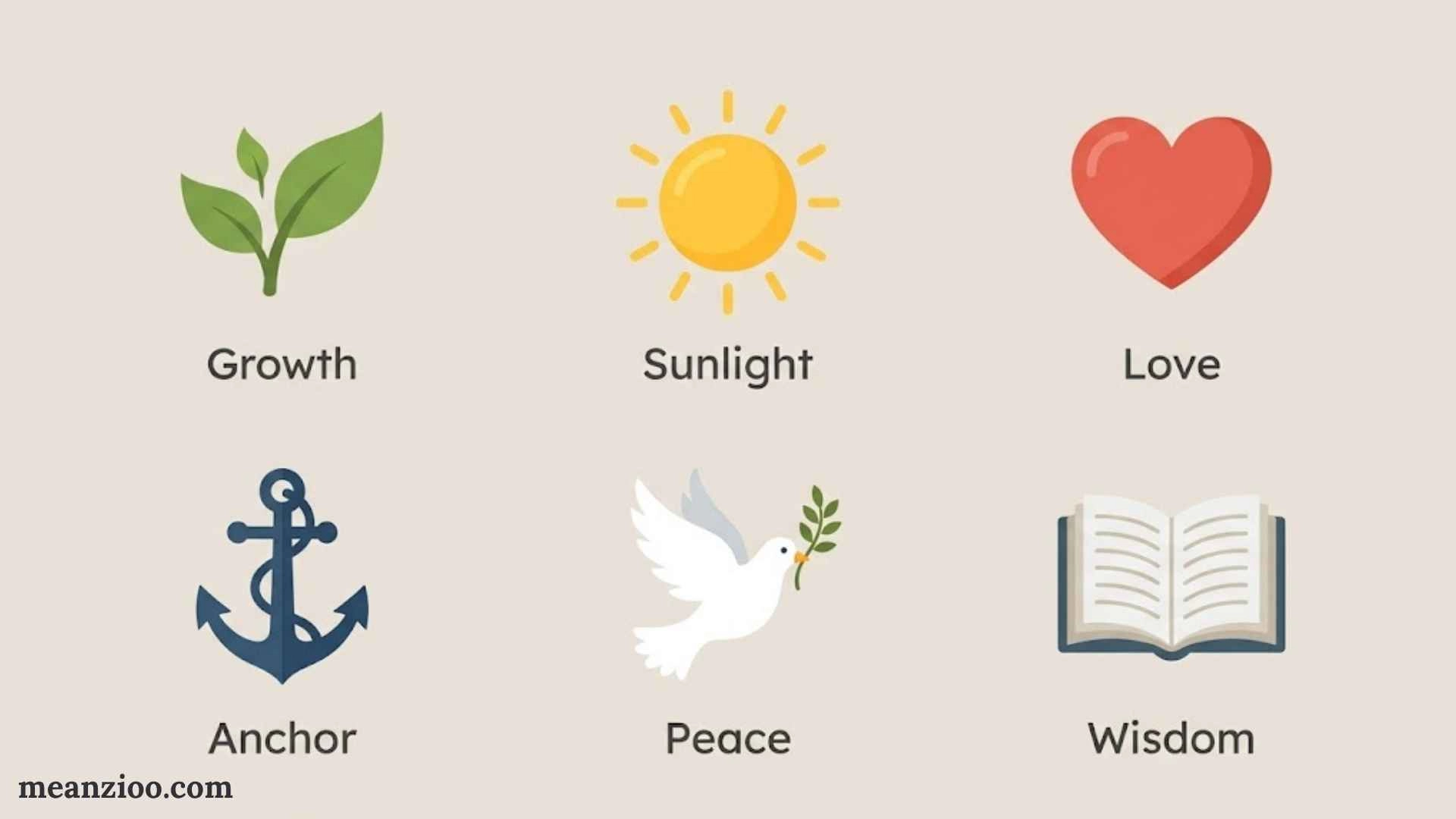
Hope can take many forms. Sometimes it looks like a dove carrying an olive branch. Other times, it appears in a tiny seed pushing through the soil, a butterfly emerging from its cocoon, or a light shining through darkness. Across cultures and generations, people have turned these images into powerful reminders of faith, resilience, peace, and new beginnings.
The meaning behind symbols of hope often reaches beyond their appearance. A Christian might see an anchor as a reminder of unwavering faith. Someone starting a new chapter might choose a butterfly to represent personal transformation. In Jewish culture, the word Chai celebrates life, while Buddhist traditions use the victory banner to symbolize overcoming obstacles.
These symbols don’t all share the same history, and their meanings can vary between communities. Understanding their origins helps you appreciate what they represent and choose one that genuinely reflects your values.
In this guide, you’ll discover 18 meaningful hope symbols, explore their historical and cultural backgrounds, and learn how to use them thoughtfully in jewelry, tattoos, artwork, and everyday life.
What Is a Symbol of Hope?
A symbol of hope is an image, object, animal, plant, or design that represents the possibility of a better future. It can express faith during uncertainty, strength after hardship, or the promise of a fresh start.
Symbols help people communicate feelings that are sometimes difficult to put into words. A small anchor pendant, for example, can remind someone to remain steady during a challenging period. A sunrise painting might represent a new beginning after a difficult year.
However, a symbol’s meaning depends on its context. Some have well-documented connections to religious texts, historical events, or established cultural traditions. Others gain their hopeful meaning through personal experiences and modern interpretations.
How Hope Symbolism Works
Hope symbolism connects a visible image with an abstract idea. People recognize something familiar in the natural world or a cultural tradition and associate it with a deeper message.
Consider these examples:
- Butterfly: Transformation, personal growth, and the possibility of change.
- Anchor: Stability, perseverance, and steadfast hope in Christian symbolism.
- Olive branch: Peace and reconciliation in several historical and cultural contexts.
- Sprouting seed: Growth, potential, and new beginnings.
- Sunrise: A fresh start and the return of light after darkness.
These associations don’t mean every culture interprets each symbol in exactly the same way. Rather, they show how images can express hope through nature, history, religion, and personal experience.
Why Different Cultures Use Different Hope Symbols
Cultural symbols of hope often emerge from the experiences and beliefs of a particular community. Religious stories give certain objects sacred meanings, while mythology and folklore connect animals, plants, and natural events with human aspirations.
For instance, the anchor appears in early Christian symbolism, the lotus holds important meanings in Hindu and Buddhist traditions, and the shamrock has a strong association with Irish identity and St. Patrick.
Understanding these differences matters. A symbol becomes more meaningful when you know the story behind it instead of relying on a simplified description.
18 Meaningful Symbols of Hope and Their Meanings
From natural wonders to sacred objects, these symbols representing hope offer different ways to understand perseverance, renewal, faith, and possibility. Some have centuries of documented history, while others draw their meaning from familiar experiences in nature.
The following guide separates historical traditions from contemporary interpretations so you can understand what each symbol actually represents.
Dove: A Symbol of Peace and Hope
Key meanings: Peace, reconciliation, renewal, faith
The dove is one of the most recognizable symbols of peace and hope. Its association with hope is especially clear in the biblical story of Noah and the flood.
According to Genesis 8:11, Noah sent a dove from the ark. The bird returned with a freshly plucked olive leaf, showing that the floodwaters had receded. After a long period of uncertainty, the leaf offered evidence that the earth was becoming habitable again.
Over time, the dove and olive branch became widely recognized symbols of peace. The image now appears in peace campaigns, religious artwork, memorials, and messages of reconciliation. Jewish tradition also gives the dove and olive tree their own layers of meaning. Chabad.org explains these biblical and Jewish associations.
Why it represents hope: A dove carrying an olive branch suggests that conflict can end and life can begin again. It suits messages of reconciliation, recovery, and a more peaceful future.
Olive Branch: A Symbol of Peace and Renewal
Key meanings: Peace, reconciliation, victory, renewal
The olive branch has a long history as a symbol of peace. Its meaning appears in both biblical tradition and ancient Greek culture, although the stories and uses differ.
In the biblical flood narrative, the olive leaf signals that the waters have receded. Ancient Greek traditions also associated olive branches with peace and victory. Olive wreaths became important in Greek athletic culture, including the ancient Olympic Games.
Olive trees themselves can survive for many years and grow in challenging environments. That natural resilience offers a useful modern comparison for people rebuilding their lives after difficult experiences. However, the tree’s biological toughness should not be confused with a universal ancient belief about hope.
Why it represents hope: An olive branch communicates the possibility of peaceful resolution. It works well in artwork, gifts, and messages intended to encourage forgiveness or a fresh start.
Anchor: A Symbol of Faith and Steadfast Hope
Key meanings: Stability, faith, perseverance, security
An anchor prevents a vessel from drifting away, making it a natural image of stability. Christianity gives the anchor a particularly direct connection to hope.
Hebrews 6:19 describes hope as an anchor for the soul, emphasizing firmness and security. The passage connects hope with trust in God’s promises. The anchor subsequently became an important image in Christian art and devotional objects.
Outside explicitly religious settings, people also choose anchors to represent commitment, emotional stability, and perseverance through uncertain periods. Sailors and people connected to the sea may find the image especially meaningful.
Why it represents hope: The anchor reminds you that difficult circumstances don’t have to sweep you away. It symbolizes the strength to remain grounded while circumstances change.
Butterfly: A Symbol of Transformation and New Beginnings
Key meanings: Transformation, growth, freedom, change
Few natural images illustrate change as clearly as a butterfly. It develops through several distinct stages, transforming from an egg into a caterpillar, then a pupa, and finally an adult butterfly.
This life cycle makes the butterfly a popular symbol of new beginnings and personal growth. People often choose butterfly designs to mark recovery, a major life transition, or the beginning of a new chapter.
Butterflies also appear in art, literature, and contemporary memorial practices. Their meanings vary, however, so it’s inaccurate to assign one universal interpretation to every culture or religious tradition.
A butterfly tattoo might represent independence for one person and the memory of a loved one for another. Someone else might choose a butterfly pendant after overcoming a difficult period.
Why it represents hope: The butterfly suggests that change can lead to something new. It offers a reminder that your present circumstances don’t have to define your future.
Tree of Life: A Symbol of Growth and Connection
Key meanings: Growth, continuity, connection, resilience
Trees have inspired symbolic meanings for thousands of years because they connect the earth and sky while supporting living ecosystems. Their roots anchor them in the ground, and their branches continue reaching outward.
The Celtic Tree of Life is a popular design featuring a tree whose branches and roots often form an interconnected pattern. Modern interpretations commonly connect it with the relationship between nature, family, life, and continuity.
Tree symbolism also appears in numerous religious and cultural traditions. However, the meanings attached to a particular sacred tree or tree-shaped design depend on its context. The Celtic Tree of Life shouldn’t be treated as interchangeable with every other tradition’s tree imagery.
Why it represents hope: A tree can represent steady growth, family connections, and the ability to keep developing through changing seasons. It makes a meaningful image for someone entering a new stage of life.
Sprouting Seed: A Symbol of Potential
Key meanings: Growth, possibility, patience, renewal
A seed looks small and unremarkable until it begins to grow. Once it receives suitable conditions, it can send roots into the soil and push a shoot toward the light.
This process makes a sprouting seed a compelling modern symbol of hope and renewal. It represents potential that hasn’t yet become visible and progress that begins with small steps.
Unlike a sacred emblem tied to a specific religion, a seed is a broadly understandable natural image. You can use it to express personal development, recovery, education, a new business, or any goal that requires patience.
A seedling also provides a useful reminder that progress often happens gradually. Growth doesn’t always appear dramatic from one day to the next.
Why it represents hope: A seed represents the possibility of a future that looks different from the present. It encourages patience when the results of your efforts haven’t appeared yet.
Sunrise: A Symbol of Light and Fresh Starts
Key meanings: New beginnings, optimism, clarity, possibility
Every sunrise marks the beginning of a new day. That familiar event has made dawn a common metaphor for renewed energy, fresh opportunities, and the return of light after darkness.
Artists often use sunrise imagery to communicate optimism. In personal settings, a sunrise photograph or painting can mark a new job, a move to another city, recovery from a setback, or a commitment to a different direction.
The symbolism doesn’t require a particular religious belief. People can find meaning in the daily return of daylight regardless of their cultural background.
Sunrise imagery can also appear in religious art and national emblems, where its meaning may extend beyond hope to include enlightenment, freedom, or national renewal.
Why it represents hope: A sunrise reminds you that the present moment isn’t the whole story. Tomorrow brings another opportunity to act, learn, and begin again.
Rainbow: A Symbol of Promise and Possibility
Key meanings: Promise, peace, renewal, possibility
Rainbows often appear when sunlight passes through water droplets in the atmosphere. Their vivid colors have inspired a wide range of meanings in religion, art, literature, and popular culture.
In the Bible, the rainbow serves as a sign of God’s covenant with Noah following the flood, as described in Genesis 9. In this context, it represents a divine promise rather than simply a general message of optimism.
In contemporary settings, rainbows can also express hope, inclusion, celebration, and the possibility of a better future. Their meanings depend on the context in which people display them.
Why it represents hope: A rainbow can suggest that uncertainty and hardship don’t eliminate the possibility of renewal. For some people, it represents a promise grounded in faith. For others, it offers a personal reminder to keep looking forward.
Star: A Symbol of Guidance and Possibility
Key meanings: Guidance, aspiration, direction, inspiration
For centuries, people have used stars to navigate at night and understand the night sky. That practical role helped stars become familiar images of direction and guidance.
Today, a star can represent ambition, inspiration, achievement, or a hopeful future. Star designs appear on jewelry, flags, artwork, and personal keepsakes, although their exact meanings depend on the design and cultural setting.
Some stars also have specific religious or historical meanings. The Star of David, for example, has a distinct place in Jewish identity and history. It shouldn’t be confused with a generic star chosen to express personal hope.
Why it represents hope: A star can remind you to keep moving toward a goal even when the path isn’t completely clear. Its association with guidance makes it a fitting symbol for someone beginning an unfamiliar journey.
Lotus: A Symbol of Spiritual Growth and Renewal
Key meanings: Spiritual development, purity, awakening, resilience
The lotus holds deep significance in Hindu and Buddhist traditions. Its growth in muddy water and emergence into a flower have helped establish its importance in religious art and spiritual teachings.
In Hindu traditions, the lotus appears in imagery associated with deities, including Lakshmi and Vishnu. It can communicate beauty, auspiciousness, purity, and divine qualities depending on the context.
Buddhist art also uses the lotus extensively. It often represents spiritual awakening, purity, and the possibility of developing wisdom despite difficult conditions.
These meanings make the lotus relevant to discussions of hope, but the word hope doesn’t capture its entire religious significance. The flower carries complex meanings that deserve attention within each tradition.
Why it represents hope: The lotus can remind you that difficult circumstances don’t necessarily prevent growth. It offers a powerful image of spiritual development, patience, and the possibility of positive change.
Shamrock: A Symbol of Faith and Irish Identity
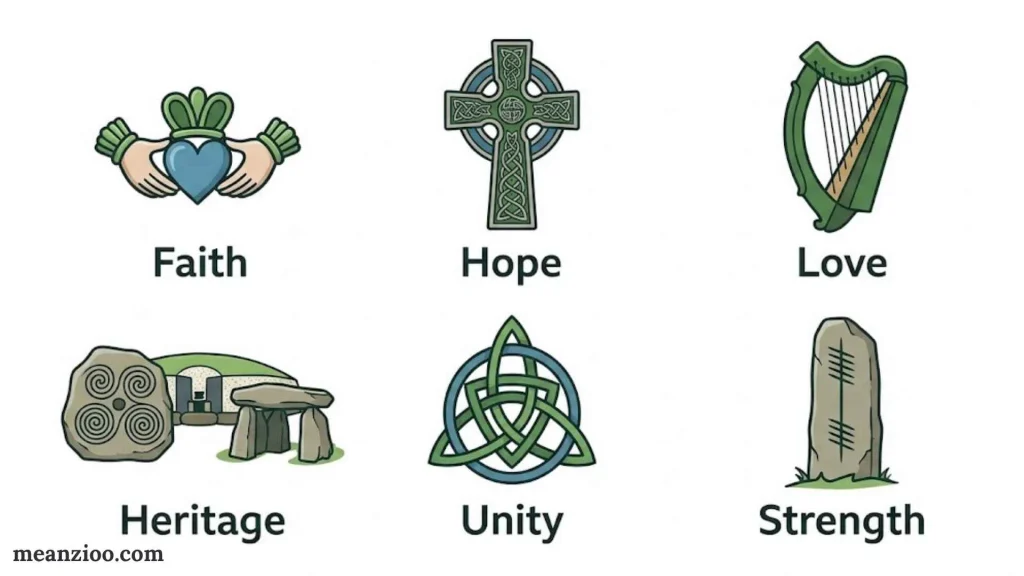
Key meanings: Irish identity, faith, heritage, good fortune in modern use
The shamrock is a three-leafed plant strongly associated with Ireland. It is especially connected to St. Patrick, the patron saint of Ireland, and the Christian tradition that links its three leaves with the Holy Trinity.
The shamrock also appears in Irish cultural celebrations, clothing, jewelry, and national imagery. Many people associate it with Irish heritage and good luck, although these meanings don’t make it a universal ancient symbol of hope.
Its hopeful significance is often personal. Someone might wear a shamrock to maintain a connection with family heritage or to celebrate a new opportunity.
Why it represents hope: The shamrock can express faith, cultural pride, and optimism when those ideas matter to the person using it.
Triquetra: A Symbol of Interconnection and Eternity
Key meanings: Interconnection, unity, continuity, religious symbolism in some contexts
The Triquetra is a three-pointed knot design formed by interlacing lines. It appears in historical Celtic art and later Christian contexts, although its meaning isn’t identical across every period.
In Christian use, the three-part design can represent the Holy Trinity: the Father, the Son, and the Holy Spirit. Modern interpretations may also associate the interlaced shape with unity, continuity, and interconnectedness.
However, claims that every Triquetra represents the past, present, and future or mind, body, and spirit aren’t established universal historical meanings. Such interpretations should be identified as modern or context-specific.
Why it represents hope: For people who connect the design with unity or continuity, the Triquetra can represent lasting bonds, faith, and the belief that different parts of life remain connected.
Awen: A Symbol of Inspiration
Key meanings: Inspiration, creativity, spiritual insight
Awen is a Welsh word associated with inspiration. Its familiar modern symbol consists of three rays rising upward, sometimes surrounded by circles.
The symbol is especially recognizable in modern Druidic and Celtic-inspired spiritual movements. It can represent creative inspiration, spiritual insight, and the search for wisdom.
It’s important to distinguish modern Awen symbolism from claims about ancient Celtic practices. Although the word has historical roots, the familiar graphic symbol and its interpretations reflect particular spiritual and cultural developments.
Why it represents hope: Awen can remind people that inspiration and fresh ideas may emerge during uncertain periods. It suits writers, artists, and anyone who associates hope with creativity or spiritual growth.
Menorah: A Symbol of Light and Jewish Tradition
Key meanings: Religious devotion, light, Jewish identity, unity
The menorah is a seven-branched lampstand associated with the ancient Israelite Tabernacle and the Jerusalem Temple. It remains an important symbol in Jewish religious and cultural life.
Light carries rich meaning in Jewish tradition. The Torah, for example, is associated with illumination and guidance, and the menorah can serve as a reminder of religious devotion and Jewish continuity.
The seven-branched Temple menorah differs from the nine-branched hanukkiah used during Hanukkah. The latter holds eight lights associated with the holiday, along with a separate light used to kindle the others.
The menorah isn’t exclusively a symbol of hope. Its religious meaning is more specific and extensive. Still, its association with light and continuity can make it a personal emblem of hope.
Why it represents hope: Light can serve as a metaphor for guidance and spiritual understanding. For many people, that connection makes the menorah a meaningful reminder of faith and continuity.
Chai: A Symbol of Life and Vitality
Key meanings: Life, vitality, Jewish identity, celebration
The Hebrew word chai means “life.” It’s written with the letters chet (ח) and yud (י), which together have the numerical value of 18 in traditional Hebrew letter-number associations.
The symbol appears on Jewish jewelry, decorative objects, and gifts. Giving money or gifts in multiples of 18 is also a recognized Jewish custom because of the connection between the number and the word for life.
Chai expresses something more specific than hope: it celebrates life itself. Its connection to hope emerges when people use it to express wishes for health, vitality, recovery, and a meaningful future.
Why it represents hope: Chai is a fitting symbol for celebrating life, honoring Jewish heritage, or expressing a heartfelt wish for someone’s well-being.
Dhvaja: A Symbol of Victory Over Obstacles
Key meanings: Victory, perseverance, spiritual progress
The Sanskrit word dhvaja means a flag or banner. In Buddhist iconography, the victory banner is one of the Eight Auspicious Symbols and represents triumph over obstacles, particularly those associated with ignorance and harmful mental states.
The symbol’s meaning is rooted in Buddhist teachings rather than a generic idea of winning. It points toward spiritual progress and the ability to overcome barriers to wisdom.
The dhvaja also appears in wider South Asian religious and cultural contexts, where banners can carry different meanings. The Buddhist victory banner should therefore be discussed within its specific tradition.
Why it represents hope: The victory banner reminds practitioners that obstacles can be faced and overcome. Its hopeful message centers on spiritual effort, perseverance, and the possibility of progress.
Cornucopia: A Symbol of Abundance and Prosperity
Key meanings: Abundance, nourishment, harvest, prosperity
The cornucopia, or horn of plenty, is an ancient symbol associated with abundance in Greek and Roman mythology. Artwork often depicts it as a curved horn overflowing with fruit, grain, flowers, or other produce.
In Greek mythology, the cornucopia appears in stories connected with nourishment and divine abundance. Roman art also used it to express prosperity and plenty.
Today, the image is especially familiar in harvest decorations and Thanksgiving displays in the United States. It represents the hope for enough food, resources, and good fortune to sustain a household or community.
Why it represents hope: The cornucopia expresses the desire for a future with sufficient resources and opportunities. It suits messages about prosperity, gratitude, and hopes for a flourishing life.
Phoenix: A Symbol of Rebirth and Resilience
Key meanings: Rebirth, recovery, transformation, resilience
The phoenix is a legendary bird associated with renewal and rebirth. In popular retellings, it dies or burns and then rises again, making it a familiar image of recovery after destruction.
Phoenix traditions have changed across time and place. Ancient accounts don’t all describe the bird in exactly the same way, so its symbolism shouldn’t be reduced to a single universal story.
In contemporary literature, art, and tattoo designs, the phoenix commonly represents rebuilding after hardship. People may choose it to mark recovery, major life changes, or the determination to move forward after a painful experience.
Why it represents hope: The phoenix expresses the idea that an ending doesn’t have to be final. It represents resilience and the possibility of creating something new after loss or change.
Symbols of Hope From Different Cultures and Religions
Understanding hope symbols from different cultures helps you see how communities express faith, renewal, and perseverance in their own ways. Some symbols have specific religious meanings, while others have become popular through art, folklore, and modern personal use.
The following examples highlight important traditions without assuming that everyone within a culture interprets a symbol identically.
Celtic Symbols of Hope
Celtic art and later Celtic-inspired traditions feature several designs that people associate with hope and continuity.
- Triquetra: An interlaced three-pointed knot used in Celtic art and later Christian contexts.
- Awen: A symbol associated with inspiration in modern Druidic spirituality.
- Shamrock: A plant connected with Ireland and the Christian tradition surrounding St. Patrick.
- Celtic Tree of Life: A popular modern design associated with growth, nature, and interconnectedness.
These symbols have different histories. The Celtic Tree of Life, in particular, appears in many contemporary designs, so its modern meaning shouldn’t automatically be treated as an established belief of every ancient Celtic community.
Christian Symbols of Hope
Christianity uses several images to express trust in God, peace, and perseverance.
- Anchor: Represents steadfast hope in Hebrews 6:19–20.
- Dove: Appears in the biblical story of Noah and has become a familiar image of peace.
- Olive branch: Signals the recession of floodwaters in Genesis and later became associated with peace.
- Rainbow: Represents God’s covenant with Noah in Genesis 9.
These examples connect hope with promises, reconciliation, and faith during uncertainty.
Jewish Symbols of Hope and Life
Jewish religious and cultural traditions include symbols that express life, religious devotion, continuity, and identity.
- Menorah: The seven-branched lampstand associated with the ancient Tabernacle and Temple.
- Chai: The Hebrew word for life, commonly used in jewelry and celebratory gifts.
- Dove and olive imagery: Appears in biblical passages and Jewish interpretations of faithfulness and continuity.
Although people may use these symbols to express hope, each has its own religious and cultural significance.
Hindu and Buddhist Symbols of Hope
Hindu and Buddhist traditions share some visual motifs but have distinct teachings and interpretations.
- Lotus: Associated with spiritual development, purity, and divine imagery in Hinduism and Buddhism.
- Dhvaja: The Buddhist victory banner represents triumph over obstacles and spiritual progress.
- Sacred imagery associated with light and wisdom: Expresses different ideas depending on the deity, teaching, or tradition involved.
The lotus is especially useful for understanding how a single natural image can carry several related meanings without becoming a generic symbol of hope.
Symbols of Hope in Ancient Greek and Roman Traditions
Ancient Greek and Roman art frequently used symbolic objects to communicate ideas about prosperity, peace, and divine favor.
- Cornucopia: Represented abundance and nourishment.
- Olive branch: Became associated with peace and victory.
- Phoenix: Developed through ancient traditions and later became widely associated with renewal and rebirth.
These symbols offer historical insight into how people connected their hopes for security, peace, and prosperity with familiar images.
Which Symbol Represents Hope During Difficult Times?
The best choice depends on what you want the symbol to express. Some emphasize stability, while others focus on change or recovery.
| Symbol | Meaning associated with hope | Best suited to |
| Anchor | Steadfastness and faith | Staying grounded through uncertainty |
| Butterfly | Transformation and growth | Personal change or a fresh start |
| Phoenix | Rebirth and resilience | Recovery after a major setback |
| Lotus | Spiritual growth and awakening | Personal reflection and spiritual development |
| Sunrise | New beginnings | Starting a new chapter |
| Olive branch | Peace and reconciliation | Healing relationships or resolving conflict |
| Sprouting seed | Potential and patience | Long-term goals and gradual progress |
A symbol won’t change your circumstances on its own. However, a meaningful reminder can help you reconnect with your values and intentions when life feels overwhelming.
Symbols of Hope for Tattoos, Jewelry, and Gifts
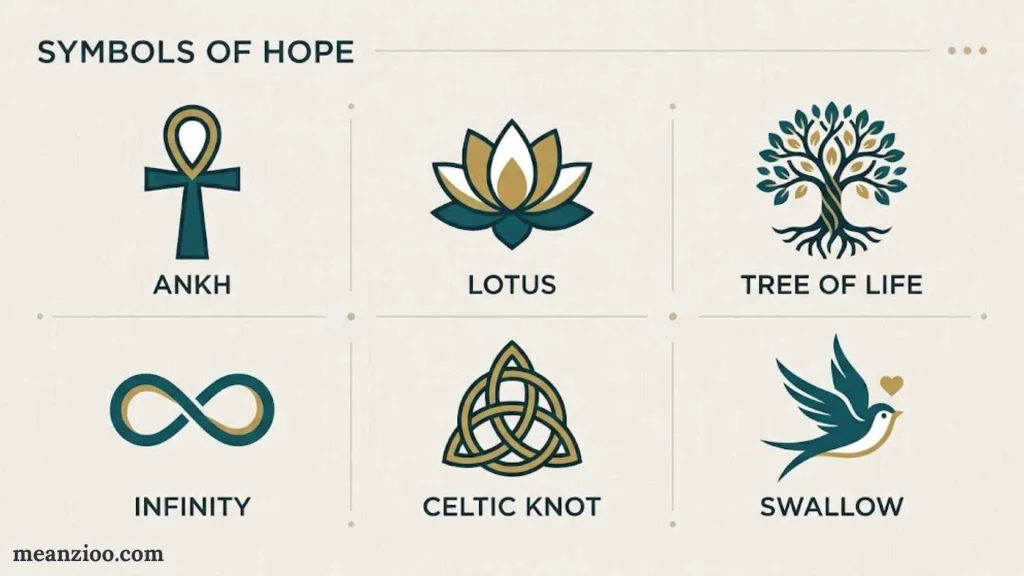
A hope symbol in jewelry or a tattoo can serve as a personal reminder of something important. The most meaningful choice usually reflects your own experience rather than a passing trend.
Hope Symbols for Tattoos
Consider these designs and their common interpretations:
- Anchor tattoo: A reminder of stability, faith, or commitment.
- Butterfly tattoo: A symbol of transformation and personal growth.
- Phoenix tattoo: A representation of resilience after hardship.
- Lotus tattoo: An expression of spiritual development within an appropriate cultural or religious context.
- Sunrise tattoo: A reminder of a fresh start or a new chapter.
- Olive branch tattoo: A symbol of peace, reconciliation, or a desire for harmony.
Before choosing a design, research its cultural history. This matters especially when the image belongs to a living religious tradition or a community whose symbolism has been misrepresented.
Hope Symbols for Jewelry and Meaningful Gifts
Jewelry makes it easy to carry a personal symbol throughout the day.
For example, an anchor pendant can represent steadfastness, while a butterfly necklace might celebrate someone’s personal growth. A Chai pendant can be meaningful to someone with a connection to Jewish identity and tradition.
When choosing a gift, consider the recipient’s beliefs and experiences. A symbol tied to their heritage or an important life event may carry more meaning than a generic inspirational design.
Hope Symbols for Home Decor
You can also incorporate symbols of hope into your surroundings.
- Display sunrise artwork to celebrate a fresh start.
- Keep a small plant on your desk as a reminder of steady growth.
- Choose olive branch artwork to express a desire for peace.
- Use tree imagery to celebrate family connections and continuity.
A meaningful object doesn’t need to be expensive or elaborate. Sometimes a simple reminder in a place you see every day is enough.
Are Symbols of Hope Universal?
Not entirely. Although people across the world draw inspiration from nature, symbols acquire their meanings through specific cultural, historical, and personal experiences.
A rainbow, for example, represents God’s covenant with Noah in the biblical tradition. In another setting, it may symbolize inclusion or a hopeful future. Similarly, a lotus has deep religious significance in Hinduism and Buddhism, while someone outside those traditions might interpret it more generally as a symbol of growth.
It’s also important to distinguish historical symbolism from modern interpretations. A meaning that appears in contemporary jewelry descriptions may not reflect an ancient belief.
When researching a symbol, ask three questions:
- Where did the symbol originate?
- How does the relevant culture or religion interpret it?
- Is its connection to hope historically documented or a more recent personal interpretation?
These questions help you understand the symbol more accurately and use it respectfully.
Frequently Asked Questions About Symbols for Hope
What Is the Most Recognized Symbol of Hope?
There isn’t one universally recognized symbol of hope. The anchor is strongly associated with Christian hope, while the dove and olive branch are widely recognized images of peace and reconciliation. The butterfly and phoenix are also popular contemporary symbols of transformation and renewal.
What Flower Represents Hope?
The lotus is a meaningful example because of its associations with spiritual growth and awakening in Hindu and Buddhist traditions. Other flowers may symbolize hope in particular cultures or modern floral traditions, but their meanings depend on the context.
What Animal Symbolizes Hope?
The butterfly is commonly associated with transformation and new beginnings. The mythical phoenix represents rebirth and resilience. Doves also carry hopeful associations through biblical imagery and their broader connection with peace.
What Is an Ancient Symbol of Hope?
The anchor has a documented connection to hope in early Christian symbolism, particularly through Hebrews 6:19. The lotus also has a long history in South Asian religious art. Both examples show why historical context matters when identifying ancient symbols.
What Symbol Represents New Beginnings?
The sunrise, sprouting seed, butterfly, and phoenix are popular choices. A sunrise represents the start of a new day, while a seed suggests potential and gradual growth. The butterfly and phoenix are associated with transformation and rebirth.
What Are Some Religious Symbols of Hope?
Examples include the Christian anchor, the menorah in Jewish tradition, the lotus in Hinduism and Buddhism, and the Buddhist victory banner. Each symbol has its own religious significance, so it’s best to understand its original context rather than assign all of them the same meaning.
What Symbol Represents Hope and Strength?
The anchor represents steadiness and perseverance, while the tree suggests growth and continuity. The phoenix is a popular contemporary symbol of resilience after adversity. Choose the image that best reflects the kind of strength you want to express.
Can I Use a Symbol of Hope for a Tattoo or Gift?
Yes. Many people choose symbols of hope for tattoos, jewelry, greeting cards, and meaningful gifts. Before selecting a design, learn about its cultural or religious origins and consider what it means to the recipient.
Final Thoughts on Symbols for Hope
Symbols of hope give people a way to express faith, peace, resilience, and the possibility of change. From the anchor’s steadfastness to the butterfly’s transformation, each image offers a different perspective on moving forward.
Some symbols carry deep religious or cultural histories. Others draw their meaning from nature or personal experience. Neither kind needs to mean the same thing to everyone.
When choosing a symbol, start with the message you want to express. Whether you want to celebrate a new beginning, honor your heritage, or remember a difficult period you’ve overcome, the most meaningful symbol is one whose story resonates with your own.

Hi, I’m Charlotte Hayes. I love writing about the newest English slang, pop culture phrases, and digital communication. I spend my time exploring how language evolves across social media, gaming, and everyday conversations. I enjoy sharing easy-to-understand guides that help learners keep up with modern English. My goal is to make every article useful, accurate, and enjoyable for readers around the world.
Books:
- Everyday Slang Dictionary
- Fluent Through Informal English
 Ryan Mitchell