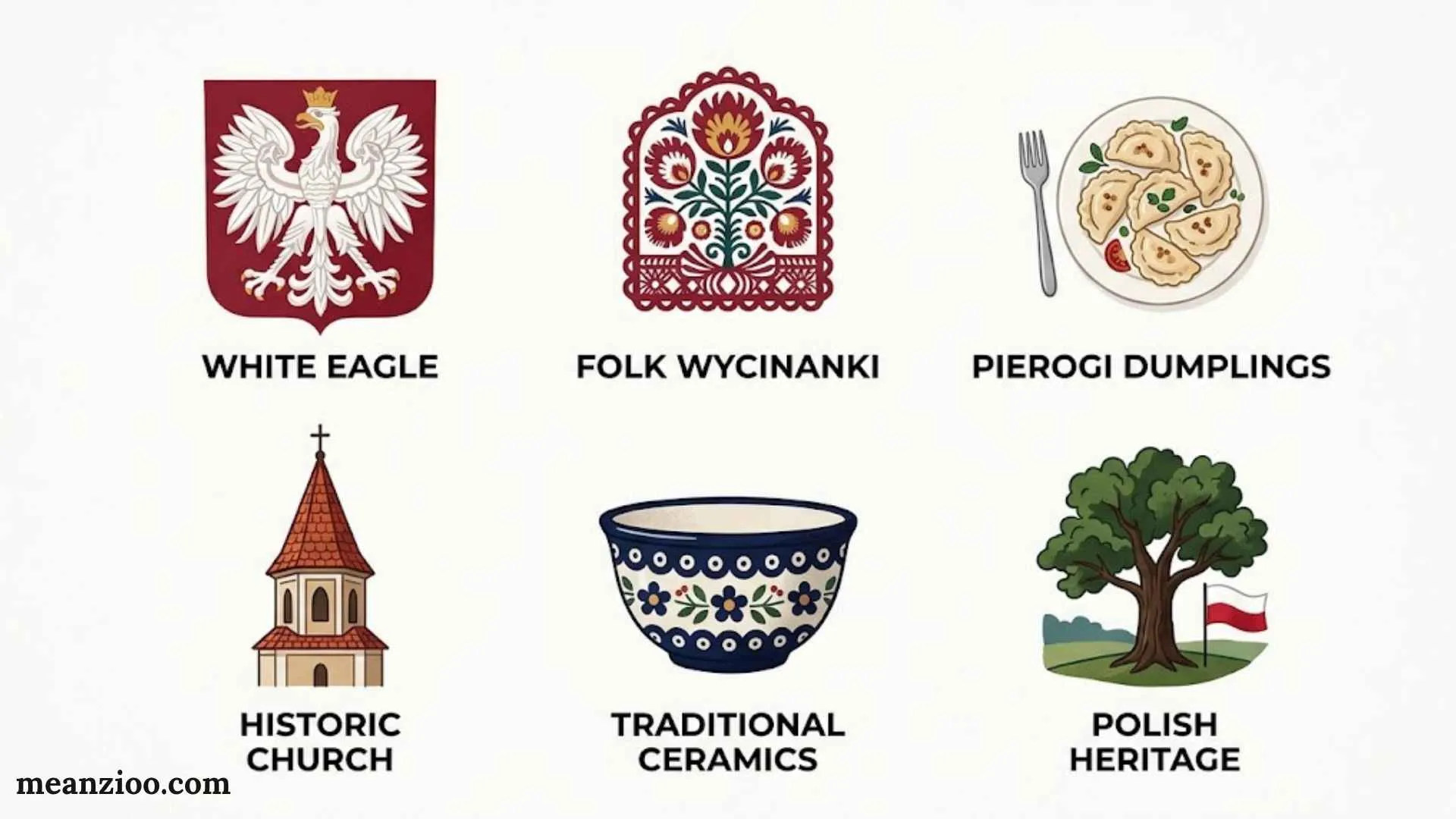
Poland’s identity comes to life through its crowned White Eagle, red-and-white flag, traditional cuisine, historic landmarks, and powerful stories of resistance. These Polish symbols reveal how the country’s people have preserved their heritage through centuries of political change, cultural achievement, and struggles for independence.
Some symbols have official status under Polish law. Others grew from everyday traditions, historical events, literature, or the landscapes that generations have called home. Together, they help explain the meaning of Polish national identity, from medieval victories to modern democracy.
The country’s best-known symbols include the White Eagle, Poland’s national colors, and Dąbrowski’s Mazurka, its national anthem. Beyond these official emblems, pierogi, bigos, the Solidarity movement, the European bison, and Białowieża Forest represent important parts of Polish culture and heritage.
Understanding these symbols means looking beyond their appearance. Each one tells a story about what people remember, celebrate, protect, and pass on to future generations.
What Are the Official National Symbols of Poland?
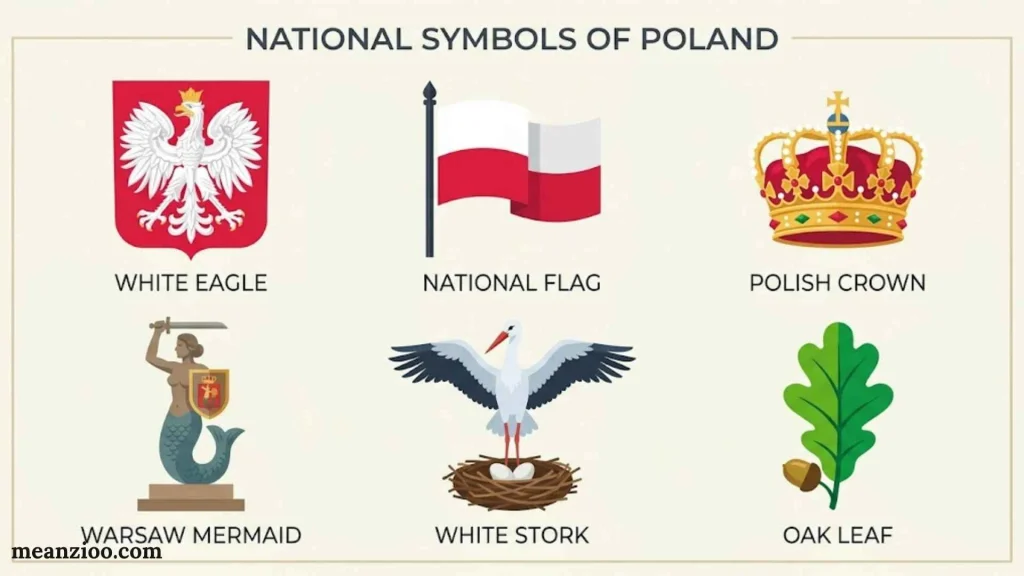
Poland has three principal national symbols protected by law: the White Eagle, the white-and-red national colors, and Dąbrowski’s Mazurka, the national anthem. Article 28 of the Polish Constitution identifies these symbols and provides for their legal protection.
senat.gov.pl+1
These official emblems represent the Polish state. Cultural symbols, by contrast, may reflect regional traditions, historical experiences, or shared customs without having the same legal status.
The White Eagle: Poland’s National Emblem
The White Eagle, known in Polish as Orzeł Biały, is one of the most recognizable national symbols of Poland. It appears as a white eagle with a golden crown, golden beak and talons, and outstretched wings against a red shield.
The emblem connects modern Poland with centuries of state history. Polish rulers used eagle imagery in medieval heraldry, and the crowned White Eagle became closely associated with the kingdom and its political identity.
Its meaning reaches beyond royal history. Today, the emblem represents Polish statehood, sovereignty, and continuity. You can see it on official government buildings, diplomatic materials, court buildings, and other state institutions.
The eagle also carries a strong emotional meaning for many Poles. During periods when Poland lost its independence, national emblems helped people maintain a connection with the idea of a Polish state.
What makes the White Eagle significant?
- Statehood: It represents the Republic of Poland and its public institutions.
- Historical continuity: Its heraldic tradition connects modern Poland with earlier Polish states.
- National identity: It appears in official settings and public commemorations.
- Sovereignty: It recalls the survival and restoration of Polish independence.
The White Eagle is not simply a decorative bird. It is an official emblem with a long history and a defined place in Polish law.
senat.gov.pl+1
The Polish Flag: White and Red
Poland’s flag features two equal horizontal bands: white on top and red below. Its straightforward design makes it easy to recognize at national ceremonies, sporting events, and public celebrations.
The colors have heraldic origins. White draws on the White Eagle, while red comes from the shield behind it. The colors also connect with the historical heraldry of the Polish-Lithuanian lands.
Gov.pl website+1
White and red became recognized as Polish national colors in 1831, during the November Uprising against Russian rule. After Poland regained independence, the Legislative Sejm formally approved the national flag design on August 1, 1919.
Poland celebrates Flag Day on May 2, a holiday established in 2004. The date falls between International Workers’ Day on May 1 and Constitution Day on May 3.
The flag appears during Independence Day celebrations on November 11, national sporting events, and public commemorations. Many households display it to express pride in their country.
What do the Polish flag’s colors mean?
The most firmly established explanation comes from heraldry. White corresponds to the White Eagle, while red forms the background of the coat of arms.
People may also associate these colors with peace, courage, sacrifice, or freedom. Such interpretations can carry personal and cultural meaning, but they should not replace the flag’s documented heraldic origins.
Dąbrowski’s Mazurka: Poland’s National Anthem
Poland’s national anthem, Dąbrowski’s Mazurka (Mazurek Dąbrowskiego), tells a story of national survival and hope.
Józef Wybicki wrote the song in 1797, when Polish Legions were serving in Italy. Poland had disappeared from the European political map after its partitions by Russia, Prussia, and Austria. The song expressed the hope that Poles could restore their country through continued struggle.
Its opening line, commonly translated as “Poland has not yet perished,” captures the central message. Even when a state loses its territory and government, its people can preserve a national identity.
The song gained widespread recognition and eventually became Poland’s national anthem in 1927.
Today, the anthem accompanies official ceremonies, state occasions, and international sporting events. Its words connect the modern republic with the historical struggle to restore Polish independence.
Together, the White Eagle, the flag, and Dąbrowski’s Mazurka form the core of Poland’s official national symbolism. Each expresses a different aspect of the same national story: statehood, identity, and the determination to endure.
Cultural Symbols of Poland and Polish Heritage
Official emblems tell only part of Poland’s story. Food, family customs, folk art, and religious celebrations also help preserve Polish cultural identity.
These traditions often vary by region and household. That variety is part of what makes Polish heritage rich and distinctive.
Pierogi: A Beloved Polish Food Tradition
Pierogi are among the most recognizable foods associated with Polish cuisine. These filled dumplings use dough wrapped around savory or sweet ingredients, then boiled and sometimes pan-fried.
Common fillings include potatoes and cheese, sauerkraut and mushrooms, ground meat, and seasonal fruit. Many families serve them with fried onions, melted butter, sour cream, or other toppings.
One popular variety, pierogi ruskie, traditionally contains potatoes, cheese, and onion. Despite the name, it refers to a historical regional association with Ruthenian lands rather than modern Russia.
Pierogi appear at family dinners, holiday meals, and community celebrations. In many households, preparing them becomes a shared activity, with family members helping roll the dough, shape the dumplings, and prepare fillings.
Their cultural significance comes from this combination of food and social tradition. Recipes pass between generations, while regional and family variations keep the dish evolving.
Pierogi are not exclusive to Poland, since related dumplings appear throughout Central and Eastern Europe. Nevertheless, they remain a powerful symbol of Polish food culture and a familiar introduction to the country’s culinary heritage.
Bigos: Poland’s Traditional Hunter’s Stew
Bigos, often called hunter’s stew, is another well-known dish in Polish culinary tradition. It typically combines sauerkraut, fresh cabbage, meat, sausage, mushrooms, and seasonings in a rich, slowly cooked stew.
Recipes differ considerably. Some cooks add dried prunes or other ingredients for sweetness, while others emphasize smoked meat, mushrooms, or the sharp flavor of fermented cabbage.
Bigos has long associations with hearty winter meals, hunting traditions, and communal cooking. Its ingredients also reflect the historical importance of preserved foods in a climate where fresh produce could become less available during winter.
Some cooks prepare bigos over several cooking sessions, allowing the flavors to develop. However, no single cooking schedule defines every traditional recipe.
Bigos symbolizes Polish culinary heritage because it connects practical cooking methods with regional ingredients and family customs. It also illustrates a broader feature of Polish cuisine: simple ingredients can produce complex flavors when prepared with patience.
Żurek: Traditional Sour Rye Soup
Żurek is a distinctive Polish soup known for its tangy flavor. Its defining ingredient is a fermented rye mixture, often called zakwas, which gives the broth its characteristic sourness.
Recipes commonly include sausage, potatoes, marjoram, and hard-boiled eggs. Some versions arrive in a hollowed-out bread loaf, while others use a simple bowl.
Żurek is particularly associated with Easter meals in many Polish households. Its ingredients and preparation vary by region, and similar sour soups exist in neighboring Central European cuisines.
It is important not to confuse żurek with barszcz biały, or white borscht. The two soups can look similar, but their traditional fermented bases and regional recipes differ.
As a traditional Polish dish, żurek represents the country’s preference for fermented ingredients and hearty soups. Its place at holiday tables also connects food with seasonal celebrations and family gatherings.
Wigilia: The Polish Christmas Eve Tradition
Wigilia, the traditional Polish Christmas Eve supper, is one of the most meaningful customs in Polish family life. For many households, the meal combines religious observance, family history, hospitality, and seasonal food.
A traditional table may feature pierogi, fish, mushroom soup, cabbage dishes, and poppy-seed desserts. The familiar practice of sharing opłatek, a thin Christmas wafer, offers family members an opportunity to exchange good wishes.
Some families leave an extra place setting at the table. This custom is often associated with hospitality and remembrance, although practices differ among households.
The meal is traditionally linked to the appearance of the first star in the evening sky. Many families also avoid meat in accordance with customary Christmas Eve practice, though specific menus and observances vary.
Wigilia demonstrates how Polish traditions can carry several layers of meaning at once. Food provides the practical center of the celebration, while shared rituals reinforce family relationships and cultural continuity.
Polish Folk Art and Regional Dress
Polish folk art includes colorful regional costumes, embroidery, paper cutouts, decorative ceramics, and traditional woodwork. These crafts express the history and creativity of particular communities rather than one uniform national style.
The Łowicz region, for example, is known for vivid striped fabrics and elaborate floral decorations. In the Podhale region near the Tatra Mountains, highlander culture includes distinctive clothing, carved wooden objects, music, and architectural traditions.
Traditional paper cutouts, known as wycinanki, offer another recognizable example. Artists create intricate designs from colored paper, often featuring flowers, roosters, geometric patterns, and symmetrical shapes.
Folk costumes can identify regional origins and appear at festivals, weddings, religious celebrations, and cultural performances. They also help museums and community organizations teach younger generations about local heritage.
These traditions matter because Poland contains considerable regional diversity. A costume from central Poland may look very different from one associated with the mountainous south.
Rather than treating folk art as a single national uniform, it is more accurate to view it as a collection of Polish cultural symbols that reveal the country’s local histories.
Historical Symbols of Poland’s Independence and National Identity
Poland’s history includes periods of territorial expansion, political upheaval, partition, occupation, and independence. Several events became powerful symbols because later generations connected them with national survival and collective memory.
These events are not official national emblems. Their significance comes from their place in Polish history and the ways people have remembered them.
The Battle of Grunwald: A Defining Medieval Victory
The Battle of Grunwald took place on July 15, 1410, during a major conflict between the Polish-Lithuanian alliance and the Teutonic Order.
King Władysław II Jagiełło led the Polish forces alongside Grand Duke Vytautas of Lithuania. The Teutonic army included its Grand Master, Ulrich von Jungingen, who died during the battle. The Polish-Lithuanian victory dealt a major blow to the military power of the Teutonic Order.
Najważniejsze Bitwy Oręża Polskiego
The battle became one of the best-known military events in the history of medieval Poland and Lithuania. It demonstrated the strength of their alliance, although the victory did not immediately eliminate the Teutonic Order or settle every territorial dispute.
Its later symbolic importance grew through historical writing, public commemorations, and art. Polish painter Jan Matejko portrayed the battle in a monumental painting completed in the 19th century.
Matejko’s work helped turn the event into a vivid image of national achievement. Created during a period when Poland lacked independent statehood, the painting encouraged viewers to remember a time when Polish forces could shape the region’s political future.
The battle therefore represents more than a military victory. It has become a symbol of medieval power, Polish-Lithuanian cooperation, and the role of historical memory in national identity.
The Miracle on the Vistula: Poland’s Defense in 1920
The Miracle on the Vistula refers to the Polish victory during the Battle of Warsaw in August 1920, fought during the Polish-Soviet War.
Poland had regained independence in 1918 after more than a century of partitions. Its borders and political future remained unsettled, however, and the conflict with Soviet Russia threatened the young republic.
Polish forces halted and pushed back the advancing Red Army during the decisive fighting near Warsaw. The victory disrupted Soviet plans for the campaign and helped secure Poland’s position in the war.
The term “Miracle on the Vistula” reflects the extraordinary importance later attached to the victory. It became associated with national survival, military strategy, and the defense of Polish sovereignty.
The battle was not the only event that determined the outcome of the war. Subsequent military operations and the Peace of Riga in 1921 also shaped the settlement.
Today, the event remains an important part of Polish historical memory. It illustrates the difficult work of defending independence after a state returns to the political map.
The Polish-Lithuanian Commonwealth
The Polish-Lithuanian Commonwealth was a major European political entity formed through the Union of Lublin in 1569. It joined the Kingdom of Poland and the Grand Duchy of Lithuania in a shared political system.
The Commonwealth covered extensive territories across parts of present-day Poland, Lithuania, Belarus, Ukraine, and neighboring regions at different points in its history. Its population included people of different languages, religious traditions, and ethnic backgrounds.
The state became known for its elected monarchy and the political role of the nobility. Its institutions differed from those of many European monarchies, although political rights were unevenly distributed and most inhabitants did not enjoy the privileges of the noble class.
The Commonwealth also left a complicated legacy. It supported important cultural and intellectual developments, but it experienced internal political weaknesses and conflicts that affected its ability to respond to external pressure.
In the late 18th century, Russia, Prussia, and Austria partitioned its remaining territory. The final partition in 1795 ended the Commonwealth’s existence as an independent state.
Its history remains important to Polish national heritage, but it should not be treated as exclusively Polish. The Commonwealth was a shared political and cultural space whose legacy matters to several modern nations.
The Warsaw Uprising and the Polish Resistance Symbol
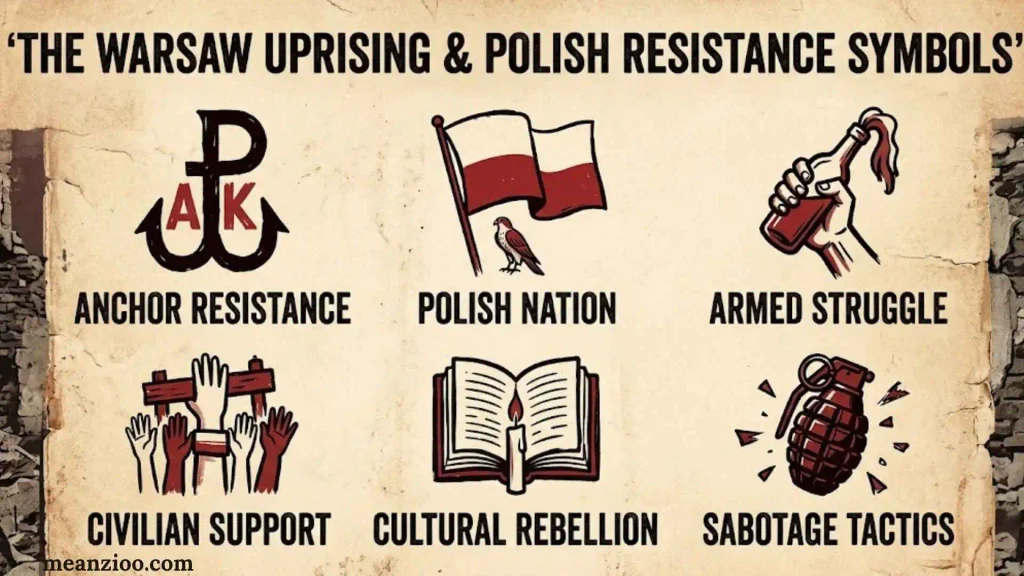
The Warsaw Uprising of 1944 was an armed effort by the Polish resistance to liberate Warsaw from Nazi German occupation before Soviet forces established control over the city.
The uprising began on August 1, 1944, and continued for 63 days. German forces eventually suppressed it, and Warsaw suffered extensive destruction. Many resistance fighters and civilians died, while survivors faced displacement and severe hardship.
One enduring symbol associated with the resistance is the Kotwica, or Fighting Poland anchor. It combines the letters P and W, standing for Polska Walcząca, meaning “Fighting Poland.”
The symbol appeared on walls and other surfaces in occupied Poland. Displaying it offered a visible sign of opposition to the German occupation, even when public expressions of resistance could bring serious punishment.
The Warsaw Uprising must be distinguished from the Warsaw Ghetto Uprising of 1943, which was a separate revolt by Jewish resistance fighters against the Nazi German attempt to liquidate the Warsaw Ghetto.
Both events occupy important places in the history of occupied Poland, but they involved different circumstances, participants, and objectives.
The Kotwica remains a symbol of courage, resistance, and sacrifice. It also demonstrates how a simple graphic can become a lasting expression of national defiance.
Solidarność: A Symbol of Freedom and Democracy
Solidarność, meaning “Solidarity,” began as an independent trade union in Poland in 1980. It grew out of worker strikes and demands for better working conditions, greater rights, and political change.
The movement emerged most visibly at the Lenin Shipyard in Gdańsk, where workers protested in August 1980. Lech Wałęsa, an electrician and labor activist, became one of its leading figures.
Solidarity was especially significant because it operated independently of the communist authorities. It created space for workers and other citizens to organize outside the state-controlled political system.
The movement grew rapidly. At its height, Solidarity attracted approximately 10 million members, making it a remarkable force in a country with a population of around 35 million at the time.
European Union+1
The authorities imposed martial law in December 1981 and attempted to suppress the movement. Activists faced surveillance, arrest, and other forms of political repression, but Solidarity continued through underground networks and later negotiations.
In 1989, negotiations between the government and opposition led to partially free parliamentary elections. Solidarity-backed candidates won an overwhelming victory in the freely contested seats, accelerating Poland’s transition away from communist rule.
The movement’s significance extended beyond Poland. It inspired people across Central and Eastern Europe who sought greater political freedom and democratic government.
The Solidarity logo and its meaning
The Solidarity logo uses bold red lettering that resembles a crowd of people standing together. Its visual design reinforces the idea that collective action can give ordinary citizens a stronger voice.
The logo became internationally recognizable during the struggle against communist rule. Today, it remains associated with workers’ rights, civil resistance, and democratic change.
Solidarity is a useful example of a modern symbol developing through collective action rather than centuries of tradition. Its meaning comes from the experiences of the people who built and sustained the movement.
Polish Literary and Artistic Symbols
Polish literature and art have helped preserve cultural memory through periods of political upheaval. Writers and painters explored questions of national identity, historical responsibility, exile, and freedom.
Their work also demonstrates that Polish cultural heritage extends beyond political struggle. It includes personal reflection, philosophical questions, humor, imagination, and observations of everyday life.
Adam Mickiewicz and Polish Romantic Literature
Adam Mickiewicz was one of the leading figures of Polish Romanticism. Born in 1798, he became a central literary voice during a period when Poland had lost its independence.
His writing often explored national identity, exile, spiritual questions, and the relationship between individuals and their homeland. These themes resonated with readers who wanted to preserve Polish language and culture under foreign rule.
One of his best-known works is Pan Tadeusz, an epic poem published in 1834. Set in the historical Polish-Lithuanian borderlands, the work depicts the customs, social relationships, and political hopes of the nobility in the years before Napoleon’s invasion of Russia.
Mickiewicz’s work became an important part of the Polish literary canon. His influence demonstrates how literature can preserve cultural memories that political borders and governments cannot fully erase.
Other major Polish Romantic poets include Juliusz Słowacki, whose dramatic and poetic works explored national history, spiritual struggle, and political ideals.
Together, these writers helped establish poetry as an important part of Poland’s literary heritage. However, their work should be understood as art in its own right, not merely as a vehicle for nationalism.
Czesław Miłosz and Wisława Szymborska
Czesław Miłosz received the Nobel Prize in Literature in 1980. His writing explored history, exile, moral responsibility, and the pressures individuals face under authoritarian systems.
Miłosz experienced the upheavals of 20th-century Europe, including World War II and communist rule in Poland. His work often examined the relationship between personal conscience and political power.
Wisława Szymborska received the Nobel Prize in Literature in 1996. Her poems frequently begin with ordinary observations and develop into questions about human nature, knowledge, history, and chance.
Her style is known for clarity, irony, and a thoughtful sense of surprise. Rather than relying only on grand historical themes, she often found philosophical depth in everyday experiences.
Their international recognition strengthened Poland’s reputation for literary achievement. Both writers demonstrate how Polish literature can engage with universal questions while remaining shaped by the country’s particular history.
Jan Matejko’s Historical Paintings
Jan Matejko was a 19th-century Polish painter best known for monumental works depicting major events and figures from Polish history.
His paintings include Battle of Grunwald and Rejtan, or the Fall of Poland. These works portray turning points in the country’s past and helped audiences visualize events that carried deep political meaning.
Matejko painted during a period when Poland did not exist as an independent state. His historical scenes therefore offered viewers a way to engage with a national past that foreign rulers could not simply erase.
Historical paintings, however, are interpretations rather than neutral photographs. Artists select particular figures, gestures, and moments to communicate an argument or emotional impression.
Matejko’s work remains significant because it combines artistic achievement with historical memory. It shows how paintings can become Polish cultural symbols when generations use them to understand and discuss their shared past.
Natural Symbols of Poland
Poland’s natural landscapes also contribute to its identity. Ancient forests, mountain ranges, rivers, and wildlife connect the country’s heritage with its environment.
These subjects are best described as symbols of Polish natural heritage, rather than official national emblems.
The European Bison: Poland’s Iconic Wildlife
The European bison, known in Polish as żubr, is one of Europe’s most recognizable large mammals and a prominent symbol of wildlife conservation in Poland.
The species once faced severe population declines caused by hunting, habitat loss, and other pressures. By the early 20th century, wild European bison had disappeared from the wild, and recovery depended on carefully managed breeding and reintroduction programs.
Białowieża Forest became central to the species’ recovery. Conservation efforts helped establish free-ranging populations, although the species still requires habitat protection and long-term management.
The European bison is the iconic animal of the Białowieża Forest World Heritage site. UNESCO identifies the forest as home to the largest free-roaming population of the species within the site.
UNESCO World Heritage Centre+1
The bison’s significance extends beyond its size or appearance. Its recovery demonstrates how sustained conservation can help restore a species after a severe decline.
It has consequently become a recognizable emblem of Poland’s natural heritage, biodiversity, and conservation efforts. That cultural association does not make it Poland’s official national animal under the same legal framework as the White Eagle.
Białowieża Forest: A Living Natural Heritage Site
Białowieża Forest lies along the border between Poland and Belarus. It contains extensive old-growth woodland and supports a wide variety of plants, fungi, insects, birds, and mammals.
Its ecological importance comes from the presence of relatively undisturbed forest ecosystems. Fallen trees, decaying wood, wetlands, and varied vegetation create habitats that are less common in heavily managed forests.
UNESCO first inscribed Białowieża National Park on the World Heritage List in 1979. The transboundary property was expanded to include the Belarusian portion in 1992 and underwent a further major extension in 2014.
UNESCO World Heritage Centre
The forest is particularly important for biodiversity conservation. Its ecosystems support large mammals such as European bison, as well as wolves, lynx, and numerous other species.
Białowieża Forest also carries cultural meaning. It demonstrates the value of protecting natural environments that preserve ecological processes over long periods.
However, the forest is not exclusively Polish. It extends across an international border, and its conservation depends on recognizing the shared natural heritage of both countries.
The Tatra Mountains and Poland’s Highland Culture
The Tatra Mountains form part of the Carpathian range along the border between Poland and Slovakia. Their dramatic peaks, alpine lakes, and mountain valleys make them one of Poland’s best-known natural landscapes.
The Polish side of the Tatras attracts hikers, climbers, and winter sports enthusiasts. Zakopane, a popular mountain town, serves as a major center for tourism and highlander culture.
The region is associated with traditional wooden architecture, folk music, distinctive dress, and regional food. One famous product is oscypek, a smoked sheep’s-milk cheese traditionally associated with the area’s highland communities.
The Tatras also demonstrate why Polish cultural identity cannot be reduced to a single set of national customs. Mountain communities have developed distinctive traditions shaped by geography, pastoral life, and contact with neighboring regions.
These mountains represent both natural beauty and regional heritage. Their importance comes from the relationship between the landscape and the people who have lived and worked there.
The Vistula River: A Geographic and Historical Symbol
The Vistula River, called Wisła in Polish, is Poland’s longest river. It flows through the country from the Carpathian Mountains toward the Baltic Sea, passing near or through important urban centers such as Kraków and Warsaw.
For centuries, the river supported trade, transport, agriculture, and settlement. It helped connect inland communities with the Baltic coast and shaped the development of towns along its banks.
The Vistula also appears in Poland’s historical imagination. The name “Miracle on the Vistula,” given to the 1920 Battle of Warsaw, links the river with the defense of the restored Polish state.
Still, the river does not have one fixed meaning for every Polish person. Its significance varies with location and context. For some, it evokes national history; for others, it represents local identity, recreation, or the natural landscape.
Its importance lies in the way geography and history intersect. The Vistula is both a working river and a familiar feature of the country’s cultural memory.
Polish Heritage Sites and Their Symbolic Importance
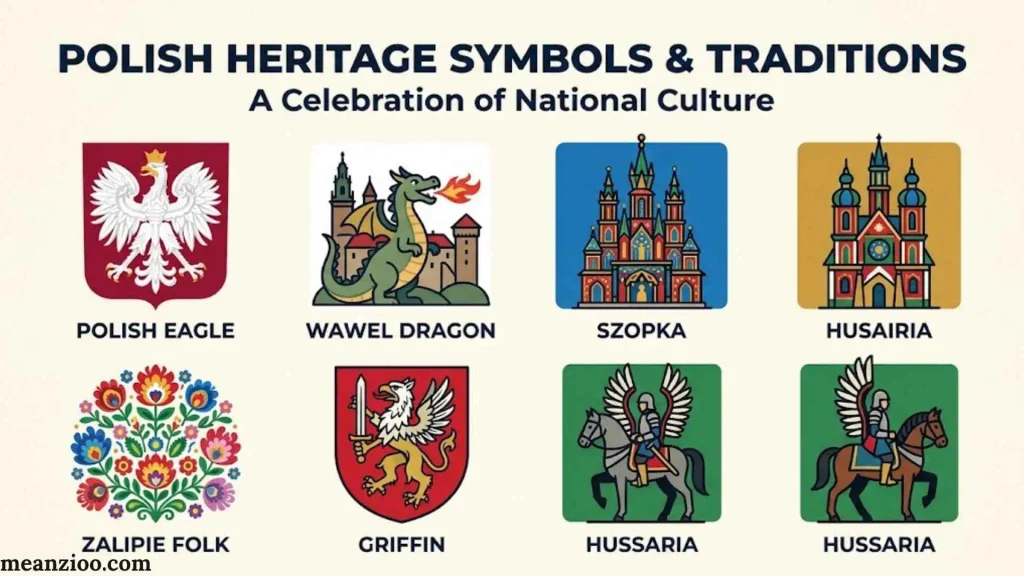
Poland’s historic buildings and memorials preserve stories that are difficult to capture through flags or written records alone. They show how architecture, public memory, and national identity have developed over time.
Several sites stand out for their cultural, historical, or international significance.
Wawel Royal Castle and Cathedral
Wawel Royal Castle and Cathedral in Kraków are closely associated with Poland’s monarchy and political history. For centuries, Kraków served as a royal capital, and Wawel became an important center of royal ceremonies and religious life.
The castle complex contains architectural elements from different periods, reflecting changes in artistic styles and political circumstances. The cathedral served as a coronation and burial site for many Polish monarchs and other prominent figures.
Wawel represents royal heritage, statehood, and the long history of Polish cultural institutions. It also demonstrates how a historic place can retain symbolic importance even after the country’s political center moves elsewhere.
The Historic Center of Warsaw
Warsaw’s historic center is a powerful example of heritage preservation. During World War II, German forces destroyed much of the city, including large parts of its historic core.
After the war, Polish architects, conservators, and residents rebuilt the Old Town using historical records, paintings, surviving fragments, and other evidence.
UNESCO recognized Warsaw’s Historic Centre as a World Heritage site in 1980. The reconstruction was notable because it recreated a historic urban landscape that had suffered extensive destruction.
The site symbolizes cultural resilience and the determination to preserve a city’s identity. It also shows that heritage does not always survive through untouched buildings; sometimes, preserving it requires careful reconstruction.
The Historic Center of Kraków
Kraków’s historic center contains medieval streets, historic churches, the Main Market Square, and buildings that reflect the city’s long development as a commercial and political center.
The city became an important royal capital and a major center of Polish art, education, and religious life. Its historic urban layout preserves evidence of these roles.
Kraków’s Old Town, Wawel Hill, and the historic district of Kazimierz form part of a UNESCO World Heritage property. Together, they illustrate the city’s architectural and cultural development.
The historic center represents continuity between Poland’s medieval past and its modern cultural life.
Auschwitz-Birkenau: A Place of Remembrance
The Auschwitz-Birkenau Memorial and Museum preserves the site of the Nazi German concentration and extermination camp established during World War II in occupied Poland.
Nazi Germany murdered approximately 1.1 million people at Auschwitz, most of them Jews. Polish political prisoners, Roma and Sinti people, Soviet prisoners of war, and other groups also suffered imprisonment, forced labor, and murder there.
The memorial’s importance lies in remembrance, historical education, and preserving evidence of the Holocaust. It is not a celebratory national symbol. Rather, it represents the responsibility to confront historical atrocities and honor their victims.
Including this site in an overview of Polish heritage helps show that national memory encompasses suffering and loss as well as achievements and victories.
What Do Poland’s Symbols Mean? A Quick Comparison
The following table summarizes the main Polish symbols and the aspects of national identity they represent.
| Symbol | Category | Main significance |
| White Eagle | Official national emblem | Polish statehood and identity |
| White-and-red flag | Official national colors | National identity and sovereignty |
| Dąbrowski’s Mazurka | National anthem | National survival and independence |
| Pierogi | Culinary tradition | Food culture and family customs |
| Bigos | Culinary tradition | Traditional cooking and shared meals |
| Wigilia | Cultural tradition | Family, hospitality, and Christmas |
| Battle of Grunwald | Historical event | Medieval history and national memory |
| Miracle on the Vistula | Historical event | Defense of the restored Polish state |
| Kotwica | Resistance symbol | Courage and resistance during occupation |
| Solidarność | Social movement | Workers’ rights and democratic change |
| Polish Romantic poetry | Literary heritage | Language, identity, and historical memory |
| European bison | Natural heritage | Wildlife conservation |
| Białowieża Forest | Natural heritage | Biodiversity and ancient woodland |
| Tatra Mountains | Natural and regional heritage | Highland culture and landscape |
| Wawel Royal Castle | Historical landmark | Royal history and cultural heritage |
The distinction between these categories matters. Poland’s flag and anthem have official status, while its food traditions, writers, landscapes, and historical events carry cultural significance in different ways.
Why Are Polish Symbols Important Today?
Polish symbols remain relevant because they connect the country’s past with everyday life. Their meanings appear in public ceremonies, family traditions, education, art, and conservation.
They preserve national identity
The White Eagle, flag, and anthem give Poland recognizable emblems of statehood. Their historical roots also connect the modern republic with earlier periods of Polish history.
They keep traditions alive
Foods such as pierogi and bigos, along with celebrations such as Wigilia, help families pass customs between generations. Regional folk art and dress preserve traditions that might otherwise fade as lifestyles change.
They help people remember history
The Battle of Grunwald, the Miracle on the Vistula, and the Warsaw Uprising remain part of public historical memory. Museums, memorials, literature, and commemorations help explain these events to new generations.
They represent the struggle for freedom
Solidarity illustrates how ordinary workers and citizens can influence political change through collective action. Its legacy remains important to discussions of civil society, workers’ rights, and democracy.
They encourage the protection of natural heritage
Białowieża Forest and the European bison highlight the importance of biodiversity conservation. These symbols remind people that natural heritage requires active protection rather than admiration alone.
Not everyone interprets these symbols in exactly the same way. Personal experiences, regional backgrounds, family traditions, and political perspectives can influence what each symbol means. That diversity makes Poland’s cultural identity more complex and interesting than any single emblem could suggest.
Frequently Asked Questions About Polish Symbols
What are the three official national symbols of Poland?
Poland’s three principal national symbols are the White Eagle, the white-and-red national colors, and Dąbrowski’s Mazurka, the national anthem. Article 28 of the Polish Constitution identifies these symbols and provides for their legal protection.
senat.gov.pl+1
What animal symbolizes Poland?
The White Eagle is Poland’s official national emblem. The European bison, or żubr, is another prominent animal associated with Poland because of its connection with Białowieża Forest and wildlife conservation.
What do the colors of the Polish flag mean?
The white and red colors come from Polish heraldry. White corresponds to the White Eagle, while red comes from the background of the coat of arms. Poland formally adopted the national flag design in 1919.
Gov.pl website+1
What is Poland’s national flower?
Poland’s three principal official national symbols do not include a national flower. Various flowers appear in Polish folk art, regional traditions, and seasonal celebrations, but these associations should not be confused with an officially designated national flower.
What is the most famous Polish cultural symbol?
There is no single answer for every context. The White Eagle and national flag are the most recognizable official emblems, while pierogi, Solidarity, and the European bison represent important aspects of Poland’s culinary, political, and natural heritage.
What food represents Polish culture?
Pierogi, bigos, and żurek are widely recognized examples of Polish cuisine. Wigilia also plays an important cultural role because its traditional Christmas Eve meal combines food with family customs and religious observance.
What does Solidarność mean in Polish history?
Solidarność means “Solidarity.” Founded as an independent trade union in 1980, the movement grew into a major force for workers’ rights and democratic change. Its activities contributed significantly to Poland’s transition away from communist rule.
European Union+1
Why is the Battle of Grunwald important to Poland?
The Battle of Grunwald took place on July 15, 1410, when Polish and Lithuanian forces defeated the Teutonic Order. It became a major symbol of medieval military achievement and later played an important role in Polish historical memory.
Najważniejsze Bitwy Oręża Polskiego
Why is the European bison important to Poland?
The European bison represents Poland’s natural heritage and conservation efforts. Białowieża Forest supports an important free-roaming population of these animals and is internationally recognized for its biodiversity.
UNESCO World Heritage Centre
What are Poland’s most important cultural and historical landmarks?
Notable sites include Wawel Royal Castle and Cathedral in Kraków, Warsaw’s reconstructed historic center, Kraków’s Old Town, and the Auschwitz-Birkenau Memorial and Museum. Each preserves a different part of Poland’s royal, urban, or wartime history.
Conclusion: Understanding the Symbols of Poland
The symbols of Poland tell a story that reaches far beyond flags and official emblems. The White Eagle, white-and-red colors, and national anthem represent the Polish state, while traditional food, literature, folk art, and regional customs express the country’s cultural heritage.
Historical events such as the Battle of Grunwald and the Miracle on the Vistula help explain Poland’s long struggle to preserve its sovereignty. Meanwhile, Solidarity represents the modern movement for workers’ rights and democracy. Białowieża Forest, the European bison, and the Tatra Mountains highlight the natural landscapes and wildlife that form another part of Poland’s identity.
These symbols matter because they preserve different kinds of memory. Some appear in official ceremonies, others at family tables, in museums, or across protected landscapes.
Together, they offer a fuller understanding of Polish national identity: a living combination of history, traditions, artistic achievement, freedom, and natural heritage.

I’m Ryan Mitchell, and I write about modern English, trending slang, and online expressions. I enjoy explaining the meanings, origins, and real-life usage of popular words in a simple way. I believe learning slang is an important step toward understanding today’s English-speaking culture. Through my work, I aim to help readers speak more naturally and stay updated with the latest language trends.
 Charlotte Hayes