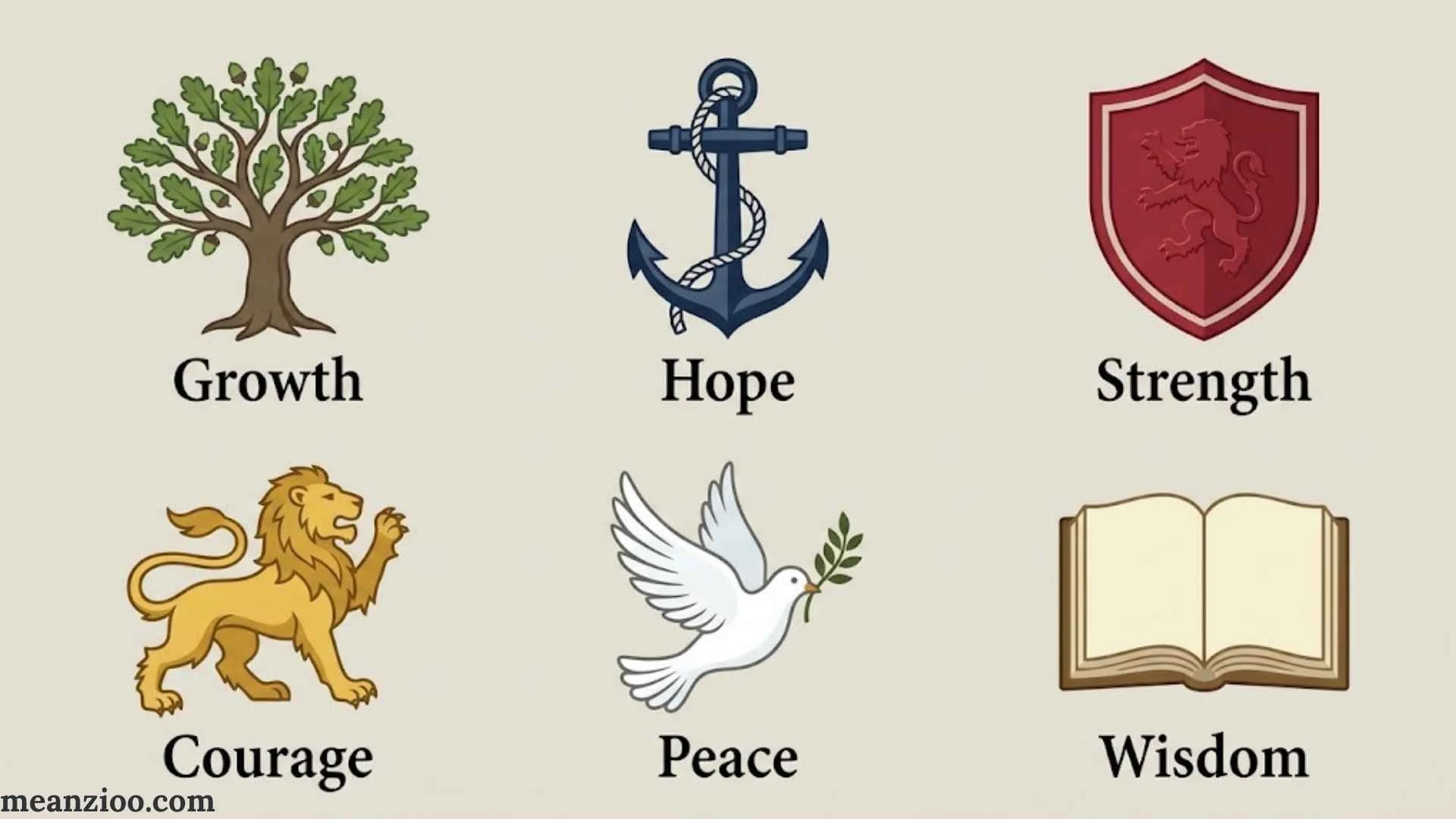
Family crest symbols tell fascinating stories about heraldry, history, and personal identity. From powerful lions and soaring eagles to colorful shields and mythical dragons, these designs have appeared on banners, seals, armor, monuments, and family records for centuries.
Understanding family crest symbols and meanings starts with recognizing how heraldry works. A shield might feature a red lion, a golden star, a silver cross, or a green tree. Each element contributes to the design, but its historical meaning depends on the specific coat of arms and the person or institution associated with it.
You may have heard that red represents courage, blue stands for loyalty, or a lion proves royal ancestry. These are familiar interpretations in popular heraldic guides, but they aren’t universal rules. The original designer’s intentions often remain undocumented.
This guide explores coat of arms symbols and meanings, including heraldic animals, colors, flowers, geometric shapes, mythical creatures, and traditional design elements. You’ll also learn how to interpret a coat of arms and research whether a historical heraldic design belongs to your own family line.
What Is a Family Crest?
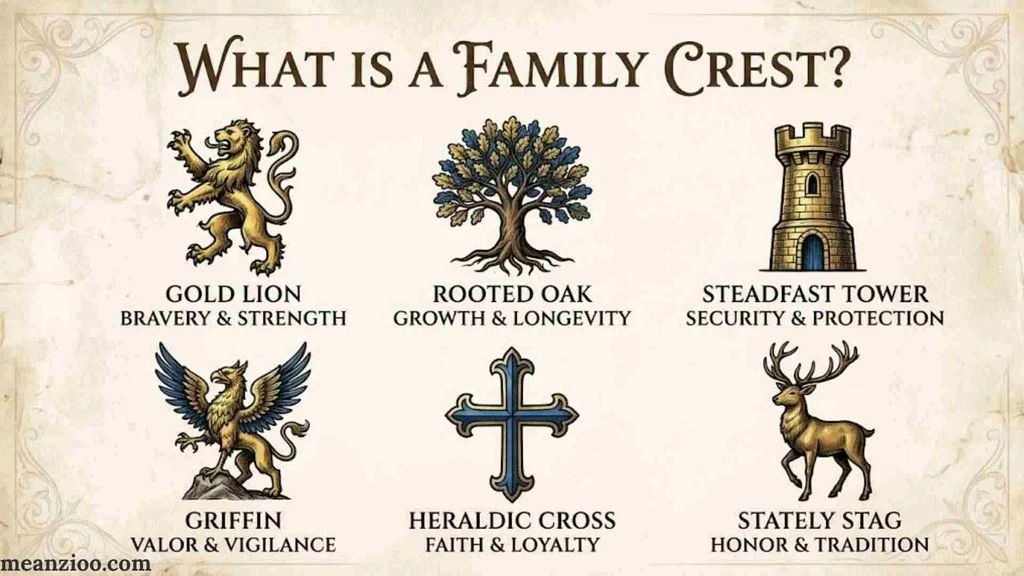
A family crest is commonly understood as a symbol representing a family or its heritage. In technical heraldry, however, the word crest refers to one specific part of a larger heraldic design.
A crest traditionally sits above a helmet in a complete heraldic display. It might depict an animal, a human figure, a bird, or an imaginary creature. The shield below it carries the principal coat of arms.
The term heraldry describes the system used to design, describe, identify, and record heraldic emblems. It developed in medieval Europe and remains in use today.
According to the Heraldry Society, a complete heraldic achievement may contain a shield, helmet, crest, mantling, motto, supporters, and other elements. Not every design includes all of them.
Family Crest vs. Coat of Arms
People often use family crest and coat of arms interchangeably. Knowing the difference makes it easier to understand historical records and identify the individual elements in a design.
| Heraldic term | Meaning |
| Coat of arms | The heraldic arms displayed principally on a shield |
| Crest | The figure traditionally placed above the helmet |
| Shield | The central surface carrying the principal arms |
| Heraldry | The system and practice of creating and recording heraldic designs |
| Heraldic charge | An animal, object, plant, or other figure placed on a shield |
| Blazon | The formal written description of a coat of arms |
| Heraldic achievement | The complete display, potentially including the shield, helmet, crest, mantling, and supporters |
| Motto | A phrase associated with a particular heraldic display |
A crest can appear by itself on objects such as jewelry, bookplates, and decorative items. That doesn’t make it the same thing as the complete coat of arms.
It’s also important to distinguish a heraldic emblem from a modern decorative logo. A logo can represent a family, organization, or business without following heraldic conventions.
Why Did Families Use Heraldic Symbols?
Heraldry developed in a society where recognizable visual identifiers had practical value. During the Middle Ages, knights and other participants in military and tournament settings used distinctive designs to identify themselves.
Heraldic imagery later appeared on seals, documents, buildings, monuments, and other objects. Over time, coats of arms became associated with personal identity, descent, institutions, and established traditions.
A design might incorporate an animal, a geometric figure, or a visual reference to a name. Some arms also included marks associated with inheritance or distinctions within a heraldic system.
However, a coat of arms is not automatically a record of everything a family accomplished. A lion doesn’t prove that an ancestor fought bravely in battle, and a crown doesn’t independently establish royal descent. Historical evidence is needed to support those conclusions.
Family Crest Symbols and Their Meanings
The most recognizable family crest symbols include animals, flowers, stars, crosses, weapons, and mythical creatures. Their appearance can be described accurately even when their original symbolism remains uncertain.
The following sections explain common traditional associations while distinguishing them from documented historical meanings.
Heraldic Animal Symbols and Their Traditional Meanings
Animals are among the most recognizable elements of heraldic design. They can appear alone, in groups, or alongside geometric figures and other charges.
Their posture, direction, and placement also matter. A lion standing upright is described differently from one walking, while an eagle with outstretched wings has a distinct heraldic appearance.
The lion in heraldry is associated in popular interpretations with courage, strength, authority, and power. Lions became prominent in European heraldic traditions, including royal and noble arms.
A lion may be rampant, passant, or depicted in another posture. Its exact form and position help distinguish one design from another.
The heraldic eagle often evokes power, vigilance, and authority in popular symbolism. Its wings may be spread, folded, or shown in another specified position.
Eagles also appear in the heraldic traditions of states and institutions. Their presence alone doesn’t establish a family’s national origin or political allegiance.
Bears can suggest strength and resilience in modern interpretations. Heraldic artists may depict them standing, walking, or in other recognizable poses.
The bear’s exact design and the historical identity of its bearer are more reliable clues than a generalized symbolic definition.
A wolf symbol may evoke endurance, ferocity, or the natural world. Wolves appear in various heraldic traditions, and their depiction can vary considerably.
A wolf on a shield doesn’t automatically mean the family descended from warriors or had a particular relationship with the animal.
A stag in heraldry is often associated in modern explanations with nature, grace, and renewal. Its antlers and posture make it easy to distinguish from other animal charges.
Deer also appear in hunting imagery and regional heraldic designs. The context of a particular coat of arms determines how much can reasonably be inferred.
Dogs and hounds are commonly associated with loyalty, faithfulness, and service. In heraldry, they may appear as hunting dogs or other recognizable breeds.
Their presence can invite questions about the original bearer’s intentions, but it doesn’t prove that an ancestor held a specific occupation.
Other Common Animals in Heraldry
Several additional animals appear in heraldic symbols and popular family crest designs.
| Animal | Common traditional or popular association |
| Horse | Movement, service, and equestrian imagery |
| Boar | Ferocity, determination, and defensive strength |
| Hare | Speed, alertness, and resourcefulness |
| Falcon | Hunting, skill, and status in historical contexts |
| Raven | Intelligence and associations that vary by culture and tradition |
| Badger | Persistence and tenacity in popular interpretations |
| Ram | Determination and strength in popular interpretations |
| Fish | Aquatic life, local identity, or religious associations in some contexts |
These descriptions offer starting points for interpreting the imagery. They aren’t a definitive dictionary of historical meanings.
The American Heraldry Society explains that the meanings commonly assigned to heraldic charges and colors are often assumed rather than documented. Unless the designer recorded an explanation, the original reason for choosing a symbol may be impossible to establish. See its guide to heraldry and genealogy.
Mythical Creatures in Heraldry
Mythical creatures in heraldry combine familiar animals with legendary features. Medieval art and literature helped popularize many of these beings, and heraldic designs adopted a wide variety of real and imaginary creatures.
Their appearance can make a coat of arms distinctive, but their symbolism varies across historical and cultural contexts.
Dragons appear in heraldic designs as powerful, fearsome creatures. Popular interpretations associate them with strength, protection, or formidable power, although these meanings aren’t universal.
Their form also varies across traditions. A dragon should be identified from its actual depiction rather than assumed to have one standard meaning.
A griffin combines the body of a lion with the head and wings of an eagle. This mixture brings together two animals that frequently appear in heraldic imagery.
Griffin symbolism is often explained through courage, watchfulness, and strength. The specific significance of a griffin in an individual coat of arms requires historical context.
The unicorn has a distinctive place in Scottish royal heraldry. A unicorn appears as a supporter in the Royal Arms of the United Kingdom, alongside the lion associated with England.
The creature is often linked with purity and rarity in popular symbolism. Its role in a particular royal or personal design, however, should be understood within the relevant heraldic tradition.
A wyvern is a dragon-like creature commonly depicted with two legs and wings. Its distinctive silhouette separates it from the more familiar four-legged dragon in many heraldic illustrations.
Wyverns can create a striking visual identity, but their inclusion doesn’t automatically indicate a particular family achievement.
The phoenix is a legendary bird widely associated with rebirth and renewal in broader symbolic traditions. In heraldic art, it may be shown rising from flames.
Its meaning should be assessed in context rather than treated as proof of a historical family tragedy, recovery, or victory.
Other legendary creatures, including the cockatrice, mermaid, and manticore, also appear in heraldic imagery. These figures connect heraldry with medieval storytelling, folklore, and artistic traditions.
Heraldic Colors and Their Meanings
Color is a defining feature of coat of arms symbols and colors meanings. In heraldry, colors, metals, and furs belong to a broader category called tinctures.
Heraldic descriptions use traditional names such as gules for red and azure for blue. These terms help describe a design consistently, even when different artists use slightly different shades.
The table below covers familiar color associations found in popular explanations of heraldry. These are interpretive conventions, not universal rules governing every historical coat of arms.
| Heraldic tincture | Common appearance | Popular symbolic associations |
| Gules | Red | Courage, strength, and martial imagery |
| Azure | Blue | Loyalty, truth, and constancy |
| Vert | Green | Hope, nature, and renewal |
| Sable | Black | Constancy, dignity, and grief in some traditions |
| Purpure | Purple | Sovereignty, dignity, and status |
| Or | Gold or yellow | Generosity, honor, and elevated status |
| Argent | Silver or white | Peace, sincerity, and purity |
Red in Heraldry: Gules
Red is one of the most recognizable heraldic colors. In popular interpretations, it is associated with courage, strength, and military imagery.
A red shield or red animal can create a bold visual contrast against gold, silver, or other suitable tinctures.
However, a red charge doesn’t prove that its bearer fought in battle or performed a particular act of bravery. Such claims need independent evidence.
Blue in Heraldry: Azure
Blue, known as azure, is often associated with loyalty, truth, and constancy in modern symbolism guides.
It is also useful as a clear visual element in heraldic design. Its historical significance in a specific coat of arms depends on the design’s origin and documentation.
Green in Heraldry: Vert
Green, or vert, is often connected with hope, nature, and renewal in popular interpretations.
Green may appear in plants, trees, animals, or geometric sections. The presence of green doesn’t automatically indicate that an ancestor owned land, worked in agriculture, or had a particular environmental connection.
Black in Heraldry: Sable
Black, known as sable, is sometimes associated with constancy, dignity, or grief.
Its visual role is equally important. Black can define a figure clearly against a contrasting metal or color, helping make the shield easy to recognize.
Purple in Heraldry: Purpure
Purple, or purpure, has associations with dignity and sovereignty in some popular explanations. Its historical use and visual appearance vary across heraldic traditions.
Don’t assume that purple in a coat of arms proves royal ancestry or membership in a noble family.
Gold and Silver in Heraldry: Or and Argent
Gold and silver are the two principal heraldic metals.
- Or is conventionally represented by gold or yellow.
- Argent is represented by silver or white.
These terms describe heraldic tinctures rather than requiring a shield to contain actual metal. An illustration can use yellow to represent Or and white to represent Argent.
What Is the Rule of Tincture?
The rule of tincture is a major heraldic design convention intended to maintain visual contrast. In its familiar form, it discourages placing a color directly on another color or a metal directly on another metal.
The traditional categories are:
- Colors: Gules, azure, vert, sable, and purpure.
- Metals: Or and argent.
- Furs: Patterns such as ermine and vair.
This convention helps make charges recognizable against the shield’s background. Historical designs and specialized heraldic practices can require closer examination, so the rule shouldn’t be applied as an absolute explanation for every design.
Heraldic Furs and Patterns
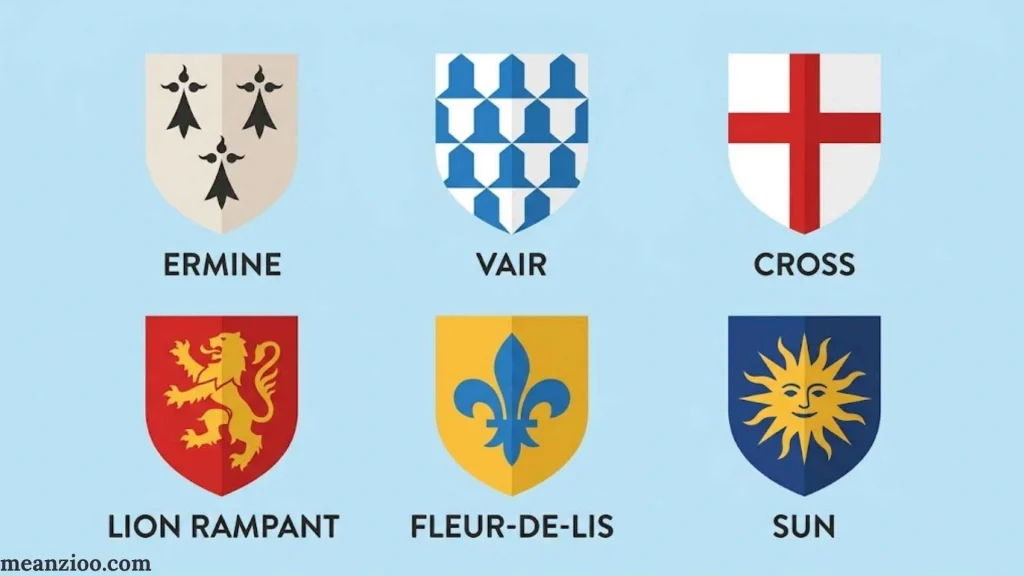
Heraldic furs are conventional patterns used in coats of arms. Their designs developed from representations of fur, including the fur linings found in historical clothing.
Unlike ordinary colors, furs have their own distinctive visual patterns. They can serve as a background or appear as part of a larger heraldic design.
Ermine
Ermine is a heraldic fur pattern traditionally represented by black spots on a white or silver field. Its design is based on the winter coat of the stoat, historically called ermine when its white fur was used in luxury clothing.
Ermine became associated with high-status dress, particularly in European courtly traditions. It remains a recognizable feature of heraldic art.
Although ermine can evoke dignity and prestige, its presence doesn’t independently prove that a historical bearer held a particular rank.
Vair
Vair is another traditional heraldic fur pattern. It is based on stylized representations of squirrel pelts arranged in a repeating pattern, often using blue and white.
The pattern looks different from ermine because it relies on repeated shapes rather than individual spots.
Ermine and vair are examples of how heraldic patterns contribute to a shield’s appearance. They shouldn’t be confused with ordinary decorative textures or treated as evidence of a specific family occupation.
Heraldic Ordinaries and Geometric Symbols
Heraldic ordinaries are conventional geometric figures used in heraldic design. They form some of the most recognizable structures on a shield and can appear alone or alongside other charges.
Although popular guides sometimes assign meanings to these shapes, their presence doesn’t automatically establish a family’s military history, religious beliefs, or social position.
| Heraldic symbol | Appearance | What to know |
| Fess | Horizontal band | A principal geometric figure across the shield |
| Pale | Vertical band | Extends vertically through the shield |
| Bend | Diagonal band | Runs diagonally across the shield |
| Chevron | Inverted V shape | A distinctive angular figure |
| Chief | Upper portion of the shield | A defined area at the top |
| Bordure | Border around the shield | Surrounds the shield’s inner field |
| Pile | Wedge-shaped figure | Extends into the shield, commonly from its upper edge |
| Cross | Cross-shaped figure | Appears in many heraldic forms |
| Saltire | X-shaped figure | Also known as St. Andrew’s cross |
Fess: The Horizontal Band
A fess is a horizontal band across the shield. It may appear in a contrasting tincture and can carry additional charges.
Its shape is relatively simple, which makes it easy to recognize in historical illustrations and modern heraldic designs.
Pale: The Vertical Band
A pale is a vertical band running down the shield. Like a fess, it can appear alone or contain other figures.
Its orientation is an important part of the formal description of a coat of arms.
Bend: The Diagonal Band
A bend is a diagonal band across the shield. Its direction and placement are recorded in the formal heraldic description.
A bend should not automatically be interpreted as a symbol of military service or a particular journey. The documented history of the arms is needed to establish such a connection.
Chevron: The Inverted V
A chevron resembles an inverted V. It is a common geometric figure in European heraldry and can be displayed in different tinctures.
Although modern symbolic guides may connect it with protection or construction, these associations shouldn’t be assumed to explain every historical design.
Chief, Bordure, and Pile
A chief occupies the upper part of the shield. A bordure forms a border around its edge, while a pile is a wedge-shaped figure extending into the field.
These elements help structure a design and distinguish one coat of arms from another. Their formal descriptions are more reliable than assigning them universal symbolic meanings.
Shield Divisions and Repeating Patterns
A shield can be divided into sections or filled with repeating patterns.
Common terms include:
- Per pale: Divided vertically.
- Per fess: Divided horizontally.
- Per bend: Divided diagonally.
- Quarterly: Divided into four sections.
- Checky: Covered with a checkerboard-like pattern.
- Lozengy: Covered with a repeating diamond pattern.
- Wavy: Describes a line drawn in a wave-like form.
Shield divisions can organize multiple designs or combine arms in accordance with particular heraldic traditions. A quartered shield, for example, may reflect a historical combination of arms, but that interpretation must be verified for the specific bearer.
Heraldic Charges: Stars, Flowers, Crosses, and Objects
A heraldic charge is a figure placed on a shield or another heraldic element. Charges include animals, plants, objects, geometric shapes, and many other recognizable forms.
The term describes what appears in the design. It doesn’t automatically tell us why the original bearer chose it.
Stars and Crescents
Stars and crescents are among the most familiar coat of arms symbols.
- Mullet: A star-shaped heraldic charge, traditionally depicted with a specified number of points.
- Estoile: A star-like figure distinguished by its wavy rays in common heraldic usage.
- Crescent: A crescent-shaped lunar figure.
- Annulet: A ring-shaped charge.
- Lozenge: A diamond-shaped figure.
Stars may be associated with guidance or aspiration in modern symbolic interpretations. Crescents may evoke the moon or appear as a distinguishing element in a particular heraldic system.
However, a star doesn’t automatically indicate divine guidance, and a crescent doesn’t establish a bearer’s religion. The symbol’s form, use, and historical context all matter.
Crosses and Their Different Forms
Crosses appear in many heraldic traditions, including religious, institutional, and personal designs.
Common forms include:
- Latin cross: A cross with a longer vertical arm and a shorter horizontal arm.
- Saltire: An X-shaped cross.
- Cross pattée: A cross with arms that broaden toward their outer ends.
- Maltese cross: A distinctive cross form with four principal arms and characteristic outer edges.
A cross may have a religious association, but it can also function as part of a wider heraldic design. Its presence alone doesn’t prove that the original bearer belonged to a particular religious group.
Roses, Lilies, and Other Flowers
Flowers are recognizable charges in European heraldry. Their meanings often overlap with broader cultural symbolism.
The rose is a prominent example. Roses appear in numerous heraldic designs, including the Tudor rose, which became associated with the Tudor dynasty in England.
The fleur-de-lis is a stylized lily-like figure strongly associated with French heraldic history. Despite its familiar name, it is a conventional heraldic design rather than a realistic botanical illustration.
Other plant charges include oak leaves, thistles, shamrocks, wheat, and laurel.
| Plant or flower | Common cultural association | Important context |
| Rose | Love, beauty, and cultural identity | Its heraldic use varies by design and historical period |
| Fleur-de-lis | French heraldic and royal traditions | Its use does not automatically prove French ancestry |
| Oak leaves | Strength and endurance | These are broad symbolic associations |
| Thistle | Scotland | Its national association is distinct from its meaning in every individual coat of arms |
| Shamrock | Ireland | Cultural symbolism doesn’t establish ancestry |
| Wheat | Agriculture and harvest | The particular arms may have a different documented explanation |
| Laurel | Achievement and honor | These associations also appear outside heraldry |
Crowns, Swords, Anchors, and Keys
Objects can serve as heraldic charges in their own right.
- Crown: Can indicate rank or authority in certain established heraldic contexts.
- Sword: May evoke martial imagery or appear as an institutional or personal emblem.
- Anchor: Has maritime associations and appears in some naval and civic designs.
- Key: May carry religious, institutional, or personal associations.
- Tower or castle: Often appears in civic and personal heraldic designs.
- Ship: Can reflect a maritime theme or a specific institutional history.
- Book: May represent an institution or an idea chosen by the bearer, although the original intent needs evidence.
An object may look meaningful to a modern viewer without having a known historical explanation. If you are interpreting a real coat of arms, identify the charge first and investigate its documented use second.
Heraldic Animal Positions and What They Mean
The position of an animal is an important part of heraldic terminology. Heraldic artists use established terms to describe how an animal stands, walks, looks, or spreads its wings.
These descriptions help readers distinguish similar designs and allow artists to reproduce the arms accurately.
| Heraldic term | Meaning |
| Rampant | An animal shown upright, usually with its forelegs raised |
| Passant | An animal shown walking |
| Statant | An animal shown standing |
| Sejant | An animal shown seated |
| Couchant | An animal lying down with its head raised |
| Guardant | An animal’s head faces the viewer |
| Regardant | An animal looks backward over its body |
| Displayed | Commonly describes a bird with its wings spread |
A lion rampant, for example, is shown upright with its forelegs raised. A lion passant is shown walking.
These terms describe the image rather than assigning a separate personality trait to the animal. A rampant lion doesn’t necessarily mean that the original bearer was aggressive, while a passant lion doesn’t establish a peaceful character.
What Do Dexter and Sinister Mean?
Heraldry also uses special terms for direction.
- Dexter means the bearer’s right side.
- Sinister means the bearer’s left side.
When you face a shield, dexter appears on your left and sinister appears on your right. This can seem counterintuitive until you remember that heraldic directions are described from the bearer’s perspective.
These terms matter when interpreting a blazon, the formal description of a coat of arms. A charge placed on dexter isn’t necessarily in the same position as one placed on sinister.
What Do the Different Parts of a Coat of Arms Mean?
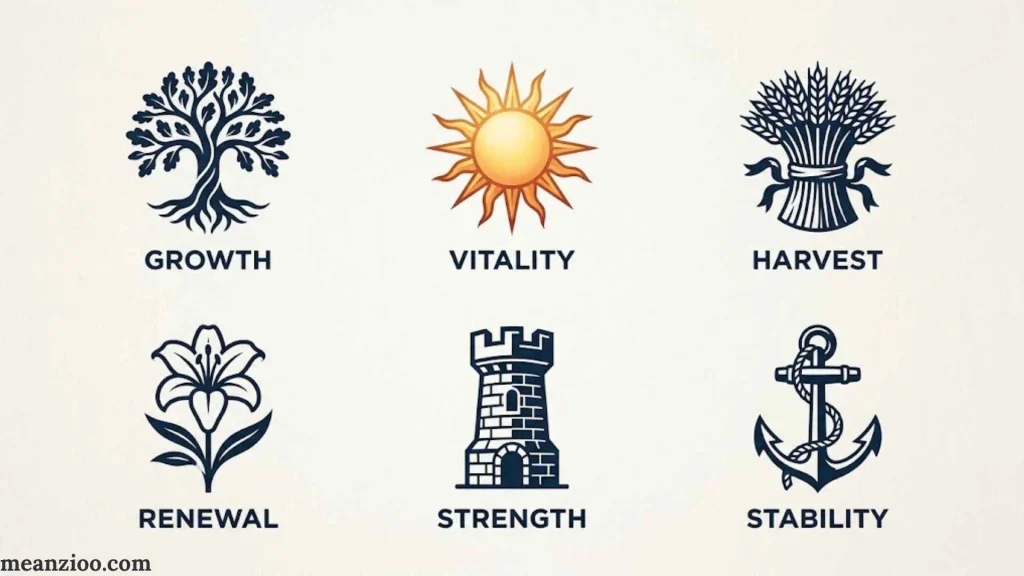
A complete heraldic achievement can include several components beyond the shield. Each has a distinct place in the overall design.
The Shield
The shield is the principal part of the arms. It carries the field, tinctures, ordinaries, and charges that make up the core design.
When researching an old coat of arms, start with the shield. Its formal description is often the most useful starting point for comparing illustrations and historical records.
The Helmet and Mantling
The helmet sits above the shield in many full heraldic achievements. Its depiction varies according to the tradition and context.
Mantling is the decorative fabric-like element associated with the helmet. It is commonly shown flowing around the upper part of the achievement.
Although helmets and mantling can contribute to the overall appearance, their styles should not be used to infer rank without considering the relevant heraldic rules.
The Crest
The heraldic crest sits above the helmet, traditionally on a wreath or another appropriate support. It may show an animal, a bird, an arm, or another recognizable figure.
The crest is distinct from the shield. Two images that share a similar crest may still represent different coats of arms.
The Motto
A heraldic motto is a phrase associated with a heraldic display. It may appear on a scroll below the shield or elsewhere in the design.
Mottoes can be written in Latin, English, or another language. They are not compulsory in every tradition, and the rules governing them vary by jurisdiction.
A motto can provide useful clues about a bearer or institution, but it shouldn’t automatically be treated as a historical record of an ancestor’s words.
Supporters and Other Elements
Supporters are figures placed on either side of the shield. They may be animals, human figures, or other designs.
Other elements can include:
- A compartment beneath the shield or supporters.
- A banner displaying the arms or a related emblem.
- A badge used separately from the full achievement.
- Crowns or coronets in systems where they indicate a recognized status.
- Decorative elements associated with a particular order or institution.
Not every coat of arms includes these features. Their use and interpretation depend on the relevant heraldic tradition.
How to Read and Interpret Family Crest Symbols
You don’t need to be a professional herald to begin interpreting a coat of arms. A systematic approach can help you describe the design, identify its elements, and find reliable historical information.
Follow these steps when examining a family crest or coat of arms.
Identify the Complete Design
First, determine what you’re looking at. Is the image a shield, a crest above a helmet, a clan crest badge, or a full heraldic achievement?
This distinction matters because a standalone crest may not show the shield’s principal charges or tinctures.
Describe the Shield and Its Colors
Record the shield’s background, divisions, and prominent figures. Note the colors and metals using both their ordinary names and their heraldic terms where possible.
For example, a shield with a blue field and a silver chevron could be described using the tinctures azure and argent.
Identify Each Charge
Look for animals, plants, crosses, stars, weapons, and other objects.
Pay attention to details that distinguish one figure from another. An eagle with its wings spread looks different from an eagle with folded wings, while a lion’s posture can change its formal description.
Examine the Blazon
A blazon is the formal written description of a coat of arms. It records the arrangement, tinctures, charges, and relevant details of the design.
Blazons are especially useful because an illustration may vary in artistic style while the underlying heraldic description remains the same.
Research the Historical Bearer
Once you’ve described the design, investigate who bore the arms and when they were recorded.
Useful sources include:
- Official heraldic registers and grants.
- Historical armorials.
- Genealogical records.
- Archives and museum collections.
- Historical documents that identify the bearer.
- Publications from recognized heraldic organizations.
The goal is to connect a specific design to a documented bearer, not simply to find an image that shares your surname.
How to Find Your Family Crest or Coat of Arms
If you want to discover whether your ancestors used heraldic arms, genealogical research is the best place to start.
Many websites sell decorative products featuring coats of arms alongside surname histories. These products may be attractive keepsakes, but the image alone doesn’t prove that the arms belonged to your ancestors.
Start With Your Family History
Begin by tracing your family line through reliable records.
Collect information such as:
- Full names of known ancestors.
- Birth, marriage, and death records.
- Dates and places associated with earlier generations.
- Immigration or residence records where relevant.
- Historical documents that establish relationships between generations.
Work backward one generation at a time. A documented connection between you and a historical bearer is much more useful than a shared surname.
Search Heraldic Records
Once you have a possible historical connection, identify the relevant heraldic authority or archive.
In England, Wales, and Northern Ireland, the College of Arms maintains an important role in the granting and recording of arms. Scotland has its own heraldic jurisdiction through the Court of the Lord Lyon. Other countries have their own rules, institutions, and traditions.
Not every historical coat of arms appears in a single database, so research may involve published armorials, archival documents, and specialist assistance.
Does Everyone With the Same Surname Share a Coat of Arms?
No. Sharing a surname doesn’t automatically entitle you to use a particular coat of arms.
In many heraldic systems, arms are associated with a specific person and may pass to eligible descendants under the applicable rules. Unrelated people can have the same surname and bear entirely different arms, while others may have no inherited heraldic arms at all.
Scotland also has a distinct system of clan heraldry. A clan chief’s personal arms aren’t automatically the arms of every clan member. Clan crest badges are a separate form of emblem associated with clan traditions.
Can You Create Your Own Family Crest?
You can create a personal emblem or design a coat of arms, but the rules governing its adoption and official recognition vary by country.
In the United States, people can generally design and adopt original arms without a government grant. In some other jurisdictions, formal grants or registration may be required to obtain recognized arms or exercise particular heraldic rights.
If you want to create a meaningful design, consider:
- Choosing a small number of distinctive charges.
- Using clear contrasts between tinctures.
- Avoiding designs that closely imitate existing arms.
- Drawing inspiration from your family’s documented history.
- Checking the relevant rules before seeking a formal grant or registration.
A personally designed emblem can represent your family’s values and shared history. It should not be presented as an inherited historical coat of arms unless the evidence supports that claim.
Do Family Crest Symbols Have Fixed Meanings?
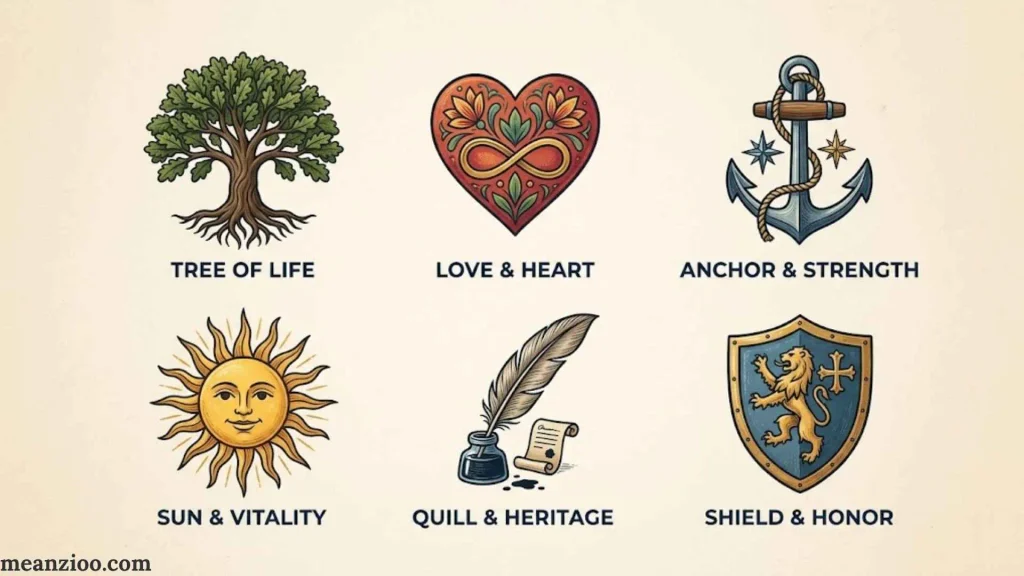
The short answer is no, not in the universal way many popular guides suggest.
Heraldry has a formal vocabulary for describing colors, charges, positions, and arrangements. That vocabulary allows people to identify and reproduce a design accurately.
However, there isn’t a universally accepted dictionary that explains the original intention behind every heraldic symbol.
For example, a lion may be associated with courage in a modern symbolism guide. Yet the original bearer might have chosen it for another reason, including a visual pun on a name, a connection to another person, or a preference for the design.
This is an important distinction:
| Type of interpretation | What it tells you |
| Formal heraldic description | What the design actually contains |
| Traditional symbolic association | A meaning commonly assigned to a symbol in later explanations |
| Documented historical explanation | What a reliable historical source says about the specific design |
| Personal interpretation | What the symbol means to a modern individual or family |
| Genealogical evidence | Whether a documented historical bearer belongs to your family line |
One especially useful concept is canting arms. These are arms that use imagery as a visual or verbal reference to the bearer’s name.
For example, a coat of arms associated with a surname meaning or resembling the name of an animal might depict that animal. Such imagery can provide a more specific explanation than a generic symbolism chart.
The practical lesson is simple: learn what the symbol is, identify the person or institution associated with the design, and then investigate its history.
Frequently Asked Questions About Family Crest Symbols and Meanings
What Are the Most Common Family Crest Symbols?
Common heraldic symbols include lions, eagles, crosses, stars, roses, fleur-de-lis figures, crescents, swords, and geometric shapes such as chevrons and bends. Their popularity varies by period and region.
What Does a Lion Mean on a Family Crest?
A lion is commonly associated with courage, strength, authority, and power in popular heraldic explanations. However, its appearance doesn’t automatically prove that an ancestor was a warrior, noble, or royal.
What Do Colors Mean on a Family Crest?
Popular interpretations associate red with courage, blue with loyalty, green with hope, black with constancy, gold with generosity, and silver with peace. These are traditional or modern symbolic associations rather than universal rules. The historical reason for a particular color depends on the specific arms.
What Is the Difference Between a Family Crest and a Coat of Arms?
A crest is the figure traditionally placed above a helmet in a full heraldic achievement. A coat of arms refers to the heraldic arms centered on the shield. Although people often use the terms interchangeably, they describe different elements.
How Can I Find My Family’s Original Coat of Arms?
Start with your family tree and establish a documented connection to an individual who bore arms. Then search the relevant heraldic records, historical armorials, and archival sources. A surname match alone isn’t enough.
Does My Surname Have Its Own Family Crest?
Not necessarily. Many surnames are shared by unrelated families, and each may have a different heraldic history. Some people have inherited arms, while others don’t have a documented ancestral connection to any coat of arms.
What Do Dragons and Griffins Represent in Heraldry?
Dragons and griffins are legendary creatures used in heraldic art. Popular interpretations associate them with power, courage, watchfulness, or protection, but their meanings vary. Their formal appearance and historical context provide more reliable clues.
Can I Use a Coat of Arms I Found Online?
Finding an image online doesn’t establish a right to use it as your own coat of arms. Check who bore the arms, whether you can document the relevant family connection, and which heraldic rules apply in your jurisdiction.
What Is a Blazon in Heraldry?
A blazon is the formal written description of a coat of arms. It records the design’s tinctures, charges, arrangement, and other relevant details, helping heraldic researchers identify and reproduce the arms.
What Is the Rule of Tincture?
The rule of tincture is a heraldic convention intended to preserve contrast between elements. Its familiar form discourages placing a color on another color or a metal on another metal. Historical and specialized cases may require additional context.
Conclusion: Understanding the Meaning Behind Family Crest Symbols
Family crest symbols and meanings offer an engaging way to explore heraldry, visual identity, and family history. Lions, eagles, dragons, flowers, crosses, stars, and geometric figures all contribute to the distinctive appearance of heraldic designs.
Learning the terminology makes these designs easier to understand. Tinctures explain the colors and metals, charges identify the figures, ordinaries describe geometric elements, and a blazon records the arms in a formal written form.
Still, the most important distinction is between a symbol’s popular interpretation and its documented historical meaning. A lion may evoke courage, but it doesn’t prove that an ancestor performed a heroic deed. A shared surname may lead you toward a historical record, but it doesn’t establish that the arms belong to your family.
If you’re researching your ancestry, start with the people and records you can verify. Once you establish a connection to a historical bearer, heraldic sources can help you understand the design and its place in history.
That approach turns a decorative symbol into something far more valuable: a starting point for evidence-based family history.

I’m Ryan Mitchell, and I write about modern English, trending slang, and online expressions. I enjoy explaining the meanings, origins, and real-life usage of popular words in a simple way. I believe learning slang is an important step toward understanding today’s English-speaking culture. Through my work, I aim to help readers speak more naturally and stay updated with the latest language trends.