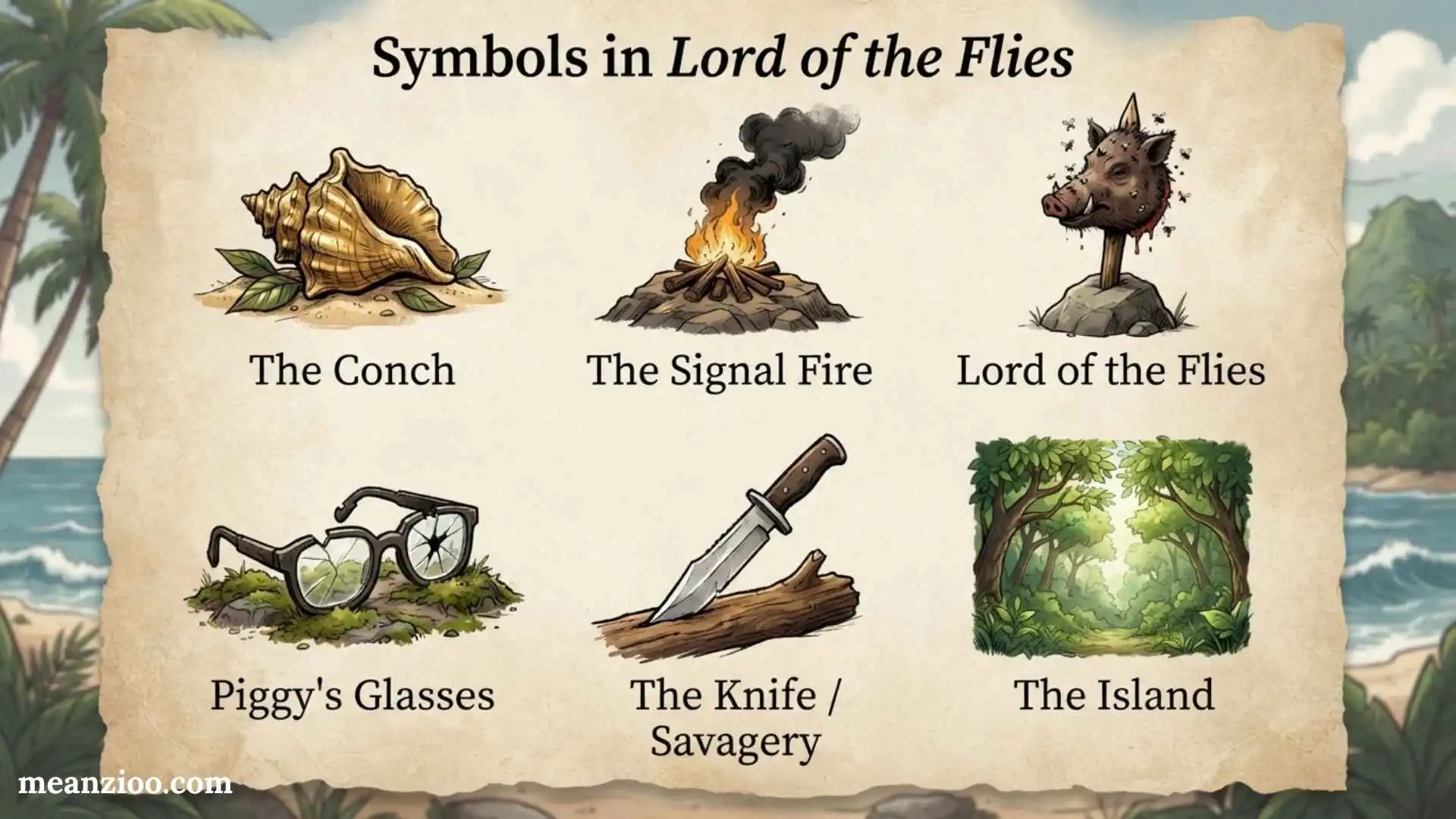
William Golding’s Lord of the Flies uses powerful symbols to explore human nature, civilization, fear, power, and the struggle between order and savagery. The novel follows a group of British schoolboys who become stranded on a remote island after a plane crash. Without adult supervision, they attempt to create their own society, but their efforts gradually collapse as fear, violence, and the desire for control take over.
The most important symbols in Lord of the Flies include the conch shell, Piggy’s glasses, the signal fire, the beast, and the Lord of the Flies. Other symbols, such as face paint, the island, the scar, and the dead parachutist, deepen the novel’s message. Each represents an idea that becomes clearer as the boys change from organized schoolchildren into increasingly violent hunters.
Understanding these symbols helps readers recognize Golding’s central warning: civilization depends on shared rules, rational thinking, and personal responsibility. When people abandon these values, their fear and desire for power can destroy the society they are trying to build.
What Is Symbolism in Lord of the Flies?
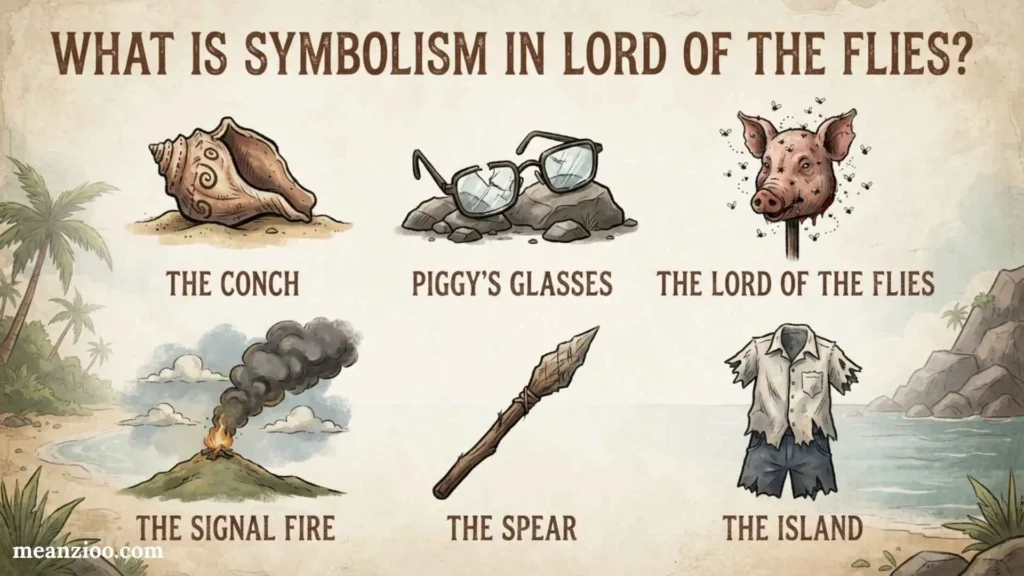
Symbolism is a literary technique in which an object, character, place, or event represents an idea beyond its literal meaning. In Lord of the Flies, Golding uses everyday objects and dramatic events to communicate complex messages about human behavior.
For example, the conch shell is an ordinary object found near the beach. However, once Ralph and Piggy use it to call meetings, it becomes a symbol of democracy, authority, and alternative discussion.
Similarly, Piggy’s glasses are useful because their lenses can focus sunlight to start a fire. Beyond this practical purpose, they represent intelligence, scientific knowledge, and the power of reason.
Golding’s symbols also change as the story progresses. Objects that once represented order lose their influence, while symbols connected to fear and violence become more powerful. These changes reflect the boys’ declining respect for rules and their growing attraction to savagery.
1. The Conch Shell: Civilization, Democracy, and Authority
The conch shell is one of the most important symbols in Lord of the Flies. Ralph and Piggy discover it near the beginning of the novel, and Ralph uses it to summon the other boys for their first meeting.
The boys establish a simple rule: whoever holds the conch has the right to speak during meetings. This arrangement gives them a shared system for discussing problems and making decisions.
What Does the Conch Shell Symbolize?
- Civilization: The conch represents the boys’ attempt to establish an organized society.
- Democracy: It gives members of the group an opportunity to express their opinions.
- Authority: It supports the rules established under Ralph’s leadership.
- Equality: In principle, the right to speak depends on holding the conch rather than being physically strong.
- Order: It encourages discussion instead of allowing everyone to shout at once.
At first, most of the boys respect the conch. They understand that meetings provide a way to organize their activities and decide how to survive.
However, Jack increasingly rejects this system. He prefers hunting, immediate action, and personal control. As his influence grows, the conch becomes less effective because the boys no longer agree that its authority matters.
The destruction of the conch occurs when Roger releases a boulder that kills Piggy and shatters the shell. This moment represents the collapse of the remaining structure of alternative authority.
Literary significance: Golding uses the conch to demonstrate that democracy cannot survive through symbols and rules alone. It also requires people to respect those rules, listen to others, and accept limits on their own power.
2. Piggy’s Glasses: Intelligence, Reason, and Technology
Piggy’s glasses are essential to the boys’ survival because their lenses allow them to focus sunlight and start a fire. However, their importance extends beyond their practical use.
Piggy is one of the most rational characters in the novel. He thinks carefully about survival, recognizes the importance of shelter, and repeatedly encourages the boys to maintain the signal fire.
Unfortunately, many boys dismiss his advice because of his physical appearance, asthma, and social position. Their treatment of Piggy reveals their growing preference for strength and popularity over intelligence.
What Do Piggy’s Glasses Represent?
- Intelligence: The glasses are associated with Piggy’s ability to think logically.
- Science and technology: They show how practical knowledge can solve problems.
- Reason: Piggy represents careful judgment rather than impulsive behavior.
- Power: Control of the glasses means control over the ability to produce fire.
- Vulnerability: Piggy depends on the glasses to see clearly, making their loss personally damaging.
When Jack’s group steals Piggy’s glasses, the theft becomes a turning point. Jack gains control of the fire-making tool, demonstrating that knowledge can be exploited by people seeking power.
The glasses also connect Piggy to the conch. Both initially support Ralph’s organized society, but neither can protect its owner when the other boys become violent.
Literary significance: Golding suggests that intelligence and knowledge are valuable, but they are vulnerable in a society that rewards intimidation instead of reason.
3. The Signal Fire: Hope, Rescue, and Responsibility
The signal fire represents the boys’ hope of returning home. Ralph understands that a passing ship may notice the smoke and rescue them, so he insists that the boys keep the fire burning.
Unlike hunting, which provides immediate rewards, maintaining the signal fire requires patience and cooperation. The boys must think about their future instead of focusing only on what they want at the moment.
The Changing Meaning of Fire
At the beginning, the fire symbolizes hope and the boys’ connection to civilization. It gives them a shared goal and reminds them that they should prepare for rescue.
Later, the boys neglect the fire because hunting becomes more exciting. Their failure to maintain it demonstrates their declining sense of responsibility.
The fire also reflects the contrast between Ralph and Jack. Ralph views it as essential to rescue, while Jack prioritizes hunting and his own authority.
Near the end, Jack’s hunters start a large fire while attempting to drive Ralph out of hiding. The destructive blaze creates enough smoke to attract a naval officer, who arrives and ends the boys’ ordeal.
This ending is ironic because the boys are rescued not through their careful maintenance of a signal fire but through the uncontrolled fire created during their violent pursuit of Ralph.
Literary significance: Fire represents both the constructive and destructive potential of human actions. Its changing purpose shows how the boys’ priorities shift from cooperation and rescue toward violence and domination.
4. The Beast: Fear and the Darkness Within Human Nature
The beast is one of the novel’s most important symbols because it reveals how fear can influence people’s decisions.
The younger boys become frightened by stories about a mysterious creature on the island. As their fear spreads, the beast becomes more than an imagined animal. It influences the group’s discussions, decisions, and behavior.
Sam and Eric later mistake a dead parachutist for the beast. Their frightened interpretation strengthens the other boys’ belief that a dangerous creature is living on the island.
Simon gradually recognizes that the boys’ greatest threat may not be an external monster. Instead, it is the cruelty and destructive potential within human beings themselves.
What Does the Beast Symbolize?
- Fear: The boys become increasingly controlled by something they do not understand.
- Human evil: The beast represents the capacity for cruelty within people.
- Ignorance: The boys struggle to distinguish reality from their frightening assumptions.
- Manipulation: Jack uses the fear of the beast to increase his influence.
- Loss of reason: Panic gradually replaces careful thought and discussion.
Jack presents himself as a protector who can defend the group from the beast. This approach helps him gain followers, even though his own violent behavior contributes to the danger on the island.
Simon attempts to explain the truth about the beast, but the frightened boys mistake him for a threat during their frenzied gathering and kill him.
Literary significance: Golding uses the beast to show that fear can become a destructive force when people refuse to question their beliefs. The imagined monster reveals a deeper danger: human beings can create real violence in response to a threat they misunderstand.
5. The Lord of the Flies: Evil, Corruption, and Savagery
The Lord of the Flies is the pig’s head that Jack’s hunters place on a sharpened stick as an offering to the beast. Surrounded by flies, the decaying head becomes one of the novel’s most disturbing images.
The name also has a connection to Beelzebub, a figure associated with the devil in Christian tradition. This association strengthens the symbol’s connection to evil and corruption.
What Does the Lord of the Flies Represent?
- Human evil: It represents the destructive impulses within people.
- Savagery: It reflects the boys’ growing willingness to abandon alternative behavior.
- Corruption: The decaying pig’s head mirrors the moral decline of the group.
- Violence: It is connected to the killing that becomes increasingly normal on the island.
- The inner beast: It reinforces the idea that evil is not simply an external creature.
When Simon encounters the pig’s head during a disturbing experience, he begins to understand the relationship between the beast and human nature. The scene suggests that the boys cannot escape the threat by hunting an imaginary monster because the source of the danger lies within themselves.
The Lord of the Flies also contrasts with the conch shell. The conch represents an effort to establish rules and cooperation, while the pig’s head represents the destructive impulses that undermine them.
Literary significance: Golding uses the Lord of the Flies to communicate his central concern about humanity’s capacity for evil. The symbol suggests that civilization can restrain destructive instincts, but it cannot automatically eliminate them.
6. The Island: Paradise, Isolation, and a Miniature Society
When the boys first arrive, the island appears beautiful and full of opportunities. It has beaches, fruit, fresh water, and forests. The absence of adults initially seems to offer freedom and adventure.
However, the island gradually becomes a setting for conflict, fear, and violence.
What Does the Island Symbolize?
- Paradise: Its natural beauty initially suggests a peaceful environment.
- Isolation: The boys are separated from ordinary society and adult supervision.
- A miniature society: Their group reflects the problems of larger human communities.
- Human nature: Their behavior reveals how they respond when familiar rules disappear.
- Lost innocence: The island becomes associated with the boys’ moral decline.
The island itself is not responsible for the boys’ violence. It provides resources for survival, but the boys decide how to organize themselves and treat one another.
Their society initially includes meetings, shared responsibilities, and a leader chosen through a vote. Over time, it becomes divided between Ralph’s efforts to maintain order and Jack’s increasingly authoritarian leadership.
The island therefore acts as a setting in which Golding can explore political authority, social responsibility, fear, and the struggle between cooperation and domination.
Literary significance: The island functions as a miniature model of human society. Golding uses it to suggest that peaceful surroundings do not guarantee peaceful behavior.
7. Face Paint and Masks: Anonymity and Loss of Shame
Face paint becomes important when Jack and his hunters begin painting their faces before hunting. The paint changes their appearance and helps them develop a separate identity from the rest of the boys.
Before using the paint, the boys remain visibly connected to their former lives as schoolchildren. Their behavior is still influenced, at least partly, by the expectations of alternative society.
The paint gives them a sense of concealment. They feel less exposed to judgment and become more willing to participate in aggressive activities.
What Does Face Paint Symbolize?
- Anonymity: The boys feel less recognizable as individuals.
- Freedom from shame: The paint helps them distance themselves from personal responsibility.
- Savagery: It becomes associated with hunting, aggression, and violence.
- Group identity: It strengthens the bond among Jack’s hunters.
- Loss of civilization: It reflects their growing separation from their former identities.
The paint also helps Jack establish his authority. His hunters become a recognizable group, distinct from the boys who continue to support Ralph’s priorities.
Literary significance: Golding uses face paint to explore how people may behave differently when they feel anonymous or protected by a group. The symbol shows how group identity can weaken individual responsibility.
8. The Scar: Destruction and the Consequences of Human Actions
The scar is one of the first images in the novel. It refers to the mark left on the island by the plane crash that brought the boys there.
The crash damages the natural environment, leaving a visible reminder of human interference. It also establishes the circumstances that separate the boys from their former society.
The scar symbolizes:
- Destruction: It marks the physical damage caused by the crash.
- Human interference: It shows that the island has been affected by events beyond its control.
- A damaged environment: It contrasts the island’s natural beauty with the destructive arrival of the boys.
- Foreshadowing: It introduces the idea that human actions will leave lasting marks on the island.
As the novel progresses, the boys cause further damage through hunting, conflict, and fire. The original scar therefore becomes an early reminder of the destructive potential that will grow throughout the story.
Literary significance: The scar introduces the relationship between human behavior and destruction. It also prepares readers for the more serious damage caused by the boys’ later actions.
9. The Dead Parachutist: War and the Violence of the Adult World
The dead parachutist lands on the island after an air battle. Carried by the wind, the figure appears to move, causing Sam and Eric to believe that they have discovered the beast.
This event is important because it connects the boys’ isolated world to the larger conflict taking place outside it.
What Does the Dead Parachutist Symbolize?
- War: The figure is a direct consequence of violence in the adult world.
- Fear: Its appearance intensifies the boys’ terror.
- Misunderstanding: The boys interpret an unfamiliar sight as proof of a monster.
- The failure of civilization: The war suggests that adults are also capable of destructive behavior.
The parachutist is particularly significant because the boys initially imagine that adults represent safety and order. Yet the circumstances of the crash and the parachutist reveal that the adult world is not free from violence.
The boys’ belief in the beast also shows how fear affects their ability to understand evidence. Rather than examining the figure calmly, they interpret it through their existing anxieties.
Literary significance: Golding connects the violence of the boys to the violence of the wider world. The novel suggests that savagery is not limited to children or isolated communities.
10. The Ocean: Isolation and Separation from Civilization
The ocean surrounds the island and separates the boys from the society they once knew. It is both a physical barrier and a reminder that rescue depends on forces beyond their control.
The ocean symbolizes several important ideas:
- Isolation: It separates the boys from adults and familiar social structures.
- Uncertainty: The boys cannot know when a ship might pass.
- Separation: It marks the distance between the island and their former lives.
- Hope: A ship crossing the ocean could provide an opportunity for rescue.
The boys can make shelters, hunt animals, and organize meetings, but they cannot control the ocean or guarantee that anyone will find them.
The possibility of rescue remains important throughout the novel, particularly for Ralph, who repeatedly emphasizes the signal fire.
Literary significance: The ocean highlights the boys’ vulnerability. Their attempts to control life on the island take place within a much larger world that they cannot command.
11. The Forest Clearing: Fear, Violence, and the Loss of Safety
The island’s forest contains places where the boys hunt, explore, and hide. Although the natural environment initially seems inviting, some areas become associated with fear and violence.
The forest clearing where Simon encounters the Lord of the Flies is especially important. It becomes a place where he confronts the symbolic meaning of the beast and recognizes the danger within human nature.
The forest can be understood as representing:
- The unknown: Its shadows and unfamiliar spaces encourage fear.
- Isolation: Characters can become separated from the group.
- Instinct: Hunting in the forest encourages the boys to focus on immediate desires.
- Inner conflict: Simon’s experience in the clearing reveals his struggle to understand the truth about the beast.
The forest is not simply evil. It is a natural environment that takes on darker associations as the boys’ behavior changes.
Literary significance: Golding uses the forest and its clearing to contrast the island’s natural world with the boys’ increasingly disturbed state of mind.
12. Pig Hunts: Violence, Power, and the Loss of Innocence
Hunting initially provides food for the boys. As the story progresses, however, it becomes a source of excitement, status, and control.
Jack increasingly values hunting over maintaining the signal fire or helping build shelters. The hunters celebrate their success in killing animals, and their behavior becomes more aggressive.
The pig hunts symbolize:
- Violence: Killing becomes an increasingly central activity.
- Power: Jack gains influence by presenting himself as a strong hunter.
- Loss of innocence: The boys become more comfortable with cruelty.
- Instinct: Immediate desires replace careful judgment.
- Group loyalty: Shared hunting experiences strengthen the hunters’ identity.
The hunts also contribute to the conflict between Ralph and Jack. Ralph emphasizes long-term survival and rescue, while Jack increasingly focuses on hunting and personal authority.
As the boys become more violent, the distinction between hunting animals and attacking human beings becomes less secure.
Literary significance: Golding uses hunting to show how violence can become normalized when it brings excitement, status, or a sense of belonging.
13. The Beast’s Sacrifices: Superstition and the Desire for Protection
As the boys become more afraid of the beast, Jack’s hunters leave the pig’s head as an offering. They hope that the sacrifice will protect them from the creature they believe threatens the island.
This ritual reveals how fear changes the group’s thinking. Instead of relying on evidence and reason, the boys begin accepting practices that make them feel safer.
The sacrifices symbolize superstition, desperation, and the desire to control an uncertain situation. They also strengthen Jack’s influence because he presents himself as someone willing to confront the beast.
The ritual is especially important because the offering itself becomes the Lord of the Flies, a symbol associated with the evil the boys fear.
Literary significance: Golding shows that fear can lead people toward irrational beliefs and harmful actions. The boys attempt to protect themselves from an imagined enemy while ignoring the destructive behavior developing within their own group.
14. The Naval Officer: Civilization, Rescue, and Irony
At the end of the novel, a naval officer arrives after seeing the smoke from the fire that Jack’s hunters started while pursuing Ralph.
His arrival brings the boys’ immediate ordeal to an end. The officer represents the organized adult world, including its uniforms, discipline, and authority.
However, the ending is more complicated than a simple return to safety. The officer arrives from a world engaged in war, so the adult society he represents also contains violence.
The officer symbolizes:
- Rescue: His arrival ends the boys’ isolation.
- Civilization: He represents the organized world beyond the island.
- Authority: His uniform and position contrast with the boys’ uncontrolled conflict.
- Irony: The adult world is not free from the violence that has developed among the boys.
Ralph’s emotional response reflects the realization of what has happened on the island. His tears are connected to the loss of innocence and the knowledge of human cruelty.
Literary significance: Golding uses the officer to create an ironic ending. The boys are rescued by representatives of a society that is itself involved in war, suggesting that the problems exposed on the island exist beyond it.
15. The Beast and the Lord of the Flies: What Is the Difference?
Although these symbols are closely connected, they serve different purposes in the novel.
| Symbol | Main meaning | Role in the story |
| The beast | Fear and the perceived threat of evil | Shows how the boys’ fear influences their behavior. |
| The Lord of the Flies | Inner evil and human savagery | Connects the imagined threat to destructive impulses within humanity. |
The beast begins as something the younger boys fear is physically present on the island. Their belief spreads because they lack information and become increasingly frightened.
The Lord of the Flies develops this idea further. Through Simon’s encounter with the pig’s head, Golding suggests that the danger the boys fear is connected to their own capacity for cruelty.
Together, the two symbols reveal the difference between fearing evil as an outside force and recognizing the potential for evil within oneself.
16. How the Symbols Change Throughout the Novel
Golding’s symbols become more meaningful when readers examine how they change as the boys’ society develops.
Beginning: Cooperation and Civilization
The conch establishes rules, Piggy’s glasses help start the signal fire, and Ralph organizes meetings. The boys still believe they can create a functioning society and return home.
Middle: Fear and Division
The beast becomes a source of panic, face paint strengthens the hunters’ identity, and Jack gains followers by offering excitement and protection. The boys become increasingly divided over leadership and responsibility.
Ending: Savagery and the Collapse of Order
The conch is destroyed, Piggy is killed, and Ralph becomes the target of a violent hunt. The boys’ original rules have lost their authority. The fire that leads to rescue also demonstrates how destruction can have unexpected consequences.
These changes show that the symbols do more than represent separate ideas. Together, they reveal the gradual breakdown of the boys’ society.
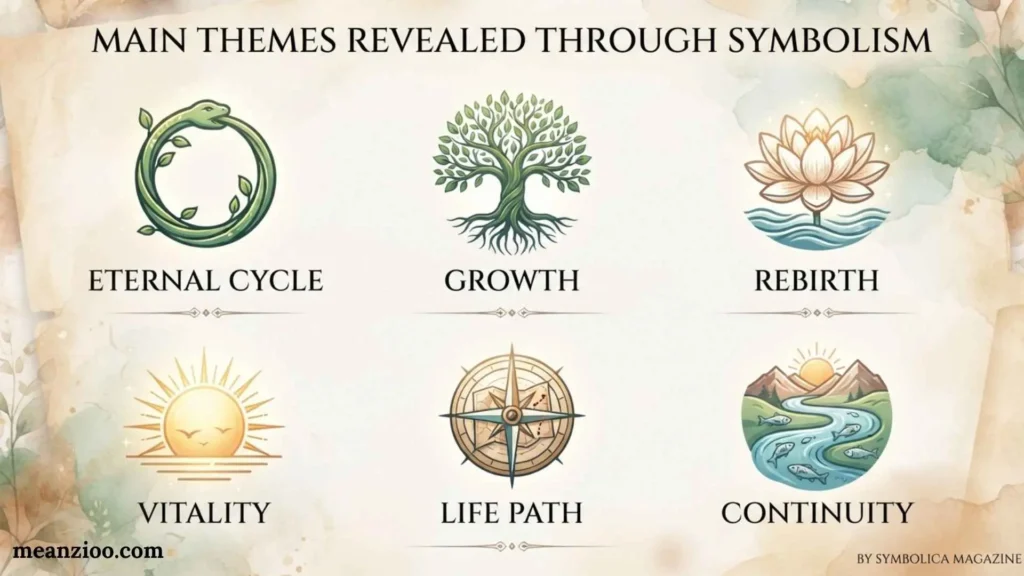
17. Main Themes Revealed Through Symbolism
Civilization Versus Savagery
The conch and signal fire represent the boys’ attempt to maintain order and responsibility. In contrast, face paint, the pig hunts, and the Lord of the Flies reflect their growing attraction to violence and domination.
Fear and Human Behavior
The beast and the dead parachutist show how fear can distort judgment. Rather than seeking clear explanations, the boys allow their anxiety to shape their decisions.
Power and Leadership
The conch supports Ralph’s democratic leadership, while Jack gains influence through hunting, intimidation, and promises of protection. The conflict reveals the difference between authority based on shared rules and control based on force.
The Loss of Innocence
The boys’ transformation from schoolchildren into violent hunters is reflected in the changing meanings of the island, face paint, and pig hunts. Their experiences force them to confront the darker side of human behavior.
The Fragility of Society
The destruction of the conch demonstrates how quickly social order can collapse when people stop respecting common rules. Golding suggests that civilization depends on the choices and values of the people who sustain it.
Quick Summary of Symbols in Lord of the Flies
| Symbol | Meaning |
| Conch shell | Democracy, civilization, and authority |
| Piggy’s glasses | Intelligence, reason, and technology |
| Signal fire | Hope, rescue, and responsibility |
| Beast | Fear and the potential for human evil |
| Lord of the Flies | Inner evil and savagery |
| Island | Isolation and a miniature society |
| Face paint | Anonymity and loss of shame |
| Scar | Destruction and human interference |
| Dead parachutist | War and misunderstanding |
| Ocean | Separation and isolation |
| Forest clearing | The unknown and inner conflict |
| Pig hunts | Violence, power, and loss of innocence |
| Beast’s sacrifices | Superstition and desperation |
| Naval officer | Rescue, adult authority, and irony |
How to Write a Strong Essay About Symbols in Lord of the Flies
A strong literature essay should explain not only what a symbol represents but also how Golding develops its meaning and connects it to the novel’s themes.
Follow these steps:
- Identify the symbol. Choose an important object, character, place, or event.
- Explain its meaning. Describe the idea it represents.
- Use a specific example. Refer to an event from the novel that illustrates the symbol.
- Analyze its development. Explain how its meaning changes as the boys’ behavior changes.
- Connect it to a major theme. Show how the symbol supports Golding’s ideas about civilization, fear, power, or human nature.
For example, an essay about the conch should not simply state that it represents democracy. It should explain how the conch initially allows the boys to speak in an organized way, how Jack challenges its authority, and how its destruction marks the collapse of their alternative society.
A possible thesis statement is:
In Lord of the Flies, William Golding uses the conch shell, Piggy’s glasses, and the beast to demonstrate how fear, the desire for power, and the rejection of reason can destroy the structures that support civilization.
When including quotations, verify the wording and chapter against your edition of the novel. Analyze the evidence in your own words so that your essay demonstrates a clear understanding of the text.
Frequently Asked Questions
What are the five most important symbols in Lord of the Flies?
The five most important symbols are the conch shell, Piggy’s glasses, the signal fire, the beast, and the Lord of the Flies. They represent civilization, intelligence, hope, fear, and human evil.
What is the most important symbol in Lord of the Flies?
The conch shell is often considered the most important symbol because it represents democracy, authority, and alternative order. Its destruction marks the collapse of the boys’ shared rules and the loss of their remaining democratic structure.
How does the conch change throughout the novel?
At first, the conch gives the boys an organized way to hold meetings and express their opinions. As Jack’s influence grows, fewer boys respect its authority. Its destruction coincides with Piggy’s death and symbolizes the collapse of civilization on the island.
What does the beast symbolize in the novel?
The beast symbolizes fear and the potential for evil within human nature. Although the boys initially imagine an external monster, Simon recognizes that their own capacity for violence may be the real danger.
What do Piggy’s glasses represent?
Piggy’s glasses represent intelligence, reason, and scientific knowledge. Their role in starting fires also makes them a source of power, particularly when Jack takes control of them.
Why is fire an important symbol in Lord of the Flies?
Fire represents hope and rescue when the boys maintain it as a signal. It also becomes a symbol of destruction when the hunters start a blaze to pursue Ralph. The final fire leads to the boys’ rescue, creating an important irony.
How does symbolism support the theme of civilization versus savagery?
The conch and signal fire represent the boys’ efforts to maintain order and work together. The beast, face paint, and pig hunts reflect the growing influence of fear and violence. Their changing meanings reveal the gradual collapse of the boys’ alternative society.
What is William Golding’s main message through symbolism?
Golding suggests that civilization is fragile and depends on people respecting rules, using reason, and accepting responsibility. The symbols reveal how fear and the desire for power can encourage people to abandon these values.
Final Thoughts
The symbols in Lord of the Flies reveal the deeper meaning behind William Golding’s story of boys stranded on an island. The conch represents democracy and order, Piggy’s glasses symbolize reason and knowledge, and the signal fire expresses hope for rescue. In contrast, the beast and the Lord of the Flies reveal how fear and the potential for evil can influence human behavior.
Other symbols, including face paint, the scar, the dead parachutist, and the naval officer, expand the novel’s exploration of violence, identity, and the relationship between children and the adult world.
Together, these symbols show that the boys’ downfall is not simply caused by isolation. It develops through their choices, their treatment of one another, and their growing willingness to abandon shared rules. Golding’s lasting message is that civilization requires more than laws or authority figures: it depends on people who are willing to respect others, think rationally, and take responsibility for their actions.

Hi, I’m Charlotte Hayes. I love writing about the newest English slang, pop culture phrases, and digital communication. I spend my time exploring how language evolves across social media, gaming, and everyday conversations. I enjoy sharing easy-to-understand guides that help learners keep up with modern English. My goal is to make every article useful, accurate, and enjoyable for readers around the world.
Books:
- Everyday Slang Dictionary
- Fluent Through Informal English
 Ryan Mitchell