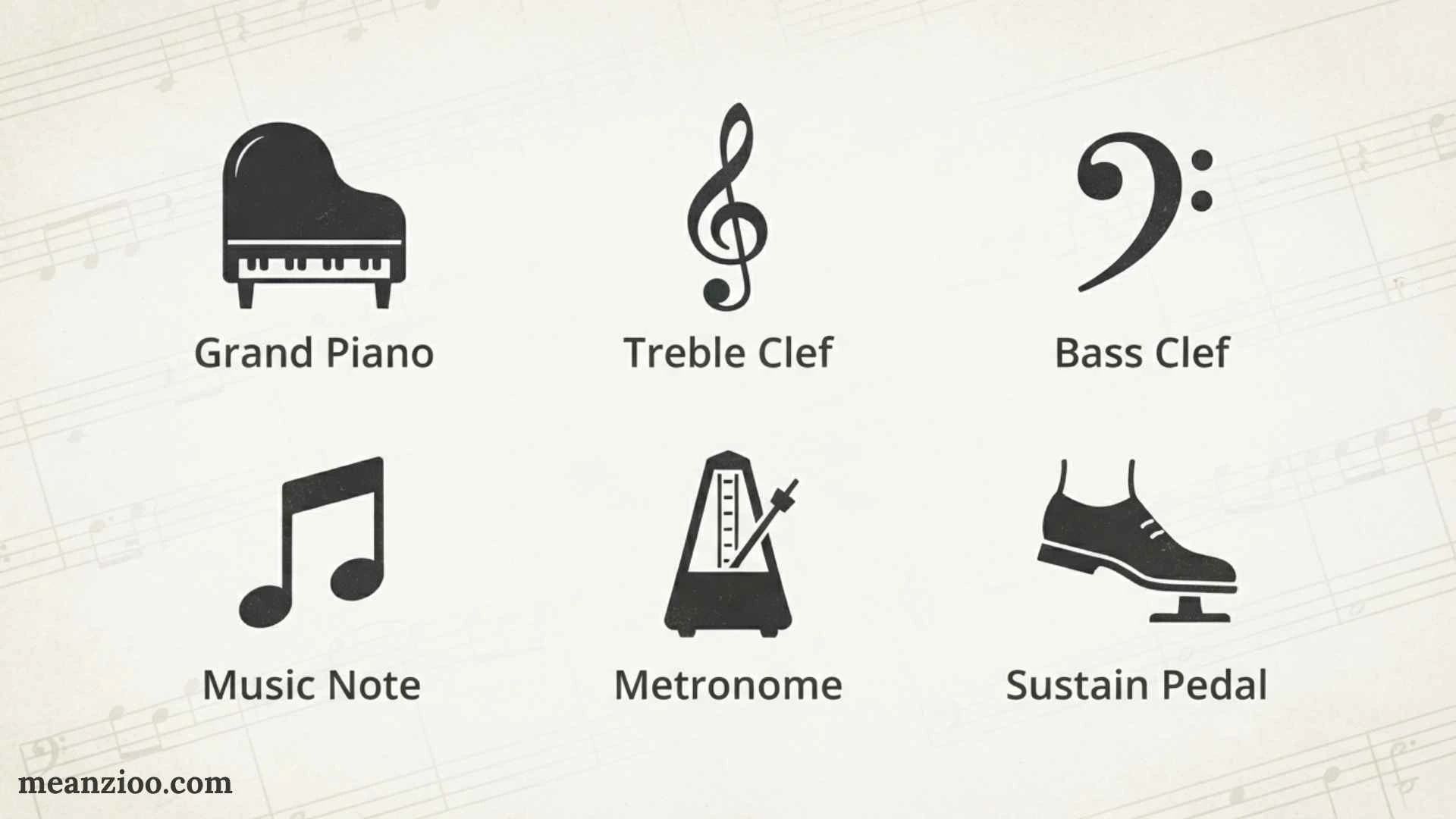
Learning to read piano music means understanding much more than the notes on the page. Piano symbols are the visual language that tells you what notes to play, how long to hold them, how loudly or softly to play, how to connect them, when to use the pedal, and how to repeat or navigate different sections of a piece.
For a beginner, symbols such as ♯, ♭, ♮, p, f, >, dots, curved lines, and pedal markings can seem difficult to remember. Fortunately, they become much easier once you understand what each one does.
This complete guide explains the most common piano symbols, their meanings, examples, differences between similar markings, rhythm notation, dynamics, articulation, pedal signs, ornaments, and common questions beginners have when reading sheet music.
What Are Piano Symbols?
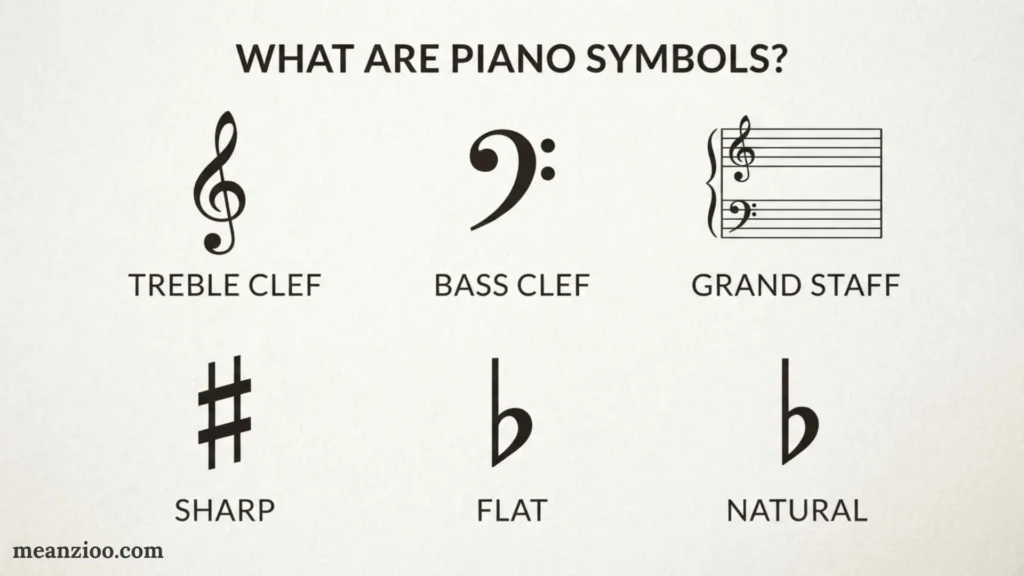
Piano symbols are signs, markings, letters, and abbreviations used in written music to communicate instructions to the pianist. They provide information about pitch, rhythm, dynamics, tempo, articulation, expression, technique, and musical structure.
For example, the note itself tells you which pitch to play, but a symbol such as p tells you to play softly. A dot can tell you to play a note staccato, while a curved line may indicate a slur or tie.
A piano score may contain several symbols at once. You might need to read the clef, key signature, time signature, notes, accidentals, dynamics, articulation, and pedal markings simultaneously.
Understanding these symbols allows you to interpret a piece rather than simply pressing the correct keys.
Piano Symbols Chart
Here is a useful reference chart for common piano notation.
| Symbol | Name | Meaning |
| 𝄞 | Treble clef | Identifies higher register notes |
| 𝄢 | Bass clef | Identifies lower register notes |
| ♯ | Sharp | Raises a note by one semitone |
| ♭ | Flat | Lowers a note by one semitone |
| ♮ | Natural | Cancels an applicable sharp or flat |
| 𝄪 | Double sharp | Raises a note by two semitones |
| 𝄫 | Double flat | Lowers a note by two semitones |
| . | Staccato | Short, detached articulation |
| — | Tenuto | Sustained or fully valued note |
| > | Accent | Emphasize the note |
| 𝄐 | Fermata | Hold longer than written |
| p | Piano | Soft |
| pp | Pianissimo | Very soft |
| mp | Mezzo piano | Moderately soft |
| mf | Mezzo forte | Moderately loud |
| f | Forte | Loud |
| ff | Fortissimo | Very loud |
| < | Crescendo hairpin | Gradually louder |
| > | Diminuendo hairpin | Gradually softer |
| tr | Trill | Rapid alternation between notes |
| 8va | Ottava | Play one octave higher |
| 8vb | Ottava bassa | Play one octave lower |
| Ped. | Sustain pedal | Use sustain pedal |
| D.C. | Da Capo | Return to the beginning |
| D.S. | Dal Segno | Return to the sign |
| Fine | Ending | End of the piece or section |
| Coda | Coda | Move to a separate ending section |
Some symbols can have different meanings depending on their position, musical context, or notation system. Always check the score’s instructions when available.
The Piano Grand Staff
Most piano music is written on a grand staff, which combines two five-line staves.
The upper staff normally uses the treble clef, while the lower staff normally uses the bass clef.
Treble staff
—————–
—————–
—————–
—————–
—————–
Bass staff
—————–
—————–
—————–
—————–
—————–
The two staves are connected by a brace.
The grand staff gives pianists enough range to represent both high and low notes without requiring excessive ledger lines.
Although the right hand often plays the treble staff and the left hand often plays the bass staff, this is not an absolute rule. Hand assignments can change according to the music.
Treble Clef: 𝄞
The treble clef is also called the G clef.
It identifies the position of G on the staff and is commonly used for higher-pitched notes.
The notes on the lines of the treble clef are:
E – G – B – D – F
The spaces spell:
F – A – C – E
Many beginners use memory phrases to learn these notes, but regular reading practice is more useful in the long term.
Bass Clef: 𝄢
The bass clef is also known as the F clef.
It is commonly used for lower-pitched notes.
The lines of the bass clef are:
G – B – D – F – A
The spaces are:
A – C – E – G
A pianist needs to become comfortable reading both clefs because piano music frequently moves between higher and lower registers.
Middle C
Middle C is an important reference point between the treble and bass staves.
On the grand staff, it is usually written on a short ledger line between the two staves.
Middle C helps beginners connect the written staff to the physical keyboard.
Once you know where middle C is, you can use it as a reference to identify neighboring notes.
Note Values
Piano symbols also communicate rhythm.
The most common note values include:
Whole Note
A whole note is an open notehead without a stem.
In 4/4 time, it normally receives four beats.
Half Note
A half note has an open notehead and a stem.
It normally receives two beats in 4/4 time.
Quarter Note
A quarter note has a filled notehead and a stem.
It normally receives one beat in 4/4 time.
Eighth Note
An eighth note has a filled notehead, stem, and flag. When several eighth notes appear together, they may be connected by a beam.
It normally receives half a beat in 4/4 time.
Sixteenth Note
A sixteenth note has two flags or two beams when grouped.
It normally receives one-quarter of a beat in 4/4 time.
The written value is always interpreted within the current time signature.
Dotted Notes
A dot placed immediately after a note increases its duration by half of the original value.
For example:
- Dotted half note = 3 beats in 4/4
- Dotted quarter note = 1½ beats
- Dotted eighth note = ¾ of a beat
The dot is therefore a rhythm symbol, not an articulation mark when it appears directly after the notehead as part of its rhythmic notation.
Rests
Rests tell you when to remain silent.
Common rests include:
- Whole rest
- Half rest
- Quarter rest
- Eighth rest
- Sixteenth rest
A rest has a specific rhythmic value.
For example, a quarter rest generally represents one beat of silence in 4/4 time.
Beginners sometimes ignore rests because no key is being pressed, but counting rests correctly is essential for maintaining the rhythm.
Sharps: ♯
A sharp raises a note by one semitone.
For example:
C → C♯
On a standard piano, C♯ is the black key immediately above C.
A sharp may be part of a key signature or appear as an accidental beside an individual note.
Flats: ♭
A flat lowers a note by one semitone.
For example:
B → B♭
B♭ is the black key immediately below B.
Sharps and flats can sometimes refer to the same physical piano key but have different musical spellings.
For example:
C♯ = D♭
These are called enharmonic equivalents.
Natural: ♮
A natural sign cancels an applicable sharp or flat.
For example, if a passage contains C♯ because of a key signature or accidental, a natural sign can indicate C natural where appropriate.
C♯ → C♮
The effect of an accidental follows the rules of the current measure and key signature.
Double Sharp and Double Flat
Advanced music may use double accidentals.
Double Sharp: 𝄪
Raises a note by two semitones.
Double Flat: 𝄫
Lowers a note by two semitones.
They may look unusual to beginners, but they are useful for maintaining correct musical spelling in certain keys and harmonic situations.
Key Signatures
A key signature appears after the clef and before the time signature.
It contains a fixed group of sharps or flats that apply throughout a section unless changed.
For example, a key signature with one sharp indicates that certain notes are normally sharp throughout the piece.
Key signatures help musicians understand the tonal center and make reading music more efficient.
Instead of writing the same accidental beside every affected note, the composer establishes it at the beginning.
Time Signatures
A time signature tells you how beats are organized into measures.
4/4
Four quarter-note beats per measure.
It is one of the most common time signatures.
3/4
Three quarter-note beats per measure.
It is frequently associated with waltz-style music.
2/4
Two quarter-note beats per measure.
It is common in marches and other strongly organized rhythmic patterns.
6/8
Six eighth-note units occur in each measure, often grouped into two larger beats.
The upper number tells you how many rhythmic units are contained in the measure, while the lower number identifies the type of note used as the basic unit.
Bar Lines and Measures
Vertical lines divide written music into measures.
For example:
| ♩ ♩ ♩ ♩ | ♩ ♩ ♩ ♩ |
Each measure contains the amount of rhythmic value specified by the time signature.
Bar lines help musicians keep their place and understand the structure of a composition.
Repeat Signs
Repeat signs instruct you to replay a section.
A repeat may look like:
:||
or:
||:
When paired together, they mark the beginning and end of a repeated passage.
Some pieces also use first and second endings.
The first time through, you play the first ending. When repeating, you skip the first ending and continue to the second.
Dynamics
Dynamics tell the pianist how loudly or softly to play.
pp — Pianissimo
Very soft.
p — Piano
Soft.
mp — Mezzo Piano
Moderately soft.
mf — Mezzo Forte
Moderately loud.
f — Forte
Loud or strong.
ff — Fortissimo
Very loud.
fff
Extremely loud.
Dynamics are relative rather than fixed. A p marking in one passage may not produce exactly the same physical volume as a p marking in another passage.
The goal is to create the intended musical contrast.
Crescendo: <
A crescendo means gradually become louder.
It can be written as a hairpin:
<——–
or with a word such as:
cresc.
For example:
p <———- f
Start softly and gradually increase the intensity.
Diminuendo: >
A diminuendo means gradually become softer.
It may appear as:
——–>
or as:
dim.
The terms diminuendo and decrescendo can both be used for a gradual reduction in volume.
Accent: >
An accent mark tells you to give a particular note extra emphasis.
The note should stand out from the surrounding notes.
An accent is different from a general dynamic marking because it usually applies to an individual note or specific musical event.
Staccato: .
A dot above or below a note generally indicates staccato.
Staccato means the note should sound short and detached.
It does not necessarily mean the note must be exactly half its written duration. The appropriate amount of separation depends on the musical style and context.
Tenuto: —
A horizontal line above or below a note indicates tenuto.
Tenuto generally means to sustain the note for its full written value, often with careful emphasis.
Tenuto and staccato create very different effects:
- Staccato: short and detached
- Tenuto: sustained and fully valued
Slur
A slur is a curved line connecting several notes.
It generally tells the pianist to play the notes smoothly as a phrase.
For example:
(—————-)
The exact musical interpretation can depend on the style and passage.
Tie
A tie also uses a curved line, but it connects two notes of the same pitch.
The rhythmic values are combined.
For example, a quarter note tied to another quarter note produces one sustained note lasting two beats.
Slur vs. Tie
This is an important distinction:
| Marking | Function |
| Slur | Connects different notes smoothly |
| Tie | Connects notes of the same pitch and combines their duration |
A tie means you do not replay the second note. You sustain the first note for the combined duration.
Fermata: 𝄐
A fermata tells the pianist to hold a note, chord, or rest longer than its written value.
There is no universal fixed duration for every fermata.
The performer considers the musical context, style, phrasing, and interpretation.
Tempo Markings
Tempo tells you how quickly the music should be performed.
Common Italian tempo terms include:
- Largo — broad and slow
- Adagio — slow
- Andante — walking or moderate
- Moderato — moderate
- Allegro — fast
- Vivace — lively
- Presto — very fast
A composer may also provide a metronome marking such as:
♩ = 80
This indicates approximately 80 quarter-note beats per minute.
Tempo Changes
Music often changes speed.
Accelerando
accel. means gradually become faster.
Ritardando
rit. means gradually slow down.
Rallentando
rall. also indicates a gradual slowing.
A Tempo
a tempo means return to the previous or established tempo.
These markings are important because tempo changes can significantly affect the character of a piece.
Pedal Symbols
Pedaling adds resonance and helps connect notes.
Sustain Pedal
The right pedal is the most commonly used pedal and is often marked:
Ped.
A release symbol or bracket may indicate when to lift the pedal.
The sustain pedal allows notes to continue sounding after the fingers leave the keys.
Una Corda
The left pedal is often called the soft pedal or una corda.
It changes the tone and can reduce the perceived intensity of the sound.
Sostenuto
The middle pedal on many grand pianos is the sostenuto pedal. It can sustain selected notes while allowing other notes to remain unaffected.
Not every piano has a traditional sostenuto pedal, particularly among some digital and upright models.
Pedal notation can vary between composers and editions, so follow the specific markings in the score.
Octave Symbols
Octave markings reduce the need for numerous ledger lines.
8va
Means play the passage one octave higher than written.
8vb
Means play one octave lower.
You may also encounter related octave indications in more advanced scores.
These markings are especially useful when music moves into a very high or low register.
Chord Symbols
Piano music, especially lead sheets and popular music, may use chord symbols.
Examples include:
- C — C major
- Cm — C minor
- C7 — C dominant seventh
- Cmaj7 — C major seventh
- Dm7 — D minor seventh
- G7 — G dominant seventh
Chord symbols give the pianist harmonic information and can be used to create accompaniment patterns.
Arpeggio Symbol
An arpeggio marking is often shown as a vertical wavy line beside a chord.
It means the notes of the chord should be played one after another rather than simultaneously.
For example, instead of pressing C, E, and G at exactly the same time, the pianist may roll through the notes quickly.
Arpeggios are common in classical, pop, jazz, and contemporary piano music.
Trill: tr
A trill is a rapid alternation between a principal note and a neighboring note.
It may be shown with:
tr
The exact execution can depend on the period and style of the music.
Baroque, Classical, Romantic, and modern music can have different conventions for ornament performance.
Mordent
A mordent is an ornament that creates a quick movement between the written note and a neighboring note.
There are different types, including:
- Upper mordent
- Lower or inverted mordent
The specific symbol and performance depend on the musical notation and historical style.
Turn
A turn is another ornament that surrounds a principal note with neighboring notes.
It is often represented by a curved symbol resembling a sideways or reversed S.
The precise notes and rhythm used to perform a turn can depend on context.
Grace Notes
Grace notes are small notes written before a main note.
They usually function as quick ornaments rather than receiving the same rhythmic emphasis as full-sized notes.
Grace-note performance varies by style, period, and composer, so the notation alone may not always tell you the complete interpretation.
Tremolo
A tremolo indicates rapid repetition or alternation.
In piano music, it may be used between two notes or chords or for rapid repetition of a single pitch.
Tremolo notation can vary depending on whether the composer wants repeated notes, alternating notes, or another effect.
Da Capo: D.C.
D.C. means Da Capo, or “from the beginning.”
When you see:
D.C.
you return to the beginning of the indicated section or piece.
You may also see:
D.C. al Fine
which means return to the beginning and continue until Fine.
Dal Segno: D.S.
D.S. means Dal Segno, or “from the sign.”
It instructs you to return to a special sign in the music.
For example:
D.S. al Fine
means return to the sign and continue until the word Fine.
Coda
A coda is a separate concluding section.
You may see:
D.S. al Coda
This tells you to return to the indicated sign and then follow the instructions that lead to the coda.
The coda provides a way to create a structured ending without writing the same material repeatedly.
Fine
Fine means the end.
It is commonly used with navigation instructions such as:
D.C. al Fine
The performer returns to the beginning and stops at the point marked Fine.
How Different Piano Symbols Work Together
A piano score rarely asks you to interpret one symbol in isolation.
Imagine a passage containing:
- Treble clef
- Bass clef
- 4/4 time
- A key signature
- Eighth notes
- A crescendo
- A slur
- Staccato notes
- A pedal marking
Each marking answers a different question.
Clefs: Which pitches are represented?
Key signature: Which notes are normally sharp or flat?
Time signature: How are the beats organized?
Note values: How long should each note last?
Dynamics: How loud or soft should the passage be?
Articulation: Should the notes be short, connected, emphasized, or sustained?
Pedal: Should resonance be added?
Reading piano music becomes much easier when you learn to process these layers separately and then combine them.
A Simple Step-by-Step Piano Reading Example
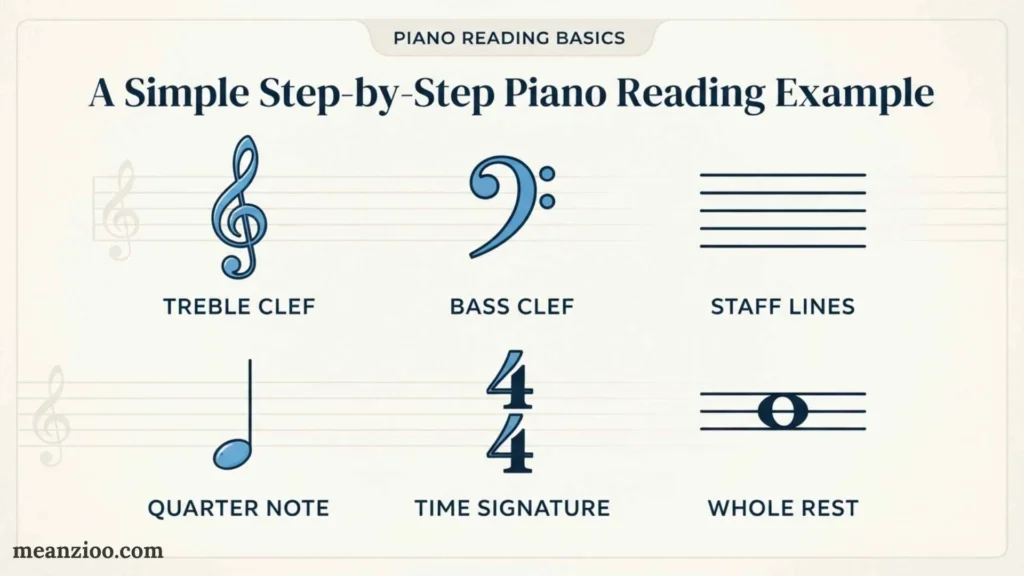
Suppose you encounter a passage with a treble clef, a 4/4 time signature, a key signature containing one sharp, p, a slur, and a crescendo.
Read it in this order:
- Identify the clef to determine the pitch positions.
- Check the key signature before playing the notes.
- Check the time signature to understand the beat structure.
- Count the note values in each measure.
- Follow the p marking and begin softly.
- Follow the slur by connecting the notes smoothly.
- Follow the crescendo by gradually increasing the volume.
- Maintain the rhythm while changing the dynamics.
This approach prevents you from becoming overwhelmed by multiple markings at once.
Common Mistakes When Reading Piano Symbols
Ignoring the Key Signature
Beginners sometimes read individual notes without considering the sharps or flats established by the key signature.
Confusing a Slur With a Tie
A slur generally connects different notes for smooth phrasing, while a tie connects notes of the same pitch.
Ignoring Rests
A rest is part of the rhythm. It should be counted just like a note.
Treating Dynamics as Fixed Volumes
A p marking does not represent one exact volume level. It describes a relative dynamic.
Playing Staccato Too Aggressively
Staccato means detached, not necessarily harsh or extremely short.
Forgetting Pedal Changes
Holding the sustain pedal too long can cause notes and harmonies to blur together.
Learning Symbols Without Practicing Them
Memorizing definitions is useful, but seeing the symbol in actual music and applying it on the keyboard is much more effective.
Beginner Piano Symbols Cheat Sheet
If you are just starting, concentrate on these symbols first:
- 𝄞 — Treble clef
- 𝄢 — Bass clef
- ♯ — Sharp
- ♭ — Flat
- ♮ — Natural
- 4/4 — Time signature
- p — Soft
- f — Loud
- mp — Moderately soft
- mf — Moderately loud
- . — Staccato
- — — Tenuto
- > — Accent
- 𝄐 — Fermata
- < — Crescendo
- > — Diminuendo
- Ped. — Sustain pedal
- 8va — One octave higher
- D.C. — Return to the beginning
- D.S. — Return to the sign
- Fine — End
Once these are familiar, move on to ornaments, advanced pedal techniques, tremolos, and more specialized notation.
Are Piano Symbols the Same in Every Score?
Most basic symbols are standardized, but not every musical marking is interpreted identically across all scores.
This is particularly true for:
- Ornaments
- Pedaling
- Tremolo
- Historical notation
- Performance practices
- Some contemporary techniques
A Baroque piece may use an ornament differently from a modern composition. Likewise, different editions may provide different editorial markings.
When possible, use the score’s performance notes, publisher information, or composer-specific guidance.
Frequently Asked Questions About Piano Symbols
What are the most common piano symbols?
The most common include treble and bass clefs, sharps, flats, naturals, note values, rests, time signatures, key signatures, dynamics, staccato, legato, slurs, ties, pedal markings, and repeat signs.
What does p mean in piano music?
p means piano, which tells the performer to play softly.
What does f mean in piano music?
f means forte, which indicates a loud or strong dynamic.
What does mf mean?
mf means mezzo forte, or moderately loud.
What does mp mean?
mp means mezzo piano, or moderately soft.
What does a sharp symbol mean on piano?
A sharp ♯ raises a note by one semitone.
What does a flat symbol mean?
A flat ♭ lowers a note by one semitone.
What does a natural symbol mean?
A natural ♮ cancels an applicable sharp or flat and returns the note to its natural pitch.
What does a dot above a piano note mean?
A dot placed above or below a note generally indicates staccato, meaning the note should be played in a short, detached manner.
What is the difference between a slur and a tie?
A slur connects notes to indicate smooth phrasing, while a tie connects two notes of the same pitch and combines their durations.
What does a fermata mean?
A fermata tells the pianist to hold a note, chord, or rest longer than its written value.
What does 8va mean?
8va means to play the indicated passage one octave higher than written.
What does Ped. mean?
Ped. usually indicates use of the sustain pedal.
What does D.C. mean?
D.C. means Da Capo, instructing the pianist to return to the beginning.
What does D.S. mean?
D.S. means Dal Segno, instructing the pianist to return to the designated sign.
What does Fine mean?
Fine means the end of the piece or the designated ending point.
What does an arpeggio symbol mean?
An arpeggio marking tells you to play the notes of a chord in quick succession rather than simultaneously.
What does tr mean in piano music?
tr indicates a trill, a rapid alternation between a written note and a neighboring note.
Final Thoughts
Understanding piano symbols turns sheet music from a page of unfamiliar marks into a clear set of musical instructions. The notes tell you what pitches to play, while the symbols explain rhythm, dynamics, articulation, tempo, expression, pedal use, and musical structure.
Start with the treble and bass clefs, note values, rests, accidentals, key signatures, and time signatures. Then add dynamics, articulation, pedal markings, octave signs, repeats, and ornaments to your knowledge.
The goal is not to memorize every symbol in one sitting. Learn a few at a time, practice them in real pieces, and listen carefully to how each marking changes the sound. With regular practice, you will become much more comfortable reading piano sheet music and understanding not only what the composer wrote, but how the music is meant to be played.

I’m Ryan Mitchell, and I write about modern English, trending slang, and online expressions. I enjoy explaining the meanings, origins, and real-life usage of popular words in a simple way. I believe learning slang is an important step toward understanding today’s English-speaking culture. Through my work, I aim to help readers speak more naturally and stay updated with the latest language trends.
 Charlotte Hayes