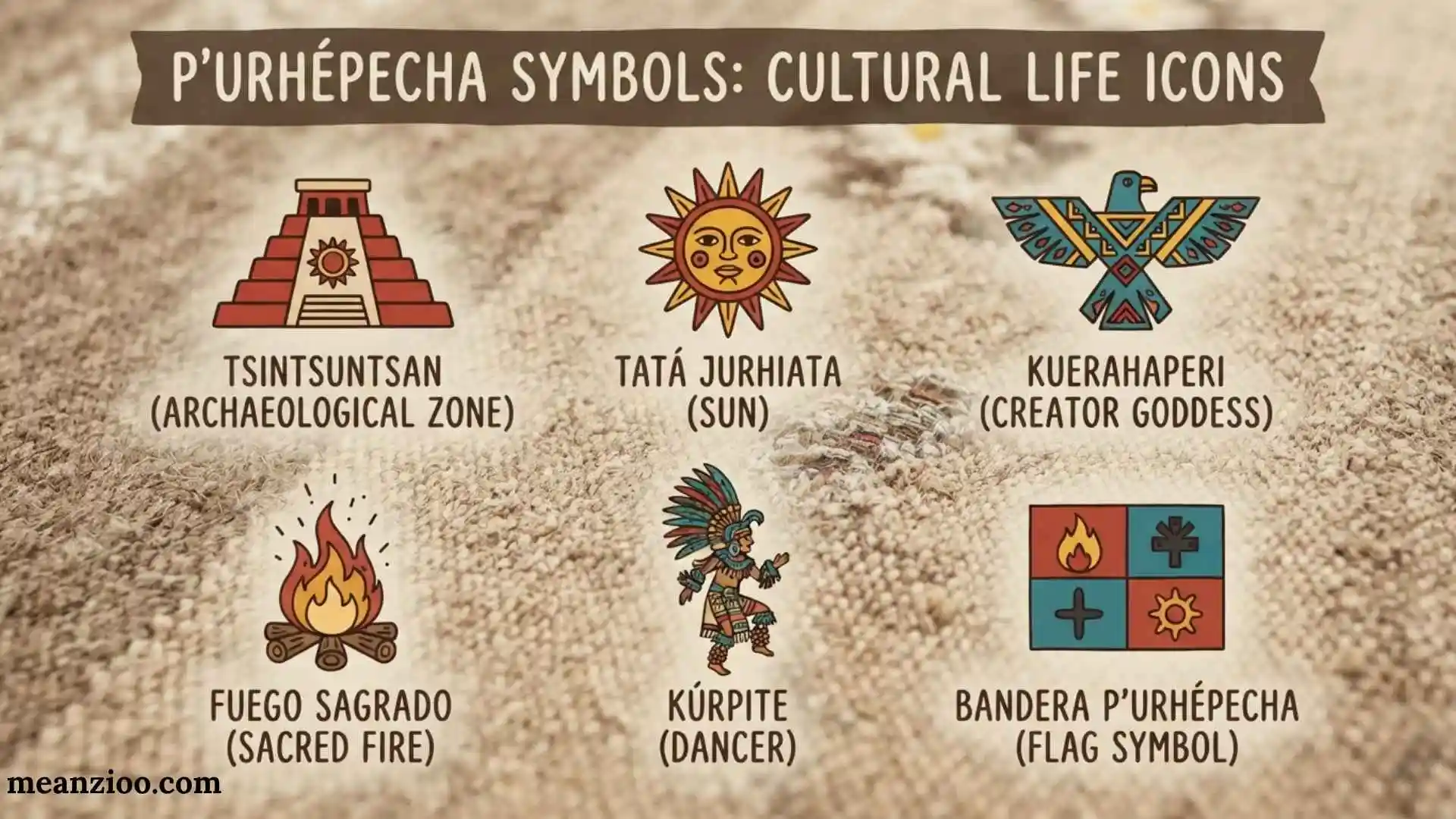
Purepecha symbols provide a fascinating way to understand the history, art, spirituality, identity, and traditions of the Purépecha people of Michoacán, Mexico. These symbols and motifs can appear in textiles, pottery, architecture, jewelry, ceremonial objects, community art, and modern cultural designs.
However, there is an important detail to understand before looking at individual symbols: there is no single universal dictionary of Purepecha symbols in which every shape has one fixed meaning. Some meanings are documented through historical sources or museum collections, while others are interpretations of traditional artwork or modern designs.
Historical Purépecha visual traditions include geometric forms, celestial imagery, animals, plants, fire, landscapes, and objects connected with community life. Colonial-era pictorial documents from Michoacán also recorded histories, migrations, rituals, territorial boundaries, lineages, and other forms of Indigenous knowledge.
This guide explains the most important Purepecha symbols and meanings, separates documented traditions from modern interpretations, and explores how these designs continue to be used today.
What Are Purepecha Symbols?
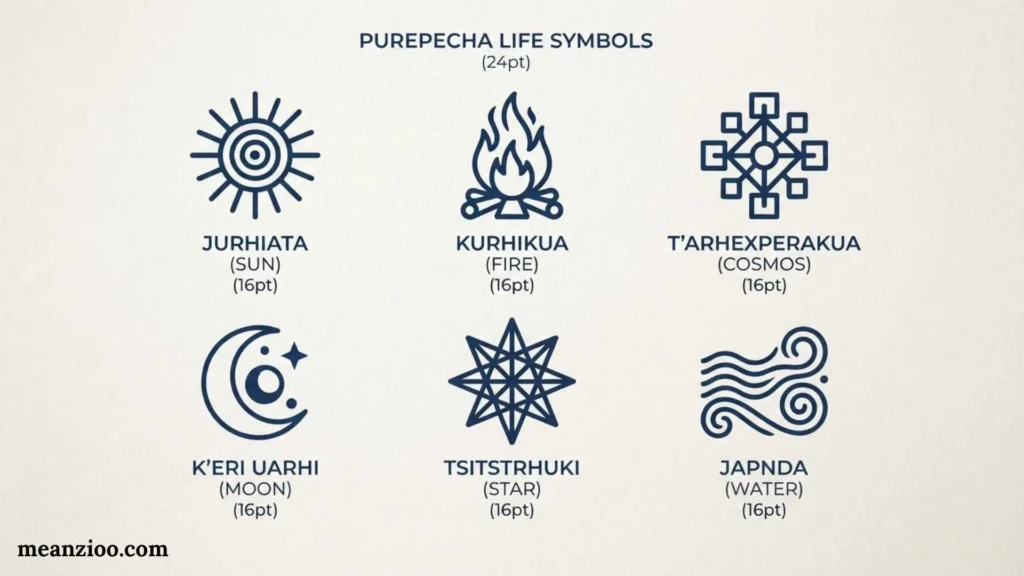
Purepecha symbols are visual motifs, images, patterns, objects, and signs associated with Purépecha history and cultural expression.
They may be found in:
- Traditional textiles
- Embroidery
- Pottery
- Wood carving
- Architecture
- Jewelry
- Ceremonial objects
- Community flags
- Contemporary artwork
- Historical pictorial documents
The word Purépecha refers to the Indigenous people and their language associated especially with Michoacán. The older term Tarascan is also widely used in historical and archaeological literature.
A key distinction is that a decorative motif is not automatically a symbolic sign. A geometric pattern may have aesthetic, cultural, or cosmological associations, but its exact meaning should be established from the particular community, object, and historical context.
A Short History of Purepecha Symbolism
The Purépecha developed a powerful society in western Mexico before Spanish colonization. Their historical heartland included the Lake Pátzcuaro region, and important centers included Pátzcuaro, Ihuatzio, and Tzintzuntzan.
Archaeological collections demonstrate sophisticated Purépecha traditions in ceramics and metalworking. For example, the Museo Amparo identifies a Tarascan/Purépecha copper axe from the Late Postclassic period, dated approximately 1200–1521 CE.
Visual traditions also continued after the arrival of the Spanish. INAH explains that although no pre-Hispanic codices or painted cloths have been found in Michoacán, colonial-period documents survived and contain Indigenous pictographic traditions alongside European influence and Latin-script annotations. These documents could record founding stories, migrations, rituals, political structures, lineages, territorial jurisdictions, maps, and tribute systems.
This history is important because modern Purepecha symbols can come from several different periods rather than one single ancient symbol system.
Important Purepecha Symbols and Motifs
The Sun
The sun is one of the most important celestial images associated with Purépecha cultural symbolism.
A particularly documented modern example is the Purépecha flag, developed and consolidated during the 1980s. INAH describes its central image as the Padre Sol, represented as a large fire sending rays toward the earth and the four cardinal directions.
The sun therefore appears not simply as a decorative circle but as part of a broader cultural representation involving territory, fire, direction, ancestry, and community identity.
It is important, however, to distinguish this modern community symbol from claims that a particular sun drawing was the one universal ancient “Purépecha sun symbol.”
Fire
Fire has a significant place in Purépecha historical and contemporary symbolism.
In the Purépecha flag, the central sun is represented as fire. The same design also includes an obsidian element described by INAH as symbolizing fire turned to stone.
Fire also appears in historical discussions of Purépecha religion. Curicaueri, one of the principal deities in historical accounts, has strong associations with fire and celestial traditions.
Because fire can have different meanings in different contexts, it is better to connect its interpretation to the specific artifact or tradition instead of assigning one universal definition.
Obsidian
Obsidian is another important material in Purépecha symbolism.
The Purépecha flag includes an obsidian block and an obsidian knife. According to INAH, these elements connect the community with fire and the lineage of Curicaveri/Curicaueri.
Obsidian was also an important material in pre-Hispanic Mesoamerica because of its sharp edges and usefulness for tools and cutting implements.
Therefore, when you see obsidian represented in a Purépecha cultural context, its significance may involve technology, ancestry, fire, or historical identity depending on the particular design.
The Moon
The moon has a documented symbolic role in some contemporary Purépecha architectural traditions.
INAH describes carved images of the sun and moon on traditional trojes, or wooden structures, as representing a founding couple. In this interpretation, the sun is associated with masculinity, day, and protection, while the moon has feminine associations with night and fertility.
This is an excellent example of why context matters. The meaning comes from a documented cultural tradition rather than simply from the appearance of a crescent shape.
Deer
The deer is an important animal in Purépecha cultural imagery.
The modern Purépecha flag includes deer imagery in its representation of the Sierra region. INAH specifically notes deer among the elements used to represent that region.
Deer also appear in contemporary cultural artwork and community traditions. However, it would be inaccurate to claim that every deer image automatically means one specific concept such as “strength” or “freedom.”
The meaning depends on the artwork and community context.
Geometric Patterns
Geometric patterns are common in Purépecha textiles and ceramics.
These can include:
- Diamonds
- Lines
- Repeating bands
- Zigzags
- Squares
- Circular forms
- Repeated geometric borders
A particularly useful museum example is a Purépecha quechquémitl from Angahuan, Michoacán. The Museo Nacional de Antropología describes its geometric iconography as being associated with the structure of the universe within a Mesoamerican worldview.
This does not mean every diamond or geometric shape found in a modern textile has exactly the same cosmological meaning. The specific textile and community tradition must be considered.
Plant and Floral Motifs
Plant-like and floral designs are also visible in Purépecha textile traditions.
The National Museum of Anthropology documents a Purépecha silk shawl from Aranza, Michoacán, featuring phytomorphic patterns combined with small diamonds and multiple decorative bands.
Such designs demonstrate how natural forms can become part of highly structured textile compositions.
It is safer to describe these as plant or floral motifs unless a reliable source identifies a particular plant and its specific symbolic meaning.
The Purépecha Flag and Its Symbols
One of the clearest examples of a modern Purépecha symbolic system is the Purépecha flag.
It was formed and consolidated during the 1980s as a symbol of unity around cultural, territorial, and community concerns. INAH describes four colored sections representing the four regions of the Purépecha territory.
The four regions are represented as:
- Purple: Ciénega
- Blue: Lake
- Yellow: Cañada
- Green: Sierra
The colors come together around a central group of symbols.
The center includes the Padre Sol, fire, rays extending toward the four directions, bundles of arrows, a fist pointing east, obsidian, and a knife. INAH also notes the Purépecha phrase Juchari Uinápikua, translated as “our strength.”
This makes the flag especially useful for understanding modern Purépecha identity because it combines geography, history, community, territory, and cultural heritage.
Purepecha Warrior Symbols
People often search for Purepecha warrior symbols, but this phrase can be misleading if it implies that there was one universal warrior emblem.
The historical Purépecha state had military organization and political expansion. Historical sources describe rulers and leaders such as Hiripan, Tangaxoan, and Hiquingaje, while Curicaueri was an important deity associated with the ruling tradition.
Weapons and military objects were part of this world. Obsidian knives, for example, appear in modern representations of Purépecha identity, including the Purépecha flag.
However, modern graphics marketed online as “Purépecha warrior symbols” should be checked carefully before being described as ancient symbols.
Purepecha Symbols in Textiles
Textiles are among the most important places to study Purépecha visual traditions.
Traditional clothing can contain:
- Geometric designs
- Floral patterns
- Animal imagery
- Decorative borders
- Repeated bands
- Regional motifs
- Symbolic colors
The National Museum of Anthropology documents Purépecha garments made using techniques such as the backstrap loom and supplementary-weft decoration. One quechquémitl from Angahuan contains geometric iconography associated with the structure of the universe in Mesoamerican worldview.
Another museum-recorded Purépecha shawl from Aranza contains phytomorphic designs and small diamond shapes.
This demonstrates that Purepecha textile symbols should be studied as part of complete artistic traditions rather than as isolated icons.
Purepecha Symbols in Pottery
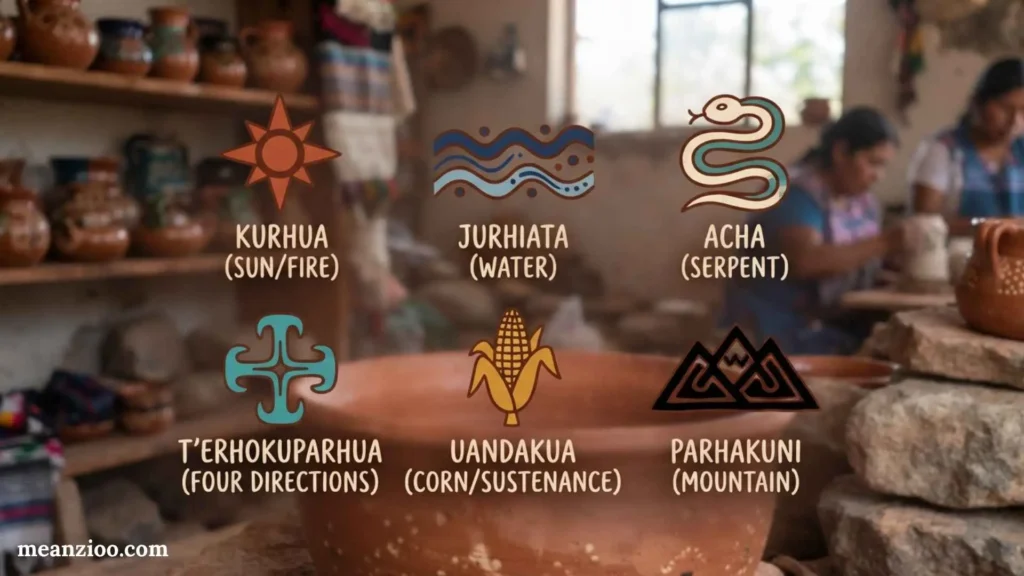
Purépecha pottery also contains important visual traditions.
A Late Postclassic Tarascan tripod vessel in the Museo Amparo collection features geometric decoration. The museum dates the object to approximately 1200–1521 CE and notes that the Tarascan cultural area included a diverse population, with the Purépecha at its head.
Geometric decoration on pottery may communicate artistic style, cultural identity, or other meanings, but not every pattern has a separately documented symbolic translation.
Purepecha Symbols in Architecture
Traditional Purépecha architecture provides another important source of symbolism.
The troje is a traditional wooden structure associated with Purépecha communities. Decorative carvings can include celestial imagery.
INAH documents sun and moon carvings on trojes and explains their association with a founding couple, masculine/feminine principles, day/night, protection, and fertility.
This shows that architecture itself can function as a carrier of cultural symbolism.
Purepecha Symbols in Jewelry and Metalwork
Metalworking was particularly important in the historical Purépecha region.
The Museo Amparo notes that the Tarascans, also known as Purépechas, were the principal Mesoamerican people known for large-scale metalworking traditions, especially copper and copper alloys. Copper could be used for ornaments, while bronze was useful for tools.
Therefore, metal objects can be studied not only as decorative pieces but also as evidence of technology, trade, status, and cultural development.
Purepecha Mythology and Important Deities
When researching ancient Purepecha symbols and meanings, mythology is an important part of the picture.
Curicaueri
Curicaueri is one of the best-known deities in historical accounts of the Purépecha.
INAH sources describe Curicaueri as a principal deity associated with the historical Tarascan/Purépecha ruling tradition. Historical scholarship also discusses connections between Curicaueri and celestial and fire-related concepts.
Xaratanga
Xaratanga is another important figure in historical Purépecha traditions. INAH’s account of Tzintzuntzan states that Tangaxoan I rebuilt the settlement according to the orders of the goddess Xaratanga.
These figures help explain why fire, celestial imagery, political identity, and ritual traditions can appear together in discussions of historical Purépecha symbolism.
Purepecha Tribal Symbols
The phrase Purepecha tribal symbols is commonly used online, but it can oversimplify a complex living Indigenous culture.
Purépecha identity includes multiple communities and regions, and traditional designs can vary from place to place.
The modern Purépecha flag itself recognizes four major regional areas:
- Ciénega
- Lake
- Cañada
- Sierra
INAH’s documentation shows that each region receives its own visual representation, including local landscape and cultural elements.
Therefore, a regional Purépecha motif may be more accurate than treating every design as one universal “tribal symbol.”
Purepecha Ancient Symbols vs. Modern Symbols
This distinction is essential for anyone researching Purepecha ancient symbols.
Ancient or Pre-Hispanic Context
Archaeological objects, ceramics, metalwork, architecture, and other surviving material evidence provide information about pre-Hispanic Purépecha society.
Colonial Context
Colonial documents from Michoacán preserved Indigenous pictographic and historical traditions, but they also contain European influence. INAH specifically notes that surviving documents contain Western artistic techniques, European iconography, and Latin-script glosses.
Modern Context
The Purépecha flag is a modern cultural symbol developed during the 1980s. Its imagery connects contemporary community identity with historical traditions.
Therefore, calling a modern design an “ancient Purepecha symbol” without evidence can create historical misinformation.
Purepecha Alphabet Symbols: An Important Difference
Another search term is Purepecha alphabet symbols.
This should not be confused with ancient pictographic symbols.
Purépecha is a living language, and modern writing uses an alphabetic writing system rather than a single ancient symbol alphabet comparable to Egyptian hieroglyphs.
Mexico’s National Institute of Indigenous Languages, INALI, has worked with researchers and Purépecha institutions on issues involving writing standardization, including the alphabet, spelling, phonology, syllable division, punctuation, and other aspects of written Purépecha.
So if you are searching for Purépecha letters, words, or writing, you are dealing with language and orthography, not necessarily ancient symbolic artwork.
Purepecha Symbols for Tattoos
Purepecha tattoo symbols are another popular search.
If you want a tattoo inspired by Purépecha culture, the safest approach is to research the exact design rather than choosing an image from an anonymous “Indigenous symbols” collection.
Before using a design, ask:
- Where did the symbol originate?
- Is the original object documented?
- Is it ancient, colonial, or modern?
- Which Purépecha community uses it?
- Does the claimed meaning come from a reliable source?
- Is the design actually Purépecha rather than another Mesoamerican tradition?
A culturally meaningful tattoo is more respectful when its history is understood rather than based on an invented internet definition.
How to Verify a Purepecha Symbol
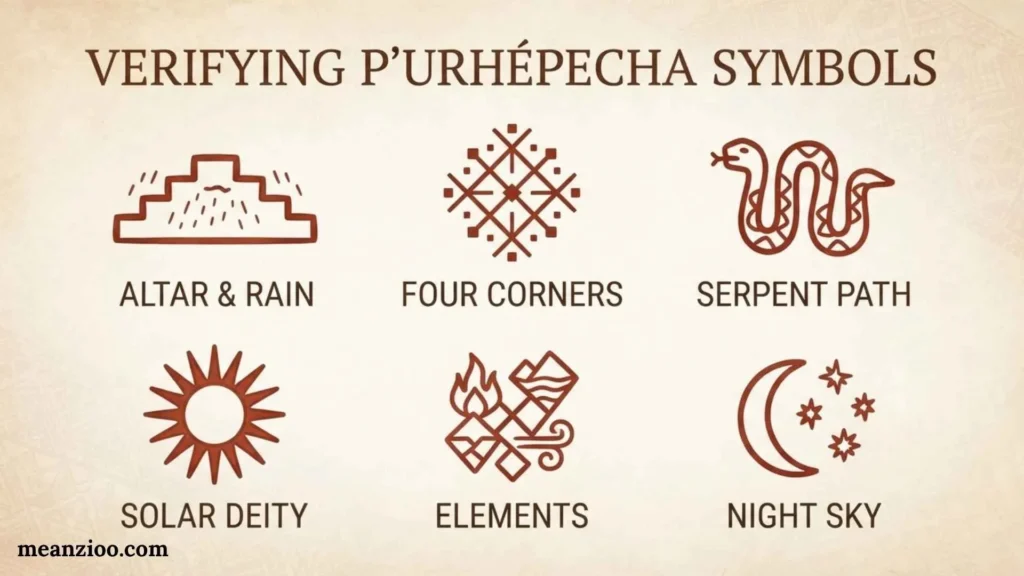
If you find a symbol online and want to determine whether it is authentic, use these steps.
1. Find the Original Source
Look for a museum, university, archive, archaeological collection, or Indigenous cultural organization.
2. Identify the Object
A symbol on a garment has a different context from a symbol on pottery, architecture, a flag, or a ceremonial object.
3. Check the Date
Determine whether the design is:
- Pre-Hispanic
- Colonial
- 19th century
- 20th century
- Contemporary
4. Identify the Community
A design from one Purépecha community should not automatically be presented as a universal symbol of all Purépecha people.
5. Separate Documentation From Interpretation
A museum may document what a design represents, while a website may simply claim a meaning without evidence.
6. Compare Multiple Sources
Reliable sources should generally agree on the basic historical context. If a meaning appears only on social-media posts or unsourced symbol websites, treat it cautiously.
Are Purepecha Symbols the Same as Aztec Symbols?
No. Purépecha and Mexica/Aztec cultures were distinct Indigenous traditions.
The Purépecha developed primarily in western Mexico, particularly Michoacán, while the Mexica political center was in central Mexico.
Their languages, political histories, artistic traditions, and religious systems were different.
Some visual themes may look similar because both belonged to the broader cultural world of ancient Mesoamerica, but visual similarity does not prove that two symbols had the same meaning.
This is one of the most important points for anyone researching Mexican Indigenous symbols.
Why Purepecha Symbols Still Matter Today
Purépecha symbolism is not simply an archaeological subject.
The Purépecha are a living Indigenous people with continuing traditions in language, crafts, community organization, ceremonies, clothing, art, and cultural identity.
The modern Purépecha flag is one example of this continuity. INAH describes the flag as a symbol of unity and recognition that is used in cultural, educational, and community settings.
The Purépecha language is also actively studied and supported. INALI has documented ongoing work involving writing standards and language revitalization.
This makes modern Purépecha symbolism different from simply copying an ancient archaeological design.
Frequently Asked Questions About Purepecha Symbols
What are Purepecha symbols?
Purepecha symbols are visual motifs, objects, images, and designs associated with Purépecha history and cultural traditions. They appear in textiles, pottery, architecture, community art, historical documents, and modern cultural symbols.
What is the most important Purepecha symbol?
There is no universally accepted single “most important” Purepecha symbol. The modern Purépecha flag is one of the clearest examples of a contemporary community symbol because it combines regional colors, the sun, fire, obsidian, arrows, and other elements.
What does the Purepecha sun symbol mean?
The meaning depends on the specific design and historical context. In the modern Purépecha flag, the Padre Sol is represented as a central fire sending rays toward the four cardinal directions.
What does the Purepecha moon symbol mean?
INAH documents sun and moon imagery on traditional Purépecha trojes. In that context, the sun and moon represent a founding couple, with the sun associated with masculine/day/protection and the moon with feminine/night/fertility.
What are common Purepecha textile symbols?
Purépecha textiles can contain geometric, floral, animal, and regional motifs. Museum collections document geometric designs associated with cosmological ideas as well as phytomorphic and diamond patterns.
Are Purepecha symbols ancient?
Some are connected with pre-Hispanic traditions, while others are colonial or modern. The modern Purépecha flag, for example, was developed during the 1980s.
Is there a Purepecha alphabet?
Purépecha is a living language with modern writing conventions. Its writing system should not be confused with an ancient pictographic symbol system. INALI has worked on standardization issues involving the Purépecha writing system.
Are Purepecha symbols the same as Aztec symbols?
No. Purépecha and Mexica/Aztec traditions were distinct cultures with different languages, histories, and cultural systems.
Can Purepecha symbols be used as tattoos?
They can inspire culturally informed artwork, but the exact origin and meaning of a design should be verified first. Modern internet graphics should not automatically be presented as authentic ancient Purépecha symbols.
Final Thoughts
Purepecha symbols reflect a long and continuing cultural history rather than one simple collection of icons. Sun, fire, moon, geometric patterns, animals, plants, obsidian, regional imagery, and traditional crafts can all provide important clues about Purépecha identity and artistic traditions.
The most reliable way to understand a symbol is to study its original object, community, historical period, and documented context. Museum collections and Indigenous cultural sources are particularly valuable because they help distinguish historically supported meanings from modern internet interpretations.
Most importantly, Purépecha symbolism should be understood as part of a living Indigenous culture, not only as something belonging to the ancient past.

I’m Ryan Mitchell, and I write about modern English, trending slang, and online expressions. I enjoy explaining the meanings, origins, and real-life usage of popular words in a simple way. I believe learning slang is an important step toward understanding today’s English-speaking culture. Through my work, I aim to help readers speak more naturally and stay updated with the latest language trends.
 Charlotte Hayes