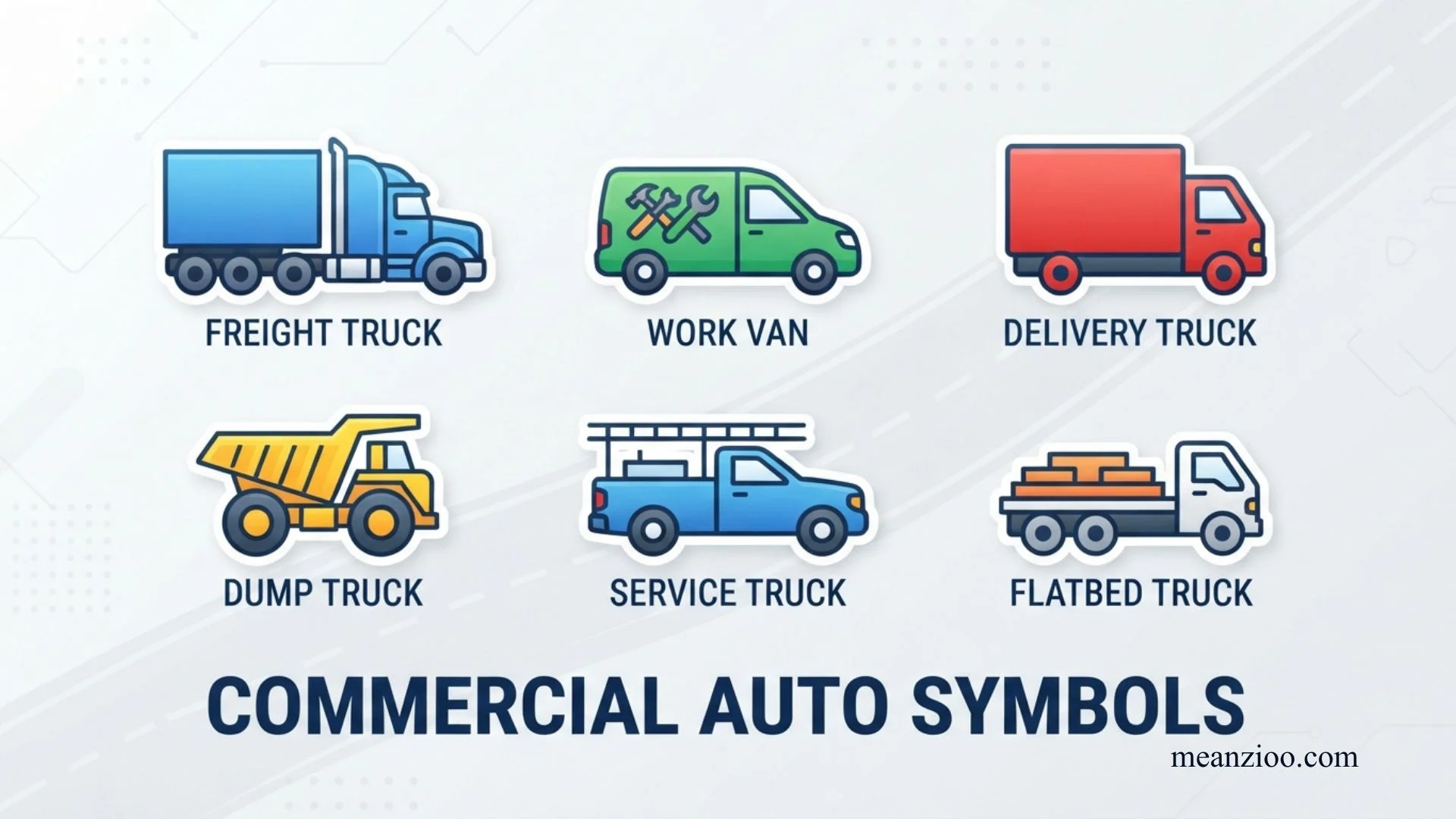
If you own a business vehicle or use cars, trucks, vans, rentals, or employee-owned vehicles for business purposes, you may have seen numbers such as 1, 2, 7, 8, or 9 on your commercial auto insurance declarations page. These numbers are called commercial auto symbols or covered auto designation symbols.
Commercial auto symbols tell you which category of vehicles a particular coverage applies to. A business auto policy can use different symbols for liability, physical damage, medical payments, uninsured motorist coverage, and other coverages. Therefore, the symbol shown next to one coverage does not necessarily describe every vehicle covered by the entire policy.
The most important symbols to understand are 1 through 9 and 19. Symbol 1 generally provides the broadest vehicle designation, while symbols such as 7, 8, and 9 define much narrower categories.
This guide explains every standard commercial auto symbol, provides real-world examples, compares commonly confused symbols, and shows how to determine which symbol applies to your business.
What Are Commercial Auto Symbols?
Commercial auto symbols are numerical designations used in a Business Auto Coverage Form to identify the types of autos that qualify for a specific coverage.
You will typically find them on the declarations page beside individual coverages. For example, a policy could show one symbol for liability and another symbol for physical damage. The selected symbol determines the category of vehicles to which that particular coverage applies.
Think of a commercial auto symbol as a coverage key.
If your declarations page shows:
- Liability — Symbol 1
- Comprehensive — Symbol 7
- Collision — Symbol 7
- Hired Auto — Symbol 8
- Non-Owned Auto — Symbol 9
you should read each coverage separately rather than assuming Symbol 1 applies to everything.
Why Are Commercial Auto Symbols Important?
A business can use several types of vehicles:
- Vehicles owned by the company
- Employee-owned personal vehicles
- Rental cars
- Leased vehicles
- Borrowed vehicles
- Delivery trucks
- Passenger cars
- Vans
- Specialized equipment
The commercial auto symbol determines which of these vehicle categories qualify for the applicable coverage. Using the wrong symbol can create a coverage gap.
Commercial Auto Symbols 1–9 and 19 Chart
Here is a quick commercial auto symbols cheat sheet:
| Symbol | Basic meaning | Common application |
| 1 | Any Auto | Broad commercial auto liability |
| 2 | Owned Autos Only | Business-owned vehicles |
| 3 | Owned Private Passenger Autos Only | Business-owned passenger cars |
| 4 | Owned Autos Other Than Private Passenger Autos | Business-owned trucks and other commercial autos |
| 5 | Owned Autos Subject to No-Fault | Certain owned vehicles subject to no-fault laws |
| 6 | Owned Autos Subject to Compulsory Uninsured Motorist Law | Certain owned vehicles subject to compulsory UM requirements |
| 7 | Specifically Described Autos | Individually scheduled vehicles |
| 8 | Hired Autos Only | Rented, leased, hired, or borrowed autos |
| 9 | Non-Owned Autos Only | Autos the business does not own but uses for business |
| 19 | Mobile Equipment Subject to Motor Vehicle Law | Certain mobile equipment subject to applicable vehicle laws |
Symbols 1–9 have standardized meanings in the Business Auto Coverage Form, while Symbol 19 addresses certain mobile equipment that becomes subject to applicable motor vehicle insurance requirements.
Commercial Auto Symbol 1: Any Auto
Symbol 1 means “Any Auto.”
It is generally the broadest covered-auto designation in the standard Business Auto Coverage Form. It can extend the applicable coverage beyond vehicles the business owns to other qualifying categories of autos.
Example of Symbol 1
Imagine a construction company that:
- Owns pickup trucks
- Rents a box truck occasionally
- Uses a leased van
- Has employees who sometimes use personal vehicles for business
If the applicable liability coverage uses Symbol 1, the covered-auto designation is broadly written rather than being restricted only to owned or scheduled vehicles.
However, Symbol 1 does not mean that every type of coverage automatically applies to every vehicle. You must look at the symbol assigned to each individual coverage.
Is Symbol 1 the Best Symbol?
Not automatically.
Symbol 1 is broad, but broader coverage can have underwriting and pricing implications. A business should select coverage based on its actual operations and insurance requirements rather than simply choosing the largest symbol.
Commercial Auto Symbol 2: Owned Autos Only
Symbol 2 means “Owned Autos Only.”
It generally applies to autos owned by the insured and can include qualifying autos acquired after the policy begins. The standard wording can also address certain trailers attached to owned power units.
Example of Symbol 2
Suppose a landscaping company owns:
- Three pickup trucks
- Two work vans
- One small delivery truck
If the applicable coverage uses Symbol 2, the designation is focused on the company’s owned autos.
When Is Symbol 2 Useful?
Symbol 2 can make sense for businesses whose exposure primarily comes from vehicles they own.
However, if the business also rents vehicles or has employees regularly using personal vehicles for work, additional consideration may be needed for hired and non-owned auto exposures.
Commercial Auto Symbol 3: Owned Private Passenger Autos Only
Symbol 3 means “Owned Private Passenger Autos Only.”
It is narrower than Symbol 2 because it applies only to qualifying private passenger autos owned by the business.
Example of Symbol 3
A company owns several passenger cars that are used by sales representatives to visit customers.
Symbol 3 may apply when the coverage is intended specifically for those owned private passenger autos.
It would not generally be the appropriate designation for a business fleet consisting primarily of commercial trucks.
Commercial Auto Symbols and Meanings
Commercial auto symbols are numbers used on a Business Auto Coverage Form (BACF) to identify which types of vehicles are covered by an insurance policy. These symbols help insurers define the scope of coverage without listing every vehicle individually.
For example, a policy may use Symbol 1 – Any Auto when broad coverage is intended, while another policy may use Symbol 7 – Specifically Described Autos when only vehicles listed in the policy should be covered.
The symbol matters because the same coverage can apply differently depending on the symbol shown next to it. Always check the declarations page and policy wording before assuming a particular vehicle is covered.
Commercial Auto Symbols PDF
A commercial auto symbols PDF or chart is useful for quickly checking what each ISO commercial auto symbol generally represents. It can help business owners, agents, fleet managers, and insurance professionals understand the vehicle categories used in a commercial auto policy.
A typical reference includes symbols such as:
- 1 — Any Auto
- 2 — Owned Autos Only
- 3 — Owned Private Passenger Autos Only
- 4 — Owned Autos Other Than Private Passenger Autos Only
- 5 — Owned Autos Subject to No-Fault
- 6 — Owned Autos Subject to a Compulsory Uninsured Motorists Law
- 7 — Specifically Described Autos
- 8 — Hired Autos Only
- 9 — Non-Owned Autos Only
- 19 — Mobile Equipment Subject to Compulsory or Financial Responsibility or Other Motor Vehicle Insurance Law Only
These descriptions are general references. The actual policy language and applicable state requirements should be reviewed for a specific insurance question.
Auto Symbols List
The commercial auto symbols list provides a standardized way to describe the vehicles to which coverage applies. The most commonly discussed symbols are 1, 2, 3, 4, 5, 6, 7, 8, 9, and 19.
Here is a simplified overview:
| Symbol | General meaning |
| 1 | Any auto |
| 2 | Owned autos only |
| 3 | Owned private passenger autos only |
| 4 | Owned autos other than private passenger autos only |
| 5 | Owned autos subject to no-fault |
| 6 | Owned autos subject to compulsory uninsured motorists law |
| 7 | Specifically described autos |
| 8 | Hired autos only |
| 9 | Non-owned autos only |
| 19 | Mobile equipment subject to specified motor vehicle laws |
The exact application depends on the coverage section and policy provisions.
Commercial Auto Symbols 6
Commercial auto symbol 6 generally means owned autos subject to a compulsory uninsured motorists law.
This symbol is associated with vehicles owned by the business that are subject to a state’s compulsory uninsured motorists coverage requirements.
It is important to understand that Symbol 6 is not simply another way of saying “all company vehicles.” Its application is tied to the particular type of uninsured motorists coverage and applicable legal requirements.
If you see Symbol 6 on a Business Auto Coverage Form, review the declarations page to determine which coverage is assigned to the symbol.
Commercial Auto Symbols Insurance
Commercial auto symbols are important because they define the vehicle category covered by different parts of a business auto insurance policy.
For example, a company could have:
- Liability coverage applying to one symbol.
- Physical damage coverage applying to another.
- Hired auto coverage using a different symbol.
- Non-owned auto coverage using another symbol.
This means you should not look at a symbol by itself. You also need to look at which coverage is next to that symbol.
A vehicle may be covered for liability but not physical damage, depending on the policy.
Commercial Auto Symbols 7
Symbol 7 generally means Specifically Described Autos.
This is one of the most important symbols for businesses that want coverage tied to particular vehicles. Under this approach, the autos are identified or described in the policy rather than automatically covering every vehicle the business owns.
For example, a company might insure:
- A delivery van
- A company pickup truck
- A service vehicle
- A particular business-owned car
When Symbol 7 applies, businesses should keep their vehicle schedules accurate. A newly purchased or replaced vehicle may require specific attention under the policy’s reporting and coverage provisions.
What Are the Commercial Auto Symbols?
Commercial auto symbols are numerical codes used in business auto insurance to identify the kinds of vehicles to which coverage applies.
They are commonly found on the Business Auto Coverage Form declarations page.
The symbols answer a basic question:
“Which vehicles does this coverage apply to?”
For example:
- Symbol 1 = broadest auto category, generally Any Auto
- Symbol 2 = Owned Autos Only
- Symbol 7 = Specifically Described Autos
- Symbol 8 = Hired Autos Only
- Symbol 9 = Non-Owned Autos Only
Because symbols can differ by coverage, reading the symbol next to each coverage line is essential.
ISO Commercial Auto Symbols
ISO commercial auto symbols are standardized symbols associated with the Insurance Services Office (ISO) commercial auto forms.
They provide a shorthand method for describing vehicle categories in business auto insurance policies.
The commonly referenced ISO symbols include:
1, 2, 3, 4, 5, 6, 7, 8, 9, and 19.
One useful point to remember is that the symbols are not simply a ranking from “best” to “worst.” Each symbol describes a different category of vehicle.
For example, Symbol 8 focuses on hired autos, while Symbol 9 focuses on non-owned autos.
Commercial Auto Symbols Chart
A commercial auto symbols chart makes it easier to compare the major symbols at a glance.
| Symbol | Description | Simple explanation |
| 1 | Any Auto | Generally covers any auto |
| 2 | Owned Autos Only | Autos the business owns |
| 3 | Owned Private Passenger Autos Only | Owned personal-type passenger autos |
| 4 | Owned Autos Other Than Private Passenger Autos Only | Owned commercial/non-passenger autos |
| 5 | Owned Autos Subject to No-Fault | Owned autos subject to applicable no-fault laws |
| 6 | Owned Autos Subject to Compulsory Uninsured Motorists Law | Owned autos subject to applicable UM requirements |
| 7 | Specifically Described Autos | Vehicles specifically identified in the policy |
| 8 | Hired Autos Only | Autos rented, leased, hired, or borrowed as defined by the policy |
| 9 | Non-Owned Autos Only | Autos the business uses but does not own, subject to the policy definition |
| 19 | Mobile Equipment Subject to Specified Motor Vehicle Laws | Certain mobile equipment subject to specified motor vehicle laws |
The chart is best used as a quick reference. For an actual claim or coverage decision, the complete policy should control.
Commercial Auto Symbols 67 68 71
Searches for commercial auto symbols 67, 68, and 71 can be confusing because these numbers are not the standard ISO commercial auto vehicle symbols in the commonly used 1–9 and 19 series.
In many cases, numbers such as 67, 68, and 71 may refer to:
- A form number
- A state-specific endorsement
- A company-specific reference
- A classification or rating code
- Another insurance document
Therefore, do not automatically treat 67, 68, or 71 as standard commercial auto vehicle symbols.
If these numbers appear on an actual policy, check the heading, form number, endorsement title, and surrounding text to determine what they represent.
What Is Symbol 19 on a Commercial Auto Policy?
Symbol 19 generally refers to mobile equipment subject to compulsory or financial responsibility or other motor vehicle insurance law only.
It is different from symbols that describe ordinary business-owned autos.
The purpose of Symbol 19 is connected to certain mobile equipment that can become subject to motor vehicle insurance requirements under applicable law.
Because laws differ between jurisdictions, the precise effect of Symbol 19 should be determined from the policy wording and applicable state requirements.
On a Business Auto Policy, What Represents a Vehicle Symbol?
On a Business Auto Coverage Form, a vehicle symbol is the numerical designation used to identify the category of autos covered by a particular coverage.
You will commonly find the symbol on the policy declarations page alongside a coverage such as:
- Liability
- Medical payments
- Uninsured motorists
- Comprehensive
- Collision
For example, if the declarations show a particular symbol next to liability coverage, that symbol tells you what category of vehicles the liability coverage is intended to apply to.
The key is to read coverage + symbol together rather than interpreting the number separately.
Automobile Insurance Symbols
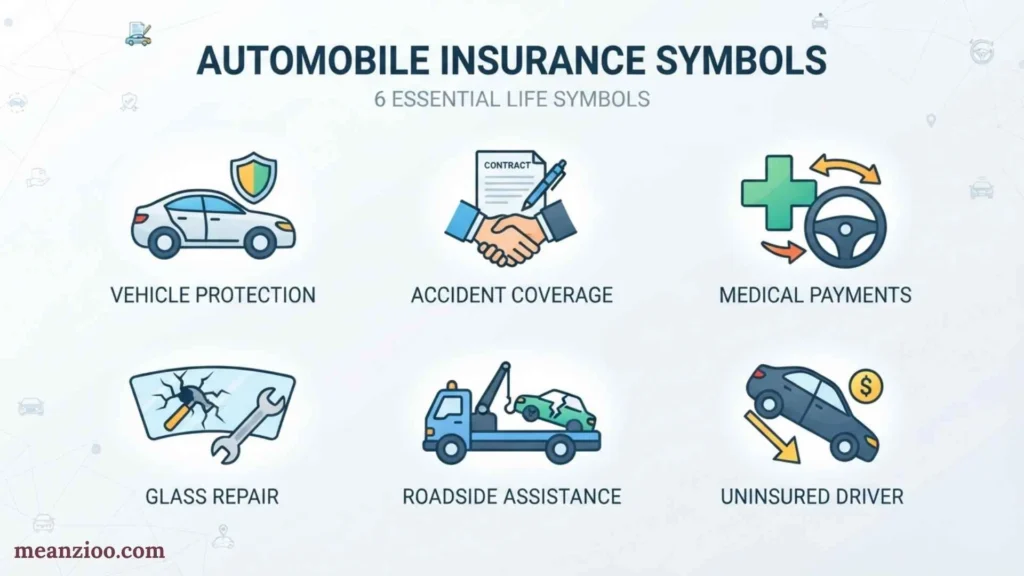
Automobile insurance symbols are shorthand codes that help insurers describe vehicle categories.
Personal auto insurance and commercial auto insurance can use different systems, so it is important not to assume that a symbol from one type of policy means exactly the same thing in another.
In commercial insurance, symbols are especially useful because businesses may have:
- Cars
- Vans
- Pickup trucks
- Box trucks
- Service vehicles
- Trailers
- Rented vehicles
- Employee-owned vehicles used for business
Symbols provide a practical way to define which categories receive coverage.
Business Auto Coverage Form Symbols
The Business Auto Coverage Form (BACF) is commonly used for commercial automobile insurance. Its symbols help identify the types of vehicles to which the policy’s coverage applies.
A business should review its declarations carefully because different coverage sections can have different symbols.
For example, a business might have a particular symbol for liability while hired or non-owned autos are handled separately.
Understanding the BACF symbols can help answer questions such as:
- Is my newly purchased vehicle covered?
- Is a rented vehicle covered?
- Is an employee’s vehicle covered?
- Are all company vehicles insured?
- Does physical damage coverage apply?
- Does liability coverage apply?
However, the actual policy language always matters.
Vehicle Symbol Lookup
A vehicle symbol lookup is useful when you want to determine what a particular commercial auto symbol means.
For a quick reference, start with the number shown on the declarations page and compare it with the applicable policy’s symbol definitions.
For example:
Symbol 7 → Specifically Described Autos
Symbol 8 → Hired Autos Only
Symbol 9 → Non-Owned Autos Only
If the symbol does not appear in a standard reference list, don’t guess. It may be connected to a form, endorsement, classification, or insurer-specific document rather than being a standard vehicle symbol.
Scheduled Autos Meaning
Scheduled autos generally refers to vehicles that are individually identified or specifically described in an insurance policy.
This concept is closely associated with Symbol 7 — Specifically Described Autos.
For a business with a small, stable fleet, scheduling vehicles can provide a clear way to identify the autos being insured.
A scheduled auto record may include information such as:
- Vehicle identification information
- Year
- Make
- Model
- Coverage
- Limits
- Deductibles
Businesses should promptly review policy changes when vehicles are purchased, sold, replaced, or added to the fleet.
Vehicle Series Rating Symbols
Vehicle series rating symbols are different from the commercial auto coverage symbols discussed in a Business Auto Coverage Form.
Rating symbols can be used in automobile insurance rating systems to help determine factors such as the relative risk or premium associated with a particular vehicle.
This creates an important distinction:
Coverage symbol ≠ vehicle rating symbol.
A coverage symbol tells you what category of vehicle the insurance coverage applies to. A rating symbol can be related to how a vehicle is evaluated for insurance pricing.
Confusing these two systems can lead to incorrect conclusions about coverage or premiums.
Symbol 19 Commercial Auto
Symbol 19 is a specialized commercial auto symbol associated with certain mobile equipment subject to motor vehicle insurance requirements.
It should not be confused with Symbol 9, which relates to non-owned autos.
When reviewing a policy containing Symbol 19, pay attention to:
- The coverage section
- The policy definitions
- Applicable state law
- Any endorsements
- The specific mobile equipment involved
Because Symbol 19 has a narrower and more specialized purpose, professional policy review can be important when a claim or coverage dispute involves it.
What Is Symbol 7 Commercial Auto?
Symbol 7 in commercial auto insurance means Specifically Described Autos.
In simple terms, it generally points to vehicles that have been specifically identified in the policy.
For example, if a business has three delivery vehicles and those vehicles are specifically described on the policy, Symbol 7 may be used for applicable coverage.
The advantage is clarity: the policy identifies the vehicles intended to receive that coverage.
The limitation is that businesses must pay attention to changes in their fleet. Adding a vehicle does not necessarily mean every type of coverage automatically applies in every situation.
Symbol 6 Auto Coverage
Symbol 6 generally means Owned Autos Subject to a Compulsory Uninsured Motorists Law.
It is primarily associated with uninsured motorists coverage where applicable law requires that type of protection.
A simple way to remember the difference is:
- Symbol 2: Owned autos generally
- Symbol 6: Owned autos connected to compulsory uninsured motorists requirements
- Symbol 7: Specifically described autos
- Symbol 8: Hired autos
- Symbol 9: Non-owned autos
The actual coverage depends on the policy, declarations, applicable law, and endorsements. For that reason, the symbol should be treated as a starting point for understanding the policy—not as a substitute for reading the coverage language.
Commercial Auto Symbol 4: Owned Autos Other Than Private Passenger Autos
Symbol 4 means “Owned Autos Other Than Private Passenger Autos Only.”
It is designed for owned vehicles that do not fall into the private passenger auto category.
Examples may include qualifying:
- Pickup trucks
- Commercial vans
- Delivery vehicles
- Work trucks
Example of Symbol 4
A plumbing company owns five service trucks and does not operate a fleet of private passenger cars.
Symbol 4 can be relevant when the coverage is intended for those owned commercial-type autos.
Symbol 3 vs. Symbol 4
The simplest way to remember the difference is:
Symbol 3 = owned private passenger autos
Symbol 4 = owned autos other than private passenger autos
This distinction is particularly useful for businesses with mixed vehicle fleets.
Commercial Auto Symbol 5: Owned Autos Subject to No-Fault
Symbol 5 applies to owned autos subject to applicable no-fault laws.
It is a more specialized designation than Symbols 1, 2, or 7 and is connected to statutory requirements in jurisdictions with applicable no-fault systems.
Example of Symbol 5
A business owns vehicles that are licensed or principally garaged in a jurisdiction where applicable no-fault requirements apply.
The symbol can be used for the relevant coverage where those statutory conditions are met.
Because no-fault requirements vary by jurisdiction, businesses should not rely on the symbol alone when determining their legal insurance obligations.
Commercial Auto Symbol 6: Owned Autos Subject to Compulsory Uninsured Motorist Law
Symbol 6 applies to owned autos subject to a compulsory uninsured motorist law.
This symbol addresses situations where applicable law requires uninsured motorist coverage for certain owned autos.
Example of Symbol 6
Suppose a company operates vehicles in a jurisdiction where uninsured motorist coverage is compulsory.
Symbol 6 may be relevant to the coverage that responds to that legal requirement.
Symbol 5 vs. Symbol 6
The distinction is straightforward:
- Symbol 5: Connected with applicable no-fault requirements
- Symbol 6: Connected with compulsory uninsured motorist requirements
These symbols are more specialized than the commonly encountered Symbols 1, 2, 7, 8, and 9.
Commercial Auto Symbol 7: Specifically Described Autos
Symbol 7 means “Specifically Described Autos.”
This designation is more restrictive because coverage applies to autos specifically described in the applicable policy schedule or declarations.
Example of Symbol 7
A delivery company owns:
- Truck A
- Truck B
- Truck C
The company lists these vehicles on its commercial auto policy.
If a coverage uses Symbol 7, the business should pay close attention to the vehicles specifically described in the policy.
Why Symbol 7 Matters
Symbol 7 can work well when a business wants to schedule individual vehicles.
The tradeoff is that the business must maintain accurate vehicle information.
If the company:
- Buys a new truck
- Sells an old truck
- Replaces a vehicle
- Adds another van
it should promptly review the policy and applicable reporting requirements.
Symbol 7 vs. Symbol 2
This is one of the most important comparisons.
Symbol 2 generally describes owned autos broadly.
Symbol 7 focuses on specifically described autos.
Therefore, a business with a changing fleet should not assume Symbol 7 automatically gives the same flexibility as Symbol 2.
Also Check This Post:Symbols of Mexico: National, Cultural, Historical, and Natural Symbols Explained
Commercial Auto Symbol 8: Hired Autos Only
Symbol 8 means “Hired Autos Only.”
It generally applies to autos the business leases, hires, rents, or borrows, subject to the policy’s specific definition and exclusions.
Examples of Hired Autos
A business might:
- Rent a truck for a week
- Lease a vehicle
- Borrow a vehicle for business purposes
- Rent a passenger car for a business trip
These situations can create hired-auto exposure.
Important Symbol 8 Limitation
The standard wording has an important exception: vehicles leased, hired, rented, or borrowed from certain employees, partners, LLC members, or members of their households may be treated differently.
That is one reason businesses should read the actual policy definition rather than assuming that every borrowed vehicle automatically qualifies as a hired auto.
Commercial Auto Symbol 9: Non-Owned Autos Only
Symbol 9 means “Non-Owned Autos Only.”
It generally applies to autos the business does not own, lease, hire, rent, or borrow but that are used in connection with its business.
Example of Symbol 9
An employee uses their personal car to:
- Visit a customer
- Pick up business supplies
- Deliver documents
- Visit a bank
- Attend a business meeting
The company does not own the employee’s car, but the vehicle is being used for business.
This is a classic example of a non-owned auto exposure.
Does Symbol 9 Insure the Employee’s Vehicle?
Generally, no.
Non-owned auto coverage is primarily concerned with the business’s liability exposure arising from qualifying business use. It does not automatically provide physical damage insurance for the employee’s personal vehicle.
The employee’s own personal auto policy may be relevant to damage to that vehicle, subject to its terms.
Commercial Auto Symbol 19: Mobile Equipment
Symbol 19 addresses certain mobile equipment subject to compulsory, financial responsibility, or other motor vehicle insurance laws.
The concept is important because some equipment may ordinarily fall within a policy’s mobile equipment definition but can become subject to motor vehicle insurance requirements because of the law where it is licensed or principally garaged.
Example of Symbol 19
Consider a contractor using specialized self-propelled equipment.
Normally, the equipment may be treated as mobile equipment rather than an auto. But if applicable law requires the vehicle to be registered or insured as a motor vehicle, Symbol 19 can become relevant.
Because this area depends heavily on the equipment, policy language, and applicable law, it is important to check the actual policy rather than relying on a general example.
Commercial Auto Symbols for Liability Coverage
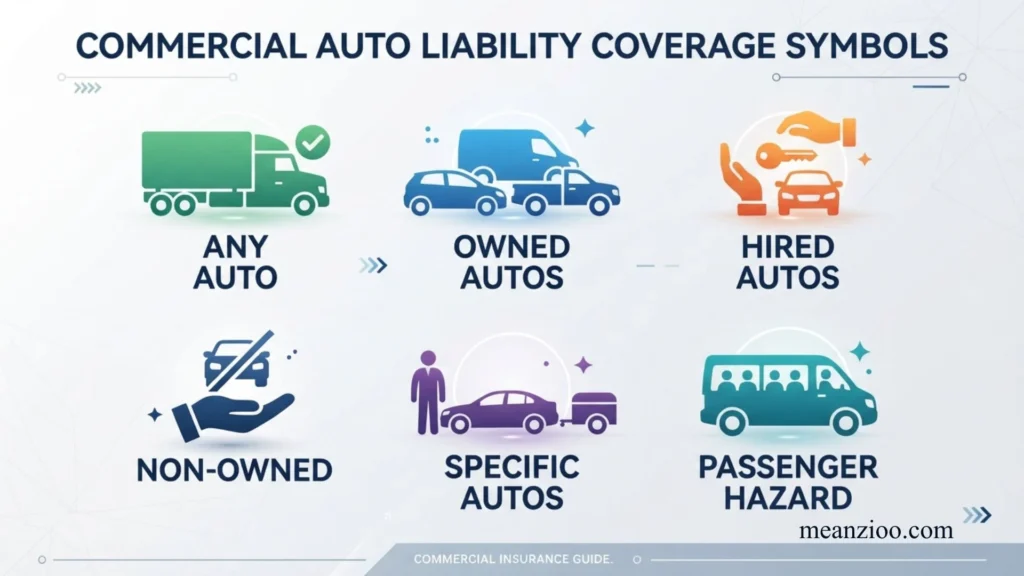
Commercial auto symbols are particularly important for liability coverage because they determine which vehicles qualify as covered autos for that coverage.
Common examples include:
- Symbol 1: Any auto
- Symbol 2: Owned autos
- Symbol 7: Specifically described autos
- Symbol 8: Hired autos
- Symbol 9: Non-owned autos
A business should match the symbol to its actual vehicle exposures.
Why Liability Symbols Matter
Imagine a company has Symbol 7 for liability but regularly rents trucks that are not included in the described autos.
The company should not automatically assume the rental truck receives the same liability coverage.
That is exactly why checking the declarations page before a loss occurs is so important.
Commercial Auto Symbols for Physical Damage Coverage
Physical damage coverage is different from liability coverage.
Physical damage coverage can include protection such as:
- Collision
- Comprehensive or other-than-collision coverage
The symbol assigned to the physical damage coverage determines which autos qualify for that particular protection, subject to the policy terms, conditions, exclusions, and deductibles.
For example, a business could have a broad liability designation while using a more specific designation for physical damage.
This means:
Never assume that the liability symbol automatically applies to physical damage.
Always examine the symbol shown beside the specific coverage you are trying to understand.
Which Commercial Auto Symbol Is Best for Liability?
There is no single symbol that is best for every business.
A company that owns a large fleet may have different needs from a company with no owned vehicles but frequent employee business driving.
Businesses With Owned Vehicles
Businesses that primarily operate company-owned vehicles may consider coverage based on owned-auto designations such as Symbol 2, depending on the policy structure.
Businesses With Scheduled Vehicles
Businesses that want to specifically identify vehicles may use Symbol 7 for applicable coverage.
Businesses That Rent Vehicles
Businesses with significant rental or leased vehicle exposure should pay particular attention to Symbol 8 and the applicable hired-auto provisions.
Businesses With Employee-Owned Vehicles
Businesses whose employees regularly use personal vehicles for work should evaluate Symbol 9 and other applicable non-owned auto arrangements.
Businesses With Broad Auto Exposure
Businesses with complex operations may use Symbol 1 for certain coverages where broad auto liability protection is appropriate.
The correct choice depends on the business’s operations, underwriting requirements, policy form, endorsements, and applicable law.
Symbol 1 vs. Symbol 2 vs. Symbol 7
These three symbols are frequently confused.
| Feature | Symbol 1 | Symbol 2 | Symbol 7 |
| Basic meaning | Any auto | Owned autos | Specifically described autos |
| Scope | Broadest | Owned vehicles | Listed/described vehicles |
| Rental exposure | Generally broader | Not generally included simply because it is rented | Not included unless it qualifies under the policy |
| Employee personal auto | Potentially within broad designation, subject to terms | Generally not | Generally not |
| Fleet scheduling | Broad | Less restrictive than scheduled-only | Requires attention to listed vehicles |
The key takeaway is:
1 = Any
2 = Owned
7 = Specifically described
This simple distinction can help when reading a commercial auto declarations page.
Symbol 8 vs. Symbol 9
Symbols 8 and 9 are another common source of confusion.
Symbol 8: Hired Auto
The business hires, rents, leases, or borrows the vehicle, subject to the policy’s definition.
Example: A company rents a van from a rental company.
Symbol 9: Non-Owned Auto
The business does not own, hire, rent, lease, or borrow the vehicle, but the vehicle is used for business.
Example: An employee uses their personal car to deliver company documents.
Easy Way to Remember
8 = Hired
9 = Non-Owned
Together, these symbols are often associated with hired and non-owned auto exposures. However, their exact operation depends on the policy language and applicable endorsements.
Do Symbols 8 and 9 Provide Physical Damage Coverage?
Do not assume they do.
Hired and non-owned auto coverage is commonly used to address liability exposure, not automatically to insure physical damage to the hired or non-owned vehicle.
For example, if a business rents a vehicle and damages the rental vehicle, the business may need separate physical damage arrangements, depending on its commercial auto policy, hired-auto physical damage coverage, rental agreement, and other applicable insurance.
This is an important distinction:
Liability coverage protects against covered legal liability to others.
Physical damage coverage addresses damage to the covered vehicle, subject to policy terms.
Commercial Auto Symbols and Newly Acquired Autos
Newly acquired vehicles are particularly important for businesses using Symbols 2, 3, and 4.
Standard Business Auto Coverage Form wording can extend certain owned-auto designations to autos acquired after the policy begins, subject to the form’s conditions and notice requirements.
However, businesses should not treat this as a reason to delay notifying their insurer.
When purchasing a new vehicle, contact the insurer or agent promptly and confirm:
- Whether coverage applies immediately
- How long the automatic coverage period lasts
- What notice is required
- Whether the vehicle needs to be added to the schedule
- Whether physical damage coverage applies
- What deductible applies
- Whether financing or leasing requirements affect the coverage
The exact answer depends on the policy form and endorsements.
Commercial Auto Symbols and Endorsements
Commercial auto symbols do not always tell the entire story.
Insurance companies can use endorsements to modify, expand, restrict, or otherwise change coverage.
Some policies can also use customized covered-auto designations through endorsements. IRMI notes that custom symbols can be created through the Covered Autos Designation Symbol endorsement.
Therefore, when reviewing a commercial auto policy, look at:
- Declarations
- Coverage form
- Definitions
- Endorsements
- Exclusions
- Conditions
- State-specific requirements
A symbol should always be interpreted together with the actual policy wording.
Commercial Auto Symbols and Mixed Fleets
Many businesses do not have only one type of vehicle.
For example, a company could have:
- Five company-owned trucks
- Two company-owned passenger cars
- Occasional rental vehicles
- Employees using personal vehicles
This is a mixed fleet.
A business with a mixed fleet needs to make sure each relevant exposure is addressed.
For example:
| Business vehicle exposure | Symbol to investigate |
| Company-owned autos | 2 |
| Owned private passenger autos | 3 |
| Owned commercial autos | 4 |
| Scheduled vehicles | 7 |
| Rental vehicles | 8 |
| Employee-owned vehicles used for work | 9 |
| Broad auto exposure | 1 |
This is not a recommendation to select those symbols automatically. It is a starting point for identifying which coverage categories should be discussed with an insurance professional.
Also Check This Post:Symbols of Ireland: 15 Irish Symbols, Their Meanings, History, and Cultural Significance
Real-World Commercial Auto Symbol Examples
Example 1: Construction Company
A construction company owns:
- Pickup trucks
- Work vans
- Trailers
It should review the symbols applying to its owned autos and determine whether hired and non-owned exposures also exist.
If employees occasionally rent vehicles for company business, Symbol 8 may become relevant.
If employees use personal vehicles for company errands, Symbol 9 may also need to be considered.
Example 2: Delivery Business
A delivery company owns several delivery trucks and occasionally rents additional vehicles during busy seasons.
The business has two separate exposures:
- Owned vehicles
- Hired vehicles
The business should verify that the applicable liability and physical damage coverages address both exposures appropriately.
Example 3: Consulting Company
A consulting firm owns no vehicles.
Instead, employees use their personal vehicles to visit clients.
The company may have a significant non-owned auto exposure, making Symbol 9 an important topic to discuss with its insurance professional.
Example 4: Business With a Scheduled Fleet
A company owns 10 vehicles and wants each vehicle specifically identified on its policy.
Symbol 7 may be relevant for applicable coverage.
However, the company should maintain accurate schedules and report changes according to the policy requirements.
Common Commercial Auto Symbol Mistakes
Mistake 1: Assuming the Whole Policy Uses One Symbol
A commercial auto policy can use different symbols for different coverages.
Always check each coverage line.
Mistake 2: Confusing Symbol 8 With Symbol 9
A rental vehicle and an employee’s personal vehicle are not automatically treated the same way.
Remember:
8 = Hired
9 = Non-Owned
Mistake 3: Assuming Symbol 7 Covers Every Vehicle the Business Owns
Symbol 7 is specifically described auto coverage.
Do not assume an unscheduled vehicle receives the same treatment.
Mistake 4: Ignoring Employee-Owned Vehicles
Businesses sometimes focus only on their company fleet and forget that employees may use personal vehicles for work.
That can create a non-owned auto exposure.
Mistake 5: Assuming Liability Means Physical Damage
Liability coverage and physical damage coverage serve different purposes.
The symbols assigned to them may also be different.
Mistake 6: Forgetting Newly Acquired Vehicles
Buying a new truck or van should trigger an immediate policy review.
Do not assume the vehicle is permanently covered simply because another owned vehicle is already insured.
Mistake 7: Ignoring Endorsements
An endorsement can modify the meaning or scope of coverage.
The declarations page should be read together with the actual policy and endorsements.
Mistake 8: Assuming Every Insurer Uses Identical Forms
The standard ISO framework is widely used, but insurers may use their own forms or endorsements.
Always check the actual policy issued to the business.
How to Check Your Commercial Auto Symbols
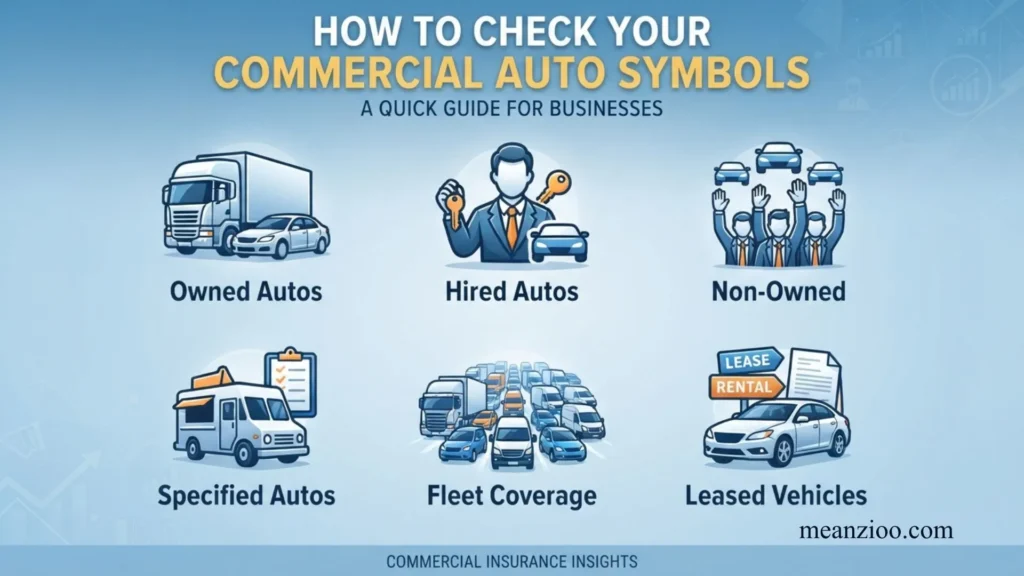
If you already have commercial auto insurance, you can usually identify your symbols by following these steps.
Step 1: Find Your Declarations Page
Locate the declarations page provided by your insurer.
Step 2: Find the Coverage Section
Look for sections such as:
- Liability
- Medical payments
- Uninsured/underinsured motorists
- Comprehensive
- Collision
- Other applicable coverage
Step 3: Identify the Symbol
A number should appear beside the applicable coverage.
Step 4: Match the Number to Its Definition
Use the policy’s symbol definitions rather than relying only on a generic online chart.
Step 5: Compare It With Your Business
Ask:
- Do we own the vehicles?
- Do we rent vehicles?
- Do employees use personal cars?
- Are our vehicles specifically listed?
- Have we recently acquired a vehicle?
- Do we operate specialized equipment?
- Do we operate in multiple states?
Step 6: Review Endorsements
Check whether an endorsement changes the standard coverage.
Step 7: Ask Your Insurance Professional
If the symbol does not appear to match your business operations, ask your insurer or licensed insurance professional to explain the coverage.
Which Commercial Auto Symbol Do I Need?
The answer depends on what vehicles your business uses and what coverage you are purchasing.
A simplified guide is:
- Need broad auto liability? Ask about Symbol 1.
- Own business vehicles? Review Symbol 2.
- Own private passenger vehicles? Review Symbol 3.
- Own commercial vehicles other than private passenger autos? Review Symbol 4.
- Need coverage connected to no-fault requirements? Review Symbol 5.
- Need coverage connected to compulsory uninsured motorist requirements? Review Symbol 6.
- Want specifically scheduled vehicles? Review Symbol 7.
- Rent or hire vehicles? Review Symbol 8.
- Employees use personal vehicles for business? Review Symbol 9.
- Operate mobile equipment subject to motor vehicle laws? Review Symbol 19.
This is a general guide, not a recommendation to select a particular symbol. Your insurer determines the actual policy wording and coverage.
Commercial Auto Symbols Frequently Asked Questions
What are commercial auto symbols?
Commercial auto symbols are numbers used to identify which categories of vehicles are covered by a particular commercial auto coverage.
How many commercial auto symbols are there?
The standard Business Auto Coverage Form uses symbols 1 through 9 and 19. Other customized symbols can also be created through endorsements.
What is commercial auto symbol 1?
Symbol 1 means Any Auto and is generally the broadest standard covered-auto designation.
What is commercial auto symbol 2?
Symbol 2 means Owned Autos Only and generally applies to qualifying autos owned by the insured.
What is commercial auto symbol 7?
Symbol 7 means Specifically Described Autos. It generally applies to autos specifically described in the policy.
What is commercial auto symbol 8?
Symbol 8 means Hired Autos Only and generally applies to qualifying autos the business leases, hires, rents, or borrows.
What is commercial auto symbol 9?
Symbol 9 means Non-Owned Autos Only and generally applies to qualifying autos the business does not own but uses in connection with its business.
What is the difference between Symbol 8 and Symbol 9?
Symbol 8 generally applies to hired autos, while Symbol 9 generally applies to non-owned autos.
A rental car is a common hired-auto example. An employee’s personal car used for business is a common non-owned-auto example.
Is Symbol 1 better than Symbol 7?
Symbol 1 is broader, but that does not automatically make it better for every business. The correct designation depends on the company’s operations, coverage requirements, insurer, and policy terms.
Does Symbol 7 cover newly purchased vehicles?
Symbol 7 is tied to specifically described autos, so businesses should not assume that a newly purchased vehicle automatically receives the same treatment. Review the policy’s newly acquired auto provisions and contact the insurer promptly.
Does Symbol 9 cover an employee’s personal vehicle?
It can address the business’s qualifying liability exposure when an employee-owned vehicle is used for business, subject to the policy’s terms. It does not automatically mean the employee’s vehicle itself has physical damage coverage under the business policy.
Are commercial auto symbols the same for every insurance company?
Not necessarily. The standard ISO Business Auto Coverage Form provides standardized symbol definitions, but insurers can use different forms and endorsements. Always read the actual policy.
Where are commercial auto symbols found?
They are typically shown on the commercial auto declarations page, next to the applicable coverage.
Commercial Auto Symbols Quick Reference
For a quick memory aid:
1 — Any Auto
2 — Owned Autos Only
3 — Owned Private Passenger Autos Only
4 — Owned Autos Other Than Private Passenger Autos
5 — Owned Autos Subject to No-Fault
6 — Owned Autos Subject to Compulsory Uninsured Motorist Law
7 — Specifically Described Autos
8 — Hired Autos Only
9 — Non-Owned Autos Only
19 — Certain Mobile Equipment Subject to Motor Vehicle Insurance Law
The exact wording should always be confirmed against the policy form issued by your insurer.
Final Takeaway
Commercial auto symbols are one of the most important parts of understanding a Business Auto Coverage Form because they determine which categories of vehicles qualify for particular coverages.
The easiest symbols to remember are:
- 1 = Any Auto
- 2 = Owned Autos
- 7 = Specifically Described Autos
- 8 = Hired Autos
- 9 = Non-Owned Autos
Symbols 3, 4, 5, 6, and 19 address more specific vehicle or statutory situations.
The most important point is that there is no single symbol that automatically describes your entire commercial auto policy. Different coverages can have different symbols, and endorsements can modify the standard wording.
If you are reviewing a commercial auto policy, start with the declarations page, identify the symbol beside each coverage, compare those symbols with the vehicles your business actually owns or uses, and then review the policy definitions and endorsements.
For questions involving an actual claim, legal requirement, or coverage dispute, rely on the specific policy language and guidance from a qualified insurance professional or attorney rather than a general online explanation.
Disclaimer: This article is for general educational purposes only. Commercial auto coverage varies by insurer, policy form, endorsements, and jurisdiction. It is not insurance, legal, or financial advice.
Also Check This Post:Catholic Church Symbols: Complete Guide to Their Meanings, History, and Significance

Hi, I’m Charlotte Hayes. I love writing about the newest English slang, pop culture phrases, and digital communication. I spend my time exploring how language evolves across social media, gaming, and everyday conversations. I enjoy sharing easy-to-understand guides that help learners keep up with modern English. My goal is to make every article useful, accurate, and enjoyable for readers around the world.
Books:
- Everyday Slang Dictionary
- Fluent Through Informal English
 Ryan Mitchell