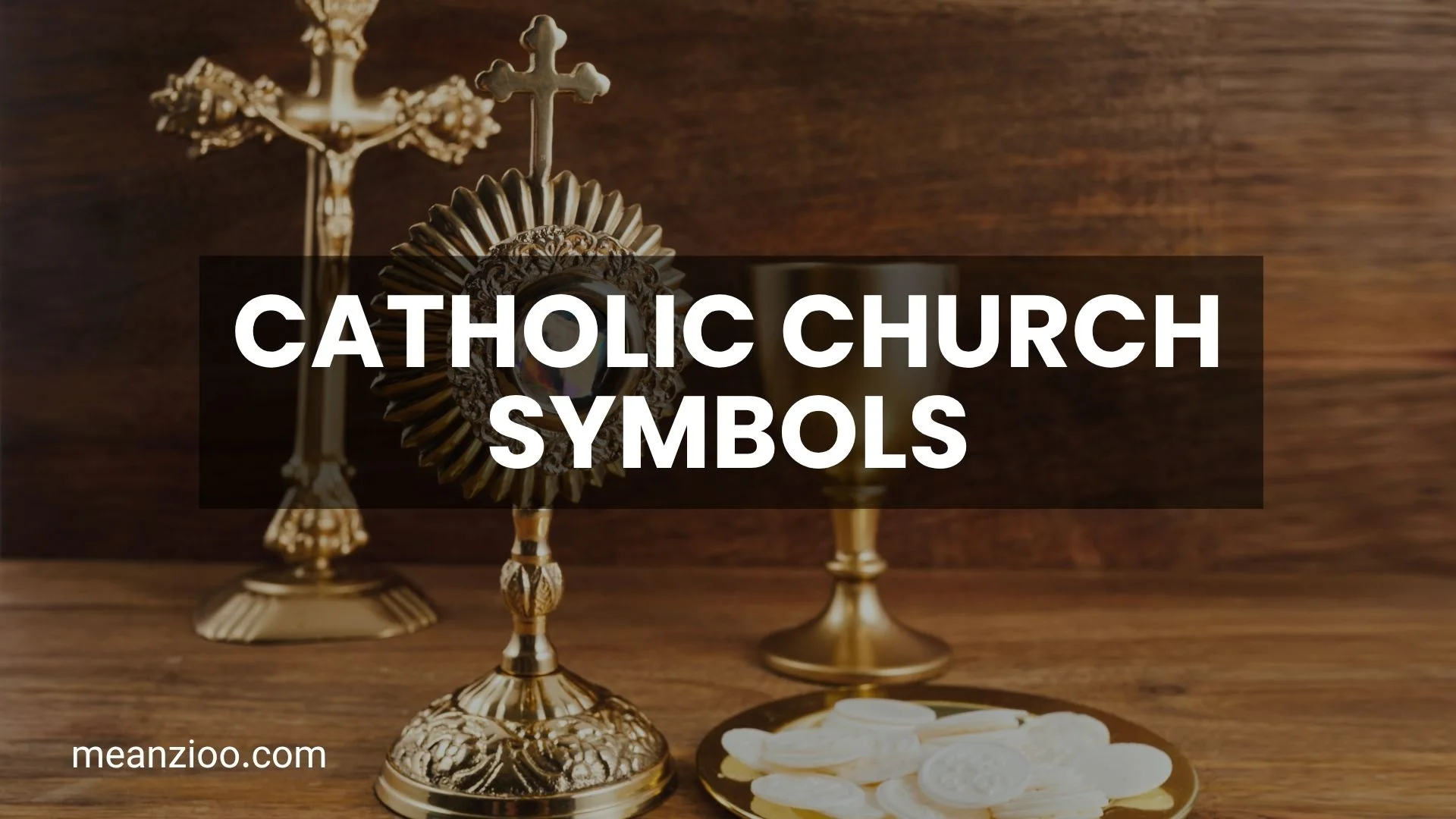
Catholic churches are filled with symbols that communicate important ideas about Jesus Christ, the sacraments, the saints, the Virgin Mary, salvation, prayer, and the life of the Church. Some are immediately recognizable, such as the cross and crucifix, while others—such as the Chi-Rho, IHS, tabernacle lamp, paschal candle, keys of Saint Peter, and liturgical colors—may require more explanation.
For anyone searching for Catholic Church symbols, understanding what these objects and images mean can make a visit to a Catholic church, participation in Mass, or study of Catholic art much more meaningful.
Catholic teaching gives an important place to signs and symbols. The Catechism explains that human beings use visible signs to express spiritual realities and that the Church incorporates signs from creation, Scripture, human culture, and the events of salvation history into its liturgy.
This guide explains the most important Catholic Church symbols and their meanings, how to identify them, where they are found, and how Catholic symbols differ from symbols that are shared more broadly across Christianity.
What Are Catholic Church Symbols?
Catholic Church symbols are visible signs, objects, images, colors, gestures, and artistic representations that communicate aspects of Catholic faith.
They can point to:
- Jesus Christ
- The Holy Trinity
- The Holy Spirit
- The Eucharist
- Baptism
- The Passion and Resurrection
- The Virgin Mary
- The saints
- Prayer and worship
- Salvation
- Christian hope
- Particular seasons of the liturgical year
The important point is that Catholic symbols are not simply decoration.
Catholic liturgy uses physical signs to communicate spiritual realities. The Catechism describes sacramental celebrations as being woven from signs and symbols whose meaning is rooted in creation, human culture, the Old Covenant, and ultimately the person and work of Christ.
That is why a Catholic church can communicate so much theology visually.
Catholic Symbols and Meanings
Catholic symbols are visual signs that help communicate important ideas about Christian faith, worship, Scripture, the sacraments, and the life of the Church. Some are directly connected with Jesus Christ, while others represent Mary, the saints, the Trinity, the Eucharist, or particular Christian virtues.
The cross is the central symbol of Catholic Christianity because it recalls the crucifixion and resurrection of Jesus. Other familiar symbols include the fish, dove, lamb, Sacred Heart, Chi-Rho, and various Marian symbols. Their meanings can vary slightly according to their historical and liturgical context.
Understanding these symbols can make Catholic artwork, church architecture, stained glass, statues, prayer cards, and religious objects much easier to interpret.
Pictures of Catholic Symbols
Pictures of Catholic symbols can help readers recognize religious imagery that they may encounter in churches, artwork, books, medals, or devotional objects. Common examples include the crucifix, cross, chalice, Eucharistic host, dove, Sacred Heart, Alpha and Omega, and Marian imagery.
When identifying a Catholic symbol from a picture, it is useful to look at the complete design rather than a single shape. For example, a heart surrounded by flames and a cross may refer to the Sacred Heart of Jesus, while a lily may be associated with purity and is frequently connected with Saint Joseph or the Virgin Mary in Christian art.
Captions are especially valuable because they explain both the name of the symbol and its religious meaning.
10 Catholic Symbols and Their Meanings
Here are ten widely recognized Catholic symbols and their traditional meanings:
- Cross – Represents the crucifixion of Jesus Christ and is the central symbol of Christian faith.
- Crucifix – Shows Christ on the cross and emphasizes his suffering and sacrifice.
- Dove – Commonly represents the Holy Spirit and peace.
- Chalice – Associated with the Eucharist and the Precious Blood of Christ.
- Host – Represents the Eucharistic bread used in Catholic worship.
- Sacred Heart – Represents the love of Jesus Christ for humanity.
- Lamb – Refers to Christ as the Lamb of God.
- Chi-Rho – A Christian monogram formed from the first two Greek letters of “Christ.”
- Alpha and Omega – Represent Christ as the beginning and the end.
- Fish – An ancient Christian symbol associated with Christ and Christian faith.
These symbols appear in different combinations throughout Catholic churches and religious artwork.
Original Roman Catholic Symbol
There is not one single symbol that represents every aspect of Roman Catholicism. The cross and crucifix are among the most recognizable symbols of Catholic faith.
The crucifix is especially characteristic of Catholic devotional tradition because it depicts Jesus on the cross. Catholic churches may also use the Chi-Rho, Eucharistic symbols, papal insignia, Marian symbols, and other traditional Christian imagery.
Therefore, when someone searches for the “original Roman Catholic symbol,” it is important to distinguish between the central Christian symbol of the cross and symbols specifically associated with particular Catholic traditions or institutions.
Catholic Symbols and Meanings PDF
A Catholic symbols and meanings PDF can be useful as a printable reference for students, catechists, teachers, church groups, and anyone learning about Christian iconography. A useful guide can organize each symbol with its name, image, traditional meaning, and historical or liturgical context.
For example, a reference table might include the cross, crucifix, Eucharistic host, chalice, Sacred Heart, dove, fish, lamb, Chi-Rho, and Marian symbols.
When creating a downloadable Catholic symbols guide, it is important to use original artwork or properly licensed images rather than copying copyrighted illustrations from another website.
4 Symbols of the Church
The phrase “four symbols of the Church” can refer to the traditional marks of the Church expressed in the Nicene Creed: one, holy, catholic, and apostolic.
These four characteristics describe how the Church understands its identity:
- One – The Church is understood as one body in Christ.
- Holy – Its holiness is connected with God and the call to holy living.
- Catholic – The word means universal, expressing the Church’s worldwide mission.
- Apostolic – The Church traces its teaching and mission to the apostles.
These are not simply decorative icons. They are theological descriptions of the Church’s identity and mission.
Catholic Symbols Drawing
Catholic symbols drawings can be simple enough for children and beginners while still communicating traditional Christian meanings. Common subjects for drawings include a cross, rosary, dove, chalice, Eucharistic host, fish, Sacred Heart, crown, and Marian symbols.
A simple drawing can be made more educational by adding the symbol’s name and a short explanation underneath. This approach works well for religious education worksheets, classroom projects, church activities, and introductory guides.
For historical artwork, however, the style and symbolism should be presented accurately rather than mixing modern decorative designs with traditional religious imagery.
Catholic Church Symbols of Mary
Catholic tradition contains many symbols associated with the Virgin Mary. Some of the most recognizable include the lily, rose, crown, star, and monogram “AM” or “MA.”
The lily is commonly associated with purity, while the crown can represent Mary’s honored place in Catholic devotion. The star, particularly the title Star of the Sea, is another longstanding Marian image.
Mary is also frequently represented through specific devotional titles and images, such as the Immaculate Heart of Mary and Our Lady of the Rosary. The exact symbolism depends on the particular Marian devotion or artwork.
Catholic Church Symbols Clipart
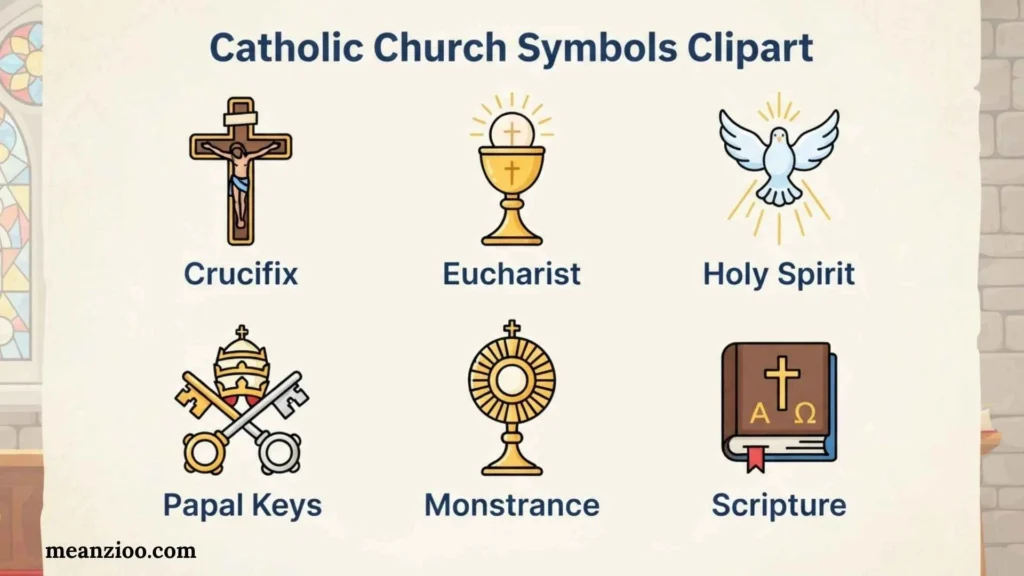
Catholic church symbols clipart can be useful for educational worksheets, presentations, church newsletters, invitations, and other religious materials. Common clipart subjects include crosses, churches, rosaries, candles, doves, chalices, angels, saints, and Marian imagery.
However, not every Christian-looking graphic is specifically Catholic. Before labeling an image as a Catholic symbol, it is useful to identify its traditional religious context.
For published materials, always check the image’s licensing conditions. Using original or appropriately licensed artwork helps avoid copyright problems.
Roman Catholic Church Symbols
Roman Catholic churches use a wide variety of symbols in architecture, liturgy, artwork, and devotional practice. The crucifix, tabernacle, altar, Eucharistic imagery, candles, holy water, statues, stained glass, and Stations of the Cross can all carry religious significance.
Church architecture itself can also communicate Catholic beliefs. For example, sacred spaces may contain imagery representing Christ, Mary, the apostles, saints, biblical events, and the sacraments.
These symbols are not merely decoration. They help worshippers connect visible objects and images with aspects of Catholic teaching and devotion.
Catholic Church Symbols Images
Catholic church symbols images can reveal meaning through visual details. A cross may point directly to Christ’s sacrifice, while a chalice and host usually indicate Eucharistic symbolism. A dove can represent the Holy Spirit, and a lamb can refer to Christ as the Lamb of God.
When studying an image, look for surrounding objects as well. A crown, stars, lilies, hearts, books, keys, or specific colors can add another layer of meaning.
This makes Catholic iconography especially interesting because a single artwork may combine several symbols to tell a larger religious story.
Classic Symbol of Purity and Grace
The lily is one of the classic Christian symbols associated with purity. In Catholic art, the white lily is particularly connected with purity and is frequently associated with the Virgin Mary and Saint Joseph.
Its meaning comes from a long Christian artistic tradition in which the flower represents qualities such as purity, innocence, and virtue. The exact interpretation can depend on the saint or religious figure depicted.
The lily is therefore a useful example of how a natural object can become a meaningful part of Catholic visual language.
Symbols of Catholic Religion
Symbols of Catholic religion include both universal Christian signs and imagery that has developed within Catholic devotional and liturgical traditions. The cross, crucifix, Eucharistic symbols, Sacred Heart, rosary, Marian imagery, saints’ attributes, and Chi-Rho are important examples.
Some symbols communicate core Christian beliefs, while others identify particular devotions. For example, the rosary is closely connected with prayer and Marian devotion, while the Sacred Heart represents a particular devotion centered on Christ’s love.
Learning these distinctions makes it easier to understand Catholic paintings, statues, medals, churches, and religious objects.
Symbol of Catholic Faith
The crucifix is one of the clearest visual symbols of Catholic faith. It directs attention to Jesus Christ’s crucifixion and, within Catholic belief, to the saving significance of his death and resurrection.
The cross without a depiction of Christ is also widely used. Other symbols, including the Eucharistic host and chalice, express central Catholic beliefs about the Eucharist.
No single symbol captures every part of Catholic faith, so different symbols are often used together to communicate different aspects of belief.
Signs of the Catholic Church
Signs of the Catholic Church can include both physical symbols and visible practices. A crucifix, tabernacle, altar, sanctuary lamp, Stations of the Cross, statues of saints, and images of Mary can all help identify a Catholic worship space.
The sacraments and liturgical practices also have visible signs and symbols. Water, oil, bread, wine, candles, gestures, and vestments can communicate religious meaning within Catholic worship.
These signs help connect physical actions and objects with spiritual realities taught by the Church.
10 Catholic Symbols
Ten commonly recognized Catholic symbols are:
- Cross
- Crucifix
- Eucharistic host
- Chalice
- Sacred Heart
- Dove
- Lamb
- Chi-Rho
- Rosary
- Marian symbols
Each has its own history and meaning. Some are directly associated with Jesus, some with the Eucharist, and others with Mary, the Holy Spirit, or broader Christian traditions.
A symbol’s meaning should always be considered within its context because the same image can sometimes appear in several Christian traditions.
Ecclesial Signs
Ecclesial signs are visible signs connected with the Church and its life, worship, mission, and identity. The word “ecclesial” relates to the Church, so the concept extends beyond individual decorative symbols.
In Catholic contexts, ecclesial signs can include sacred spaces, liturgical objects, sacramental signs, religious art, gestures, vestments, and other visible elements used in the Church’s worship and community life.
These signs help make invisible or spiritual ideas understandable through visible actions and objects. They are particularly important in Catholic liturgy, where symbolism is closely connected with prayer and worship.
Protection Symbols Catholic
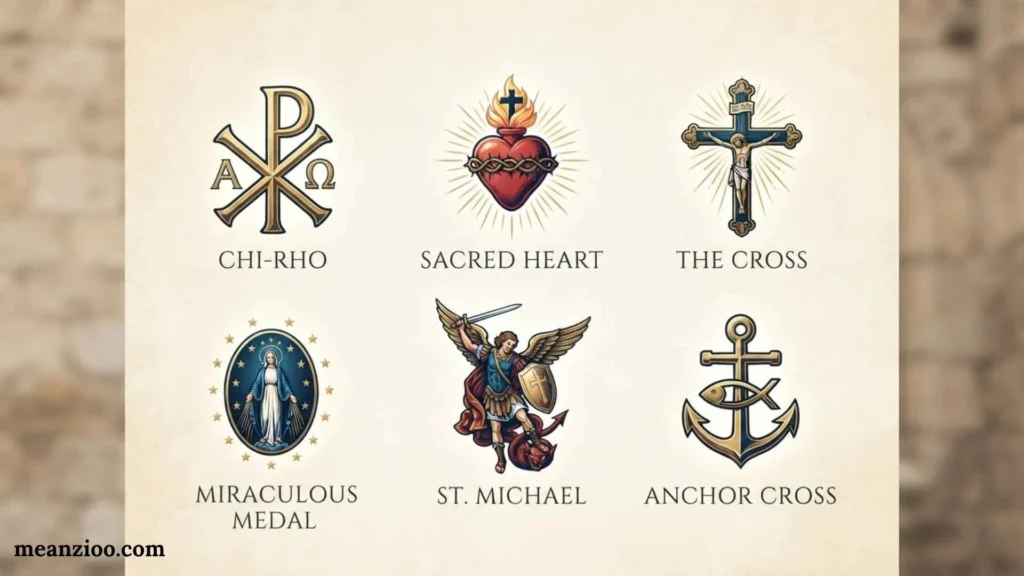
Catholic tradition includes prayers, sacramentals, medals, crosses, and devotional objects that believers may use as reminders of faith and trust in God. Examples include the crucifix, Saint Benedict Medal, Miraculous Medal, and blessed religious objects.
These should not be understood simply as magical protection symbols. Within Catholic teaching, sacramentals are intended to direct believers toward faith, prayer, and God’s grace rather than function as charms with independent supernatural power.
The meaning of a particular devotional object can also depend on the tradition and prayers associated with it.
Simple Catholic Symbols
Simple Catholic symbols are useful when someone wants an easy-to-recognize visual representation of Catholic faith. The cross, crucifix, fish, dove, chalice, Eucharistic host, rosary, and heart are among the easiest symbols to draw or identify.
Their simplicity makes them suitable for educational materials, children’s activities, church resources, logos, and basic religious illustrations. A short caption can make a simple symbol much more informative by explaining its traditional meaning.
For example, a simple cross can represent Christ’s crucifixion, while a dove can represent the Holy Spirit. Keeping the design simple does not mean the religious meaning has to be shallow.
The Most Important Catholic Church Symbols at a Glance
| Symbol | Common Meaning |
| Cross | Christ’s Passion, death, and salvation |
| Crucifix | Jesus’ sacrifice on the cross |
| Eucharist | Christ’s Real Presence |
| Chalice | Eucharistic Blood of Christ |
| Host | Eucharistic Body of Christ |
| Tabernacle | Reservation of the Blessed Sacrament |
| Sanctuary lamp | Presence of the Blessed Sacrament |
| Candle | Christ as Light and a sign of reverence |
| Paschal candle | Christ’s Resurrection and victory over death |
| Dove | Holy Spirit |
| Sacred Heart | Christ’s love and mercy |
| Immaculate Heart | Mary’s love and devotion |
| Rosary | Prayer and meditation |
| Chi-Rho | Christ |
| IHS | Jesus |
| Alpha and Omega | Christ as beginning and end |
| Fish | Christ and early Christian faith |
| Lamb of God | Christ and His sacrificial role |
| Wheat and grapes | Eucharistic bread and wine |
| Water | Baptism and new life |
| Keys | Saint Peter and the papacy |
| Palm branch | Christ’s entry into Jerusalem and martyrdom |
| Lily | Purity, especially in Marian and saintly imagery |
| Liturgical colors | The season or character of a liturgical celebration |
1. The Cross
The cross is one of the central symbols of Christianity and one of the most recognizable symbols in a Catholic church.
It recalls the crucifixion of Jesus Christ and therefore points toward His Passion, death, and saving work.
In Catholic churches, the cross may appear:
- Near the altar
- Behind the altar
- In processions
- On church walls
- In stained-glass windows
- On vestments
- On rosaries
- On devotional objects
The cross is not merely a reminder of suffering. For Christians, the Passion of Christ is inseparable from the hope of resurrection and salvation.
The General Instruction of the Roman Missal specifically calls for a cross with the figure of Christ crucified to be placed on or near the altar and says that it should remain clearly visible to the assembled faithful.
2. The Crucifix
A crucifix is a cross that includes a representation of Jesus’ body.
This makes the crucifix particularly important in Catholic visual tradition because it directs attention not only to the cross but also to Christ’s sacrifice.
A crucifix may be found:
- Above or near an altar
- In a sanctuary
- In a classroom
- In a Catholic home
- In a chapel
- On a rosary
- As part of religious artwork
Cross vs. Crucifix
The two terms are related but should not be treated as identical.
A cross may be empty, emphasizing the cross as a Christian symbol.
A crucifix specifically depicts Christ crucified.
Both are important in Catholicism, but the crucifix gives particularly strong visual emphasis to the Passion of Jesus.
3. The Eucharist
The Eucharist is at the center of Catholic sacramental worship.
Catholics believe that Christ is truly present in the Eucharist. Consequently, Eucharistic symbols have an especially important place in Catholic churches.
Common Eucharistic symbols include:
- The consecrated host
- Bread
- Wine
- Chalice
- Monstrance
- Tabernacle
- Wheat
- Grapes
- Eucharistic imagery
The Eucharist should therefore be distinguished from a symbol that merely represents Jesus. Catholic teaching understands the Eucharistic celebration as a sacramental mystery in which Christ is truly present.
4. The Host
The host is the round wafer used for the Eucharistic celebration.
Before consecration, it is bread prepared for the Mass. After consecration, Catholic teaching holds that it is the Body of Christ.
The host may be depicted in religious art or displayed during Eucharistic adoration using a monstrance.
A host surrounded by rays is therefore often a strong visual indication that the image is connected with Eucharistic devotion.
5. The Chalice
The chalice is a sacred cup used for the wine during the celebration of the Eucharist.
It represents the Eucharistic cup and is closely associated with Christ’s Blood.
A chalice may be recognized by its characteristic cup-like shape, often with an elaborate stem and base.
Catholic liturgical rules distinguish sacred vessels used for the Eucharist from ordinary household vessels.
6. The Monstrance
A monstrance, also called an ostensorium, is a vessel used to display the consecrated Eucharist for Eucharistic adoration and certain processions.
It frequently has a radiant design around the central area where the host is placed.
The rays can visually suggest:
- Light
- Glory
- Christ’s presence
- Adoration
If you see a round white host displayed in an ornate golden vessel surrounded by rays, you are likely looking at a monstrance.
7. The Tabernacle
The tabernacle is a secure container where the Blessed Sacrament is reserved.
Because Catholics believe in Christ’s Real Presence in the Eucharist, the tabernacle receives particular reverence.
Catholic liturgical guidance says that the tabernacle should occupy a worthy and suitable place and emphasizes its relationship to Eucharistic adoration.
A tabernacle may be located:
- In the sanctuary
- In a prominent chapel
- In a specially designed Eucharistic chapel
Its exact placement can vary according to the design of a particular church and the applicable liturgical norms.
8. The Sanctuary Lamp
A sanctuary lamp or sanctuary light is associated with the presence of the Blessed Sacrament reserved in the tabernacle.
The lamp may burn continuously according to the liturgical requirements governing the reservation of the Eucharist.
Its purpose is not simply to illuminate the church. It serves as a visible indication of Eucharistic presence and invites reverence.
The USCCB notes that an oil lamp may indicate the presence of the Blessed Sacrament in the tabernacle.
9. Candles
Candles are among the most familiar symbols in Catholic worship.
Light naturally suggests ideas such as:
- Christ
- Hope
- Prayer
- Faith
- God’s presence
- Celebration
Catholic liturgical guidance specifically describes candles as symbols of Christ, the Light of the World, and Baptism, as well as signs of reverence and festivity.
Candles may be found:
- Around the altar
- Near statues
- Beside the tabernacle
- During processions
- During baptisms
- During Easter celebrations
- At devotional prayer
Also Check This POst:Symbols of Mexico: National, Cultural, Historical, and Natural Symbols Explained
10. The Paschal Candle
The Paschal candle is a large candle especially associated with the Easter season.
It represents the risen Christ and His victory over death.
The candle commonly bears:
- A cross
- The current year
- Alpha
- Omega
The Paschal candle has a particularly important role during the Easter Vigil and is also used in connection with Baptism and funerals.
Its symbolism is especially powerful: the light of Christ shines in the midst of darkness.
11. The Dove
The dove is a traditional symbol of the Holy Spirit.
It is especially associated with the biblical account of Jesus’ Baptism.
A dove may appear in:
- Stained glass
- Paintings
- Mosaics
- Baptismal areas
- Ceiling artwork
- Religious medals
When you see a dove in Catholic religious art, the Holy Spirit is usually the primary meaning.
12. The Sacred Heart of Jesus
The Sacred Heart of Jesus is an important Catholic devotional symbol representing the love of Christ.
It is frequently shown as a heart surrounded by rays or flames and sometimes accompanied by a crown of thorns and a cross.
The imagery can communicate:
- Christ’s love
- Mercy
- Sacrifice
- Compassion
- Devotion
The Sacred Heart is especially associated with Catholic devotion to the love of Jesus.
13. The Immaculate Heart of Mary
The Immaculate Heart of Mary represents Mary’s love, purity, faith, and devotion to God.
Artwork may depict Mary’s heart with:
- Flames
- Flowers
- Rays
- A sword
- Other devotional elements
The Immaculate Heart is often displayed alongside the Sacred Heart of Jesus.
Although the two images are visually related, they represent different devotional subjects: Christ’s Sacred Heart and Mary’s Immaculate Heart.
14. The Rosary
The rosary is one of the most recognizable Catholic devotional objects.
It consists of a sequence of beads used to guide prayers and meditation on events in the lives of Jesus Christ and Mary.
A typical rosary includes:
- A crucifix
- A central medal
- Beads arranged in groups
- Smaller connecting beads
The rosary is therefore both a physical devotional object and a practical aid to prayer.
15. Images and Statues of Mary
Images of the Virgin Mary are common in Catholic churches.
Mary may be represented under different titles, including:
- Our Lady of Guadalupe
- Our Lady of Lourdes
- Our Lady of Fatima
- Immaculate Conception
- Assumption of Mary
- Queen of Heaven
Catholic sacred images are intended to communicate and reinforce the Gospel rather than function merely as decoration.
The Catechism explains that sacred images represent Christ and also Mary, the saints, and angels, and that Christian iconography communicates the Gospel through visual forms.
16. Images and Statues of Saints
Catholic churches often contain statues, paintings, mosaics, and stained-glass images of saints.
These images help identify people who are important witnesses to Christian faith.
Saints are often depicted with recognizable attributes.
For example:
- Saint Peter may be shown with keys.
- Saint Paul may be shown with a sword.
- Saint Joseph may be shown with lilies or other traditional attributes.
- Martyrs may be depicted holding a palm branch.
- Evangelists may be accompanied by their traditional symbols.
These details help visitors identify figures even when their names are not written beside the image.
Are Catholic Statues Idols?
This is a common question.
Catholic teaching distinguishes the sacred image from the person represented by the image. The Catechism explains that sacred images are connected with Christ, Mary, the saints, and angels and are part of Catholic Christian iconography.
In Catholic understanding, the image itself is not treated as a god. Its purpose is connected with the person or mystery represented.
17. The Chi-Rho
The Chi-Rho is an ancient Christian monogram associated with Christ.
It combines the Greek letters Chi (Χ) and Rho (Ρ), letters associated with the Greek spelling of Christ.
You may see it on:
- Church walls
- Vestments
- Altars
- Stained glass
- Religious artwork
- Manuscripts
- Easter decorations
The Chi-Rho is especially useful when identifying older Christian art and symbolism.
18. IHS
IHS is a traditional Christian monogram associated with the name of Jesus.
It is frequently found in Catholic churches on:
- Altars
- Vestments
- Banners
- Religious medals
- Eucharistic artwork
- Church furnishings
Because IHS is associated with Jesus, it is often found in places connected with Eucharistic devotion.
19. Alpha and Omega
The Greek letters Alpha (Α) and Omega (Ω) symbolize the beginning and the end.
They are strongly associated with Christ and God’s eternity.
You may see them:
- On the Paschal candle
- In stained glass
- On church walls
- In mosaics
- In manuscripts
- In Christian artwork
The combination often communicates the idea that God encompasses all of history.
20. The Fish or Ichthys
The fish, often called ichthys, is an ancient Christian symbol.
It became associated with Jesus Christ and the Christian confession of faith.
The fish is not exclusively Catholic. It is shared by many Christian traditions.
It can nevertheless appear in Catholic:
- Artwork
- Jewelry
- Educational material
- Church decoration
- Early-Christian imagery
This is a useful example of why not every Christian symbol should automatically be described as uniquely Catholic.
21. The Lamb of God
The Lamb of God, or Agnus Dei, is a symbol of Jesus Christ.
The lamb connects Christ with biblical imagery of sacrifice and redemption.
It may appear in:
- Mosaics
- Stained glass
- Paintings
- Eucharistic artwork
- Church architecture
The symbol is particularly appropriate in Catholic churches because the Eucharistic liturgy is deeply connected with Christ’s sacrificial offering.
22. Wheat and Grapes
Wheat and grapes are important Eucharistic symbols.
Wheat points toward bread, while grapes point toward wine.
Together they can represent the gifts that become central to the Eucharistic celebration.
You may find wheat and grape imagery on:
- Chalices
- Vestments
- Altar decorations
- Stained glass
- Tabernacles
- Church carvings
23. Water
Water has major significance in Catholic sacramental life, particularly in Baptism.
It can communicate ideas of:
- Cleansing
- New life
- Rebirth
- Baptism
- Death and resurrection with Christ
The Catholic Catechism identifies water as one of the created realities that can become a sign of God’s sanctifying action.
In a 2026 catechesis on liturgical signs and symbols, Pope Leo XIV likewise highlighted water as a particularly important sign connected with Baptism and new life in Christ.
24. The Baptismal Font
The baptismal font is the place where Baptism is celebrated.
Because Baptism is the sacrament of Christian initiation, the font can symbolize:
- Entry into the Christian life
- New birth
- Cleansing
- Resurrection
- Belonging to the Church
The font may be located near the entrance of a church or in a dedicated baptistery, depending on the building.
25. Holy Water
Holy water is water that has received a liturgical blessing.
Catholics may use holy water when entering or leaving a church by making the Sign of the Cross.
The gesture recalls Baptism and can serve as a reminder of Christian identity and commitment.
The symbolism of holy water therefore connects an ordinary physical substance with the spiritual memory of Baptism.
26. The Sign of the Cross
The Sign of the Cross is both a gesture and a profession of Christian faith.
Catholics commonly make the Sign of the Cross:
- At the beginning and end of prayer
- At the beginning of Mass
- When entering or leaving a church
- When receiving certain blessings
- At other devotional moments
The gesture invokes the Father, Son, and Holy Spirit.
It is one of the easiest ways to recognize Catholic prayer and worship.
27. Kneeling and Genuflection
Not every Catholic symbol is an object.
Body gestures and postures also have symbolic significance.
Kneeling can express:
- Adoration
- Reverence
- Humility
- Prayer
Genuflection is a specific gesture of reverence, particularly associated with the Blessed Sacrament.
The Catholic Church’s current liturgical teaching emphasizes that signs and symbols can include practical actions and bodily gestures, not only physical objects. Pope Leo XIV highlighted kneeling and the Sign of Peace as examples in his June 2026 catechesis.
28. The Sign of Peace
The Sign of Peace is another example of a liturgical action with symbolic meaning.
It expresses communion and peace among members of the Christian community.
Unlike a statue or cross, it is not primarily a physical object. It is an action that communicates reconciliation and fellowship.
This illustrates an important point: Catholic symbols include gestures and actions as well as things that can be seen in church architecture.
29. The Altar
The altar is one of the most important physical features of a Catholic church.
It is the central place for the celebration of the Eucharist.
Catholic liturgical teaching describes the altar, or Lord’s table, as the center of the Liturgy of the Eucharist.
The altar can therefore communicate:
- Christ
- Sacrifice
- Eucharistic worship
- Communion
- The gathering of God’s people
The altar should not be confused with an ordinary table. Its role is determined by its place in Catholic liturgy.
30. The Ambo
The ambo is the designated place for proclaiming the Word of God during Mass.
It is where the readings and Gospel are proclaimed.
The General Instruction of the Roman Missal states that the dignity of the Word of God requires a suitable place for its proclamation and generally calls for a stationary ambo.
A useful way to remember the difference is:
Altar = Eucharistic liturgy
Ambo = Liturgy of the Word
Both are important, but they serve different functions.
31. The Sanctuary
The sanctuary is the area where the altar stands and where the priest, deacon, and other ministers exercise their liturgical functions.
It is not simply an elevated stage.
Catholic liturgical teaching describes the sanctuary as a place associated with the altar and the proclamation of God’s Word and the ministry carried out during the liturgy.
Objects within the sanctuary therefore have a deliberate liturgical relationship.
32. The Book of the Gospels
The Book of the Gospels is a visible sign of the importance of the Gospel proclamation.
During Mass, it may be carried in procession, placed on the altar, proclaimed from the ambo, and incensed.
The General Instruction of the Roman Missal describes special acts of reverence associated with the Gospel book.
This is another example of Catholic symbolism involving both an object and actions surrounding it.
33. Incense
Incense is used in some Catholic liturgies.
Its rising smoke can symbolize prayer rising toward God, while the act of incensing expresses reverence.
Incense may be used for:
- The altar
- The cross
- The Gospel book
- The Eucharistic offerings
- The Blessed Sacrament
- The priest
- The people
The General Instruction explains incensation as an expression of reverence and prayer and specifies several circumstances in which incense may be used.
34. The Palm Branch
The palm branch is strongly associated with Palm Sunday.
Palm Sunday commemorates Jesus’ entry into Jerusalem.
Palm imagery also became associated with Christian martyrdom and victory.
That is why a saint shown holding a palm branch is often being identified as a martyr.
35. The Lily
The lily is a traditional Christian symbol associated with purity.
It is especially common in Catholic images of the Virgin Mary and Saint Joseph, although its meaning depends on the artistic context.
Lily imagery may appear in:
- Statues
- Paintings
- Church flowers
- Stained glass
- Religious medals
36. The Keys of Saint Peter
The keys are a distinctive symbol associated with Saint Peter.
They refer to Jesus’ biblical language about the keys of the kingdom.
Because Peter holds a unique place in Catholic tradition and is traditionally regarded as the first pope, the crossed keys also became a major symbol associated with the papacy.
When you see two crossed keys in Catholic artwork or ecclesiastical heraldry, Saint Peter or the papal office may be the intended reference.
37. The Papal Cross and Other Papal Symbols
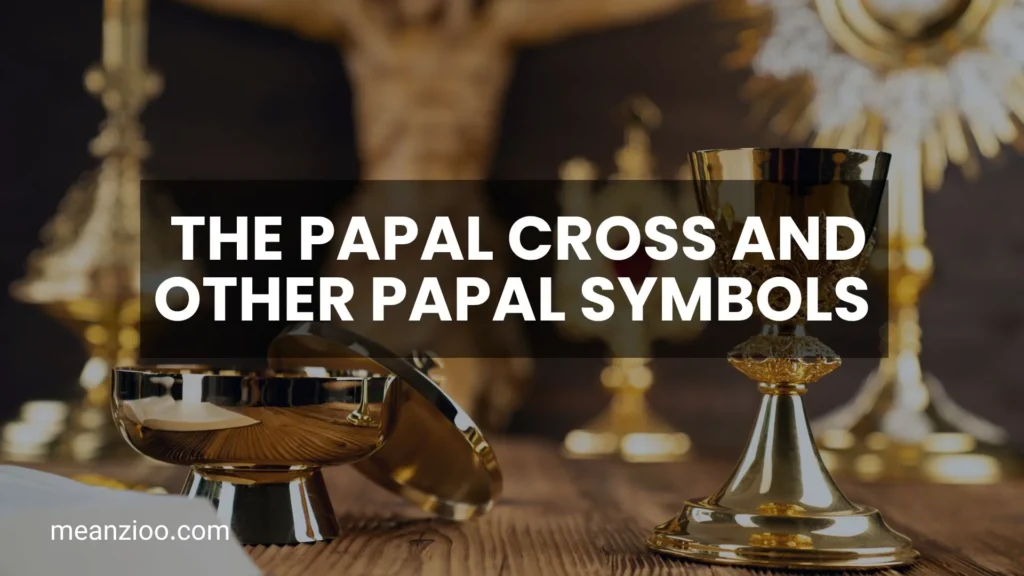
Catholic visual culture includes symbols connected with the pope and the Holy See.
The most recognizable include:
- Crosses
- Keys of Saint Peter
- Papal coats of arms
- Ecclesiastical heraldry
- The pallium
These symbols identify the Catholic Church’s hierarchical and historical traditions.
However, not every Catholic church will display all of these symbols.
38. Liturgical Colors
Liturgical colors are an important part of Catholic visual symbolism.
The four principal colors in the Roman Rite are:
White
White is associated with celebrations including Christmas and Easter, celebrations of the Lord other than His Passion, Mary, angels, and saints who are not martyrs.
Red
Red is associated with the Passion of Christ, Pentecost, Apostles, Evangelists, and martyrs.
Green
Green is used during Ordinary Time.
Violet
Violet is used during Advent and Lent and can also be used for Masses for the Dead.
Rose
Rose may be used on particular Sundays in Advent and Lent.
Black
Black may be used for Masses for the Dead.
Gold and Silver
Gold or silver may be used in the United States for particularly solemn celebrations in accordance with the relevant liturgical norms.
The colors therefore help worshippers understand where they are in the Church’s liturgical year.
39. Catholic Vestments as Symbols
The clothing worn by clergy during Mass can also communicate the sacred character of the celebration.
Important vestments include:
- Alb
- Stole
- Chasuble
- Dalmatic
- Cope
The color and design of vestments can correspond to the liturgical celebration.
For example, a priest wearing violet vestments may indicate Advent or Lent, while white may indicate a major celebration associated with Christ, Mary, or a non-martyr saint.
Also Check This POst:Symbols of Ireland: 15 Irish Symbols, Their Meanings, History, and Cultural Significance
40. The Sacred Vessels
Catholic churches use vessels specifically intended for liturgical worship.
These can include:
- Chalice
- Paten
- Ciborium
- Cruets
- Pyx
The chalice and paten are particularly associated with the Eucharistic celebration.
The General Instruction emphasizes that sacred vessels should be appropriate for their sacred purpose and distinguishable from ordinary vessels.
41. The Ciborium
A ciborium is a covered vessel used for holding consecrated hosts.
It may resemble a large cup with a lid.
The ciborium is different from the chalice even though both are sacred vessels.
A simple way to distinguish them is:
- Chalice: used for the Eucharistic wine.
- Ciborium: used for consecrated hosts.
42. The Paten
A paten is a plate or shallow dish used with the Eucharistic bread.
It is normally placed with the chalice during the preparation of the altar.
Together, the paten and chalice are among the most recognizable Eucharistic vessels.
43. The Angel
Angels frequently appear in Catholic religious art.
They may represent heavenly beings who worship God and serve as messengers.
You may see angels:
- Around Christ
- Near Mary
- Around the Eucharist
- In ceiling paintings
- In stained glass
- Near the altar
The Catechism includes angels among the sacred figures represented in Christian iconography.
44. The Serpent and Dragon
A serpent or dragon can appear in Catholic art with different meanings depending on the scene.
It may represent:
- Evil
- Sin
- Satan
- A defeated spiritual enemy
For example, Saint Michael is often depicted defeating a dragon or serpent, symbolizing victory over evil.
Similarly, the Virgin Mary may sometimes be represented standing on a serpent, referring to imagery associated with the defeat of evil.
45. The Sword
A sword can have several meanings in Catholic artwork.
It may represent:
- A martyr’s death
- Spiritual warfare
- The suffering of a saint
- The traditional attribute of a particular saint
Saint Paul, for example, is commonly associated with a sword because of his martyrdom and because the sword became one of his traditional artistic attributes.
Therefore, the meaning of a sword depends on the person or scene being represented.
46. The Book
A book is another common symbol in Catholic religious art.
It may represent:
- Sacred Scripture
- Teaching
- Wisdom
- A saint’s writings
- The Gospel
When a saint is depicted holding a book, it can help identify the saint or communicate his or her role as a teacher, writer, evangelist, or theologian.
Catholic Symbols vs. General Christian Symbols
One of the most important distinctions for readers is that not every Christian symbol is exclusively Catholic.
Many symbols belong to the wider Christian tradition.
Shared Christian Symbols
These commonly include:
- Cross
- Fish
- Dove
- Lamb
- Alpha and Omega
- Chi-Rho
- Biblical imagery
- Water
- Bread and wine
Catholics use these symbols, but they are not necessarily unique to Catholicism.
Particularly Catholic Visual Traditions
Other symbols or combinations are especially associated with Catholic practice, including:
- Crucifix
- Rosary
- Sacred Heart
- Immaculate Heart
- Eucharistic monstrance
- Tabernacle and sanctuary lamp
- Papal keys
- Catholic devotional images of saints
- Liturgical colors and objects used in the Roman Rite
This distinction makes an explanation of Catholic symbols more accurate.
Sacramental Symbols vs. Devotional Symbols
Another useful distinction is between liturgical or sacramental signs and devotional imagery.
Sacramental and Liturgical Signs
These are closely connected with the Church’s official liturgy and sacraments.
Examples include:
- Water in Baptism
- Bread and wine in the Eucharist
- Oil used in anointing
- The altar
- The ambo
- Liturgical candles
- Liturgical gestures
Devotional Symbols
These are often connected with personal or communal Catholic devotion.
Examples include:
- Rosary
- Sacred Heart
- Images of Mary
- Images of particular saints
- Religious medals
- Votive candles
The two categories can overlap, but they should not be treated as exactly the same.
How to Identify Catholic Symbols Inside a Church
If you enter a Catholic church and want to understand what you are seeing, start with the following areas.
Near the Entrance
Look for:
- Holy water font
- Cross
- Statues
- Baptismal font
Holy water near the entrance can remind Catholics of their Baptism.
In the Nave
Look for:
- Stations of the Cross
- Statues of Mary and saints
- Stained glass
- Religious paintings
- Votive candles
These features often support prayer and meditation.
In the Sanctuary
Look for:
- Altar
- Crucifix
- Candles
- Ambo
- Priest’s chair
- Tabernacle
The sanctuary is particularly important during Mass.
Near the Tabernacle
Look for:
- Tabernacle
- Sanctuary lamp
- Eucharistic artwork
- Monstrance in churches with Eucharistic adoration
In the Baptismal Area
Look for:
- Baptismal font
- Water
- Paschal candle
- Baptismal imagery
These symbols help connect the space with Christian initiation.
Why Are There So Many Symbols in Catholic Churches?
Catholic worship engages the whole person.
People:
- See images
- Hear Scripture
- Smell incense
- Touch objects
- Make gestures
- Kneel
- Stand
- Walk in procession
- Hear music
- Participate in prayer
This sensory dimension is intentional.
The Catechism explains that humans perceive spiritual realities through physical signs and symbols, and Catholic liturgy uses these visible and tangible realities to communicate God’s action and the response of worshippers.
Pope Leo XIV also emphasized in 2026 that liturgical signs and symbols involve the body, mind, and heart and can help believers enter more deeply into the mystery being celebrated.
Why Do Catholic Churches Use Images and Statues?

Catholic sacred art has a theological purpose.
The Catholic Church teaches that the Incarnation made the invisible God visible in the person of Jesus Christ. Consequently, Christian art can communicate the Gospel through visible representations.
The Catechism explains that sacred images principally represent Christ and that images of Mary, the saints, and angels are also part of Christian iconography.
This is why Catholic churches may contain:
- Crucifixes
- Paintings
- Statues
- Icons
- Mosaics
- Stained glass
- Relief sculptures
The purpose is not simply to make the building attractive. Sacred art can help believers contemplate the mysteries of Christian faith.
Do All Catholic Churches Have the Same Symbols?
No.
A Catholic church in Rome may look very different from one in Mexico, the Philippines, Ireland, the United States, Africa, or another part of the world.
Differences can result from:
- Local culture
- Architectural tradition
- Age of the church
- Artistic style
- Liturgical customs
- Patron saints
- Local devotions
- Available materials
A church dedicated to Saint Joseph may contain extensive imagery of Saint Joseph, while another church may emphasize a different saint or Marian devotion.
The core Catholic faith remains the same even though the visual language can vary.
Catholic Symbols and the Liturgical Year
Catholic symbolism changes throughout the year.
During Advent, violet is commonly seen and imagery can emphasize preparation and expectation.
During Christmas, white or gold becomes prominent and imagery focuses on the birth of Christ.
During Lent, violet is prominent and the church’s visual atmosphere becomes more penitential.
During Holy Week, the Passion of Christ becomes especially prominent.
During Easter, white and gold communicate celebration and the Resurrection.
During Ordinary Time, green is commonly used.
Thus, the same church building can look visually different depending on the liturgical season.
Common Catholic Symbols and Their Meanings
Here is a quick reference:
| Catholic Symbol | Meaning |
| Crucifix | Christ’s Passion and sacrifice |
| Cross | Christ’s death and salvation |
| Eucharistic host | Christ’s Body in Catholic Eucharistic faith |
| Chalice | Eucharistic Blood |
| Monstrance | Eucharistic adoration |
| Tabernacle | Reservation of the Blessed Sacrament |
| Sanctuary lamp | Indicates Eucharistic presence |
| Candle | Christ, light, reverence, and celebration |
| Paschal candle | Risen Christ |
| Dove | Holy Spirit |
| Sacred Heart | Christ’s love |
| Immaculate Heart | Mary’s love and devotion |
| Rosary | Prayer and meditation |
| Chi-Rho | Christ |
| IHS | Jesus |
| Alpha and Omega | Beginning and end |
| Fish | Christ and early Christianity |
| Lamb | Christ as Lamb of God |
| Wheat | Eucharistic bread |
| Grapes | Eucharistic wine |
| Water | Baptism and new life |
| Baptismal font | Christian initiation |
| Palm | Palm Sunday and martyrdom |
| Lily | Purity |
| Keys | Saint Peter and papacy |
| Incense | Reverence and prayer |
| Altar | Eucharistic celebration |
| Ambo | Proclamation of God’s Word |
| Liturgical colors | Liturgical season or celebration |
Frequently Asked Questions About Catholic Church Symbols
What is the main symbol of the Catholic Church?
The cross and crucifix are among the most recognizable symbols of Catholic Christianity. The crucifix is particularly associated with Christ’s Passion and sacrifice.
What is the most important Catholic symbol?
There is no single symbol that communicates every aspect of Catholic faith. The cross, Eucharist, crucifix, water, candles, and sacred images each communicate different aspects of Christian belief.
What does the crucifix mean in Catholicism?
The crucifix depicts Jesus on the cross and emphasizes His suffering and sacrificial death.
What does a Catholic church cross mean?
It points to Jesus Christ, His Passion, death, and saving work.
What does the dove mean in Catholic churches?
The dove traditionally represents the Holy Spirit, especially in connection with the Baptism of Jesus.
What does the chalice symbolize?
The chalice is the sacred cup associated with the wine used in the Eucharistic celebration.
What does the monstrance represent?
The monstrance is used to display the consecrated Eucharist during Eucharistic adoration and related processions.
What is the Catholic tabernacle?
The tabernacle is a secure place where the Blessed Sacrament is reserved.
Why is there a candle near the Catholic tabernacle?
A sanctuary lamp indicates the presence of the Blessed Sacrament when the Eucharist is reserved there.
What do Catholic church colors mean?
Liturgical colors communicate the character or season of the Church’s liturgical celebration. The principal colors include white, red, green, and violet, with rose, black, and gold or silver used in specified circumstances.
What does IHS mean?
IHS is a traditional Christian monogram associated with the name of Jesus.
What does Chi-Rho mean?
Chi-Rho is an ancient Christian monogram associated with Christ.
Why do Catholic churches have statues?
Sacred statues and other images help communicate and contemplate the Christian mysteries and the people represented. Catholic teaching places sacred images within the tradition of Christian iconography.
Are Catholic symbols the same as Christian symbols?
Some are. The cross, fish, dove, lamb, and Alpha and Omega are used broadly throughout Christianity. Other symbols, such as the rosary, monstrance, Sacred Heart, and papal keys, are particularly associated with Catholic tradition.
What does water symbolize in Catholicism?
Water is especially associated with Baptism and can represent cleansing, new life, and participation in Christ’s death and resurrection.
What does incense symbolize in a Catholic church?
Incense expresses reverence and prayer. Its use can accompany the altar, Gospel book, Eucharistic offerings, Blessed Sacrament, priest, and congregation during Mass.
Final Thoughts
Catholic Church symbols form a rich visual and physical language of faith.
The cross and crucifix point to Christ’s Passion. The Eucharist, chalice, host, monstrance, and tabernacle communicate the central place of the Eucharist in Catholic worship. Water and the baptismal font point toward Christian initiation, while candles and the Paschal candle use the symbolism of light to communicate Christ and Christian hope.
Images of Mary and the saints, the rosary, Sacred Heart, Immaculate Heart, and other devotional symbols express important traditions of Catholic prayer. Meanwhile, the altar, ambo, sanctuary, sacred vessels, gestures, incense, and liturgical colors help structure and communicate the Church’s worship.
Perhaps the most important thing to understand is that Catholic symbols are not merely decorations. They connect visible things with invisible realities and help worshippers engage with the Christian mysteries through sight, sound, movement, touch, and prayer. That understanding is consistent with Catholic teaching on signs and symbols and with recent Vatican teaching emphasizing the role of liturgical signs in helping believers participate more deeply in worship.
For readers trying to understand what they see inside a Catholic church, learning these symbols provides a useful visual key: the objects, colors, images, gestures, and spaces all work together to tell the story of Catholic faith.
Also Check This POst:Valentine’s Day Symbols: Meanings, History, Colors, and Significance

I’m Ryan Mitchell, and I write about modern English, trending slang, and online expressions. I enjoy explaining the meanings, origins, and real-life usage of popular words in a simple way. I believe learning slang is an important step toward understanding today’s English-speaking culture. Through my work, I aim to help readers speak more naturally and stay updated with the latest language trends.