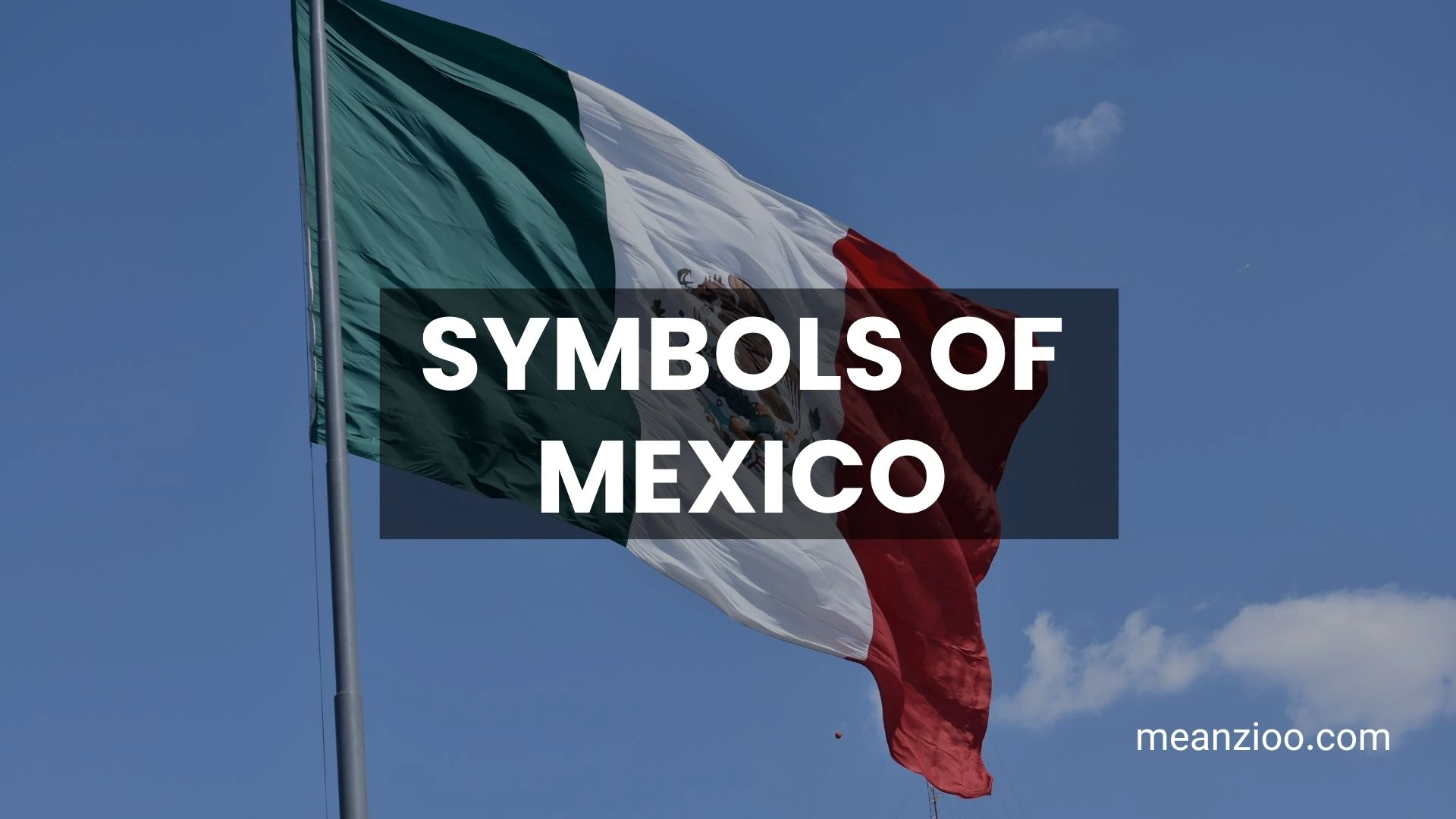
Mexico has some of the world’s most recognizable national and cultural symbols. From the green, white, and red Mexican flag to the eagle, serpent, and nopal cactus on the National Coat of Arms, these symbols reflect Mexico’s history, Indigenous heritage, independence, traditions, religion, nature, and modern identity.
If you are searching for symbols of Mexico, the most important distinction to understand is that Mexico has three official patriotic symbols: the National Flag, National Coat of Arms, and National Anthem. Other well-known images—such as the golden eagle, nopal cactus, marigold, Día de los Muertos skulls, mariachi, sombrero, dahlia, and ahuehuete—are important cultural, historical, or natural symbols, but they are not all official Símbolos Patrios.
Mexican law specifically identifies the flag, coat of arms, and anthem as the country’s patriotic symbols.
Quick Answer: What Are the Symbols of Mexico?
The main symbols associated with Mexico include:
- Mexican National Flag — represents national identity, history, and unity.
- National Coat of Arms — shows an eagle, serpent, nopal cactus, rock, water, oak, and laurel.
- National Anthem — represents patriotism and national identity.
- Golden eagle — a powerful national and historical symbol.
- Nopal cactus — connected to the traditional founding story of Mexico-Tenochtitlan.
- Serpent — part of the National Coat of Arms and the traditional founding imagery.
- Green, white, and red — the colors of the national flag.
- Dahlia — Mexico’s national flower.
- Ahuehuete — Mexico’s national tree.
- Día de los Muertos — a major cultural tradition associated with remembrance.
- Cempasúchil (marigold) — strongly associated with Día de los Muertos.
- Calaveras and La Catrina — famous Mexican artistic and cultural imagery.
- Mariachi — a major symbol of Mexican musical heritage.
- Corn or maize — deeply connected with Indigenous Mexican culture and cuisine.
- Agave — represents Mexican landscapes, agriculture, and traditional practices.
- Axolotl — a distinctive symbol of Mexico’s biodiversity.
- Quetzalcoatl — an important figure in Mesoamerican cultural history.
- Virgin of Guadalupe — an influential religious and cultural symbol in Mexico.
- Charro traditions and sombreros — recognizable representations of Mexican cultural heritage.
What Are Mexico’s 3 Official National Symbols?
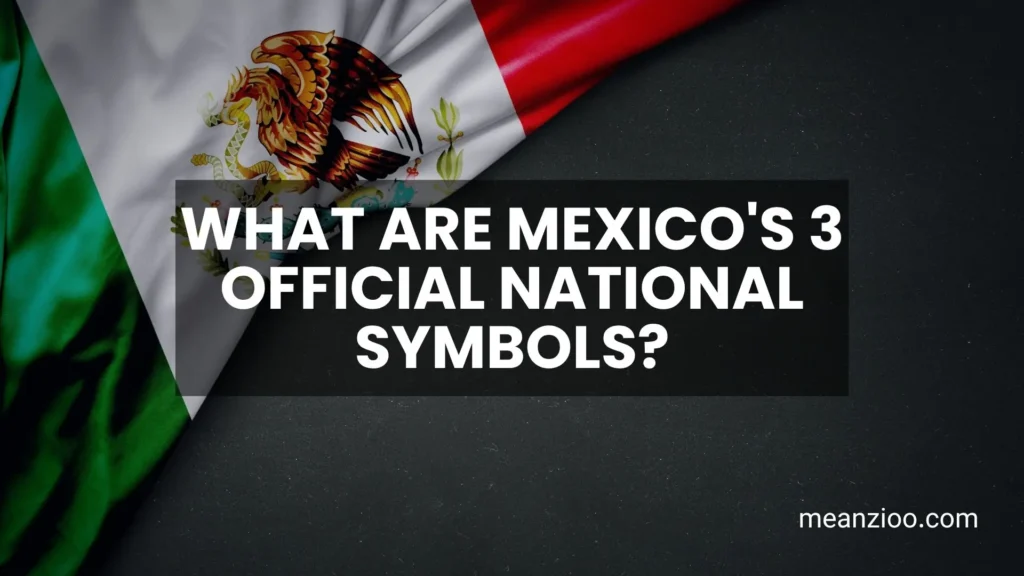
Mexico’s three official patriotic symbols are the National Coat of Arms, National Flag, and National Anthem. This is established by Mexico’s Law on the National Coat of Arms, Flag, and Anthem.
This distinction is important because many websites list dozens of things as “national symbols of Mexico” without explaining whether they are legally official symbols or simply cultural icons.
The 3 official symbols are:
- National Flag
- National Coat of Arms
- National Anthem
Other symbols discussed in this article represent Mexico’s culture, history, religion, nature, Indigenous heritage, or traditions.
1. Mexican National Flag
The Mexican flag is arguably the country’s most recognizable official symbol.
It consists of three vertical bands:
- Green
- White
- Red
The National Coat of Arms appears in the center of the white band. Mexico’s national-symbols law defines the flag’s characteristics, including its colors, proportions, and central emblem.
The flag’s modern history is closely connected with Mexico’s independence. The Mexican government’s Archivo General de la Nación explains that the three-color design emerged prominently with the Army of the Three Guarantees in 1821, when green, white, and red represented religion, independence, and union.
What Do the Mexican Flag Colors Mean?
A common explanation assigns modern symbolic meanings to the colors, but historically the meanings have changed.
The 1821 Trigarante interpretation connected:
- White with religion
- Green with independence
- Red with union
Later interpretations changed as Mexico’s political and national identity developed. Therefore, it is more accurate to explain the colors through their historical evolution rather than claiming that one modern interpretation has always been their meaning.
Why Is the Mexican Flag Important?
The flag represents:
- Mexican sovereignty
- National unity
- Independence
- Historical memory
- National identity
It is displayed at government buildings, schools, public ceremonies, sporting events, and national celebrations.
Mexico also celebrates Día de la Bandera, or Flag Day, on February 24.
2. National Coat of Arms of Mexico
The National Coat of Arms is the central image on the Mexican flag and one of the country’s most distinctive symbols.
Its main design shows an eagle standing on a nopal cactus while holding and biting a serpent. The cactus grows from a rock associated with a lake, and oak and laurel branches appear below the central scene. Mexican law formally defines the characteristics of the National Coat of Arms.
The emblem connects modern Mexican national identity with the historical tradition surrounding Mexico-Tenochtitlan.
The Eagle, Snake, and Cactus
The famous image is commonly connected with the Mexica founding story of Tenochtitlan.
According to the traditional narrative, the Mexica were instructed to establish their settlement where they saw an eagle associated with a nopal. However, historians caution that the exact modern image of an eagle devouring a serpent should not automatically be treated as a literal depiction found in every pre-Hispanic or colonial source. Mexico’s National Institute of Anthropology and History notes that no pre-Hispanic or colonial document describes the exact scene in the modern form.
This distinction makes the symbol even more interesting: the modern coat of arms is a national emblem shaped by historical memory, artistic development, and the traditions surrounding the founding of Mexico-Tenochtitlan.
3. The Golden Eagle
The golden eagle, or águila real, is one of Mexico’s most important animal symbols.
The species is Aquila chrysaetos. Mexican government conservation authorities describe the golden eagle as a national symbol with deep cultural importance.
The eagle has long been associated with ideas such as:
- Strength
- Courage
- Power
- The sun
- National pride
- Mexican heritage
Its presence in the National Coat of Arms gives the bird an especially important place in Mexican identity.
4. The Nopal Cactus
The nopal cactus is one of the most recognizable symbols of Mexico.
In the National Coat of Arms, the eagle stands on a nopal growing from a rock.
The nopal is also important outside the national emblem. It is deeply connected with Mexican food, agriculture, landscapes, and Indigenous traditions.
You can find nopal in traditional dishes such as:
- Nopal salads
- Tacos
- Soups
- Stews
- Grilled dishes
Because it is both a national emblem and an everyday plant, the nopal provides a strong connection between Mexico’s historical identity and contemporary life.
5. The Serpent
The serpent is another central element of the National Coat of Arms.
It appears in the eagle’s beak and talon, forming the dramatic central scene that many people immediately associate with Mexico.
The serpent should not be understood through a single universal meaning. Snakes had different meanings across Mesoamerican cultures and historical periods.
In the modern Mexican coat of arms, however, the serpent is primarily understood as part of the national emblem’s historical and symbolic composition.
Symbols of Mexico Flag
The Mexican flag is one of the most important national symbols of Mexico. It has three vertical bands: green, white, and red. In the center of the white band is the national coat of arms, showing an eagle perched on a prickly pear cactus while holding a snake.
The colors are commonly associated with Mexico’s history and national identity. The eagle, snake, cactus, and lake scene come from the famous Mexica (Aztec) foundation story associated with the founding of Tenochtitlan, the city that later became Mexico City.
The flag represents Mexican independence, history, unity, and national pride. It is especially visible during Día de la Independencia, when Mexican communities decorate streets, homes, schools, and public buildings with the national colors.
Mexico Symbols and Meanings
Mexico has many symbols that reflect its Indigenous heritage, colonial history, independence, nature, and modern culture. Some of the best-known symbols include the Mexican eagle and snake, prickly pear cactus, national flag, national coat of arms, golden eagle, jaguar, axolotl, dahlia, mariachi, and sombrero.
Each symbol has a different story. The eagle and snake are closely connected with the Mexica origin story, while the dahlia represents Mexico’s native plant heritage. The axolotl is strongly associated with Mexico’s freshwater ecosystems and Indigenous history, particularly around the Valley of Mexico.
Other cultural symbols, such as mariachi music, Día de Muertos imagery, colorful papel picado, and traditional Mexican cuisine, represent the country’s living cultural identity rather than being official national emblems.
Symbols of Mexico City
Mexico City has symbols that connect its modern identity with the ancient city of Tenochtitlan. One of the most recognizable is the eagle standing on a prickly pear cactus with a snake in its beak, a design that appears in Mexico’s national coat of arms.
The city’s historic center also represents the meeting of Indigenous and Spanish colonial history. Important landmarks such as the Zócalo, Metropolitan Cathedral, Templo Mayor, and Palacio Nacional help tell this story.
The symbol of the eagle and cactus is particularly meaningful because it recalls the traditional Mexica story of seeing an eagle on a cactus as a sign that they had found the place where they should establish their city.
Mexico National Animal Jaguar
The jaguar is one of the most powerful animals associated with Mexican culture and history. Although the jaguar is often described online as Mexico’s “national animal,” Mexico does not have a single legally designated official national animal in the same way that some countries do.
The jaguar has enormous cultural importance. Ancient Mesoamerican civilizations viewed it as a powerful and spiritually significant creature. In Mexica culture, jaguars were associated with warriors, strength, nighttime, and the supernatural world.
Today, the jaguar is also an important symbol of Mexico’s natural heritage. Wild jaguars still live in parts of southern Mexico, including areas of the Yucatán Peninsula and other tropical regions. Its status as an apex predator makes it an important part of Mexico’s ecosystems.
Mexican Symbol Eagle
The eagle is perhaps the most recognizable animal symbol of Mexico. It appears at the center of the Mexican coat of arms and on the national flag.
The eagle is shown standing on a prickly pear cactus while holding a snake. This image is connected with the traditional Mexica story about the founding of Tenochtitlan.
The eagle has also come to represent strength, courage, independence, and Mexican identity. Because it appears on official national symbols, it is one of the strongest visual representations of Mexico around the world.
Mexico National Animal Axolotl
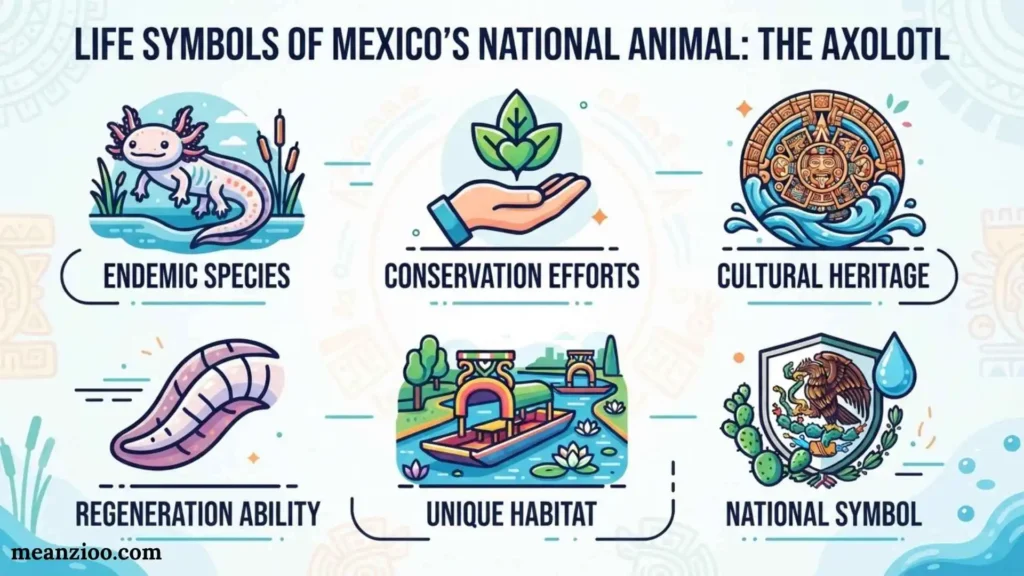
The axolotl is one of Mexico’s most distinctive native animals. It is a type of salamander famous for its unusual appearance and remarkable ability to regenerate certain body tissues.
The axolotl is native to the waterways around Mexico City, especially the Xochimilco area. It also has deep connections to Mexican history and mythology. Its name comes from Nahuatl and is associated with Xolotl, a deity in Mexica mythology.
Although the axolotl is frequently called Mexico’s national animal on websites and social media, it is more accurate to describe it as an iconic Mexican species and cultural symbol, rather than a formally designated national animal.
Its endangered status also makes it a symbol of conservation and the need to protect Mexico’s unique natural habitats.
Symbols of Mexico Culture
Mexican culture is represented by a huge range of symbols, from ancient Indigenous traditions to modern artistic expressions. Some of the most recognizable include Día de Muertos, mariachi music, papel picado, traditional pottery, alebrijes, the Mexican flag, the eagle and snake, and traditional foods.
Día de Muertos is especially important because it reflects a cultural approach to remembering deceased family members. Marigold flowers, decorated altars, candles, photographs, and colorful paper decorations are commonly associated with the celebration.
Mexican cultural symbols also vary by region. Indigenous communities, for example, have their own languages, clothing, art, ceremonies, foods, and symbols. This diversity is an important part of Mexico’s national identity.
National Symbols of Mexico Fruit
Mexico does not have a universally recognized official national fruit established in the same way that it has official national symbols such as the flag, coat of arms, and national anthem.
However, several fruits are strongly connected with Mexican agriculture and culture. The avocado is one of the most internationally recognizable Mexican crops, and Mexico is a major producer of avocados.
The prickly pear, known in Mexico as tuna, also has special symbolic importance because the cactus appears in the national coat of arms. This makes the prickly pear plant more significant as a national symbol than many ordinary fruits.
So, if someone asks about Mexico’s “national fruit,” it is better to explain the distinction between an official national symbol and a fruit that is culturally or agriculturally important.
What Are the National Symbols of Mexico?
Mexico’s most important official national symbols are the national flag, national coat of arms, and national anthem.
The coat of arms is particularly distinctive. It shows a golden eagle standing on a prickly pear cactus and holding a snake. The scene is surrounded by elements representing Mexico’s natural and historical heritage.
Mexico also has officially recognized symbols associated with its natural heritage. The golden eagle is closely connected to the national coat of arms, while the dahlia is Mexico’s national flower.
Beyond official symbols, animals such as the jaguar and axolotl, cultural traditions such as Día de Muertos, and music such as mariachi are widely recognized as symbols of Mexican identity.
Symbols of Mexico City
Some of the most recognizable symbols of Mexico City are connected to its Indigenous roots and historic development. The eagle, cactus, and snake are especially important because they recall the traditional Mexica foundation story.
The Zócalo is another powerful symbol of the city. Located in the historic center, it is one of the country’s most important public spaces and is surrounded by major historic buildings.
Templo Mayor represents the ancient Mexica capital of Tenochtitlan, while the Metropolitan Cathedral reflects the city’s Spanish colonial and Catholic history. Together, these landmarks show how Mexico City developed through several layers of history.
Famous Symbols of Mexico
Mexico is recognized worldwide through a mixture of official symbols, animals, traditions, foods, and cultural icons. Famous examples include:
- 🇲🇽 The Mexican flag
- 🦅 The eagle and snake
- 🌵 The prickly pear cactus
- 🐆 The jaguar
- 🦎 The axolotl
- 🌺 The dahlia
- 🎺 Mariachi music
- 💀 Día de Muertos imagery
- 🌼 Marigold flowers
- 🎨 Alebrijes
- 🌮 Mexican cuisine
- 👒 Traditional sombreros
- 🪅 Piñatas
Not all of these are legally designated national symbols. Instead, they represent different parts of Mexico’s history, biodiversity, traditions, and everyday culture.
What Are Some Symbols of Mexico?
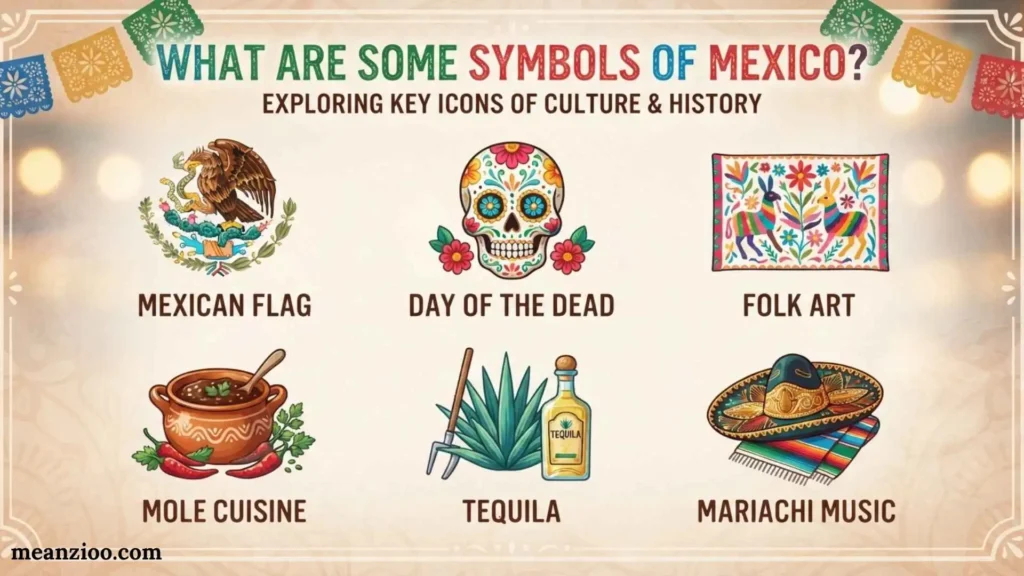
If you are looking for symbols that immediately make people think of Mexico, the Mexican flag, eagle and snake, cactus, jaguar, axolotl, dahlia, mariachi, Día de Muertos, marigolds, and alebrijes are strong examples.
The eagle and cactus are especially important because they appear in Mexico’s official coat of arms. The jaguar and axolotl represent Mexico’s wildlife, while mariachi and Día de Muertos represent important parts of its cultural heritage.
Food can also act as a cultural symbol. Tacos, maize, chili peppers, chocolate, and traditional Mexican cooking have become globally recognized parts of Mexican culture.
Official Animal of Mexico
Mexico does not have one simple official national animal comparable to countries that formally designate a single species as their national animal.
The golden eagle has the strongest official connection because it is the eagle depicted on Mexico’s national coat of arms and flag. The jaguar is another major symbol because of its importance in Indigenous history and Mexican biodiversity.
The axolotl is also an iconic Mexican species, particularly because of its connection to Xochimilco and Mexica culture.
Therefore, when discussing Mexico’s national animal, it is important not to present the jaguar or axolotl as an officially designated national animal without qualification.
Things That Represent Mexico
Many things can represent Mexico depending on whether you are talking about government symbols, history, wildlife, or popular culture.
The Mexican flag and coat of arms represent the nation officially. The eagle, snake, and cactus connect modern Mexico with its ancient Indigenous history. The jaguar and axolotl represent Mexico’s remarkable biodiversity.
For culture, Día de Muertos, mariachi, papel picado, alebrijes, traditional clothing, Mexican cuisine, and colorful folk art are widely recognized representations of the country.
These symbols should not be treated as if Mexico has only one culture. Mexico is home to many Indigenous peoples and regional traditions, making its cultural identity much more diverse than a short list of popular images can show.
Mexico National Bird and Flower
Mexico’s national bird is the golden eagle, the same eagle represented in the national coat of arms. It is a powerful symbol of strength and national identity.
Mexico’s national flower is the dahlia (Dahlia pinnata is commonly associated with the cultivated national flower). Dahlias are native to Mexico and have a long history in the country’s botanical and cultural heritage.
The combination of the golden eagle and dahlia reflects two different sides of Mexican identity: the eagle represents national history and symbolism, while the dahlia highlights Mexico’s rich native plant heritage.
Mexico’s Motto
Mexico does not have a single universally recognized official national motto comparable to countries whose constitutions formally establish one.
One phrase strongly associated with Mexican history is “La Patria Es Primero,” meaning “The Homeland Comes First.” It is famously linked with Vicente Guerrero and expresses the idea of placing the nation above personal interests.
Another important phrase associated with Mexico’s national identity is “¡Viva México!”, which is widely used during patriotic celebrations, especially around Mexican Independence Day. However, this is a patriotic expression rather than an official national motto.
For accuracy, it is best to distinguish between historical patriotic phrases and an officially designated national motto when writing about Mexico’s symbols.
6. Green, White, and Red
The combination of green, white, and red is one of the easiest visual ways to identify Mexico.
The colors appear on:
- The national flag
- Independence Day decorations
- Clothing
- Public celebrations
- Sports merchandise
- Mexican-themed artwork
- Festivals
Their historical importance comes particularly from the independence era and the 1821 Army of the Three Guarantees.
7. Mexican National Anthem
The Mexican National Anthem is the third official patriotic symbol.
Mexico’s national-symbols law establishes the anthem as one of the country’s three Símbolos Patrios.
The anthem expresses themes of:
- Patriotism
- Courage
- Defense of the homeland
- National unity
- Mexican sovereignty
It is performed during official ceremonies and other events where national symbols are honored.
Unlike the flag and coat of arms, the anthem represents Mexico through music and words rather than a visual image.
Also Check This Post:Valentine’s Day Symbols: Meanings, History, Colors, and Significance
8. Mexico’s National Flower: Dahlia
The dahlia is Mexico’s national flower.
The Mexican government states that the dahlia was declared the National Flower and a symbol of national floriculture in 1963.
The flower has deep Mexican roots. Government agricultural sources note that the dahlia is native to Mexico and was known in pre-Hispanic times by names including acocoxóchitl.
Why Is the Dahlia a Symbol of Mexico?
The dahlia represents:
- Mexican biodiversity
- Natural beauty
- Indigenous plant knowledge
- Horticultural heritage
- Cultural history
It is available in numerous shapes and colors, making it one of Mexico’s most distinctive native flowers.
Dahlia vs. Marigold
A common mistake is to call the marigold Mexico’s national flower.
The distinction is:
- Dahlia = Mexico’s national flower.
- Cempasúchil/marigold = a powerful cultural symbol, especially associated with Día de los Muertos.
This difference is important when answering questions about Mexican national symbols.
9. Mexico’s National Tree: Ahuehuete
The ahuehuete, also called the Mexican cypress or Taxodium mucronatum, is recognized as Mexico’s national tree.
Mexico’s National Forestry Commission explains that the ahuehuete was designated the National Tree in 1921 during commemorations of independence.
The name comes from Nahuatl and is associated with the idea of an “old tree of water,” reflecting the tree’s tendency to grow near water.
What Does the Ahuehuete Represent?
Because these trees can live for centuries, the ahuehuete is strongly associated with:
- Longevity
- History
- Mexican landscapes
- Water
- Continuity
- National heritage
Famous ahuehuetes include the enormous Árbol del Tule in Oaxaca and historically important trees associated with Mexico’s past.
10. Día de los Muertos
Día de los Muertos, or Day of the Dead, is one of the most recognizable Mexican cultural traditions.
It is not one of Mexico’s three official patriotic symbols, but it is one of the country’s most internationally recognized cultural traditions.
UNESCO recognized the Indigenous festivity dedicated to the dead as Intangible Cultural Heritage in 2008. The tradition combines Indigenous practices with Catholic influences introduced during the colonial period.
The celebration focuses on remembering and honoring deceased relatives and loved ones.
Common Día de los Muertos Symbols
Important imagery includes:
- Cempasúchil flowers
- Candles
- Ofrendas
- Photographs
- Calaveras
- Papel picado
- Food offerings
- Pan de muerto
- Incense
- La Catrina
These symbols emphasize remembrance, family, memory, and the relationship between the living and the dead.
11. Cempasúchil: The Mexican Marigold
The cempasúchil, often called Mexican marigold, is strongly associated with Día de los Muertos.
Its bright orange and yellow flowers are commonly used to decorate altars and graves.
Rather than simply representing death, the flower is part of a broader tradition of welcoming and remembering deceased loved ones.
Its importance is particularly visible during the Day of the Dead period.
12. Calaveras and Sugar Skulls
Calaveras, or skulls, are among the most recognizable images associated with Mexican culture.
During Día de los Muertos, skull imagery can appear as:
- Sugar skulls
- Painted faces
- Ceramic figures
- Paper decorations
- Illustrations
- Jewelry
- Artwork
The colorful appearance of these skulls can be surprising to people unfamiliar with the tradition.
They are generally connected with remembrance and celebration of life, rather than simply fear or horror.
13. La Catrina
La Catrina is another iconic Mexican cultural image.
She is commonly represented as an elegantly dressed female skeleton.
The modern image is strongly associated with the Mexican printmaker José Guadalupe Posada, whose work helped establish the skeleton figure as a powerful form of social and political commentary. Later Mexican artists helped popularize La Catrina as a cultural icon.
Today she is especially visible during Día de los Muertos through:
- Makeup
- Costumes
- Paintings
- Sculptures
- Posters
- Festivals
- Public art
La Catrina is therefore a cultural and artistic symbol rather than an official national emblem.
Also Check This Post:Symbols of Ireland: 15 Irish Symbols, Their Meanings, History, and Cultural Significance
14. Mariachi
Mariachi is one of the most recognizable musical symbols of Mexico.
The tradition is associated with instruments such as:
- Violins
- Trumpets
- Vihuela
- Guitar
- Guitarrón
Mariachi musicians are also known for distinctive charro-inspired clothing.
The Mexican government describes mariachi as one of the country’s most representative musical and cultural expressions. UNESCO included Mariachi, string music, song and trumpet on the Representative List of the Intangible Cultural Heritage of Humanity in 2011.
What Does Mariachi Represent?
Mariachi can symbolize:
- Mexican musical heritage
- Celebration
- Family
- Regional traditions
- National identity
- Cultural pride
It is performed at weddings, birthdays, festivals, public celebrations, restaurants, and national events.
15. The Sombrero
The sombrero is a widely recognized cultural symbol associated with Mexico.
However, there is no single traditional Mexican hat. Mexico has many regional styles of hats and headwear.
The oversized sombrero commonly seen in international popular culture is only one representation of Mexican hat traditions.
The sombrero is particularly associated with:
- Charro culture
- Ranching traditions
- Festive clothing
- Regional celebrations
- Mexican performance traditions
It is therefore best understood as a broad cultural icon rather than an official national symbol.
16. The Charro Tradition
Charrería, the traditional Mexican equestrian culture, is another important symbol of Mexican heritage.
Charros are associated with skilled horsemanship, ranching traditions, distinctive clothing, and organized equestrian events.
The traditional charro outfit can include:
- Embroidered jacket
- Fitted trousers
- Wide-brimmed sombrero
- Boots
- Belt
- Decorative accessories
Mexico’s cultural institutions identify charrería among the country’s important cultural heritage traditions.
17. Corn or Maize
Corn, or maize, is one of the deepest cultural symbols associated with Mexico.
Maize has been central to Mesoamerican agriculture and remains fundamental to Mexican cuisine.
Traditional foods based on maize include:
- Tortillas
- Tamales
- Tostadas
- Pozole
- Atole
- Many regional dishes
Corn represents much more than food. It connects modern Mexico with Indigenous agricultural knowledge and centuries of cultural history.
18. Agave
The agave plant is another important symbol of Mexico.
Agave species have been used for:
- Food
- Fiber
- Traditional beverages
- Crafts
- Agriculture
- Cultural practices
Different agave species are associated with different regions and traditions.
Agave therefore represents Mexico’s relationship with its landscape and the knowledge developed by communities over generations.
19. Axolotl
The axolotl is one of Mexico’s most fascinating natural symbols.
This unusual amphibian is native to the Valley of Mexico and is strongly associated with the canals and wetlands of Xochimilco.
The animal has become an icon of:
- Mexican biodiversity
- Conservation
- Indigenous and Mesoamerican heritage
- Natural history
Its unusual ability to regenerate body parts has also made it famous in scientific research.
Unlike the eagle, the axolotl is not one of Mexico’s official patriotic symbols, but it has become an increasingly recognizable representation of the country’s unique natural heritage.
20. Quetzalcoatl and Mesoamerican Heritage
Quetzalcoatl, commonly translated as the Feathered Serpent, is an important figure in Mesoamerican cultural history.
The name combines the idea of the quetzal bird with the serpent.
Quetzalcoatl appears in different traditions and historical contexts, so it should not be treated as though all Mesoamerican peoples understood the figure in exactly the same way.
The symbol is nevertheless important for understanding Mexico’s pre-Hispanic heritage and the civilizations that existed before Spanish colonization.
21. The Virgin of Guadalupe
The Virgin of Guadalupe is one of Mexico’s most influential religious and cultural images.
Her image is associated particularly with the Basilica of Our Lady of Guadalupe in Mexico City and with the annual celebration of December 12.
She has played an important role in Mexican religious history, art, identity, and popular culture.
The image also became connected with Mexico’s independence movement. During the beginning of the 1810 uprising, Miguel Hidalgo famously used an image of the Virgin of Guadalupe as a banner.
Because of her religious importance, she should be described as a religious and cultural symbol, not one of Mexico’s three official patriotic symbols.
22. Ancient Pyramids and Archaeological Sites
Mexico’s ancient archaeological sites are also powerful symbols of its history.
Some of the most famous include:
- Teotihuacan
- Chichén Itzá
- Palenque
- Monte Albán
- Tulum
- El Tajín
These sites represent the achievements of different Mesoamerican civilizations.
It is important not to treat all ancient Mexican cultures as one civilization. Mexico’s pre-Hispanic history includes many distinct peoples and societies, including the Maya, Mexica, Zapotec, Mixtec, Teotihuacan, and many others.
23. Mexican Food as a Cultural Symbol
Mexican cuisine is itself a major cultural representation of Mexico.
Traditional foods and ingredients include:
- Tacos
- Tamales
- Mole
- Enchiladas
- Pozole
- Tortillas
- Chiles
- Beans
- Corn
- Cacao
- Avocado
Food traditions reflect the combination of Indigenous knowledge, regional diversity, colonial influences, and modern Mexican culture.
Mexico’s traditional cuisine is also internationally recognized as an important part of the country’s cultural heritage. Mexican government cultural materials include Traditional Mexican Cuisine among the Mexican cultural elements recognized by UNESCO.
24. Papel Picado
Papel picado is a decorative Mexican paper-cutting tradition.
Intricately cut sheets of colored tissue paper are commonly used during:
- Día de los Muertos
- Weddings
- Festivals
- National celebrations
- Religious events
The decorations often feature flowers, skeletons, geometric patterns, birds, and other designs.
Papel picado is especially recognizable because it adds movement and color to Mexican celebrations.
25. Mexican Talavera
Talavera pottery is another important cultural symbol.
Traditional Talavera ceramics are associated particularly with Puebla and nearby regions.
The distinctive decorated pottery can include:
- Plates
- Tiles
- Bowls
- Vases
- Decorative objects
It represents Mexican craftsmanship and the long history of ceramic production and artistic exchange.
Mexico’s cultural institutions include Talavera among the country’s recognized cultural heritage elements.
26. Regional Symbols of Mexico
Mexico does not have one single cultural identity. Its regions have their own symbols, foods, clothing, music, crafts, and traditions.
Examples include:
Oaxaca
Often associated with:
- Día de los Muertos traditions
- Zapotec and Mixtec heritage
- Alebrijes
- Mole
- Mezcal
- Traditional textiles
Yucatán
Known for cultural associations with:
- Maya heritage
- Chichen Itza
- Regional cuisine
- Traditional clothing
- Maya architecture
Jalisco
Strongly associated with:
- Mariachi
- Charrería
- Tequila
- Charro traditions
Puebla
Known for:
- Talavera
- Mole poblano
- Colonial architecture
- Regional crafts
Mexico City
Associated with:
- Mexico-Tenochtitlan
- The National Palace
- Museums
- Xochimilco
- Contemporary Mexican culture
These examples show why “Mexican symbols” cannot be reduced to a few stereotypical images.
Official vs. Cultural Symbols of Mexico
This is one of the most important distinctions for anyone researching the topic.
| Category | Examples |
| Official patriotic symbols | Flag, Coat of Arms, National Anthem |
| National natural symbols | Golden eagle, dahlia, ahuehuete |
| Indigenous/historical symbols | Nopal, eagle, serpent, Quetzalcoatl, maize |
| Cultural symbols | Mariachi, sombrero, charrería, Talavera |
| Día de los Muertos symbols | Cempasúchil, calaveras, La Catrina, candles, ofrendas |
| Religious symbols | Virgin of Guadalupe |
| Natural/cultural heritage | Axolotl, agave, maize |
| Architectural/historical symbols | Pyramids and archaeological sites |
This classification prevents a common mistake: not every famous symbol associated with Mexico is an official national symbol.
Symbols of Mexico and Their Meanings
| Symbol | Main Meaning or Association |
| Mexican Flag | National identity, unity, and sovereignty |
| National Coat of Arms | Mexican history and national identity |
| National Anthem | Patriotism and national unity |
| Golden Eagle | Strength, courage, and heritage |
| Nopal | Mexico-Tenochtitlan tradition and Mexican landscape |
| Serpent | Part of the National Coat of Arms |
| Dahlia | Mexican natural heritage and national floriculture |
| Ahuehuete | Longevity and Mexican history |
| Cempasúchil | Remembrance and Día de los Muertos |
| Calavera | Memory, mortality, and cultural celebration |
| La Catrina | Mexican art and Día de los Muertos |
| Mariachi | Music and Mexican cultural identity |
| Sombrero | Traditional Mexican culture |
| Charrería | Equestrian and ranching heritage |
| Corn | Indigenous heritage and Mexican cuisine |
| Agave | Agriculture and traditional culture |
| Axolotl | Mexican biodiversity |
| Quetzalcoatl | Mesoamerican heritage |
| Virgin of Guadalupe | Religious and cultural identity |
| Papel Picado | Celebration and Mexican decorative art |
| Talavera | Mexican craftsmanship |
| Ancient Pyramids | Pre-Hispanic civilizations |
Why Are Mexican Symbols Important?
Mexican symbols are important because they connect different layers of the country’s identity.
They can represent:
Indigenous heritage
Symbols such as maize, the nopal, Quetzalcoatl, and the eagle connect Mexico with its pre-Hispanic past.
Independence
The Mexican flag and its historical development are closely connected with the country’s independence movement.
Religion
The Virgin of Guadalupe and many Día de los Muertos traditions demonstrate the importance of religious and spiritual traditions in Mexican culture.
Nature
The dahlia, ahuehuete, golden eagle, axolotl, agave, and nopal demonstrate Mexico’s extraordinary biodiversity.
Art and creativity
La Catrina, papel picado, Talavera, textiles, murals, and traditional crafts demonstrate Mexico’s artistic heritage.
Music and celebration
Mariachi, regional music, dance, festivals, and charrería contribute to the country’s cultural identity.
Common Misconceptions About Mexican Symbols
Is the Mexican eagle the same as the golden eagle?
The eagle in the Mexican Coat of Arms is commonly referred to as the Mexican eagle. Mexico’s golden eagle, Aquila chrysaetos, is also officially described by Mexican government institutions as a national symbol.
However, it is better not to assume that every artistic representation of the coat of arms is simply a zoologically exact illustration of a particular modern bird.
Is the marigold Mexico’s national flower?
No. The dahlia is Mexico’s national flower.
The cempasúchil or marigold is an important cultural flower, especially during Día de los Muertos.
Is Día de los Muertos an official national symbol?
No. It is a major Mexican cultural tradition rather than one of the three official patriotic symbols.
Is the sombrero Mexico’s official symbol?
No. The sombrero is a widely recognized cultural icon, but it is not one of Mexico’s three official patriotic symbols.
Is the eagle, cactus, and snake story historically exact?
The imagery is strongly associated with the traditional founding story of Mexico-Tenochtitlan. However, historians caution against assuming that the exact modern composition appears unchanged in ancient sources. INAH specifically notes that the precise modern scene is not described in surviving pre-Hispanic or colonial documents.
Frequently Asked Questions About Symbols of Mexico
What are the three national symbols of Mexico?
The three official patriotic symbols are the National Flag, National Coat of Arms, and National Anthem.
What is the most famous symbol of Mexico?
The Mexican flag is probably the most recognizable official symbol, while the eagle standing on a nopal with a serpent is the country’s most distinctive emblematic image.
What animal symbolizes Mexico?
The golden eagle is one of Mexico’s most important national animal symbols and appears in the National Coat of Arms.
What flower represents Mexico?
The dahlia is Mexico’s national flower. It was declared the national flower in 1963.
What tree represents Mexico?
The ahuehuete is Mexico’s national tree and was designated as such in 1921.
What does the eagle and snake symbolize in Mexico?
The eagle, serpent, and nopal are the central imagery of Mexico’s National Coat of Arms and are associated with the traditional founding story of Mexico-Tenochtitlan.
What does the cactus symbolize in Mexico?
The nopal cactus is part of the National Coat of Arms and is associated with the founding tradition of Mexico-Tenochtitlan. It is also an important food plant and part of Mexico’s landscape.
What does the Mexican flag symbolize?
The Mexican flag represents national identity and sovereignty. Its three colors have historical roots in the independence era, particularly the Army of the Three Guarantees of 1821.
What symbols are associated with Día de los Muertos?
Common symbols include cempasúchil flowers, calaveras, La Catrina, candles, photographs, food offerings, papel picado, and ofrendas. The tradition centers on remembering and honoring deceased loved ones.
Why is mariachi a symbol of Mexico?
Mariachi is one of Mexico’s most representative musical traditions and was added to UNESCO’s Representative List of the Intangible Cultural Heritage of Humanity in 2011.
What represents Indigenous Mexico?
There is no single symbol that represents every Indigenous community in Mexico. However, maize, nopal, ancient Mesoamerican imagery, traditional textiles, regional languages, archaeological traditions, and figures such as Quetzalcoatl are important examples of Mexico’s Indigenous heritage.
Final Thoughts
The symbols of Mexico are much more diverse than the country’s famous flag alone. The three official patriotic symbols—the National Flag, National Coat of Arms, and National Anthem—form the formal foundation of Mexican national identity.
Around these official symbols exists a much larger cultural world. The golden eagle, nopal, serpent, dahlia, ahuehuete, maize, agave, axolotl, mariachi, charrería, Día de los Muertos, cempasúchil, calaveras, La Catrina, Talavera, and Virgin of Guadalupe each tell a different part of Mexico’s story.
The most accurate way to understand Mexican symbols is therefore to look at their context. Some are official national emblems; others are Indigenous, religious, natural, artistic, regional, or cultural symbols. Together, they reflect Mexico’s long history, extraordinary biodiversity, diverse peoples, and continuing cultural traditions.
That combination of official emblems and living cultural traditions is what makes Mexico’s symbols so distinctive and meaningful.
Also Check This Post:Symbols of Faith: Complete Guide to Religious, Spiritual, and Faith Symbols and Their Meanings

I’m Ryan Mitchell, and I write about modern English, trending slang, and online expressions. I enjoy explaining the meanings, origins, and real-life usage of popular words in a simple way. I believe learning slang is an important step toward understanding today’s English-speaking culture. Through my work, I aim to help readers speak more naturally and stay updated with the latest language trends.