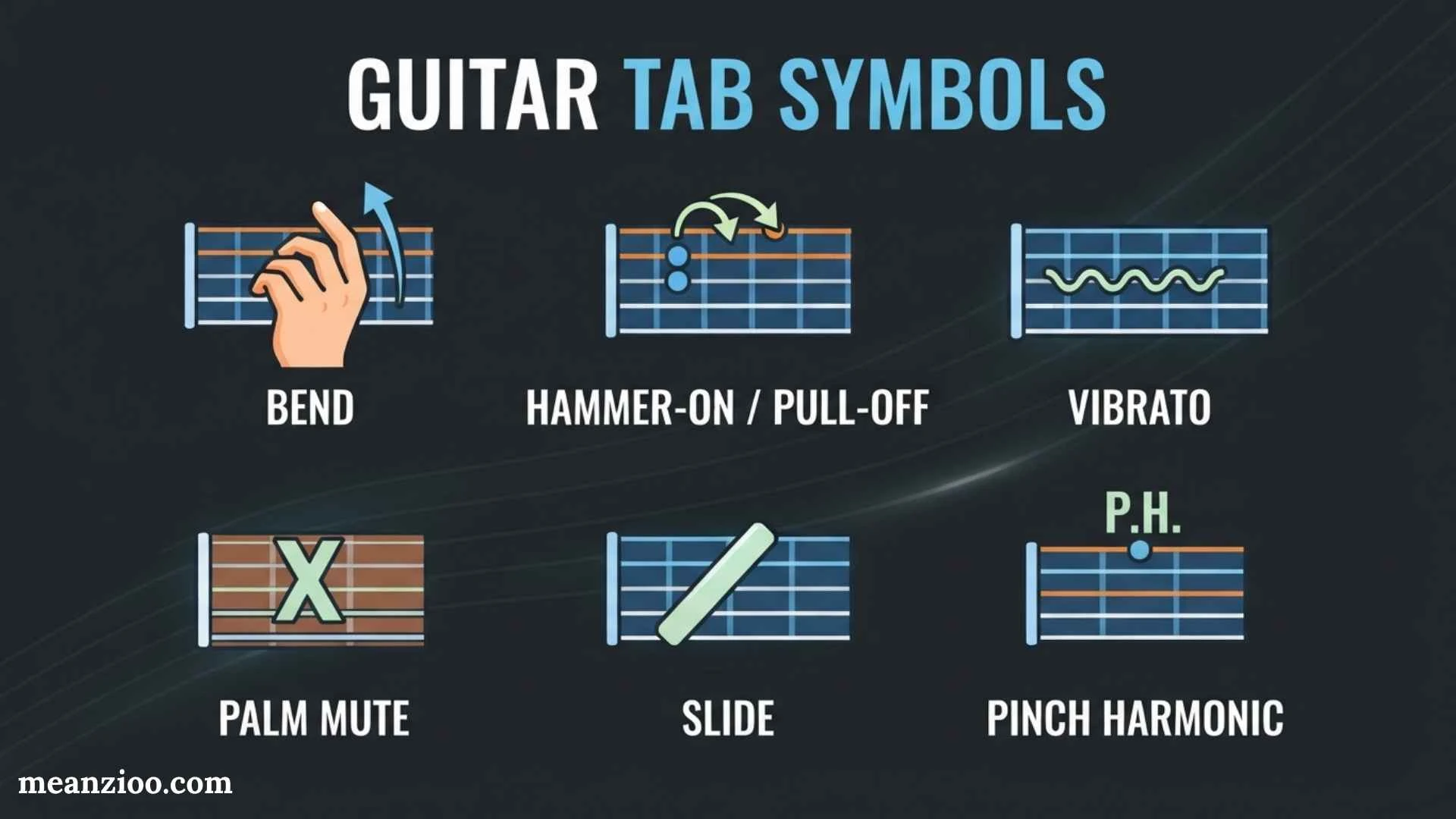
Learning to read guitar tabs becomes much easier once you understand the symbols that appear between the numbers. While the numbers tell you which fret to play, guitar tab symbols explain how to play the note, how to connect notes, and what technique or effect should be used.
You may see symbols such as h, p, /, \, b, r, ~, x, PM, and < >. At first, they can look like a secret code, but most are simple once you know what they mean. This guide explains the most common guitar tab symbols, including beginner and advanced notation, with practical examples you can use while learning songs.
What Are Guitar Tab Symbols?
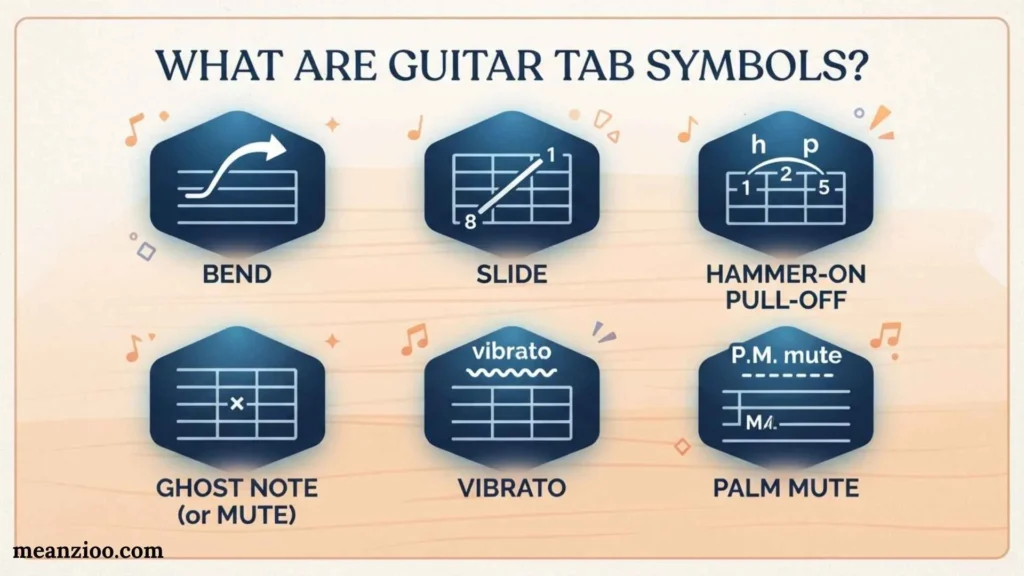
Guitar tab symbols are letters, marks, and abbreviations used in guitar tablature to describe playing techniques and musical effects. Standard tablature uses six horizontal lines to represent the six guitar strings, while numbers show the frets.
For example:
e|—————-|
B|—————-|
G|——5———|
D|—-5—7——-|
A|–3————-|
E|—————-|
The numbers tell you where to place your fingers. Symbols add instructions about how the notes should be played.
For example:
e|—————-|
B|–5h7———–|
G|—————-|
D|—————-|
A|—————-|
E|—————-|
The h means hammer-on. You play the 5th fret and then sound the 7th fret without picking it separately.
Understanding these symbols helps you move from simply copying fret numbers to actually interpreting the guitarist’s intended technique.
Guitar Tab Symbols Chart
The following chart covers many of the symbols you are most likely to encounter.
| Symbol | Meaning |
| h | Hammer-on |
| p | Pull-off |
| / | Slide up |
| \ | Slide down |
| b | Bend |
| r | Release bend |
| ~ | Vibrato |
| x | Muted or dead note |
| PM | Palm muting |
| T | Tapping |
| < > | Harmonic in many tabs |
| NH | Natural harmonic |
| AH | Artificial harmonic |
| PH | Pinch harmonic |
| tr | Trill |
| () | Ghost, grace, or optional note depending on notation |
| S | Slide in some tab systems |
| t | Tap in some notation |
| + | Tap, harmonic, or other special technique depending on the tab |
| * | Special effect explained by the tab |
| let ring | Allow notes to continue ringing |
| mute | Mute the indicated notes |
| riff | Indicates a repeated musical phrase |
| N.C. | No chord |
The exact meaning of some symbols can vary between websites, software, and tab writers. When a tab provides a legend, use that legend as the final authority.
Understanding the Six Guitar Tab Lines
Before learning the symbols, it is important to understand the basic structure of tablature.
A standard six-string guitar tab looks like this:
e|—————-| High E
B|—————-| B
G|—————-| G
D|—————-| D
A|—————-| A
E|—————-| Low E
The top line represents the thin, high-pitched E string. The bottom line represents the thick, low-pitched E string.
The tab is normally read from left to right, just like written music.
Numbers represent frets:
e|–0–1–3–|
Here:
- 0 means play the open string.
- 1 means play the first fret.
- 3 means play the third fret.
When numbers are stacked vertically, they are generally played together.
e|–0–|
B|–1–|
G|–0–|
D|–2–|
A|–3–|
E|—–|
This represents a C major chord shape.
Hammer-On: h
A hammer-on is represented by h.
e|—————-|
B|–5h7———–|
G|—————-|
D|—————-|
A|—————-|
E|—————-|
Play the 5th fret and then use your fretting hand to press the 7th fret without picking the second note separately.
Hammer-ons are useful for creating smooth transitions between notes.
You may also see several hammer-ons together:
e|–5h7h8———|
This means you move from the 5th fret to the 7th and then to the 8th using hammer-ons.
Pull-Off: p
A pull-off is generally shown with p.
e|—————-|
B|–8p5———–|
G|—————-|
D|—————-|
A|—————-|
E|—————-|
Play the 8th fret and then pull your finger away so the 5th fret sounds without a separate pick stroke.
Hammer-ons and pull-offs are often combined:
e|–5h7p5———|
This means play 5, hammer to 7, and pull off back to 5.
Slides: / and \
A slash usually indicates a slide.
Slide Up: /
e|—————-|
B|–5/7———–|
G|—————-|
D|—————-|
A|—————-|
E|—————-|
Start at the 5th fret and slide upward to the 7th fret.
Slide Down: \
e|—————-|
B|–7\5———–|
G|—————-|
D|—————-|
A|—————-|
E|—————-|
Start at the 7th fret and slide downward to the 5th fret.
Some tabs use / and \ differently depending on how the tab is formatted, so read the surrounding notation carefully.
Bend: b
The b symbol means bend the string.
e|—————-|
B|–7b9———–|
G|—————-|
D|—————-|
A|—————-|
E|—————-|
Play the 7th fret and bend the string until its pitch reaches the approximate pitch of the 9th fret.
Bends are particularly important in blues, rock, country, and lead guitar.
Common Bend Amounts
A tab may specify different bend distances:
7b8
7b9
7b10
These indicate different target pitches.
Some tabs may write:
7b9r7
This means:
- Play the 7th fret.
- Bend it to the pitch of the 9th fret.
- Release the bend back to the original pitch.
You may also see terms such as:
- 1/2 — half-step bend
- full — whole-step bend
- 1 1/2 — one-and-a-half-step bend
Release Bend: r
The r commonly means release a bend.
Example:
e|—————-|
B|–7b9r7———|
G|—————-|
D|—————-|
A|—————-|
E|—————-|
After reaching the bent pitch, gradually release the string until it returns to the original note.
Vibrato: ~
The tilde symbol normally represents vibrato.
e|—————-|
B|–8~————|
G|—————-|
D|—————-|
A|—————-|
E|—————-|
Hold the note and repeatedly vary its pitch slightly.
Vibrato can make a sustained note sound more expressive. The exact width and speed of vibrato depend on the style of music and the guitarist.
Muted or Dead Note: x
An x usually means a muted or dead note.
e|—————-|
B|—————-|
G|–x-x-x-x——-|
D|–x-x-x-x——-|
A|–x-x-x-x——-|
E|—————-|
Instead of allowing a clear pitch to ring, lightly mute the strings and strike them.
Dead notes are common in funk, pop, rock, and rhythmic guitar parts.
Palm Muting: PM
Palm muting is often written as PM.
PM—————-
e|—————-|
B|—————-|
G|—————-|
D|–2-2-2-2——-|
A|–2-2-2-2——-|
E|–0-0-0-0——-|
Place the edge of your picking-hand palm lightly against the strings near the bridge.
Palm muting produces a short, controlled sound. It is especially common in rock and metal riffs.
The notation may also specify exactly where the palm muting starts and stops:
PM—-| |—-PM
e|—-2-2-2-2—-|
Always follow the placement of the PM marking.
Tapping: T or t
Tapping involves using a finger from the picking hand to tap a fret directly.
A tab may show:
e|–5h8t12p8p5—|
This indicates a sequence involving hammer-ons, tapping, and pull-offs.
Tapping is frequently used in fast solos and technical guitar passages.
Because notation differs, some tabs use T, while others use t, tap, or another marking.
Harmonics
Harmonics produce a bell-like tone and can be shown in several ways.
A common notation is:
e|–<12>———-|
The number inside angle brackets often indicates a natural harmonic.
You may also encounter:
- NH — natural harmonic
- AH — artificial harmonic
- PH — pinch harmonic
Natural Harmonic
Natural harmonics are commonly played by lightly touching the string at specific points, such as the 12th fret, while picking.
Example:
e|–<12>———-|
The exact technique depends on the guitar and tab.
Pinch Harmonic
Pinch harmonics are often marked PH and are produced using a combination of the pick and thumb while picking.
They are particularly common in rock and metal.
Trill: tr
A trill involves rapidly alternating between two notes.
Example:
e|—————-|
B|–5tr7———-|
G|—————-|
D|—————-|
A|—————-|
E|—————-|
This usually means rapidly alternate between the 5th and 7th frets, often with repeated hammer-ons and pull-offs.
Ghost Notes: ( )
Parentheses can have different meanings, but they often indicate a ghost note, grace note, optional note, or a note that should be played softly.
Example:
e|—————-|
B|–5-(7)-5——-|
G|—————-|
D|—————-|
A|—————-|
E|—————-|
Because parentheses are not standardized across every tab system, check the tab’s notation key.
Let Ring
You may see:
let ring
This means allow the notes or strings to continue sounding instead of stopping them immediately.
For example:
e|–0————-|
B|—-1———–|
G|——0———|
D|——–2——-|
A|———-3—–|
E|—————-|
If the tab says let ring, allow the notes to overlap and continue sounding.
This technique is common in acoustic arrangements and melodic guitar parts.
Rhythm and Timing in Guitar Tabs
One of the biggest weaknesses of basic ASCII guitar tabs is that they may not clearly show rhythm.
For example:
e|–5–7–8–10–|
This tells you the notes but may not tell you exactly how long each note lasts.
Professional tabs may include traditional rhythmic notation above the tab. You might also encounter:
- Quarter notes
- Eighth notes
- Sixteenth notes
- Triplets
- Rests
- Dotted notes
- Ties
When rhythm is unclear, listening to the original recording is extremely helpful.
Some tab websites use spacing to suggest timing, but spacing should not always be treated as precise rhythmic notation.
Chord Symbols Above Guitar Tabs
Tabs often include chord names above the fret numbers.
G C D
e|—3——–0——–2—|
B|—0——–1——–3—|
G|—0——–0——–2—|
D|—0——–2——–0—|
A|—2——–3————|
E|—3———————|
The chord names tell you the harmonic structure, while the tab shows the individual notes or finger positions.
This is useful when learning songs because you can understand both the chord progression and the specific guitar part.
Combining Guitar Tab Symbols
Real guitar tabs often use several symbols in one phrase.
For example:
e|—————————|
B|–5h7p5–5/8–8b10r8~—–|
G|—————————|
D|—————————|
A|—————————|
E|—————————|
A possible interpretation is:
- Play the 5th fret.
- Hammer on to the 7th fret.
- Pull off back to the 5th fret.
- Slide from the 5th to the 8th fret.
- Bend the 8th fret toward the pitch of the 10th fret.
- Release the bend.
- Add vibrato.
This is why learning symbols individually is so useful. Once you recognize each mark, complicated tab becomes much easier to decode.
Advanced Guitar Tab Symbols and Techniques
More advanced guitar tabs may contain additional notation.
Tremolo Picking
Tremolo picking means rapidly picking the same note. Some tabs use repeated notes, slashes, or a specific tremolo marking.
Whammy Bar
Tabs involving a tremolo arm may use markings such as:
- dive
- dip
- release
- ^
- \
- w/bar
These symbols are not completely standardized, so the tab’s legend is important.
Slide In and Slide Out
A note may have a slide leading into or away from it.
For example:
e|—————-|
B|–/7————|
G|—————-|
D|—————-|
A|—————-|
E|—————-|
This can indicate sliding into the 7th fret from an unspecified lower position.
Similarly:
e|—————-|
B|–7\————|
G|—————-|
D|—————-|
A|—————-|
E|—————-|
may indicate sliding away from the 7th fret.
Grace Notes
A small or parenthesized note before a main note can indicate a grace note. It is played quickly as an ornament rather than receiving the same rhythmic emphasis as the main note.
Why Guitar Tab Symbols Matter
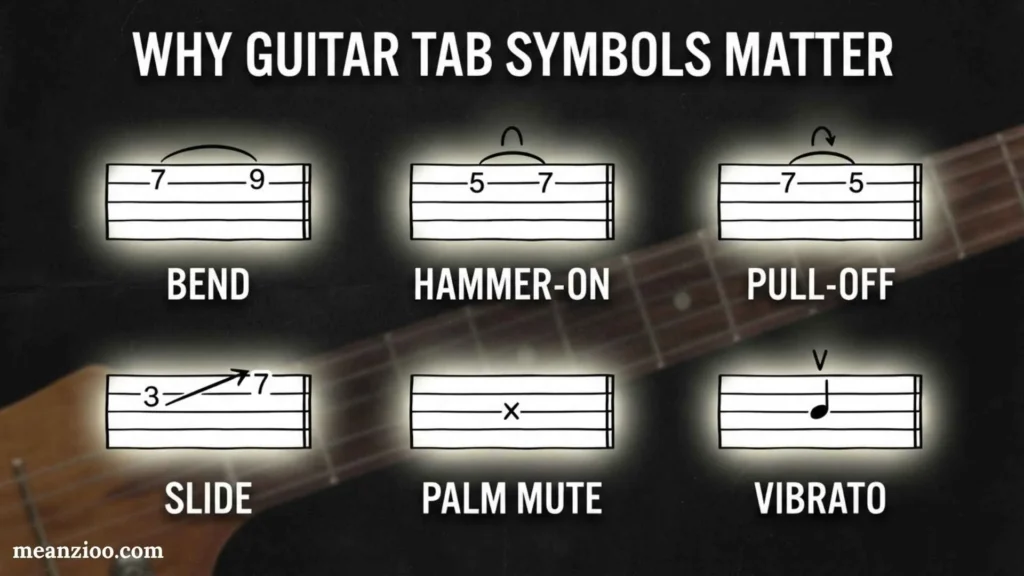
Numbers alone cannot describe everything a guitarist needs to know.
Compare:
7 9
with:
7h9
The first may mean two separately picked notes, while the second specifically indicates a hammer-on.
Likewise:
7 9
and:
7/9
can sound very different because the second uses a slide.
Guitar tab symbols therefore communicate technique, articulation, expression, and sound. They turn basic fret information into a more complete set of playing instructions.
Guitar Tab Symbol Differences Between Websites
One important thing beginners should know is that guitar tab notation is not perfectly standardized.
One website might use:
7b9
while another might describe the same bend with a different format.
Likewise, tapping might be shown as:
t12
or:
T12
Harmonics may appear as:
<12>
or:
12H
This is why you should check the notation guide provided by the tab creator whenever possible.
Common Mistakes When Reading Guitar Tabs
Ignoring the Symbols
A common beginner mistake is playing only the numbers and ignoring symbols. This can remove much of the intended character from the guitar part.
Confusing String Order
Remember that the top line is normally the high E string and the bottom line is the low E string.
Playing Every Number Separately
A hammer-on or pull-off should not necessarily be picked like two independent notes.
Ignoring Rhythm
Knowing the correct frets is not enough. You also need to understand when each note occurs and how long it lasts.
Forgetting Muting
An x or PM marking can dramatically change the sound. Do not treat it as optional unless the tab indicates otherwise.
Using Too Much Force
Beginners sometimes press too hard when playing hammer-ons, bends, or vibrato. Good technique requires control rather than excessive pressure.
How to Learn Guitar Tab Symbols Faster
Start by learning the symbols that appear most frequently:
- h — hammer-on
- p — pull-off
- / — slide up
- \ — slide down
- b — bend
- r — bend release
- ~ — vibrato
- x — muted note
- PM — palm mute
- T — tapping
Practice one technique at a time. Once you are comfortable with individual symbols, move to tabs that combine two or three techniques.
It also helps to listen to the original song while following the tab. Your ears can help you connect the written symbol with the sound it produces.
A Simple Example of Reading a Tab
Consider this short example:
e|———————-|
B|–5h7–7p5–5/8–8~–|
G|———————-|
D|———————-|
A|———————-|
E|———————-|
Read it from left to right.
- 5h7 = play 5 and hammer on to 7.
- 7p5 = pull off from 7 to 5.
- 5/8 = slide from 5 to 8.
- 8~ = hold the 8th fret and add vibrato.
Instead of memorizing the entire sequence, break it into these smaller techniques. This makes even complicated tabs easier to understand.
Frequently Asked Questions About Guitar Tab Symbols
What are guitar tab symbols?
Guitar tab symbols are marks and abbreviations that explain how guitar notes should be played. They can indicate techniques such as hammer-ons, pull-offs, bends, slides, vibrato, harmonics, tapping, and muting.
What does h mean in guitar tabs?
h normally means hammer-on. Play the first note and then sound the higher note by pressing it with your fretting hand without picking it separately.
What does p mean in guitar tabs?
p usually means pull-off. Play the higher note and pull your finger away to sound the lower note.
What does b mean in guitar tabs?
b means bend. The number after the b commonly indicates the target pitch. For example, 7b9 means bend the 7th-fret note until it reaches the pitch associated with the 9th fret.
What does r mean in guitar tabs?
r commonly means release a bend. In 7b9r7, you bend the 7th fret to the 9th-fret pitch and then release the bend back to the original note.
What does / mean in guitar tabs?
A forward slash generally indicates a slide from a lower fret to a higher fret, such as 5/7.
What does \ mean in guitar tabs?
A backslash generally indicates a slide from a higher fret to a lower fret, such as 7\5.
What does x mean in guitar tabs?
An x normally indicates a muted or dead note. The string is struck while being muted so that it produces a percussive sound rather than a clear pitch.
What does ~ mean in guitar tabs?
The ~ symbol usually indicates vibrato. It means to repeatedly vary the pitch of a sustained note slightly.
What does PM mean in guitar tabs?
PM means palm muting. It instructs you to rest the edge of your picking-hand palm lightly against the strings near the bridge.
What does T mean in guitar tabs?
T often means tapping. It indicates that a note should be sounded by tapping the string against a fret with a finger from the picking hand.
Are guitar tabs easy for beginners?
Yes. Basic guitar tabs are generally easier to learn than standard musical notation because the lines correspond directly to guitar strings and the numbers show the frets. Learning the common symbols makes tabs much easier to follow.
Final Thoughts
Learning guitar tab symbols is one of the easiest ways to improve your ability to read and play guitar music. The numbers tell you where to place your fingers, while symbols explain how those notes should be performed.
Start with the most common techniques such as hammer-ons, pull-offs, slides, bends, vibrato, muted notes, and palm muting. Then gradually move into harmonics, tapping, trills, tremolo effects, and other advanced notation.
The most important habit is to read the entire tab rather than focusing only on the numbers. When you understand both the frets and the symbols, you can reproduce guitar parts more accurately and play with much more expression.

I’m Ryan Mitchell, and I write about modern English, trending slang, and online expressions. I enjoy explaining the meanings, origins, and real-life usage of popular words in a simple way. I believe learning slang is an important step toward understanding today’s English-speaking culture. Through my work, I aim to help readers speak more naturally and stay updated with the latest language trends.
 Charlotte Hayes