If you are searching for swinger symbols, you have probably seen claims about upside-down pineapples, black rings, flamingos, anklets, pampas grass, and other supposedly secret signs. Some of these symbols are genuinely associated with the swinging or broader consensual non-monogamy community, while others are mostly internet myths or symbols with multiple unrelated meanings.
The key point is that there is no universal secret code that can reliably identify a swinger. A symbol may suggest a lifestyle association in one context but mean nothing in another. Even sources that discuss swinger symbols caution readers not to assume that someone participates in the lifestyle simply because they wear or display a particular object.
This guide explains the most commonly discussed swinger symbols, what they may mean, how reliable each association is, where these symbols appear, and how to distinguish genuine community signals from popular myths.
What Are Swinger Symbols?
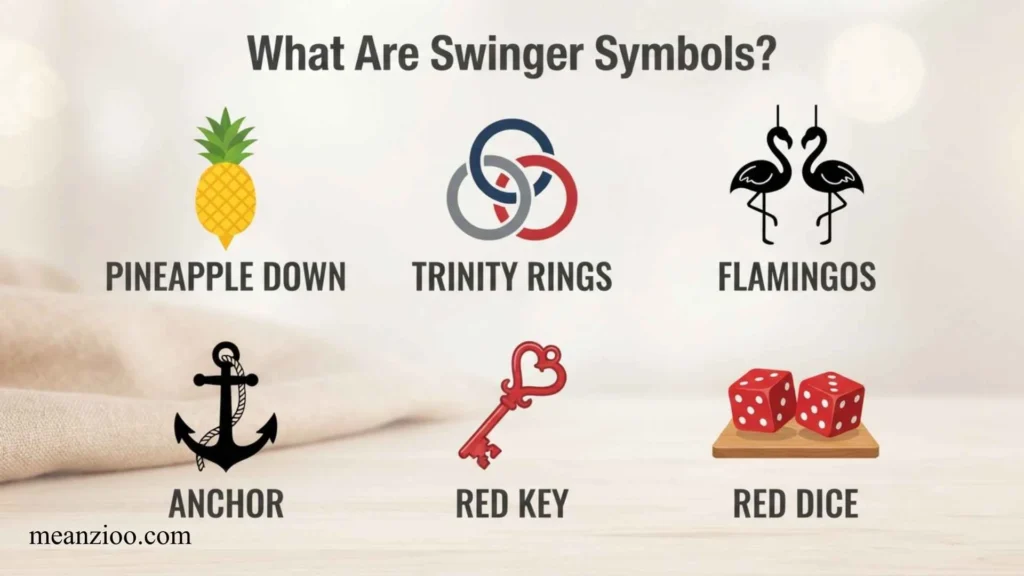
Swinger symbols are visual signs, objects, accessories, designs, or images that some people use to communicate an association with the swinging lifestyle or consensual non-monogamy.
The idea behind a discreet symbol is simple: someone may want to identify themselves to people who understand the reference without publicly announcing their private relationship preferences.
Some lifestyle communities use recognizable symbols, while others rely more heavily on private events, online communities, dating platforms, and direct conversations. Modern sources describe symbols as possible conversation starters or identifiers rather than guarantees of sexual availability or consent.
Are swinger symbols official?
No. There is no single organization that controls or officially defines all swinger symbols.
Different communities can use different signs, and some symbols have meanings outside the swinging community. This is particularly important with common objects such as black rings, pineapples, flamingos, and anklets.
For that reason, it is better to describe these as commonly associated symbols rather than universally recognized codes.
Swinger Symbols at a Glance
| Symbol or sign | Commonly associated meaning | Reliability | Important context |
| Upside-down pineapple | Swinging/lifestyle interest | Moderate | Meaning varies by setting |
| Black ring | Possible lifestyle affiliation | Low to moderate | Also has other meanings |
| Swinger “swing” symbol | Explicit lifestyle identity | Higher | Designed specifically as a discreet symbol |
| Anklet | Sometimes associated with lifestyle | Low | Very common fashion accessory |
| Toe ring | Sometimes listed as a lifestyle cue | Low | No universal meaning |
| Thumb ring | Sometimes associated with lifestyle | Low | Context is essential |
| Flamingos | Frequently claimed as a swinger sign | Very low | Often ordinary decoration |
| Pampas grass | Frequently claimed as a swinger sign | Very low | Mostly an internet rumor |
| White landscaping rocks | Frequently claimed as a secret sign | Very low | No universal meaning |
| Garden gnomes | Internet swinger myth | Very low | Usually ordinary decoration |
| Pineapple clothing | Possible lifestyle reference | Low to moderate | Context matters |
| Lifestyle-themed jewelry | Possible community identification | Moderate | Depends on the actual design |
This table is best understood as a guide to associations, not a method for identifying strangers.
1. The Upside-Down Pineapple
The upside-down pineapple is the most widely discussed swinger symbol.
In lifestyle contexts, an inverted pineapple can be used as a discreet reference to swinging or openness to consensual non-monogamy. It has been reported on clothing, jewelry, stickers, home decorations, cruise-cabin doors, and online profiles.
The pineapple already has a long-standing association with hospitality and welcome. That makes it particularly useful as a symbol because it can have an ordinary interpretation while carrying an additional meaning for people who recognize the lifestyle association.
What does an upside-down pineapple mean?
In a swinger or lifestyle context, it can indicate that an individual or couple identifies with the swinging community or may be open to meeting other people within that community.
However, an upside-down pineapple is not proof that someone is a swinger.
Pineapple designs are extremely common in clothing, home décor, travel products, and tropical-themed merchandise. Context makes a significant difference.
Where might you see an upside-down pineapple?
Possible locations include:
- Clothing
- Hats
- Jewelry
- Stickers
- Car decals
- Cruise-cabin decorations
- Welcome signs
- Home décor
- Dating profiles
- Lifestyle-event merchandise
Cruise-related sources specifically discuss upside-down pineapples as a signal sometimes used by passengers interested in swinging, but also emphasize that not every pineapple has that meaning.
Is the pineapple symbol universal?
No.
Some members of the lifestyle community use it intentionally, while others consider it an exaggerated internet myth. Reporting from lifestyle communities shows that attitudes toward the pineapple vary considerably.
The safest interpretation is therefore:
Upside-down pineapple = possible lifestyle association, not definite proof.
2. Black Rings
A black ring is another frequently mentioned swinger symbol.
Some lifestyle sources associate a black ring worn on the right hand with swinging. The idea is that the ring can function as a subtle identifier without looking unusual to people outside the community.
However, black rings are also extremely popular as ordinary jewelry.
Why is the black ring confusing?
A black ring can have several unrelated meanings. Some people wear one because they like the style, while black rings are also associated with other communities and personal identities.
The specific finger and context are sometimes discussed in lifestyle circles, but neither can reliably identify a person’s relationship preferences.
Should you assume someone with a black ring is a swinger?
No.
A black ring should be treated as an ambiguous signal unless the surrounding context provides a clearer indication.
This is one reason some lifestyle communities have developed more distinctive symbols specifically intended to avoid confusion.
3. The Swinger “Swing” Symbol
Unlike ordinary objects such as pineapples or rings, the swinger “swing” symbol was specifically designed to represent the swinging lifestyle.
The creators describe it as a discreet symbol intended to be recognizable to people familiar with the lifestyle while remaining relatively inconspicuous to everyone else.
This makes it different from symbols that became associated with swinging only through internet culture.
Why was a specific swinger symbol created?
The idea was to create a recognizable mark that could be:
- Worn as jewelry
- Used as a tattoo
- Printed on clothing
- Used online
- Drawn by hand
- Reproduced discreetly
A dedicated symbol can reduce the confusion associated with generic objects such as black rings and pineapples.
4. Anklets
Anklets sometimes appear on lists of supposed swinger symbols.
Some lifestyle sources describe particular anklets or their placement as possible indicators of lifestyle participation.
However, anklets are extremely common fashion accessories.
People wear them for:
- Fashion
- Cultural reasons
- Personal preference
- Gifts
- Beach or summer styling
- Jewelry collections
Therefore, an anklet should never be interpreted as evidence that someone participates in swinging.
What about a particular ankle?
Internet lists sometimes claim that wearing an anklet on a particular ankle has a specific swinger meaning. These claims are not universal and can vary between communities.
Treat them as community-specific claims rather than established rules.
5. Toe Rings
Toe rings are another item sometimes included in lists of swinger symbols.
The alleged meaning is generally connected with lifestyle openness or identification. However, toe rings are common fashion accessories and have no universal swinger meaning.
A person wearing a toe ring could simply enjoy the jewelry.
Reliability: Low.
6. Thumb Rings
Thumb rings are occasionally mentioned as lifestyle signals, particularly in lists of discreet jewelry cues.
As with toe rings and anklets, there is no reliable universal rule that a thumb ring means someone is a swinger.
The meaning depends on:
- The design
- The wearer
- The community
- The setting
- Whether other lifestyle indicators are present
A thumb ring by itself tells you very little.
7. Flamingos
Pink flamingos are among the most famous rumored swinger symbols.
Internet discussions sometimes claim that flamingo decorations, particularly multiple flamingos displayed outside a home, indicate that the residents are swingers.
This claim is much less reliable than the commonly discussed pineapple association. Some sources explicitly identify flamingos and other yard decorations as myths rather than dependable lifestyle signals.
Why did flamingos become associated with swinging?
The exact origin is unclear.
Flamingos have long been popular lawn decorations, especially in warm-weather areas, campgrounds, RV communities, and vacation destinations. Their unusual appearance made them an easy subject for internet speculation about secret codes.
As the claim spread online, ordinary flamingo decorations increasingly became associated with swinging in popular articles.
Can a flamingo prove someone is a swinger?
Absolutely not.
A flamingo in someone’s yard is far more likely to be a decorative choice than a reliable relationship signal.
8. Pampas Grass
Pampas grass is another supposed swinger sign that frequently appears in online lists.
The claim usually suggests that particular landscaping choices might identify a swinger household.
However, pampas grass is an ordinary landscaping and decorative plant. There is no universal rule stating that growing it means someone participates in swinging.
Some recent discussions specifically categorize pampas grass among the more questionable or mythical signs.
Bottom line: Don’t interpret someone’s landscaping as evidence of their private life.
Also Check This Post:September Symbols: Complete Guide to Meanings, Birthstone, Flowers, Colors, Zodiac Signs, and More
9. White Landscaping Rocks
White rocks placed around a home or garden have also been described online as possible swinger signals.
Again, this claim should be treated with extreme caution.
White landscaping rocks are common because they are:
- Decorative
- Easy to combine with plants
- Popular in modern landscaping
- Used for drainage and ground cover
- Available at ordinary garden centers
There is no universal swinger code that makes white rocks reliable evidence.
10. Garden Gnomes
Garden gnomes occasionally appear on lists of alleged swinger symbols.
This is one of the clearest examples of why readers should distinguish internet folklore from established community signals.
A garden gnome is usually just a garden gnome.
Recent lifestyle commentary specifically describes gnomes and similar garden decorations as unreliable myths.
11. Pineapple Clothing and Accessories
A pineapple printed on a shirt, hat, swimsuit, bag, or accessory can sometimes carry a lifestyle association.
The context matters considerably.
For example:
- A pineapple shirt at a tropical resort may simply be vacation clothing.
- An upside-down pineapple displayed intentionally at a lifestyle event may have a different meaning.
- A pineapple emoji in a dating profile may be more deliberate than a pineapple print on ordinary clothing.
Some sources report pineapple imagery being used on clothing, accessories, and online profiles within lifestyle communities.
12. Lifestyle-Themed Jewelry
Jewelry can be used as a discreet way to communicate membership in a community.
Unlike generic jewelry, a piece featuring a recognizable lifestyle-specific design can have a more intentional meaning.
Possible forms include:
- Rings
- Pendants
- Bracelets
- Charms
- Necklaces
- Pins
The more distinctive the symbol, the less likely it is to be accidental. Nevertheless, even an intentional symbol does not automatically communicate consent or interest in a particular person.
Swinger Symbols vs. Swinger Myths
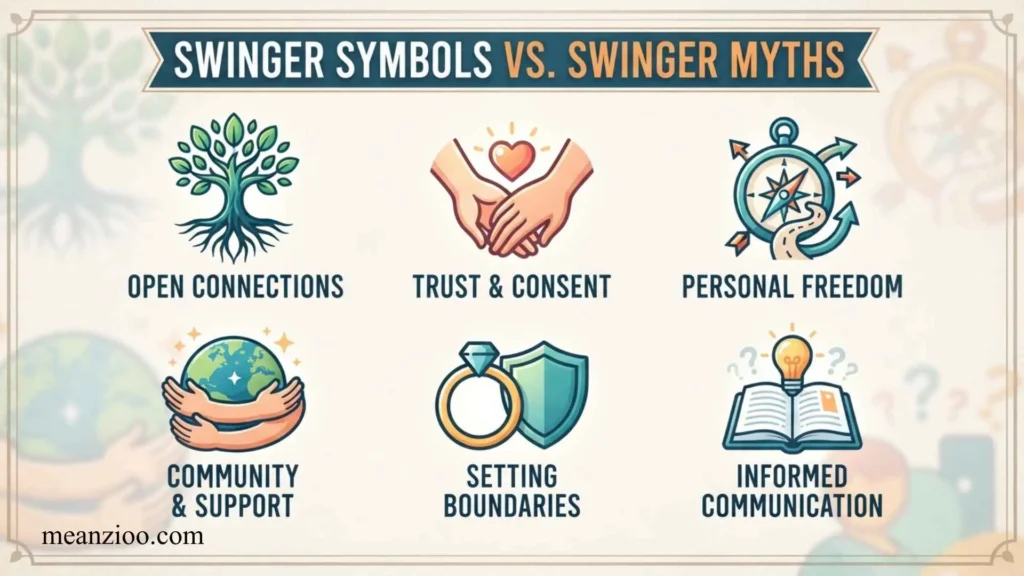
This distinction is one of the most important parts of understanding the topic.
The internet has produced long lists of alleged secret swinger signs. Some have genuine connections to lifestyle communities, while others appear to have become popular through repetition.
More commonly associated symbols
These include:
- Upside-down pineapple
- Certain black-ring uses
- Dedicated swinger symbols
- Some lifestyle-specific jewelry
Less reliable or commonly disputed signs
These include:
- Flamingos
- Garden gnomes
- Pampas grass
- White landscaping rocks
- Ordinary anklets
- Ordinary toe rings
- Ordinary thumb rings
Even the more commonly associated symbols are not guaranteed indicators.
Different lifestyle communities can interpret them differently, and many people use these objects for completely unrelated reasons.
Why Do Swinger Symbol Myths Spread?
Secret symbols are naturally attractive to people because they create the feeling that ordinary objects have hidden meanings.
Several factors contribute to the popularity of these claims.
1. Social media
Short videos and viral posts can turn a niche community reference into a widely repeated claim.
2. Clickable “secret code” stories
Articles about hidden signs are naturally curiosity-driven. A headline such as “10 signs your neighbor is a swinger” is more attention-grabbing than a nuanced explanation saying that most signs are unreliable.
3. Ordinary objects are easy to misinterpret
Pineapples, flamingos, rings, plants, and garden decorations are everywhere. When people learn a possible hidden meaning, they may begin noticing the object everywhere.
4. Confirmation bias
Once someone believes that an object has a particular meaning, they may interpret every example as supporting the belief.
That is why a single symbol should never be considered conclusive evidence.
Where Are Swinger Symbols Commonly Seen?
Potential lifestyle symbols may appear in several environments.
Clothing
Symbols may appear on:
- T-shirts
- Hats
- Swimwear
- Shoes
- Bags
- Jewelry
Home Décor
Some people may use symbols on:
- Door decorations
- Welcome mats
- Wall art
- Ornaments
- Garden decorations
But ordinary décor is particularly unreliable because people buy decorative objects for many reasons.
Cars
Stickers, decals, and small symbols may sometimes be used by people who want a discreet way to identify themselves.
Cruises and Resorts
Cruises and adult-oriented resorts are frequently mentioned in discussions about lifestyle signaling. An upside-down pineapple may be displayed on a cabin door or clothing in a context where other guests already understand the reference.
Online Profiles
Lifestyle-specific emojis, symbols, and descriptions can also appear in dating profiles and social profiles.
Online communication is generally clearer than trying to interpret random objects because people can explicitly state their interests and boundaries.
Also Check This Post:Vampire Symbols: Meanings, Origins, and the Dark Imagery Behind Them
Does Symbol Placement Change the Meaning?
Sometimes, community discussions attach different meanings to placement.
Examples frequently mentioned online include:
- Which hand a ring is worn on
- Which finger is used
- Which ankle carries an anklet
- Whether a pineapple is upright or upside down
- Where a decoration is displayed
However, placement rules are not universal.
A black ring on a particular finger can have a completely different meaning in another community, while an anklet may simply be jewelry.
Therefore, placement should be treated as additional context, not proof.
How Reliable Are Swinger Symbols?
A useful way to think about symbols is to divide them into three categories.
Higher-confidence association
A purpose-built swinger symbol that is clearly displayed in a lifestyle context is more likely to have an intentional meaning.
Moderate-confidence association
An upside-down pineapple or certain black-ring uses may have a lifestyle association, but they are still ambiguous.
Low-confidence or rumor-based association
Flamingos, gnomes, pampas grass, white rocks, and ordinary jewelry are poor indicators.
This distinction is much more useful than simply publishing a long list of supposed secret codes.
Are Swinger Symbols Universal?
No.
There is no worldwide dictionary of swinger symbols.
Meanings can differ according to:
- Country
- City
- Social group
- Event
- Online community
- Cruise or resort
- Personal preference
A symbol recognized by one group may be completely unknown to another.
Some people also deliberately avoid symbols because they prefer private conversations or online communities.
Swinger Symbols Do Not Equal Consent
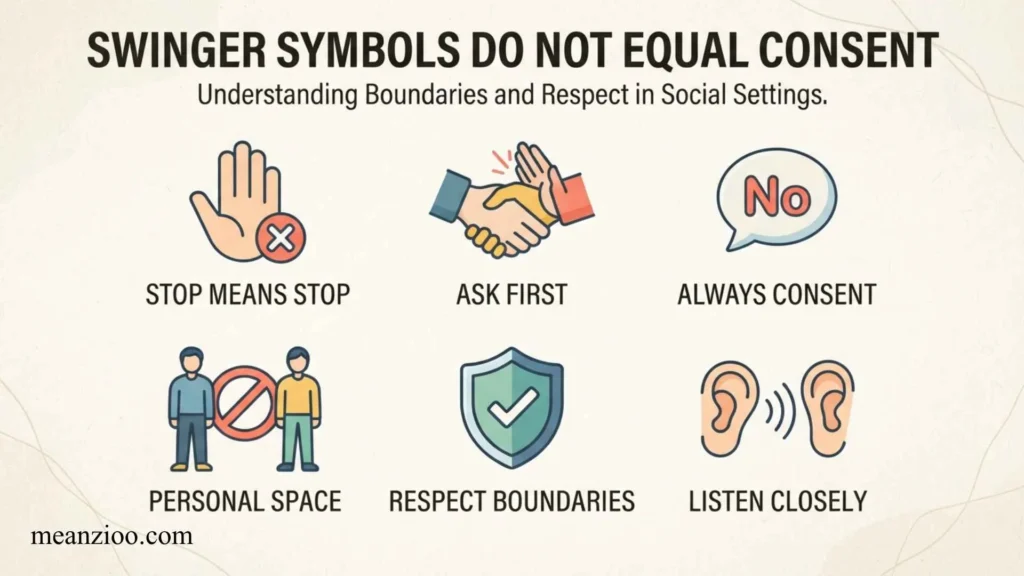
This point deserves special attention.
Even if someone intentionally displays a recognized swinger symbol, that does not mean they are sexually available to anyone who notices it.
A symbol can indicate:
- Lifestyle identity
- General openness
- Community membership
- Interest in meeting like-minded people
It does not automatically mean:
- Consent to sexual activity
- Interest in a particular stranger
- Permission to approach aggressively
- Agreement to a specific activity
Consent must be communicated directly and respected.
Lifestyle sources similarly warn readers not to interpret symbols as invitations or guarantees of sexual availability.
How to Interpret a Possible Swinger Symbol Respectfully
If you notice something that you think may be a swinger symbol, the best approach is to avoid assumptions.
Consider the setting
A symbol at a lifestyle event may have more relevance than the same symbol at a shopping mall.
Look for deliberate context
A dedicated lifestyle symbol is different from an ordinary pineapple pattern.
Don’t judge someone’s private life
Clothing, jewelry, landscaping, or home décor cannot reliably reveal someone’s relationship preferences.
Don’t treat a symbol as an invitation
Even an intentional lifestyle symbol does not replace consent.
Communicate respectfully
If a conversation naturally reaches the topic, direct communication is far more reliable than attempting to decode someone’s accessories.
Common Questions About Swinger Symbols
What is the most common swinger symbol?
The upside-down pineapple is probably the most widely recognized symbol associated with swinging. It is frequently discussed in lifestyle communities and mainstream media, although its meaning is not universal.
What does an upside-down pineapple mean?
In some swinger and consensual non-monogamy contexts, it can indicate lifestyle participation or openness to meeting others. However, pineapples are also ordinary decorative objects, so the symbol should not be treated as proof.
Does a pineapple always mean someone is a swinger?
No. Pineapples traditionally symbolize hospitality and are extremely common in home décor and fashion. Even an upside-down pineapple can have a non-lifestyle explanation.
What does a black ring mean?
A black ring can have many meanings, including fashion and associations with other communities. Some lifestyle groups use particular black-ring placements as a swinger signal, but the ring alone is not reliable evidence.
Are flamingos swinger symbols?
Flamingos are frequently claimed to be swinger symbols, but the association is highly unreliable. A flamingo decoration should not be used to identify someone’s relationship preferences.
Is pampas grass a swinger symbol?
Pampas grass is sometimes listed online as a swinger sign, but there is no universal rule giving it that meaning. It is primarily an ordinary decorative plant.
Are garden gnomes swinger symbols?
Garden gnomes are commonly mentioned in internet lists of supposed swinger signs, but the claim is generally regarded as unreliable or mythical rather than a dependable community code.
Does an anklet mean someone is a swinger?
Not necessarily. Some lifestyle sources mention anklets as possible cues, but anklets are ordinary jewelry and have no universal swinger meaning.
Does a toe ring mean someone is a swinger?
No reliable universal rule exists. Toe rings are common fashion accessories and should not be interpreted as proof of lifestyle participation.
Are swinger symbols used on cruises?
Yes, some cruise passengers use lifestyle symbols, particularly upside-down pineapple imagery, to identify themselves to others who understand the reference. However, a pineapple on a cruise ship does not automatically mean swinging.
Are swinger symbols used online?
Yes. People may use symbols, emojis, profile descriptions, and community-specific terminology on dating and social platforms. Online profiles can provide more explicit context than trying to interpret someone’s clothing or home décor.
Is there one official swinger symbol?
No. There are multiple symbols and interpretations. A dedicated “swing” symbol has been created specifically to provide a more distinctive lifestyle reference, but it is not a universal official standard.
Final Takeaway
Swinger symbols are informal signs associated with the swinging and consensual non-monogamy communities, but they should never be treated as a foolproof secret code.
The upside-down pineapple is the most recognizable association, while black rings and certain lifestyle-specific jewelry may also be used. Other popular claims—such as flamingos, pampas grass, garden gnomes, and white landscaping rocks—are much less reliable and are often repeated online without strong evidence.
The most important distinction is between a possible association and a definite meaning.
If you are researching swinger symbols because you saw one somewhere, consider the entire context rather than focusing on one object. And if the question involves another person’s private relationships, remember that respectful communication is always more reliable than guessing from symbols.
Also Check This Post:Lutheran Symbols: Meanings, History, Colors, and Christian Significance

Hi, I’m Charlotte Hayes. I love writing about the newest English slang, pop culture phrases, and digital communication. I spend my time exploring how language evolves across social media, gaming, and everyday conversations. I enjoy sharing easy-to-understand guides that help learners keep up with modern English. My goal is to make every article useful, accurate, and enjoyable for readers around the world.
Books:
- Everyday Slang Dictionary
- Fluent Through Informal English
 Ryan Mitchell