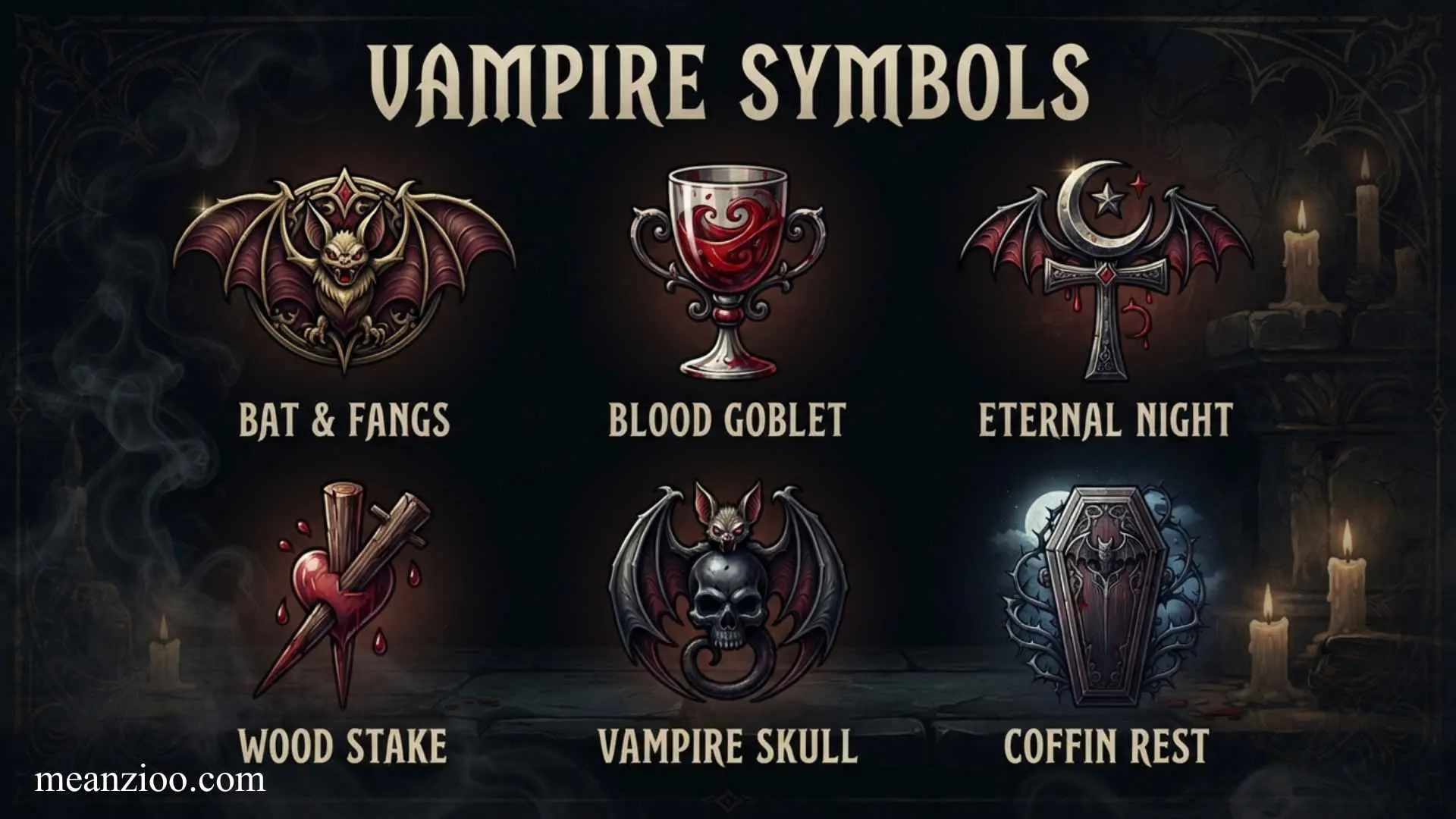
Vampire symbols have fascinated people for centuries because they connect frightening supernatural stories with deeper ideas about death, immortality, blood, temptation, transformation, power, mystery, and the unknown. Today, vampire imagery appears in Gothic art, tattoos, Halloween designs, literature, movies, games, jewelry, fashion, and fantasy culture.
The most recognizable vampire symbols include blood, fangs, bats, coffins, crosses, garlic, stakes, graves, the moon, roses, darkness, and vampire bite marks. Some have roots in older folklore, while others became popular through Gothic literature and modern entertainment.
It is also important to separate historical vampire folklore from modern vampire imagery. Not every symbol commonly associated with vampires today was part of older traditions. The modern image of the vampire was shaped significantly by 19th-century Gothic literature, especially Bram Stoker’s Dracula, published in 1897. The Victoria and Albert Museum describes Stoker’s Dracula as a lasting influence on popular representations of the vampire and its associations with death, decay, degeneration, and contagion.
What Are Vampire Symbols?
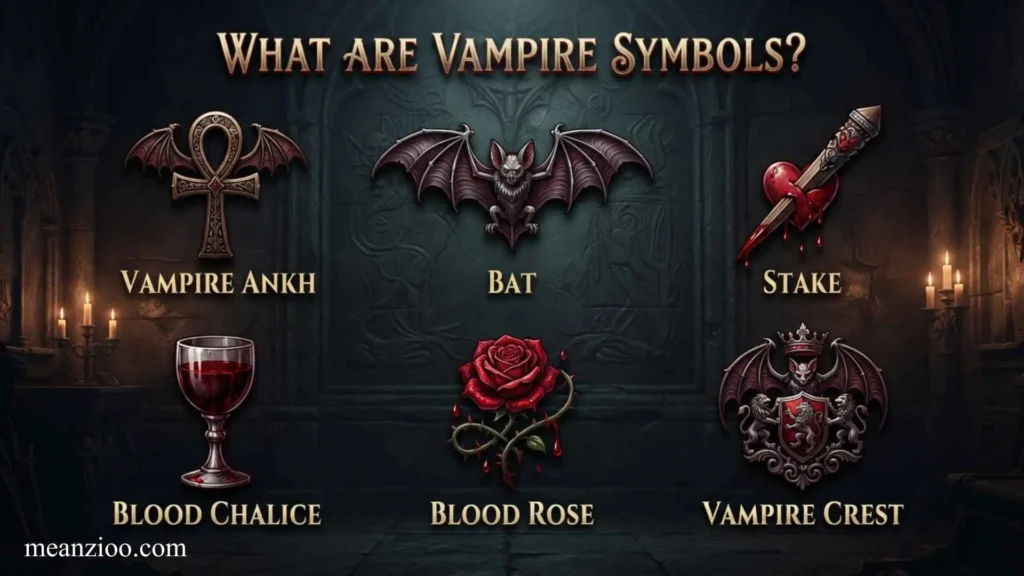
Vampire symbols are objects, images, animals, colors, or motifs associated with vampires and the themes surrounding them.
They can communicate different ideas depending on context. A fang may suggest danger and predation, while a rose may represent beauty, passion, or forbidden desire. A cross or crucifix can represent protection against a vampire rather than the vampire itself.
Vampire symbolism generally falls into several broad categories:
- Vampire identity: fangs, blood, bite marks, bats
- Death and undeath: coffins, graves, skulls
- Protection: garlic, crosses, stakes
- Darkness and mystery: moon, night, shadows
- Desire and romance: roses, red, blood
- Transformation: bites, bats, supernatural changes
- Power and immortality: castles, crowns, eternal life
Understanding this distinction makes vampire symbolism easier to interpret accurately.
Vampire Symbols and Their Meanings
1. Blood
Blood is arguably the central symbol of vampire mythology.
It can represent:
- Life
- Vitality
- Hunger
- Death
- Desire
- Power
- Dependency
- Transformation
The vampire’s need for blood creates a symbolic relationship between life and death. A living person has blood and vitality, while the vampire is an undead creature that survives by taking that vitality from others.
In Bram Stoker’s Dracula, blood is one of the novel’s most important recurring images, connecting physical survival with fear, sexuality, illness, and supernatural power.
2. Vampire Fangs
Fangs are among the clearest modern visual signs of a vampire.
They symbolize:
- Predatory instinct
- Hunger
- Violence
- Danger
- Supernatural identity
- The vampire bite
Fangs turn the vampire from an apparently human figure into a predator. They also make the vampire’s method of feeding immediately recognizable.
However, the familiar image of sharp vampire fangs should be understood primarily as a modern fictional convention, rather than assuming that every historical vampire tradition described vampires in exactly this way.
3. Bat
The bat is probably the most recognizable animal associated with vampires today.
It can symbolize:
- Night
- Darkness
- Transformation
- Flight
- Mystery
- Supernatural power
- The hidden world
The association became particularly powerful through vampire literature. In Dracula, the Count transforms into a bat, helping establish an image that later became a standard part of vampire fiction.
An important distinction is that vampire folklore did not originate from vampire bats. Vampire legends and the zoological classification of vampire bats developed in different contexts. The modern literary association became especially influential through works such as Dracula.
4. Vampire Bite
The vampire bite represents the moment when the vampire attacks its victim.
It may symbolize:
- Transformation
- Loss of control
- Temptation
- Infection
- Desire
- Death
- The transfer of supernatural power
In many modern stories, the bite is more than an injury. It becomes a mechanism through which one person enters the vampire world.
5. Coffin
The coffin represents the vampire’s connection with death.
It can symbolize:
- Death
- Sleep
- Undeath
- Immortality
- Burial
- The return of the dead
The coffin is particularly effective in vampire imagery because it creates a contradiction: the person inside is associated with death but continues to exist.
In Dracula, the vampire’s resting place and connection to earth are important parts of the story’s supernatural logic.
6. Grave or Tombstone
A grave is another strong vampire symbol.
It represents:
- Death
- Burial
- Resurrection
- The past
- Undeath
- Fear of mortality
The grave creates the classic vampire idea of someone who should be dead but returns to interact with the living.
Historical vampire beliefs in Europe included stories of suspected dead people returning from graves, which helped establish the connection between vampires and burial places.
7. Cross or Crucifix
The cross or crucifix is traditionally presented as a protective symbol in many Christian-influenced vampire stories.
It can represent:
- Faith
- Protection
- Good versus evil
- Spiritual authority
- Resistance to supernatural danger
The symbol is especially prominent in Dracula. Characters use Christian objects and practices as part of their resistance to the vampire.
This makes the cross different from blood or fangs: it is usually a symbol used against vampires, rather than a symbol representing the vampire.
8. Garlic
Garlic is one of the best-known vampire protection symbols.
It can symbolize:
- Protection
- Defense
- Purification
- Warding off evil
- Folkloric medicine
Garlic’s connection with vampires became especially famous through Dracula, where garlic is repeatedly used to protect characters from the vampire. Research into the tradition also notes that garlic-related protective practices have roots in folklore that predates the discovery of New World vampire bats.
9. Wooden Stake
The wooden stake represents the destruction or defeat of the vampire.
It can symbolize:
- Protection
- Human resistance
- Defeating evil
- Death
- The destruction of the undead
Staking is part of the broader historical and literary tradition surrounding ways of preventing suspected vampires from returning from their graves. In Dracula, the stake becomes one of the methods used to destroy the undead.
10. Moon
The moon, especially a full moon, is a popular modern vampire symbol.
It represents:
- Night
- Mystery
- The unknown
- Transformation
- Hidden desires
- Supernatural activity
The moon is not an exclusively historical vampire symbol. Instead, it is often a Gothic atmosphere symbol that works with vampire imagery because vampires are traditionally associated with nighttime.
11. Darkness
Darkness is one of the broadest symbols associated with vampires.
It can represent:
- Fear
- Secrecy
- The unknown
- Death
- Hidden desires
- Isolation
- Evil
Darkness also creates a contrast between vampires and ordinary human life. The vampire belongs to a world that exists outside normal daylight and society.
12. Red Color
The color red is particularly important in vampire imagery.
It may represent:
- Blood
- Passion
- Desire
- Violence
- Life
- Danger
- Power
Red is especially effective when paired with black. The combination creates the familiar Gothic contrast of blood and darkness.
13. Black Color
Black often represents the darker side of vampire mythology.
It can symbolize:
- Death
- Mystery
- Darkness
- Mourning
- Power
- Secrecy
- The supernatural
Black clothing, black backgrounds, and black castles are common visual elements in vampire-inspired art.
14. Red Rose
The red rose is frequently used in modern vampire and Gothic imagery.
It can symbolize:
- Love
- Passion
- Desire
- Beauty
- Blood
- Temptation
The rose becomes especially effective as a vampire symbol because it combines beauty and danger. A beautiful flower can therefore represent something attractive that may also be deadly.
15. Black Rose
The black rose has a stronger Gothic association.
It may symbolize:
- Death
- Mourning
- Mystery
- Forbidden love
- Darkness
- Loss
- Transformation
Unlike garlic, crosses, or staking, the black rose is better understood as a modern Gothic artistic symbol rather than a universal historical vampire object.
16. Skull
The skull is commonly used alongside vampire imagery because it immediately communicates mortality.
It can represent:
- Death
- Mortality
- Decay
- The grave
- Fear
- The passage of time
A skull does not specifically mean “vampire,” but when combined with fangs, bats, blood, or Gothic lettering, it becomes strongly associated with vampire aesthetics.
17. Castle
The Gothic castle represents the vampire’s mysterious environment.
It can symbolize:
- Isolation
- Wealth
- Power
- Ancient history
- Mystery
- Fear
- Supernatural authority
The castle became particularly important to the modern vampire image through Dracula and related Gothic fiction.
18. Mirror or Lack of Reflection
The mirror is a popular modern vampire motif because some vampire stories portray vampires as lacking a reflection.
Symbolically, this can represent:
- Lack of humanity
- Otherness
- Identity
- The supernatural
- Separation from ordinary life
This idea should be treated as a fictional convention, not a universal rule of vampire folklore.
19. Red Eyes
Red eyes are another common modern vampire design element.
They can represent:
- Bloodlust
- Supernatural power
- Anger
- Hunger
- Danger
- Transformation
Red eyes are especially common in movies, games, anime, fantasy artwork, and contemporary vampire fiction.
20. Black Cape
The black cape is strongly connected with the classic theatrical image of the vampire.
It can symbolize:
- Mystery
- Elegance
- Darkness
- Wealth
- Old-world Gothic culture
- Supernatural identity
The cape is mainly a popular-culture representation, rather than a defining element of historical vampire folklore.
Also Check This Post: Lutheran Symbols: Meanings, History, Colors, and Christian Significance
Vampire Symbols Copy and Paste
Vampire symbols are popular for social media bios, usernames, Halloween posts, gaming profiles, captions, and Gothic designs. While there is no official Unicode set specifically called “vampire symbols,” several characters can create a dark or mysterious vampire-inspired style.
Here are some symbols you can copy and paste:
🧛 🧛♂️ 🧛♀️ 🦇 🩸 🦷 🕯️ 🌙 ☠️ 🖤 † ♱ ⚰️ 🪦
You can combine them to create decorative text, such as:
🦇🩸🧛🌙
† 🧛♀️ 🦇 †
🩸🦇🖤🌙
These symbols are mainly aesthetic. Their exact meaning depends on how they are used.
Vampire Symbols Text
Vampire symbols text usually means decorative characters, emojis, or Gothic-style Unicode text associated with vampires. Common choices include bats, blood drops, fangs, coffins, moons, skulls, and vampire emojis.
For a simple vampire-inspired look, you can use:
🦇 🩸 🧛 🧛♀️ 🧛♂️ 🦷 ⚰️ 🌙 🖤 †
Some websites also call Gothic Unicode characters “vampire text,” but these are generally decorative rather than traditional vampire writing. There is no historically verified vampire alphabet.
Vampire Symbols and Meanings
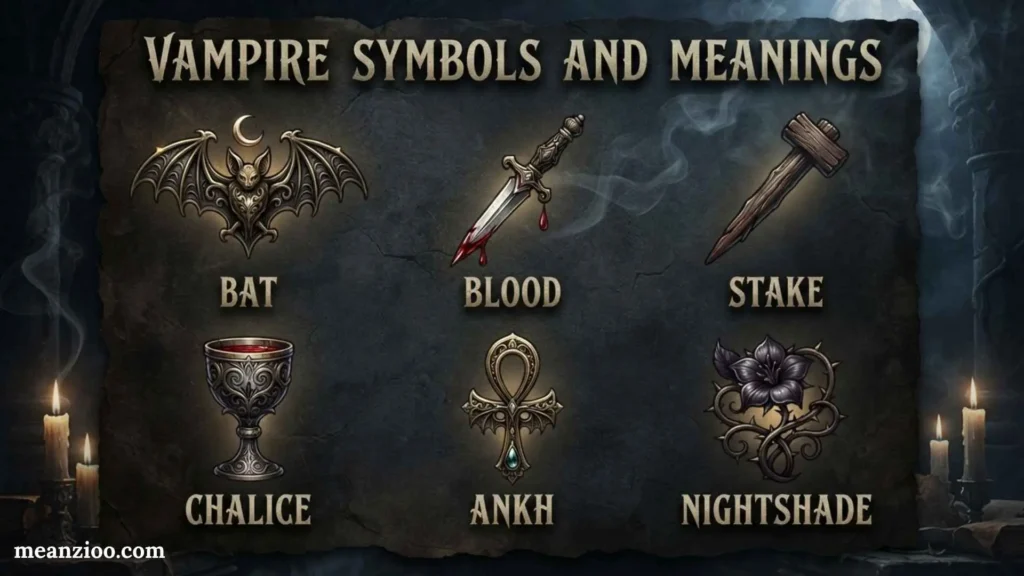
Vampire symbolism combines ideas of blood, death, immortality, darkness, temptation, fear, and the supernatural. Different cultures and stories give vampires different characteristics.
Here are some common vampire symbols and their meanings:
- Bat: Night, transformation, secrecy, and the classic vampire image.
- Blood: Life, death, hunger, power, and the connection between vampires and their victims.
- Fangs: Predation, danger, and the vampire’s ability to drink blood.
- Coffin: Death, burial, and the vampire’s connection with the grave.
- Moon: Night, mystery, transformation, and supernatural activity.
- Rose: Beauty, romance, blood, and mortality in Gothic storytelling.
- Cross: Religion, protection, faith, and the traditional conflict between vampires and Christianity in Western fiction.
- Garlic: Protection from vampires in European folklore and later popular culture.
Ancient Vampire Symbols
There is no single set of symbols that can accurately be called “ancient vampire symbols.” The modern vampire developed from a mixture of older beliefs about revenants, restless dead, spirits, and supernatural beings.
Ancient and medieval cultures had many stories about the dead returning to harm the living. Archaeological discoveries and historical accounts sometimes describe unusual burials that were interpreted as attempts to prevent the dead from returning.
Symbols now associated with vampires—such as bats, fangs, and capes—mostly became established through later folklore, literature, theater, movies, and popular culture rather than belonging to one ancient vampire religion.
Vampire Teeth Text Symbol
Vampire teeth are commonly represented with tooth, fang, or vampire emojis and decorative characters. There is no official Unicode character specifically representing a vampire fang.
Some useful options include:
🦷 🧛 🧛♂️ 🧛♀️
For decorative text, people also use combinations such as:
ʚ🦷ɞ
༺🧛༻
†🦇†
🩸🦷🩸
The exact appearance may change between devices because Unicode characters are displayed according to the font and emoji system being used.
Vampire Symbols Tattoos
Vampire tattoos are often chosen because of their Gothic, mysterious, romantic, or supernatural appearance. Popular designs include vampire fangs, bats, blood drops, coffins, roses, moons, Gothic crosses, vampire portraits, and dark castles.
The meaning can be personal. A bat may represent mystery or transformation, while vampire fangs can suggest power, danger, or an attraction to Gothic culture. A vampire tattoo can also symbolize immortality, living outside social expectations, or embracing one’s darker side.
Adding roses, blood, candles, or Gothic lettering can give the tattoo a more romantic or dramatic meaning.
Red Vampire Symbols
Red is strongly connected with vampire imagery because of its association with blood. In Gothic artwork, a red accent against black or dark backgrounds creates a dramatic contrast that immediately suggests danger, passion, violence, or supernatural horror.
Common red vampire imagery includes:
- Red blood drops
- Red vampire eyes
- Red roses
- Red fangs
- Red moons
- Red-and-black Gothic designs
- Blood-red lettering
Red vampire symbols are especially common in Halloween artwork, posters, tattoos, book covers, and fantasy designs.
Vampire Symbols Wallpaper
Vampire wallpapers often combine traditional Gothic imagery with modern fantasy aesthetics. Common elements include castles, full moons, bats, vampires, coffins, roses, candles, mist, dark forests, and blood-red details.
For a classic Gothic wallpaper, a black castle beneath a full moon can create a mysterious atmosphere. A modern fantasy wallpaper may instead focus on a vampire character with glowing eyes, dark clothing, and dramatic lighting.
Vampire wallpaper can work especially well for phone backgrounds, desktops, gaming setups, Halloween themes, and Gothic social media profiles.
Daywalker and Vampire Symbols Zombies 4
“Daywalker” is a vampire concept most famously associated with characters who can survive or function in daylight. The term is strongly connected with Blade, whose character is a human-vampire hybrid in Marvel stories.
“Zombies 4” may refer to a specific entertainment franchise or game context in which vampires, zombies, and other supernatural characters appear. Because vampire symbols can differ between fictional universes, the meaning of a symbol should be connected to the particular game, movie, or series being discussed.
In general, a daywalker symbol can represent a vampire who exists between the human and supernatural worlds. It often suggests dual identity, adaptation, freedom from traditional vampire limitations, or conflict between two natures.
Ancient Gothic Vampire Symbols
Ancient Gothic vampire symbols are best understood as a combination of historical vampire folklore and later Gothic artistic traditions. The Gothic vampire became especially influential through nineteenth-century literature.
Common Gothic vampire imagery includes:
- Bats
- Black roses
- Coffins
- Gothic crosses
- Blood
- Full moons
- Dark castles
- Graveyards
- Candles
- Fangs
- Black clothing
- Mist and shadow
Not all of these symbols are ancient. Many became associated with vampires through Gothic novels, theater, cinema, and modern fantasy.
Objects Associated With Vampires
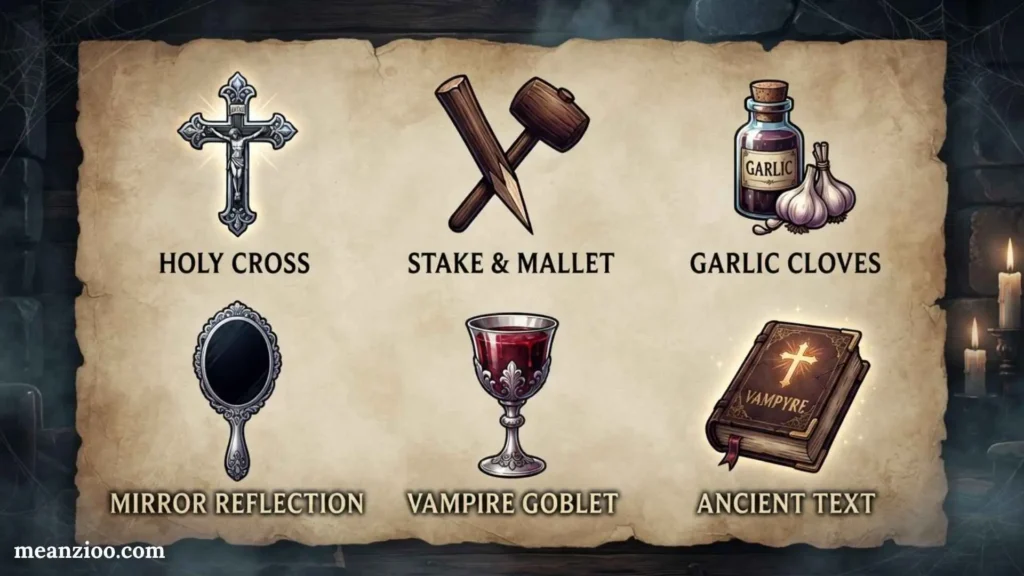
Several objects have become closely associated with vampire stories. They help audiences recognize the vampire theme even when no vampire character is shown.
Common vampire-related objects include:
- Coffins: Connection to death and burial.
- Mirrors: Used in folklore and fiction to explore supernatural identity.
- Garlic: Traditional protective object in vampire folklore.
- Wooden stakes: Famous vampire-hunting weapon in popular culture.
- Crosses: Religious protection in many Western vampire stories.
- Blood bottles: A modern visual representation of vampire feeding.
- Candles: Gothic atmosphere and nighttime mystery.
- Bats: Transformation and nocturnal life.
- Old books: Mystery, forbidden knowledge, and supernatural history.
- Black roses: Beauty, death, romance, and darkness.
Vampire Icons
Vampire icons are small visual symbols used to represent vampires or vampire-themed content. The most recognizable include the vampire emoji, bat, fangs, blood drop, coffin, skull, and Gothic cross.
Some easy vampire-themed icons are:
🧛 🦇 🩸 🦷 ⚰️ 🌙 ☠️ 🖤
These work well in social media bios, Halloween posts, gaming profiles, website categories, and decorative headings.
What Does a Vampire Symbolize
A vampire can symbolize many ideas beyond simply drinking blood. In folklore and literature, vampires are often connected with death, immortality, forbidden desire, temptation, fear, power, and the boundary between life and death.
Vampires can also represent the fear of aging because they remain young while humans grow old. Their endless existence can therefore symbolize both the desire for immortality and the curse of living forever.
In modern stories, vampires may additionally represent identity, social outsiders, romance, rebellion, or the struggle between human and supernatural instincts.
Vampire Markings
Vampire markings are visual signs used in fiction, folklore-inspired artwork, games, tattoos, and fantasy stories to identify vampires or their victims. Examples can include bite marks, glowing eyes, blood stains, scars, magical symbols, or fictional clan markings.
The most recognizable vampire “mark” is the pair of puncture wounds associated with a vampire bite. Modern fiction often uses these marks as evidence that a character has encountered a vampire or has been transformed into one.
There is no universally accepted historical vampire marking system.
Vampire Signs and Symbols
Common vampire signs and symbols include:
- 🦇 Bat — night and transformation
- 🩸 Blood — feeding and life force
- 🦷 Fangs — predation and danger
- ⚰️ Coffin — death and burial
- 🌙 Moon — nighttime and mystery
- 🧛 Vampire figure — supernatural identity
- 🧄 Garlic — traditional protection
- † Cross — faith and protection in Western vampire fiction
- 🥀 Dark rose — Gothic romance and mortality
Some of these are rooted in folklore, while others became popular through novels, movies, television, games, and Halloween culture.
What Do Vampires Represent
Vampires often represent the tension between life and death. They appear alive but are traditionally connected with the dead, making them powerful symbols of the fear of death and the desire to escape it.
They can also represent:
- Immortality
- Temptation
- Forbidden desire
- Youth and aging
- Power
- Loneliness
- Outsider identity
- Fear of death
- Rebellion
- Transformation
- Addiction or uncontrollable desire
The symbolism changes considerably from one story to another. A vampire may be a terrifying monster in one work and a sympathetic romantic character in another.
Vampire Symbolism in Literature
Vampire symbolism has played an important role in Gothic literature. Early vampire stories often used the creature to explore fears surrounding death, disease, sexuality, temptation, and the unknown.
Bram Stoker’s Dracula helped establish many features that became central to modern vampire fiction, including the mysterious aristocratic vampire, blood drinking, supernatural seduction, and the conflict between modern society and ancient evil.
Later writers changed the vampire into a more complex figure. Instead of being only a monster, the vampire could represent loneliness, forbidden love, immortality, alienation, or a struggle with one’s own nature.
This is why vampire symbolism remains popular today: the vampire can be frightening, romantic, tragic, powerful, or mysterious depending on the story. Its meaning continues to evolve through novels, films, television, games, tattoos, fashion, and Gothic culture.
Vampire Symbols: Historical vs. Modern
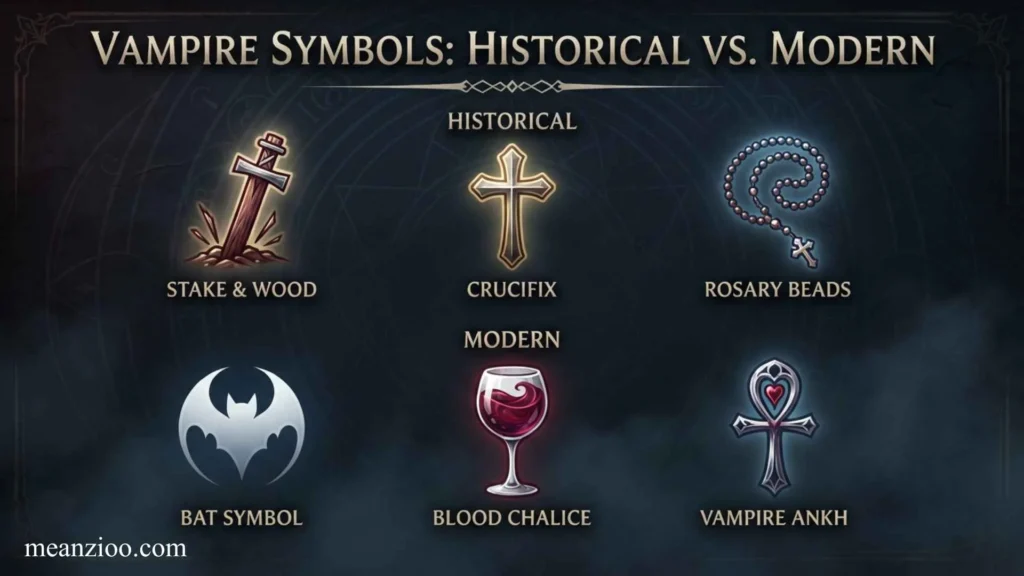
One of the most important things to understand is that vampire symbolism has changed over time.
Historical or Folkloric Associations
These include motifs such as:
- Graves
- Corpses
- Burial
- Staking
- Protective objects
- Garlic
- Religious symbols
- Fear of the returning dead
European vampire traditions developed across different regions and periods, so there was never one universal vampire rulebook.
Literary Vampire Symbols
Gothic writers added new characteristics and symbolism to the vampire.
The 19th century was particularly important because vampire folklore and Gothic literature increasingly interacted. Literary works such as The Vampyre, Carmilla, and Dracula helped transform the vampire into a more sophisticated fictional figure.
Modern Vampire Symbols
Modern entertainment expanded the imagery even further.
Common modern symbols include:
- Fangs
- Red eyes
- Black capes
- Bats
- Red roses
- Gothic castles
- Moonlight
- Bite marks
- Black-and-red color schemes
- Skulls
- Mirrors
These symbols are familiar because movies, television, games, books, and visual art repeatedly use them.
Vampire Symbols and Their Meanings at a Glance
| Vampire symbol | Common meaning |
| Blood | Life, hunger, power, desire |
| Fangs | Predation, danger, hunger |
| Bat | Night, transformation, mystery |
| Bite | Transformation, danger, temptation |
| Coffin | Death, sleep, immortality |
| Grave | Death, burial, undeath |
| Cross | Faith, protection, resistance |
| Garlic | Protection and defense |
| Wooden stake | Defeat and destruction |
| Moon | Night, mystery, transformation |
| Darkness | Fear, secrecy, unknown forces |
| Red | Blood, passion, danger |
| Black | Death, mystery, power |
| Red rose | Love, passion, beauty, desire |
| Black rose | Mourning, death, forbidden love |
| Skull | Mortality and death |
| Castle | Power, isolation, mystery |
| Mirror | Otherness and supernatural identity |
| Red eyes | Hunger, danger, supernatural power |
| Black cape | Gothic mystery and elegance |
Vampire Symbols in Folklore
Vampire folklore existed before the modern Dracula character.
Historical traditions concerning the returning dead developed in different parts of Europe. In some cases, communities believed that a deceased person could return and harm the living. These beliefs contributed to practices intended to prevent the dead from returning.
This background explains why older vampire symbolism often focuses on burial, corpses, graves, protection, and methods of restraining the dead.
The elegant aristocratic vampire wearing a cape and living in a castle is therefore only one stage in the development of vampire imagery.
Vampire Symbols in Dracula
Bram Stoker’s Dracula is one of the most influential works in vampire culture.
The novel uses numerous symbolic objects, including:
- Blood
- Bats
- Garlic
- Crucifixes
- Roses
- Stakes
- Coffins
- Sacred objects
- Darkness
- Dracula’s homeland and earth
Modern scholarship continues to examine how these objects work symbolically in the novel. A 2025 scholarly study, for example, discusses garlic, roses, ash wood, crucifixes, blood, and Dracula’s connection to his earth-home as recurring elements in the story.
The influence of Dracula is enormous. The V&A notes that Stoker’s 1897 portrayal helped make Dracula a defining representation of the vampire in art, literature, and film.
Vampire Symbols in Gothic Culture
Vampire symbols are now closely connected with Gothic aesthetics.
Gothic vampire designs often combine:
- Black clothing
- Red roses
- Blood
- Bats
- Candles
- Gothic architecture
- Crosses
- Skulls
- Moonlight
- Shadows
The purpose is not always to represent literal vampire folklore. Sometimes these symbols simply communicate a mood of mystery, darkness, romance, melancholy, rebellion, or dramatic beauty.
Vampire Tattoo Symbols and Their Meanings
Vampire symbols are popular tattoo choices because they can have multiple interpretations.
Vampire Fang Tattoo
A fang tattoo can symbolize:
- Strength
- Independence
- Danger
- Fearlessness
- Vampire fandom
Bat Tattoo
A bat can represent:
- Transformation
- Freedom
- Night
- Mystery
- Rebirth
Blood Drop Tattoo
Blood may symbolize:
- Life
- Passion
- Sacrifice
- Mortality
- Emotional intensity
Vampire Bite Tattoo
A bite mark may represent:
- Transformation
- Forbidden desire
- Obsession
- A connection between two people
- A personal change
Gothic Rose Tattoo
A rose combined with vampire imagery can represent:
- Beauty and danger
- Passion
- Forbidden love
- Death and romance
- Gothic identity
Cross and Vampire Tattoo
A cross combined with vampire imagery can create a contrast between:
- Good and evil
- Faith and darkness
- Protection and danger
- Humanity and supernatural power
The personal meaning of a tattoo is ultimately more important than any universal dictionary definition.
Vampire Symbols in Dreams
Vampire imagery in dreams does not have one universal interpretation.
Depending on the dream and personal circumstances, a vampire may be interpreted symbolically as:
- Something draining your energy
- Fear of losing control
- Temptation
- A difficult relationship
- Transformation
- Anxiety about death
- A powerful or controlling person
For example, dreaming about being bitten may be interpreted differently from dreaming about defeating a vampire. Dream symbolism is personal, so these interpretations should not be treated as scientific predictions.
Vampire Symbols in Movies and Television
Modern movies and television have expanded vampire symbolism significantly.
Different stories may portray vampires as:
- Monsters
- Villains
- Romantic figures
- Antiheroes
- Tragic immortals
- Powerful supernatural beings
- Metaphors for outsiders
This evolution reflects a broader transformation in vampire fiction. Modern vampire stories often give vampires more complex personalities and emotional motivations than older monster narratives.
Vampire Symbols for Halloween
For Halloween, some of the easiest symbols to recognize as vampire imagery include:
- 🦇 Bat
- 🩸 Blood
- 🧛 Vampire
- 🧛♀️ Vampire woman
- 🦇 Bat silhouettes
- 🥀 Dark roses
- 🪦 Grave imagery
- 🧛♂️ Vampire characters
- Gothic castles
- Coffins
- Fangs
Emoji and decorative symbols are modern representations, not historical vampire symbols. They are useful when the goal is visual communication rather than historical accuracy.
Also Check This Post: Dishwasher Symbols: Complete Guide to Every Common Symbol and Meaning
Vampire Symbols for Copy and Paste
If you are looking for simple vampire-themed characters for usernames, posts, captions, or designs, you can combine symbols such as:
🧛 🧛♀️ 🧛♂️ 🦇 🩸 🪦 🥀 🌙 🖤
You can also create decorative combinations:
🦇 🩸 🧛 🩸 🦇
🖤 🦇 🌙 🥀 🩸
🦇 † 🩸 † 🦇
The final combination is decorative rather than a historically established vampire symbol.
Vampire Symbol Combinations and What They Suggest
Individual symbols become even more meaningful when combined.
Bat + Moon
Bat + Moon suggests:
- Night
- Mystery
- Transformation
- Supernatural activity
Blood + Rose
Blood + Rose suggests:
- Passion
- Forbidden love
- Beauty and danger
- Desire
Cross + Garlic
Cross + Garlic suggests:
- Protection
- Vampire defense
- Folkloric vampire hunting
Coffin + Bat
Coffin + Bat suggests:
- Undeath
- Transformation
- Classic vampire imagery
Skull + Rose
Skull + Rose suggests:
- Beauty and death
- Mortality
- Gothic romance
- Love beyond death
What Do Vampire Symbols Represent?
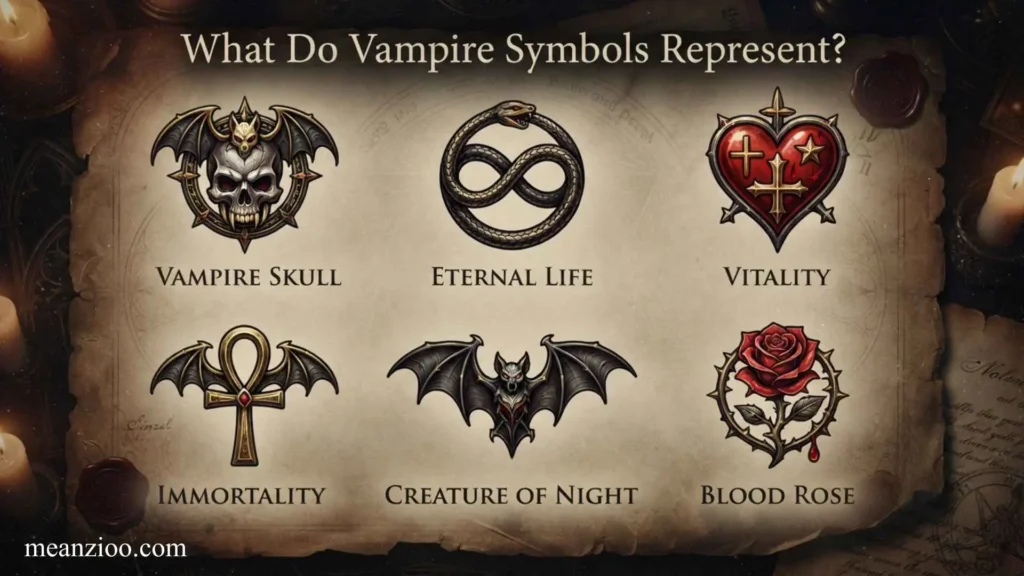
Although individual symbols have different meanings, several major themes appear repeatedly.
Death
The vampire exists in a strange relationship with death. It is often dead but active, buried but returning, mortal in origin but seemingly immortal.
Immortality
The vampire’s long or endless existence makes it a symbol of humanity’s fascination with escaping death.
Temptation
The vampire can be attractive, powerful, and dangerous at the same time. This creates a strong symbolism of temptation.
Desire
Blood, biting, seduction, and romantic imagery often connect vampires with desire and forbidden attraction.
Power
Supernatural strength, immortality, hypnotic abilities, and control over others make vampires symbols of power.
Transformation
The vampire bite frequently changes a human into something supernatural, making the vampire a symbol of personal transformation.
Fear of the Unknown
Vampires exist outside ordinary human rules. They therefore represent the fear of things that cannot easily be explained.
Otherness
The vampire is often human-like but not fully human. This makes it a powerful literary symbol for outsiders and people who exist outside social norms.
Are All Vampire Symbols Historically Accurate?
No.
This is an important distinction when researching vampire symbols.
Some symbols have strong connections with vampire folklore or classic vampire literature, while others are primarily modern artistic conventions.
Stronger historical or literary connections
- Graves
- Corpses
- Staking
- Garlic
- Crosses
- Coffins
- Blood
- Protective objects
Strong modern-pop-culture connections
- Red eyes
- Black capes
- Mirror symbolism
- Gothic roses
- Stylish vampire castles
- Certain fang designs
Context-dependent symbols
- Silver
- Black roses
- Skulls
- Wolves
- Moon imagery
- Red eyes
For accurate writing, it is better to say “commonly associated with vampires” than to claim every modern vampire image is an ancient vampire symbol.
Vampire Symbols vs. Werewolf Symbols
Vampires and werewolves are both popular supernatural creatures, but their symbolism differs.
| Vampire imagery | Werewolf imagery |
| Blood | Moon |
| Fangs | Claws |
| Bat | Wolf |
| Coffin | Forest |
| Immortality | Transformation |
| Seduction | Instinct |
| Darkness | Wildness |
| Gothic castle | Wilderness |
There can be overlap, particularly around the moon, darkness, transformation, and supernatural danger.
Why Are Vampire Symbols So Popular?
Vampire imagery remains popular because it combines several powerful human themes.
Vampires allow stories to explore:
- Fear of death
- Desire for eternal life
- Forbidden attraction
- Loss of humanity
- Social isolation
- Power
- Transformation
- Good versus evil
The vampire has also proven extremely adaptable. It can be a terrifying monster in one story, a romantic figure in another, or a metaphor for social and psychological fears in another.
Academic discussions of Gothic fiction have emphasized this symbolic flexibility, describing the vampire as a figure through which cultural fears and conflicts can be expressed.
Frequently Asked Questions About Vampire Symbols
What is the most common vampire symbol?
The bat, blood, and fangs are among the most recognizable modern vampire symbols. The bat became especially prominent through Dracula and later popular culture.
What does a vampire symbol mean?
A vampire symbol can represent death, immortality, blood, danger, temptation, transformation, darkness, desire, or supernatural power.
What symbolizes protection from vampires?
In classic vampire fiction, garlic, crosses or crucifixes, and stakes are strongly associated with vampire protection or destruction.
Why is a bat a vampire symbol?
The bat became strongly connected with vampires through literature and popular culture. Stoker’s Dracula helped establish the famous image of a vampire transforming into a bat.
What does vampire blood symbolize?
Vampire blood can symbolize life, hunger, power, desire, mortality, and supernatural transformation.
What does a vampire bite symbolize?
A vampire bite commonly represents danger, transformation, temptation, loss of control, or the transfer of supernatural power.
What flower symbolizes vampires?
There is no single universally recognized vampire flower. Roses, particularly red or dark roses, are commonly used in modern Gothic and vampire imagery. In Dracula, wild roses also have a specific protective role.
Is garlic really a vampire symbol?
Yes, garlic is a well-established symbol in vampire fiction and folklore. It became particularly famous through Dracula, where garlic is used as protection against vampires.
Is the cross a vampire symbol?
Yes, but usually as a protective or opposing symbol. In Christian-influenced vampire fiction, the cross or crucifix is often used against the vampire.
Are vampire symbols real?
Vampire symbols are cultural, folkloric, literary, and artistic symbols. They do not provide evidence that supernatural vampires exist.
What is the difference between vampire folklore and vampire symbolism?
Vampire folklore refers to traditional beliefs and stories about supernatural beings, while vampire symbolism refers to the meanings attached to vampire-related objects, images, and ideas in folklore, literature, art, and popular culture.
Final Thoughts
Vampire symbols have developed from older beliefs about the dead returning to modern images of Gothic monsters, seductive immortals, and supernatural antiheroes.
The most recognizable symbols—blood, fangs, bats, coffins, graves, crosses, garlic, stakes, roses, moonlight, darkness, and bite marks—each communicate a different part of the vampire myth.
Some symbols, such as garlic, crucifixes, graves, and staking, have strong connections to vampire folklore and classic literature. Others, such as red eyes, black capes, black roses, and mirror symbolism, are primarily modern conventions.
That distinction matters because vampire symbolism is not one fixed system. It has changed through folklore, Gothic literature, theater, film, television, games, tattoos, fashion, and online culture.
Ultimately, vampire symbols endure because they allow people to explore some of the oldest human concerns—death and immortality, fear and desire, beauty and danger, humanity and transformation—through one of fiction’s most enduring supernatural figures.
Also Check This Post: Cat Symbols: Meanings, Symbolism, Cultural Significance, and Common Designs

Hi, I’m Charlotte Hayes. I love writing about the newest English slang, pop culture phrases, and digital communication. I spend my time exploring how language evolves across social media, gaming, and everyday conversations. I enjoy sharing easy-to-understand guides that help learners keep up with modern English. My goal is to make every article useful, accurate, and enjoyable for readers around the world.
Books:
- Everyday Slang Dictionary
- Fluent Through Informal English
 Ryan Mitchell