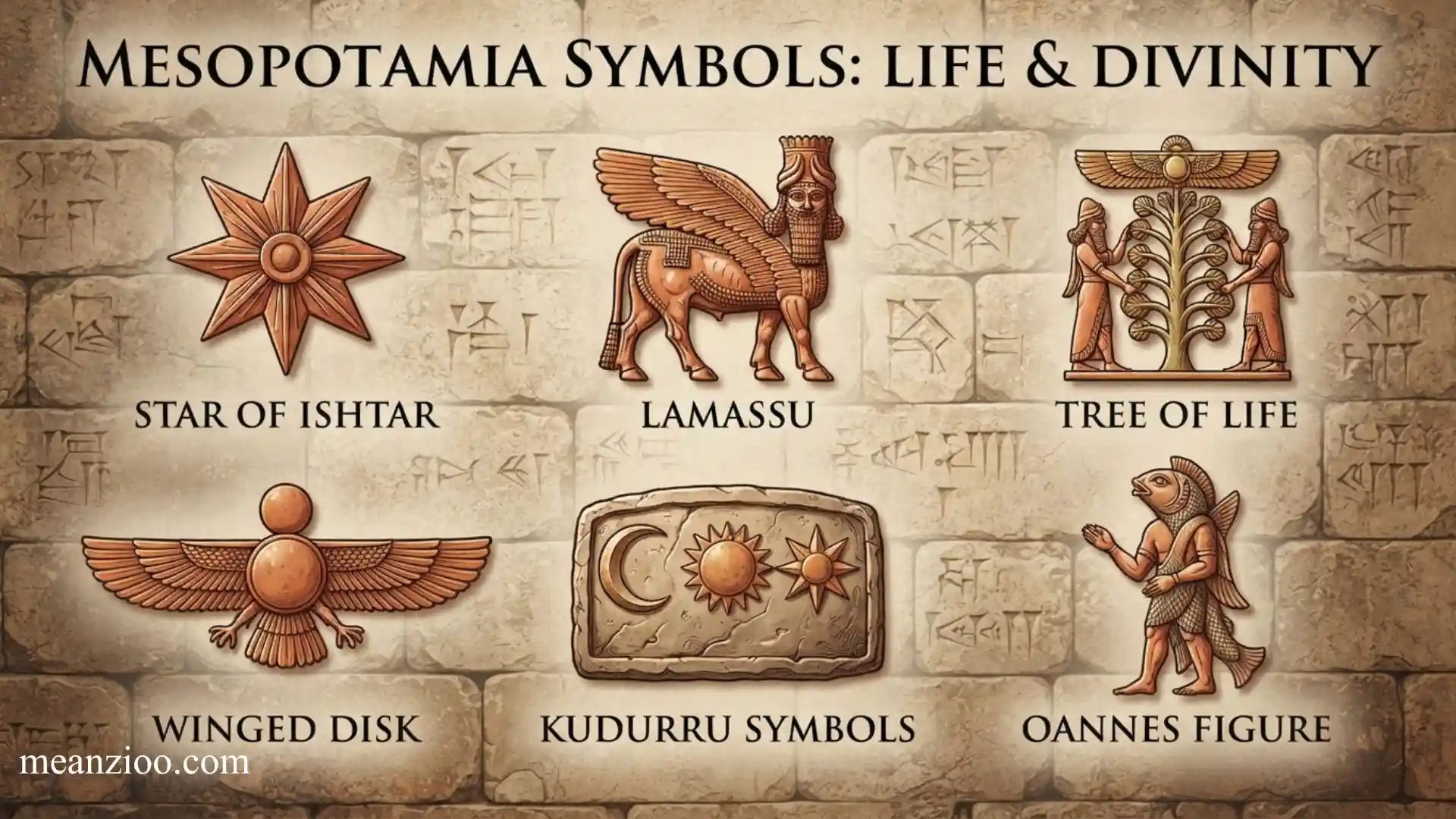
Mesopotamia symbols are among the most fascinating visual traditions of the ancient world. From the eight-pointed star of Inanna and Ishtar to the crescent of the moon god Sin, the winged disk, the lion, the mušḫuššu dragon of Marduk, and the protective lamassu, these symbols communicated ideas about gods, kingship, justice, astronomy, protection, nature, and the supernatural world.
However, there was no single set of “Mesopotamian symbols.” Mesopotamia was a region occupied by different cultures over thousands of years, including the Sumerians, Akkadians, Babylonians, and Assyrians. A symbol could therefore have different associations depending on its period and context.
This detailed guide explains the most important Mesopotamian symbols and their meanings, identifies which gods they represented, compares Sumerian, Babylonian, and Assyrian traditions, and explains how these ancient symbols are understood today.
Quick Guide to Mesopotamia Symbols
| Symbol | Associated deity or idea | Common meaning |
| Eight-pointed star | Inanna/Ishtar | Venus, love, warfare, divine power |
| Lion | Inanna/Ishtar | Strength, warfare, royal power |
| Crescent moon | Sin/Nanna | Moon and celestial power |
| Sun symbol | Shamash/Utu | Sun, justice, judgment |
| Winged disk | Ashur/Shamash in different contexts | Divine and royal authority |
| Forked thunderbolt | Adad/Ishkur | Storms, thunder, rain |
| Horned crown | Gods and divine beings | Divinity |
| Mušḫuššu dragon | Marduk | Babylonian divine power |
| Spade | Marduk | Symbol of Marduk |
| Rod and ring | Divine authority/kingship | Justice, order, legitimate rule |
| Lamassu | Protective supernatural being | Protection and guardianship |
| Goat-fish | Ea/Enki | Water and wisdom |
| Sacred tree/plant motifs | Religious and cosmic traditions | Life, fertility, order, sacred space |
| Cuneiform | Mesopotamian writing | Record keeping, knowledge, communication |
These associations should be understood as historical rather than universal. The same visual motif could have different meanings in different periods.
What Are Mesopotamian Symbols?
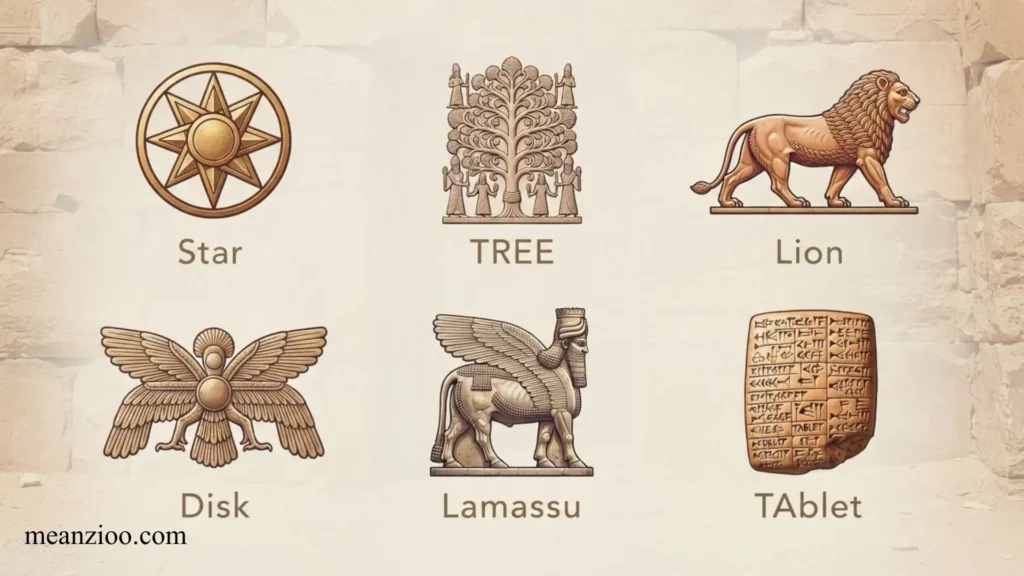
Mesopotamian symbols were visual representations used to communicate religious, political, social, astronomical, and mythological ideas.
They appeared on many types of objects, including:
- Temple walls
- Palace reliefs
- Cylinder seals
- Clay tablets
- Boundary stones
- Royal stelae
- Amulets
- Jewelry
- Statues
- Ceramics
- Monumental architecture
Some symbols directly represented a deity, while others were animals, celestial objects, weapons, crowns, or objects associated with a particular god.
For example, the eight-pointed star was strongly associated with Inanna/Ishtar, while the lion was her attribute animal. These are related symbols, but they are not exactly the same kind of symbol.
The British Museum’s Neo-Assyrian objects demonstrate how several divine emblems could appear together, including symbols associated with Ashur, Shamash, Sin, Adad, and Ishtar.
Mesopotamia Symbols and Meanings
Mesopotamian civilization used symbols to communicate ideas about gods, kingship, protection, fertility, nature, power, and the relationship between humans and the divine. These symbols appeared on cylinder seals, temple objects, sculptures, pottery, jewelry, boundary stones, and written records.
It is important to remember that Mesopotamia was not one single culture with one universal symbol system. Sumerians, Akkadians, Babylonians, and Assyrians lived in the region at different times and developed traditions that sometimes overlapped and sometimes changed.
The sections below explore some of the most recognizable Mesopotamia symbols and meanings, including religious symbols, Sumerian god symbols, the famous rod-and-ring motif, and symbols associated with royal authority.
Mesopotamia Symbols Tattoos
Mesopotamian symbols can be an interesting source of tattoo inspiration because many of them connect to ancient ideas about protection, wisdom, strength, divinity, and kingship. However, a modern tattoo does not necessarily have the same meaning that the original symbol had in ancient Mesopotamia.
For example, the rod and ring motif is frequently associated with divine authority and royal legitimacy. A person choosing this imagery today might use it as a representation of leadership, responsibility, order, or strength.
Other tattoo ideas can draw inspiration from Mesopotamian art, including:
- Cuneiform-inspired designs
- Ancient protective figures
- Winged divine or guardian imagery
- Mesopotamian star symbols
- Lion imagery associated with power
- Serpent imagery
- Divine emblems
- Ancient cylinder-seal designs
- Stylized representations of Sumerian deities
If you choose a cuneiform tattoo, it is especially important to check the original signs and translation rather than using a random online design. Cuneiform is a writing system rather than a simple collection of decorative symbols, and the meaning can depend on the language, period, and context.
A historically inspired Mesopotamian tattoo can therefore combine visual beauty with a meaningful connection to one of the world’s earliest urban civilizations.
Mesopotamia Symbols and Meanings
Mesopotamian symbols represented many different concepts, and their meanings depended heavily on context. A symbol used in a temple could have a religious meaning, while a similar image on royal artwork could communicate authority or political power.
Some important symbolic themes include:
| Symbol or Motif | Common Association |
| Rod and ring | Divine authority, kingship, justice, legitimacy |
| Eight-pointed star | Inanna/Ishtar and celestial symbolism |
| Lion | Strength, royalty, warfare, divine power |
| Winged imagery | Divinity, protection, supernatural power |
| Serpent | Different meanings depending on deity and context |
| Bull | Strength, fertility, and associations with certain gods |
| Cuneiform signs | Written language, names, titles, prayers, records |
| Sacred trees | Life, fertility, order, and religious imagery |
| Divine emblems | Identification of particular gods or goddesses |
One of the most important ideas to understand is that Mesopotamian symbols were not always fixed like modern logos. The same animal, object, or celestial image could have different associations depending on the period and artistic setting.
This makes Mesopotamian symbolism especially rich for researchers and readers interested in ancient religion, mythology, archaeology, and art.
Ancient Mesopotamia Symbols
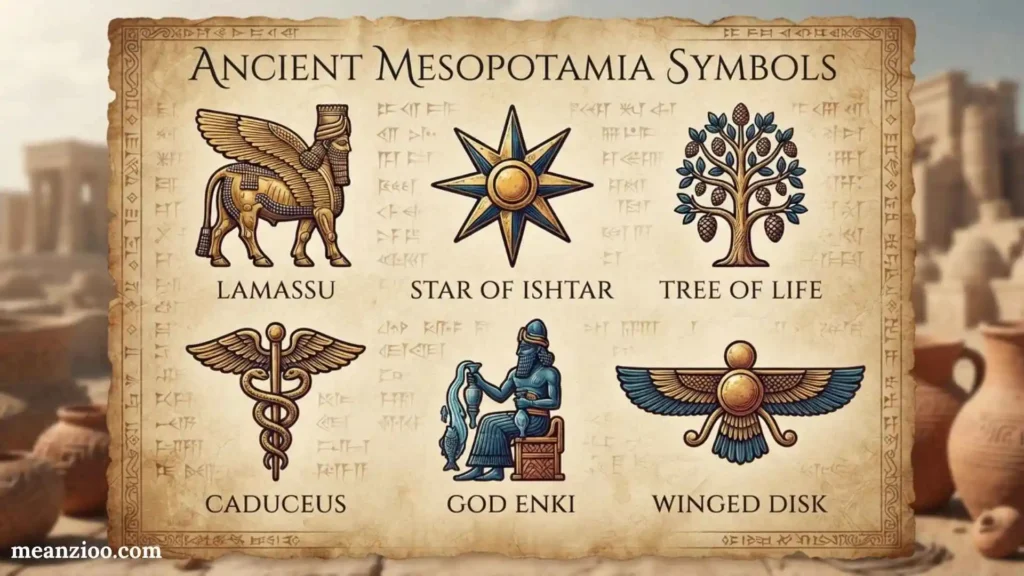
Ancient Mesopotamia produced an enormous variety of symbolic imagery. The region between the Tigris and Euphrates rivers was home to several civilizations over thousands of years, so its artistic traditions developed and changed over time.
Symbols were found in places such as temples, palaces, tombs, administrative buildings, and private objects. Cylinder seals are particularly valuable because they often contain compact scenes showing gods, humans, animals, sacred objects, and mythological events.
The eight-pointed star is one of the best-known Mesopotamian motifs. It became strongly associated with the goddess Inanna in Sumerian tradition and Ishtar in later Akkadian, Babylonian, and Assyrian traditions.
Animals were also important. Lions could communicate strength and royal or divine power, while bulls appeared in several religious and mythological contexts. Protective supernatural beings were frequently represented in monumental art, particularly in later Assyrian architecture.
Another important category is cuneiform. Cuneiform signs could represent sounds, words, names, numbers, or concepts. Because the system changed over time and was used for multiple languages, individual signs should always be interpreted in their historical context.
Polytheism Mesopotamia Symbols
Religion in ancient Mesopotamia was generally polytheistic, meaning people worshiped many gods and goddesses. Different cities often had particular patron deities, and religious traditions evolved across Sumerian, Akkadian, Babylonian, and Assyrian periods.
Symbols helped people identify and represent these divine figures.
For example, the goddess Inanna was strongly connected with the eight-pointed star. In later Mesopotamian traditions, Ishtar inherited many of Inanna’s characteristics and became an important goddess associated with love, sexuality, fertility, and warfare.
Other deities had their own identifying objects, animals, or celestial associations. The bull, for example, appears in connection with several gods and mythological traditions, while the crescent moon became strongly associated with the moon god Nanna or Sin.
Mesopotamian religious symbolism also appeared in temples, seals, statues, amulets, and ritual objects. These images were not simply decorative. They could identify a deity, communicate religious beliefs, invoke protection, or express the relationship between a ruler and the gods.
Gods Mesopotamia Symbols
Mesopotamian gods were often recognized through distinctive attributes, animals, celestial objects, or objects held by the deity.
Some important examples include:
Inanna / Ishtar
The eight-pointed star is one of the most recognizable symbols connected with Inanna and Ishtar. She was one of the most important goddesses in Mesopotamian religion.
Nanna / Sin
The moon and crescent became important symbols of Nanna in Sumerian tradition and Sin in later Akkadian and Babylonian traditions. The lunar cycle was closely connected with ancient Mesopotamian religious and calendrical traditions.
Utu / Shamash
The sun was central to the symbolism of Utu, later known as Shamash. He was associated with justice, truth, and divine judgment. His imagery often includes solar rays or a distinctive solar emblem.
Enki / Ea
Enki, later known as Ea, was associated with freshwater, wisdom, craftsmanship, and the subterranean freshwater realm known as the Abzu. Water imagery is therefore important when studying his representation.
Enlil
Enlil was one of the most important gods in Sumerian religion and became associated with authority, wind, and rulership. His importance was particularly connected to the city of Nippur.
These associations demonstrate why studying a symbol separately from its historical context can be misleading. A single object or animal may have connections to more than one deity.
Sumerian Mesopotamia Symbols
Sumerian symbolism developed within one of the earliest urban civilizations of southern Mesopotamia. Sumerian cities such as Uruk, Ur, Lagash, and Nippur developed distinctive religious and artistic traditions.
The Sumerians used symbols in writing, religious art, architecture, cylinder seals, and ritual objects. Their cuneiform writing system is particularly important because it provides direct evidence about their language, religion, administration, mythology, and social organization.
The eight-pointed star of Inanna is one of the most recognizable examples of Sumerian religious symbolism. Inanna was associated with the city of Uruk and held an important place in Sumerian mythology.
The crescent moon was associated with Nanna, while solar imagery was connected with Utu. Divine symbols could also appear alongside inscriptions that identified kings, temples, gods, or religious dedications.
Sumerian symbols should therefore be understood as part of a broader visual and written language rather than as isolated decorative marks.
Mesopotamian Symbol of Power
Power in Mesopotamian art was frequently expressed through images of kingship, divine approval, weapons, animals, crowns, and ceremonial objects.
The rod and ring is particularly important when discussing the visual language of authority. It appears in scenes involving gods and rulers and has traditionally been interpreted as an emblem connected with justice, authority, measurement, or kingship.
Lions were another powerful visual motif. Their strength and dangerous nature made them suitable symbols for royal authority and divine power. Kings were sometimes depicted hunting lions as a demonstration of courage and control.
Weapons could also communicate power. In mythological and religious scenes, divine figures may carry weapons or other objects that identify their authority.
Mesopotamian rulers often presented themselves as acting with divine approval. Royal inscriptions could describe the king as chosen by a god, while palace and temple art reinforced the relationship between political authority and the supernatural world.
Rod and Ring Mesopotamia
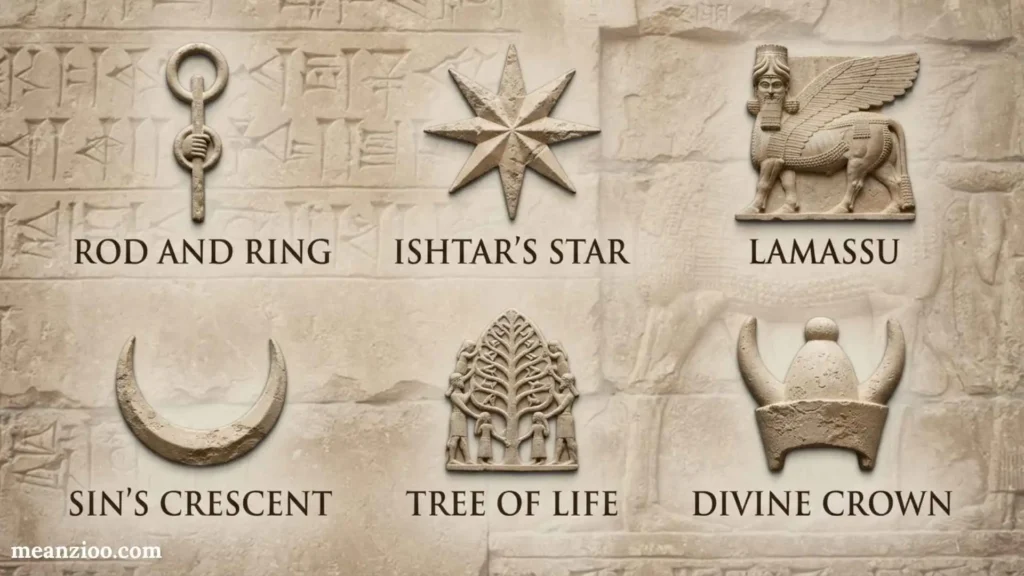
The rod and ring is one of the most recognizable motifs in Mesopotamian art. It is commonly shown as a deity holding or presenting these objects to a ruler.
The motif appears in important ancient Near Eastern artworks, including scenes of kings standing before gods. One famous example is associated with the Babylonian king Hammurabi and the god Shamash on the upper portion of the Code of Hammurabi stele.
The exact interpretation of the objects has been debated. They are often described as symbols of authority, justice, kingship, or measurement. Some interpretations connect them with the idea of a measuring rod and a coiled rope, while others emphasize their broader role as insignia of divine or royal authority.
What makes the motif important is its visual message: legitimate earthly authority is presented as connected to divine authority.
This connection was central to Mesopotamian kingship. A ruler was not simply shown as a powerful individual; royal art often presented his authority within a larger religious and cosmic order.
Sumerian God Symbols
Sumerian gods had different identities, functions, cities, and visual associations. Their symbols helped ancient viewers recognize them in religious art.
Some important examples include:
- Inanna: eight-pointed star and associations with Venus
- Nanna: crescent moon
- Utu: sun and solar imagery
- Enki: water and the Abzu
- Enlil: authority, wind, and divine kingship
- Ninhursag: fertility, motherhood, and the natural world
- Ninurta: warfare, agriculture, and heroic power
These associations were not always represented through a single universal icon. Ancient Mesopotamian art could use a combination of divine emblems, inscriptions, animals, celestial objects, and narrative scenes.
This is why a good interpretation should consider who is depicted, what objects appear nearby, where the artwork was found, and which historical period produced it.
Mesopotamian Religion Symbol
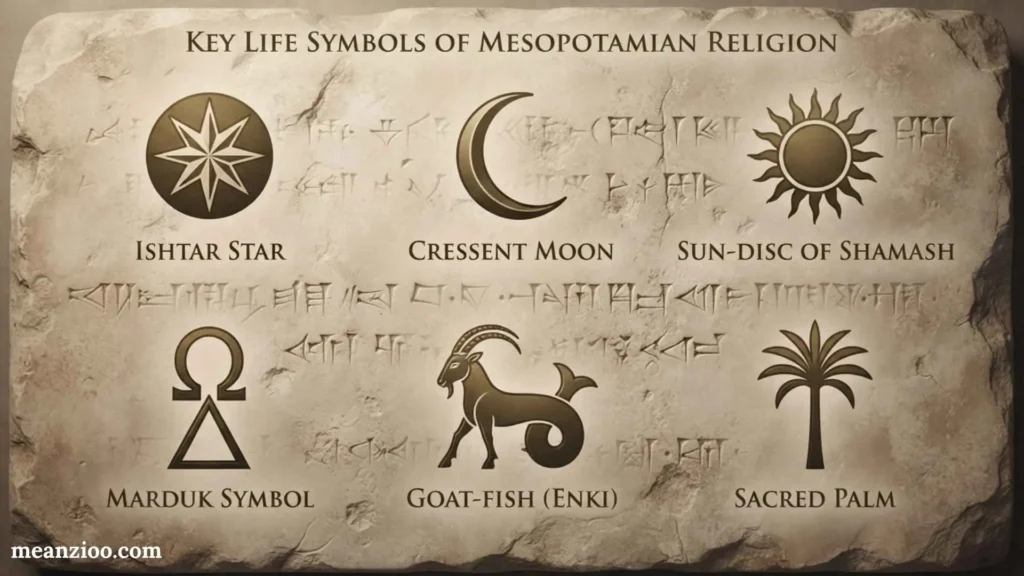
There was no single universal symbol representing all of Mesopotamian religion. Ancient Mesopotamian religion developed across different cities and civilizations over thousands of years.
Instead, there were many religious symbols associated with individual gods, temples, rituals, and beliefs.
The eight-pointed star is strongly associated with Inanna and Ishtar. The crescent moon is associated with the moon god Nanna/Sin, while solar imagery is connected with Utu/Shamash.
Protective figures were also common. Mesopotamian people used amulets and protective imagery in religious contexts, while monumental architecture featured supernatural guardian figures intended to protect important spaces.
Sacred animals, plants, celestial bodies, weapons, and ritual objects could all carry religious significance.
Therefore, if someone searches for a “Mesopotamian religion symbol,” it is more accurate to explain the diversity of the tradition rather than claiming that one modern-looking emblem represented the entire religion.
Gods, Demons and Symbols of Ancient Mesopotamia: An Illustrated Dictionary
Gods, Demons and Symbols of Ancient Mesopotamia: An Illustrated Dictionary is a reference work associated with the study of Mesopotamian mythology, religion, and symbolism. Works of this type are useful because Mesopotamian religious traditions contain a large number of gods, goddesses, supernatural beings, symbols, and specialized terms.
A dictionary or illustrated reference can help readers distinguish between:
- Major gods and goddesses
- Lesser deities
- Demons and protective spirits
- Mythological creatures
- Divine symbols
- Religious objects
- Ancient names and titles
- Sumerian and Akkadian terminology
Readers should still consider the historical period when using a reference book. Mesopotamian religion changed over time, and a Sumerian tradition could have a different name or interpretation in later Babylonian or Assyrian sources.
This historical development is one reason Mesopotamian symbolism remains such a fascinating subject. Rather than being a single fixed system, it was a long tradition that evolved alongside cities, languages, political powers, and religious practices.
Understanding that complexity makes ancient Mesopotamian symbolism even more interesting—and helps modern readers, researchers, artists, and tattoo enthusiasts use these ancient motifs with greater historical awareness.
The Most Important Mesopotamia Symbols and Their Meanings
1. Eight-Pointed Star of Inanna and Ishtar
The eight-pointed star is probably the most recognizable religious symbol associated with Mesopotamian goddess Inanna, known in Akkadian as Ishtar.
Inanna/Ishtar was an exceptionally important goddess. She was associated with sexual love and warfare and, in her astral aspect, with the planet Venus—the morning and evening star.
The star therefore had several interconnected meanings:
- Inanna or Ishtar
- Venus
- The morning and evening star
- Love
- Sexuality
- Warfare
- Divine power
- The heavens
The exact appearance of the star was not necessarily identical in every period. Ancient Mesopotamian artists used different variations, and not every star-shaped image should automatically be identified as Ishtar.
2. Lion of Ishtar
The lion was an important attribute animal of Ishtar, particularly in her warrior aspect.
Ishtar could be depicted standing on or associated with a lion, emphasizing her strength and martial nature. ORACC identifies the lion as her attribute animal in her warrior aspect.
The lion can therefore suggest:
- Strength
- Courage
- Warfare
- Royal power
- Divine authority
- Ishtar’s warrior identity
A famous example of Ishtar’s association with the lion comes from Babylonian glazed-brick decoration.
3. Crescent Moon of Sin/Nanna
The crescent moon was associated with the Mesopotamian moon god Sin, known in Sumerian tradition as Nanna.
The crescent was one of the major celestial symbols found in Mesopotamian religious art.
Its associations include:
- The moon
- Night
- Time and lunar cycles
- Sin/Nanna
- Celestial order
Neo-Assyrian artwork frequently placed the crescent of Sin alongside the symbols of Shamash and Ishtar.
4. Sun Symbol of Shamash/Utu
Shamash was the Akkadian name of the sun god, corresponding to the Sumerian Utu.
The sun was associated with light, visibility, truth, and justice. Shamash was particularly important in Mesopotamian ideas about judgment and law.
His symbols could appear alongside those of other major celestial deities.
The British Museum identifies a winged disk as the symbol of Shamash in some Assyrian contexts and a sun-related symbol among the divine emblems associated with Shamash.
Common associations include:
- Sunlight
- Justice
- Judgment
- Truth
- Divine observation
- Cosmic order
5. Winged Disk
The winged disk is one of the most famous images in ancient Mesopotamian and Assyrian art.
However, it is important not to assign one universal meaning to every winged disk.
Depending on the historical context, it could be associated with Ashur or Shamash. The British Museum explicitly notes that interpretations can differ, identifying the winged disk on one Neo-Assyrian stela with Ashur or, according to some interpretations, Shamash.
This is an excellent example of why historical symbols should be interpreted according to their specific archaeological context.
Possible associations include:
- Divine authority
- Heavenly power
- Royal legitimacy
- Ashur
- Shamash
- Protection
6. Thunderbolt of Adad
Adad, also known as Ishkur in Sumerian tradition, was associated with storms and weather.
His symbol could be represented as a forked thunderbolt.
The British Museum identifies a forked line as the symbol of the storm god Adad on Neo-Assyrian royal imagery.
The thunderbolt represented powerful natural forces such as:
- Thunder
- Storms
- Rain
- Weather
- Divine power
Because agriculture depended heavily on water and weather, storm deities could have enormous importance in Mesopotamian society.
7. Horned Crown
The horned crown or horned headdress is one of the clearest visual indicators of divinity in Mesopotamian art.
Gods were often distinguished from humans through their divine headgear.
A Neo-Assyrian stela, for example, depicts the supreme god Ashur through a horned helmet, while other gods are represented by their characteristic symbols.
The horned crown can therefore indicate:
- Divinity
- Supernatural status
- Divine authority
- Sacred identity
It is important to distinguish this from ordinary royal crowns. A ruler’s headgear communicated kingship, while the horned headdress was strongly connected with divine status.
8. Mušḫuššu: The Babylonian Snake-Dragon
The mušḫuššu, often translated as a snake-dragon or dragon-like creature, is one of the most distinctive symbols of Babylon.
It was strongly associated with Marduk, the patron god of Babylon.
ORACC identifies the mušḫuššu as Marduk’s symbol animal and notes that the creature frequently appears on the glazed brick reliefs of Babylon.
The creature combined features from several animals, creating a supernatural appearance.
Its associations include:
- Marduk
- Babylon
- Divine power
- Protection
- Supernatural authority
The famous Babylonian processional imagery makes the mušḫuššu particularly important when studying Babylonian symbolism.
9. Spade of Marduk
The spade is another symbol associated with Marduk.
ORACC notes that the spade became Marduk’s symbol as early as the Old Babylonian period.
The spade is particularly important because it demonstrates that a Mesopotamian deity could have more than one identifying symbol.
Marduk could therefore be represented through:
- The mušḫuššu
- The spade
- Written references
- Other religious imagery
A limestone kudurru fragment at The Metropolitan Museum of Art shows the mušḫuššu alongside a spade symbol associated with Marduk.
10. Rod and Ring
The rod and ring is one of the most interesting and debated Mesopotamian symbols.
It frequently appears in scenes where a deity presents these objects to a king.
They have traditionally been interpreted as symbols of:
- Authority
- Justice
- Legitimate kingship
- Order
- Measurement
- Divine approval
Scholarly interpretations are more nuanced, however. Research published by Oxford Academic describes the rod and ring as an icon associated with righteous kingship and the relationship between palace and temple.
Another scholarly analysis notes that the objects may have connections with measurement, order, harmony, judgment, and justice rather than simply representing generic royal power.
This makes the rod and ring a good example of a symbol whose meaning cannot be reduced to one simple definition.
11. Lamassu
The lamassu is a protective supernatural figure especially famous from Assyrian palace architecture.
It typically combines:
- A human head
- Wings
- A powerful animal body
The creature’s enormous size and placement at entrances communicated protection and authority.
Lamassu figures were not merely decorative. They were part of a broader visual system in which supernatural beings protected important spaces.
Common meanings include:
- Protection
- Guardianship
- Strength
- Royal authority
- Supernatural power
12. Goat-Fish of Ea/Enki
The goat-fish is associated with Ea, known in Sumerian as Enki.
Ea was strongly connected with freshwater, wisdom, magic, and knowledge.
The goat-fish combines an animal’s front portion with a fish-like body, creating a supernatural creature appropriate for a deity associated with water.
A Mesopotamian kudurru fragment at The Met identifies the goat-fish with Ea.
13. Sacred Tree and Plant Motifs
Trees and plant imagery appear frequently in Mesopotamian art.
One famous example is the Adda Seal, where a small tree appears within a complex scene involving several deities and supernatural figures.
However, not every ancient tree image should automatically be called a single universal “tree of life” symbol.
Depending on the object and period, plant imagery may relate to:
- Fertility
- Life
- Nature
- Sacred space
- Abundance
- Cosmic order
The safest interpretation depends on the archaeological context.
14. Rosette
The rosette or star-like floral motif appears in Mesopotamian art and can have religious associations.
In Neo-Assyrian material, the British Museum identifies a rosette or star symbol as representing Ishtar or the planet Venus on a stela of Adad-nirari III.
This demonstrates an important point: symbols did not always look exactly like the modern geometric icons people associate with them today.
Also Check This Post: Science Safety Symbols: Complete Guide to Laboratory, Chemical, and Hazard Symbols
Mesopotamian Symbols by Civilization
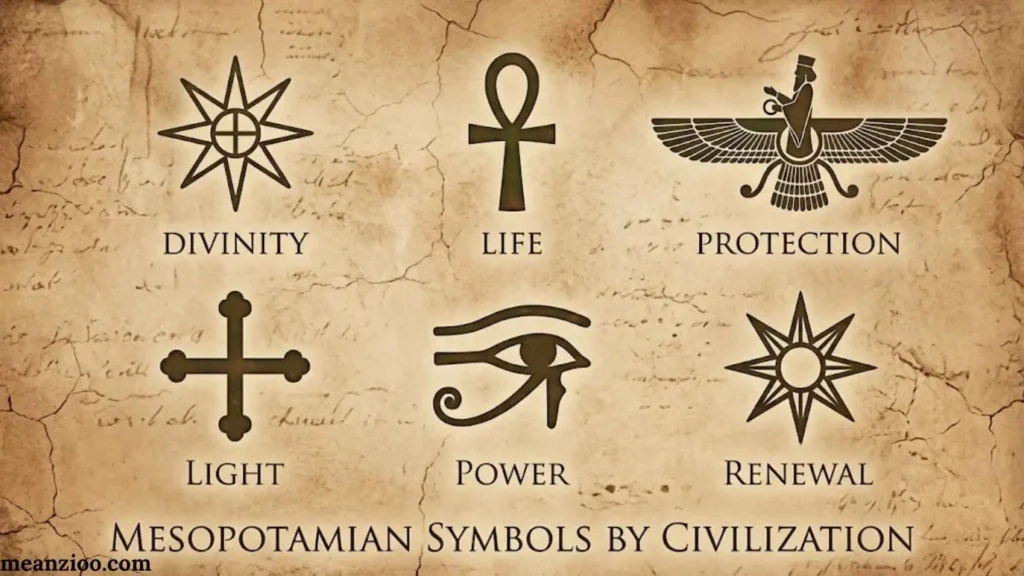
Mesopotamia was not one civilization. Understanding the major cultures makes the symbols easier to interpret.
Sumerian Symbols
The Sumerians developed some of the earliest cities and writing traditions in southern Mesopotamia.
Important Sumerian deities included:
- Inanna
- Enki
- Enlil
- Utu
- Nanna
- An
Sumerian religious symbols often involved celestial objects, animals, crowns, plants, and divine attributes.
Inanna, for example, was associated with the planet Venus and the eight-pointed star.
Akkadian Symbols
The Akkadian-speaking world inherited and transformed many earlier Sumerian traditions.
This is why the same deity can have different names in different languages.
For example:
- Inanna → Ishtar
- Utu → Shamash
- Nanna → Sin
- Enki → Ea
- Ishkur → Adad
The underlying religious traditions were interconnected, but they were not completely identical.
Babylonian Symbols
Babylon became especially important during the Old Babylonian and Neo-Babylonian periods.
Marduk became the patron deity of Babylon and eventually rose to a position of extraordinary importance in the Babylonian religious system.
Major Babylonian symbols include:
- Mušḫuššu
- Marduk’s spade
- Ishtar’s lion
- Ishtar’s star
- Celestial symbols
- Divine crowns
The Met’s collection provides a useful example of a Babylonian-period object combining the mušḫuššu, Marduk’s spade, the sun, Venus, and the horned crown.
Assyrian Symbols
Assyrian art placed enormous emphasis on kingship, military power, religion, and imperial authority.
Neo-Assyrian royal monuments frequently show kings standing before divine symbols.
A stela of Ashurnasirpal II, for example, identifies symbols for Ashur, Shamash, Sin, Adad, and Ishtar.
Important Assyrian symbols and motifs include:
- Winged disk
- Horned helmet
- Crescent
- Thunderbolt
- Ishtar star
- Royal imagery
- Lamassu
- Winged protective beings
Mesopotamian Symbols of the Gods
One of the easiest ways to understand these symbols is to organize them by deity.
| Deity | Mesopotamian name | Symbol or attribute | Main association |
| Inanna/Ishtar | Sumerian/Akkadian | Eight-pointed star, lion | Venus, love, warfare |
| Shamash/Utu | Akkadian/Sumerian | Sun | Justice and sunlight |
| Sin/Nanna | Akkadian/Sumerian | Crescent | Moon |
| Adad/Ishkur | Akkadian/Sumerian | Thunderbolt | Storms and rain |
| Marduk | Babylonian | Mušḫuššu, spade | Babylon and divine kingship |
| Ea/Enki | Akkadian/Sumerian | Goat-fish, water imagery | Wisdom and freshwater |
| An/Anu | Sumerian/Akkadian | Horned crown | Sky |
| Ashur | Assyrian | Winged disk in Assyrian contexts | Assyria and supreme divine authority |
The symbols should be treated as contextual associations rather than a rigid dictionary. Archaeological examples show that the same visual form can sometimes have different interpretations.
Mesopotamian Symbols in Astronomy
Astronomy was deeply important in Mesopotamian intellectual and religious traditions.
Several major gods had celestial associations:
- Inanna/Ishtar → Venus
- Shamash/Utu → Sun
- Sin/Nanna → Moon
A Neo-Assyrian tile in the British Museum shows symbols for Shamash, Sin, and Ishtar together above a worshipper.
This combination is significant because it demonstrates how celestial observation and religious symbolism could operate together.
The sky was not simply viewed as a physical environment. Celestial bodies were also part of a religious and interpretive system.
Mesopotamian Symbols of Kingship
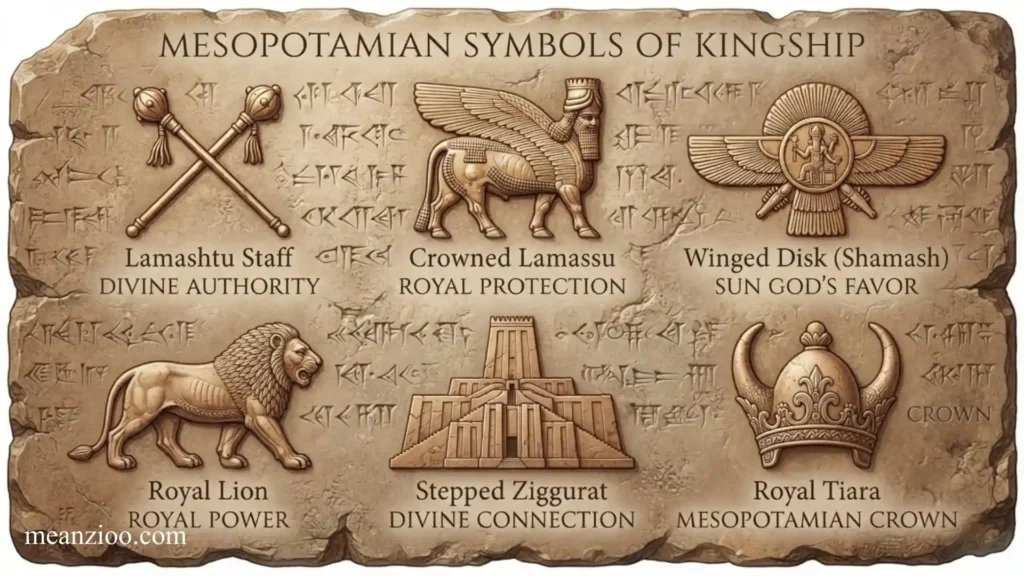
Symbols were essential to Mesopotamian ideas of royal authority.
Kings did not generally present themselves as ordinary political leaders. Royal imagery often connected the ruler’s authority with the gods.
The rod and ring are especially important in this context. Artistic scenes show divine figures presenting these objects to kings, creating a visual connection between divine authority and legitimate rule.
Other royal symbols included:
- Maces
- Crowns and royal hats
- Divine emblems
- Protective supernatural creatures
- Weapons
- Royal inscriptions
A British Museum stela of Ashurnasirpal II shows the king wearing royal headgear and holding a mace symbolizing authority while standing before divine symbols.
Mesopotamian Symbols of Protection
Protection was another major function of ancient Mesopotamian imagery.
Protective symbols and figures could appear on:
- Palace entrances
- Temples
- Amulets
- Seals
- Ritual objects
- Household objects
The lamassu is one of the clearest examples of monumental protective imagery.
Other supernatural beings could also serve protective or apotropaic purposes.
This means that not every supernatural creature represented an evil being. Some were specifically used to defend people or sacred spaces from supernatural threats.
Sumerian Protection Symbols
Sumerian protection symbols should be understood within the broader religious practices of ancient Sumer. People used religious objects, ritual practices, and images of divine beings to seek protection from danger and harmful supernatural forces.
However, there is no single universally accepted symbol that represents all Sumerian protection. Different objects served different purposes, and their functions depended on the period and context.
Three important areas to consider are:
Protective figures and divine beings
Sumerian religious traditions included gods and supernatural beings who could provide help, maintain order, or protect people. Their images and associated objects could communicate divine power.
Amulets and ritual objects
Protective practices could involve objects used in religious or ritual settings. The purpose of a particular object should be established through archaeological evidence or relevant ancient texts rather than assumed from its appearance.
Religious symbols and divine emblems
Symbols associated with individual gods could express their authority and influence. However, a deity’s symbol was not necessarily a dedicated protective sign.
It is also important to distinguish Sumerian traditions from later Mesopotamian practices. The lamassu, for example, is especially famous as a protective figure in Assyrian palace architecture. It is relevant to the wider history of Mesopotamian protection, but it should not be presented as an exclusively Sumerian symbol.
For anyone researching Sumerian protection symbols for historical study, art, or tattoos, the most reliable approach is to identify the original object, its date, and the evidence for its intended purpose. This helps separate historically supported meanings from modern interpretations.
Protection Sumerian Symbols
Protection played an important role in ancient Mesopotamian religious life. People believed that divine beings and supernatural forces could influence their health, homes, families, and communities. Protective objects, rituals, and images were used to guard against harmful forces and seek divine support.
When discussing protection in Sumerian culture, it is important to distinguish between symbols directly associated with Sumerian traditions and protective figures that became especially prominent in later Babylonian or Assyrian periods.
Some relevant examples include:
- Protective divine imagery: Images of gods and supernatural beings could express divine support and protection.
- Cylinder seal imagery: Seals sometimes included religious scenes and divine figures. Their meanings depended on the specific design and historical context.
- Amulets: Small objects could be used in protective or religious practices.
- Divine symbols: Celestial objects and other emblems could identify gods who were believed to hold power over particular aspects of life.
The eight-pointed star of Inanna is an important Sumerian religious symbol, but it should not automatically be described as a universal protection symbol. Its best-established associations include Inanna, Venus, and the goddess’s divine powers.
Similarly, not every ancient amulet or religious image had the same protective function. Archaeological evidence and written sources are necessary to determine how a particular object was used.
Cuneiform Symbols vs. Religious Symbols
A common source of confusion is the difference between cuneiform signs and religious symbols.
Cuneiform was a writing system. It was created by pressing a stylus into clay, producing wedge-shaped marks.
A cuneiform sign could represent:
- A word
- A syllable
- A name
- A grammatical element
- A number
- A divine name
Therefore, cuneiform should not be treated as one single symbol system with fixed mystical meanings.
However, cuneiform inscriptions frequently appeared alongside religious imagery. A royal monument could therefore contain both visual religious symbols and written cuneiform text.
The combination allowed Mesopotamian artists and scribes to communicate both visually and linguistically.
Mesopotamian Cuneiform
Mesopotamian cuneiform was one of the earliest writing systems in the world. It developed in ancient Mesopotamia and was first used by the Sumerians. Writers made wedge-shaped impressions on clay tablets using a cut reed stylus.
The word cuneiform comes from a Latin term meaning “wedge-shaped,” which describes the distinctive appearance of its marks. Over time, cuneiform was adapted to write several languages, including Sumerian and Akkadian.
Cuneiform was used for many purposes, such as recording trade, managing goods, writing royal inscriptions, preserving myths, and documenting religious beliefs. Ancient scribes also used it for letters, legal records, mathematics, and astronomical observations.
Cuneiform was not simply a collection of decorative signs. It was a complex writing system in which signs could represent words, syllables, or other linguistic elements. Their interpretation depends on the language, period, and surrounding text.
For this reason, anyone using Mesopotamian cuneiform in artwork, jewelry, or tattoos should check the intended spelling and meaning rather than choosing characters only because they look ancient.
Cuneiform Symbols and Meanings
Cuneiform signs could have different functions depending on the text in which they appeared. Some represented words or ideas, while others represented sounds or syllables. A sign could also have more than one reading.
Here are a few examples of Unicode cuneiform characters:
| Cuneiform sign | Sign name | Important note |
| 𒀭 | AN | Associated with the word for heaven or sky and the name of the god An in relevant contexts |
| 𒂗 | EN | Used in words and titles; its meaning depends on the text |
| 𒆠 | KI | Could represent “earth” or serve other grammatical and writing functions |
| 𒀀 | A | Used as a sign with readings that depend on the language and context |
These examples demonstrate why cuneiform signs should not be assigned one fixed spiritual meaning. A sign that appears in a religious text may form part of a god’s name, a title, or a complete written expression.
Cuneiform signs were also used in personal names, temple records, royal inscriptions, and myths. To understand a particular sign accurately, it is necessary to identify its transliteration, language, and role in the original text.
If you are choosing cuneiform for a design, use a verified inscription or a reliable transliteration. Copying individual signs without understanding their context may produce a sequence that does not express the intended meaning.
Mesopotamian Symbols on Cylinder Seals
Cylinder seals are among the most valuable sources for understanding Mesopotamian symbolism.
A cylinder seal was rolled across wet clay, creating a continuous image.
The famous Adda Seal includes a complex composition containing Ishtar, Shamash, Ea, a tree, mountains, animals, water, and supernatural figures.
This illustrates how Mesopotamian symbols often worked together rather than appearing individually.
For example, a scene could combine:
- A deity
- A divine animal
- A celestial symbol
- A sacred plant
- Water
- Mountains
- Weapons
The meaning came from the entire composition.
Mesopotamian Iconography
Mesopotamian iconography refers to the visual images, figures, objects, and artistic motifs used by the ancient civilizations of Mesopotamia. These images appeared on temple walls, palace reliefs, cylinder seals, statues, jewelry, clay tablets, and ceremonial objects.
Ancient Mesopotamian artists used iconography to communicate religious beliefs, royal authority, divine power, and ideas about the natural world. Gods were often identified through specific animals, celestial objects, crowns, or objects they carried.
Some important examples of Mesopotamian iconography include:
- Eight-pointed star: Associated with Inanna and Ishtar, as well as the planet Venus.
- Lion: Connected with Ishtar and commonly associated with strength, warfare, and royal power.
- Crescent moon: Associated with the moon god Nanna, later known as Sin.
- Sun emblem: Connected with Utu, later known as Shamash, the god associated with justice and judgment.
- Mušḫuššu dragon: A supernatural creature associated with Marduk, the patron god of Babylon.
- Lamassu: A protective supernatural figure commonly depicted with a human head, wings, and an animal body.
- Rod and ring: A motif associated with divine authority, kingship, and legitimate rule.
These images were not simply decorative. Their meaning often depended on the deity, historical period, location, and objects surrounding them. For example, a lion could communicate divine power in one setting and royal authority in another.
Mesopotamian iconography is especially valuable to historians because it provides evidence about religious beliefs, political systems, artistic traditions, and the relationship between rulers and their gods.
Mesopotamian Symbols on Kudurru Stones
Kudurru stones are another important source.
These stones could contain legal or land-related inscriptions accompanied by divine symbols.
A surviving example at The Metropolitan Museum of Art includes the mušḫuššu, Marduk’s spade, the sun of Shamash, Venus of Ishtar, and the horned crown associated with major gods.
This demonstrates that religious symbolism could appear in documents connected with property, law, and authority.
Also Check This Post: Swinger Symbols: Meanings, Common Signs, Myths, and What They Really Mean
What Is the Difference Between a Symbol and an Attribute?
This distinction is important when discussing Mesopotamian symbols.
Divine Symbol
A divine symbol directly identifies or represents a deity.
Examples include:
- Ishtar’s star
- Sin’s crescent
- Adad’s thunderbolt
Attribute Animal
An animal may be strongly associated with a deity without being the deity’s only symbol.
Examples include:
- Lion → Ishtar
- Mušḫuššu → Marduk
- Goat-fish → Ea
Divine Emblem
A divine emblem can be an object or visual sign used to represent a god in religious art.
Examples include:
- Winged disk
- Horned crown
- Spade
Understanding these distinctions makes descriptions of Mesopotamian symbolism more historically accurate.
Why Did Mesopotamians Use So Many Symbols?
Symbols provided an efficient way to communicate complex religious ideas.
Imagine a royal monument containing several divine symbols. A viewer familiar with the religious system could identify:
- The moon
- The sun
- Venus
- The storm god
- The supreme deity
- The king’s relationship with the gods
The images communicated a theological and political message without requiring a long written explanation.
Symbols were therefore part of a sophisticated visual language.
Did Mesopotamian Symbols Have the Same Meaning Everywhere?
No.
This is one of the most important points to remember.
Mesopotamia lasted for thousands of years and included many cultures and languages.
A symbol could change because of:
- Time period
- City
- Deity
- Political dynasty
- Religious tradition
- Artistic style
- Archaeological context
Even the winged disk can have different interpretations. One British Museum object describes it as the symbol of Ashur while noting that some interpret it as Shamash.
Therefore, websites that provide one fixed meaning for every ancient symbol can oversimplify the evidence.
Famous Mesopotamian Symbols You May See Today
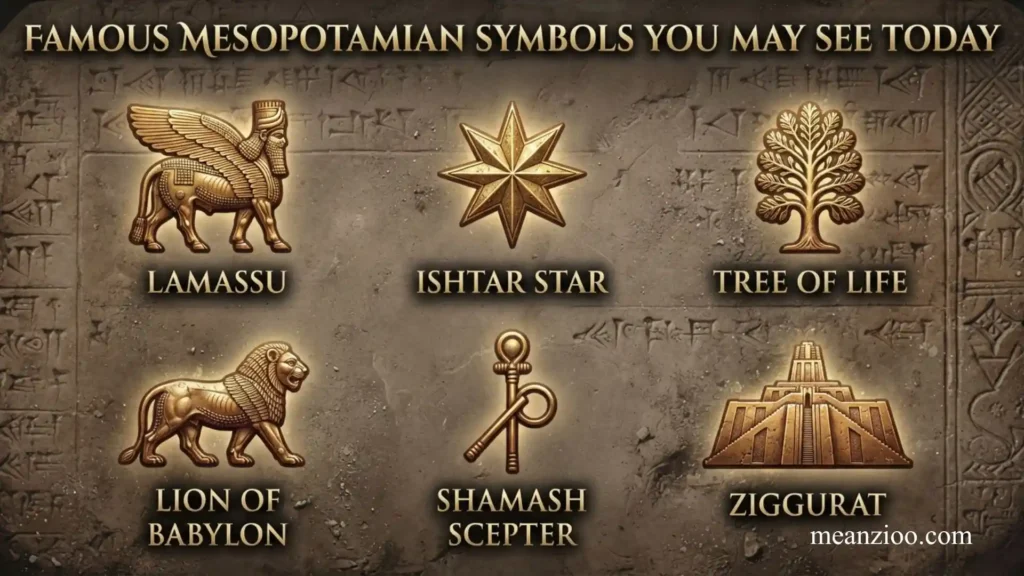
Ancient Mesopotamian imagery continues to influence modern art and popular culture.
People may encounter Mesopotamian-inspired symbols in:
- Jewelry
- Tattoos
- Museum reproductions
- Historical artwork
- Video games
- Movies
- Fantasy artwork
- Educational materials
- Architecture
- Logos
The lamassu, Ishtar’s star, Babylonian dragon, cuneiform, and winged figures are especially recognizable.
However, modern usage does not necessarily preserve the original ancient meaning.
For example, someone might use an eight-pointed star today as an aesthetic design without intending to reference Inanna or Ishtar.
Mesopotamian Symbols Copy and Paste
Mesopotamian symbols are inspired by the ancient civilizations of Sumer, Akkad, Babylon, and Assyria. These symbols include stars, crescents, animals, divine emblems, and cuneiform writing. Many people search for Mesopotamian symbols to use in notes, artwork, tattoos, social media posts, and historical designs.
Below are some characters and symbols you can copy and paste. Keep in mind that not every symbol shown here is an authentic Mesopotamian symbol. Some are modern Unicode characters that resemble ancient shapes, while others are general symbols used for decorative purposes.
| Symbol | Name or description |
| ☀ | Sun |
| ☾ | Crescent moon |
| ★ | Star |
| ☆ | Outline star |
| ✧ | Decorative star |
| ✦ | Four-pointed star |
| ♌ | Leo zodiac sign |
| ♉ | Taurus zodiac sign |
| 𒀭 | Cuneiform sign AN |
| 𒂗 | Cuneiform sign EN |
| 𒆠 | Cuneiform sign KI |
| 𒀀 | Cuneiform sign A |
The cuneiform characters above are genuine Unicode cuneiform signs, but their meanings depend on how they are used in ancient writing. They should not be treated as universal symbols of protection, power, or spirituality.
If you want to use an ancient Mesopotamian design, the eight-pointed star associated with Inanna and Ishtar, the crescent associated with Sin and Nanna, and the mušḫuššu dragon associated with Marduk are historically meaningful choices. However, these ancient images do not always have a simple text character that can be copied and pasted.
Give Me Another Symbol
One additional Mesopotamian symbol worth exploring is the forked thunderbolt of Adad, also known as Ishkur in Sumerian tradition.
Adad was associated with storms, thunder, rain, and the powerful forces of weather. His symbol could appear as a forked or branching thunderbolt, representing the strength of storms and the importance of rainfall.
In ancient Mesopotamia, agriculture depended heavily on the availability of water. Rain and storms could bring essential moisture, but severe weather could also threaten crops and communities. A storm deity therefore represented a powerful natural force that could bring both benefits and danger.
The thunderbolt is a useful example of how Mesopotamian symbols connected the natural world with religious beliefs. It was not merely an image of lightning; in the appropriate historical context, it identified a deity and communicated ideas about divine power.
Mesopotamian Symbols for Tattoos and Jewelry
People interested in ancient symbolism sometimes choose Mesopotamian designs for tattoos or jewelry.
Common choices include:
- Eight-pointed star
- Lion
- Lamassu
- Mušḫuššu
- Cuneiform
- Crescent
- Winged disk
- Rod and ring
Before using one, it is worth checking its historical meaning.
For example, the eight-pointed star has a strong connection with Inanna/Ishtar and Venus, while the mušḫuššu is associated with Marduk.
A historically accurate design should also avoid presenting a modern invention as an authentic ancient symbol.
Mesopotamian Symbols and Their Modern Meanings
| Ancient symbol | Historical association | Possible modern interpretation |
| Ishtar star | Venus, Ishtar | Feminine power, celestial symbolism |
| Lion | Ishtar, strength | Courage and strength |
| Crescent | Sin/Nanna | Moon and spirituality |
| Sun | Shamash | Justice and truth |
| Lamassu | Protection | Guardianship |
| Mušḫuššu | Marduk | Mythical power |
| Rod and ring | Divine authority and kingship | Justice and leadership |
| Cuneiform | Writing | Ancient knowledge and history |
Modern meanings should be described as modern interpretations, not as direct translations of ancient Mesopotamian beliefs.
Common Misconceptions About Mesopotamian Symbols
Myth 1: Every Mesopotamian star is the Star of Ishtar
Not necessarily.
Stars and rosettes appear in many contexts. The eight-pointed star is strongly associated with Inanna/Ishtar, but individual artifacts must be interpreted in context.
Myth 2: The winged disk always represents one god
Not necessarily.
Its identification can vary depending on the period and artwork. British Museum evidence demonstrates that Ashur and Shamash can both be relevant to interpretations of winged-disk imagery.
Myth 3: Every Mesopotamian dragon represents evil
No.
The mušḫuššu was associated with Marduk and functioned as a divine symbol rather than simply representing an evil monster.
Myth 4: Cuneiform symbols have mystical meanings
Cuneiform was primarily a writing system.
Individual signs can have linguistic meanings, but they should not automatically be treated as magical symbols.
Myth 5: Mesopotamian symbols never changed
They changed considerably over thousands of years.
The symbolism of Sumerian, Babylonian, and Assyrian art overlaps but is not identical.
Frequently Asked Questions About Mesopotamia Symbols
what about other symbols
Mesopotamian culture included many symbols beyond the well-known eight-pointed star, crescent moon, lion, and mušḫuššu dragon. Some represented gods, while others communicated ideas about fertility, nature, kingship, and the relationship between humans and the divine.
Here are several additional examples:
| Symbol | Historical association | Meaning or significance |
| Spade | Marduk | Divine emblem associated with the Babylonian god |
| Goat-fish | Ea/Enki | Associated with freshwater, wisdom, and divine power |
| Forked thunderbolt | Adad/Ishkur | Storms, rain, and weather |
| Horned crown | Gods and divine beings | Divine status and authority |
| Sacred tree motifs | Various religious and artistic contexts | May relate to life, fertility, abundance, or sacred space |
| Rosette | Ishtar and other artistic contexts | Could have religious or celestial associations |
| Rod and ring | Divine authority and kingship | Legitimate rule, order, and authority |
These symbols show that Mesopotamian visual culture was much broader than a simple collection of religious icons. Animals, plants, tools, celestial objects, and supernatural creatures all played a role.
Their meanings were not always fixed. A symbol might change in appearance or significance as it passed from one civilization to another. The safest interpretation considers the original artifact and the period in which it was created.
What is the most famous Mesopotamian symbol?
The eight-pointed star of Inanna/Ishtar is one of the most famous, while the lamassu and Babylonian mušḫuššu are among the most recognizable Mesopotamian figures.
What does the Mesopotamian eight-pointed star mean?
It is strongly associated with Inanna/Ishtar and her astral identity as Venus. It could therefore represent the goddess, Venus, and her associations with love and warfare.
What does the lion symbolize in Mesopotamia?
The lion was an important attribute of Ishtar, especially in her warrior aspect. It communicated strength, ferocity, and divine power.
What does the crescent moon symbolize in Mesopotamia?
The crescent was associated with Sin/Nanna, the Mesopotamian moon god.
What does the sun symbolize in Mesopotamia?
The sun was associated with Shamash/Utu and ideas of light, justice, judgment, and divine observation.
What is the Mesopotamian dragon called?
One famous Mesopotamian dragon-like creature is the mušḫuššu, associated particularly with the Babylonian god Marduk.
What does the lamassu symbolize?
The lamassu is a protective supernatural figure associated with guardianship, strength, and the protection of important architectural spaces.
What does the rod and ring mean?
The rod and ring are associated with divine authority, kingship, order, justice, measurement, and legitimate rule. Scholars continue to discuss their precise meaning.
What is the symbol of Marduk?
Marduk is especially associated with the mušḫuššu, or snake-dragon, and the spade.
What is the symbol of Ishtar?
The eight-pointed star is her best-known astral symbol, while the lion is an important attribute animal.
What is the symbol of Shamash?
Shamash is represented through solar imagery, including the sun and related divine emblems.
What is the symbol of Adad?
Adad is associated with the forked thunderbolt representing storms and weather.
Were Mesopotamian symbols religious or political?
Both.
Religious symbols identified gods and supernatural forces, while royal monuments used them to communicate the king’s authority and relationship with the divine.
Are Mesopotamian symbols still used today?
Yes. Ancient Mesopotamian imagery appears in museums, historical art, jewelry, tattoos, popular culture, games, films, and modern designs. However, modern uses often give the symbols meanings that differ from their ancient contexts.
Final Thoughts on Mesopotamia Symbols
Mesopotamia symbols form a rich visual language that connected religion, astronomy, kingship, justice, nature, and supernatural beliefs.
The eight-pointed star linked Inanna/Ishtar with Venus. The lion expressed her warrior identity. The crescent represented Sin and the moon, while solar imagery represented Shamash. Adad’s thunderbolt communicated the power of storms. Marduk was associated with the mušḫuššu and spade, while protective creatures such as the lamassu guarded important spaces. The rod and ring connected divine authority with ideas of kingship, justice, and order.
The most important lesson is that there was no single universal Mesopotamian symbol dictionary. Sumerians, Akkadians, Babylonians, and Assyrians lived across different periods and developed interconnected but distinct traditions.
For that reason, the best way to understand a Mesopotamian symbol is to ask three questions: What does it look like, which culture and period produced it, and what archaeological or textual context surrounds it?
That approach turns a simple list of ancient symbols into a much more accurate understanding of one of the world’s earliest civilizations.
Also Check This Post: Lutheran Symbols: Meanings, History, Colors, and Christian Significance

I’m Ryan Mitchell, and I write about modern English, trending slang, and online expressions. I enjoy explaining the meanings, origins, and real-life usage of popular words in a simple way. I believe learning slang is an important step toward understanding today’s English-speaking culture. Through my work, I aim to help readers speak more naturally and stay updated with the latest language trends.