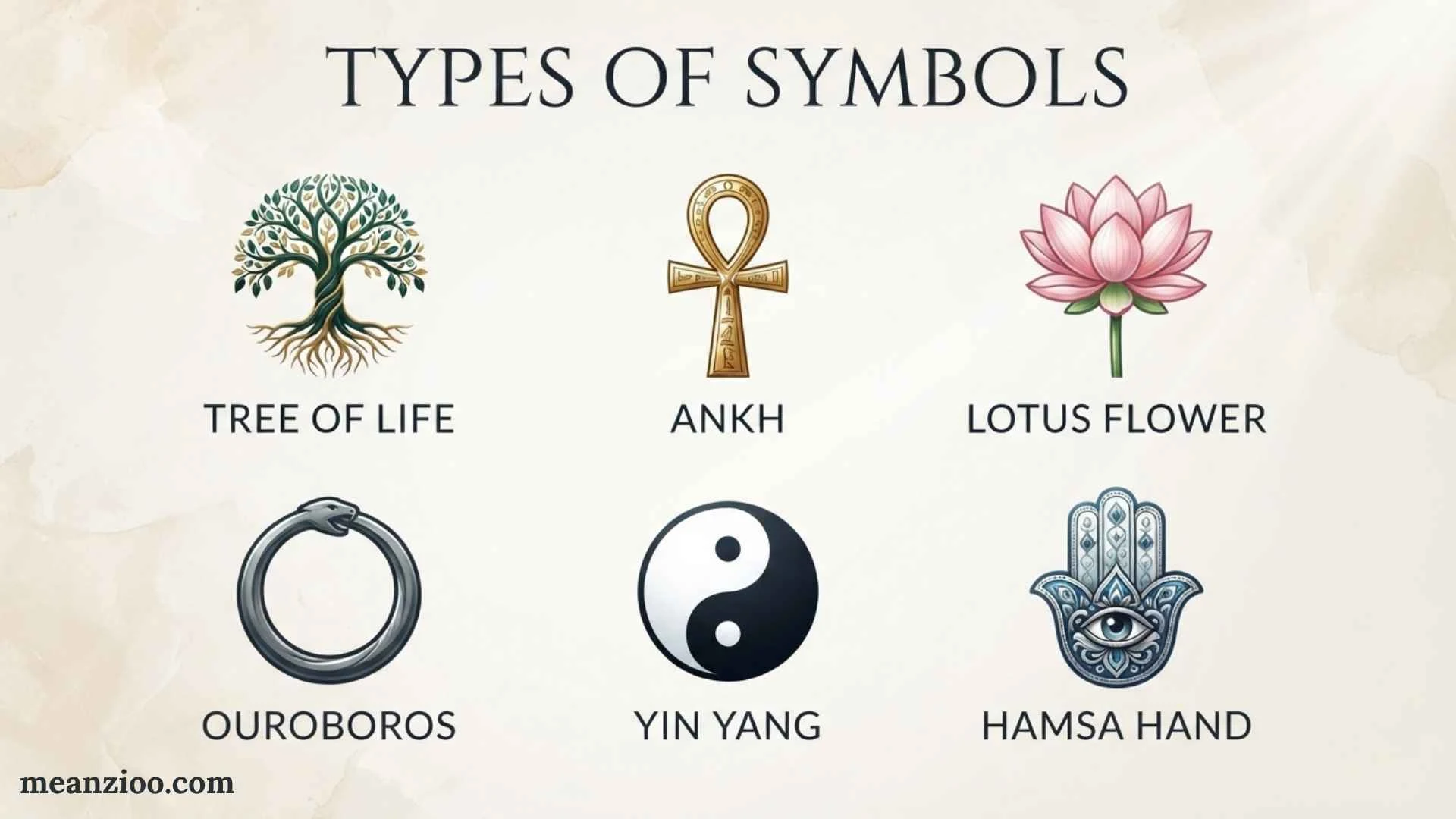
Symbols are an important part of everyday communication. We see them on road signs, smartphones, maps, clothing labels, religious objects, mathematical formulas, medical documents, electrical diagrams, websites, and social media. A simple shape, picture, letter, or mark can communicate an idea that might otherwise require several words to explain.
But how many types of symbols are there? The answer depends on how symbols are classified. Some are grouped by their purpose, such as safety symbols or mathematical symbols. Others are classified by how they communicate meaning, such as icons, indexes, and conventional symbols.
This guide explains the major types of symbols, their meanings, common examples, and where they are used. It also explains the difference between symbols, signs, icons, and signals so you can understand how visual communication works in different situations.
What Is a Symbol?
A symbol is a mark, image, character, object, gesture, or representation that communicates an idea, meaning, instruction, identity, or concept.
A symbol does not always look like the thing it represents. Its meaning may come from a shared convention, cultural tradition, learned system, or context.
For example:
- ❤️ commonly represents love or affection.
- ✓ can represent approval, completion, or correctness.
- ⚠ communicates a warning.
- $ represents a monetary unit associated with dollars in many contexts.
- + represents addition in mathematics.
- ♻ is associated with recycling.
- A red traffic light tells drivers to stop.
The same symbol can sometimes have different meanings in different cultures, professions, or situations. Context is therefore important when interpreting symbols.
How Many Types of Symbols Are There?
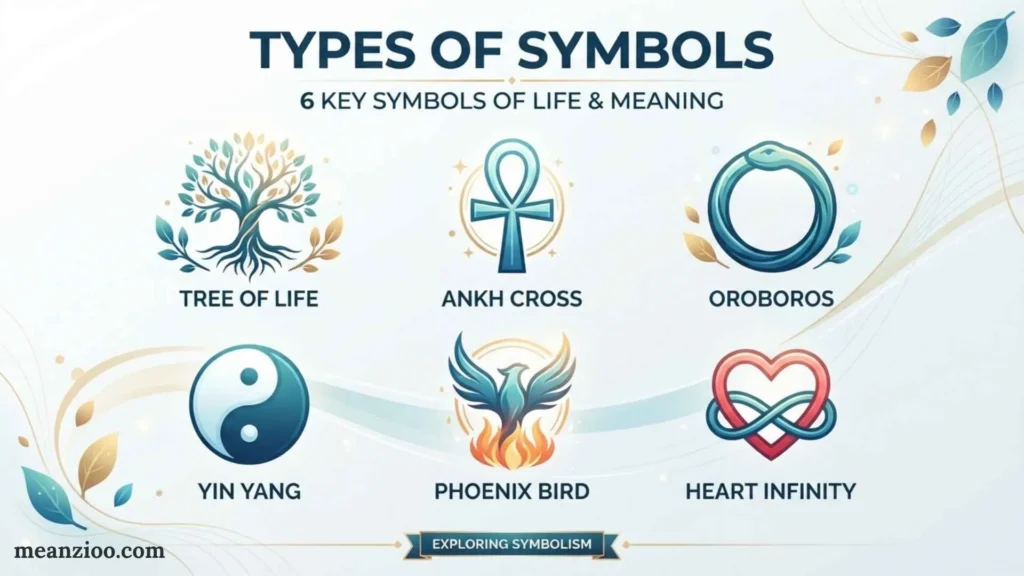
There is no single universally accepted number of symbol types because symbols can be classified in different ways.
For everyday use, common categories include:
- Cultural symbols
- Religious symbols
- Mathematical symbols
- Scientific symbols
- Chemical symbols
- Electrical symbols
- Medical symbols
- Road and traffic symbols
- Safety symbols
- Warning symbols
- Digital and computer symbols
- Communication symbols
- Emoji symbols
- Punctuation symbols
- Currency symbols
- National symbols
- Political symbols
- Gender symbols
- Map symbols
- Weather symbols
- Environmental symbols
- Laundry symbols
- Architectural symbols
- Music symbols
- Literary symbols
- Zodiac symbols
- Text and keyboard symbols
These categories can overlap. For example, a heart can be an emotional symbol, an emoji, a cultural symbol, or a decorative symbol depending on how it is used.
Types of Symbols Based on How They Represent Meaning
One of the most useful ways to understand symbols is through three broad categories: icons, indexes, and symbols.
Iconic Symbols
An iconic symbol resembles the object, action, or idea it represents.
For example, a simple picture of a camera can represent a camera function on a phone. A drawing of a person can represent a pedestrian area.
Common examples include:
- Camera icons
- Trash-can icons
- House icons
- Telephone icons
- Human figures on signs
- Pictures of food on menus
Because iconic symbols have a visual resemblance to their meaning, people may understand them without knowing a particular language.
Indexical Symbols
An indexical sign has a direct connection or association with the thing it indicates.
For example, smoke can indicate fire. Footprints can indicate that someone or something has passed through an area.
Other examples include:
- Smoke indicating fire
- A thermometer indicating temperature
- A fingerprint indicating physical presence
- Dark clouds indicating possible rain
- A speedometer indicating vehicle speed
The relationship between the sign and what it indicates is usually based on a physical, causal, or contextual connection.
Conventional or Symbolic Signs
A conventional symbol has a meaning that people learn through social agreement, education, or established systems.
Examples include:
- Letters
- Numbers
- Mathematical signs
- Currency symbols
- National flags
- Many traffic signs
- Chemical element symbols
The shape of a symbol does not necessarily resemble its meaning. People understand it because they have learned the convention associated with it.
Cultural Symbols
Cultural symbols represent the identity, traditions, history, values, or customs of a particular society or community.
Examples include:
- Traditional clothing
- National flags
- Traditional patterns
- Cultural artwork
- National flowers
- Traditional foods
- Historic monuments
- Cultural objects
A symbol may have a deep meaning within one culture while having little or no meaning in another.
Cultural symbols are often connected with celebrations, heritage, family traditions, historical events, and community identity.
Religious Symbols
Religious symbols represent beliefs, traditions, spiritual ideas, religious communities, or practices.
Examples include:
- Cross
- Om
- Star of David
- Crescent and star
- Dharma wheel
- Khanda
- Yin-yang in relevant religious or philosophical contexts
Religious symbols can appear in places of worship, books, artwork, clothing, jewelry, ceremonies, and architecture.
It is important to interpret religious symbols within their specific historical and religious context rather than assuming that one meaning applies everywhere.
Mathematical Symbols
Mathematical symbols provide a compact way to express numbers, operations, relationships, and abstract concepts.
Common examples include:
| Symbol | Common meaning |
| + | Addition |
| − | Subtraction |
| × | Multiplication |
| ÷ | Division |
| = | Equality |
| < | Less than |
| > | Greater than |
| % | Percentage |
| √ | Square root |
| ∞ | Infinity |
| π | Pi |
| ≠ | Not equal to |
| ≤ | Less than or equal to |
| ≥ | Greater than or equal to |
Mathematical symbols are useful because they allow complex relationships to be communicated in a standardized form.
Scientific Symbols
Scientific symbols represent concepts, measurements, quantities, units, processes, and other scientific information.
Examples include:
- °C for degrees Celsius
- °F for degrees Fahrenheit
- Δ for change in many scientific contexts
- λ for wavelength in many contexts
- μ for micro or other scientific quantities depending on context
- ⚛ as a commonly used atomic or nuclear-science symbol
Scientific notation can vary by field, so the surrounding formula or subject should always be considered when interpreting a symbol.
Chemical Symbols
Chemical symbols identify chemical elements using standardized abbreviations.
Examples include:
- H — Hydrogen
- He — Helium
- C — Carbon
- N — Nitrogen
- O — Oxygen
- Na — Sodium
- Fe — Iron
- Cu — Copper
- Ag — Silver
- Au — Gold
An element symbol normally contains one or two letters. The first letter is capitalized, while the second letter, when present, is lowercase.
Chemical symbols make it possible to write formulas and chemical equations in a concise and internationally recognizable format.
Electrical Symbols
Electrical symbols are used in circuit diagrams and technical drawings to represent electrical components.
Common examples represent:
- Batteries
- Resistors
- Switches
- Wires
- Lamps
- Motors
- Capacitors
- Diodes
- Ground connections
- Transformers
Instead of drawing a realistic picture of every component, engineers use standardized diagram symbols. This makes electrical plans easier to read and understand.
Medical Symbols
Medical symbols communicate information related to healthcare, medicine, hospitals, pharmacies, emergency services, and medical professions.
Examples include:
- ⚕ — commonly associated with medicine
- Red Cross-related imagery in appropriate contexts
- Rx — commonly associated with prescription medicine
- Hospital symbols
- First-aid symbols
- Medical alert symbols
Medical symbols can appear on hospital signs, medical documents, emergency equipment, pharmacies, websites, and healthcare facilities.
Some medical symbols have specific legal or organizational meanings, so a symbol should not be assumed to have the same official status everywhere.
Road and Traffic Symbols
Road and traffic symbols help drivers, cyclists, and pedestrians understand road conditions, directions, restrictions, and hazards.
Examples include symbols for:
- Stop
- No entry
- Speed limits
- Pedestrian crossings
- Parking
- One-way traffic
- Road construction
- Railway crossings
- U-turn restrictions
- School zones
Traffic symbols are designed for quick recognition. Drivers often have only a few seconds to understand a road sign, so simple visual communication is essential.
Exact designs and meanings can vary between countries, so local traffic regulations should be used when interpreting official road signs.
Safety Symbols
Safety symbols warn people about hazards or communicate precautions.
They are common in:
- Laboratories
- Factories
- Construction areas
- Hospitals
- Schools
- Workplaces
- Public buildings
- Industrial facilities
Safety symbols can indicate hazards involving electricity, chemicals, fire, radiation, biological materials, machinery, or protective equipment.
For example, a symbol may tell workers to wear eye protection, avoid a dangerous area, or take precautions around hazardous materials.
Warning Symbols
Warning symbols are designed to attract attention to a possible danger or hazardous condition.
Common examples include:
- ⚠ — general warning
- ☠ — skull and crossbones, commonly associated with serious toxicity or danger
- Lightning-bolt imagery — electrical hazard
- Slippery-surface symbols
- Falling-object warnings
- High-voltage warnings
Warning symbols are especially useful because they can communicate danger without requiring a long written explanation.
Digital and Computer Symbols
Digital symbols and icons appear on smartphones, computers, websites, applications, and electronic devices.
Common examples include:
| Symbol | Common digital meaning |
| 🔍 | Search |
| ⚙ | Settings |
| 🏠 | Home |
| 🔒 | Lock or security |
| 🗑 | Delete or trash |
| ⬇ | Download |
| ⬆ | Upload |
| 🔗 | Link |
| ☰ | Menu |
| 🔔 | Notifications |
| ❤️ | Like, favorite, or affection |
| ↗ | Share or open externally, depending on context |
Digital symbols make interfaces easier to navigate. However, designers must use familiar icons carefully because some symbols can have different interpretations.
Communication Symbols
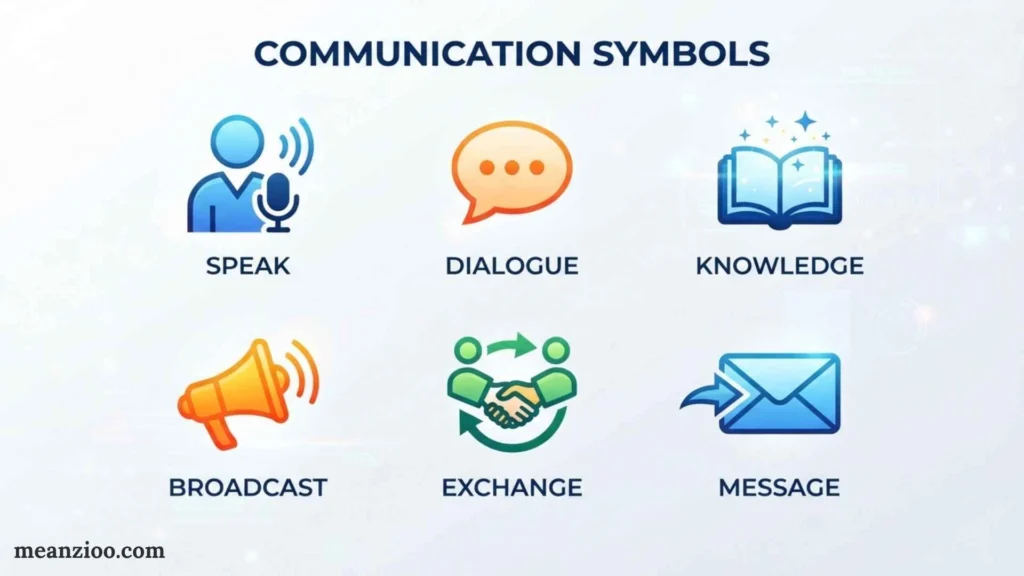
Communication symbols help people express information, emotions, actions, reactions, or relationships.
Examples include:
- Speech bubbles
- Arrows
- Check marks
- Exclamation marks
- Question marks
- @
- Hashtags
- Emojis
- Chat icons
Symbols are especially important in digital communication because they can communicate an idea quickly while using very little space.
Emoji Symbols
Emojis are small digital images or characters used to express objects, emotions, actions, ideas, and reactions.
Examples include:
- ❤️ — love or affection
- 😂 — laughter or amusement
- 👍 — approval or agreement
- 🎉 — celebration
- 🔥 — commonly used for something exciting, popular, or impressive
- 😢 — sadness
- 🤔 — thinking or uncertainty
Emoji meanings can change according to context, age group, culture, platform, and conversation.
An emoji should therefore be interpreted based on the complete message rather than its appearance alone.
Punctuation Symbols
Punctuation marks are meaningful marks used to organize written language.
Common punctuation symbols include:
- . — period
- , — comma
- ? — question mark
- ! — exclamation mark
- : — colon
- ; — semicolon
- ( ) — parentheses
- [ ] — brackets
- ” “ — quotation marks
- — — dash
- ‘ — apostrophe
Punctuation can change the meaning, rhythm, or structure of a sentence.
For example, a question mark indicates that a sentence is functioning as a question, while an exclamation mark can emphasize strong emotion or emphasis.
Currency Symbols
Currency symbols identify or abbreviate monetary units.
Common examples include:
- $ — dollar
- € — euro
- £ — pound sterling
- ¥ — yen or yuan, depending on context
- ₹ — Indian rupee
- ₩ — South Korean won
- ₺ — Turkish lira
Currency symbols are commonly used in prices, financial documents, shopping websites, accounting, and economic information.
A currency symbol may represent more than one currency, so the country or currency code may be needed for complete clarity.
National Symbols
National symbols represent a country and can be connected with its history, identity, government, people, or cultural heritage.
Examples include:
- National flags
- National coats of arms
- National seals
- National animals
- National flowers
- National birds
- National monuments
- National mottos
National symbols are often used during official events, public celebrations, international sporting events, government activities, and educational programs.
Political Symbols
Political symbols can represent political parties, movements, ideologies, campaigns, institutions, or historical movements.
They may include:
- Party logos
- Campaign emblems
- Political colors
- Historical symbols
- Movement-specific imagery
- Election-related signs
The meaning of a political symbol can change over time and can differ between countries. Understanding the organization or historical context behind the symbol is important before interpreting it.
Gender Symbols
Gender-related symbols are commonly used in educational, medical, public, and social contexts.
Examples include:
- ♂ — traditionally used to represent male
- ♀ — traditionally used to represent female
- ⚧ — commonly associated with transgender identity
The interpretation and use of gender symbols can depend on context and the standards used by a particular organization.
Map Symbols
Maps use symbols to represent geographical features and important locations.
Common map symbols can identify:
- Roads
- Airports
- Hospitals
- Schools
- Hotels
- Restaurants
- Parks
- Rivers
- Lakes
- Mountains
- Railways
- Tourist attractions
A map legend or key explains what individual symbols mean.
Without map symbols, a map would need to contain much more written information and could become difficult to read.
Weather Symbols
Weather symbols provide quick information about atmospheric conditions.
Common weather icons represent:
- ☀ Sunny conditions
- ☁ Cloudy conditions
- 🌧 Rain
- ❄ Snow
- ⛈ Thunderstorms
- 🌫 Fog
- Wind
- Temperature
Weather symbols are widely used in weather apps, forecasts, television graphics, websites, and newspapers.
Their exact appearance can differ between weather services.
Environmental and Recycling Symbols
Environmental symbols communicate information about recycling, waste, energy use, environmental practices, and sustainability.
The familiar ♻ symbol is strongly associated with recycling.
Other environmental symbols can communicate:
- Recycling instructions
- Waste disposal
- Energy efficiency
- Packaging information
- Environmental certification
- Composting
- Sustainable practices
These symbols can help consumers understand how products should be handled or disposed of.
Laundry and Clothing Symbols
Laundry symbols appear on clothing-care labels and explain how a garment should be washed, dried, ironed, bleached, or professionally cleaned.
They can communicate instructions about:
- Machine washing
- Hand washing
- Water temperature
- Bleaching
- Tumble drying
- Air drying
- Ironing
- Dry cleaning
Following care symbols can help reduce the risk of damaging clothing.
Different countries and labeling systems may use slightly different conventions, so checking the garment label’s accompanying information is useful.
Architectural Symbols
Architectural symbols are used in building plans, floor plans, construction documents, and technical drawings.
They may represent:
- Doors
- Windows
- Walls
- Stairs
- Electrical outlets
- Lighting
- Plumbing
- Furniture
- Structural elements
Architectural symbols allow architects, engineers, contractors, and clients to understand a building design without using realistic drawings of every object.
Music Symbols
Music symbols communicate information about notes, rhythm, pitch, dynamics, timing, and musical structure.
Common musical symbols include:
- ♪ — musical note
- ♫ — paired musical notes
- ♯ — sharp
- ♭ — flat
- ♮ — natural
- 𝄞 — treble clef
- 𝄢 — bass clef
Musical notation uses a structured system of symbols so performers can interpret written compositions.
Literary Symbols
In literature, a symbol is an object, person, place, action, image, or idea that represents a deeper meaning beyond its literal role.
For example, writers may use:
- A journey to represent personal change
- Light to represent hope
- Darkness to represent uncertainty
- A storm to represent conflict
- A season to represent a stage of life
Literary symbolism depends heavily on context. The same object can symbolize different ideas in different works.
Zodiac Symbols
Zodiac symbols are associated with the twelve traditional zodiac signs used in astrology.
They include:
- ♈ Aries
- ♉ Taurus
- ♊ Gemini
- ♋ Cancer
- ♌ Leo
- ♍ Virgo
- ♎ Libra
- ♏ Scorpio
- ♐ Sagittarius
- ♑ Capricorn
- ♒ Aquarius
- ♓ Pisces
These symbols are commonly seen in astrology charts, horoscopes, calendars, jewelry, artwork, and online content.
Text and Keyboard Symbols
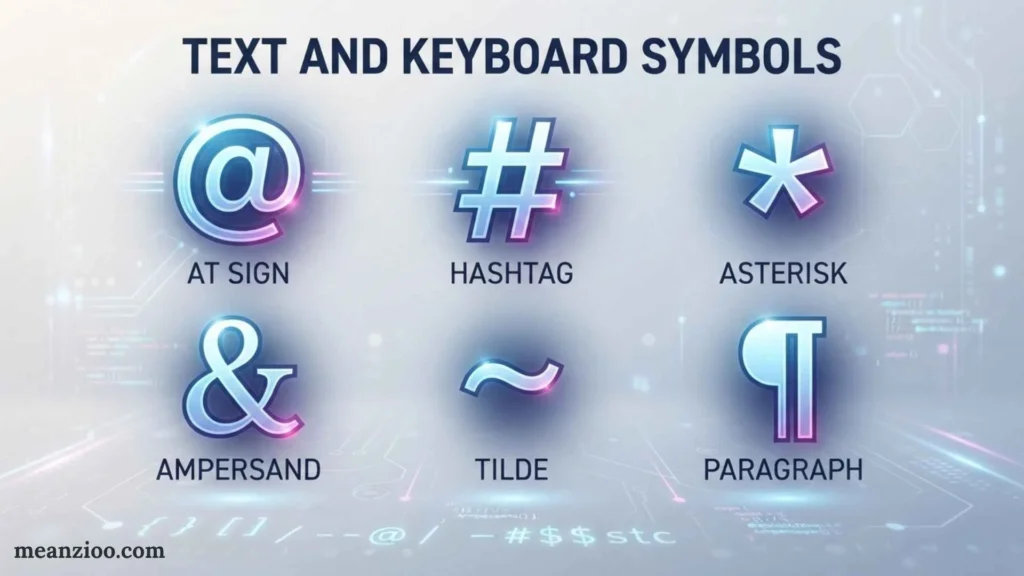
Text symbols are characters that can be typed or inserted into digital documents, messages, websites, and social media posts.
Examples include:
- @
- &
- %
- $
- =
- <
- °
- ©
- ®
- ™
- §
- ✓
Many keyboard symbols have practical functions in computing, mathematics, writing, programming, and online communication.
Symbols and Their Meanings
The following table provides a quick overview of common symbols and their typical meanings.
| Symbol | Common meaning | Category |
| ❤️ | Love or affection | Emotional |
| ✓ | Check, completion, or approval | Communication |
| ⚠ | Warning | Safety |
| ♻ | Recycling | Environmental |
| $ | Dollar currency | Currency |
| € | Euro | Currency |
| + | Addition | Mathematics |
| = | Equality | Mathematics |
| √ | Square root | Mathematics |
| ⚛ | Atomic or nuclear science | Scientific |
| ⚕ | Medicine | Medical |
| 🔒 | Lock or security | Digital |
| 🔍 | Search | Digital |
| ☀ | Sunny weather | Weather |
| ♪ | Musical note | Music |
| ♂ | Traditionally male | Gender |
| ♀ | Traditionally female | Gender |
| @ | At symbol | Text/Communication |
| # | Number, hashtag, or related uses | Text/Digital |
| © | Copyright | Legal/Information |
These are common meanings, not necessarily universal definitions. Context determines how many symbols should be interpreted.
What Is the Difference Between a Symbol, Sign, Icon, and Signal?
These terms are related but are not always interchangeable.
Symbol
A symbol communicates a learned or culturally established meaning. Letters, currency marks, and many national symbols are examples.
Sign
A sign is a broader form of communication that conveys information or meaning. A sign can include words, pictures, symbols, or other indicators.
Icon
An icon is generally a visual representation that resembles the thing it represents. A small picture of a printer used to represent printing is an example.
Signal
A signal communicates information or indicates an event, instruction, or condition. Traffic lights, alarms, and certain sounds can function as signals.
The boundaries between these concepts can overlap, particularly in everyday language.
Why Are Symbols Important?
Symbols make communication faster, clearer, and more compact.
They are useful because they can:
- Communicate information quickly
- Reduce the need for lengthy text
- Help people navigate unfamiliar places
- Highlight warnings and hazards
- Organize technical information
- Support visual learning
- Help communicate across language barriers in some contexts
- Represent cultural and religious ideas
- Make digital interfaces easier to use
- Explain complex information through standardized notation
For example, a road warning symbol can alert a driver to a hazard much faster than a paragraph of text.
Why Can One Symbol Have Different Meanings?
A symbol’s meaning can change because symbols are influenced by culture, context, history, profession, technology, and location.
For example, a symbol used in mathematics may have one meaning in an equation but a different meaning in another field.
Similarly, colors and gestures can have different cultural meanings. A symbol that is familiar in one country may be unfamiliar somewhere else.
When researching a symbol, consider:
- Where was it found?
- What field is it used in?
- Which country or culture uses it?
- What appears around it?
- Is it part of a standardized system?
- Is it being used literally or metaphorically?
These questions can prevent incorrect interpretations.
Common Uses of Symbols in Everyday Life
Symbols are present in almost every area of modern life.
On Smartphones
You may see symbols for Wi-Fi, battery level, Bluetooth, notifications, settings, location, downloads, and security.
On Roads
Drivers encounter signs representing speed limits, crossings, parking, directions, hazards, and restrictions.
At Work
Employees may use safety, electrical, chemical, fire, and emergency symbols.
In Education
Students encounter mathematical, scientific, chemical, musical, and literary symbols.
On Products
Packaging may include recycling, handling, warning, clothing-care, certification, and safety symbols.
Online
People use emojis, hashtags, icons, punctuation, reaction symbols, and interface symbols every day.
How to Identify the Meaning of an Unknown Symbol
If you see an unfamiliar symbol, do not immediately assume what it means. Use its context to identify it.
Check the Context
Look at where the symbol appears. A symbol on a car dashboard may have a different purpose from one in a mathematics textbook.
Look for a Legend or Key
Maps, diagrams, manuals, and technical documents often include a key explaining their symbols.
Identify the Field
Ask whether the symbol belongs to medicine, science, mathematics, technology, transportation, religion, or another field.
Check the Country or Standard
Some road, safety, and public-information symbols vary between countries or standards.
Look at Nearby Text
Labels and instructions often provide clues about the intended meaning.
Frequently Asked Questions About Types of Symbols
What are the main types of symbols?
The main categories include cultural, religious, mathematical, scientific, chemical, electrical, medical, road, safety, digital, communication, currency, national, map, weather, environmental, laundry, architectural, musical, literary, zodiac, and text symbols.
What are the three main types of symbols?
In semiotic classification, the three commonly discussed types are icons, indexes, and symbols. Icons resemble what they represent, indexes have a direct connection with what they indicate, and conventional symbols depend on learned meanings.
How many types of symbols are there?
There is no fixed universal number. Symbols can be classified according to purpose, subject, culture, profession, or how they communicate meaning.
What is an example of a symbol?
A heart can represent love, a dollar sign can represent currency, a plus sign can represent addition, and a recycling symbol can communicate information about recycling.
What is the difference between symbols and signs?
A sign is a broad form of communication that conveys information, while a symbol often communicates a learned, conventional, cultural, or abstract meaning. The terms can overlap.
Are emojis symbols?
Yes. Emojis function as visual symbols in digital communication. They can represent emotions, objects, actions, ideas, and reactions.
Why are symbols used instead of words?
Symbols can communicate information quickly, save space, improve visual recognition, and sometimes work across language barriers.
Can symbols have multiple meanings?
Yes. Meaning depends on context, culture, historical period, profession, location, and the system in which the symbol is being used.
What are common examples of symbols in everyday life?
Common examples include traffic signs, mathematical signs, currency marks, smartphone icons, emojis, weather icons, recycling symbols, warning signs, map symbols, and clothing-care symbols.
What are symbolic signs?
Symbolic signs are signs whose meanings are learned through convention or social agreement. Written language, mathematical notation, and many cultural symbols are examples.
Final Thoughts
There are many types of symbols, ranging from simple everyday icons to complex systems used in science, mathematics, medicine, engineering, music, religion, and culture. Symbols help people communicate information quickly and often make complicated ideas easier to understand.
The most useful way to understand a symbol is to consider both its appearance and its context. A symbol can represent an object, action, warning, emotion, belief, measurement, identity, or abstract idea.
From a tiny icon on a smartphone to a symbol on a road sign or a mathematical equation, symbols are a powerful part of human communication. Learning their categories and meanings can help you interpret information more accurately in everyday life, education, technology, and many professional fields.

I’m Ryan Mitchell, and I write about modern English, trending slang, and online expressions. I enjoy explaining the meanings, origins, and real-life usage of popular words in a simple way. I believe learning slang is an important step toward understanding today’s English-speaking culture. Through my work, I aim to help readers speak more naturally and stay updated with the latest language trends.