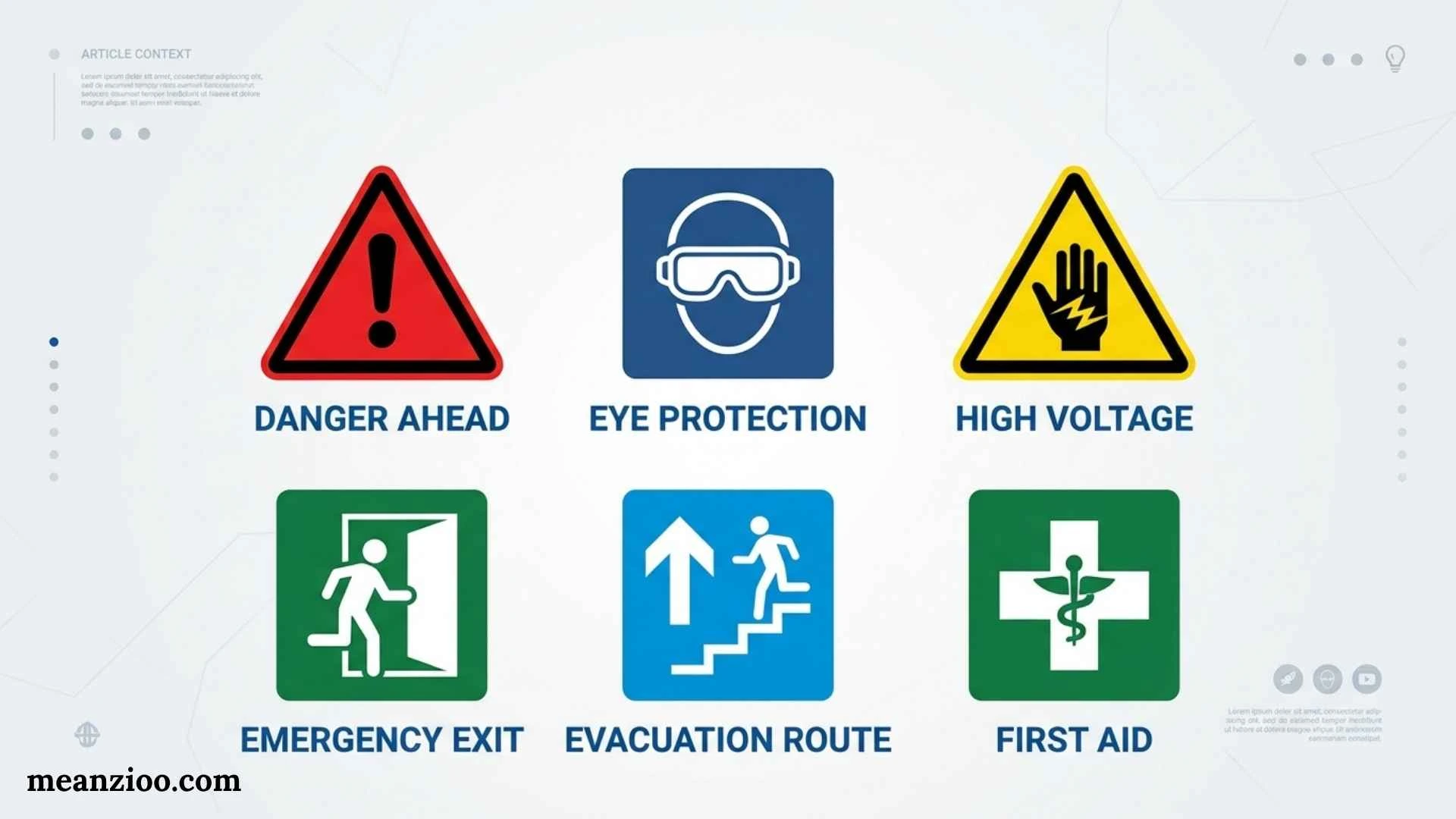
Safety signs and symbols play an important role in protecting people from danger and preventing accidents in everyday life. From workplaces and schools to hospitals and construction sites, these signs provide clear warnings and instructions that help people stay safe. Understanding their meanings can help you recognize hazards and make better decisions before an accident happens.
Different safety signs and symbols use specific colors, shapes, and pictures to communicate important messages quickly. Yellow signs commonly warn about potential hazards, red signs indicate prohibitions or fire equipment, blue signs show mandatory actions, and green signs often identify emergency exits and first-aid facilities. Learning these meanings makes it easier to recognize dangers and understand what action you should take.
In this guide, you will discover the most common safety signs and symbols, their meanings, colors, shapes, and practical examples. Whether you are a student, employee, teacher, or simply interested in workplace safety, this information will help you understand important safety messages and recognize the precautions needed to protect yourself and others.
What Are Safety Signs and Symbols?
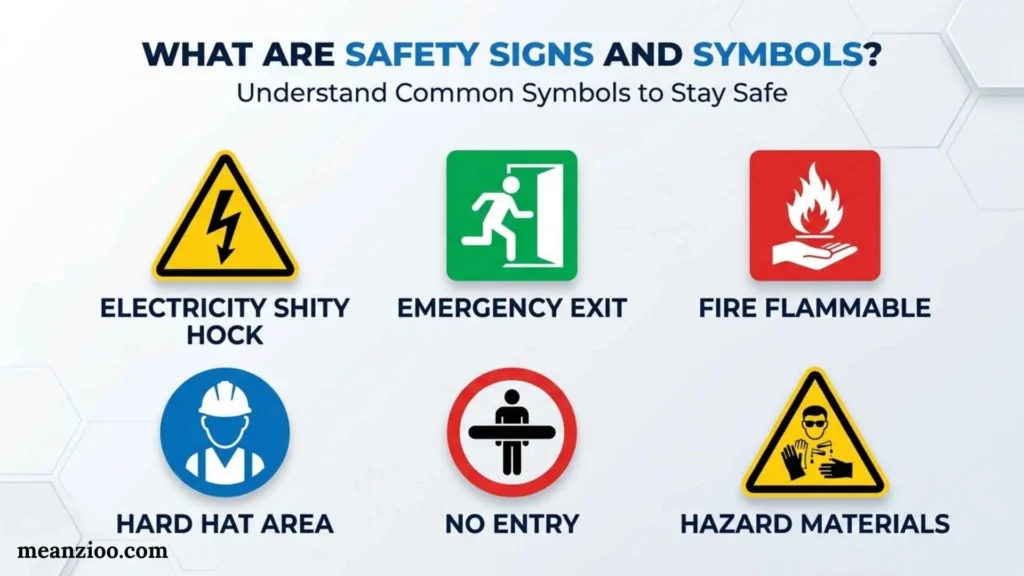
Safety signs and symbols are visual messages that communicate hazards, restrictions, required actions, and emergency information. They usually combine colors, shapes, pictures, and sometimes written instructions to help people understand important safety information quickly.
For example, a sign showing a person slipping warns people about a slippery surface. A hard-hat symbol tells workers that head protection is required, while an emergency exit symbol helps people locate a safe escape route.
Safety signs are especially useful in places where people need to understand instructions quickly or where several languages are spoken. However, their meaning should be clear, and signs must be supported by appropriate safety procedures, equipment, and training.
Why Are Safety Signs and Symbols Important?
Safety signs help people recognize hazards before they cause injuries, property damage, or other emergencies. They also help organizations communicate safety rules consistently to employees, visitors, contractors, and members of the public.
The main benefits of safety signs include:
- Accident prevention: Signs warn people about slippery floors, exposed electrical equipment, moving machinery, and other hazards.
- Personal protection: Mandatory signs remind people to wear suitable protective equipment, such as helmets, gloves, goggles, and safety footwear.
- Emergency guidance: Exit, first-aid, and fire equipment signs help people locate essential facilities.
- Clear communication: Standardized pictograms can communicate important messages to people who speak different languages.
- Workplace awareness: Signs help workers recognize restricted areas, dangerous materials, and special operating requirements.
- Regulatory support: Appropriate signs can help organizations meet relevant workplace, building, and fire safety requirements.
Safety signs do not remove hazards by themselves. For example, a warning sign near an unguarded machine does not replace the need for suitable machine guarding. Signs work best as part of a complete safety system.
What Are the Main Types of Safety Signs?
Safety signs are commonly divided into warning, prohibition, mandatory action, emergency or safe-condition, and fire safety categories. Each category communicates a different type of message.
1. Warning Signs
Warning signs alert people to hazards that could cause injury, illness, or damage. Under common international conventions, these signs use a triangular shape, a yellow or amber background, and a contrasting pictogram.
Common warning signs include:
- Slippery Surface: Warns that a floor or walkway may cause slipping.
- High Voltage: Indicates a potentially dangerous electrical hazard.
- Flammable Material: Warns that a substance or material can catch fire.
- Biohazard: Identifies biological materials that may present a health risk.
- Falling Objects: Warns people about objects that could fall from above.
- Hot Surface: Indicates a surface that may cause burns.
- Moving Machinery: Alerts people to mechanical hazards.
- Forklift Traffic: Warns pedestrians about industrial vehicles operating nearby.
- Radiation Hazard: Identifies a potential radiation risk.
- Corrosive Chemicals: Warns about substances that may damage skin, eyes, or materials.
When you notice a warning sign, assess the surrounding area, keep a safe distance where necessary, and follow the stated precautions.
2. Prohibition Signs
Prohibition signs show that a particular activity is not allowed. They commonly use a circular shape with a red border and diagonal bar across a contrasting pictogram.
Examples include:
- No Smoking: Smoking is not permitted in the designated area.
- No Open Flames: Matches, lighters, and other open flames are prohibited.
- No Entry: Entry is prohibited for people who are not authorized.
- Do Not Touch: Contact with the indicated object or surface is not allowed.
- No Pedestrians: People on foot must not enter a designated route or area.
- Do Not Use the Elevator During a Fire: Directs people to follow the designated emergency evacuation procedure.
- No Mobile Phones: Phone use is restricted in the area where the sign applies.
A prohibition sign should be followed even if the reason for the restriction is not immediately apparent.
3. Mandatory Action Signs
Mandatory signs tell people what they must do to reduce a hazard or follow a safety procedure. Under common international conventions, these signs use a blue circular background with a contrasting pictogram.
Examples include:
- Wear a Hard Hat: Head protection is required.
- Wear Safety Glasses: Eye protection must be used.
- Wear Protective Gloves: Suitable gloves are required for the task.
- Wear Hearing Protection: Earplugs or earmuffs must be used in the designated area.
- Wear Safety Footwear: Appropriate protective shoes or boots must be worn.
- Wear a Face Shield: A suitable face shield is required for the indicated activity.
- Wear a Respirator: Appropriate respiratory protection must be used where specified.
- Use a Safety Harness: Fall-protection equipment is required in designated circumstances.
The correct equipment depends on the hazard. Workers should understand how to select, wear, inspect, and maintain the required protective equipment.
4. Emergency and Safe-Condition Signs
Emergency signs help people find safe routes, emergency facilities, and locations where assistance is available. Common international conventions use green backgrounds with contrasting symbols for many safe-condition signs.
Examples include:
- Emergency Exit: Identifies an exit intended for emergency evacuation.
- First Aid: Shows the location of first-aid supplies or a treatment station.
- Emergency Assembly Point: Marks the designated meeting place after evacuation.
- Emergency Shower: Identifies equipment used to rinse hazardous substances from the body.
- Eyewash Station: Shows where people can flush contaminants from their eyes.
- Escape Route: Indicates the direction of a designated evacuation route.
- Emergency Telephone: Identifies a telephone intended for emergency communication where provided.
Learn the locations of exits and emergency facilities before you need them. During an emergency, follow the site’s evacuation instructions and do not enter unsafe areas to retrieve personal belongings.
5. Fire Safety Signs
Fire safety signs identify firefighting equipment, fire alarms, and facilities that support fire prevention and emergency response. Common systems use red signs with contrasting symbols or lettering.
Examples include:
- Fire Extinguisher: Shows where a portable fire extinguisher is located.
- Fire Hose Reel: Identifies a fixed hose used for firefighting.
- Fire Alarm: Marks the location of a manual alarm activation point.
- Fire Blanket: Identifies where a fire blanket is stored.
- Fire Hydrant: Shows the location of a firefighting water connection.
- Fire Door: Identifies a door designed to help limit the spread of fire and smoke.
- Keep Clear: Reminds people to keep access to fire equipment and escape routes unobstructed.
Never block fire safety equipment or emergency exits. Use firefighting equipment only when it is safe to do so and you have the appropriate training.
Safety Sign Colors and Their Meanings
Colors provide an important visual clue about a sign’s purpose. The following table explains common meanings used in many safety sign systems.
| Color | Common meaning | Examples |
| Red | Prohibition or fire equipment | No smoking, fire extinguisher |
| Yellow or amber | Warning or potential hazard | Slippery surface, high voltage |
| Blue | Mandatory action | Wear a hard hat |
| Green | Safe condition or emergency information | First aid, emergency exit |
These meanings are common conventions, not a universal rule for every country, industry, or sign type. For example, chemical hazard labels use a separate standardized system that includes red-framed diamond pictograms.
What Does a Red Safety Sign Mean?
Red is commonly used for prohibition signs and for identifying fire safety equipment. A red circle with a diagonal bar generally indicates that an activity is prohibited. Red fire equipment signs identify resources such as extinguishers and alarm points.
What Does a Yellow Safety Sign Mean?
Yellow or amber commonly warns people about potential hazards. It may indicate electrical danger, slippery floors, hot surfaces, or moving machinery. People should assess the hazard and take appropriate precautions.
What Does a Blue Safety Sign Mean?
Blue commonly identifies a mandatory action. A sign showing a hard hat, safety glasses, or hearing protection indicates that the specified protective measure is required in that location.
What Does a Green Safety Sign Mean?
Green commonly identifies safe conditions or emergency information. Green signs may show emergency exits, first-aid facilities, escape routes, or assembly points.
Safety Sign Shapes and Their Meanings
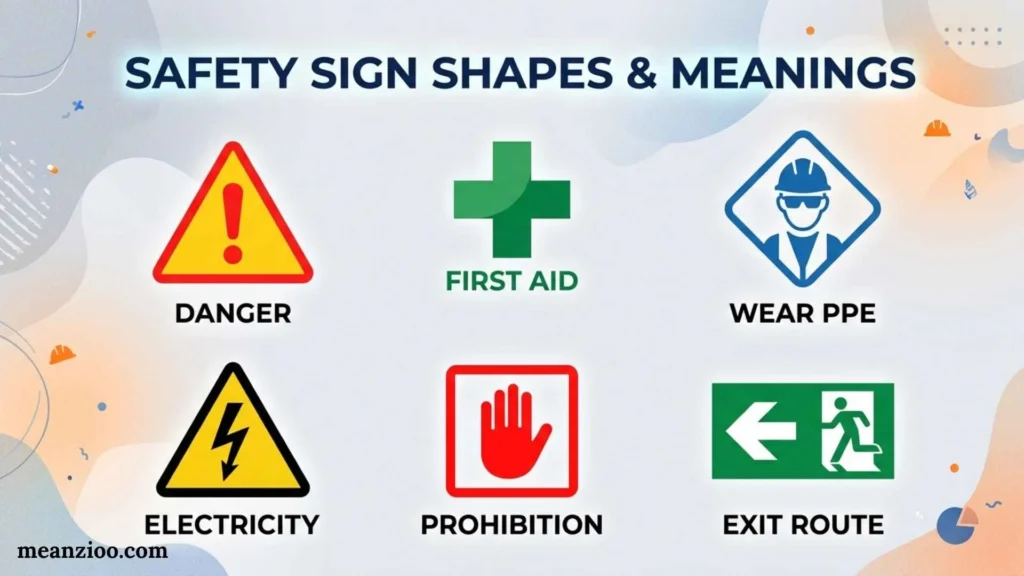
The shape of a sign provides another clue about the message it communicates.
- Triangle: Commonly used for warning signs, especially those with yellow or amber backgrounds.
- Red-bordered circle with a diagonal bar: Commonly indicates a prohibited action.
- Blue circle: Commonly indicates a mandatory action.
- Square or rectangle: Often used for emergency information, fire equipment, and supplementary instructions.
These shape conventions make signs easier to recognize quickly. However, always consider the pictogram and accompanying text rather than relying on shape alone.
20 Common Safety Signs and Symbols With Their Meanings
The following quick-reference table explains 20 familiar safety signs and symbols. It can help students, employees, visitors, and anyone learning basic safety signage identify common messages.
| No. | Safety sign or symbol | Meaning |
| 1 | Slippery Surface | A floor or walkway may cause slipping. |
| 2 | High Voltage | Electrical equipment may present a serious shock hazard. |
| 3 | Flammable Material | The material can catch fire easily. |
| 4 | Biohazard | Biological materials may present a health risk. |
| 5 | Falling Objects | Objects may fall from above. |
| 6 | Hot Surface | Touching the surface may cause burns. |
| 7 | No Smoking | Smoking is prohibited in the designated area. |
| 8 | No Open Flames | Open flames are not permitted. |
| 9 | No Entry | Entry is prohibited for unauthorized people. |
| 10 | Do Not Touch | The indicated object or surface must not be touched. |
| 11 | Wear a Hard Hat | Head protection is required. |
| 12 | Wear Safety Glasses | Eye protection is required. |
| 13 | Wear Protective Gloves | Suitable hand protection is required. |
| 14 | Wear Hearing Protection | Hearing protection must be used. |
| 15 | Wear Safety Footwear | Protective footwear is required. |
| 16 | Emergency Exit | Identifies an emergency exit. |
| 17 | First Aid | Shows the location of first-aid facilities. |
| 18 | Emergency Assembly Point | Indicates where evacuees should gather. |
| 19 | Fire Extinguisher | Shows the location of a fire extinguisher. |
| 20 | Fire Alarm | Identifies a point for activating a fire alarm. |
The exact appearance of these signs can differ between standards and countries. For regulated workplaces, use approved signage that matches the applicable requirements rather than relying on an informal illustration or text description alone.
Chemical Hazard Symbols and Their Meanings
Chemical hazard pictograms help people understand the risks associated with hazardous substances. Under the Globally Harmonized System of Classification and Labelling of Chemicals (GHS), many chemical labels use black symbols on white backgrounds inside red diamond-shaped frames. These pictograms are different from the common colored workplace safety signs described above.
Common GHS pictograms include:
- Flame: Indicates certain flammable or self-reactive substances and other fire-related hazards.
- Flame Over Circle: Identifies oxidizing substances that can intensify a fire.
- Corrosion: Indicates substances that can cause severe skin burns, serious eye damage, or corrosion of certain metals.
- Skull and Crossbones: Warns of certain forms of acute toxicity that may be fatal or toxic.
- Exclamation Mark: Identifies certain harmful or irritating effects.
- Gas Cylinder: Indicates gases under pressure.
- Health Hazard Silhouette: Identifies certain serious health hazards, such as carcinogenicity or respiratory sensitization.
- Exploding Bomb: Indicates certain explosive, self-reactive, or organic peroxide hazards.
- Environment: Commonly used to indicate hazards to aquatic life, although its regulatory status varies by system.
Always read the chemical label and consult its Safety Data Sheet (SDS) when working with hazardous substances. A pictogram communicates a hazard category; it does not provide every handling, storage, first-aid, or disposal instruction.
Where Are Safety Signs and Symbols Used?
Safety signs appear in different environments because each location has its own hazards, restrictions, and emergency needs.
Workplace and Factory Safety
Factories and industrial workplaces may display high-voltage warnings, machine hazard signs, forklift traffic warnings, chemical notices, and hearing protection requirements. Employees should understand these signs before operating equipment or entering restricted areas.
Construction Sites
Construction sites commonly use signs for hard hats, safety footwear, falling objects, excavations, moving machinery, and restricted access. Workers and visitors should follow site instructions and stay within authorized routes.
Schools and Colleges
Schools may display fire exit signs, laboratory hazard warnings, first-aid indicators, electrical warnings, and restricted-area signs. Science laboratories may require goggles, gloves, or other protective equipment.
Hospitals and Laboratories
Hospitals and laboratories use signs for infection control, biological hazards, radiation, chemical storage, and restricted access. Staff and visitors should follow the instructions relevant to the area they enter.
Roads and Public Areas
Road safety signs communicate speed limits, traffic restrictions, pedestrian crossings, roadwork warnings, and directions. Their legal meanings and designs depend on the country’s road traffic rules, which may differ from workplace safety sign conventions.
Warehouses and Storage Areas
Warehouses use signs to identify forklift routes, stacking restrictions, loading zones, flammable materials, and areas requiring protective equipment. Clear signs help separate pedestrian movement from vehicle operations.
How to Read Safety Signs Correctly
Understanding a sign is only useful if you know what action to take. Follow these steps when you encounter an unfamiliar safety symbol.
- Check the color and shape. These can indicate whether the sign is a warning, prohibition, mandatory instruction, or emergency notice.
- Identify the pictogram. Look for the hazard, prohibited activity, required equipment, or emergency facility.
- Read the text. Additional wording may explain the specific restriction or precaution.
- Assess the surroundings. Consider nearby equipment, chemicals, vehicles, and other possible hazards.
- Follow the instruction. Use required protective equipment, keep away from dangerous areas, or follow the designated escape route.
- Ask for help when uncertain. Contact a supervisor or safety officer rather than guessing what an unfamiliar sign means.
If a sign is damaged, hidden, or difficult to understand, report it to the appropriate person so the hazard can be communicated clearly.
Safety Sign Standards: ISO 7010, OSHA, and GHS
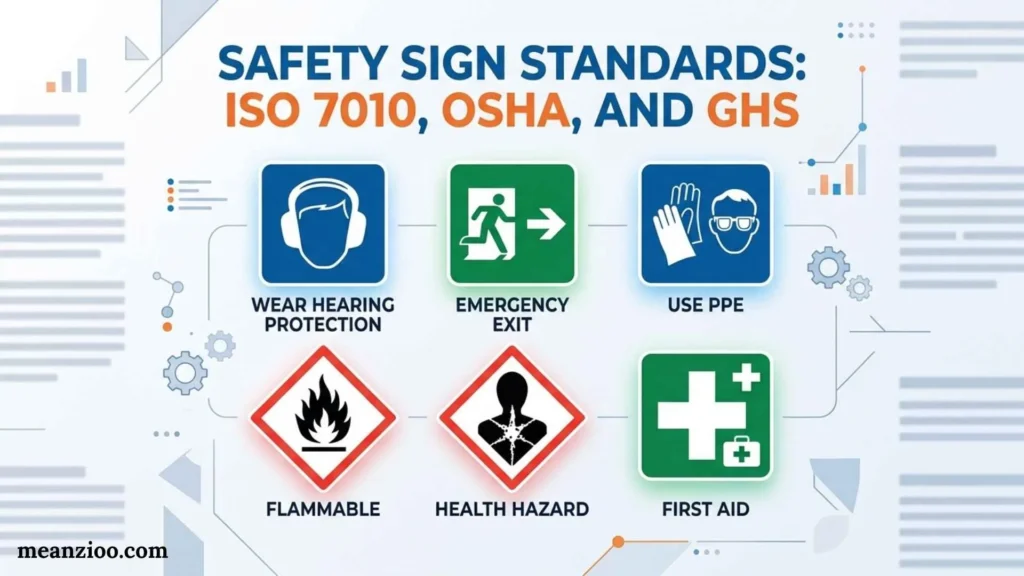
Safety signs and symbols are influenced by several international standards and national regulations. The correct requirements depend on the location, industry, and type of hazard.
ISO 7010
ISO 7010 specifies registered graphical safety signs used for purposes such as accident prevention, fire protection, health hazard information, and emergency evacuation. Its symbols use established design principles to support consistent recognition across different locations. The official ISO online browsing platform provides access to standardized sign information. <Link url= title=”Explore the ISO Online Browsing Platform”/>. <Cite refs={[“turn227660search4”]}/>
OSHA Safety Sign Requirements
In the United States, the Occupational Safety and Health Administration (OSHA) addresses accident-prevention signs and tags under standards including 29 CFR 1910.145 for relevant workplaces. Construction safety signage is also addressed under 29 CFR 1926.200. These regulations distinguish between sign purposes, including warnings about potential hazards and signs for immediate dangers. Employers should consult the applicable regulation for their workplace and circumstances. <Cite refs={[“turn227660search7″,”turn227660search6”]}/>
GHS Chemical Hazard Labelling
The Globally Harmonized System provides a framework for classifying and communicating chemical hazards. Its pictograms help identify risks such as flammability, acute toxicity, corrosion, and gas under pressure. In the United States, OSHA explains the pictograms used under its Hazard Communication Standard. <Link url=”” title=”View OSHA’s chemical hazard pictograms”/>. <Cite refs={[“turn227660search3”]}/>
These systems serve related but different purposes. A chemical label, workplace warning sign, and road traffic sign should not be treated as interchangeable. Organizations should follow the rules that apply to each setting.
How to Choose and Display Effective Safety Signs
Choosing the right sign starts with identifying the hazard and determining how people need to respond. A sign should communicate a clear message at the point where that information matters.
Use these practical guidelines:
- Assess the hazard first: Identify the risk, who may be exposed, and what action is necessary.
- Choose a suitable sign: Use a recognized symbol that accurately represents the hazard or required action.
- Place it where people can see it: Position signs before people reach the hazardous area or decision point.
- Use clear wording: Add concise text when a symbol alone may not communicate the message.
- Consider viewing conditions: Account for distance, lighting, obstructions, and the needs of people with disabilities.
- Maintain the signs: Replace damaged, faded, dirty, or outdated signs.
- Provide training: Explain unfamiliar symbols and site-specific safety procedures to employees and visitors.
- Review legal requirements: Confirm that signs meet relevant workplace, building, fire, and industry regulations.
Safety signs should support, not replace, engineering controls, safe work practices, emergency planning, and suitable protective equipment.
Common Mistakes to Avoid When Using Safety Signs
Even well-designed signs can fail if people cannot see them or misunderstand their purpose. Avoid these common mistakes:
- Using the wrong sign: A generic warning may not communicate the specific hazard clearly enough.
- Ignoring damaged signs: Faded or broken signs may no longer communicate a message reliably.
- Blocking visibility: Equipment, stored goods, doors, or decorations should not obscure essential signs.
- Using too much text: Long messages can be difficult to understand quickly.
- Assuming every country uses identical designs: Standards and legal requirements can differ.
- Relying on signs alone: Physical safeguards, training, and emergency procedures remain essential.
- Leaving obsolete signs in place: Remove or update signs when the relevant hazard or procedure changes, in accordance with applicable requirements.
Frequently Asked Questions About Safety Signs and Symbols
What are the five main types of safety signs?
Five commonly discussed categories are warning signs, prohibition signs, mandatory action signs, emergency or safe-condition signs, and fire safety signs. Some standards and workplaces classify signs differently, so the applicable system should be checked.
What do safety sign colors mean?
Common conventions use red for prohibition and fire equipment, yellow or amber for warnings, blue for mandatory actions, and green for safe-condition or emergency information. Other systems, including chemical hazard labelling, use different color and shape combinations.
What is the difference between a warning sign and a prohibition sign?
A warning sign alerts people to a hazard that may cause harm. A prohibition sign tells people not to perform a specific action, such as smoking in a restricted area or entering a prohibited zone.
Why are safety symbols important in the workplace?
Safety symbols help employees recognize hazards, understand required precautions, locate emergency equipment, and follow safety rules. They also support communication between people who speak different languages.
What does a triangular safety sign mean?
A triangular sign commonly indicates a warning. For example, a yellow triangle with a lightning symbol may indicate an electrical hazard. The exact meaning should always be confirmed by the pictogram and accompanying information.
What does a blue circular safety sign mean?
A blue circular sign commonly indicates a mandatory action. It may require workers to wear a hard hat, protective footwear, eye protection, or another specified item of protective equipment.
What is the difference between safety signs and chemical hazard symbols?
Safety signs communicate workplace hazards, required actions, restrictions, and emergency information. Chemical hazard pictograms, such as those used under GHS, communicate specific categories of chemical risk on labels and related hazard communication materials.
Are safety signs legally required?
Requirements depend on the country, industry, workplace, and hazard. Some regulations require signs in particular circumstances. Employers and facility managers should consult the laws and standards applicable to their location.
How can I learn safety signs and symbols quickly?
Start by learning common colors and shapes, then study frequently encountered symbols such as slippery surface, high voltage, no smoking, hard hat required, first aid, and emergency exit. Practice matching each sign to the action it requires.
Final Thoughts
Safety signs and symbols are essential for recognizing hazards, communicating instructions, and helping people respond correctly in everyday situations and emergencies. Learning the main types of signs, their colors, shapes, and meanings makes it easier to recognize risks in workplaces, schools, hospitals, construction sites, and public areas.
Remember that recognizing a symbol is only the first step. Read the instructions, follow the required precautions, use appropriate protective equipment, and seek clarification when a sign is unfamiliar. When signs are correctly selected, clearly displayed, and supported by effective safety procedures, they can contribute to a safer environment for everyone.

I’m Ryan Mitchell, and I write about modern English, trending slang, and online expressions. I enjoy explaining the meanings, origins, and real-life usage of popular words in a simple way. I believe learning slang is an important step toward understanding today’s English-speaking culture. Through my work, I aim to help readers speak more naturally and stay updated with the latest language trends.
 Charlotte Hayes