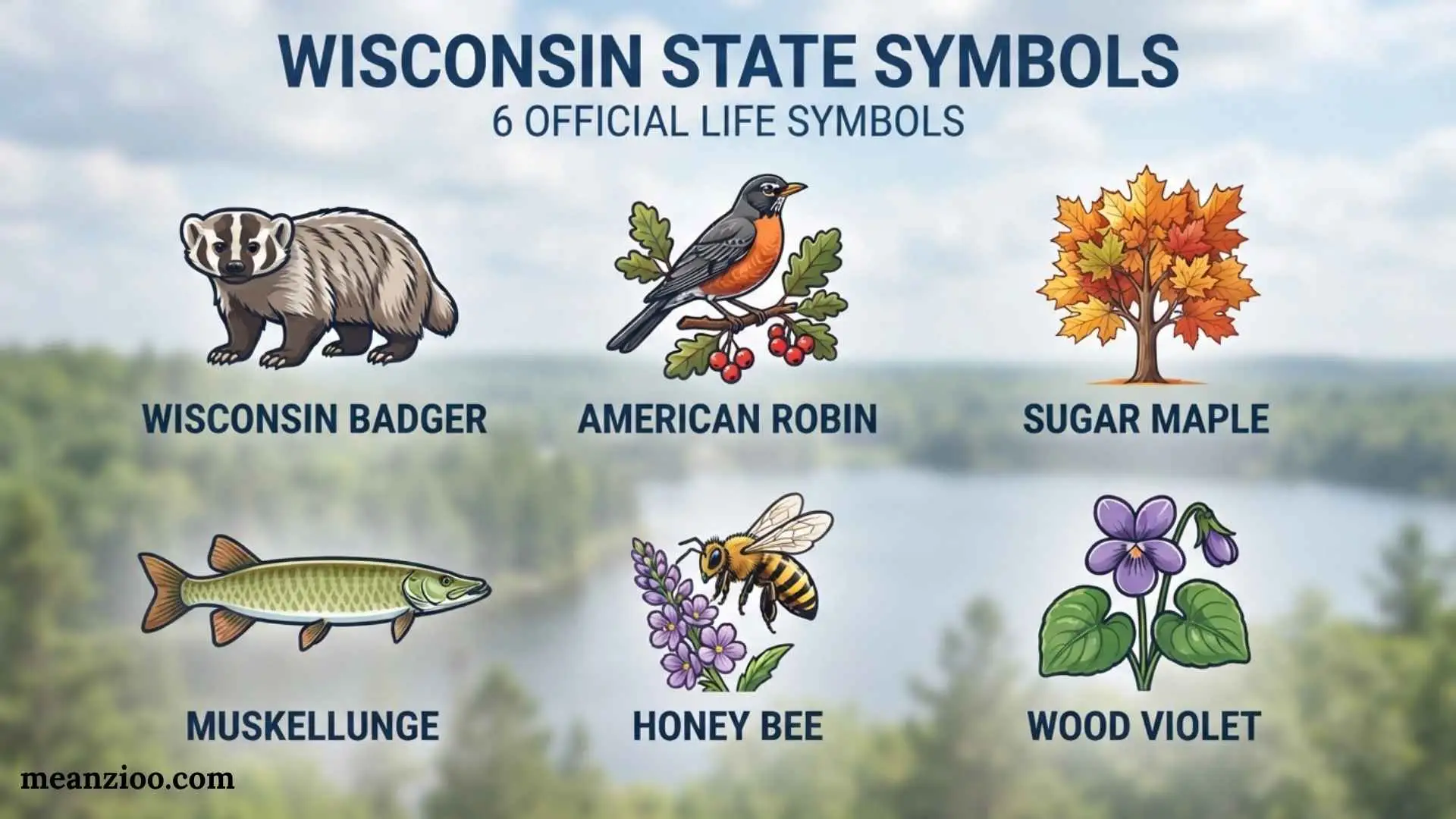
Wisconsin state symbols represent the animals, plants, foods, natural resources, history, and traditions that help define the state. From the American badger and American robin to cheese, cranberries, milk, and the sugar maple, each official symbol connects to an important part of Wisconsin’s identity.
If you are researching Wisconsin state symbols for a school project, state report, quiz, or general information, this guide brings the major official symbols together in one place. It also explains what each symbol means, when it was designated, and why it is connected with Wisconsin.
What Are Wisconsin State Symbols?
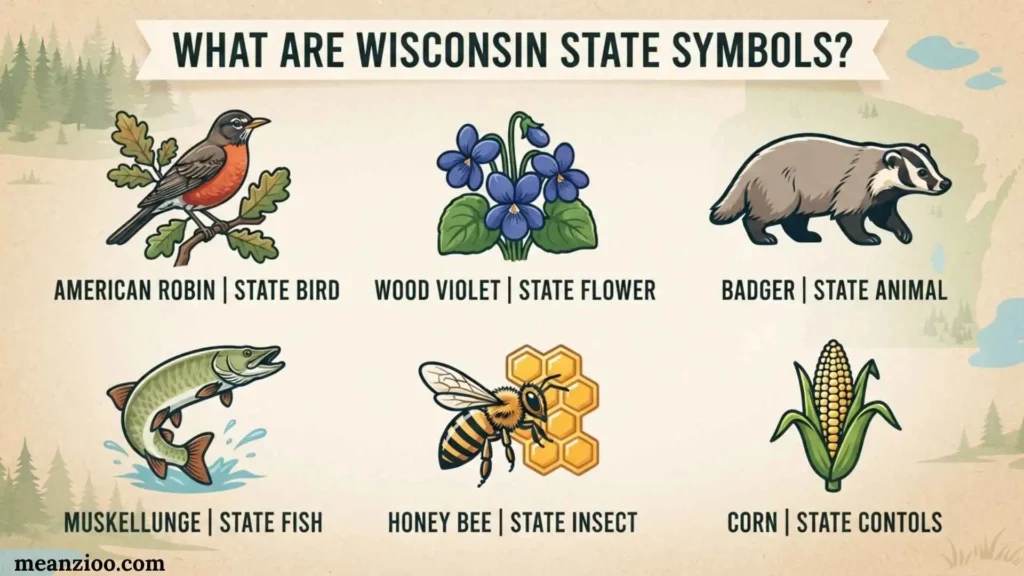
Wisconsin state symbols are officially recognized animals, plants, foods, geological features, cultural items, and other representations of the state. They are not all from one category. Some represent Wisconsin’s natural environment, while others reflect agriculture, history, culture, or traditions.
The Wisconsin government currently identifies symbols such as the badger, robin, cheese, wood violet, galena, dairy cow, muskellunge, sugar maple, cranberry, kringle, red granite, and others.
These symbols are useful because they provide a quick way to understand what Wisconsin values and what makes the state distinctive.
Wisconsin State Symbols at a Glance
| Category | Official Symbol | Designation |
| State Animal | American Badger | 1957 |
| State Bird | American Robin | 1927 |
| State Flower | Wood Violet | 1909 |
| State Tree | Sugar Maple | 1893 |
| State Fish | Muskellunge | 1955 |
| State Wildlife Animal | White-tailed Deer | 1957 |
| State Domestic Animal | Dairy Cow | — |
| State Dairy Product | Cheese | 2017 |
| State Beverage | Milk | 1987 |
| State Fruit | Cranberry | 2003 |
| State Pastry | Kringle | 2013 |
| State Grain | Corn | 1989 |
| State Insect | Honey Bee | 1977 |
| State Dog | American Water Spaniel | 1985 |
| State Mineral | Galena | 1971 |
| State Rock | Red Granite | 1971 |
| State Fossil | Trilobite | 1985 |
| State Soil | Antigo Silt Loam | 1983 |
| State Dance | Polka | 1993 |
| State Tartan | Hunting Tartan | 2007 |
| State Symbol of Peace | Mourning Dove | 1971 |
| State Song | “On, Wisconsin!” | — |
Some designations have complicated legislative or historical timelines, so the years above should be understood as commonly cited designation years rather than assuming every symbol followed the same legal process. Wisconsin’s official educational material provides the historical background for these symbols.
Wisconsin State Animal: American Badger
The American badger is Wisconsin’s official state animal.
The badger has been connected with Wisconsin for a very long time. It appeared in Wisconsin’s coat of arms and other state imagery and became associated with the state’s early mining history. Cornish miners who worked underground were linked with the badger because of the animal’s habit of digging and living in underground burrows.
The American badger, Taxidea taxus, was officially designated Wisconsin’s state animal in 1957. The choice followed discussion about whether the badger or white-tailed deer should receive the title.
Wisconsin’s DNR describes the badger as a stocky member of the weasel family that typically weighs about 12 to 16 pounds and is recognized by the white markings on its head.
Wisconsin State Bird: American Robin
The American robin is Wisconsin’s official state bird.
The robin was selected by Wisconsin schoolchildren during a statewide bird-selection effort during the 1926–27 school year. Students chose the robin by a large margin over its closest competitor.
The robin is familiar throughout Wisconsin and is commonly associated with the arrival of spring. It is also a migratory bird and an abundant summer resident in the state.
Wisconsin State Flower: Wood Violet
The wood violet is Wisconsin’s official state flower.
Wisconsin schoolchildren selected the wood violet in 1909. Other flowers considered included the wild rose, trailing arbutus, and white water lily.
The wood violet is a small purple flower commonly found in woodland and meadow environments. It typically blooms during spring and is a familiar wildflower in Wisconsin.
Wisconsin State Tree: Sugar Maple
The sugar maple is Wisconsin’s official state tree.
Schoolchildren selected the sugar maple through a statewide vote in 1893. Other popular choices included oak, pine, and elm. The choice was later reaffirmed during Wisconsin’s centennial period.
The sugar maple is particularly appropriate as a state symbol because it represents Wisconsin’s forests and is also important for maple syrup production.
Wisconsin State Fish: Muskellunge
Wisconsin’s official state fish is the muskellunge, commonly called the musky.
The muskellunge became the state fish in 1955. It is a member of the pike family and is known for its size, strength, and importance to freshwater fishing.
Wisconsin’s official educational material notes that muskellunge are found in numerous Wisconsin lakes and river segments, especially in northern parts of the state.
The musky therefore represents Wisconsin’s extensive freshwater environment and fishing tradition.
Wisconsin State Wildlife Animal: White-tailed Deer
The white-tailed deer is Wisconsin’s official state wildlife animal.
In 1957, lawmakers from northern Wisconsin supported the deer as an official symbol because of its large native population, physical characteristics, and economic importance associated with deer hunting. The final arrangement allowed the American badger to become the state animal while the white-tailed deer received its own wildlife-animal designation.
This distinction is important because the badger and white-tailed deer are both official Wisconsin symbols, but they hold different titles.
Wisconsin State Domestic Animal: Dairy Cow
The dairy cow is Wisconsin’s official state domestic animal.
This symbol reflects Wisconsin’s long association with dairy farming. The state has promoted itself as “America’s Dairyland,” and dairy agriculture remains an important part of Wisconsin’s identity.
The dairy cow also connects naturally with two other Wisconsin symbols: milk and cheese.
Wisconsin State Dairy Product: Cheese
Cheese is Wisconsin’s official state dairy product.
Cheese became the official state dairy product in 2017 after fourth-grade students at Mineral Point Elementary School proposed the idea. Wisconsin’s government notes that a large percentage of milk produced in the state goes into cheesemaking.
This symbol is one of the clearest examples of how Wisconsin’s agricultural history has influenced its official identity.
Wisconsin State Beverage: Milk
Milk is Wisconsin’s official state beverage.
The state designated milk as its official beverage in 1987, recognizing the importance of dairy farming and milk production to Wisconsin.
Together, the dairy cow, milk, and cheese create a group of symbols that represents Wisconsin’s dairy heritage.
Wisconsin State Fruit: Cranberry
The cranberry is Wisconsin’s official state fruit.
It was designated in 2003 after a school project helped bring attention to the fruit as a candidate for state recognition. Wisconsin is a major cranberry-producing state, and cranberries are grown in numerous Wisconsin counties, particularly in the central part of the state.
The cranberry represents Wisconsin agriculture just as strongly as many of the state’s better-known dairy symbols.
Wisconsin State Pastry: Kringle
The kringle is Wisconsin’s official state pastry.
Wisconsin designated the kringle as its state pastry in 2013. It has a particularly strong connection with Racine, where Scandinavian-American traditions helped establish the pastry as part of local culture.
Kringle is generally made from flaky pastry dough and may contain fruit, nuts, or other fillings before being finished with icing.
Wisconsin State Grain: Corn
Corn is Wisconsin’s official state grain.
It was designated in 1989. During the legislative discussion, supporters highlighted corn’s importance as an agricultural crop and its many uses, including livestock feed and products such as sweeteners and ethanol.
Corn therefore represents Wisconsin’s broader agricultural economy rather than one specific food tradition.
Wisconsin State Insect: Honey Bee
The honey bee is Wisconsin’s official state insect.
The honey bee received this designation in 1977 after students from Holy Family School in Marinette became involved in a hands-on lesson about the legislative process. Several insects were considered, but the honey bee ultimately received the official designation.
The honey bee is also important because pollination supports many agricultural crops and natural plant communities.
Wisconsin State Dog: American Water Spaniel
The American Water Spaniel is Wisconsin’s official state dog.
The breed is strongly associated with Wisconsin and was officially designated the state dog in 1985. It is a versatile hunting dog that has been used around the state’s waterways and wetlands.
Its connection to Wisconsin makes it different from many state dogs that are simply popular breeds. The American Water Spaniel has a particularly strong regional history.
Wisconsin State Mineral: Galena
Galena is Wisconsin’s official state mineral.
Galena is a naturally occurring mineral and an important source of lead. Wisconsin selected it as the state mineral in 1971.
The selection reflected several factors, including galena’s abundance, economic importance, historical significance, uniqueness, and connection to Wisconsin’s geology.
Galena is commonly recognized by its metallic appearance and characteristic cubic crystal forms.
Wisconsin State Rock: Red Granite
Red granite is Wisconsin’s official state rock.
It was designated in 1971, the same year galena became the official state mineral. Red granite is an igneous rock containing minerals such as quartz and feldspar.
Wisconsin selected it partly because of its geological importance and economic significance, including quarrying in different parts of the state.
Wisconsin State Fossil: Trilobite
The trilobite is Wisconsin’s official state fossil.
Trilobites were ancient marine arthropods that lived hundreds of millions of years ago. Their fossils are found in Wisconsin’s Paleozoic rock formations.
The trilobite represents Wisconsin’s deep geological history and gives students a way to connect the state’s modern landscape with ancient environments.
Wisconsin’s current State Park System also includes the trilobite among its state-symbol learning activities for children.
Wisconsin State Soil: Antigo Silt Loam
Antigo Silt Loam is Wisconsin’s official state soil.
It was selected in 1983. State soil designations help recognize the importance of soil as a natural resource and its relationship with agriculture and ecosystems.
Antigo Silt Loam is particularly associated with agricultural areas of Wisconsin and helps demonstrate how the state’s natural resources support farming.
Wisconsin State Dance: Polka
The polka is Wisconsin’s official state dance.
It became the state dance in 1993 and reflects Wisconsin’s European cultural heritage and community traditions.
Polka music and dancing have remained especially visible at Wisconsin festivals, community celebrations, and cultural events.
Wisconsin State Tartan: Hunting Tartan
Wisconsin’s official state tartan is the Hunting Tartan.
The tartan was created around 2007 following efforts by the Saint Andrew’s Society of Milwaukee and a committee that worked on an appropriate design. Its colors were intended to reflect Wisconsin’s Scottish heritage along with aspects of the state’s natural resources and industries.
The tartan adds a cultural dimension to Wisconsin’s collection of official symbols.
Wisconsin State Symbol of Peace: Mourning Dove
The mourning dove is Wisconsin’s official state symbol of peace.
It received the designation in 1971. The mourning dove is widespread in North America and is familiar to many Wisconsin residents.
Its role as a symbol of peace is separate from its status as a wild bird, making it another example of how Wisconsin’s official symbols can represent cultural ideas as well as nature.
Wisconsin State Song: “On, Wisconsin!”
“On, Wisconsin!” is Wisconsin’s official state song.
The music was written by W. T. Purdy, and the song celebrates Wisconsin as the “Badger State.” It is also widely associated with the University of Wisconsin and Wisconsin’s broader cultural identity.
The song is one of the state’s best-known cultural symbols.
Wisconsin State Ballad and Waltz
Wisconsin also recognizes official musical symbols beyond its state song.
State Ballad
“Oh Wisconsin, Land of My Dreams” is recognized as the state ballad.
State Waltz
“The Wisconsin Waltz” is the state waltz.
These musical designations show that Wisconsin’s official symbols include not only animals, plants, and foods but also pieces of cultural heritage.
Wisconsin State Flag
The Wisconsin state flag is another important state symbol.
The flag was originally designed in 1863 for Wisconsin’s Civil War regiments. It was revised over time to make the design more distinctive. The flag contains the state’s coat of arms, which represents important resources and aspects of Wisconsin’s development.
The flag is different from the state seal, although both use imagery connected with Wisconsin’s coat of arms.
Wisconsin State Seal
The Great Seal of the State of Wisconsin contains the state’s coat of arms.
One distinctive feature is the curved line containing 13 stars, representing the 13 original United States. The seal also includes the words “The Great Seal of the State of Wisconsin.”
The seal is used as an official emblem of the state and should not be confused with the state flag.
Wisconsin’s Official Colors
Wisconsin’s state identity is often represented visually through its flag, coat of arms, and other official imagery. However, it is important to distinguish commonly used colors from symbols that Wisconsin statutes or official state resources specifically designate as an individual “state color.”
For a school project, it is safer to describe the colors appearing in official Wisconsin emblems rather than automatically calling a color an official state color unless the designation is supported by an authoritative state source.
Wisconsin State Symbols and the Badger State
The badger is closely connected with Wisconsin’s nickname, the Badger State.
The connection goes back to Wisconsin’s early mining history. Miners sometimes lived in temporary underground shelters or worked underground, creating an association with the burrowing badger.
Over time, the badger became part of Wisconsin’s visual identity and appeared in official imagery. It eventually became the state’s official animal in 1957.
Wisconsin State Symbols and America’s Dairyland
Wisconsin’s other famous identity is “America’s Dairyland.”
The nickname is closely connected with the state’s dairy industry and helps explain why the dairy cow, milk, and cheese all have official symbolic roles.
These three symbols should not be treated as identical:
- Dairy cow — state domestic animal
- Milk — state beverage
- Cheese — state dairy product
Together, they tell a larger story about Wisconsin’s agricultural heritage.
Official Symbols vs. Popular Wisconsin Symbols
Not everything commonly associated with Wisconsin is automatically an official state symbol.
For example, people may associate Wisconsin with:
- Beer
- Brats
- Green Bay Packers
- Lakes
- Fishing
- Snow
- Dairy farms
- Cheeseheads
These are important parts of Wisconsin’s culture or public image, but they should not automatically be presented as official state symbols.
For accurate research, it is best to distinguish officially designated symbols from popular cultural associations.
Wisconsin State Symbols for Students
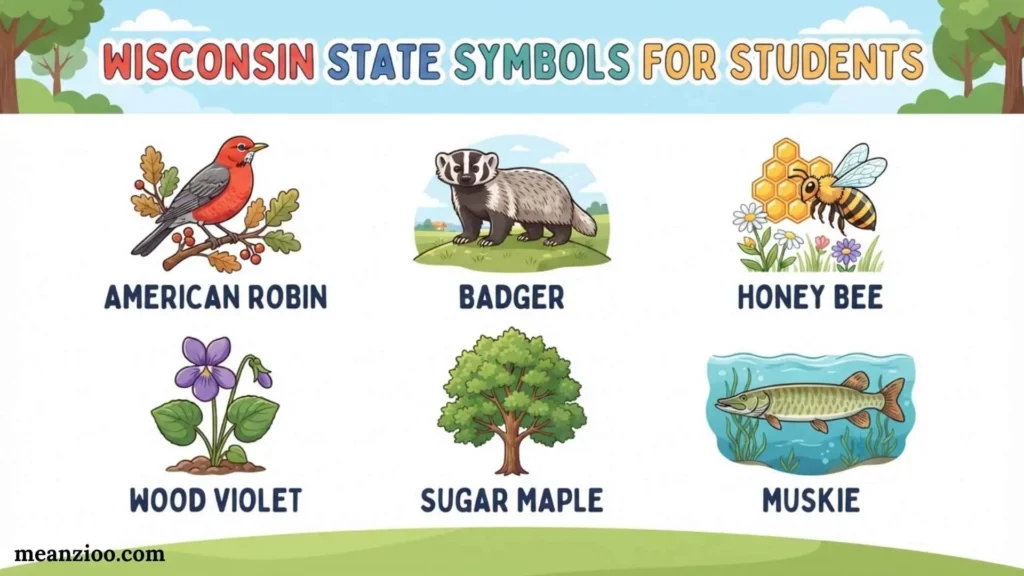
For a school assignment, one of the easiest ways to remember Wisconsin’s symbols is to group them by subject.
Animals and Wildlife
- American badger — state animal
- White-tailed deer — state wildlife animal
- Dairy cow — state domestic animal
- American Water Spaniel — state dog
Birds and Insects
- American robin — state bird
- Mourning dove — state symbol of peace
- Honey bee — state insect
Plants and Agriculture
- Wood violet — state flower
- Sugar maple — state tree
- Cranberry — state fruit
- Corn — state grain
Food and Drink
- Cheese — state dairy product
- Milk — state beverage
- Kringle — state pastry
Geology
- Galena — state mineral
- Red granite — state rock
- Trilobite — state fossil
- Antigo Silt Loam — state soil
Culture
- Polka — state dance
- Hunting Tartan — state tartan
- “On, Wisconsin!” — state song
This grouping makes the information much easier to study and remember.
Why Wisconsin State Symbols Matter
Wisconsin state symbols are useful because they connect official government recognition with everyday life.
The symbols represent several major themes:
- Wildlife: badgers, deer, robins, and mourning doves
- Agriculture: dairy cows, milk, cheese, cranberries, and corn
- Forests: sugar maple
- Freshwater: muskellunge
- Geology: galena, red granite, and trilobites
- Culture: polka, kringle, tartan, and state music
- History: the badger, state flag, and state seal
Wisconsin’s current State Park System even uses several state symbols in its Wisconsin Explorer program, including the sugar maple, American robin, honey bee, red granite, muskellunge, white-tailed deer, trilobite, wood violet, and American badger.
Frequently Asked Questions About Wisconsin State Symbols
What are the main Wisconsin state symbols?
Some of the best-known official Wisconsin state symbols are the American badger, American robin, wood violet, sugar maple, muskellunge, dairy cow, cheese, milk, cranberry, red granite, galena, and honey bee.
What is Wisconsin’s most famous state symbol?
The American badger is one of Wisconsin’s most recognizable official symbols because it is the state animal and is closely connected with the nickname Badger State.
Why is Wisconsin called the Badger State?
The nickname is historically connected with miners and Wisconsin’s early mining communities, whose underground lifestyles were compared with the burrowing habits of badgers. The animal later became Wisconsin’s official state animal.
What is Wisconsin’s state food?
There is no single official designation that should simply be called Wisconsin’s “state food.” Instead, Wisconsin officially recognizes cheese as its state dairy product, milk as its state beverage, and kringle as its state pastry.
What is Wisconsin’s state flower?
The wood violet is Wisconsin’s official state flower. Schoolchildren selected it in 1909.
What is Wisconsin’s state tree?
The sugar maple is Wisconsin’s official state tree. It was selected by schoolchildren in a statewide vote in 1893.
What is Wisconsin’s state fish?
The muskellunge, or musky, is Wisconsin’s official state fish. It was designated in 1955.
What is Wisconsin’s state fruit?
The cranberry is Wisconsin’s official state fruit. It was designated in 2003.
What is Wisconsin’s state mineral?
Galena is Wisconsin’s official state mineral. It was designated in 1971.
What is Wisconsin’s state rock?
Red granite is Wisconsin’s official state rock. It was designated in 1971.
What is Wisconsin’s state insect?
The honey bee is Wisconsin’s official state insect. It became the state insect in 1977.
Final Thoughts
Wisconsin state symbols tell a much bigger story than a simple list of official names. The American badger connects to the state’s history and identity, while the robin and wood violet represent familiar Wisconsin wildlife and plants. The sugar maple reflects the state’s forests, the muskellunge represents its lakes and rivers, and the cranberry and corn highlight agriculture.
Wisconsin’s dairy cow, milk, and cheese show why the state is closely associated with dairy farming, while the kringle, polka, tartan, and state songs represent its cultural traditions. Geological symbols such as galena, red granite, and the trilobite add another layer by connecting modern Wisconsin with its ancient natural history.
Taken together, these official symbols provide a useful snapshot of Wisconsin’s nature, agriculture, history, geology, and culture. They are also a simple and memorable way for students and readers to understand what makes the Badger State distinctive.

Hi, I’m Charlotte Hayes. I love writing about the newest English slang, pop culture phrases, and digital communication. I spend my time exploring how language evolves across social media, gaming, and everyday conversations. I enjoy sharing easy-to-understand guides that help learners keep up with modern English. My goal is to make every article useful, accurate, and enjoyable for readers around the world.
Books:
- Everyday Slang Dictionary
- Fluent Through Informal English
 Ryan Mitchell