Venn diagram symbols make it easier to understand relationships between sets. Symbols such as ∪, ∩, ⊂, ⊆, ∈, ∉, ∅, and Aᶜ may look complicated at first, but each one has a specific meaning. Once you know what the symbols represent and which part of a diagram they describe, you can solve set and probability questions much more confidently.
Venn diagrams are used in mathematics, statistics, probability, logic, computer science, and everyday comparisons. This guide explains the major symbols in detail, shows what areas they represent, compares similar operations, and provides simple examples you can use to understand each concept.
What Is a Venn Diagram?
A Venn diagram is a visual way to show relationships between sets. A set is a collection of objects, numbers, people, or other items that share a defined characteristic.
A typical Venn diagram uses circles inside a rectangle:
- The rectangle represents the universal set.
- Each circle represents a set.
- An overlapping area represents elements shared by sets.
- An area outside a circle represents elements that do not belong to that set.
- Labels such as A, B, and C identify individual sets.
For example, imagine:
A = people who like tea
B = people who like coffee
The overlapping section contains people who like both tea and coffee.
Venn diagrams turn abstract set relationships into something you can see.
Venn Diagram Symbols at a Glance
| Symbol | Name | Basic Meaning |
| ∪ | Union | Everything in either set or both |
| ∩ | Intersection | Everything shared by the sets |
| ∈ | Element of | Belongs to a set |
| ∉ | Not an element of | Does not belong to a set |
| ⊆ | Subset | Every element of one set is in another |
| ⊂ | Proper subset | One set is contained in another but is not equal |
| ⊄ | Not a subset | One set is not contained in another |
| ∅ | Empty set | Contains no elements |
| U | Universal set | All elements being considered |
| Aᶜ | Complement | Elements in U but outside A |
| \ | Difference | Elements in one set but not another |
| △ | Symmetric difference | Elements in either set but not both |
| = | Equal sets | Both sets contain the same elements |
Union Symbol (∪)
The union symbol ∪ means that the elements from the sets are combined.
For two sets:
A ∪ B
means all elements that are in A, in B, or in both.
Example
Suppose:
A = {1, 2, 3, 4}
B = {3, 4, 5, 6}
Then:
A ∪ B = {1, 2, 3, 4, 5, 6}
The numbers 3 and 4 appear in both sets, but they are counted only once in the union.
What Area Does Union Represent?
In a two-circle Venn diagram, A ∪ B includes:
- The part belonging only to A
- The overlapping part
- The part belonging only to B
In other words, shade both entire circles.
Easy Way to Remember Union
Think of union as joining or combining sets.
If a question asks for everyone who belongs to A or B, including people who belong to both, you are usually looking for a union.
Intersection Symbol (∩)
The intersection symbol ∩ represents elements shared by two or more sets.
For example:
A ∩ B
means elements that belong to both A and B.
Using the previous sets:
A = {1, 2, 3, 4}
B = {3, 4, 5, 6}
Therefore:
A ∩ B = {3, 4}
What Area Does Intersection Represent?
In a two-circle Venn diagram, shade only the area where A and B overlap.
That region contains elements that satisfy both conditions.
Easy Way to Remember Intersection
Think of an intersection as a place where two roads meet. Similarly, the intersection of two sets is where their elements meet.
Union vs. Intersection
Union and intersection are two of the most commonly confused Venn diagram symbols.
| Operation | Symbol | What It Includes |
| Union | ∪ | A, B, and their overlap |
| Intersection | ∩ | Only the overlap |
For example:
A ∪ B = everything in A or B.
A ∩ B = only what A and B share.
If you remember union = all combined areas and intersection = shared area, these symbols become much easier.
Element of Symbol (∈)
The symbol ∈ means “is an element of” or “belongs to.”
Suppose:
A = {2, 4, 6, 8}
Then:
4 ∈ A
is true because 4 belongs to A.
This symbol is used for an individual element, not an entire set.
Real-World Example
If Set A contains people who play soccer, and John is one of those people, you could write:
John ∈ A
This means John belongs to set A.
Not an Element of Symbol (∉)
The symbol ∉ means “is not an element of.”
Using:
A = {2, 4, 6, 8}
we can say:
5 ∉ A
because 5 is not contained in A.
In a Venn diagram, an element that is not in A would be positioned outside circle A, assuming it is still part of the universal set.
Subset Symbol (⊆)
The symbol ⊆ means that one set is a subset of another set.
When:
A ⊆ B
every element in A is also in B.
For example:
A = {1, 2}
B = {1, 2, 3, 4}
Therefore:
A ⊆ B
because every member of A is also a member of B.
Venn Diagram Representation
A subset can be represented by placing the smaller set completely inside the larger set.
The inner circle represents A, while the larger circle represents B.
Proper Subset Symbol (⊂)
The symbol ⊂ is commonly used for a proper subset.
A proper subset is contained in another set but is not equal to it.
For example:
A = {1, 2}
B = {1, 2, 3}
Then:
A ⊂ B
because all elements of A are in B, but B has an additional element.
⊂ vs. ⊆
This distinction can be confusing.
- A ⊂ B commonly means A is a proper subset of B.
- A ⊆ B means every element of A is in B, and equality may be allowed.
However, mathematical texts do not use these symbols consistently. Some textbooks use ⊂ simply to mean “subset.” If a course or textbook defines its notation differently, follow that definition.
Not a Subset Symbol (⊄)
The symbol ⊄ means that one set is not a subset of another.
For example:
A ⊄ B
means at least one element of A is not contained in B.
Suppose:
A = {1, 2, 5}
B = {1, 2, 3, 4}
Because 5 is not in B:
A ⊄ B
is true.
Empty Set Symbol (∅)
The symbol ∅ represents the empty set.
An empty set contains no elements.
For example:
A = ∅
means A contains nothing.
The empty set is important when two sets have no elements in common.
Example
If:
A = {1, 2}
and:
B = {3, 4}
then:
A ∩ B = ∅
There is no overlap between A and B.
Venn Diagram Representation
Two disjoint circles with no overlapping area can represent sets whose intersection is empty.
Universal Set Symbol (U)
The universal set, commonly represented by U, contains every element relevant to the problem.
In a Venn diagram, U is usually represented by the outer rectangle surrounding the circles.
Example
Suppose:
U = {1, 2, 3, 4, 5, 6, 7}
and:
A = {1, 2, 3}
Every element in A is also inside U.
The universal set does not necessarily mean “everything that exists.” It means everything included in the particular situation being studied.
Complement Symbol (Aᶜ)
The complement of A contains every element in the universal set that is not in A.
It is commonly written:
Aᶜ
Some textbooks may use A’ instead.
Example
Suppose:
U = {1, 2, 3, 4, 5, 6}
and:
A = {1, 2, 3}
Then:
Aᶜ = {4, 5, 6}
What Area Is Aᶜ?
In a Venn diagram, shade everything inside the universal-set rectangle that is outside circle A.
This is important because the complement depends on the universal set.
Set Difference Symbol ()
Set difference identifies elements that belong to one set but not another.
A \ B
means elements in A that are not in B.
Example
Suppose:
A = {1, 2, 3, 4}
B = {3, 4, 5, 6}
Then:
A \ B = {1, 2}
The elements 3 and 4 are removed because they also belong to B.
Venn Diagram Meaning
For A \ B, shade the part of A that does not overlap B.
Notice that:
A \ B
is generally different from:
B \ A
In this example:
B \ A = {5, 6}
Symmetric Difference Symbol (△)
The symmetric difference contains elements that belong to one set or the other, but not both.
It can be written:
A △ B
Suppose:
A = {1, 2, 3}
B = {3, 4, 5}
Then:
A △ B = {1, 2, 4, 5}
The shared element 3 is excluded.
Venn Diagram Meaning
Shade:
- The A-only region
- The B-only region
Do not shade the overlapping region.
Equal Sets Symbol (=)
The equals sign = indicates that two sets contain exactly the same elements.
For example:
A = {1, 2, 3}
B = {3, 2, 1}
Therefore:
A = B
The order does not matter in an ordinary set.
Two sets can look different because their elements are listed in a different order while still being equal.
Disjoint Sets
Two sets are disjoint if they have no elements in common.
The relationship can be written:
A ∩ B = ∅
For example:
A = {1, 2, 3}
B = {4, 5, 6}
There are no shared elements.
Venn Diagram Meaning
Disjoint sets are shown as separate circles that do not overlap.
Overlapping Sets
Sets overlap when they have at least one common element.
For example:
A = {1, 2, 3}
B = {3, 4, 5}
The common element is 3.
Therefore:
A ∩ B = {3}
The overlapping section of the circles represents the shared element.
Three-Set Venn Diagram Symbols
Venn diagrams can contain three sets, commonly labeled A, B, and C.
Three-Way Intersection
The expression:
A ∩ B ∩ C
means elements that belong to all three sets.
In a standard three-circle Venn diagram, this is the central region where all three circles overlap.
Three-Set Union
The expression:
A ∪ B ∪ C
means every element belonging to A, B, or C, including elements shared by two or all three sets.
Example
Imagine:
- A = students who play football
- B = students who play basketball
- C = students who play tennis
Then:
A ∩ B ∩ C
represents students who play all three sports.
The expression:
A ∪ B ∪ C
represents students who play at least one of the three sports.
Venn Diagram Symbols in Probability
Venn diagrams are frequently used to explain probability events.
Some important notation includes:
- P(A) = probability of event A
- P(B) = probability of event B
- P(A ∩ B) = probability that both A and B occur
- P(A ∪ B) = probability that A or B occurs
- P(Aᶜ) = probability that A does not occur
For two events:
P(A ∪ B) = P(A) + P(B) − P(A ∩ B)
The intersection is subtracted because it would otherwise be counted twice.
Simple Probability Example
Suppose a survey contains 100 people:
- 60 like tea
- 50 like coffee
- 30 like both
The number who like tea or coffee is:
60 + 50 − 30 = 80
So:
80 people belong to the union of the two groups.
The overlap matters because those 30 people were included in both original totals.
Venn Diagram Symbols in Logic
Venn diagrams can also show logical relationships between categories.
For example, suppose:
- A = animals
- B = mammals
Because mammals are a category within animals, the diagram can represent B as a subset of A.
Other logical relationships can show:
- Inclusion
- Exclusion
- Shared characteristics
- Categories
- Conditions
This makes Venn diagrams useful for organizing concepts as well as solving mathematical problems.
How to Read a Venn Diagram Step by Step
1. Identify the Universal Set
Start with the outer rectangle.
Ask: What complete group is this problem considering?
That group is the universal set.
2. Identify Each Set
Look at the labels on the circles.
For example:
- A = students who study English
- B = students who study mathematics
3. Find the Overlap
The overlapping region represents:
A ∩ B
These are students who belong to both groups.
4. Find the Individual Regions
The part of A that does not overlap B represents:
A \ B
The part of B that does not overlap A represents:
B \ A
5. Look Outside a Set
The area inside U but outside A represents:
Aᶜ
6. Apply the Correct Symbol
Read the mathematical expression carefully before shading or counting any region.
This prevents common mistakes with union, intersection, difference, and complement.
Detailed Example Using Three Sets
Suppose a class survey asks students about three hobbies:
- A = reading
- B = drawing
- C = playing music
Some students belong to only one group. Others belong to two groups, and some belong to all three.
If the question asks:
How many students enjoy reading and drawing?
You need the region represented by:
A ∩ B
If it asks:
How many students enjoy reading or drawing?
You need:
A ∪ B
If it asks:
How many students enjoy all three hobbies?
You need:
A ∩ B ∩ C
If it asks:
How many students enjoy reading but not drawing?
You need:
A \ B
This shows why understanding the symbols is more important than simply memorizing the appearance of the circles.
Common Venn Diagram Symbol Mistakes
Confusing ∪ and ∩
The most common mistake is switching union and intersection.
Remember:
∪ = everything from the sets
∩ = shared area
Forgetting the Universal Set
When working with complements, you must know what U contains.
A complement is based on the universal set, not an unlimited collection of everything outside the circle.
Confusing ∈ With ⊆
These symbols describe different things.
x ∈ A
means an individual element x belongs to A.
A ⊆ B
means the entire set A is contained within B.
Assuming Every Circle Must Overlap
Not every pair of sets has common elements.
If two sets are disjoint, their circles should not overlap.
Shading the Wrong Area
An expression may contain more than one operation.
For example:
A ∩ Bᶜ
means elements that are in A and outside B.
It is not simply the entire area outside A.
How to Remember Venn Diagram Symbols
A few simple memory tricks can make these symbols easier to recall.
Remember ∩ as “Common”
The intersection focuses on what sets have in common.
Remember ∪ as “Combine”
The union brings the sets together and includes everything belonging to either set.
Remember ∈ as “Belongs”
The symbol ∈ is used when talking about one element belonging to a set.
Remember ∅ as “Nothing”
The empty-set symbol means there are no elements.
Remember the Rectangle as “Everything”
The rectangle represents the complete universe being considered in the problem.
Venn Diagram Symbols vs. Set Notation
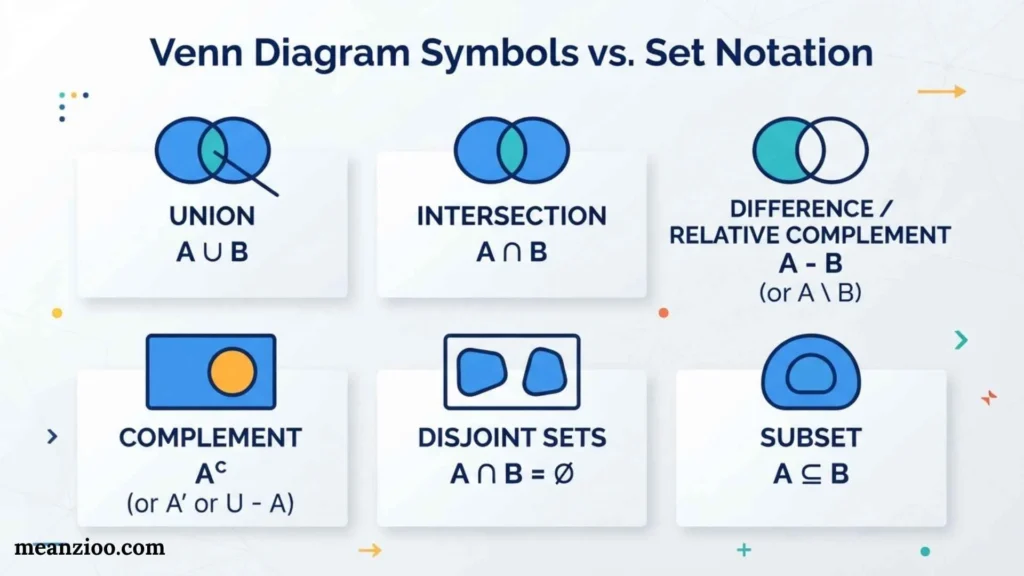
Venn diagrams are visual, while set notation is mathematical.
For example:
A ∩ B
is a mathematical expression.
The corresponding Venn diagram shows the overlapping area between A and B.
Similarly:
A ∪ B
corresponds to the combined area of both circles.
Learning to translate between symbols and shaded regions is one of the most useful Venn diagram skills.
Venn Diagram Symbols vs. Mathematical Operators
Some Venn diagram symbols resemble mathematical operators but have specific meanings in set theory.
For example:
- ∪ means union
- ∩ means intersection
- = means equal
- ⊆ means subset
- ∈ means membership
Their meaning depends on what is being described.
For this reason, do not assume a symbol has the same meaning in every area of mathematics.
Frequently Asked Questions About Venn Diagram Symbols
What are the main Venn diagram symbols?
The main symbols include union ∪, intersection ∩, element of ∈, not an element of ∉, subset ⊆, proper subset ⊂, empty set ∅, universal set U, complement Aᶜ, and set difference \.
What does ∪ mean in a Venn diagram?
The symbol ∪ means union. It represents all elements that belong to either set or both sets.
What does ∩ mean in a Venn diagram?
The symbol ∩ means intersection. It represents elements that are shared by two or more sets.
What does U mean in a Venn diagram?
U commonly represents the universal set. It contains all elements being considered in the particular problem.
What does the upside-down U mean in Venn diagrams?
The upside-down U-shaped symbol ∩ represents intersection. It identifies elements common to the sets involved.
What does the U-shaped symbol mean in a Venn diagram?
The U-shaped symbol ∪ represents union. It includes all elements found in either set, including their overlap.
What does ⊆ mean?
The symbol ⊆ means that one set is a subset of another. Every element in the first set is also in the second set.
What does ⊂ mean?
The symbol ⊂ is commonly used for a proper subset, meaning one set is contained within another but is not equal to it. However, notation conventions vary between textbooks.
What does Aᶜ mean?
Aᶜ means the complement of A. It includes elements in the universal set that are outside A.
What does ∅ mean?
∅ represents the empty set, which contains no elements.
How do you identify the intersection in a Venn diagram?
The intersection is the area where the relevant circles overlap. For two sets, it is represented by A ∩ B.
How do you identify the union in a Venn diagram?
The union includes every area belonging to either set. For two sets, it is represented by A ∪ B.
Final Thoughts
Learning Venn diagram symbols becomes much easier when you connect each symbol with a specific region of the diagram. The most important symbols to remember are ∪ for union, ∩ for intersection, ∈ for element of, ⊆ for subset, ∅ for empty set, U for universal set, and Aᶜ for complement.
Union includes the combined areas of sets, while intersection focuses only on what they share. Set difference removes elements belonging to another set, and symmetric difference keeps elements that belong to one set but not both. Three-set diagrams extend the same ideas to more complex relationships.
The key is to read the notation carefully, identify the universal set, locate the relevant circles, and then determine which region the expression describes. With a little practice, Venn diagrams become a straightforward way to visualize sets, probability, logic, and relationships between groups.

Hi, I’m Charlotte Hayes. I love writing about the newest English slang, pop culture phrases, and digital communication. I spend my time exploring how language evolves across social media, gaming, and everyday conversations. I enjoy sharing easy-to-understand guides that help learners keep up with modern English. My goal is to make every article useful, accurate, and enjoyable for readers around the world.
Books:
- Everyday Slang Dictionary
- Fluent Through Informal English
 Ryan Mitchell