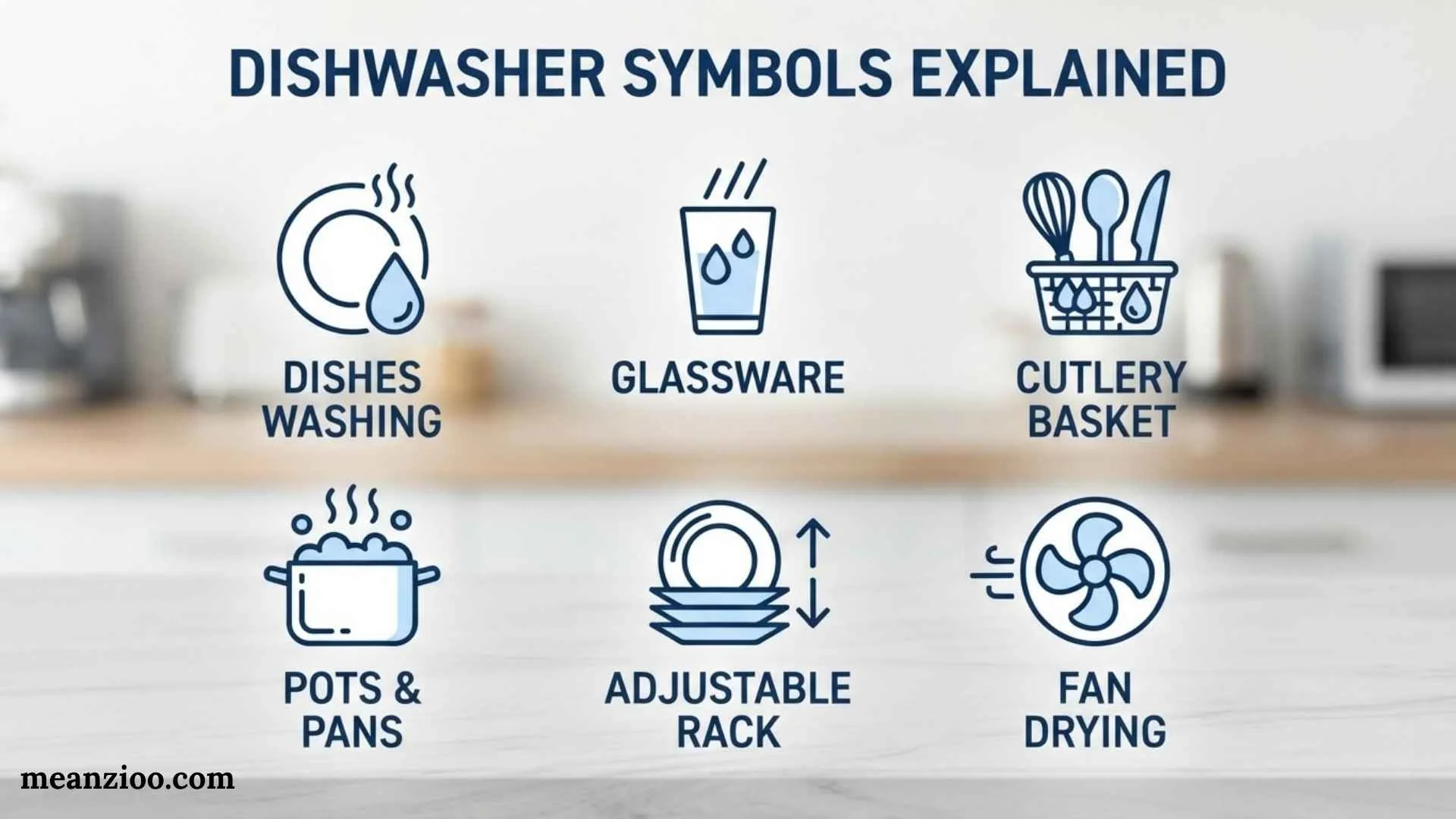
Dishwasher symbols can be confusing when you are not sure what each icon means. A small star, tap, clock, glass, or flashing light can represent anything from rinse aid and dishwasher salt to a selected wash program or a warning that needs attention. Understanding dishwasher symbols explained in simple terms can help you choose the right cycle, refill supplies on time, and recognize potential problems before they become serious.
This guide covers common dishwasher symbols, their meanings, brand-specific differences, flashing indicators, warning icons, detergent symbols, and the difference between dishwasher control symbols and dishwasher-safe markings.
What Do Dishwasher Symbols Mean?

Dishwasher symbols are icons used on the control panel, display, detergent compartment, or inside the dishwasher to communicate a function, setting, status, or warning.
The exact design is not universal. A symbol that means one thing on a particular model may look slightly different on another.
Common dishwasher symbols can indicate:
- Washing programs
- Drying functions
- Eco settings
- Rinse aid
- Dishwasher salt
- Delay start
- Half load
- Child lock
- Machine cleaning
- Water supply
- Drainage problems
- Cycle completion
- Temperature or hygiene settings
For unfamiliar symbols, the owner’s manual for your exact model is the most reliable reference.
Common Dishwasher Symbols Explained
6
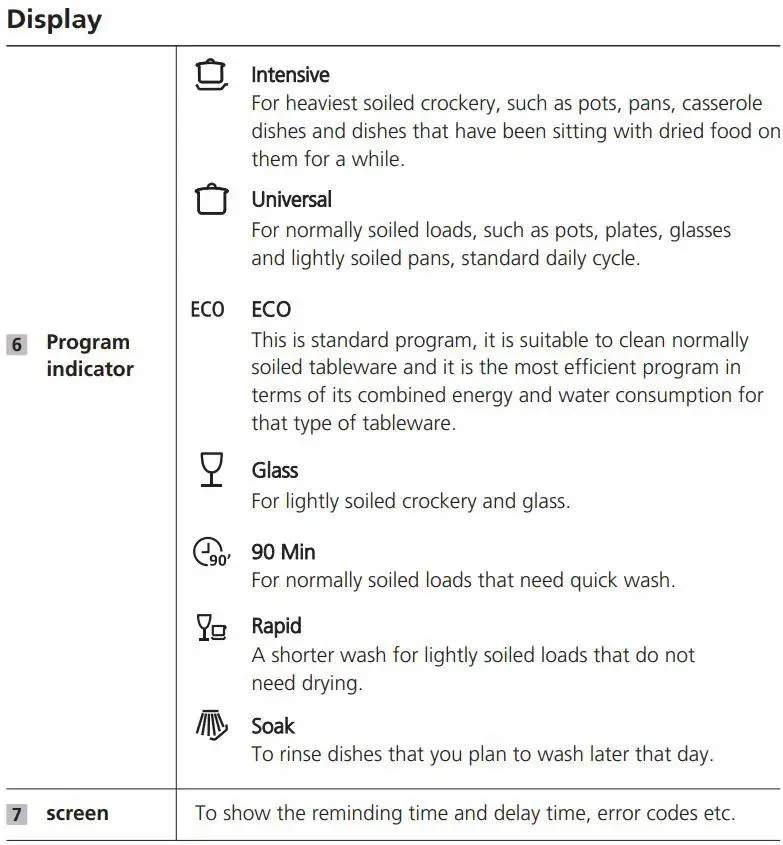
Eco Symbol
The Eco symbol is often shown as a leaf or another environmentally themed icon.
It normally identifies an energy- or water-efficient washing program. An Eco cycle can take longer than a quick cycle because efficiency does not necessarily mean speed.
The Eco program is commonly suitable for normally soiled everyday dishes.
Intensive Wash Symbol
The intensive wash symbol may look like a pot, pan, or heavily soiled dish.
It is designed for items that require stronger cleaning action, such as suitable:
- Pots
- Pans
- Baking dishes
- Heavily soiled plates
- Cookware with dried food residue
Because intensive programs can use higher temperatures or stronger washing action, check the care instructions for delicate cookware before using them.
Quick Wash Symbol
A clock, stopwatch, or speed-related icon often represents a quick or rapid program.
This cycle is useful when dishes are lightly soiled and you want a shorter washing time.
A quick cycle may not provide the same cleaning or drying performance as a longer program, so it is not always the best choice for heavily dried-on food.
Glass or Delicate Symbol
A wine glass or delicate glass icon usually represents a gentle cycle.
It may be intended for dishwasher-safe:
- Glassware
- Cups
- Delicate dishes
- Lightly soiled tableware
Always check the item’s care instructions before putting fragile glassware in a dishwasher.
Plate Symbol
A plate symbol commonly represents a normal or standard washing program.
This is often the everyday setting for plates, cups, bowls, cutlery, and other normally soiled dishwasher-safe items.
The exact temperature, water consumption, and duration depend on the model.
Pot and Pan Symbol
A pot or pan icon usually indicates a stronger cleaning program.
This setting can be useful for dishwasher-safe cookware with heavier food residue. It should not automatically be used for every pot or pan because some materials can be damaged by high temperatures or aggressive washing.
Spray Arm or Water Jet Symbol
A spray-arm or water-jet symbol represents the washing action of the dishwasher.
It may indicate:
- The wash stage is running
- Water is being sprayed
- A particular wash program
- A special spray function
The meaning depends on where the icon appears on the dishwasher.
Dishwasher Salt Symbol
The dishwasher salt indicator is commonly represented by two curved arrows forming an S-like shape.
When this light appears, the dishwasher may be telling you that the water-softening salt reservoir needs attention.
Dishwasher salt is specially formulated for compatible dishwasher water-softening systems. It should not be replaced with ordinary table salt unless the manufacturer’s instructions specifically say otherwise.
Why Does Dishwasher Salt Matter?
Hard water contains minerals that can contribute to scale buildup. A dishwasher’s water-softening system helps manage these minerals.
If the salt indicator remains illuminated, check the salt reservoir and refill it according to the manufacturer’s instructions.
Do not confuse the salt symbol with the rinse aid symbol because they serve different purposes.
Rinse Aid Symbol
The rinse aid symbol is often designed like a star, sparkle, or small sun.
It commonly appears when the rinse aid dispenser needs refilling.
Rinse aid helps water run off dishes during the final stages of the cycle. It can improve drying and reduce visible water spots on glasses and dishes.
If the rinse aid indicator stays on after refilling, the dishwasher may need a short period or another completed cycle before the indicator resets, depending on the model.
Drying Symbol
Drying symbols can appear as:
- Wavy lines
- Heat waves
- A fan
- A plate with lines above it
The symbol generally indicates that drying is selected or currently taking place.
Modern dishwashers may use different drying technologies, so a specific icon can have a model-specific meaning.
If dishes remain wet after a cycle, check whether the selected program includes drying and whether rinse aid is being used as recommended.
Delay Start Symbol
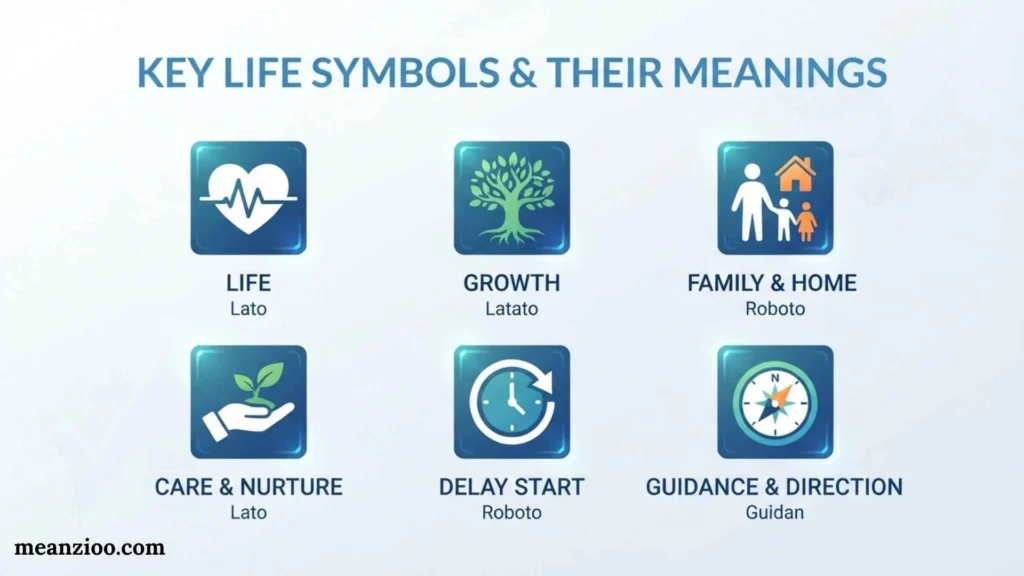
A clock symbol commonly represents Delay Start.
This function allows you to choose when the dishwasher should begin its cycle.
For example, a dishwasher might allow you to delay the start by several hours. The display may show the remaining delay period.
Do not confuse a clock symbol used for delay start with a clock or stopwatch symbol used for a quick program. Their exact appearance depends on the model.
Half-Load Symbol
The half-load symbol generally indicates that the dishwasher is operating with a smaller load.
It can be useful when you have fewer dishes and do not want to wait until the dishwasher is completely full.
Depending on the model, half-load functionality may:
- Adjust water consumption
- Adjust cycle settings
- Allow a specific basket to be selected
- Modify the washing pattern
The actual savings and operation vary by dishwasher.
Child Lock Symbol
A lock or key icon commonly represents the child-lock function.
When enabled, it may prevent buttons from being pressed accidentally or stop children from changing the selected program.
Some dishwashers activate child lock by holding a button for several seconds, while others use a combination of buttons.
The exact activation method should be checked in the owner’s manual.
Start and Pause Symbols
The start button is often represented by a triangle:
▶
It normally begins the selected program.
The pause function may use two vertical lines:
⏸
It temporarily stops the program on models that support pausing.
Some dishwashers combine start and pause into one button. Opening the door may also automatically pause the dishwasher, but the exact behavior varies by model.
End-of-Cycle Symbol
An end symbol can appear as:
- “End” on a display
- A check mark
- A completed-cycle icon
- A light indicator
- An audible signal
It generally means the selected washing program has finished.
Some dishwashers turn off or enter standby automatically after completing the cycle.
Machine-Care Symbol
Some dishwashers include a dedicated machine-care or cleaning program.
Its icon can resemble a sparkle, cleaning symbol, tub, or dishwasher with stars.
This cycle is intended to clean the dishwasher itself rather than your dishes.
A machine-care program may help remove accumulated grease and residue. Follow the manufacturer’s maintenance instructions when using dishwasher cleaning products.
What Do Dishwasher Detergent Symbols Mean?
The detergent dispenser commonly contains more than one section.
A compartment marked I often relates to a prewash detergent stage.
A compartment marked II commonly holds detergent for the main wash.
A separate compartment with a small cap or symbol is usually used for rinse aid.
However, dispenser designs vary. Some machines use automatic detergent dosing, while others use a single detergent compartment.
Always follow the instructions supplied with your dishwasher rather than relying only on the appearance of an icon.
Dishwasher Symbols for Water Supply Problems
Some dishwashers use a tap or faucet symbol to indicate a water-related issue.
If the tap symbol appears, possible causes can include:
- Water supply is turned off
- Inlet hose problem
- Blocked inlet filter
- Insufficient water pressure
- Water inlet problem
- A detected water-supply fault
Do not assume that every tap symbol means the same thing. Check your model’s troubleshooting instructions.
Before investigating connections, follow appropriate safety instructions and switch off the appliance if the manufacturer’s guidance requires it.
Dishwasher Drainage or Filter Symbols
A dishwasher may display a drain-related warning when it cannot remove water correctly.
Possible causes can include:
- A blocked filter
- Food debris
- A blocked drain path
- A drainage hose problem
- An installation issue
If water remains inside the dishwasher after the cycle, check the owner’s manual for the recommended filter-cleaning and drainage procedure.
Do not repeatedly restart a machine that is clearly reporting a serious fault.
Flashing Dishwasher Symbols Explained
A flashing symbol does not always mean the same thing as a continuously illuminated symbol.
A flashing light may indicate:
- A program is currently active
- A selected option is waiting
- A refill is required
- A door is not properly closed
- Water cannot enter the machine
- The cycle has been interrupted
- An error has occurred
The surrounding display is important. For example, a flashing icon combined with an error code can have a very different meaning from an icon that simply flashes while a cycle is running.
Dishwasher Warning Symbols
Some dishwasher symbols are designed specifically to alert you to a condition requiring attention.
Common warning indicators can relate to:
Water Supply
A tap icon can indicate that the dishwasher is not receiving water correctly.
Drainage
A drainage or water-related warning may indicate that the machine cannot remove wastewater.
Salt
A salt indicator generally means the dishwasher’s salt reservoir needs checking or refilling.
Rinse Aid
A sparkle or star indicator commonly means the rinse aid compartment needs attention.
Door
Some models display a door-related warning if the dishwasher is not fully closed.
General Error
Some dishwashers show an error symbol together with a code. The code is usually more useful than the icon alone because it identifies a particular fault according to the manufacturer’s diagnostic system.
Dishwasher Symbols by Brand
Dishwasher symbols are not completely standardized, which is why brand-specific information matters.
Bosch Dishwasher Symbols
Bosch dishwashers commonly use familiar icons for programs and functions such as Eco, intensive washing, rinse aid, salt, and delay start. However, the exact symbols can differ between series and generations.
Siemens Dishwasher Symbols
Siemens models often share design conventions with other appliances in the same product family, but specific icons and programs vary by model.
Whirlpool Dishwasher Symbols
Whirlpool dishwashers can use symbols for options such as delayed start, half load, intensive washing, and drying. The control panel layout depends on the model.
Samsung Dishwasher Symbols
Samsung models can include icons for washing programs, drying, delay functions, and alerts. Newer models may also use digital displays and additional status indicators.
LG Dishwasher Symbols
LG dishwashers may include icons for wash programs, drying options, cleaning functions, and machine status. The meaning of an icon can vary according to the specific model.
Miele Dishwasher Symbols
Miele dishwashers may use specialized program and maintenance indicators. Because Miele has multiple product generations, the owner’s manual is particularly useful when an unfamiliar symbol appears.
The important point is that brand names alone are not enough to identify every symbol. The exact model number provides much more reliable information.
Dishwasher-Safe Symbol vs. Dishwasher Control Symbol
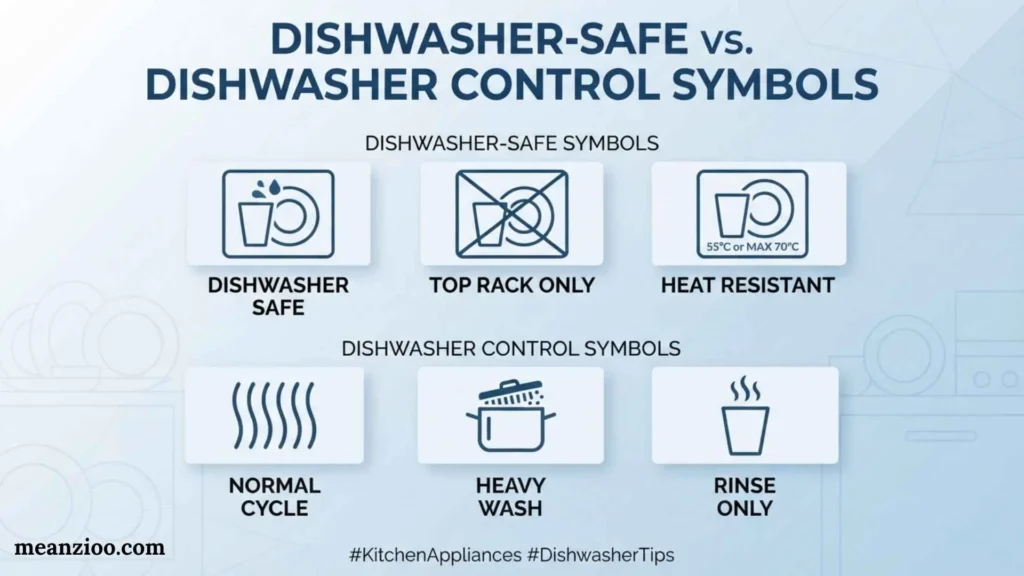
This distinction is easy to miss.
A dishwasher control symbol appears on the appliance and tells you about a program, function, warning, or setting.
A dishwasher-safe symbol appears on an item such as a plate, container, utensil, or cookware.
The dishwasher-safe marking is intended to tell you whether the item is suitable for dishwasher cleaning.
These symbols should not be treated as interchangeable.
Why Does the Difference Matter?
A dishwasher may have an intensive program that is safe for the machine but unsuitable for a particular item.
For example, a delicate plastic container may be dishwasher-safe but require placement on the upper rack or a lower-temperature program.
Always follow the product’s care instructions.
How to Identify an Unknown Dishwasher Symbol
If you see an icon you do not recognize, use this process:
- Look at where the symbol appears. Control panels, displays, detergent compartments, and warning lights have different purposes.
- Check whether it is flashing. A flashing symbol may indicate a status or problem.
- Look for an accompanying code. Error codes can provide more specific information.
- Find the dishwasher model number. It is often located around the door frame.
- Read the model-specific manual. Search the symbol or indicator section.
- Check the basic supplies. Salt and rinse aid indicators are common reasons for warning lights.
- Look for water inside the machine. Standing water can point toward a drainage issue.
- Do not guess when the symbol indicates a serious fault. Use the manufacturer’s troubleshooting instructions.
Dishwasher Symbols Quick Reference Chart
| Symbol | Common Meaning | What It Usually Indicates |
| Leaf | Eco | Efficient washing program |
| Pot | Intensive | Heavy-duty washing |
| Clock | Delay Start | Program starts later |
| Stopwatch | Quick Wash | Shorter cycle |
| Wine glass | Delicate | Gentle washing |
| Plate | Normal | Everyday washing |
| Star/Sparkle | Rinse Aid | Rinse aid needs attention |
| S-shaped arrows | Salt | Dishwasher salt needs attention |
| Wavy lines | Drying | Drying function or stage |
| Lock/Key | Child Lock | Controls are locked |
| Tap | Water Supply | Possible water inlet issue |
| Spray Arm | Washing | Water spray/wash action |
| Half-filled load | Half Load | Reduced-load option |
| Check/End | Finished | Cycle completed |
| Cleaning/Sparkle | Machine Care | Dishwasher cleaning program |
Why Is My Dishwasher Symbol Still On After Refilling?
A refill indicator may not disappear immediately after you add salt or rinse aid.
Possible reasons include:
- The dishwasher has not completed another cycle
- The reservoir was not filled correctly
- The indicator has not reset yet
- The wrong compartment was filled
- The appliance has detected another issue
Check the manufacturer’s instructions for the reset procedure rather than repeatedly adding more product.
Why Is My Dishwasher Flashing and Not Starting?
A flashing indicator with no cycle starting can have several possible causes.
The dishwasher may be:
- Waiting for the door to close
- Showing a water-supply problem
- Waiting for a delayed start
- Reporting an error
- Waiting for a button sequence
- Detecting another operating condition
Look for an accompanying error code or message. The exact meaning depends on the dishwasher model.
Frequently Asked Questions About Dishwasher Symbols
What does the star symbol mean on a dishwasher?
A star or sparkle symbol commonly represents rinse aid. If it is illuminated, the dishwasher may be indicating that the rinse aid reservoir needs refilling.
What does the S symbol mean on a dishwasher?
An S-shaped symbol made from curved arrows commonly indicates dishwasher salt. It generally means the water-softening salt reservoir needs attention.
What does the tap symbol mean on a dishwasher?
A tap or faucet symbol commonly relates to the water supply. It can appear when the dishwasher detects a problem with water entering the machine.
What does the leaf symbol mean on a dishwasher?
A leaf usually represents an Eco or energy-efficient washing program. The exact operation varies by model.
What does the clock symbol mean on a dishwasher?
A clock can represent Delay Start or, on some models, a time-related washing function. Check the surrounding controls to determine its exact purpose.
What does the wine glass symbol mean on a dishwasher?
A wine glass commonly indicates a delicate or glassware washing program intended for suitable dishwasher-safe glassware.
Why is my dishwasher salt light on?
The salt indicator usually means the dishwasher salt reservoir needs to be checked or refilled. Use dishwasher salt according to the manufacturer’s instructions.
Why is my dishwasher rinse aid light on?
The rinse aid indicator generally means the rinse aid compartment needs refilling. Some models may take a cycle or other action before the light disappears.
Are dishwasher symbols the same on every brand?
No. Many common icons have similar meanings across brands, but their appearance, programs, and functions can differ. The manual for your exact model is the safest reference.
Final Thoughts
Understanding dishwasher symbols explained makes it easier to select the right wash program, maintain your appliance, and respond to warning indicators. Common symbols such as the leaf for Eco, pot for intensive washing, wine glass for delicate items, star for rinse aid, S-shaped icon for dishwasher salt, and clock for delay functions are found on many machines.
However, dishwasher symbols are not completely universal. Bosch, Siemens, Whirlpool, Samsung, LG, Miele, and other manufacturers can use different icons and program names across models. Flashing symbols can also have different meanings from permanently illuminated indicators.
When an unfamiliar symbol appears, identify the dishwasher’s exact model, check whether the icon is flashing, look for an accompanying error code, and consult the manufacturer’s instructions. This approach is more reliable than guessing from the symbol alone and can help you use your dishwasher safely and effectively.

I’m Ryan Mitchell, and I write about modern English, trending slang, and online expressions. I enjoy explaining the meanings, origins, and real-life usage of popular words in a simple way. I believe learning slang is an important step toward understanding today’s English-speaking culture. Through my work, I aim to help readers speak more naturally and stay updated with the latest language trends.
 Charlotte Hayes