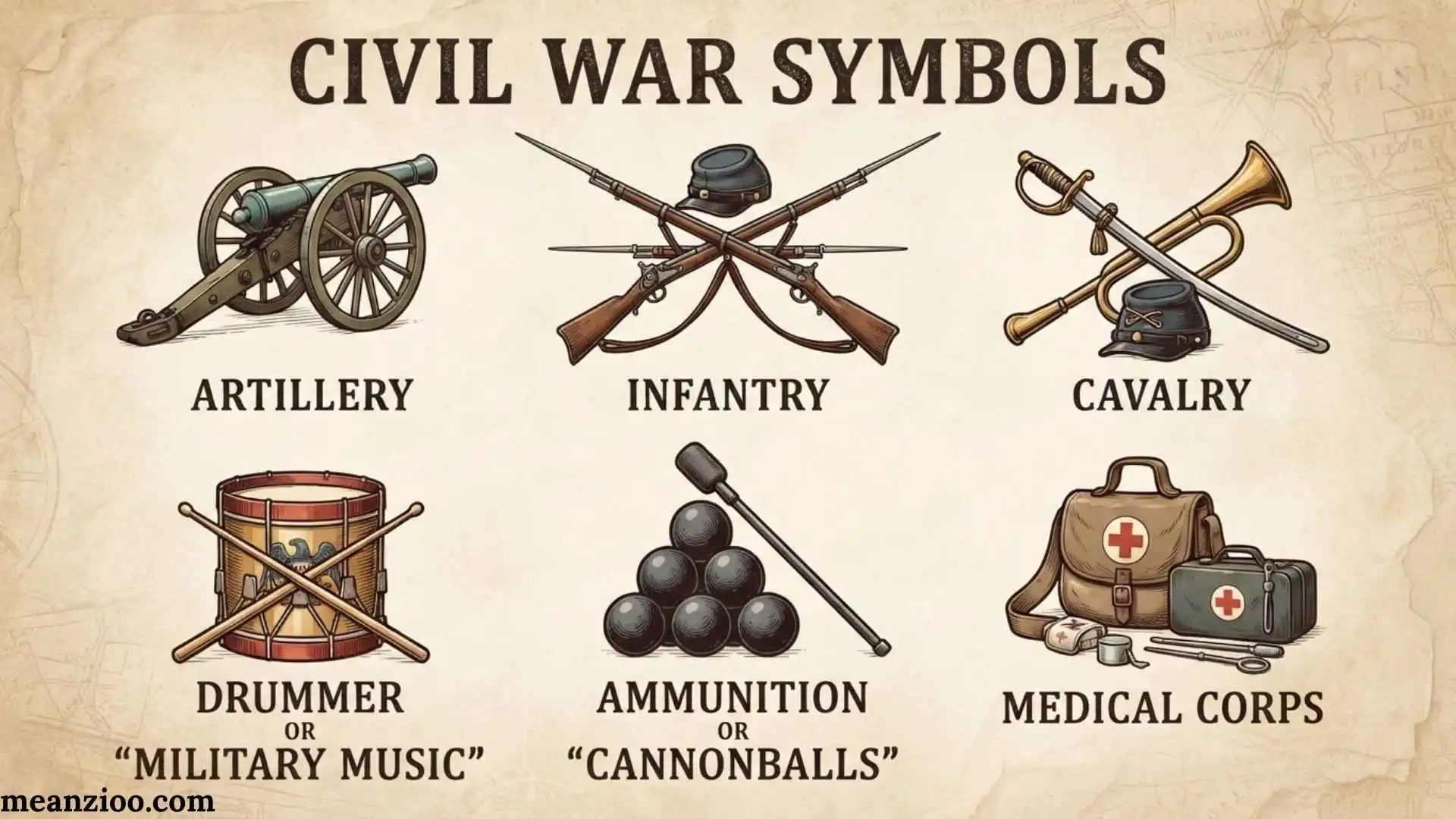
Civil War symbols are an important part of American history because they show how soldiers, states, political groups, and civilians expressed identity during the American Civil War. Flags were especially important, but they were not the only symbols. Military insignia, regimental colors, state emblems, stars, political objects, and recruitment materials also carried important meanings.
For soldiers, a flag could identify a unit in the confusion of battle. For civilians, it could represent loyalty, political beliefs, state identity, or national belonging. Some symbols also changed meaning after the war and remain subjects of historical discussion today.
Understanding these symbols requires attention to when they were used, who used them, and what they represented in that particular setting. A Confederate national flag, for example, was not necessarily the same thing as a Confederate battle flag, and Union flags could carry different meanings for different communities.
What Were Civil War Symbols?
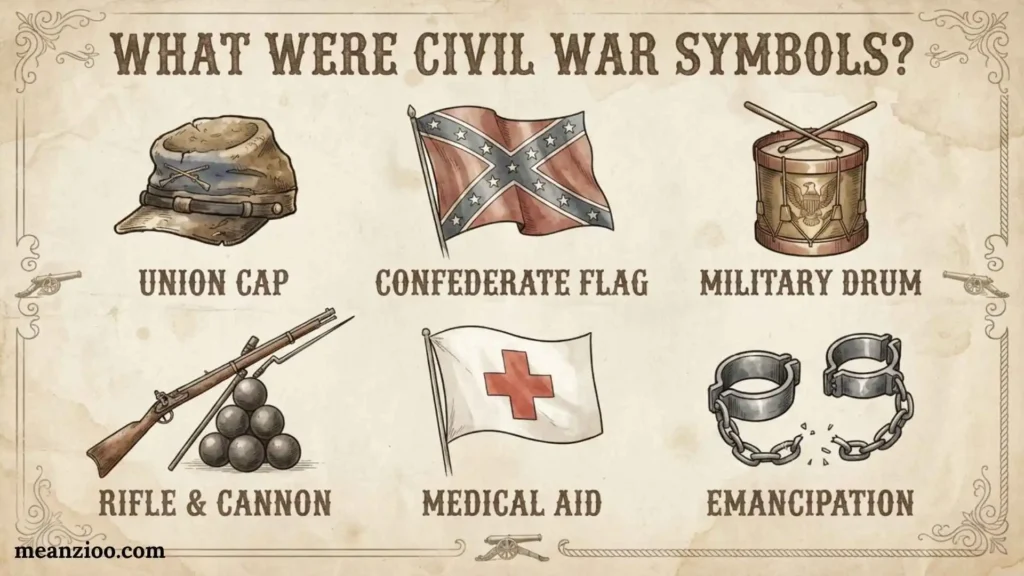
Civil War symbols were visual images, flags, emblems, objects, and designs associated with the people and organizations involved in the American Civil War from 1861 to 1865.
They appeared on:
- National flags
- State flags
- Regimental colors
- Military badges
- Corps insignia
- Political tokens
- Recruitment materials
- Personal objects
- Memorial items
- Newspapers and printed materials
Flags were particularly important because they served both practical and emotional purposes. The Smithsonian explains that flags could identify military units while also representing the beliefs and spirit of the groups carrying them. Soldiers sometimes protected their flags at enormous personal risk.
A symbol’s meaning was not always permanent. Some designs existed before the war and gained new political meanings during the conflict. Others became associated with new movements or ideas after 1865.
The United States Flag and the Union
The Stars and Stripes was the primary national symbol of the United States and the Union during the Civil War.
For Union soldiers, the flag represented the nation they were fighting to preserve. During the conflict, its emotional importance increased considerably. The Smithsonian notes that the Civil War strengthened the flag’s role as a national symbol and connected it with national identity, Union, and, increasingly, freedom and citizenship.
The United States flag also had a distinctive meaning for African Americans during the war. As Black men entered Union military service and the government moved toward emancipation, the flag could represent freedom and the possibility of citizenship.
Stars on the Union Flag
The stars on the United States flag represented the states of the Union.
One interesting feature of the Civil War period is that the U.S. government did not remove stars representing states that had seceded. The Smithsonian explains that the flag continued to include those stars because the Lincoln administration maintained that the states remained part of the United States despite rebellion. During the war, the number of stars increased from 34 to 36 as West Virginia and Nevada joined the Union.
This makes the stars an important Civil War symbol of competing ideas about state membership and national unity.
The Fort Sumter Flag
One of the most historically important Union flags from the beginning of the Civil War is the 33-star United States flag that flew over Fort Sumter.
Confederate forces fired on Fort Sumter in April 1861, beginning the conflict’s first major battle. The National Park Service preserves the Fort Sumter storm flag and describes its role in the opening of the war.
Because of this history, the flag became more than a military object. It became an artifact connected with the beginning of the Civil War and the struggle over the future of the United States.
The Confederate First National Flag: Stars and Bars
The Confederate First National Flag, commonly called the Stars and Bars, was adopted by the Confederate States of America in 1861.
Its design included:
- Red horizontal stripes
- A white horizontal stripe
- A blue canton
- White stars representing Confederate states
The Smithsonian records that the first Confederate national flag was used from 1861 to 1863. Its similarity to the U.S. flag created serious problems on battlefields because soldiers could have difficulty distinguishing the two flags in smoke and confusion.
This distinction is important because the Stars and Bars was a national flag, not simply another name for the later Confederate battle flag.
Why Did the Confederate National Flag Change?
The Confederacy changed its national flag designs during the war partly because of practical problems.
The First National flag looked too similar to the Union flag. On a battlefield, where smoke and distance made identification difficult, this similarity could cause confusion.
The National Park Service explains that Confederate flags evolved partly because the designs did not work well in battlefield conditions. The second national flag also created a different problem because its large white field could resemble a surrender flag.
These practical concerns help explain why the Confederacy used several national flag designs during the war.
The Confederate Second National Flag
The Second Confederate National Flag, commonly called the Stainless Banner, was introduced in 1863.
It featured a large white field with the Confederate battle flag in the upper corner. A red vertical bar was later added to make the flag more distinctive.
The design attempted to preserve Confederate identity while addressing problems associated with the First National flag.
Its large white field, however, could create another visual problem. From a distance or in still air, the flag could appear similar to a surrender banner. This was one reason further changes followed.
The Confederate Third National Flag
The Third Confederate National Flag was adopted in March 1865, only a short time before the Confederacy collapsed.
It retained elements of the earlier design but included a red stripe along the outer edge. Because it appeared so late in the war, it had a much shorter period of use than the earlier Confederate national flags.
The three Confederate national designs demonstrate why it is historically inaccurate to treat every Confederate flag as one identical symbol.
The Confederate Battle Flag
The Confederate battle flag is one of the most recognizable and controversial symbols associated with the Civil War.
The familiar design generally consists of:
- A red field
- A blue diagonal cross
- White edging around the cross
- White stars placed along the cross
The flag developed because Confederate troops needed a design that could be distinguished more easily from the United States flag on the battlefield. The Smithsonian identifies its origins in 1861 and explains that General Pierre T. Beauregard selected a variation of the St. Andrew’s cross for the design.
However, there is an important historical detail: the Confederate Army did not have one single official battle flag used identically by every unit. Different Confederate armies and corps used different battle-flag designs. The National Park Service specifically notes this variety.
Confederate Battle Flag vs. Confederate National Flag
These two terms are often confused.
The Confederate national flags represented the Confederate States as a government.
The battle flags were military designs used to identify Confederate formations on the battlefield.
The familiar square or rectangular battle flag became especially associated with Confederate armies and later became the image most people recognize when they think of a Confederate flag.
This distinction is one of the most important facts to understand when studying Civil War symbols.
Confederate Symbols and the States
State identity was extremely important during the Civil War.
Many soldiers identified strongly with their home states, and state flags could appear alongside national or military flags. State symbols could also become connected with secession and Confederate identity.
South Carolina provides a useful example.
The Palmetto Symbol
The palmetto tree had been associated with South Carolina long before the Civil War.
Its historical connection goes back to the American Revolution, when defenders of a fort on Sullivan’s Island used palmetto logs. The National Park Service explains that the palmetto later appeared on the Palmetto Guard flag, which became associated with secession during the Civil War era.
This demonstrates how an older symbol can gain a new meaning in a later historical period.
The palmetto was not created as a Civil War symbol. Instead, its earlier regional history became connected to the political events of 1860–1861.
Regimental Flags
Not every Civil War flag represented an entire country.
Military units also carried regimental flags, which identified individual organizations. A regiment could have a national flag as well as a regimental color that represented its particular unit.
The National Park Service notes that regimental flags could identify the unit and its branch of service, such as infantry or artillery.
These flags helped soldiers recognize their own formation during battle.
They could also become powerful symbols of:
- Unit pride
- State identity
- Military service
- Brotherhood
- Sacrifice
- Honor
- Hometown connections
A damaged or captured regimental flag could therefore have enormous emotional significance.
Why Were Civil War Flags So Important?
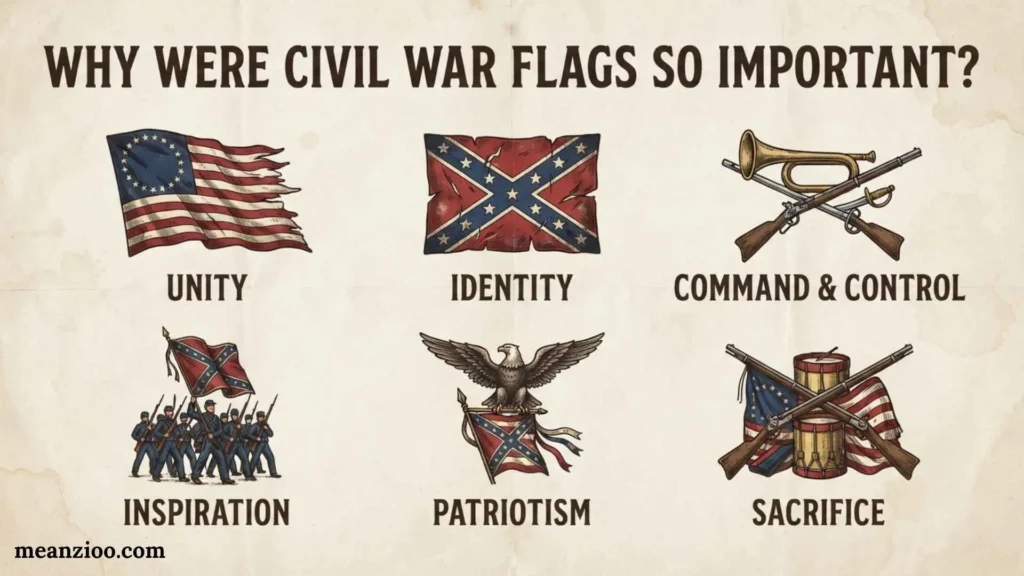
Civil War battlefields were chaotic places.
Smoke from firearms and artillery could make it difficult to see formations. Soldiers could become separated from their units. Officers needed visible reference points to understand where their men were located.
Flags helped solve part of this problem.
The National Park Service explains that flags were deliberately positioned where soldiers could see them, while the Smithsonian notes that designating flags were used to organize military formations.
A flag could therefore serve two purposes at once:
Practical purpose:
It helped soldiers identify their unit and maintain organization.
Emotional purpose:
It represented the unit, its soldiers, its state, or its national cause.
This combination made Civil War flags extraordinarily important.
United States Colored Troops Symbols
One of the most important parts of Civil War symbolism involves the United States Colored Troops (USCT).
Thousands of African American men served in Union forces during the Civil War. Their military service became closely connected with the broader struggle over slavery and freedom.
The National Park Service states that roughly 200,000 soldiers served in the United States Colored Troops, and their service contributed significantly to the Union war effort and the changing meaning of emancipation.
Flags associated with these units were therefore more than military identification.
For many Black soldiers, carrying the United States flag could represent participation in the fight for freedom and recognition.
The Flag as a Rallying Point
The role of the flag could be especially dangerous for color bearers.
At the Battle of New Market Heights in 1864, members of the 4th U.S. Colored Infantry carried their colors into battle. The National Park Service records that many members of the color guard were shot down around the flag before Sergeant Major Christian Fleetwood took up the colors and carried them forward.
This example shows why Civil War soldiers treated flags with such seriousness.
Military Corps and Unit Symbols
Civil War armies were divided into large formations and smaller units.
Symbols, badges, numbers, and flags helped soldiers identify those organizations. Different corps could use particular designs, colors, or identifying marks.
These symbols helped answer practical questions:
- Which unit is this?
- Where is the formation located?
- Which soldiers belong together?
- Where should a soldier regroup?
- Which headquarters or brigade is nearby?
The Smithsonian’s Civil War collections include headquarters flags and designating flags for specific military formations, demonstrating the wide range of symbols used for organization.
Stars as Civil War Symbols
Stars appeared repeatedly in Civil War flags.
On the Union flag, stars represented states of the United States. On Confederate flags, stars represented states claimed as members of the Confederacy.
This created an interesting symbolic contrast.
Both sides used stars to express ideas about political membership, but they represented competing governments and competing interpretations of the Union.
The Confederate First National Flag, for example, initially displayed eight stars when adopted in March 1861, with additional stars added as Confederate authorities claimed more states.
Crosses and Confederate Military Design
The diagonal cross associated with the Confederate battle flag became one of the most recognizable Civil War-era military designs.
The Smithsonian describes the design as a blue cross edged in white on a red field, with stars positioned along the cross. It originated in the Confederate military context during 1861.
However, not every cross-shaped design from the Civil War had the same meaning. Historical symbols should therefore be identified based on their complete design, date, organization, and documented use rather than one visual feature alone.
Civil War Tokens and Political Symbols
Symbols also appeared on objects that people used away from the battlefield.
Civil War-era tokens, political items, recruitment materials, printed images, and other objects could communicate political opinions and patriotic messages.
These objects provide historians with another way to study how ordinary people interacted with the conflict.
A flag might be seen on a battlefield, while a token or printed item could circulate among civilians. Both could express ideas about the war, but their audiences and purposes were different.
Political Symbols During the Civil War
The Civil War was not only a military conflict. It was also a struggle over political authority, slavery, secession, emancipation, and the future of the United States.
As a result, symbols could carry political messages.
Union symbols could communicate support for preserving the United States. Confederate symbols could communicate identification with the Confederate States and secession. Other symbols represented individual states, military units, or particular political causes.
The meaning of an object should therefore be considered alongside the historical circumstances in which it was created and displayed.
Civil War Symbols and Their Modern Meanings
One of the most important questions about Civil War symbols is why some continue to generate debate today.
The answer is partly connected to changing historical contexts.
A symbol used during the Civil War may have had one meaning in 1862 and another meaning decades later. Some symbols were reused by political and social movements after the war, adding new associations to their earlier history.
The Confederate battle flag is the clearest example.
During the Civil War, related designs were used as military flags. After the war, however, Confederate imagery continued to appear in different settings, including reunions, memorial culture, political movements, and later conflicts over race and civil rights.
Because of this history, modern interpretations of Confederate symbols can differ sharply.
Some people associate them with Southern ancestry or regional history, while others associate them with slavery, racial segregation, white supremacy, or resistance to civil rights. These later meanings should be distinguished from the documented military uses of the flag during 1861–1865.
Why Context Matters
A Civil War symbol cannot always be understood simply by looking at its design.
Consider these questions:
Who used it?
Was it used by the U.S. government, a Confederate government, a state, a military regiment, or civilians?
When was it used?
Was it created during the Civil War or decades afterward?
Where was it displayed?
A battlefield, government building, museum, cemetery, private home, and political rally can give the same image very different contexts.
What was its purpose?
Was it used for identification, military organization, political expression, commemoration, decoration, or something else?
Did its meaning change?
A symbol can acquire additional meanings over time without losing its earlier historical significance.
These questions are especially useful when examining Confederate imagery or other symbols whose meanings have changed over generations.
Major Civil War Symbols at a Glance
| Symbol | Historical connection | Primary context |
| Stars and Stripes | United States | Union and national identity |
| Fort Sumter Storm Flag | U.S. Army at Fort Sumter | Opening of the Civil War |
| Stars and Bars | Confederate States | Confederate national government |
| Stainless Banner | Confederate States | Confederate national government |
| Third Confederate National Flag | Confederate States | Late-war national flag |
| Confederate Battle Flag | Confederate military formations | Battlefield identification |
| Regimental Colors | Military regiments | Unit identity |
| USCT Flags | United States Colored Troops | Union military service |
| Palmetto | South Carolina | State and regional identity |
| Stars | Union and Confederate flags | State representation |
| Corps and unit insignia | Military organizations | Organization and identification |
How to Identify a Civil War Symbol
If you discover an old flag, badge, emblem, or image and want to know what it represents, start with its physical characteristics.
Look at:
Colors:
Red, blue, white, gold, and other colors may help identify a flag or organization.
Stars:
Count the stars and examine their arrangement.
Crosses:
Look at the shape, position, color, and surrounding design.
Letters and numbers:
Regimental numbers or initials can provide important clues.
State imagery:
Trees, animals, shields, or other state-related images may point toward a particular state.
Date:
The period when the object was made can eliminate many possibilities.
Provenance:
Information about where the object came from can be just as valuable as its design.
Historical museums and archives are useful sources for confirming an identification.
Why Civil War Symbols Still Matter
Civil War symbols remain important because they connect physical objects with major events in American history.
A flag can show which government a soldier supported. A regimental banner can identify the unit in which someone served. A state symbol can reveal regional identity. A political token can show how civilians expressed their views.
These objects also demonstrate that historical meanings are not always simple.
The United States flag, for example, carried meanings of national unity for many Union supporters while also becoming increasingly associated with freedom and citizenship among African Americans.
Confederate symbols similarly developed different meanings across the Civil War and later American history.
Studying those changes helps explain why Civil War symbols remain relevant more than 160 years after the conflict ended.
Frequently Asked Questions About Civil War Symbols
What is the most famous Civil War symbol?
The Stars and Stripes and the Confederate battle flag are among the best-known symbols associated with the American Civil War. However, many other national, state, regimental, and military flags were used during the conflict.
What did the Union flag symbolize during the Civil War?
The Union flag represented the United States and the cause of preserving the Union. During the war, it also became associated with freedom and citizenship for many African Americans, particularly as Black men entered Union military service.
What is the difference between the Stars and Bars and the Confederate battle flag?
The Stars and Bars was the first national flag of the Confederate States. The Confederate battle flag was a military design developed for battlefield identification. They were not the same flag.
Why did the Confederacy change its national flag?
The First National flag looked too similar to the United States flag during battle. The Second National flag created concerns because its white field could resemble a surrender flag. These practical problems contributed to subsequent changes.
Did the Confederate Army have one official battle flag?
No. Confederate armies and corps used different battle-flag designs. The National Park Service specifically notes that the Confederate Army never had one single official battle flag used by all formations.
What did regimental flags represent?
Regimental flags identified individual military units and could represent unit pride, state connections, branch of service, and military identity. They also helped soldiers locate their formations during battle.
What symbols were used by Black Union soldiers?
Black Union soldiers served in the United States Colored Troops and carried Union military colors. These flags represented their military units while also becoming connected with the struggle for freedom and citizenship.
What does the palmetto symbolize in Civil War history?
The palmetto was a longstanding South Carolina symbol connected to the American Revolution. During the Civil War era, it appeared on the Palmetto Guard flag, which became associated with South Carolina’s secession.
Why are Confederate symbols controversial today?
Their modern meanings developed through multiple historical periods. Confederate imagery has been associated with the Confederacy and its military during the Civil War, but later uses connected some Confederate symbols with different political, racial, and regional movements. As a result, people can interpret the same symbol very differently today.
Final Thoughts
Civil War symbols provide a visual record of one of the most important conflicts in American history. The Stars and Stripes represented the United States and the Union, while Confederate national flags represented the Confederate States. Regimental colors identified military units, state symbols expressed regional identity, and USCT flags became connected with the service of African American soldiers and the struggle surrounding emancipation.
The Confederate battle flag deserves particular historical distinction because it was a military symbol rather than simply another name for every Confederate flag. Likewise, symbols such as the South Carolina palmetto had histories that began before the Civil War and acquired additional meanings during the secession crisis.
The most reliable way to understand any Civil War symbol is to consider its design, date, creator, user, location, purpose, and historical context. Looking at all of these factors makes it easier to distinguish what a symbol meant during the Civil War from meanings it acquired in later generations.

I’m Ryan Mitchell, and I write about modern English, trending slang, and online expressions. I enjoy explaining the meanings, origins, and real-life usage of popular words in a simple way. I believe learning slang is an important step toward understanding today’s English-speaking culture. Through my work, I aim to help readers speak more naturally and stay updated with the latest language trends.
 Charlotte Hayes