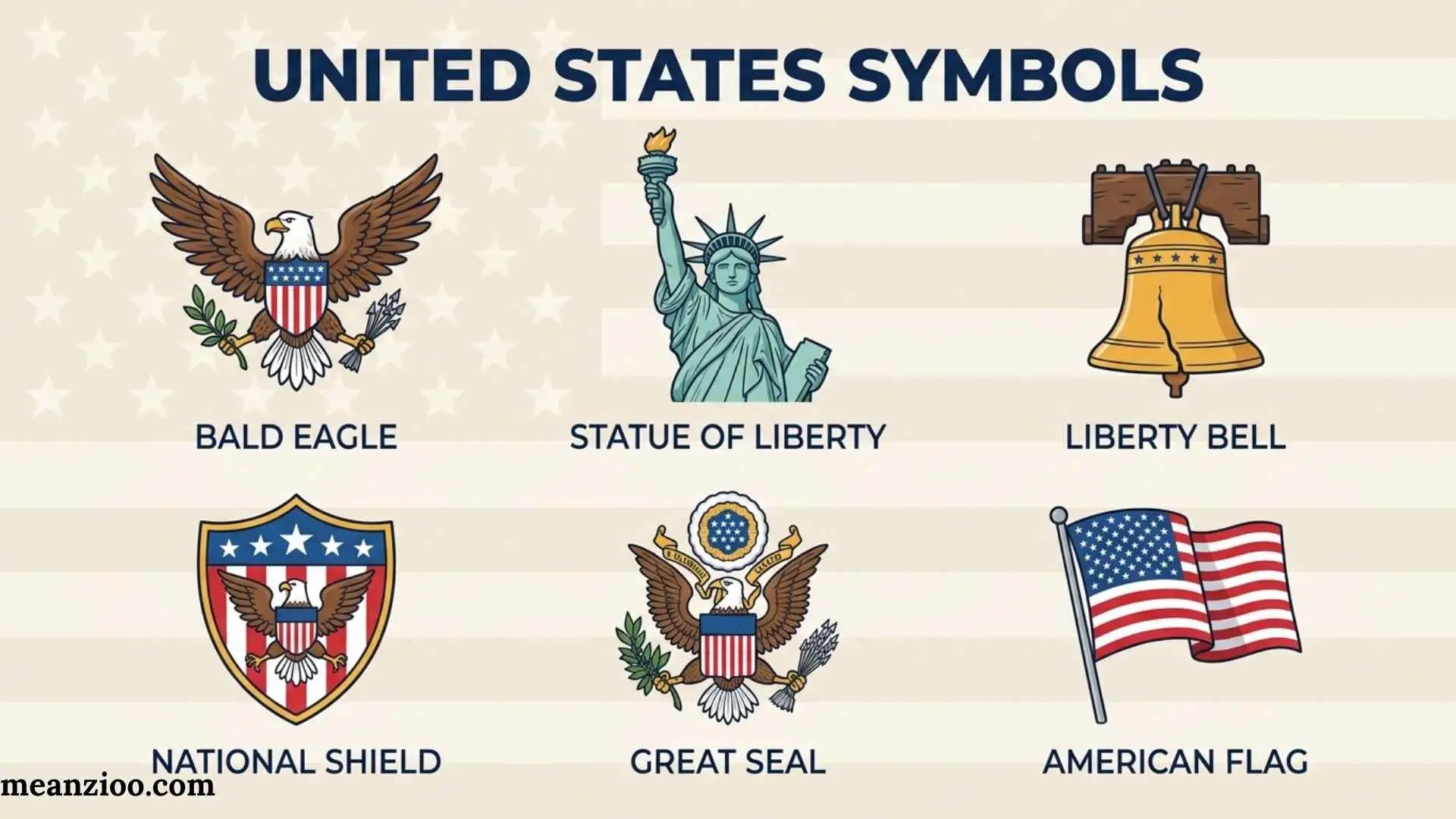
The United States is recognized around the world for its powerful national symbols, including the American flag, bald eagle, Statue of Liberty, and Great Seal. Each symbol tells a different part of America’s story, representing its history, independence, government, natural heritage, and cultural identity. Some symbols have official recognition under federal law, while others became famous through important historical events and public traditions.
United States symbols help people understand what America represents and how its national identity developed over time. From the 50 stars on the American flag to the Liberty Bell’s connection with freedom, these symbols appear in schools, government buildings, national celebrations, museums, and public monuments. They also help students learn about American history and the principles that shaped the country.
In this guide, you will discover the most important national symbols of the United States, their meanings, historical backgrounds, and official status. You will also learn about famous American landmarks, national animals and plants, patriotic songs, and historical documents, with a simple reference table to make the information easy to understand.
What Are the Symbols of the United States?
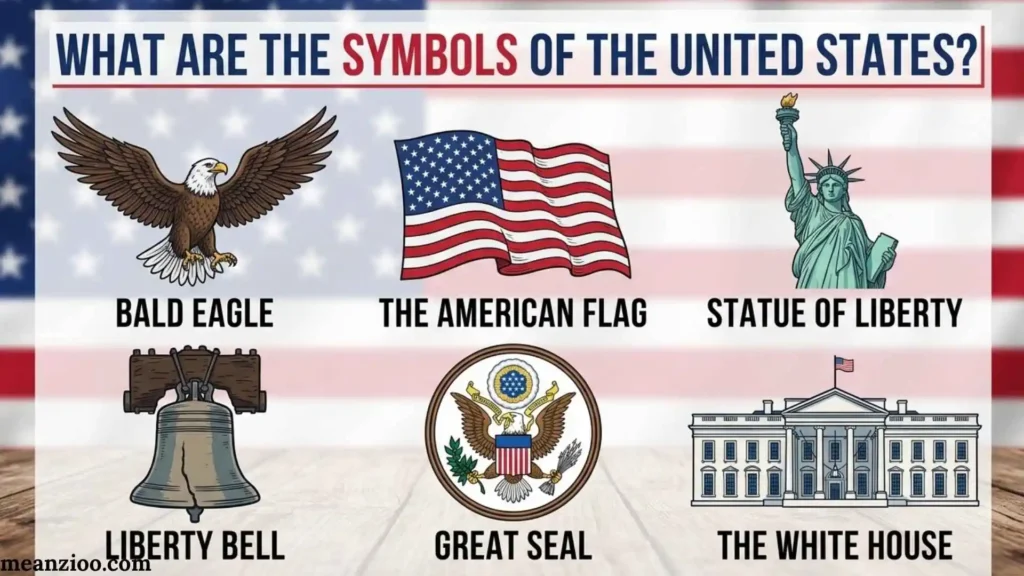
United States symbols are objects, animals, plants, songs, documents, monuments, and images that represent the country, its government, history, or cultural values. They help communicate ideas such as freedom, independence, courage, unity, and democracy.
Not every American symbol has the same legal status. Federal law officially recognizes several national symbols, including the bald eagle as the national bird, the North American bison as the national mammal, the rose as the national floral emblem, and the oak as the national tree. Other symbols, such as the Statue of Liberty and Liberty Bell, are famous historical icons rather than formally designated national emblems in the same way.
Understanding this distinction makes it easier to learn about America’s national identity without confusing official designations with popular traditions.
25 Important United States Symbols and Their Meanings
The following symbols represent different parts of American life, including national government, independence, history, wildlife, and culture.
1. The American Flag
The American flag, commonly called the Stars and Stripes or Old Glory, is one of the most recognizable symbols of the United States. Its design includes 13 horizontal stripes and 50 white stars on a blue field.
- 13 stripes: Represent the original 13 colonies.
- 50 stars: Represent the 50 states.
- Red: Traditionally represents valor and bravery.
- White: Represents purity and innocence.
- Blue: Represents vigilance, perseverance, and justice.
The current 50-star flag took effect on July 4, 1960, following Hawaii’s admission as the 50th state. The flag represents national identity, independence, and the country’s historical development.
2. The Bald Eagle
The bald eagle is the national bird of the United States and one of its oldest national emblems. Congress officially designated it as the national bird in December 2024, although it had already been used as a national emblem since 1782.
The bald eagle is associated with strength, independence, courage, and freedom. Its image appears on the Great Seal, government insignia, military emblems, and many official American designs.
The bird also has deep cultural and spiritual significance for many Indigenous peoples and Tribal communities, beyond its use as a national emblem.
3. The Statue of Liberty
The Statue of Liberty stands on Liberty Island in New York Harbor. France gave the monument to the United States, and it was dedicated in 1886.
The statue represents freedom, hope, and opportunity. Its raised torch is commonly associated with enlightenment, while the tablet in its left hand bears the date July 4, 1776, when the Declaration of Independence was adopted.
For generations, the Statue of Liberty has also represented immigration and the hopes of people seeking a new beginning in America. It is a historic monument and a widely recognized national icon.
4. The Great Seal of the United States
The Great Seal of the United States is an official emblem used to authenticate certain important government documents. Its design was adopted in 1782.
The front features a bald eagle holding an olive branch in one talon and arrows in the other. The olive branch is associated with peace, while the arrows represent the ability to defend the nation. A shield appears on the eagle’s chest, and a constellation of stars sits above its head.
The Great Seal represents the authority of the federal government, national unity, and the balance between peace and defense.
5. The Liberty Bell
The Liberty Bell is a historic bell in Philadelphia, Pennsylvania, closely associated with American independence and freedom.
Its famous inscription refers to proclaiming liberty throughout the land. Although popular stories about exactly when the bell rang during the Declaration of Independence are not fully supported by historical evidence, its importance as a symbol of liberty grew over time.
The Liberty Bell later became associated with abolitionism and civil rights movements. Today, it reminds visitors of America’s continuing struggle to make its founding ideals meaningful for everyone.
6. The White House
The White House is the official residence and workplace of the president of the United States. Located in Washington, D.C., it has served as the presidential residence since 1800.
It represents the presidency and the executive branch of the federal government. The building is also a familiar symbol of American political leadership because it appears frequently in news reports, official announcements, and presidential ceremonies.
Although it is one of America’s most famous landmarks, it is more accurately described as a symbol of the presidency than as a formally designated national emblem.
7. The United States Capitol
The U.S. Capitol is where the United States Congress meets to debate legislation and conduct other official business.
Its location in Washington, D.C., and its recognizable dome make it an important part of the country’s political landscape. The Capitol symbolizes representative government, lawmaking, and the legislative branch.
It also reflects the constitutional system in which elected representatives make laws for the nation.
8. The Washington Monument
The Washington Monument honors George Washington, the first president of the United States and a leading figure in the American Revolution.
Its tall obelisk design makes it one of the most recognizable landmarks in Washington, D.C. The monument represents leadership, national independence, and the country’s founding history.
It is a central feature of the National Mall and a popular destination for visitors learning about American history.
9. The Declaration of Independence
The Declaration of Independence was adopted on July 4, 1776, by representatives of the 13 American colonies. It announced that the colonies considered themselves independent of British rule.
The document is a central symbol of American independence and self-government. Its statements about equality and inherent rights have influenced political movements around the world.
The Declaration also provides an important starting point for understanding the ideals that shaped the United States, along with the later debates over how those ideals should be applied.
10. The Constitution of the United States
The U.S. Constitution was signed in 1787 and established the framework of the federal government. It defines the powers of the legislative, executive, and judicial branches and provides a system of checks and balances.
The Constitution represents constitutional government, the rule of law, and the structure of American political institutions. Its amendments, including the Bill of Rights, protect important liberties and establish limits on government power.
Unlike a monument or animal emblem, the Constitution is a foundational legal document whose influence extends into everyday American life.
11. The Star-Spangled Banner
The Star-Spangled Banner is the official national anthem of the United States. Its lyrics were written by Francis Scott Key in 1814 after he witnessed the American flag flying over Fort McHenry during the War of 1812.
The song became the national anthem in 1931. It represents national resilience and the defense of the country.
Today, it is performed at major sporting events, military ceremonies, public gatherings, and other important occasions.
12. The Pledge of Allegiance
The Pledge of Allegiance is a statement of loyalty to the American flag and the republic it represents.
It is often recited at schools, civic gatherings, and public ceremonies. For many Americans, it expresses national unity and a commitment to the country’s ideals.
Participation is voluntary. Students cannot be forced to recite the pledge, and its use in schools has been the subject of legal and public debate.
13. The American Bison
The North American bison is the national mammal of the United States. Its designation in 2016 recognized the animal’s historical, ecological, and cultural importance.
Bison once roamed vast areas of North America and played important roles in many Indigenous communities. Their populations declined dramatically during the 19th century, but conservation efforts helped protect and restore them.
The bison symbolizes endurance, natural heritage, and wildlife conservation. Its story also highlights the importance of protecting native species and respecting Indigenous histories.
14. The Oak Tree
The oak tree is the national tree of the United States. The federal designation was established in 2004.
Oaks are known for their strength, long life, and important ecological role. They provide food and shelter for wildlife and are found in many American forests and landscapes.
As a national symbol, the oak represents endurance, stability, and the country’s natural heritage. It is an official national tree, not merely a tree commonly associated with American culture.
15. The Rose
The rose is the national floral emblem of the United States. It received official recognition in 1986.
Roses are widely associated with love, beauty, devotion, and celebration. They appear in gardens, public spaces, art, and ceremonies throughout the country.
The rose’s national status reflects its long-standing place in American culture. It is important to distinguish the national floral emblem from the many state flowers adopted by individual states.
16. The National Motto: “In God We Trust”
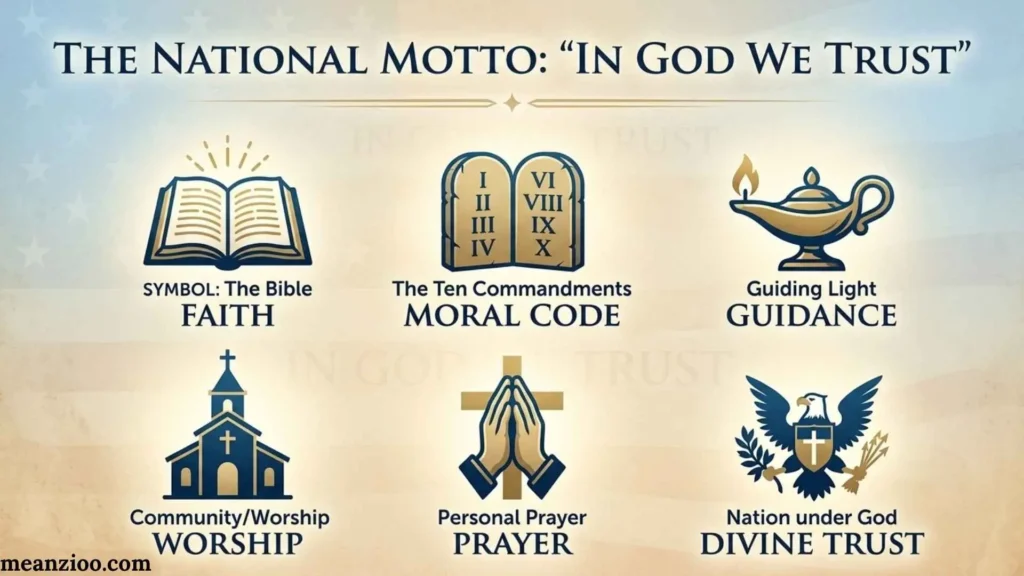
“In God We Trust” is the official national motto of the United States. Congress designated it as the national motto in 1956.
The phrase reflects the country’s historical religious traditions and appears on American currency. Its public use has also prompted debate about religion, government, and constitutional principles.
As a national motto, it is an official designation, unlike many patriotic phrases that are popular but have no formal national status.
17. “The Stars and Stripes Forever”
“The Stars and Stripes Forever,” composed by John Philip Sousa, is the official national march of the United States.
The energetic musical composition is closely associated with patriotic celebrations, parades, and military band performances. Its title refers to the American flag, connecting the music with national pride and tradition.
The national march is different from the national anthem: the Star-Spangled Banner is the official anthem, while The Stars and Stripes Forever holds the official national-march designation.
18. Uncle Sam
Uncle Sam is a personification of the United States government. He is commonly shown as an older man wearing a top hat, blue coat, and red-and-white-striped clothing.
The character became especially recognizable through recruitment posters and patriotic illustrations. Uncle Sam represents the federal government and is often used in political cartoons, public campaigns, and popular culture.
Unlike the bald eagle or national anthem, Uncle Sam is a cultural icon rather than a federally designated national symbol.
19. The Lincoln Memorial
The Lincoln Memorial honors Abraham Lincoln, the 16th president of the United States. Lincoln led the country during the Civil War and issued the Emancipation Proclamation.
The memorial is associated with the preservation of the Union, the abolition of slavery, and the continuing struggle for civil rights. In 1963, Martin Luther King Jr. delivered his “I Have a Dream” speech near the memorial during the March on Washington.
The monument represents both important achievements in American history and the unfinished work of building a more equal society.
20. The American Flag on the Moon
The American flag placed on the Moon during the Apollo 11 mission in 1969 became a famous symbol of scientific achievement and space exploration.
Astronauts Neil Armstrong and Buzz Aldrin were the first humans to walk on the lunar surface. The flag became an enduring image of the United States’ role in the Space Age.
However, planting a flag on the Moon did not establish territorial ownership. The achievement is remembered as a milestone in exploration and human technological progress.
21. The Liberty Torch
The torch held by the Statue of Liberty is a recognizable symbol of enlightenment and hope.
Its light is commonly interpreted as a guide toward freedom, knowledge, and opportunity. The torch is frequently used in artwork and patriotic designs even when the entire statue is not shown.
It is an important part of the Statue of Liberty’s symbolism rather than a separate official national emblem.
22. The National Mall
The National Mall is a historic public area in Washington, D.C., surrounded by monuments, memorials, and museums.
It includes the Washington Monument, Lincoln Memorial, and other important sites that preserve American history. The Mall also hosts public demonstrations, national celebrations, and major civic events.
As a cultural and historical landscape, it represents public participation, collective memory, and the nation’s continuing political life.
23. The Liberty Tree
Liberty Trees were gathering places associated with colonial resistance to British policies before the American Revolution. The most famous Liberty Tree stood in Boston.
Colonists used these locations for meetings and protests, making them symbols of political organizing and opposition to perceived injustice.
The Liberty Tree is a historical symbol rather than an official national tree. The oak, by contrast, is the tree formally designated as the national tree of the United States.
24. The American Eagle and Shield
The bald eagle and shield appear together in the Great Seal and many government-related designs.
The shield represents the states united under one federal government, while the eagle is associated with strength and independence. The olive branch and arrows in the eagle’s talons add ideas of peace and defense.
These combined elements communicate the country’s authority and its ability to pursue peace while protecting its interests.
25. The American Flag on Independence Day
Independence Day is celebrated on July 4 to commemorate the adoption of the Declaration of Independence in 1776.
The American flag is widely displayed during fireworks, parades, community events, and family gatherings. It connects the holiday with the country’s founding and its ongoing national identity.
Independence Day is a national observance rather than a symbol itself, but the flag is one of its most recognizable visual representations.
Official National Symbols of the United States
The federal government has formally recognized several national symbols. These designations are different from famous monuments, historical documents, and cultural icons.
| Official national symbol | What it represents |
| National flag | The United States and its 50 states |
| National bird: bald eagle | Freedom, independence, and strength |
| National mammal: North American bison | Wildlife heritage and endurance |
| National floral emblem: rose | Beauty, love, and devotion |
| National tree: oak | Strength and longevity |
| National anthem: The Star-Spangled Banner | National history and patriotism |
| National motto: In God We Trust | A phrase reflecting historical religious traditions |
| National march: The Stars and Stripes Forever | Patriotic musical tradition |
These designations are established in federal law. The bald eagle became the officially designated national bird in 2024, while the oak tree and American bison received their national designations in 2004 and 2016, respectively.
What about the national fish and insect? The United States does not have a single federally designated national fish or national insect comparable to its national bird, mammal, and tree. Individual states have their own official fish, birds, flowers, insects, and other symbols. These state-level designations should not be confused with national ones.
What Do the Colors of the American Flag Mean?
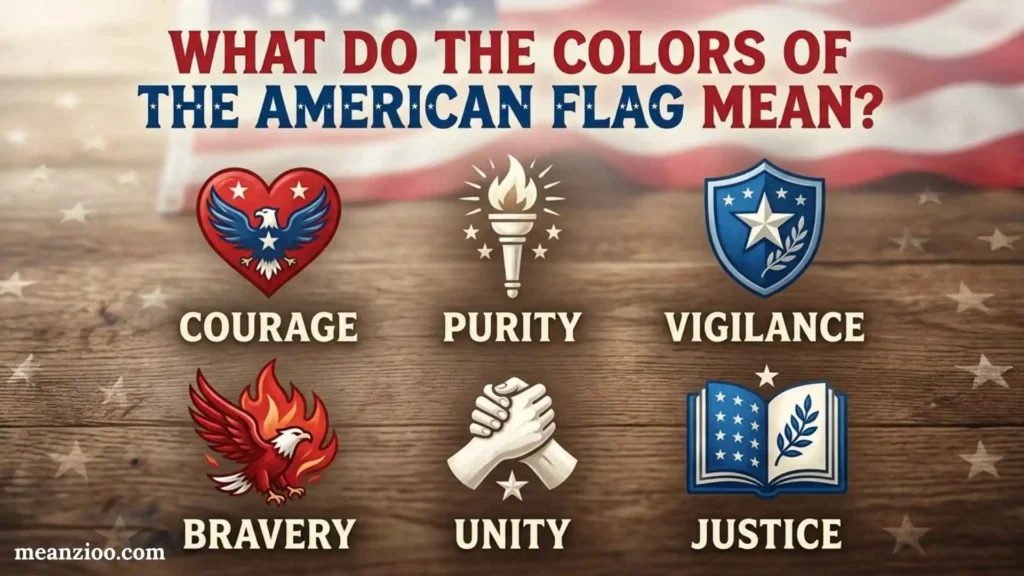
The American flag uses three colors: red, white, and blue. Each has a traditional symbolic meaning.
- Red: Valor and bravery.
- White: Purity and innocence.
- Blue: Vigilance, perseverance, and justice.
These meanings are commonly taught in American civics and history education. The flag’s stars and stripes have separate historical meanings: the 50 stars represent the states, and the 13 stripes represent the original colonies.
Why Are United States Symbols Important?
American symbols are important because they connect people with the country’s history, communicate national ideals, and preserve memories of major events.
They Preserve American History
The Declaration of Independence, Constitution, Liberty Bell, and Lincoln Memorial help people understand the country’s founding, the Civil War, and the struggle for freedom and equality.
They Represent National Identity
The American flag and national anthem appear at official ceremonies, sporting events, and public celebrations. They provide recognizable ways for people to express their connection to the nation.
They Explain the Government
The Great Seal, U.S. Capitol, White House, and Constitution help people understand the different branches of government and how the American political system operates.
They Celebrate Scientific Achievement
The Apollo 11 Moon landing flag represents the United States’ contribution to space exploration. It is a reminder of the scientific discoveries and technological achievements that shaped the modern world.
They Encourage Wildlife Conservation
The bald eagle and American bison represent important parts of North America’s natural heritage. Their histories also highlight the value of protecting wildlife and restoring threatened populations.
They Reflect Ongoing National Debates
American symbols do not have one universal meaning for every person. While some people associate the flag with unity and freedom, others use national symbols to draw attention to inequality or disagreements over how the country’s founding principles have been applied. Understanding these different perspectives provides a fuller picture of American history and culture.
United States Symbols for Students and Kids
The following quick-reference list makes it easier to learn the meanings of important American symbols.
| Symbol | Simple meaning |
| American flag | The United States |
| Bald eagle | Freedom and strength |
| Statue of Liberty | Liberty and hope |
| Liberty Bell | Freedom and equality |
| White House | The president |
| U.S. Capitol | Congress and lawmaking |
| Great Seal | Federal government authority |
| Declaration of Independence | Independence from Britain |
| Constitution | Framework of American government |
| Star-Spangled Banner | National anthem |
| American bison | National mammal and wildlife heritage |
| Oak tree | National tree |
| Rose | National floral emblem |
| Uncle Sam | American government and patriotism |
| Lincoln Memorial | Abraham Lincoln and civil rights history |
| Washington Monument | George Washington |
| Stars and Stripes Forever | National march |
| In God We Trust | National motto |
A simple way to remember these symbols is to group them into three categories: official national symbols, historical documents, and famous landmarks. This method is useful for school assignments, history lessons, quizzes, and general knowledge.
Frequently Asked Questions About United States Symbols
What is the most famous symbol of the United States?
The American flag is one of the most recognizable symbols of the United States. Its 50 stars represent the states, while its 13 stripes represent the original colonies.
What is the national bird of the United States?
The bald eagle is the national bird of the United States. Congress formally designated it as the national bird in December 2024.
What is the national animal of America?
The North American bison is the national mammal of the United States. The bald eagle is the national bird and a long-established national emblem.
What is the national flower of the United States?
The rose is the national floral emblem of the United States. It received official recognition in 1986.
What is the national tree of America?
The oak is the national tree of the United States. It was officially designated in 2004.
What are the 13 stripes on the American flag?
The 13 stripes represent the original 13 colonies that declared independence from Great Britain in 1776.
What do the 50 stars on the American flag represent?
The 50 stars represent the 50 states of the United States. The current 50-star design took effect on July 4, 1960.
What is the national motto of the United States?
The national motto is “In God We Trust.” Congress adopted it as the official national motto in 1956.
What is the difference between the national anthem and national march?
The Star-Spangled Banner is the national anthem of the United States. The Stars and Stripes Forever, composed by John Philip Sousa, is its national march.
Is the Statue of Liberty an official national symbol?
The Statue of Liberty is a famous national icon representing freedom and hope. It is a historic monument rather than one of the formally designated national symbols listed in federal law.
Does the United States have a national fish or national insect?
There is no single federally designated national fish or national insect comparable to the official national bird or mammal. Individual states have their own official animal and insect symbols.
Why is the bald eagle used as a symbol of America?
The bald eagle has been associated with American independence and strength since it appeared on the Great Seal in 1782. Its image remains widely used in government and patriotic designs.
Final Thoughts
United States symbols help explain the nation’s history, government, culture, and natural heritage. The American flag, bald eagle, national anthem, rose, oak tree, and American bison have distinct national designations, while landmarks such as the Statue of Liberty, Liberty Bell, and Lincoln Memorial hold important historical and cultural meaning.
Understanding the difference between official national symbols and famous American icons makes these symbols easier to learn and appreciate. Together, they tell a story of independence, national identity, scientific achievement, and the continuing effort to uphold the ideals associated with the United States.

Hi, I’m Charlotte Hayes. I love writing about the newest English slang, pop culture phrases, and digital communication. I spend my time exploring how language evolves across social media, gaming, and everyday conversations. I enjoy sharing easy-to-understand guides that help learners keep up with modern English. My goal is to make every article useful, accurate, and enjoyable for readers around the world.
Books:
- Everyday Slang Dictionary
- Fluent Through Informal English
 Ryan Mitchell