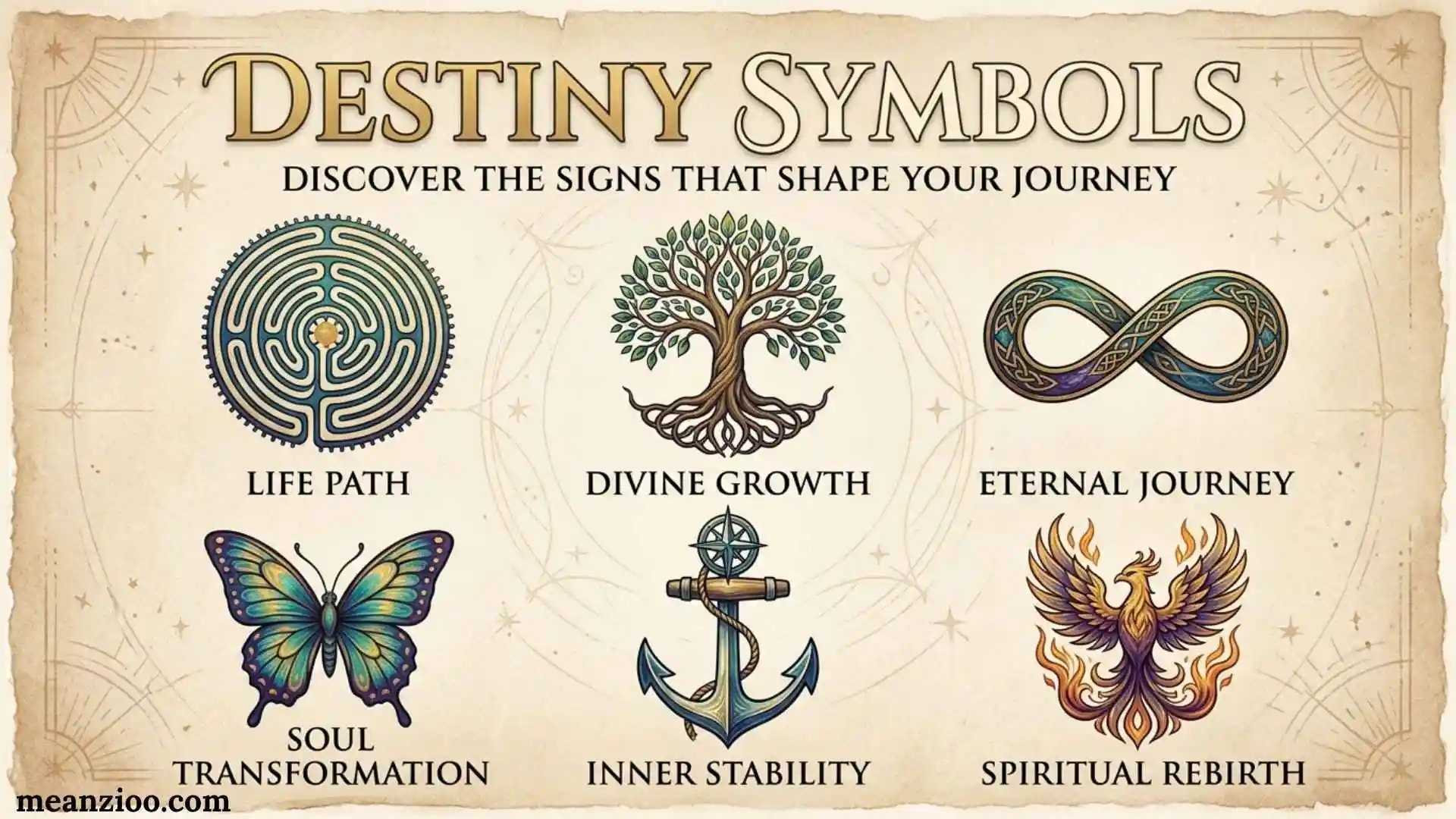
Destiny symbols represent the ideas of fate, life purpose, meaningful relationships, spiritual guidance, and the choices that shape our future. From the North Star and Wheel of Fortune to the red string of fate and the ancient thread of life, these symbols offer different ways to understand life’s journey.
Some destiny symbols come from historical mythology, religious traditions, and cultural beliefs. Others have developed through modern spirituality, art, and personal interpretation. Understanding the difference helps you choose a symbol that reflects your beliefs rather than relying on a meaning that may not be historically established.
Whether you are looking for destiny symbols for a tattoo, necklace, artwork, meditation, or personal inspiration, this guide explores their meanings, origins, cultural significance, and practical uses.
What Are Destiny Symbols?
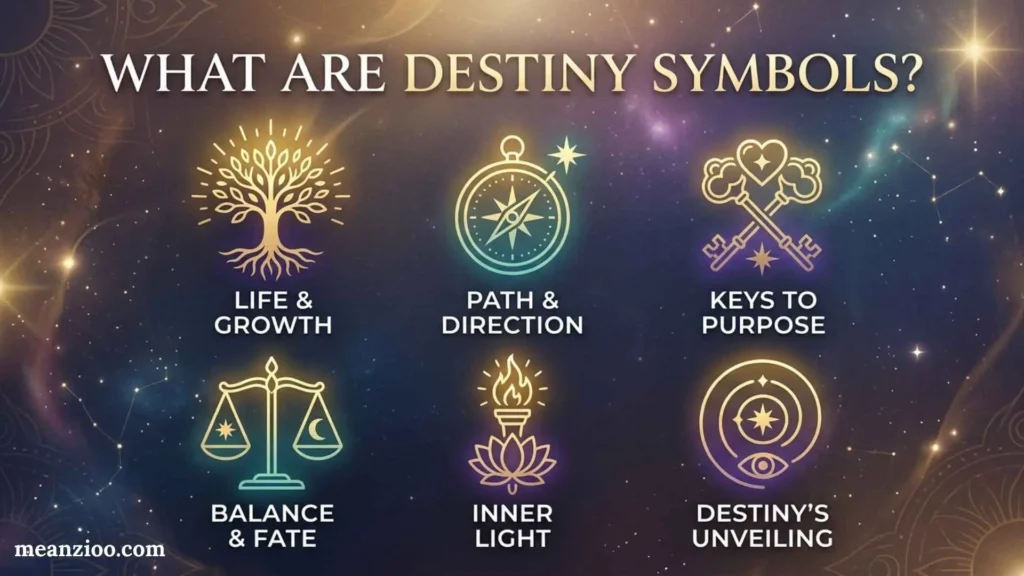
Destiny symbols are images, patterns, objects, or mythological figures associated with fate, life’s direction, personal purpose, and the relationship between choices and future events.
Different traditions approach destiny in different ways. Some describe life as being shaped by forces beyond human control, while others emphasize responsibility, ethical action, personal development, and the consequences of decisions.
Common themes associated with destiny symbols include:
- Fate: Events or outcomes believed to be determined or influenced by forces beyond individual control.
- Life purpose: A sense of direction, meaning, or responsibility.
- Guidance: Finding a path through uncertainty.
- Love and connection: Relationships believed to hold special significance.
- Transformation: Moving through change, endings, and new beginnings.
- Karma and consequences: Understanding how actions influence experiences.
- Free will: Recognizing the role personal decisions play in shaping life.
There is no single universal symbol of destiny. A symbol may have a specific traditional meaning in one culture and a broader personal meaning in another.
20 Destiny Symbols and Their Meanings
The following symbols represent different aspects of destiny, including fate, guidance, relationships, transformation, and the journey of life. Their meanings are explained with attention to historical context and modern interpretations.
1. North Star: A Symbol of Destiny and Guidance
The North Star, also called Polaris, is associated with direction, navigation, and staying on course. Because it appears nearly stationary in the northern sky, it has historically helped navigators identify north.
As a modern destiny symbol, the North Star represents having a guiding purpose even when the future is uncertain.
Common meanings:
- Finding your life direction
- Staying committed to personal values
- Following a meaningful goal
- Maintaining hope during difficult times
Best for: People who want a symbol of life purpose, direction, and determination.
A North Star tattoo or pendant can serve as a reminder that you do not need to know every detail of your future to take the next step.
2. Wheel of Fortune: The Symbol of Fate and Life’s Cycles
The Wheel of Fortune is closely associated with changing circumstances, luck, opportunity, and the unpredictable nature of life. In tarot, it is one of the Major Arcana cards and commonly represents turning points and cycles.
Its meaning depends on the particular tarot tradition, reading, and surrounding cards.
Common meanings:
- Changes in circumstances
- Unexpected opportunities
- Cycles of success and difficulty
- Turning points and uncertainty
Best for: People interested in fate, life transitions, and the idea that circumstances can change unexpectedly.
The Wheel of Fortune does not prove that every event is predetermined. Instead, it offers a symbolic way to reflect on uncertainty and the changing conditions of life.
3. Red String of Fate: A Symbol of Destined Relationships
The red string of fate is associated with East Asian folk beliefs, particularly Chinese traditions and Japanese adaptations. In popular versions, an invisible red thread connects people who are destined to meet or become important in one another’s lives.
Different versions describe the thread and its significance in different ways.
Common meanings:
- Meaningful romantic relationships
- Connections between people
- Encounters that change a person’s life
- Love that transcends distance or obstacles
Best for: Couples, people celebrating an important relationship, and those interested in romantic destiny.
The red string is often depicted around the fingers or wrists in modern artwork and jewelry. It represents a cultural belief about connection, not scientific evidence that two people are destined to be together.
4. Thread of Life: A Symbol of Human Destiny
The thread of life is a powerful mythological image associated with the Greek Fates, known as the Moirai. In Greek mythology, Clotho spins the thread of life, Lachesis measures it, and Atropos cuts it.
This imagery connects human life with birth, the passage of time, and mortality.
Common meanings:
- The course of a person’s life
- Fate and mortality
- The passage of time
- The limits of human control
Best for: People interested in classical mythology and the philosophical meaning of fate.
The thread of life is especially relevant when exploring destiny because it directly expresses the idea of a life following a particular course.
5. Tree of Life: A Symbol of Growth and Connection
The tree of life appears in multiple cultural, religious, and philosophical traditions. Its meaning varies according to context, but common themes include life, ancestry, renewal, and the interconnectedness of living things.
Its roots, trunk, and branches also provide a natural metaphor for the relationship between personal history, present experiences, and future growth.
Common meanings:
- Personal development
- Family and ancestry
- Interconnectedness
- Strength and renewal
Best for: People who view destiny as a journey shaped by relationships, experiences, and growth.
The tree of life is popular in jewelry and artwork because it can express both personal identity and connection to something larger.
6. Infinity Symbol: Endless Possibilities and Continuity
The infinity symbol (∞) is a mathematical symbol representing an unbounded quantity. In modern jewelry, tattoos, and personal artwork, it is also used to express continuity, enduring love, and endless possibilities.
When associated with destiny, it may represent a lifelong journey or a connection that remains meaningful over time.
Common meanings:
- Continuity and endlessness
- Lasting relationships
- Ongoing personal growth
- Possibilities without a fixed endpoint
Best for: People who want a simple symbol of enduring connection or an ongoing journey.
Its spiritual or romantic meanings are modern interpretations rather than one universal historical definition.
7. Ouroboros: The Cycle of Endings and Beginnings
The Ouroboros depicts a serpent or dragon consuming its own tail. It appears in ancient Egyptian and Greek-influenced traditions and later alchemical imagery, with meanings that vary across historical contexts.
It is commonly associated with cycles, renewal, continuity, and the relationship between beginnings and endings.
Common meanings:
- Repeating cycles
- Renewal and transformation
- Wholeness and continuity
- The connection between endings and beginnings
Best for: People reflecting on recurring life patterns, personal change, or renewal.
The Ouroboros can remind you that an ending may also create the conditions for a new beginning.
8. Compass: A Symbol of Choosing Your Own Path
A compass is a navigation instrument that identifies direction. As a personal symbol, it represents orientation, exploration, and the principles that guide decision-making.
Unlike symbols that emphasize predetermined fate, the compass can represent actively choosing how to move forward.
Common meanings:
- Direction and purpose
- Making thoughtful decisions
- Staying true to personal values
- Exploring new possibilities
Best for: Travelers, people starting a new chapter, and anyone trying to find direction in life.
A compass is a particularly useful symbol for expressing the balance between destiny and personal choice.
9. Star: A Symbol of Hope and Future Possibilities
Stars have inspired stories, navigation, religious imagery, and artistic symbolism across many cultures. Their specific meanings depend on the tradition and the type of star represented.
In modern personal symbolism, a star often represents hope, aspiration, and the pursuit of meaningful goals.
Common meanings:
- Hope and inspiration
- Future possibilities
- Ambition and achievement
- Guidance and aspiration
Best for: People who want a simple reminder of their dreams and future goals.
A star can represent the future you hope to create without suggesting that the future is already fixed.
10. Moon: A Symbol of Change and Life’s Phases
The moon has influenced calendars, religious traditions, mythology, and artistic imagery. Its changing appearance makes it a natural symbol of cycles and transformation.
In contemporary symbolism, different lunar phases may represent different stages of life, although these meanings are not universal.
Common meanings:
- Cycles and change
- Reflection and renewal
- New beginnings
- The passage of time
Best for: People navigating transitions or embracing the idea that life develops through different phases.
A crescent moon is often used in modern designs to suggest beginnings, while a full moon may symbolize completion or wholeness.
11. Phoenix: A Symbol of Rebirth and Renewal
The phoenix is a mythical bird associated with renewal and rebirth. Ancient accounts differ, but later traditions and popular imagery often portray the bird emerging anew after its death or destruction by fire.
Common meanings:
- Starting again after hardship
- Resilience and renewal
- Personal transformation
- Overcoming difficult experiences
Best for: People rebuilding their lives after a major challenge or embracing a fresh start.
The phoenix represents the possibility of renewal rather than a guarantee that every hardship will lead to success.
12. Butterfly: A Symbol of Personal Transformation
The butterfly is widely associated with transformation because of its life cycle, which includes metamorphosis from caterpillar to adult.
Its symbolism varies across cultures, but it is commonly used in modern artwork to express growth, freedom, and change.
Common meanings:
- Personal transformation
- Freedom and independence
- New beginnings
- Growth through experience
Best for: People entering a new stage of life or celebrating personal development.
A butterfly is an accessible choice for a tattoo or necklace because its meaning is easy to personalize.
13. Labyrinth: A Symbol of the Journey Toward Purpose
A labyrinth is a winding path leading toward a center. Traditional labyrinths generally follow a continuous route, unlike conventional mazes that offer multiple dead ends.
Labyrinths have appeared in mythology, architecture, and religious or contemplative settings.
Common meanings:
- Self-discovery
- Patience and perseverance
- Reflection and contemplation
- Finding meaning through experience
Best for: People who believe life’s direction becomes clearer through experience rather than immediate answers.
A labyrinth can represent a journey that is not always direct but still has meaning.
14. Yin and Yang: A Symbol of Balance and Change
The yin-yang symbol comes from Chinese philosophy and expresses the relationship between complementary forces. It is not simply a representation of good fighting evil; its philosophical meaning concerns interdependence, balance, and change.
Common meanings:
- Complementary forces
- Balance and harmony
- Interdependence
- The changing nature of life
Best for: People who see life’s direction as a process of balancing contrasting needs and experiences.
Its connection to destiny is usually interpretive rather than a claim that the symbol predicts an individual’s future.
15. Celtic Knot: A Symbol of Interconnectedness
Celtic knotwork is associated with historical Celtic art, particularly intricate interlaced designs found in manuscripts, metalwork, and stonework.
Modern interpretations frequently associate these patterns with eternity, loyalty, and the connections between people. However, individual meanings cannot always be verified as original historical beliefs.
Common meanings:
- Interconnectedness
- Continuity
- Relationships and loyalty
- Cultural heritage
Best for: People interested in Celtic art, family connections, or the idea that life’s experiences are intertwined.
Research the particular design if cultural or historical authenticity matters to you.
16. Mandala: A Symbol of Wholeness and Reflection
A mandala is a geometric design used in various artistic, contemplative, and religious traditions. Mandalas have particular significance in Hindu and Buddhist contexts, where their forms may have specific ritual or spiritual meanings.
In personal symbolism, a mandala may represent wholeness, balance, and reflection.
Common meanings:
- Wholeness and unity
- Reflection and contemplation
- Balance and harmony
- Spiritual practice
Best for: People interested in meditation, artistic expression, and self-reflection.
Because mandalas can have specific religious significance, it is important to understand the design’s context rather than assuming every mandala has the same meaning.
17. The Dharma Wheel: A Symbol of Spiritual Direction
The Dharma Wheel, or Dharmachakra, is an important Buddhist symbol associated with the Buddha’s teachings and the path toward liberation.
Its traditional meaning is more specific than a general symbol of luck or predetermined fate.
Common meanings within Buddhist contexts:
- The Buddha’s teachings
- Ethical and spiritual practice
- Wisdom and understanding
- The path toward liberation
Best for: People studying Buddhist philosophy or seeking to understand the symbolism of spiritual practice.
The Dharma Wheel should be understood in its Buddhist context rather than treated as a generic decorative destiny symbol.
18. The Norns: Symbols of Destiny in Norse Mythology
The Norns are figures in Norse mythology associated with fate and the course of life. They are often connected with Yggdrasil, the world tree.
Modern depictions frequently portray the Norns as figures who shape or determine the destinies of gods and humans, although details vary across surviving sources and later interpretations.
Common associations:
- Fate and the course of life
- Time and consequence
- The relationship between past and future
- The limits of individual control
Best for: People interested in Norse mythology and traditional stories about fate.
The Norns are mythological figures rather than a single universally standardized emblem. Their imagery can be used to explore the idea that individual lives unfold within a larger world of events and consequences.
19. Karma: A Symbolic Reminder of Actions and Consequences
Karma is a concept found in Hindu, Buddhist, Jain, and other Indian philosophical and religious traditions, with important differences in how each tradition explains it.
Karma is not simply a symbol or a universal promise that good actions always produce immediate rewards. It concerns action and consequences within broader ethical, philosophical, and spiritual frameworks.
There is no single universal icon that represents karma across all these traditions.
Common associations:
- Responsibility for one’s actions
- Ethical conduct
- Consequences and intention
- The relationship between actions and experience
Best for: People who want a reminder to act thoughtfully and take responsibility for their choices.
A balanced design, a cycle motif, or a personally meaningful image may serve as a modern reminder of karma, but it should not be presented as an official universal karma symbol.
20. Synchronicity: A Symbolic Idea of Meaningful Coincidence
Synchronicity is a term associated with psychologist Carl Jung. It describes coincidences that a person experiences as meaningfully connected despite lacking an obvious causal relationship.
Synchronicity is a concept, not a single established ancient symbol. In modern spiritual settings, people may use repeating numbers, stars, clocks, or other personal signs to represent meaningful coincidences.
Common associations:
- Reflection on unexpected events
- Personal meaning
- Awareness of patterns
- Openness to new possibilities
Best for: People who find personal significance in coincidences or use them as prompts for reflection.
A coincidence can feel meaningful without proving that the universe has predetermined an event or sent a message.
Destiny Symbols Across Different Cultures
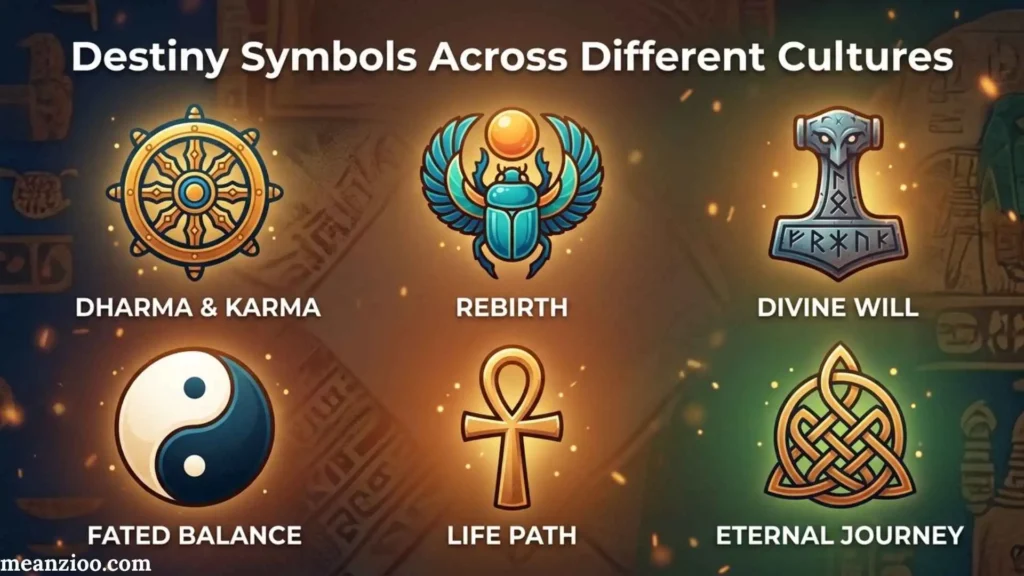
Destiny has been represented through different images and stories across the world. Understanding these differences helps prevent confusion between symbols that look similar but have different cultural origins.
Greek Mythology: The Three Fates
The Greek Moirai represent the forces that determine aspects of human life and destiny. Their thread imagery expresses the beginning, duration, and ending of life.
Norse Mythology: The Norns
The Norns are associated with fate in Norse mythology and are connected to Yggdrasil, the world tree. Traditional accounts vary, and they are not always described as three women spinning threads.
East Asian Folklore: The Red String of Fate
The red string of fate focuses on connections between people rather than the length of a person’s life. Its meaning differs from the thread of life in Greek mythology, even though both use thread imagery.
Indian Philosophical Traditions: Karma and Dharma
Karma concerns action and consequences, while dharma can refer to duty, ethical conduct, or appropriate responsibilities. Neither concept should be reduced to the idea that every event is predetermined.
Buddhist Traditions: The Dharma Wheel
The Dharma Wheel represents the Buddha’s teachings and the path toward liberation. It is a religious symbol with a particular Buddhist context, not simply a generic sign of luck or destiny.
Destiny Symbols Compared: Which Meaning Fits You?
| Symbol | Main association | Best use |
| North Star | Guidance and purpose | Life direction |
| Wheel of Fortune | Fate and changing circumstances | Life transitions |
| Red string of fate | Meaningful relationships | Romantic connection |
| Thread of life | Human destiny and mortality | Mythology and reflection |
| Tree of life | Growth and interconnectedness | Family and personal growth |
| Infinity | Continuity | Lasting connections |
| Ouroboros | Cycles and renewal | Transformation |
| Compass | Direction and decisions | Personal goals |
| Phoenix | Rebirth | New beginnings |
| Butterfly | Transformation | Personal change |
| Labyrinth | Self-discovery | Reflection |
| Yin and yang | Balance and interdependence | Harmony |
| Celtic knot | Interconnection | Heritage and relationships |
| Mandala | Wholeness and contemplation | Meditation and artwork |
| Dharma Wheel | Buddhist teachings | Spiritual learning |
| Norns | Fate in Norse mythology | Mythological interest |
| Karma | Action and consequences | Ethical reflection |
| Synchronicity | Meaningful coincidence | Personal interpretation |
These associations are useful starting points, not universal definitions. A symbol’s meaning depends on its origin and how it is used.
How to Choose the Right Destiny Symbol
The best destiny symbol is one that expresses the idea you want to remember or communicate.
For Love and Relationships
Consider the red string of fate if you want to represent a meaningful connection. The infinity symbol can represent lasting affection, while a pair of stars can express shared hopes.
For Life Purpose and Direction
The North Star and compass are strong choices when you want to emphasize direction, determination, and the importance of personal values.
For Fate and Predetermined Events
The thread of life and the Greek Fates are particularly relevant to mythology about predetermined destiny. The Wheel of Fortune is more suitable when you want to express changing circumstances and uncertainty.
For New Beginnings
The phoenix represents renewal after hardship, while the butterfly symbolizes transformation. Both work well for marking a new chapter without suggesting that change is always easy.
For Spiritual Reflection
The tree of life, mandala, or labyrinth may suit someone interested in interconnectedness, contemplation, or self-discovery. Research the specific religious or cultural meaning before selecting a design.
Destiny Symbols for Tattoos, Jewelry, and Artwork
Destiny symbols can be incorporated into personal objects as expressions of values, memories, and intentions.
Destiny Tattoos
A compass tattoo may represent choosing your direction. A phoenix can commemorate resilience, while a North Star can serve as a reminder to stay focused on a goal.
Before getting a tattoo, consider its cultural background, visual clarity, and long-term personal meaning. Do not rely solely on popular social media descriptions to determine a symbol’s historical significance.
Destiny Necklaces and Pendants
Simple symbols often work well in jewelry. Popular choices include the infinity symbol, North Star, tree of life, crescent moon, and compass.
Choose a design for its personal significance rather than assuming that wearing it will change your fate or guarantee good luck.
Destiny Symbols for Couples
The red string of fate is a popular choice for couples who want to express the belief that their connection is meaningful. Matching stars or complementary designs can represent shared goals and commitment.
A symbol can celebrate a relationship without implying that either person must remain in a relationship that is unhealthy or no longer right for them.
Destiny, Fate, Luck, and Free Will: What Is the Difference?
These concepts are related, but they are not identical.
- Destiny: A course or outcome believed to have a larger significance or to be predetermined.
- Fate: Events understood as fixed or beyond personal control, although interpretations differ.
- Luck: Outcomes influenced by chance, whether favorable or unfavorable.
- Free will: The capacity to make choices and act according to one’s intentions.
- Karma: In various Indian religious and philosophical traditions, the relationship between actions and consequences.
Some worldviews emphasize predetermined events, while others focus on choices, ethical action, or the interaction between circumstances and personal agency.
Destiny symbols can represent any of these perspectives. A thread may suggest a predetermined course, while a compass may emphasize personal decisions. The Wheel of Fortune can express the unpredictability of circumstances.
Are Destiny Symbols Real?
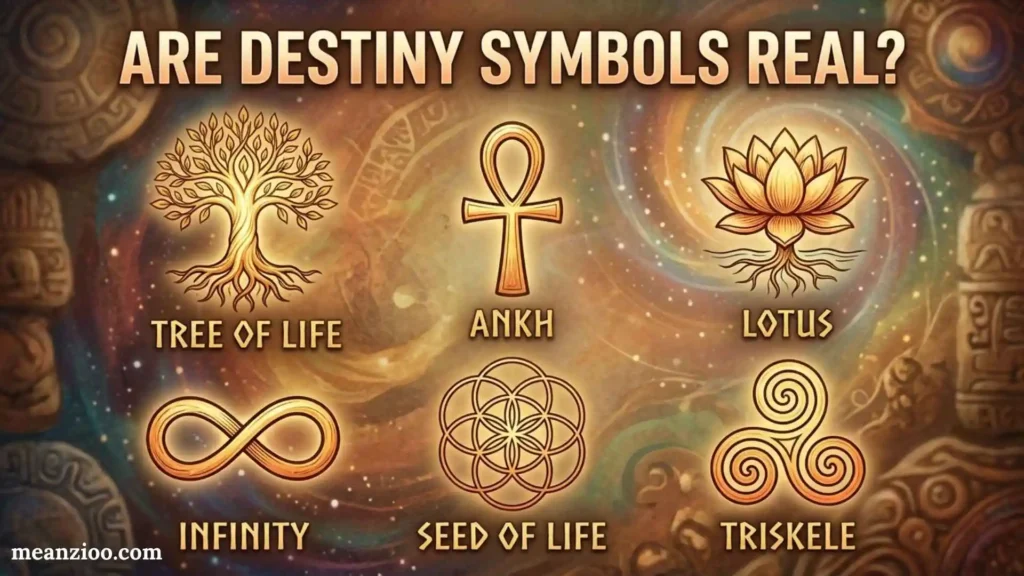
Destiny symbols are real as historical images, cultural traditions, mythological concepts, and personal forms of expression. However, there is no reliable scientific evidence that a specific symbol controls fate, guarantees a relationship, or predicts the future.
A North Star can genuinely help with navigation, but wearing a North Star pendant does not guarantee that someone will discover their purpose. Similarly, the red string of fate expresses a cultural belief about meaningful relationships rather than a scientifically verified connection between two people.
Symbols can still be valuable. They can encourage reflection, help people express their beliefs, and remind them of their goals. Their personal significance does not depend on proving that they have supernatural powers.
Frequently Asked Questions About Destiny Symbols
What is the main symbol of destiny?
There is no universally accepted main symbol of destiny. The Wheel of Fortune represents fate and changing circumstances, the thread of life connects destiny with Greek mythology, and the North Star represents guidance and purpose.
What symbol represents fate?
The Wheel of Fortune and thread of life are common symbols of fate. The Three Fates of Greek mythology and the Norns of Norse mythology are also associated with the forces believed to shape human destiny.
What symbol means everything happens for a reason?
No single symbol universally means that everything happens for a reason. The Wheel of Fortune may represent changing circumstances, while the tree of life can symbolize interconnectedness. These interpretations reflect beliefs and personal perspectives rather than established universal laws.
What symbol represents a destined relationship?
The red string of fate is a widely recognized symbol of meaningful or destined relationships in East Asian folk traditions and modern romantic imagery.
What symbol represents life purpose?
The North Star and compass are popular symbols of life purpose because they suggest guidance and direction. The tree of life may represent personal development and the connections that shape a person’s journey.
What symbol represents karma?
There is no single universal symbol of karma across Hindu, Buddhist, Jain, and other traditions. A cycle motif or another personally meaningful design may serve as a modern reminder of actions and consequences, but it should not be confused with a universally recognized religious emblem.
What symbol means a new beginning?
The phoenix is commonly associated with rebirth and renewal, while the butterfly represents transformation. Both can express the idea of moving into a new stage of life.
What symbol represents destiny in Norse mythology?
The Norns are among the most important figures associated with destiny in Norse mythology. They are connected to fate and Yggdrasil, the world tree. Some modern artwork also uses interwoven threads or knotwork to represent fate, although these designs do not all have the same historical status.
Is destiny the same as fate?
Destiny and fate are often used interchangeably. Some people use fate to describe events beyond personal control and destiny to describe a meaningful direction or outcome. These distinctions depend on context and personal interpretation.
Can destiny symbols bring good luck?
Some people use particular symbols as reminders of hope, confidence, or positive intentions. However, there is no reliable evidence that a destiny symbol independently causes good luck or guarantees a favorable outcome.
Which destiny symbol is best for a tattoo?
The best choice depends on your intended meaning. Choose a North Star for guidance, a compass for direction, a phoenix for renewal, a butterfly for transformation, or the red string of fate for a meaningful relationship.
Final Thoughts
Destiny symbols offer different ways to explore fate, life purpose, love, personal choices, and transformation. The Wheel of Fortune represents changing circumstances, the thread of life expresses mythological ideas about human destiny, the red string of fate symbolizes meaningful connections, and the compass represents direction.
Their meanings are not universal, and historical traditions should be distinguished from modern spiritual interpretations. Whether you choose a symbol for a tattoo, necklace, artwork, or personal reflection, the most meaningful option is one that reflects your values and understanding of life’s journey.

I’m Ryan Mitchell, and I write about modern English, trending slang, and online expressions. I enjoy explaining the meanings, origins, and real-life usage of popular words in a simple way. I believe learning slang is an important step toward understanding today’s English-speaking culture. Through my work, I aim to help readers speak more naturally and stay updated with the latest language trends.
 Charlotte Hayes