Mary Shelley’s Frankenstein; or, The Modern Prometheus explores the dangers of unchecked ambition, the need for companionship, and the responsibilities that come with creating life. First published anonymously in 1818, the novel combines Gothic horror, Romantic ideas about nature, and early science fiction to ask difficult questions about knowledge, morality, and human nature.
The symbols in Frankenstein help readers understand these ideas beyond the events of the plot. Fire represents both survival and destruction. Light suggests the promise of knowledge, while darkness creates an atmosphere of fear and uncertainty. The Creature’s comparisons with Adam and Satan reveal his struggle to understand his identity and the rejection he experiences.
Shelley also uses mountains, glaciers, storms, and the Arctic wilderness to explore human ambition and the limits of individual power. These settings aren’t merely backgrounds. They help readers understand the characters’ emotions and the consequences of their choices.
This guide examines the major symbols, explains their meanings through important moments in the novel, and explores how Frankenstein symbolism, biblical references, mythology, and literary devices work together.
What Does Symbolism Mean in Frankenstein?
Symbolism is a literary technique in which an object, character, setting, event, or natural element represents an idea beyond its literal meaning. Writers use symbols to communicate complex themes without explaining every meaning directly.
In Mary Shelley’s Frankenstein, a fire can provide warmth and cause injury. Light can represent discovery while also suggesting the danger of pursuing knowledge without considering its consequences. A vast mountain landscape can offer comfort while reminding a character how small and powerless a human being may feel.
Shelley often gives symbols more than one meaning. Their significance depends on the scene, the character’s experiences, and the ideas developed throughout the story.
Symbolism, Imagery, Motifs, and Allusions
These literary terms overlap, but they serve different purposes in literary analysis.
| Literary device | Meaning | Example in Frankenstein |
| Symbolism | An object or event represents a deeper idea. | Fire connects knowledge with survival and danger. |
| Imagery | Descriptive language appeals to the senses. | Descriptions of storms, glaciers, darkness, and mountains. |
| Motif | A recurring image, idea, or pattern reinforces a theme. | Isolation and the desire for companionship recur throughout the novel. |
| Allusion | A reference to another work, figure, or tradition. | The Creature’s references to Adam and Satan in Paradise Lost. |
| Foreshadowing | An early detail hints at a later event. | Warnings about ambition prepare readers for its consequences. |
| Setting | The time and place in which events occur. | The Arctic wilderness intensifies the themes of ambition and isolation. |
Understanding these distinctions makes it easier to explain how literary devices in Frankenstein support the novel’s central ideas.
For example, fire is a physical object that becomes a symbol through the Creature’s experiences. When Shelley describes its heat and brightness, she uses imagery. When fire connects to the novel’s larger concerns about knowledge and power, it becomes part of the book’s broader symbolism.
Major Symbols in Frankenstein and Their Meanings
The most important Frankenstein symbols often connect to more than one theme. Their meanings change as the characters gain knowledge, experience suffering, and face the consequences of their decisions.
| Symbol | Main meaning | Related themes |
| Fire | Knowledge, survival, and destruction | Scientific progress, danger |
| Light | Discovery and enlightenment | Ambition, understanding |
| Lightning | Nature’s power and scientific inspiration | Discovery, human limitations |
| Darkness | Fear, secrecy, and uncertainty | Gothic atmosphere, guilt |
| Nature | Beauty, healing, and overwhelming power | Romanticism, emotional suffering |
| Arctic landscape | Isolation and ambition | Loneliness, exploration |
| Adam | Creation and abandonment | Identity, responsibility |
| Satan | Rebellion and alienation | Rejection, revenge |
| Eve | Companionship and belonging | Love, exclusion |
| Prometheus | Forbidden knowledge and overreaching ambition | Creation, moral responsibility |
| Laboratory | Scientific power and neglect | Ethics, creation |
| Letters | Communication and different perspectives | Isolation, narrative structure |
These interpretations provide a starting point for deeper analysis. The following sections explain how each symbol works within the novel.
Fire: Knowledge, Survival, and Destruction
Fire is one of the clearest and most meaningful symbols in Frankenstein. Through the Creature’s discovery of fire, Shelley explores how knowledge can improve life while introducing new dangers.
When the Creature encounters a fire left by other people, he initially enjoys its warmth. Curious about the flames, he puts his hand into the burning embers and experiences pain. This discovery teaches him that the same source can provide comfort and cause injury.
His experience offers a simple lesson: knowledge doesn’t automatically make life better. Its effects depend on how people understand and use it.
Fire develops several connected meanings throughout the novel:
- Survival: It provides warmth in a cold and unfamiliar world.
- Knowledge: The Creature learns through observation and experimentation.
- Power: Fire allows humans to change their surroundings.
- Destruction: Its heat can injure living beings and damage property.
- Scientific ambition: It recalls Victor’s desire to discover the secret of life.
The Creature’s discovery also connects to the novel’s subtitle, The Modern Prometheus. In Greek mythology, Prometheus steals divine fire and gives it to humanity. That gift becomes associated with knowledge, technology, and human advancement. Shelley’s novel reworks this tradition by questioning what happens when the pursuit of extraordinary power lacks proper care and responsibility.
Fire also offers a useful comparison between Victor and his creation. The Creature learns from direct experience and gradually understands the world around him. Victor, by contrast, pursues scientific knowledge with intense determination but fails to prepare for the responsibilities that follow his experiment.
The difference matters. Shelley doesn’t simply argue that knowledge is dangerous. She asks whether people can handle the power they acquire.
Light: Enlightenment, Discovery, and Dangerous Knowledge
Light often represents understanding, intellectual discovery, and the hope of uncovering hidden truths. Victor believes scientific investigation will reveal secrets that previous generations couldn’t explain.
His ambition reflects the intellectual confidence associated with the Enlightenment, a period that emphasized reason, observation, and the pursuit of knowledge. Yet Shelley complicates this ideal by showing how discovery can become destructive when ambition overwhelms judgment.
Robert Walton shares Victor’s desire to uncover the unknown. His Arctic expedition promises geographical discovery and personal achievement. However, the expedition also exposes him and his crew to severe danger.
Light therefore represents both the attraction of discovery and the uncertainty surrounding its consequences.
Consider these interpretations:
- Enlightenment: Light suggests the power of reason to reveal what was previously hidden.
- Ambition: The desire to discover new truths drives Victor and Walton beyond familiar boundaries.
- Understanding: Knowledge can help people interpret their experiences and make informed decisions.
- Danger: The promise of discovery can distract people from the risks their actions create.
Light also contrasts with darkness in the Creature’s early experiences. When he first becomes conscious, he struggles to understand his surroundings. Gradually, he learns to recognize natural features and observe human behavior. His growing awareness brings understanding, but it also exposes him to hunger, rejection, and suffering.
The symbol’s deeper meaning emerges from this contrast: discovering the truth can be valuable even when the truth proves painful.
Lightning: Nature’s Power and Scientific Inspiration
Lightning plays an important role in Victor’s early intellectual development. As a young man, he witnesses lightning destroy a tree during a storm. The event challenges his earlier understanding of natural philosophy and encourages him to investigate electricity and other scientific forces.
The scene connects natural power with scientific curiosity. Lightning demonstrates that nature can produce dramatic effects that human beings cannot easily control. It also inspires Victor to seek a deeper understanding of the forces behind those effects.
Lightning can therefore suggest:
- Scientific inspiration: A natural event directs Victor toward new questions.
- Destructive power: The lightning strike destroys a tree.
- Human limitations: Nature can act with a force that exceeds human control.
- Change: The event marks a shift in Victor’s intellectual interests.
However, lightning isn’t simply a warning that science will lead to disaster. Victor’s interest in natural phenomena begins with observation, which is a legitimate part of scientific inquiry. The deeper problem develops later, when his ambition becomes so consuming that he neglects his relationships and responsibilities.
The distinction is important for a balanced Frankenstein analysis. Shelley presents curiosity as powerful, but she also questions the belief that intellectual achievement excuses every personal or moral cost.
Darkness: Fear, Secrecy, and Moral Uncertainty
Darkness contributes to the novel’s Gothic symbolism by creating an atmosphere of mystery, fear, and uncertainty. Victor’s secretive work takes place away from ordinary family life. His withdrawal from society makes his experiments increasingly private and separates him from the people who might otherwise support or challenge him.
Darkness can represent several ideas:
- Secrecy: Victor hides the nature of his work from his family.
- Fear: Unfamiliar surroundings and disturbing events create suspense.
- Guilt: Victor struggles with the consequences of his choices.
- Uncertainty: Characters often lack the information needed to understand what is happening.
- Isolation: Nighttime and remote settings intensify the feeling of separation.
The novel’s darkness isn’t limited to literal nighttime. It can also describe a lack of moral clarity. Victor possesses considerable scientific knowledge, yet he fails to consider what he owes the being he creates.
Meanwhile, the Creature’s frightening appearance encourages people to judge him before they understand his experiences. His outward appearance becomes associated with evil even though his early actions include attempts to learn, survive, and connect with others.
Shelley thus complicates the relationship between appearance and morality. Darkness may encourage fear, but fear doesn’t necessarily reveal the truth.
Nature: Healing, Beauty, and the Sublime
Nature is central to the novel’s Romantic outlook. Shelley repeatedly contrasts the natural world with Victor’s isolated scientific work. Mountains, valleys, lakes, and forests provide moments of beauty and emotional relief, even when the characters’ personal problems remain unresolved.
The Romantic concept of the sublime helps explain these descriptions. The sublime refers to an experience of overwhelming beauty, grandeur, or power that can inspire both wonder and fear.
A vast mountain range, for instance, may appear beautiful while making an individual feel small. Such scenery reminds readers that the natural world operates on a scale far beyond any person’s ambitions.
Nature serves several purposes in Frankenstein:
- Emotional relief: Natural beauty sometimes calms Victor during periods of distress.
- Human insignificance: Vast landscapes make individual power seem limited.
- Freedom: Open spaces contrast with Victor’s confined laboratory.
- Sublimity: Mountains and glaciers inspire awe and unease.
- Emotional reflection: Descriptions of weather and scenery often accompany changes in the characters’ feelings.
Victor’s encounters with the Alpine landscape are especially significant. When he travels through the mountains, the grandeur of the scenery temporarily changes his emotional state. Nature gives him relief from grief and anxiety, although it doesn’t erase the consequences of his actions.
This creates a useful contrast between nature and science. Victor tries to master the processes of life, while the natural world repeatedly reminds him that human control has limits.
Nature doesn’t always appear gentle in the novel. Storms, cold weather, and harsh landscapes can threaten survival. Shelley presents the natural world as powerful rather than simply good or evil.
The Arctic Ocean and North Pole: Isolation and Ambition
The Arctic setting frames the novel through Robert Walton’s letters to his sister, Margaret Saville. Walton travels north in search of discovery and distinction. His expedition reflects a desire to achieve something extraordinary, even when success demands considerable risk.
The Arctic’s vast, frozen environment strengthens several themes:
Isolation and loneliness: The remote setting separates Walton and his crew from ordinary society. Their physical distance reflects the emotional isolation experienced by Victor and the Creature.
Ambition: Walton hopes to make discoveries that will establish his reputation. His goals resemble Victor’s pursuit of scientific achievement.
Human limitations: Ice, cold, and the immense landscape remind the expedition that determination cannot overcome every natural obstacle.
Danger: The Arctic journey places human lives at risk and forces Walton to consider whether his ambition justifies the cost.
The setting also creates a narrative connection between Walton and Victor. When Walton encounters Victor, he meets someone whose experiences reveal the possible consequences of relentless ambition.
Walton’s response to this warning matters. Unlike Victor, he must make decisions that affect a crew depending on his leadership. His willingness to consider their safety creates a contrast between personal glory and responsibility toward others.
The Arctic is therefore more than a dramatic backdrop. It helps establish the novel’s central question: how far should someone go to achieve a personal goal when other people may suffer?
Adam: Creation, Innocence, and Abandonment
The Creature’s identification with Adam is one of the novel’s most important literary parallels. Adam, in the biblical creation story and Milton’s Paradise Lost, represents the first human being. The Creature sees a connection between Adam’s creation and his own unusual beginning.
Unlike a human child, the Creature awakens without parents, guidance, or a place in society. Victor creates him but immediately recoils from his appearance and abandons him.
This difference gives the Adam parallel its emotional force. The Creature wants to understand who he is and why he exists. Yet the person responsible for his existence refuses to guide him.
The comparison highlights four ideas:
- Creation: Both figures owe their existence to a creator.
- Innocence: The Creature begins life without a clear understanding of human customs or morality.
- Abandonment: Unlike an idealized creator who provides care, Victor refuses his creation’s needs.
- Identity: The Creature searches for a model that explains his place in the world.
The novel’s epigraph, taken from Paradise Lost, raises this issue before the story begins. Adam’s complaint to his Maker becomes a framework for understanding the Creature’s resentment toward Victor.
The Creature’s comparison with Adam also challenges Victor’s moral position. Victor possesses the power to create life, but he doesn’t accept the responsibilities that should accompany that power.
Shelley uses this contrast to explore fatherhood, moral responsibility, and the consequences of abandonment. The Creature’s suffering doesn’t arise solely from his unusual body. It also grows from the lack of care and acceptance he experiences.
Satan and the Fallen Angel: Rejection, Alienation, and Revenge
The Creature doesn’t identify only with Adam. After reading Paradise Lost, he also sees himself in Satan, the fallen angel who rebels against divine authority.
This comparison reflects the Creature’s changing emotional state. At first, he wants companionship and acceptance. As he encounters fear, hostility, and rejection, his understanding of humanity becomes increasingly bitter.
Satan represents a different side of the Creature’s identity:
- Alienation: The Creature feels separated from the society he wants to join.
- Rebellion: He eventually turns against his creator.
- Resentment: Repeated rejection deepens his anger.
- Revenge: His suffering becomes entangled with his desire to punish Victor.
The comparison doesn’t mean the Creature is simply evil. Instead, it reveals how he interprets his experiences through literature. Adam helps him understand his longing for belonging, while Satan gives him a language for his anger and exclusion.
This dual identification makes the Creature more complex. He is capable of sympathy and kindness, yet he also commits terrible acts. His suffering helps explain his transformation, but it doesn’t erase his responsibility for the harm he causes.
Shelley asks readers to consider two questions at once: how does society contribute to the creation of a monster, and when does a victim become responsible for becoming an aggressor?
Eve and the Female Companion: Love, Companionship, and Exclusion
The Creature’s request for a female companion develops the novel’s symbolism of Adam and Eve. He argues that another being like himself could offer the understanding and affection that human society denies him.
His request isn’t merely about romance. It expresses a broader need for companionship, acceptance, and a chance to live without constant fear of rejection.
The Creature believes that a companion might reduce his loneliness. He also argues that he would withdraw from humanity if Victor granted his request.
Victor initially agrees to create a female being but later destroys the unfinished companion. He fears that she might reject the Creature, refuse to obey him, or produce consequences he cannot control.
This decision creates a major turning point.
- Companionship: The proposed female Creature represents the possibility of emotional connection.
- Exclusion: Her destruction removes the Creature’s hope of finding someone like himself.
- Control: Victor assumes the power to decide whether another being should exist.
- Responsibility: The episode raises questions about whether Victor can create life without accepting its consequences.
The Eve parallel also has limits. The proposed companion isn’t simply a biblical figure brought into the story. She is a potential individual whose wishes and autonomy remain unknown because Victor destroys her before she comes to life.
That absence matters. Victor makes a decision about her future without knowing what she might want. Shelley therefore complicates the apparent solution to the Creature’s loneliness and raises questions about power, autonomy, and responsibility.
Prometheus: Forbidden Knowledge and Overreaching Ambition
The novel’s full title, Frankenstein; or, The Modern Prometheus, directly connects Victor to a figure from Greek mythology. Prometheus is widely associated with stealing fire from the gods and giving it to humanity.
That act represents a transfer of extraordinary power. Fire supports survival, craftsmanship, and civilization, but Prometheus also suffers punishment for defying divine authority.
Victor’s experiment echoes this myth because he seeks knowledge that allows him to create life. He crosses a boundary that previous generations could not cross, then discovers that achieving his goal doesn’t mean he understands its consequences.
The connection raises important questions about scientific responsibility:
- Should every possible discovery become an actual experiment?
- Does scientific achievement excuse neglecting other people?
- What responsibilities follow when someone creates a dependent being?
- Can ambition remain beneficial when the pursuit of success becomes more important than its effects?
The Prometheus parallel is more complex than a warning against science itself. The myth can celebrate human ingenuity and the benefits of knowledge. Shelley, however, places particular emphasis on Victor’s self-interest, secrecy, and failure to care for his creation.
Victor’s greatest mistake isn’t simply that he seeks forbidden knowledge. It is that he refuses to face the human consequences of his achievement.
This interpretation makes the novel relevant to modern debates about scientific experimentation, artificial intelligence, biotechnology, and other technologies that create new powers faster than society develops rules for using them responsibly.
The historical details differ, but the underlying question remains the same: having the power to do something doesn’t automatically mean that doing it is wise or ethical.
The Laboratory and the Act of Creation: Scientific Power Without Responsibility
Victor’s laboratory is the setting where his ambition becomes a physical reality. He isolates himself from friends and family while working toward his goal of creating life.
The laboratory doesn’t need to function as a symbol in every scene to carry thematic significance. Its role as a secluded workspace reinforces Victor’s withdrawal from society and the secrecy surrounding his experiment.
Several details make this setting important:
- Victor’s work separates him from his loved ones.
- His concentration on the experiment weakens his attention to his own health.
- He imagines the achievement will bring glory and recognition.
- When the Creature comes to life, Victor responds with horror rather than care.
The moment of creation exposes the gap between Victor’s expectations and his moral readiness. He wants the achievement associated with creating life, but he hasn’t considered how he will treat the living being who emerges.
His immediate rejection begins a chain of events that shapes the Creature’s life and Victor’s future.
The laboratory therefore helps illustrate the novel’s distinction between technical success and ethical responsibility. Victor achieves his immediate scientific objective, but he fails at the relationship that follows.
This is one of the strongest reasons to read Frankenstein as a story about the ethics of creation, not merely the dangers of unusual experiments.
Letters: Communication, Distance, and Multiple Perspectives
Letters play a structural role in Frankenstein. Walton writes to his sister, Margaret Saville, and his correspondence frames the story he hears from Victor. Victor then recounts the Creature’s experiences within his own narrative.
This structure is often called a framed or nested narrative. The reader encounters the Creature through Victor’s account, which itself reaches the reader through Walton.
The letters have several important effects:
- Personal connection: Walton writes to his sister while traveling far from home.
- Distance: The correspondence emphasizes the separation between the Arctic expedition and ordinary life.
- Perspective: Readers receive events through narrators with their own emotions and interests.
- Uncertainty: Each narrator’s account shapes how readers interpret the people and events described.
The letters aren’t necessarily symbols in the same sense as fire or lightning. Their main purpose is to organize the narrative and establish a connection between characters who are physically distant.
However, they reinforce a recurring concern in the novel: the difficulty of communicating across emotional and physical barriers.
Walton’s letters maintain a connection to his sister. Victor, by contrast, increasingly separates himself from the people who care about him. The Creature tries to communicate his suffering to Victor but receives little meaningful support.
Through these contrasts, Shelley suggests that communication can preserve human relationships, while isolation and failed communication can allow suffering to deepen.
Biblical Symbolism in Frankenstein
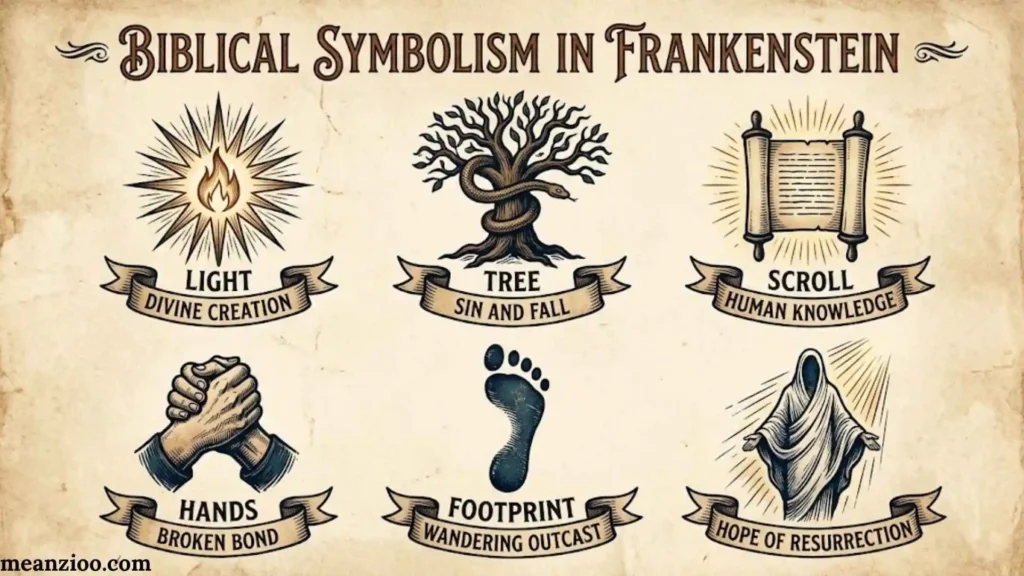
Biblical references deepen the novel’s questions about creation, free will, suffering, and moral responsibility. Shelley uses familiar religious stories to examine what happens when a creator brings a new being into existence but refuses to care for it.
Victor Frankenstein as a Creator Figure
Victor takes on a role traditionally associated with divine power when he discovers a way to create life. Yet his behavior differs sharply from the ideal of a caring creator.
He focuses on the achievement itself rather than the needs of the being he brings into the world. Once the Creature awakens, Victor abandons him instead of providing guidance or protection.
This contrast raises a central question: What does a creator owe to the life he creates?
Shelley doesn’t simply compare Victor to God to suggest that scientific creation is inherently wrong. The comparison highlights the gap between power and responsibility. Victor wants the status of an extraordinary creator without accepting the duties that come with his achievement.
Adam, Satan, and the Search for Belonging
The Creature’s identification with both Adam and Satan reveals two sides of his experience. Adam reflects his longing for acceptance and his frustration at being abandoned by his maker. Satan reflects his anger and alienation after repeated rejection.
These parallels also show how literature shapes the Creature’s understanding of himself. Having no family or community to explain his existence, he turns to stories to find a place within the human experience.
His interpretations aren’t always reliable, but they help readers understand his emotional development.
The Female Companion and the Limits of Creation
The proposed female companion extends the biblical parallel while raising questions about autonomy.
Victor assumes he can decide whether the female Creature should exist. The Creature, meanwhile, imagines that she will provide the companionship he desperately needs. Neither can know what her personality, wishes, or decisions would be.
Her destruction exposes the limits of Victor’s authority. Creating life gives him power over the experiment, but it doesn’t automatically give him moral ownership over another being’s future.
How Paradise Lost Influences Frankenstein’s Symbolism
John Milton’s Paradise Lost is one of the most important literary works referenced in Frankenstein. The epic poem explores the biblical Fall, the relationship between creator and creation, and the consequences of disobedience.
Shelley makes this connection visible from the beginning by using a passage from Paradise Lost as an epigraph. The passage expresses Adam’s complaint about being created and then cast out. It anticipates the Creature’s anger toward Victor.
The Creature later reads Paradise Lost alongside other works while living near the De Lacey family. These books help him develop language, understand human relationships, and reflect on his identity.
The poem influences his thinking in three important ways:
- Creation: The Creature compares his origin with Adam’s creation.
- Abandonment: He questions why his creator brought him into existence without providing love or guidance.
- Alienation: His identification with Satan reflects his feeling that he has been excluded from the world he wants to join.
These parallels also reveal a difference between reading about human suffering and experiencing it. The Creature learns about virtue, love, and social relationships through books, but his encounters with people often contradict the ideals he discovers.
As a result, Paradise Lost becomes more than a literary reference. It helps the Creature construct an identity while exposing the gap between humanity’s moral ideals and its treatment of outsiders.
How Nature Imagery Reinforces Symbolism in Frankenstein
Shelley’s Frankenstein imagery frequently connects physical landscapes with emotional experiences. The novel’s Romantic elements encourage readers to consider how natural beauty, overwhelming scenery, and harsh weather shape the characters’ thoughts.
Mountains and Glaciers: Awe and Human Insignificance
The Alpine mountains and glaciers create some of the novel’s most striking scenes. Their immense scale contrasts with Victor’s personal suffering and his belief that he can master the secrets of life.
The landscapes can make Victor feel temporarily removed from his grief. At the same time, their size and power remind readers that human beings cannot control everything around them.
Mountains and glaciers therefore connect to:
- The sublime power of nature.
- The limits of human ambition.
- Temporary relief from emotional distress.
- The contrast between natural grandeur and personal tragedy.
Storms and Weather: Emotional Intensity and Gothic Atmosphere
Storms, gloomy skies, and dramatic weather help establish the novel’s Gothic atmosphere. They can intensify fear and suspense, particularly when characters face uncertainty or danger.
However, weather doesn’t always correspond directly to a character’s emotions. A storm may create tension because of its physical effects, its timing, or the uncertainty it introduces.
When analyzing these scenes, distinguish imagery, which creates a sensory experience, from symbolism, which suggests a deeper meaning. The same description can serve both purposes.
Natural Beauty and Temporary Emotional Relief
Nature sometimes helps Victor regain composure after periods of grief and anxiety. Beautiful scenery offers a break from the memories that trouble him.
Yet the relief doesn’t last. His problems remain because the source of his suffering lies partly in his own choices and his failure to take responsibility.
Shelley therefore presents nature as a powerful source of comfort without suggesting that natural beauty can solve every human problem.
Other Important Motifs in Frankenstein
Beyond its major symbols, the novel uses recurring ideas to develop its themes. These Frankenstein literary elements help connect the experiences of Victor, the Creature, and Walton.
Isolation and Alienation
Isolation affects all three central figures, although each experiences it differently.
Victor withdraws from family and friends while pursuing his scientific ambition. The Creature experiences rejection because of his appearance and his lack of a social identity. Walton travels into the Arctic wilderness while longing for a friend who can understand his ambitions.
Their experiences show that isolation can be physical, emotional, or social.
More importantly, the novel distinguishes solitude from alienation. A person may spend time alone without suffering, but forced exclusion can damage a person’s sense of identity and belonging.
Companionship and Rejection
The Creature repeatedly seeks companionship. His experiences with the De Lacey family give him hope that people might accept him if they understood his character rather than judging his appearance.
When the family rejects him, that hope collapses. His later demand for a female companion grows from his belief that he cannot find acceptance among ordinary humans.
Victor also suffers from failed relationships, although his isolation often results from his own decisions. By comparing these characters, Shelley shows that relationships require more than the desire for connection. They also require empathy, honesty, and responsibility.
Knowledge and Destruction
Victor and Walton both pursue ambitious discoveries. Their goals initially appear admirable, but their journeys reveal the risks of treating achievement as the highest priority.
Victor’s experience is especially tragic because he gains the knowledge he seeks without preparing for its consequences. The Creature’s existence forces him to confront responsibilities he never considered seriously.
Shelley thus questions the assumption that scientific progress automatically leads to human improvement.
The problem isn’t knowledge itself. It’s the failure to consider how knowledge will affect living beings.
Creation, Parenthood, and Abandonment
Victor’s relationship with the Creature can be read as a disturbing version of parenthood. He brings a dependent being into existence but refuses to provide the care that would help it develop.
This failure shapes the Creature’s early experiences. He must learn to survive, interpret human behavior, and understand his emotions without guidance from his creator.
The novel doesn’t suggest that abandonment excuses every action the Creature takes. Instead, it asks readers to recognize how neglect and rejection contribute to his suffering while still holding him accountable for his decisions.
Literary Devices That Strengthen Symbolism in Frankenstein
Shelley combines symbolism with several other literary techniques. Understanding these devices helps explain how the novel communicates its ideas.
Imagery
Imagery creates vivid sensory impressions. Shelley’s descriptions of fire, lightning, mountains, glaciers, and darkness allow readers to imagine the characters’ environments.
These details also support larger themes. The warmth of fire contrasts with the Creature’s exposure to cold, while the vastness of the mountains emphasizes the limits of human power.
Allusion
An allusion refers to another literary work, myth, or cultural tradition. Shelley’s references to Paradise Lost, Adam, Satan, and Prometheus give readers additional ways to interpret the story.
These references are especially useful because they place the Creature’s experiences within familiar narratives about creation, rebellion, and exclusion.
Foreshadowing
Foreshadowing introduces details that prepare readers for later developments. Victor’s warnings about ambition encourage readers to consider the consequences of pursuing knowledge without sufficient judgment.
The novel also uses ominous descriptions and threatening situations to build anticipation. However, not every storm or dark scene directly predicts a later tragedy. Sometimes its purpose is to create atmosphere.
Personification
Personification gives human qualities to nonhuman things. When descriptions of nature suggest emotion, intention, or agency, they can make the landscape feel closely connected to the characters’ experiences.
This technique strengthens the Romantic relationship between people and the natural world. It can also make nature seem powerful and unpredictable.
Gothic and Romantic Conventions
The novel combines two major literary traditions.
| Gothic conventions | Romantic conventions |
| Darkness and secrecy | Emotional intensity |
| Horror and suspense | The power of imagination |
| Remote and threatening settings | Nature’s beauty and grandeur |
| Fear and uncertainty | Individual experience |
| Decay and disturbing events | The sublime and human limitations |
These traditions work together. Gothic elements create unease, while Romantic descriptions of nature and emotion encourage readers to consider the characters’ inner lives.
How Frankenstein’s Symbols Connect to Its Main Themes
The major symbols become more meaningful when readers examine how they connect to the novel’s broader concerns.
| Theme | Related symbols | Meaning |
| Human ambition | Light, Prometheus, the Arctic | The pursuit of achievement can lead people beyond responsible limits. |
| Knowledge | Fire, light, lightning | Discovery offers benefits but also creates risks. |
| Responsibility | The Creature, the laboratory, Adam | Creating life brings obligations toward it. |
| Isolation | Darkness, the Arctic, remote landscapes | Separation can intensify suffering and alienation. |
| Companionship | Eve, the female companion | People need connection and acceptance. |
| Nature | Mountains, glaciers, storms | The natural world can inspire awe and provide relief. |
| Identity | Adam, Satan, Paradise Lost | Stories help the Creature interpret his experiences. |
| Destruction | Fire, revenge, scientific ambition | Power without judgment can cause lasting harm. |
These connections reveal why the novel resists a single, simple interpretation. Fire can be beneficial or dangerous. Knowledge can promote understanding or encourage arrogance. The Creature can inspire sympathy while committing acts that demand moral judgment.
Shelley’s symbolism works through these tensions. Rather than telling readers exactly what to think, she presents conflicting possibilities and encourages them to consider the consequences of human choices.
Why Symbolism Matters in Mary Shelley’s Frankenstein
The symbols in Mary Shelley’s Frankenstein transform a story about an extraordinary scientific experiment into a wider examination of human behavior.
Fire and light explore the promise and danger of knowledge. Lightning reveals the power of nature to inspire scientific curiosity. Darkness intensifies fear and secrecy. Mountains and the Arctic wilderness remind characters that human ambition has limits.
Biblical and mythological references add another layer. The Creature’s identification with Adam and Satan expresses his conflicting desire for love and his anger at rejection. Prometheus connects Victor’s ambition with the pursuit of extraordinary power, while Paradise Lost gives the Creature a framework for understanding his existence.
Together, these symbols reinforce the novel’s central themes:
- Knowledge requires judgment.
- Creation brings responsibility.
- Isolation can deepen suffering.
- Rejection can damage relationships and identity.
- Scientific achievement doesn’t excuse neglecting others.
- Human beings must consider the consequences of their actions.
Ultimately, Frankenstein asks a question that extends beyond its Gothic setting: What responsibility do people have for the lives they change through their actions?
Victor’s tragedy comes not only from his desire to create life but also from his refusal to care for what he creates. Through its rich symbolism, Shelley reminds readers that ambition becomes dangerous when achievement matters more than empathy, accountability, and human connection.
Frequently Asked Questions About Symbols in Frankenstein
What are the most important symbols in Frankenstein?
The most important symbols include fire, light, lightning, darkness, nature, the Arctic setting, Adam, Satan, Eve, and Prometheus. Each connects to themes such as knowledge, ambition, isolation, creation, and responsibility.
What does fire symbolize in Frankenstein?
Fire symbolizes survival, knowledge, and destruction. The Creature learns that it provides warmth but can also cause pain. This discovery reflects the novel’s broader idea that knowledge and power can produce both benefits and harmful consequences.
What does light symbolize in Frankenstein?
Light commonly represents knowledge, discovery, and enlightenment. Victor and Walton pursue new understanding, but their ambitions also reveal the dangers of seeking achievement without considering its effects.
What does lightning symbolize in Frankenstein?
Lightning represents nature’s immense power and inspires Victor’s interest in scientific investigation. The scene in which lightning destroys a tree helps redirect his understanding of natural forces.
What does the Creature symbolize in Frankenstein?
The Creature represents the consequences of abandonment, social rejection, and the desire for companionship. His experiences also challenge readers to distinguish a person’s appearance from their character and actions.
Why does the Creature compare himself to Adam and Satan?
Adam reflects the Creature’s sense of being created and abandoned by his maker. Satan reflects his alienation, resentment, and growing desire for revenge. Together, these comparisons reveal his complicated search for identity.
Why is Frankenstein called The Modern Prometheus?
The subtitle refers to the Greek myth of Prometheus, who is associated with stealing fire from the gods and giving it to humanity. Victor resembles Prometheus because he seeks extraordinary knowledge and creates life, but he fails to accept the responsibilities that follow.
What does nature symbolize in Frankenstein?
Nature represents beauty, healing, overwhelming power, and human limitations. Its sublime landscapes can comfort Victor while reminding him that he cannot control every force in the world.
What does the Arctic setting symbolize in Frankenstein?
The Arctic setting represents isolation, ambition, danger, and the limits of human exploration. It also connects Walton’s expedition with Victor’s pursuit of extraordinary achievement.
How does Paradise Lost influence Frankenstein?
Milton’s Paradise Lost shapes the Creature’s understanding of creation, abandonment, and rebellion. By comparing himself with Adam and Satan, the Creature develops a complex interpretation of his identity and his relationship with Victor.
Is Frankenstein a Gothic novel?
Yes. Frankenstein uses Gothic conventions such as horror, secrecy, isolation, threatening settings, and disturbing events. It also incorporates Romantic themes, including emotional intensity, the sublime power of nature, and the limits of human ambition.
What is the difference between symbolism and imagery in Frankenstein?
Symbolism gives an object, event, or setting a deeper meaning. Imagery uses descriptive language to create sensory impressions. For example, a description of flames provides imagery, while fire’s connection to knowledge and destruction creates symbolism.

I’m Ryan Mitchell, and I write about modern English, trending slang, and online expressions. I enjoy explaining the meanings, origins, and real-life usage of popular words in a simple way. I believe learning slang is an important step toward understanding today’s English-speaking culture. Through my work, I aim to help readers speak more naturally and stay updated with the latest language trends.
 Charlotte Hayes