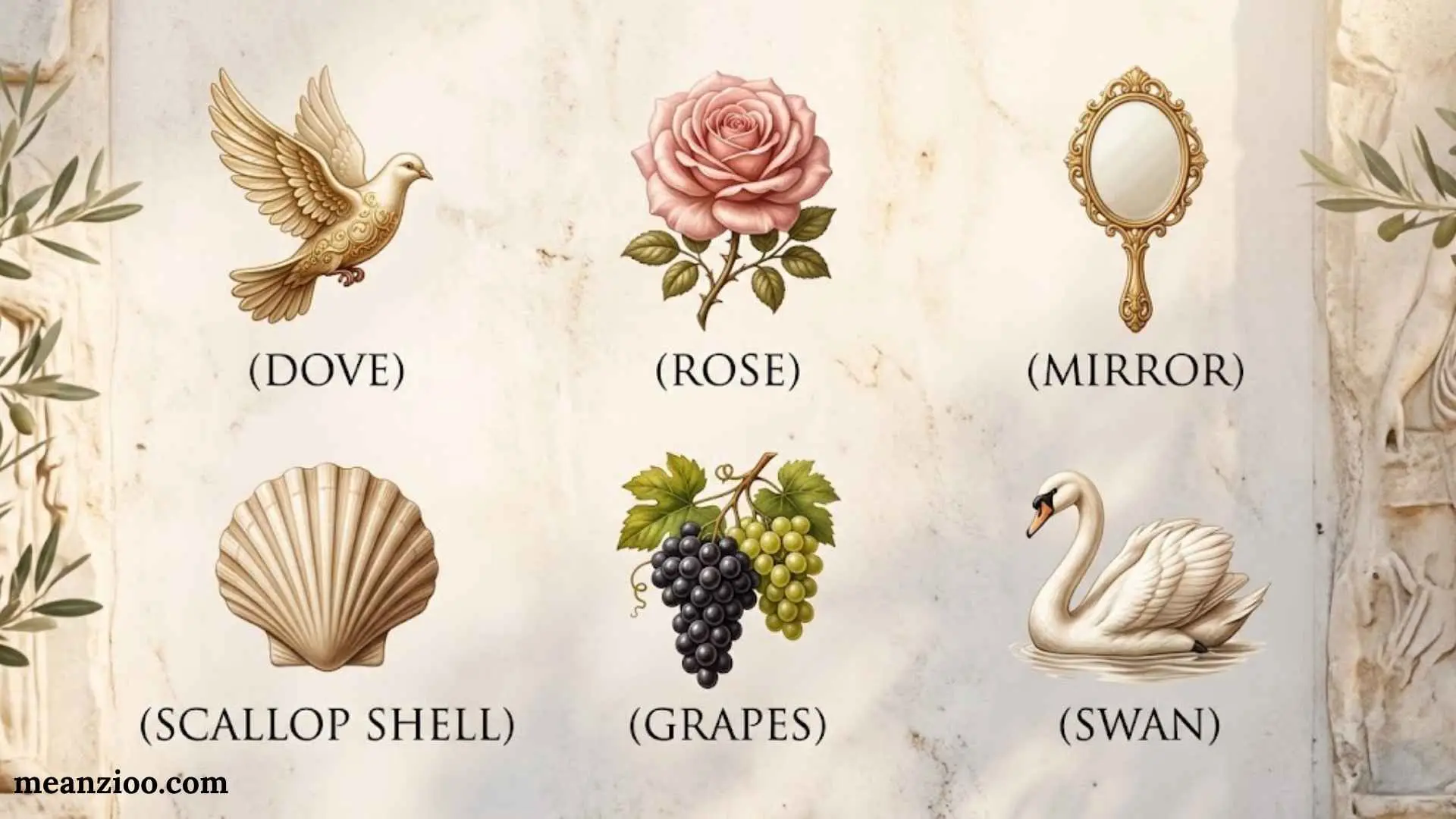
Aphrodite, the ancient Greek goddess of love and beauty, represents far more than romance. Her mythology explores desire, physical attraction, pleasure, fertility, and the powerful emotions that shape human relationships. From the gentle dove to the seashell associated with her legendary birth, the symbols of Aphrodite reveal different sides of her divine identity.
Some of these symbols appear in ancient Greek literature and religious traditions. Others became popular through classical artwork, Renaissance paintings, and modern interpretations of goddess symbolism. Understanding the difference helps you appreciate their meanings without confusing historical evidence with later beliefs.
The most recognizable Aphrodite symbols include the dove, rose, seashell, myrtle, swan, mirror, magical girdle, dove-drawn chariot, and sea foam. Each carries a different association, whether it reflects love and attraction or connects the goddess to the natural world.
This guide explores nine important Aphrodite symbols and meanings, their mythological origins, their appearances in art, and their interpretations today.
Who Is Aphrodite in Greek Mythology?
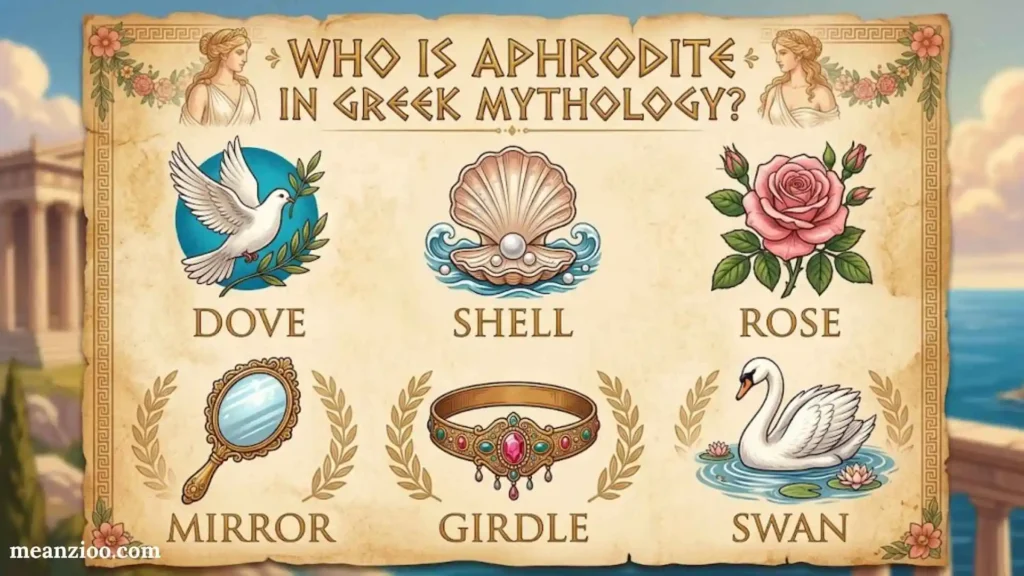
Aphrodite belongs to the Greek pantheon and is one of the best-known goddesses in ancient Greek mythology. The Greeks associated her with love, beauty, sexual desire, attraction, and aspects of fertility and reproduction. Her influence extended beyond romantic relationships because ancient myths often portrayed desire as a force capable of changing the course of human and divine affairs.
Unlike a goddess concerned primarily with marriage or childbirth, Aphrodite represents the attraction that draws people together. Her stories show that desire can inspire affection and pleasure, but it can also produce jealousy, rivalry, and conflict.
Aphrodite’s Birth and Mythological Origins
Ancient Greek sources offer different accounts of Aphrodite’s birth.
In Hesiod’s Theogony, Aphrodite emerges from the sea foam formed after Cronus casts the severed genitals of Uranus into the sea. This account connects her directly to the ocean and explains the enduring association between the goddess, sea foam, and images of emergence from the water.
Homer presents a different genealogy in the Iliad. In this tradition, Aphrodite is the daughter of Zeus and Dione. These differences show that Greek mythology developed through multiple literary and regional traditions rather than one fixed account.
What Does Aphrodite Represent?
Aphrodite’s central associations include:
- Love and attraction: The emotional and physical forces that draw people together.
- Beauty and adornment: Physical appeal, elegance, and the pleasures of appearance.
- Sexual desire: Erotic attraction and sensual pleasure.
- Fertility and procreation: Aspects of sexual union and reproduction.
- Persuasion and influence: The ability of desire to shape choices and relationships.
- Conflict arising from desire: Jealousy, rivalry, and the consequences of attraction.
These meanings explain why Aphrodite appears in stories about lovers, marriages, divine rivalries, and wars.
Aphrodite and Venus: Are They the Same Goddess?
Aphrodite and Venus are closely related figures in Greek and Roman mythology. Aphrodite is the Greek goddess, while Venus is her Roman counterpart.
Roman religion eventually absorbed many Greek stories and artistic conventions associated with Aphrodite. However, Venus also developed distinct Roman connections, including important associations with ancestry, civic identity, and the legendary origins of Rome.
Sandro Botticelli’s famous painting The Birth of Venus depicts the Roman name for the goddess through imagery strongly influenced by classical traditions. Today, people often use Aphrodite and Venus interchangeably in discussions of love and beauty, but their historical and religious contexts are not completely identical.
What Are the 9 Symbols of Aphrodite?
The following table summarizes nine recognizable symbols associated with Aphrodite. These symbols don’t form a universally established ancient list of nine; they bring together mythological attributes, classical imagery, and familiar artistic representations.
| Symbol | Main association | Historical or mythological connection |
| Dove | Love and devotion | Associated with Aphrodite in classical literature and art |
| Rose | Beauty and passion | Connected to love and the goddess in later classical traditions |
| Seashell | Birth and the sea | Popularized through imagery of Aphrodite emerging from the water |
| Myrtle | Love and sacred devotion | A plant associated with Aphrodite in ancient Greek tradition |
| Swan | Grace and beauty | Appears in classical imagery associated with the goddess |
| Mirror | Beauty and self-adornment | Connected to depictions of Aphrodite preparing herself |
| Magical girdle | Attraction and desire | Featured in Homer’s Iliad |
| Dove-drawn chariot | Divine movement and love | Appears in artistic representations of the goddess |
| Sea foam and ocean | Mythological birth | Central to the birth account in Hesiod’s Theogony |
The historical strength of these associations varies. The magical girdle, for example, has a specific literary source, while the shell became especially recognizable through later art.
The Dove: A Symbol of Love and Devotion
The dove is one of the most recognizable sacred animals of Aphrodite. Ancient Greek art and literature connect this bird with the goddess’s influence over love, attraction, and courtship. Its gentle appearance also made it a natural companion for a deity associated with beauty and affection.
Doves appear in classical representations of Aphrodite, sometimes alongside other birds or as part of her divine chariot. The association developed across different artistic and literary traditions, so not every dove image carries precisely the same meaning.
Why Is the Dove Associated With Aphrodite?
The dove’s connection to Aphrodite reflects the goddess’s influence over relationships and desire. In ancient poetry, birds could act as messengers, companions, or creatures connected to divine power.
Sappho’s famous prayer to Aphrodite, preserved in Fragment 1, describes the goddess arriving in a chariot drawn by sparrows. Other classical traditions connect Aphrodite with doves. These details show that different birds played roles in the goddess’s mythology rather than one bird serving as her only animal companion.
What Does the Dove Symbolize?
The dove commonly represents several ideas associated with Aphrodite:
- Love and affection: The bird evokes the closeness between lovers.
- Devotion: Its association with the goddess makes it a recognizable image of dedication to love.
- Gentleness: Its calm appearance suits the softer side of romantic attraction.
- Courtship: The bird’s place in classical imagery connects it with romantic relationships.
- Peace and harmony: These are broader symbolic meanings that later audiences often associate with doves.
The dove is particularly useful when choosing an Aphrodite-inspired symbol that emphasizes tenderness rather than intense passion.
The Dove in Ancient Art and Modern Symbolism
Ancient representations of Aphrodite frequently use birds to identify the goddess. Modern jewelry, artwork, and tattoos often build on those established associations.
However, not every modern meaning has an ancient religious origin. For example, using a dove to represent forgiveness or emotional healing may be personally meaningful, but those ideas shouldn’t automatically be treated as specific doctrines of Aphrodite’s ancient worship.
The Rose: A Symbol of Beauty, Love, and Desire
The rose is a familiar symbol of romantic love, and its association with Aphrodite draws on the goddess’s connection to beauty, desire, and sensual pleasure. Classical literary traditions connect Aphrodite with roses and other fragrant flowers. The flower also became a lasting part of the artistic language surrounding the goddess.
Roses work especially well as symbols of love and beauty because they combine visual appeal with fragrance and delicate petals. Their thorns add another layer of meaning, suggesting that love can bring both pleasure and pain.
Aphrodite’s Connection to Roses
Flowers play an important role in the way classical poets describe Aphrodite. In ancient accounts of the goddess’s beauty and adornment, flowers contribute to an atmosphere of fragrance, freshness, and attraction.
The rose also appears in traditions involving Aphrodite and Adonis, the beautiful youth she loved. Their story became a powerful example of love touched by loss.
Different versions of the Adonis myth vary in their details. Later retellings sometimes connect flowers, blood, and Aphrodite’s grief, but individual versions shouldn’t be combined into one supposedly universal ancient story.
What Does the Rose Symbolize?
The rose can communicate several related meanings:
- Romantic love: A widely recognized expression of affection.
- Beauty: Its appearance connects it to Aphrodite’s aesthetic qualities.
- Passion: Red roses commonly suggest intense desire.
- Sensuality: Fragrance and soft petals evoke physical pleasure.
- Vulnerability: Delicate petals suggest the fragility of affection.
- Pleasure and pain: Thorns provide a useful metaphor for complicated relationships.
These meanings make the rose a strong modern representation of Aphrodite, although their precise historical origins differ.
Red Roses and White Roses in Aphrodite Symbolism
Red and white roses carry different associations in modern floral traditions.
| Rose color | Common interpretation | Connection to Aphrodite |
| Red | Passion, romance, desire | Reflects her association with erotic love |
| White | Innocence, purity, reverence | A later symbolic interpretation of beauty |
| Pink | Tenderness, admiration, affection | Reflects gentler expressions of love |
These color meanings are not a definitive ancient Greek classification of Aphrodite’s flowers. They’re useful modern interpretations rather than a fixed system from classical mythology.
The Seashell: A Symbol of Birth and Beauty
The seashell is among the most recognizable images associated with Aphrodite, especially in Western art. It evokes the sea, the goddess’s traditional birth story, and the relationship between nature and beauty.
The shell became particularly famous through Renaissance representations of Venus. Although shells appear in Greco-Roman artistic imagery, the familiar picture of a nude goddess standing on a giant scallop shell owes much of its popularity to later artistic traditions.
Why Is the Seashell Linked to Aphrodite?
The association begins with Aphrodite’s mythological origins. In Hesiod’s Theogony, the goddess emerges from sea foam after the events involving Uranus and Cronus.
The ancient account does not require a shell to serve as a vehicle for her birth. Instead, the shell became a powerful artistic way to communicate the goddess’s connection to the ocean.
A shell’s curved form, delicate surface, and origin in marine life also make it visually suitable for representations of beauty and femininity.
The Seashell in The Birth of Venus
Sandro Botticelli’s The Birth of Venus, painted in the late 15th century, is one of the most famous images of the goddess in Western art.
The painting depicts Venus standing on a large shell as she arrives at the shore. Wind figures blow from the left while a woman on land prepares to receive the goddess.
The composition helped establish the seashell as an enduring visual symbol of Venus and, by extension, Aphrodite. However, the painting reflects Renaissance artistic interests and classical revival rather than providing a literal illustration of every detail in Hesiod’s birth account.
What Does the Seashell Symbolize?
The shell commonly represents:
- Birth and emergence: A visual connection to Aphrodite’s sea-foam origin.
- Beauty: Its shape and surface complement the goddess’s artistic image.
- The ocean: It connects Aphrodite with the marine world.
- Femininity: A common interpretation in later art and modern symbolism.
- Transformation: A contemporary reading of emergence into a new form of life.
The shell is an especially good choice for artwork or jewelry inspired by Aphrodite’s origins.
Myrtle: Aphrodite’s Sacred Plant
Myrtle has one of the strongest historical claims among the plants associated with Aphrodite. Ancient sources identify it as a sacred plant of the goddess, alongside the rose and apple. Myrtle wreaths and branches also fit the broader use of fragrant plants in Greek religious and cultural traditions.
The common myrtle, Myrtus communis, is an evergreen shrub with aromatic leaves and small flowers. Its lasting greenery and fragrance help explain why it became associated with beauty, vitality, and ceremonial adornment.
Why Is Myrtle Sacred to Aphrodite?
Myrtle’s relationship with Aphrodite appears in classical mythological and religious traditions. It wasn’t simply a modern plant chosen to represent the goddess’s personality.
Ancient Greeks used plants and wreaths in religious observances, public events, and celebrations. Myrtle’s association with Aphrodite placed it within a broader cultural world in which fragrance, greenery, and adornment could express honor or devotion.
The plant’s significance could vary by context. A myrtle wreath in an ancient setting shouldn’t automatically be interpreted as a romantic declaration.
What Does Myrtle Symbolize?
Myrtle is commonly associated with:
- Love and attraction: Its connection to Aphrodite links it with the goddess’s central domain.
- Fertility: This association reflects the broader relationship between Aphrodite, sexual union, and reproduction.
- Devotion: The plant’s religious associations give it a ceremonial dimension.
- Vitality: Its evergreen character offers a natural image of continuing life.
- Beauty and fragrance: Its appearance and scent suit the goddess’s association with adornment.
Some modern interpretations connect myrtle with marriage and lasting union. These can be reasonable contextual readings, but specific claims should be tied to the relevant historical tradition.
Myrtle in Ancient Greek Religious Traditions
Myrtle helps reveal an important feature of ancient Greek religious symbolism: sacred associations weren’t always expressed through a single official emblem.
A deity might be recognized through a combination of plants, animals, objects, titles, and stories. Aphrodite’s relationship with myrtle therefore belongs to a larger network of cultural and religious associations.
For readers looking for an Aphrodite symbol with a strong historical basis, myrtle is a particularly useful option.
The Swan: A Symbol of Grace and Beauty
The swan is associated with Aphrodite in classical traditions, although it is also strongly connected to Apollo. Its elegant appearance and presence in ancient artistic imagery make it a natural companion for a goddess associated with beauty.
Historical sources list swans among the birds linked to Aphrodite. Some artistic representations show the goddess riding a swan or appearing alongside one. However, the swan wasn’t exclusive to her.
The Swan in Aphrodite’s Iconography
Classical artists used animals to communicate aspects of a deity’s identity. A bird appearing beside a goddess could function as an identifying attribute, a companion, or part of a larger mythological scene.
The swan’s association with Aphrodite should be understood within that visual tradition. It doesn’t mean every ancient swan image depicts her or that all meanings attached to swans originated in her mythology.
What Does the Swan Represent?
Common interpretations include:
- Grace and elegance: The swan’s appearance connects it with beauty.
- Attraction: Its presence in Aphrodite’s imagery reinforces her association with desire.
- Love and courtship: These broader meanings fit modern representations of the goddess.
- Refinement: The swan’s graceful movement lends itself to artistic symbolism.
These meanings are especially common in modern goddess-inspired artwork.
Swan or Goose: Which Bird Is Associated With Aphrodite?
Both swans and geese appear in traditions concerning Aphrodite. The goose is sometimes overlooked because modern representations tend to favor the dove and swan.
The important distinction is that Aphrodite’s sacred animals include more than one kind of bird. Classical sources and later mythographic accounts identify doves, sparrows, swans, geese, and other birds with the goddess. Their prominence varies across sources and artistic contexts.
A white goose can therefore be discussed as an associated animal, but claims that it represents universal meanings such as authenticity, freedom, or self-acceptance need separate evidence. Those meanings are better presented as modern interpretations than as established ancient Greek beliefs.
The Mirror: Beauty and Self-Adornment
The mirror is a recognizable attribute of Aphrodite in classical art. It reflects the goddess’s connection with beauty, grooming, and adornment. Ancient artists sometimes depicted her holding a mirror or appearing among jewelry and other personal objects.
The mirror is especially interesting because it connects the goddess’s divine beauty with everyday cultural practices. Ancient people used mirrors for grooming and personal presentation, so the object belonged to a familiar world of appearance and self-adornment.
Why Is the Mirror Associated With Aphrodite?
Aphrodite’s visual identity often emphasizes beauty and the careful presentation of the body. A mirror fits that identity because it allows a figure to examine her appearance.
In classical representations, the mirror can help identify a scene centered on adornment. It doesn’t necessarily indicate that the goddess represents self-love or psychological self-awareness in the modern sense.
What Does the Mirror Symbolize?
The mirror can suggest several ideas:
- Beauty and appearance: Its most direct association with Aphrodite.
- Self-presentation: The relationship between grooming, clothing, and social identity.
- Vanity: A possible interpretation when appearance becomes excessive or self-absorbed.
- Self-reflection: A modern metaphor for examining personal choices and behavior.
- Identity: The difference between how someone sees themselves and how others see them.
Self-reflection and self-esteem are useful contemporary meanings, but they should not be mistaken for a complete account of the mirror’s role in ancient Greek religious life.
The Mirror in Classical Art
Artists used mirrors, jewelry boxes, and similar objects in scenes involving Aphrodite and other female figures. Such objects could convey luxury, beauty, and the rituals of personal adornment.
When interpreting a mirror in an ancient image, the surrounding composition matters. The object might identify Aphrodite, contribute to a scene of grooming, or simply reflect the visual conventions of its period.
Aphrodite’s Magical Girdle: A Symbol of Attraction and Desire
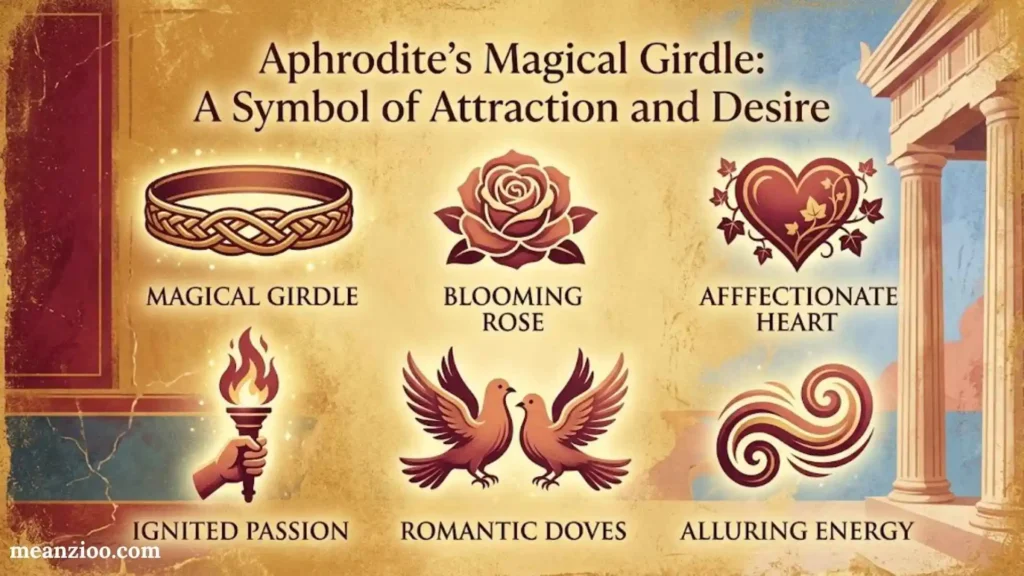
The magical girdle of Aphrodite has a particularly clear literary foundation. In Book 14 of Homer’s Iliad, Hera borrows Aphrodite’s embroidered girdle to enhance her power of attraction and influence Zeus.
The girdle contains the powers of love, desire, and persuasive charm. Its importance comes from the way the story presents attraction as a force capable of affecting even the most powerful gods.
What Is Aphrodite’s Girdle?
The girdle, often called the kestos himas, is a decorated band associated with Aphrodite’s power over desire.
Hera wants to distract Zeus during the Trojan War. To achieve her goal, she approaches Aphrodite and asks for the charms that make the goddess irresistible.
Aphrodite gives Hera the girdle without realizing the full purpose behind the request. Hera then uses its influence as part of her plan to distract Zeus.
This episode demonstrates that Aphrodite’s power extends beyond physical beauty. Her influence includes the emotional and psychological force of attraction.
What Does the Girdle Symbolize?
The girdle’s strongest associations are:
- Attraction: Its power makes desire difficult to resist.
- Seduction: Hera uses it to influence Zeus.
- Persuasion: The object helps change another person’s behavior.
- Erotic power: It represents Aphrodite’s domain over sexual desire.
- Influence through beauty: The story shows how appearance and attraction can shape events.
Modern interpretations sometimes connect the girdle with marriage, fidelity, or union. However, the best-known ancient account focuses on desire and persuasion rather than presenting it as a universal emblem of faithful marriage.
Aphrodite’s Girdle and Hera’s Plan
The episode is important because it involves two goddesses with different roles. Hera is associated with marriage, while Aphrodite governs love and sexual attraction.
Hera’s decision to borrow the girdle shows how these domains can overlap. Marriage, desire, and persuasion interact in the story, but they aren’t identical powers.
For anyone studying Greek mythology symbols, the girdle is one of the clearest examples of an object whose meaning comes directly from a specific ancient literary passage.
The Dove-Drawn Chariot: Divine Movement and Love
Aphrodite’s dove-drawn chariot is a familiar image in classical mythological representation. Some accounts describe the goddess traveling in a splendid chariot drawn by doves, connecting the bird with both her identity and her divine movement.
The chariot combines two symbolic elements: the goddess’s power and the animals associated with her. It should therefore be understood as an artistic and mythological attribute rather than as an entirely separate sacred animal.
Aphrodite’s Chariot in Mythology and Art
Ancient Greek literature frequently depicts gods traveling between different places or intervening in mortal affairs. Divine vehicles help communicate their supernatural status and ability to cross boundaries.
Aphrodite’s chariot fits this pattern. Its association with doves reinforces her connection with love and attraction, while the vehicle itself emphasizes movement and divine presence.
Sappho’s prayer to Aphrodite offers a related but distinct image: the goddess arrives in a chariot drawn by sparrows. This is an important reminder that classical literature doesn’t always use the same bird in every depiction.
What Does the Chariot Represent?
The chariot can suggest:
- Divine movement: The goddess’s ability to travel between realms.
- Presence and intervention: Her involvement in the lives of gods and mortals.
- Love and attraction: The birds connect the vehicle to her domain.
- Beauty and splendor: The imagery presents Aphrodite as a powerful divine figure.
These interpretations depend on the scene and source. The chariot isn’t best understood as a symbol of forgiveness, fidelity, or emotional healing without further evidence.
Sea Foam and Ocean Waters: Aphrodite’s Mythological Origins
The sea foam is central to one of the most famous accounts of Aphrodite’s birth. In Hesiod’s Theogony, the goddess emerges from the sea after Cronus casts the severed genitals of Uranus into the water.
The story establishes a direct connection between Aphrodite and the ocean. Although the details are mythological rather than scientific, they explain why sea foam and marine imagery became enduring parts of the goddess’s identity.
How Was Aphrodite Born From the Sea?
In Hesiod’s account, Cronus attacks Uranus, the primordial sky deity, and throws the severed remains into the sea. Foam gathers around them, and Aphrodite emerges from the water.
The narrative connects her birth to the origins of the cosmos and the succession of divine powers. It is more than a simple story about a goddess appearing on a beach.
Homer’s Iliad provides a different genealogy by identifying Aphrodite as the daughter of Zeus and Dione. Both traditions circulated in antiquity, and neither should be erased to make the mythology appear more uniform than it was.
What Does the Sea Symbolize in Aphrodite’s Myth?
The sea is closely linked to the goddess’s mythological origins, but additional meanings require careful interpretation.
- Divine emergence: The sea foam is central to Hesiod’s account of her birth.
- Natural beauty: Ocean imagery contributes to the visual language surrounding Aphrodite.
- Marine connection: Shells, waves, and water reinforce her association with the sea.
- Transformation: Modern audiences may interpret her emergence as a metaphor for change, although this is not a universal ancient doctrine.
The distinction matters because a myth can inspire modern reflection without every modern interpretation having been part of ancient Greek worship.
Sea Water, Purification, and Rebirth in Modern Interpretations
Some contemporary spiritual practices use ocean water to represent renewal, emotional release, or personal transformation. People may connect these meanings with Aphrodite because of her association with the sea.
These are modern interpretive choices rather than universal meanings established by the goddess’s birth story. The ancient myth describes divine origins, while modern readers may use its imagery as a personal metaphor.
Other Symbols and Attributes Associated With Aphrodite
The nine symbols above offer a useful introduction, but they don’t represent every animal, plant, or object connected to the goddess. Ancient literature and art preserve several additional attributes worth knowing.
Dolphins
Dolphins fit Aphrodite’s maritime associations and appear in some Greco-Roman artistic contexts involving the goddess. Their connection with the sea makes them a natural addition to marine imagery surrounding her.
However, dolphins aren’t necessarily more important than her better-attested attributes, such as doves and myrtle.
Sparrows
Sparrows deserve particular attention because Sappho’s Ode to Aphrodite describes the goddess’s chariot being drawn by these birds.
This literary detail makes the sparrow a meaningful symbol of Aphrodite, especially for readers interested in ancient poetry rather than later visual conventions.
Apples
The apple plays an important role in the Judgment of Paris. According to the myth, Paris must award a golden apple to the fairest of three goddesses: Hera, Athena, and Aphrodite.
Aphrodite promises him the love of Helen, the most beautiful mortal woman, and Paris chooses her. The decision contributes to the chain of events leading to the Trojan War.
The apple is therefore associated with beauty, competition, desire, and the consequences of choosing according to personal attraction.
Pomegranates
Pomegranates have broad associations with fertility, abundance, and life in various ancient Mediterranean traditions. However, their specific role as an identifying attribute of Aphrodite is less central than that of myrtle, doves, and the magical girdle.
They can be discussed in the wider context of Greek goddess symbols and meanings, but the article shouldn’t present every fertility-related fruit as a defining emblem of Aphrodite.
Jewelry and Adornments
Jewelry, elaborate clothing, and decorative objects frequently appear in representations of Aphrodite. They reinforce her association with beauty, luxury, and the art of adornment.
These objects may communicate social status as well as physical attractiveness. Their precise meanings depend on the artwork, period, and setting.
Pearls
Pearls are popular in modern Aphrodite-inspired jewelry because they evoke the sea and a refined form of beauty. However, pearls shouldn’t be presented as one of the goddess’s defining ancient attributes without specific supporting evidence.
Their modern appeal is understandable, but historical accuracy requires distinguishing contemporary symbolism from documented classical traditions.
What Does Aphrodite Represent Beyond Romantic Love?
Aphrodite’s symbolism extends beyond flowers, birds, and beautiful objects. Her mythology explores the emotional and social consequences of attraction, as well as the relationship between desire and power.
Love, Desire, and Attraction
Love and sexual desire are among Aphrodite’s central domains. Her stories repeatedly show that attraction can influence decisions, relationships, and even wars.
The Judgment of Paris provides a clear example. Aphrodite’s promise of Helen’s love helps her win the golden apple, but Paris’s choice contributes to a conflict that devastates communities.
This story doesn’t portray desire as purely good or bad. Instead, it shows how powerful attraction can become when it shapes choices without regard for their consequences.
Beauty, Sensuality, and Pleasure
Aphrodite’s association with beauty includes physical appearance, clothing, fragrance, and adornment. Her images often emphasize the body and the sensory qualities that make a person or object appealing.
The goddess also represents pleasure and sensuality. These aspects help explain why roses, mirrors, jewelry, and fragrant plants became associated with her in various artistic and literary traditions.
Beauty in this context isn’t simply about looking attractive. It also involves the cultural practices through which people present themselves and respond to others.
Fertility and Procreation
Aphrodite has connections to fertility and reproduction, particularly through sexual union. However, she shouldn’t be reduced to a generic fertility goddess.
Greek mythology includes other deities with more specialized agricultural, maternal, and childbirth roles. Aphrodite’s distinctive contribution centers on the attraction and desire that can lead to sexual union and reproduction.
This distinction helps explain why her symbols emphasize beauty, courtship, and erotic power rather than agriculture alone.
Conflict, Jealousy, and the Complications of Desire
Aphrodite’s myths also explore the darker consequences of desire. Her relationship with Ares, her involvement in the Judgment of Paris, and the tragedy of Adonis reveal how love can coexist with rivalry, danger, and loss.
These stories complicate the modern image of Aphrodite as a simple emblem of romance. Her mythology recognizes that attraction can bring happiness while also creating difficult choices and painful outcomes.
For contemporary readers, this makes her symbolism relevant to the complexity of human relationships. However, modern ideas about relationship boundaries or emotional healing should be identified as present-day applications rather than ancient doctrines.
Aphrodite’s Symbols in Greek Mythology and Classical Art
To understand Aphrodite symbolism, it helps to examine the original stories and artistic traditions behind the familiar images.
Aphrodite in Ancient Greek Literature
Several ancient works provide useful evidence for her identity and attributes.
| Ancient source | What it contributes |
| Hesiod’s Theogony | Describes the sea-foam birth tradition |
| Homer’s Iliad | Presents Aphrodite’s role in the Trojan War and the magical girdle episode |
| Sappho’s Fragment 1 | Describes Aphrodite arriving in a chariot drawn by sparrows |
| Homer’s Odyssey | Includes the story of Aphrodite, Hephaestus, and Ares |
| The Homeric Hymn to Aphrodite | Explores the goddess’s power over desire and her encounter with Anchises |
These sources don’t provide one standardized catalog of sacred symbols. Instead, they preserve different stories, attributes, and religious ideas that developed over time.
Aphrodite in Sculpture, Pottery, and Other Art
Artists identified Aphrodite through several recurring features, including birds, flowers, mirrors, jewelry, and shells.
An individual attribute may help identify the goddess, but its meaning depends on the larger composition. A mirror, for example, may indicate a scene of adornment, while a dove may reinforce her association with love and attraction.
Art also changed over time. Early representations often showed Aphrodite clothed, while later works increasingly explored her beauty through the nude or partially nude female figure.
From Aphrodite to Venus
Roman artists adopted and adapted many Greek representations of Aphrodite under the name Venus. Later European artists drew on both Greek mythology and Roman literature, producing familiar images that continue to shape modern interpretations.
Botticelli’s The Birth of Venus is one of the clearest examples. Its shell, sea setting, and idealized figure have made it an enduring reference point for the goddess’s visual identity.
Yet Renaissance art shouldn’t be treated as a direct record of every ancient Greek belief. It reflects the interests, artistic conventions, and cultural values of its own period.
Aphrodite’s Symbols in Modern Spirituality
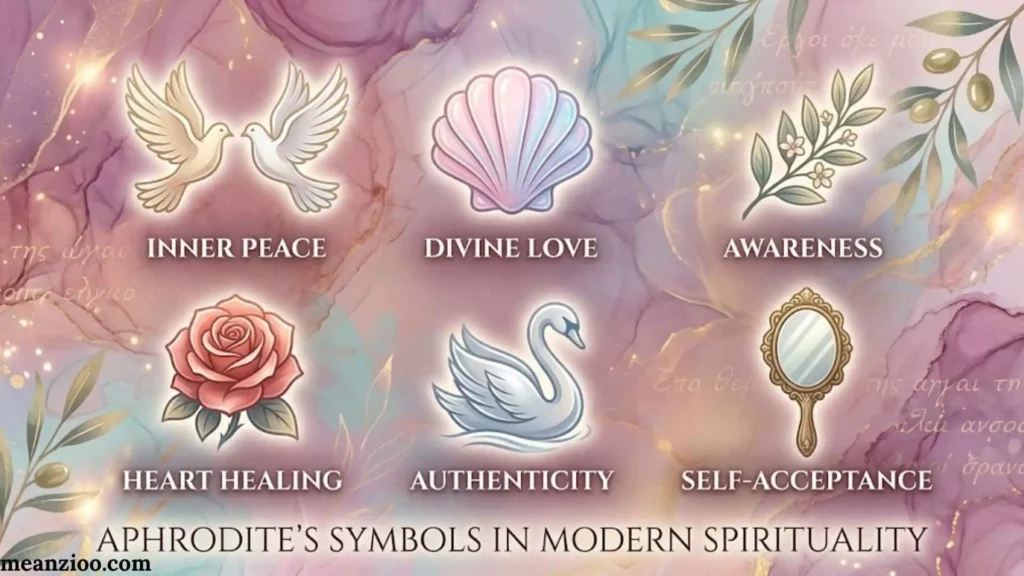
Today, many people use Aphrodite’s symbols in jewelry, personal altars, art, tattoos, and reflective practices. Their meanings often draw on classical mythology while incorporating contemporary ideas about self-expression and relationships.
Using Aphrodite Symbols for Personal Reflection
A symbol can serve as a reminder of a value or intention without requiring a belief that the object possesses supernatural power.
For example:
- A dove might remind you to approach relationships with gentleness.
- A rose might represent affection or the courage to be emotionally vulnerable.
- A mirror might encourage honest reflection on your choices.
- A shell might remind you of the goddess’s mythological origins.
- A myrtle branch might represent an interest in ancient Greek traditions.
These are personal interpretations. They shouldn’t be confused with fixed meanings shared by all historical worshippers of Aphrodite.
Aphrodite as a Modern Goddess Archetype
In contemporary spirituality, Aphrodite sometimes serves as an archetype of sensuality, creativity, attraction, and appreciation of beauty.
An Aphrodite archetype can provide a framework for reflecting on pleasure, self-expression, and relationships. However, this modern psychological and spiritual approach differs from ancient Greek religious practice.
Ancient worship involved specific rituals, offerings, local traditions, and beliefs about the gods. Modern archetypal interpretations often focus instead on personal development and symbolic meaning.
Both can be studied, but they should remain distinct.
Aphrodite Symbols in Jewelry, Art, and Tattoos
The most recognizable choices for Aphrodite-inspired designs include:
- Doves: Suitable for a design centered on love and devotion.
- Roses: A familiar choice for passion, romance, and beauty.
- Seashells: Ideal for emphasizing her mythological connection to the sea.
- Myrtle: A meaningful choice for someone interested in historically attested sacred plants.
- Mirrors: Suitable for themes of beauty and self-presentation.
- The magical girdle: A more specific reference to Aphrodite’s power over desire.
- Sparrows: A literary reference connected with Sappho’s prayer to the goddess.
When choosing a design, consider whether you want to represent a documented mythological attribute or a personal interpretation inspired by Aphrodite.
Frequently Asked Questions About Aphrodite’s Symbols
What Is Aphrodite’s Most Famous Symbol?
The dove is one of Aphrodite’s most recognizable animal symbols. The seashell is also famous, particularly through Renaissance artwork such as Botticelli’s The Birth of Venus. Which is most recognizable depends on the context: the dove has strong classical associations, while the shell dominates many modern visual representations.
What Are the Nine Symbols of Aphrodite?
Nine useful symbols to explore are the dove, rose, seashell, myrtle, swan, mirror, magical girdle, dove-drawn chariot, and sea foam. This is a modern organizational list rather than a definitive ancient catalog.
What Animal Represents the Goddess Aphrodite?
The dove is a prominent animal associated with Aphrodite. Other animals include sparrows, swans, and geese. Sappho’s Fragment 1 specifically describes the goddess’s chariot drawn by sparrows, demonstrating that different birds appear in different traditions.
What Is Aphrodite’s Sacred Flower?
Myrtle is one of the best-attested plants associated with Aphrodite in ancient Greek tradition. Roses are also connected to the goddess in classical and later literary traditions, making both plants useful subjects for understanding her symbolism.
What Does Aphrodite’s Seashell Symbolize?
The seashell represents Aphrodite’s connection with the ocean and her traditional birth from sea foam. Its popularity as a visual emblem grew through artistic representations, especially Renaissance paintings of Venus.
What Does Aphrodite’s Girdle Do?
In Homer’s Iliad, Aphrodite’s magical girdle carries the power of love, desire, and attraction. Hera borrows it to influence Zeus during the Trojan War. The episode illustrates the goddess’s power over desire and persuasion.
Is Aphrodite the Same as Venus?
Aphrodite is the Greek goddess of love and beauty, while Venus is her Roman counterpart. Roman traditions adopted many Greek stories and attributes, but Venus also developed distinct religious and cultural roles in Roman society.
Are Pearls a Traditional Symbol of Aphrodite?
Pearls are popular in modern Aphrodite-inspired jewelry because they evoke the sea and beauty. However, they aren’t as firmly established among her defining ancient attributes as myrtle, doves, or the magical girdle. Their modern symbolism should be distinguished from the historical evidence.
What Does Aphrodite Symbolize Spiritually?
Modern spiritual interpretations often associate Aphrodite with love, attraction, sensuality, beauty, creativity, and self-expression. Some people also use her symbols for personal reflection. These interpretations vary and shouldn’t be presented as universal ancient Greek religious beliefs.
Why Is Myrtle Associated With Aphrodite?
Myrtle appears among the plants identified with Aphrodite in classical traditions. Its fragrance, evergreen foliage, and use in ceremonial adornment fit the goddess’s associations with beauty and love. The plant has a stronger historical connection to her than many modern additions to lists of goddess symbols.
How Is Aphrodite Connected to Adonis?
Adonis is a beautiful youth loved by Aphrodite. Their story combines desire, devotion, and loss, with different ancient and later versions describing his death and the goddess’s grief. The myth contributes to the broader literary association between Aphrodite, love, and the pain that can accompany it.
Conclusion: Understanding the Symbols of Aphrodite
The symbols of Aphrodite reveal a goddess whose influence reaches far beyond romance. Doves and sparrows connect her with birds and courtship, myrtle reflects her place in ancient Greek religious traditions, and the magical girdle illustrates her power over attraction and desire. The seashell and sea foam, meanwhile, preserve the imagery surrounding her mythological origins.
Other familiar symbols, including roses, mirrors, and swans, help explain how artists and later audiences represented her beauty. Their meanings vary according to the source, period, and cultural setting.
The most important distinction is between documented ancient associations and modern symbolic interpretations. Once you understand that difference, you can explore Aphrodite’s mythology with greater accuracy while appreciating why her imagery continues to inspire art, jewelry, literature, and personal reflection today.

I’m Ryan Mitchell, and I write about modern English, trending slang, and online expressions. I enjoy explaining the meanings, origins, and real-life usage of popular words in a simple way. I believe learning slang is an important step toward understanding today’s English-speaking culture. Through my work, I aim to help readers speak more naturally and stay updated with the latest language trends.
 Charlotte Hayes