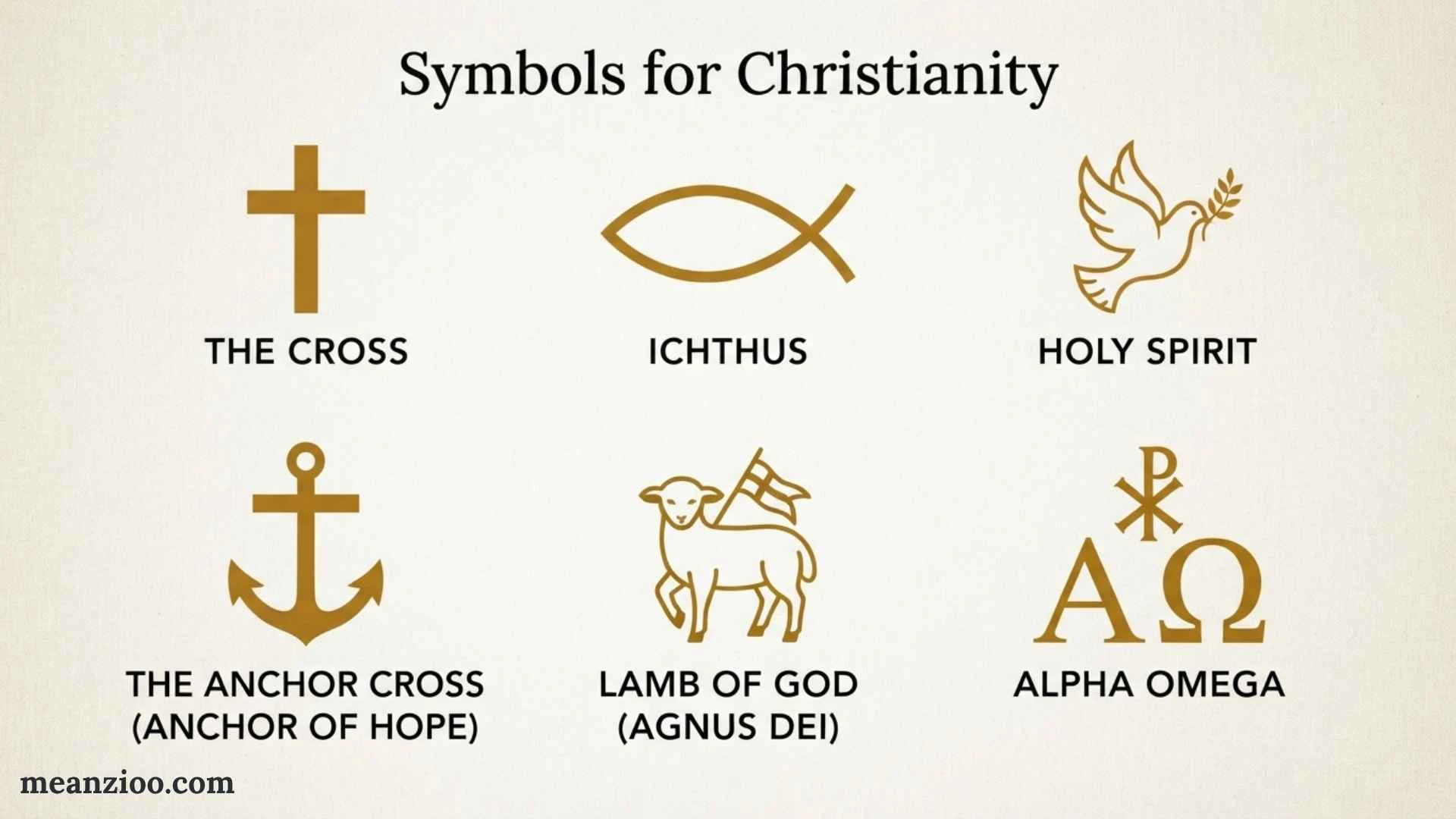
Christianity has a rich tradition of symbols that express important ideas about Jesus Christ, God, salvation, faith, hope, love, sacrifice, resurrection, and eternal life. Some symbols come directly from biblical imagery, while others developed through early Christian history, worship, art, and tradition.
The symbols for Christianity most people recognize include the cross, fish, dove, lamb, Chi-Rho, anchor, Alpha and Omega, crown, vine, and Good Shepherd. Each has a different background and meaning, and some symbols are especially important within particular Christian traditions.
This guide explains the most important Christian religious symbols, their meanings, biblical connections, historical development, and common uses. It also covers symbols connected with Jesus, the Holy Spirit, the Trinity, faith, hope, love, salvation, and resurrection.
What Are Symbols for Christianity?
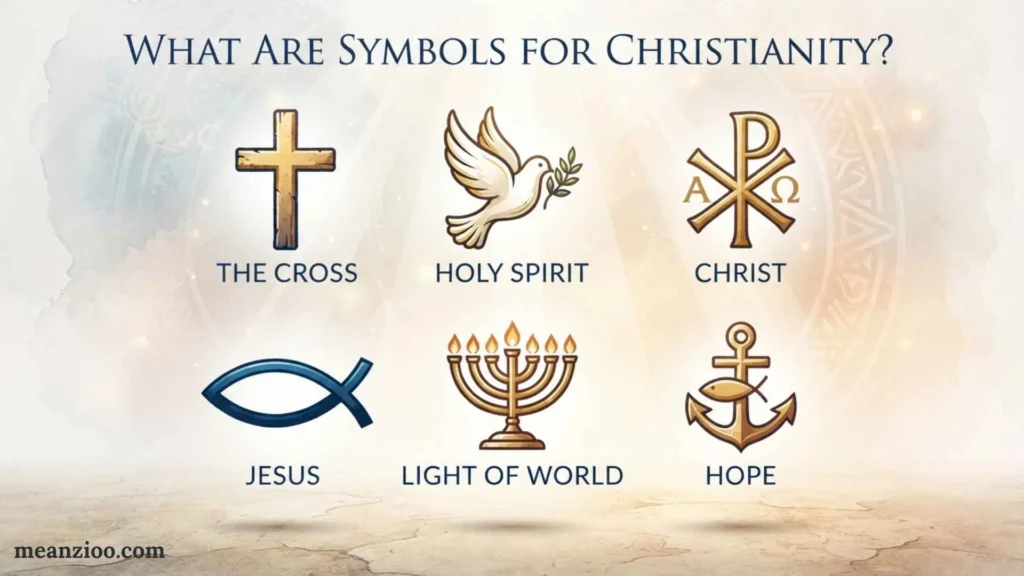
Christian symbols are visual signs, objects, letters, animals, or designs used to communicate Christian beliefs and religious ideas.
Some are closely connected to specific Bible passages. Others developed later through Christian communities and church traditions.
For example, the cross is directly connected with the crucifixion of Jesus, while the Chi-Rho developed as an early Christian monogram representing Christ.
Christian symbols can be found in:
- Churches and cathedrals
- Stained-glass windows
- Crosses and crucifixes
- Religious paintings
- Christian jewelry
- Books and manuscripts
- Cemetery monuments
- Tattoos
- Clothing
- Church logos
- Religious celebrations
The meaning of a symbol can also differ according to denomination, historical period, and cultural setting.
The Cross
The cross is the most widely recognized symbol of Christianity.
It represents the crucifixion of Jesus Christ and is closely connected with Christian beliefs about his death, sacrifice, redemption, and resurrection.
The cross appears in many forms, including the Latin cross, Greek cross, Celtic cross, Jerusalem cross, and other historical designs.
For many Christians, it represents:
- Jesus Christ
- Sacrifice
- Salvation
- Redemption
- Forgiveness
- Faith
- Resurrection
- God’s love
The crucifix is different from a simple cross because it normally includes a representation of Jesus on the cross. Crucifixes are especially prominent in Catholic and some other Christian traditions.
Bible Connection
The crucifixion is described in all four Gospels. The cross therefore has a direct and central connection to the New Testament story of Jesus.
The Christian Fish or Ichthys
The Ichthys, or Christian fish, is one of the best-known early Christian symbols.
The Greek word ichthys means “fish.” The fish became associated with Jesus and Christian identity, and early Christians used it as a meaningful sign.
The symbol is commonly represented as:
<><
It can represent:
- Jesus Christ
- Christian faith
- Christian identity
- Discipleship
- Early Christianity
The fish is connected with several New Testament stories involving Jesus, fishermen, and miraculous catches of fish.
Today, the Ichthys is commonly seen on cars, jewelry, stickers, clothing, church materials, and Christian artwork.
The Chi-Rho
The Chi-Rho is an ancient Christian symbol formed from the Greek letters Chi (Χ) and Rho (Ρ).
These letters are associated with the Greek word for Christ. The symbol became prominent in early Christianity and was used in manuscripts, artwork, objects, and other Christian settings.
It is written as:
☧
The Chi-Rho primarily represents:
- Christ
- Jesus
- Christianity
- Christian identity
It is particularly useful for understanding the history of early Christian symbolism.
The Dove
The dove is one of the most important Christian symbols connected with the Holy Spirit.
The New Testament describes the Holy Spirit descending like a dove at Jesus’ baptism. Because of this biblical imagery, the dove became strongly associated with the Holy Spirit.
The dove can also symbolize:
- Peace
- Purity
- Hope
- Spiritual presence
- God’s Spirit
Dove imagery is common in baptismal artwork, church decorations, stained glass, religious paintings, and Christian designs.
The Lamb
The lamb is an important biblical symbol associated with Jesus Christ.
John the Baptist refers to Jesus as the Lamb of God in the Gospel of John. This imagery connects Jesus with sacrifice, redemption, and salvation.
The lamb can represent:
- Jesus Christ
- Innocence
- Sacrifice
- Redemption
- Salvation
- Gentleness
Christian artwork sometimes depicts a lamb carrying a cross or banner. This is known as the Agnus Dei, meaning “Lamb of God.”
Alpha and Omega
Alpha and Omega are the first and last letters of the Greek alphabet:
Α Ω
In Revelation, the phrase is associated with God and Christ and conveys the idea of beginning and end.
As Christian symbols, Alpha and Omega can represent:
- Eternity
- God’s sovereignty
- Beginning and end
- Completeness
- Divine existence
They are commonly displayed alongside crosses in churches, stained-glass windows, religious artwork, and cemetery monuments.
The Anchor
The anchor is a historic Christian symbol of hope and steadfastness.
The anchor was particularly meaningful in early Christian symbolism. It could function as a discreet Christian image and was also associated with the idea of stability and hope.
The New Testament uses an anchor as imagery for hope in Hebrews 6:19.
The anchor can symbolize:
- Hope
- Faith
- Stability
- Perseverance
- Trust in God
The Crown
A crown can represent Christ’s kingship, victory, glory, and eternal reward.
Christian art often depicts Jesus as Christ the King, making the crown an important symbol of his royal authority.
The crown can also have different meanings when used with saints or martyrs.
Crown of Thorns
The crown of thorns has a much more specific meaning. According to the Gospel accounts, Jesus was given a crown of thorns before his crucifixion.
It therefore represents:
- Christ’s suffering
- Humiliation
- Sacrifice
- The Passion
- Crucifixion
It is frequently shown in Christian paintings, sculptures, crosses, and devotional artwork.
Bread and Wine
Bread and wine are major Christian symbols connected with the Last Supper and Communion.
Jesus shared bread and wine with his disciples at the Last Supper, and Christian communities have continued to use these elements in Communion or Eucharistic worship.
Their theological meaning differs among Christian denominations.
They can represent:
- The Last Supper
- Communion
- Remembrance
- Christ’s sacrifice
- Fellowship
- Spiritual nourishment
In Catholic, Orthodox, Anglican, Lutheran, and other traditions, bread and wine can have different theological interpretations.
The Vine
The vine is another important biblical image.
In the Gospel of John, Jesus describes himself as the vine and his followers as branches. This imagery communicates a relationship of spiritual connection and dependence.
The vine can symbolize:
- Christ
- Spiritual growth
- Connection with God
- Fruitfulness
- Discipleship
Grapes and vines are also frequently incorporated into Christian church art, especially artwork connected with Communion.
The Chalice
The chalice is a cup associated with Christian Communion and the Eucharist.
It is particularly common in churches where wine is served from a shared ceremonial cup during Communion.
The chalice can represent:
- The Last Supper
- Communion
- Eucharist
- Christ’s sacrifice
- Christian fellowship
The design and importance of the chalice can vary among Christian traditions.
The Bible
An open Bible is a common Christian symbol representing Scripture and God’s Word.
A closed Bible may represent the Scriptures as a whole, while an open Bible can suggest reading, teaching, learning, or sharing biblical truth.
Bible imagery is often used in:
- Church logos
- Christian schools
- Religious artwork
- Sermon materials
- Christian websites
- Educational resources
The Good Shepherd
The Good Shepherd is a powerful Christian image of Jesus.
In the Gospel of John, Jesus describes himself as the Good Shepherd. The shepherd cares for and guides his sheep, creating a picture of Christ’s relationship with his followers.
The Good Shepherd can symbolize:
- Guidance
- Protection
- Love
- Care
- Salvation
- Christ’s relationship with believers
Early Christian art frequently used shepherd imagery.
IHS
IHS is a Christian monogram associated with the name of Jesus.
It developed from the Greek form of Jesus’ name and became widely used in Christian art and religious traditions.
IHS may appear on:
- Altars
- Vestments
- Church buildings
- Crosses
- Communion objects
- Religious artwork
The monogram is especially familiar in Catholic contexts, although its use is not limited exclusively to Catholicism.
The Sacred Heart
The Sacred Heart is particularly important in Catholic devotional tradition.
It represents the heart of Jesus and his love for humanity. Artistic representations commonly show a heart surrounded by flames and a crown of thorns, sometimes with a cross above it.
The Sacred Heart can symbolize:
- Christ’s love
- Compassion
- Mercy
- Sacrifice
- Devotion
It is frequently found in Catholic churches, paintings, statues, prayers, medals, and devotional objects.
The Celtic Cross
The Celtic cross combines a Christian cross with a circle around the intersection.
It is strongly associated with Celtic Christian heritage, particularly Ireland and other regions connected with Celtic Christianity.
Today, Celtic crosses are frequently used on:
- Grave markers
- Church monuments
- Jewelry
- Religious artwork
- Memorials
- Tattoos
The circle has been given different interpretations over time, so there is not one universally accepted explanation for every Celtic cross.
The Jerusalem Cross
The Jerusalem Cross features a large central cross surrounded by four smaller crosses.
It has historical associations with Jerusalem and has been used in Christian contexts for centuries.
The smaller crosses have received different interpretations, including associations with the spread of Christianity to the four directions of the world.
The symbol is particularly interesting for people researching historical Christian heraldry and religious symbolism.
The Trinity Symbol
The Trinity is a central Christian doctrine describing one God in three persons:
- Father
- Son
- Holy Spirit
There is no single universal graphic symbol for the Trinity, but several designs have been used to communicate the concept.
One famous design is the triquetra, or Trinity knot.
The three-part structure can visually represent the three persons of the Trinity.
The Triquetra
The triquetra is a three-cornered interlaced design.
In Christian contexts, it is sometimes used as a symbol of the Trinity:
Father + Son + Holy Spirit
However, similar three-part designs existed in cultures before and outside Christianity. Its meaning therefore depends on its historical and cultural context.
The Peacock
The peacock appears in some early Christian art as a symbol associated with immortality and eternal life.
Ancient beliefs about the peacock’s feathers influenced how the bird was interpreted in early Christian artwork.
It can be found in historical:
- Mosaics
- Tomb decorations
- Church art
- Christian manuscripts
The peacock is more important as a historical artistic symbol than as a central Christian doctrine.
The Phoenix
The phoenix was sometimes used in early Christian art to represent resurrection and renewal.
The ancient idea of a bird rising again provided a visual metaphor that Christian artists could connect with resurrection and eternal life.
The phoenix is therefore part of Christian symbolic history, although it is not one of Christianity’s primary universal symbols.
The Rooster
The rooster has a specific connection with the story of Peter.
Jesus told Peter that he would deny knowing him three times before the rooster crowed. The rooster subsequently became a Christian reminder of Peter’s denial and repentance.
It can symbolize:
- Peter’s denial
- Repentance
- Watchfulness
- Human weakness
- Faithfulness
Rooster figures can sometimes be seen on church towers and in Christian artwork.
The Pelican
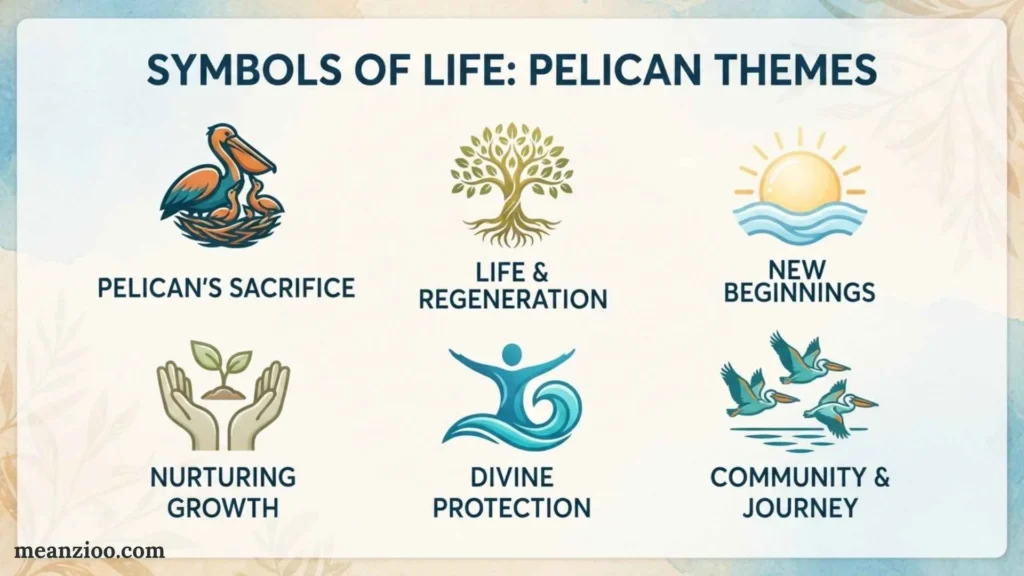
The pelican became a Christian symbol through medieval religious art and legends about the bird.
Medieval tradition sometimes portrayed a pelican feeding its young with its own blood. Christian artists connected this story with Christ’s self-sacrifice.
The pelican consequently became associated with:
- Self-sacrifice
- Christ’s love
- Charity
- Eucharistic symbolism
This symbolism comes from historical belief and artistic tradition rather than modern biological understanding of pelicans.
Symbols of Jesus Christ
Several Christian symbols specifically represent Jesus.
The most common include:
| Symbol | Connection with Jesus |
| Cross | Crucifixion and salvation |
| Ichthys | Jesus Christ and Christian identity |
| Lamb | Lamb of God |
| Chi-Rho | Christ |
| Good Shepherd | Jesus as shepherd |
| IHS | Name of Jesus |
| Crown | Christ the King |
| Vine | Jesus as the true vine |
| Alpha and Omega | Christ’s eternity and sovereignty |
These symbols do not all have identical theological meanings, and their importance varies between Christian traditions.
Symbols of God the Father
Christian art sometimes uses symbols to represent God the Father, although Christianity teaches that God is not limited to a physical image.
Common symbolic imagery can include:
- Hand of God
- Light
- Cloud
- Eye of Providence
- Alpha and Omega
The Eye of Providence is sometimes used in Christian and broader religious contexts, but it is not an exclusive symbol of Christianity.
The meaning of each image depends on its specific artistic and historical context.
Symbols of the Holy Spirit
The most recognizable symbol of the Holy Spirit is the dove.
Other Christian imagery associated with the Holy Spirit includes:
- Fire
- Wind
- Breath
- Light
These images connect with biblical descriptions of the Spirit.
Fire is particularly important in Christian art because the Holy Spirit is associated with tongues of fire in the account of Pentecost.
Symbols of the Trinity
The Trinity can be represented using:
- Triquetra
- Three interlocking circles
- Three-leaf designs
- Trinity shields
- Father, Son, and Holy Spirit inscriptions
The Trinity Shield, also known as the Shield of the Trinity, is a diagram used to explain the Christian doctrine of the Trinity.
It visually distinguishes the Father, Son, and Holy Spirit while expressing their relationship within traditional Trinitarian theology.
Christian Symbols for Faith
There is no single exclusive symbol for Christian faith.
However, several symbols are commonly associated with faith and trust in God:
- Cross
- Anchor
- Bible
- Ichthys
- Open hands
- Light
The cross is particularly recognizable because it represents the central Christian story of Jesus’ crucifixion.
Christian Symbols for Hope
The anchor is one of the strongest traditional Christian symbols of hope.
Its connection with hope comes from biblical imagery in Hebrews.
Other images can also express hope:
- Cross
- Sunrise
- Light
- Dove
- Resurrection imagery
The exact meaning depends on the context in which the symbol appears.
Christian Symbols for Love
Christianity frequently uses imagery to communicate God’s love and Christ’s love for humanity.
Common examples include:
- Sacred Heart
- Cross
- Heart
- Dove
- Good Shepherd
- Lamb
The Sacred Heart has a particularly strong association with Christ’s love in Catholic devotion.
Christian Symbols for Salvation
The cross is the most prominent Christian symbol associated with salvation.
Other symbols can communicate related ideas:
- Lamb of God
- Baptismal water
- Empty tomb
- Resurrection imagery
- Chi-Rho
The lamb connects with sacrificial imagery, while the empty tomb represents the resurrection of Jesus.
Christian Symbols for Resurrection
The empty tomb is a major Christian image of resurrection.
Other historical symbols include:
- Phoenix
- Butterfly
- Rising sun
- Cross
- Easter lily
The phoenix was used in some early Christian art, while the butterfly became a later Christian symbol associated with transformation and new life.
Christian Symbols by Denomination
Christian symbolism is not identical across all denominations.
Catholic Symbols
Catholic Christianity commonly uses:
- Crucifix
- Sacred Heart
- Rosary
- Chi-Rho
- IHS
- Eucharistic symbols
- Saints’ symbols
- Marian symbols
The crucifix and Sacred Heart are particularly prominent in Catholic devotional art.
Eastern Orthodox Symbols
Eastern Orthodox Christianity places strong emphasis on:
- Icons
- Crosses
- Christ Pantocrator
- Orthodox cross
- Chi-Rho
- Alpha and Omega
- Biblical imagery
Icons have an important theological and liturgical role within Eastern Orthodox tradition.
Protestant Symbols
Protestant traditions vary considerably, but commonly used symbols include:
- Cross
- Open Bible
- Ichthys
- Dove
- Communion symbols
- Christian monograms
Some Protestant churches use fewer visual symbols than Catholic or Orthodox churches, while others use extensive Christian artwork.
Christian Symbols in Early Christianity
Early Christians developed and used symbols for several reasons.
Symbols helped communicate Christian ideas visually and could identify Christian communities. In some historical periods, Christian imagery also provided a less direct way to express religious identity.
Early Christian symbols included:
- Fish
- Anchor
- Shepherd
- Dove
- Chi-Rho
- Alpha and Omega
- Vine
- Lamb
Early Christian catacombs and other archaeological sites contain examples of Christian symbolic artwork.
Are All Christian Symbols Found in the Bible?
No.
Some Christian symbols have direct biblical connections, while others developed through Christian tradition and historical art.
For example:
- The dove has a clear biblical connection with the Holy Spirit.
- The lamb has a strong biblical connection with Jesus as the Lamb of God.
- The cross is directly connected with the crucifixion.
- The anchor has biblical imagery associated with hope.
- The Chi-Rho developed as an early Christian monogram.
- Some interpretations of the Celtic cross developed through later Christian culture.
Therefore, a symbol can be historically Christian without being specifically commanded or illustrated in the Bible.
Christian Symbols vs. Symbols Commonly Mistaken as Christian
Some symbols are used in Christian settings but have broader origins.
For example, the triquetra existed in pre-Christian cultures before later Christian communities used it to represent the Trinity.
The Eye of Providence also appears in Christian artwork but is not exclusively Christian and has been used in different religious and cultural contexts.
The heart is widely used in Christian imagery, but it is not an exclusively Christian symbol.
Understanding historical context helps prevent overly simple interpretations.
Christian Symbols for Tattoos
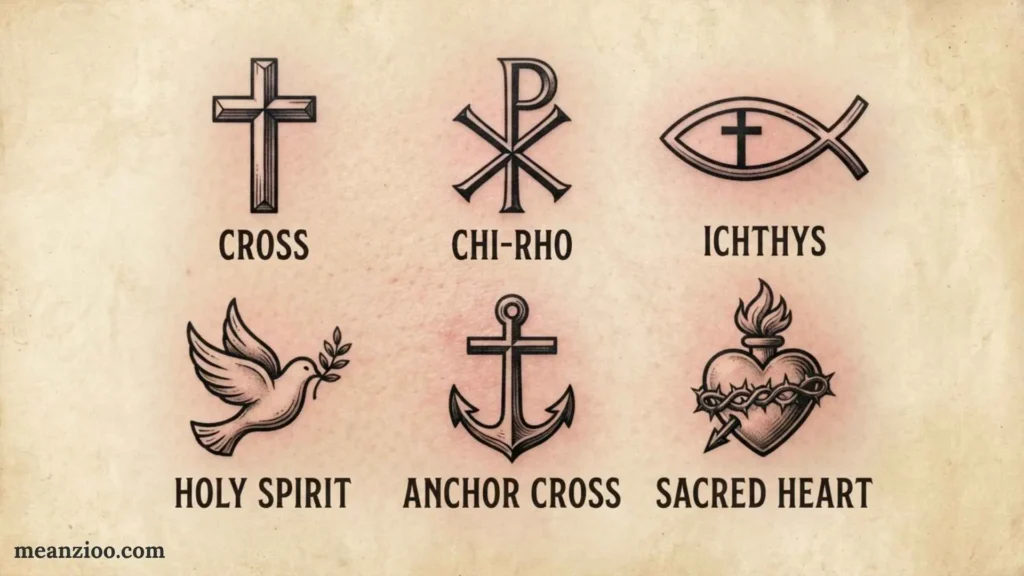
Christian symbols are popular tattoo designs because many can communicate faith through a simple visual form.
Popular choices include:
Cross Tattoos
A cross can represent Christian faith, sacrifice, salvation, or a personal connection with Jesus.
Ichthys Tattoos
The Christian fish provides a simple design associated with Jesus and Christian identity.
Dove Tattoos
A dove may represent the Holy Spirit, peace, hope, or spiritual renewal.
Celtic Cross Tattoos
The Celtic cross can represent Christian faith along with a connection to Celtic Christian heritage.
Bible Verse and Symbol Tattoos
Some people combine a Christian symbol with a meaningful Bible verse, date, name, or other personal element.
Christian Symbols for Jewelry
Christian symbolism is frequently used in necklaces, rings, bracelets, and medals.
Common designs include:
- Cross pendants
- Crucifixes
- Ichthys necklaces
- Dove pendants
- Celtic crosses
- Chi-Rho jewelry
- IHS designs
- Saint medals
- Scripture-inspired jewelry
The meaning of the jewelry depends on both the symbol and the person wearing it.
Christian Symbols in Churches
Christian symbols are an important part of church architecture and decoration.
You may find them in:
- Stained-glass windows
- Altars
- Crosses
- Baptismal fonts
- Pulpits
- Church doors
- Mosaics
- Paintings
- Statues
- Memorials
A single church may combine several symbols to communicate different aspects of Christian belief.
Why Does Christianity Use Symbols?
Symbols allow complex religious ideas to be communicated visually.
A cross can immediately point to the crucifixion. A dove can recall the Holy Spirit. A shepherd can communicate Christ’s care, while an anchor can express hope.
Symbols also became important because visual art could communicate religious stories and concepts to people regardless of their literacy.
Christian symbolism therefore developed through both Scripture and centuries of Christian art, worship, and culture.
Quick Reference: Christian Symbols and Meanings
| Christian Symbol | Common Meaning |
| Cross | Crucifixion, salvation, sacrifice |
| Crucifix | Christ’s crucifixion |
| Ichthys | Jesus Christ, Christian identity |
| Dove | Holy Spirit, peace |
| Lamb | Christ, sacrifice, redemption |
| Chi-Rho | Christ |
| Alpha and Omega | Eternity, beginning and end |
| Anchor | Hope and steadfastness |
| Crown | Kingship, victory, glory |
| Crown of Thorns | Christ’s suffering |
| Vine | Christ, spiritual connection |
| Grapes | Wine, Communion, fruitfulness |
| Chalice | Communion and Eucharist |
| Bible | Scripture and God’s Word |
| Good Shepherd | Christ’s care and guidance |
| IHS | Jesus |
| Celtic Cross | Celtic Christian heritage |
| Jerusalem Cross | Historical Christian symbolism associated with Jerusalem |
| Triquetra | Trinity in Christian usage |
| Peacock | Immortality in early Christian art |
| Phoenix | Resurrection and renewal in historical symbolism |
| Rooster | Peter’s denial and repentance |
| Pelican | Self-sacrifice in historical Christian art |
| Sacred Heart | Christ’s love and devotion |
Frequently Asked Questions About Symbols for Christianity
What is the main symbol of Christianity?
The cross is the most widely recognized symbol of Christianity. It represents the crucifixion of Jesus Christ and is closely associated with Christian beliefs about salvation, sacrifice, redemption, and resurrection.
What are the five main symbols of Christianity?
Five widely recognized Christian symbols are the cross, fish, dove, lamb, and Chi-Rho. They are associated with Jesus’ crucifixion, Christian identity, the Holy Spirit, Christ as the Lamb of God, and Christ’s name.
What symbol represents Jesus?
Several symbols represent Jesus in Christian tradition, including the cross, Ichthys, Chi-Rho, Lamb of God, Good Shepherd, IHS, and vine. The cross is the most broadly recognized.
What symbol represents Christian faith?
The cross is the most recognizable symbol of Christian faith. The anchor is also historically associated with hope and steadfastness, while the Ichthys is associated with Christian identity.
What is the Christian symbol for hope?
The anchor is a traditional Christian symbol of hope. Its association with hope is connected with the imagery found in Hebrews 6:19.
What is the Christian symbol for peace?
The dove is commonly associated with peace in Christian symbolism. It also represents the Holy Spirit because of its connection with Jesus’ baptism.
What does the Christian fish symbol mean?
The Christian fish, or Ichthys, is an ancient Christian symbol associated with Jesus Christ and Christian identity. It became especially important in early Christian history.
What does the cross symbolize?
The cross represents the crucifixion of Jesus Christ and is associated with sacrifice, redemption, salvation, forgiveness, and resurrection within Christian belief.
What does the lamb symbolize in Christianity?
The lamb is associated with Jesus as the Lamb of God. It can symbolize Christ, sacrifice, innocence, redemption, and salvation.
What does Alpha and Omega mean?
Alpha and Omega are the first and last letters of the Greek alphabet. In Christian symbolism, they communicate ideas of eternity, completeness, and the beginning and end.
What does the dove mean in Christianity?
The dove is primarily associated with the Holy Spirit. It can also represent peace, purity, hope, and God’s spiritual presence.
What does the anchor mean in Christianity?
The anchor is traditionally associated with hope, stability, perseverance, and steadfast faith. It also has a biblical connection with hope in Hebrews 6:19.
Is the Celtic cross a Christian symbol?
Yes. The Celtic cross is widely used as a Christian symbol and is strongly associated with Celtic Christian heritage. Its exact historical symbolism can vary.
Are Christian symbols mentioned in the Bible?
Some have direct biblical connections, such as the cross, dove, lamb, vine, and anchor imagery. Other symbols developed later through Christian history, art, and tradition.
What symbol represents the Holy Spirit?
The dove is the most recognizable Christian symbol of the Holy Spirit. Fire, wind, and light are also used in Christian imagery connected with the Holy Spirit.
What symbol represents the Trinity?
The triquetra is sometimes used as a Christian symbol of the Trinity. Other representations include the Trinity Shield and three-part designs.
Final Thoughts
The symbols for Christianity form a rich visual language built from Scripture, early Christian history, church tradition, and religious art. The cross remains the central and most recognizable symbol, while the Ichthys, dove, lamb, Chi-Rho, anchor, Alpha and Omega, Good Shepherd, vine, and other symbols communicate different aspects of Christian belief.
Some symbols have direct biblical connections, while others developed later within particular Christian traditions. Their meanings can also differ between Catholic, Orthodox, Protestant, and other Christian communities.
Understanding the history and context behind each symbol makes Christian symbolism easier to recognize and appreciate. Whether you are researching Christian symbols and meanings, choosing religious artwork, studying church history, or looking for a meaningful Christian design, these symbols provide a useful starting point.

I’m Ryan Mitchell, and I write about modern English, trending slang, and online expressions. I enjoy explaining the meanings, origins, and real-life usage of popular words in a simple way. I believe learning slang is an important step toward understanding today’s English-speaking culture. Through my work, I aim to help readers speak more naturally and stay updated with the latest language trends.