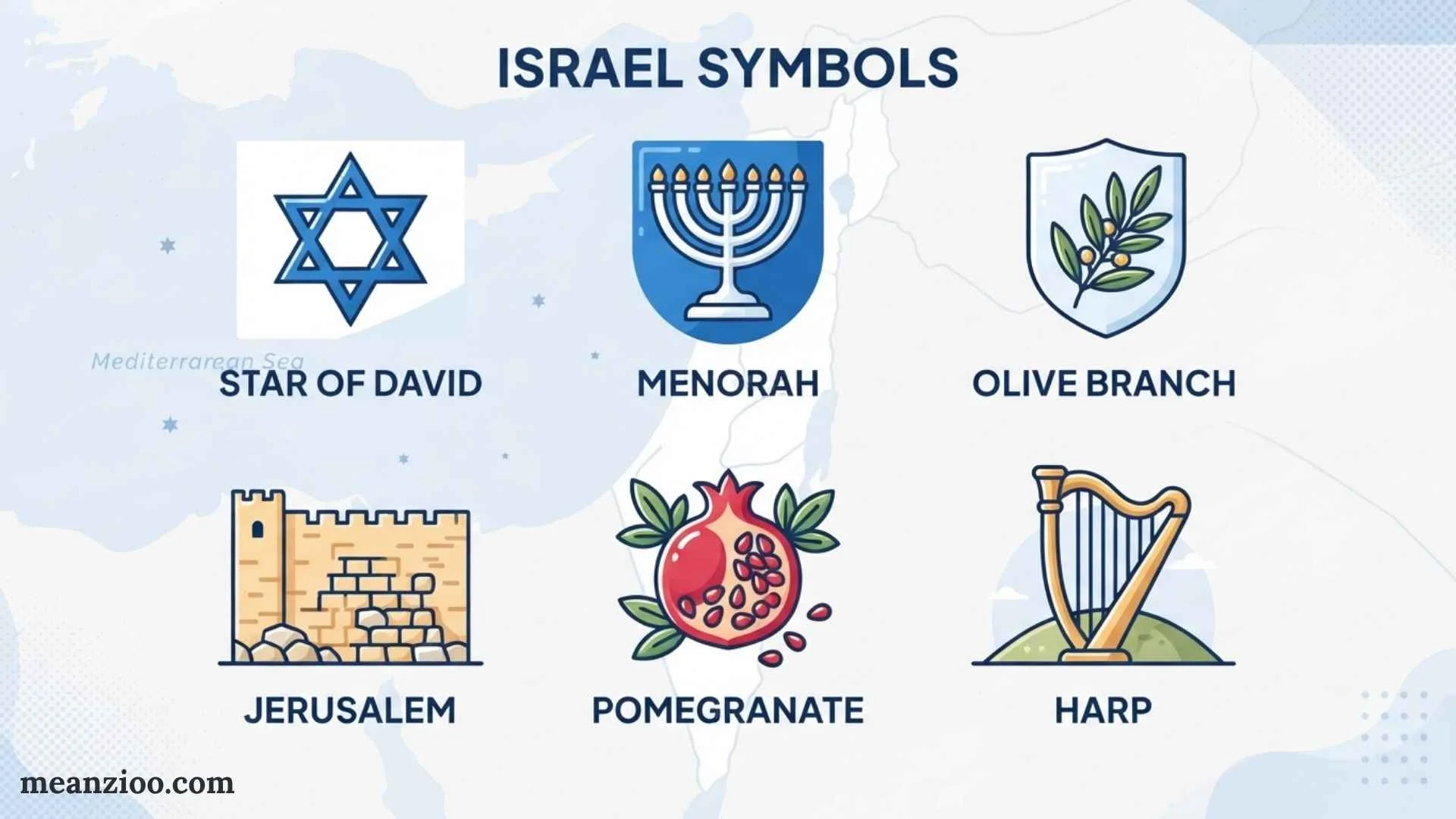
Israel has a wide range of symbols connected with its national identity, Jewish heritage, religion, history, culture, language, nature, and important landmarks. Some are official symbols of the State of Israel, while others are Jewish or cultural symbols that have become strongly associated with Israel.
The best-known Israel symbols include the Israeli flag, Star of David, seven-branched menorah, olive branches, and Hatikvah. Other familiar images include the Lion of Judah, shofar, Torah scroll, Western Wall, Hebrew letters, olive tree, pomegranate, and the Israeli gazelle.
Knowing the difference between an official Israeli symbol and a broader Jewish or cultural symbol is important. The Israeli flag, state emblem, and national anthem have official status, while many other symbols have religious, historical, or cultural significance.
This guide explains the major symbols of Israel, their meanings, history, colors, national nature symbols, landmarks, and common questions people ask about Israeli and Jewish symbolism.
What Are the Main Symbols of Israel?
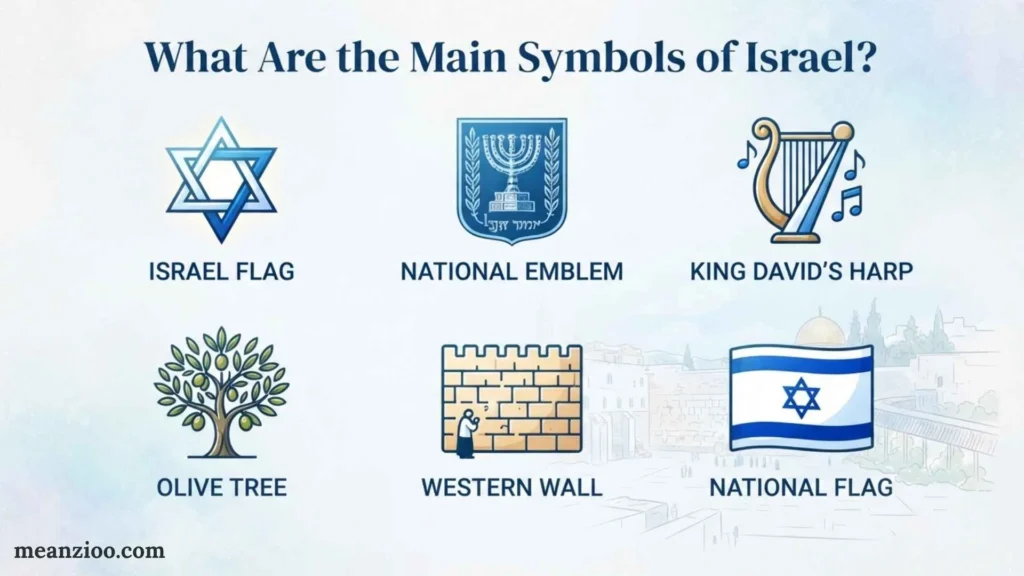
The principal official national symbols of Israel are the national flag, state emblem, and national anthem.
The Israeli flag features a white background, two blue horizontal stripes, and a blue Star of David. The state emblem features a seven-branched menorah surrounded by olive branches, with the Hebrew word for Israel below it. The national anthem is Hatikvah, meaning “The Hope.”
Other widely recognized symbols include:
- Star of David
- Menorah
- Olive branches
- Lion of Judah
- Shofar
- Torah
- Western Wall
- Jerusalem
- Hebrew alphabet
- Olive tree
- Pomegranate
- Israeli gazelle
- Hoopoe
- Anemone
Not all of these are official state symbols. Some belong to Jewish religious tradition, while others are cultural, historical, or natural symbols.
Israeli Flag
The Israeli flag is one of the most recognizable symbols of the country.
It has a white background with two horizontal blue stripes and a blue six-pointed Star of David in the center.
The design connects modern Israel with Jewish religious and cultural heritage.
What Do the Blue and White Colors Mean?
Blue and white have long been associated with Jewish tradition. The design of the flag’s stripes is connected with the tallit, the Jewish prayer shawl.
The white background and blue stripes therefore create a visual connection between the modern Israeli state and Jewish heritage.
What Does the Star on the Israeli Flag Mean?
The star is the Star of David, known in Hebrew as Magen David.
It became a widely recognized symbol of Jewish identity before the establishment of the modern State of Israel. Its inclusion on the national flag gives it an important national as well as Jewish association.
Star of David
The Star of David is one of the most famous symbols associated with Israel and Judaism.
It consists of two overlapping triangles that create a six-pointed star.
The symbol is commonly associated with:
- Jewish identity
- Judaism
- Israel
- Jewish heritage
- Community
- Historical identity
The Star of David was not created specifically for the modern State of Israel. Its association with Jewish communities developed over a long historical period.
Today, it is used on the Israeli flag and appears in synagogues, Jewish artwork, jewelry, memorials, books, and cultural designs.
Menorah
The menorah is one of the oldest and most important symbols associated with Jewish history.
The seven-branched menorah is described in the Book of Exodus and was associated with the ancient Temple in Jerusalem.
The modern Israeli state emblem features a seven-branched menorah.
The menorah can represent:
- Jewish history
- Jerusalem
- The ancient Temple
- Jewish heritage
- Light
- Continuity
Seven-Branched Menorah vs. Hanukkah Menorah
The seven-branched menorah should not be confused with the hanukkiah, the nine-branched lamp used during Hanukkah.
The traditional Temple menorah has seven branches.
A hanukkiah has eight lights plus a separate shamash light used to light the others.
Both are Jewish symbols, but they have different historical and religious functions.
Israel State Emblem
The state emblem of Israel is an official national symbol.
Its central design contains a seven-branched menorah based on the ancient Temple menorah. Two olive branches surround the menorah, and the Hebrew word for Israel appears below it.
The emblem connects the modern state with ancient Jewish history.
What Do the Parts of the Emblem Mean?
Menorah: Connects the state with ancient Jewish and Temple history.
Olive branches: Represent peace and the desire for peace.
Hebrew word “Israel”: Identifies the state represented by the emblem.
The emblem can be found on official government materials, documents, institutions, and public buildings.
Olive Branches
The olive branch is an important symbol in Israel’s official emblem.
Olive branches traditionally symbolize peace. In the Israeli state emblem, they surround the menorah and create a visual combination of ancient Jewish heritage and the aspiration for peace.
The olive tree itself also has deep roots in the landscape, agriculture, history, and culture of the region.
Olive imagery can therefore have several meanings depending on context:
- Peace
- Agriculture
- Land
- Heritage
- Continuity
- Regional culture
Hatikvah
Hatikvah, meaning “The Hope,” is the national anthem of Israel.
It expresses a historical aspiration for Jewish national renewal and a homeland in the Land of Israel.
The anthem is a national symbol rather than a visual symbol. It is used during official ceremonies, national events, and other occasions representing the State of Israel.
The text originated in the nineteenth century with poet Naftali Herz Imber, and the melody later associated with the anthem was arranged from a musical tradition used by Samuel Cohen.
National Colors of Israel
Israel’s most recognizable national colors are blue and white.
They appear prominently on the national flag and are strongly connected with Jewish tradition.
Blue
Blue is historically associated with Jewish religious tradition, including the blue thread known as tekhelet and the tallit.
White
White forms the background of the Israeli flag and contributes to the traditional blue-and-white visual identity.
Together, blue and white are strongly associated with:
- Israel
- Jewish identity
- The Israeli flag
- Jewish cultural heritage
Lion of Judah
The Lion of Judah is a biblical symbol associated with the alternative of Judah.
The image comes from biblical references to Judah as a lion and has been used in Jewish and Christian traditions.
It can represent:
- Judah
- Strength
- Royal heritage
- Biblical history
- Jewish identity
The Lion of Judah is important in Jewish symbolism but is not the official state emblem of Israel.
Shofar
The shofar is a ram’s horn used in Jewish religious practice.
It has a particularly important role during Rosh Hashanah and is also associated with other religious occasions.
The shofar can symbolize:
- Repentance
- Spiritual awakening
- Religious tradition
- Worship
- Jewish heritage
Although strongly connected with Jewish culture and religion in Israel, the shofar is not an official national symbol of the State of Israel.
Torah Scroll
The Torah scroll is central to Judaism and Jewish religious life.
The Torah contains the Five Books of Moses and is traditionally handwritten by a trained scribe on parchment.
As a symbol, the Torah represents:
- Jewish Scripture
- Religious learning
- Jewish law
- Tradition
- Faith
- Continuity
The Torah is an important Jewish symbol in Israel, but it is not one of the official national symbols of the state.
Western Wall
The Western Wall, known in Hebrew as the Kotel, is one of the most important Jewish religious and historical sites in Jerusalem.
It is not an official national symbol, but it is widely recognized as a symbol of:
- Jerusalem
- Jewish history
- Jewish prayer
- Religious heritage
- Connection with the Temple
The Western Wall frequently appears in cultural imagery representing Jerusalem and Jewish heritage.
Jerusalem as a Symbol
Jerusalem has exceptional historical and religious significance.
It is important to Judaism, Christianity, and Islam and contains numerous sacred sites.
For Judaism, Jerusalem has a central place in biblical and Temple history.
For Israel, Jerusalem is also deeply connected with national institutions and modern statehood.
Images of Jerusalem may include:
- Western Wall
- Old City
- Dome of the Rock
- City walls
- Temple Mount
- Menorah
- Ancient stone architecture
These images can represent the city’s religious and historical significance, although they are not all official symbols of the State of Israel.
Hebrew Language as a Symbol
Hebrew is an important cultural symbol of Israel.
Modern Hebrew is widely used in everyday life, education, government, literature, media, and public communication.
The revival and development of modern Hebrew created an important connection between ancient Jewish textual traditions and modern Israeli society.
Hebrew can therefore symbolize:
- Jewish heritage
- Language
- Culture
- History
- Israeli identity
- Continuity
Hebrew Alphabet
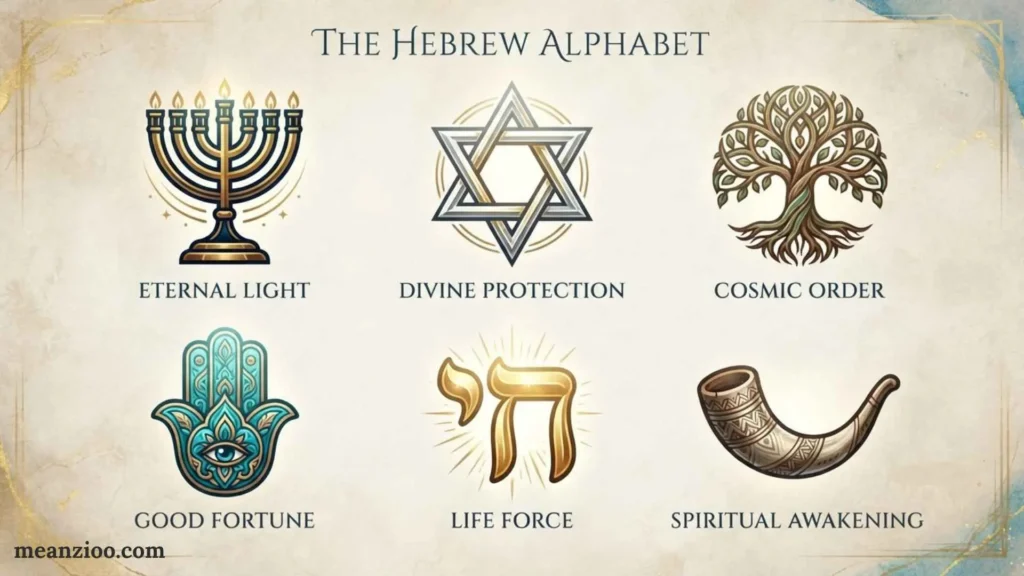
The Hebrew alphabet is often used in designs representing Israel and Jewish culture.
Hebrew letters appear on:
- Religious texts
- Synagogue decorations
- Jewelry
- Artwork
- Israeli signs
- Cultural materials
- Memorials
Individual Hebrew letters can have religious interpretations in some traditions, but the alphabet itself is primarily a language and cultural symbol rather than an official state emblem.
Pomegranate
The pomegranate has a long history in Jewish culture.
Pomegranates appear in biblical imagery and Jewish decorative traditions. The fruit has been associated with abundance and religious symbolism.
Pomegranate designs can be found in:
- Jewish artwork
- Religious objects
- Textiles
- Ceramics
- Jewelry
- Decorative architecture
The pomegranate is a Jewish cultural and religious symbol rather than an official national symbol of Israel.
Olive Tree
The olive tree is strongly connected with the land and culture of the eastern Mediterranean.
Olive cultivation has a long history in the region, and olive branches appear in Israel’s official state emblem.
The olive tree can symbolize:
- Peace
- Land
- Agriculture
- Longevity
- Cultural heritage
- Continuity
Its meaning depends on the context.
Dove
The dove is widely recognized as a symbol of peace.
It is not an official Israeli national symbol, but it can appear in Israeli, Jewish, and broader Middle Eastern peace imagery.
The dove is often shown together with an olive branch, creating a widely understood visual message of peace.
Sabra
The sabra is a cactus fruit and plant strongly associated with Israeli culture.
The word sabra also became a cultural term for a person born in Israel.
The plant is known for its prickly exterior and sweet fruit. This contrast became a metaphor for an Israeli person perceived as tough on the outside and softer or warmer inside.
The sabra is therefore an interesting example of a cultural symbol of Israeli identity, rather than an official national emblem.
Israeli National Bird
The hoopoe was selected as Israel’s national bird in a nationwide public process in 2008.
The bird is found in Israel and is recognizable by its distinctive crown-like crest.
As a national nature symbol, the hoopoe represents Israel’s natural environment and biodiversity.
It should be distinguished from the official state symbols such as the flag and emblem.
Israeli National Animal
The Israeli gazelle is commonly identified as Israel’s national animal.
The animal is native to the region and has become associated with Israel’s natural heritage and wildlife conservation.
The gazelle represents the country’s native wildlife and natural landscapes rather than its political institutions.
Israel’s National Flower
The anemone is commonly recognized as Israel’s national flower.
Anemones are found across parts of the country and are especially noticeable during the flowering season.
The flower provides a connection between Israeli national identity and the country’s natural landscape.
Israel’s National Symbols of Nature
Israel’s commonly recognized nature symbols include:
| Nature Symbol | Meaning or Association |
| Hoopoe | National bird and Israeli wildlife |
| Israeli gazelle | Native wildlife and natural heritage |
| Anemone | National flower and natural landscape |
| Olive tree | Land, agriculture, peace, heritage |
| Sabra cactus | Israeli cultural identity |
| Pomegranate | Jewish and regional cultural heritage |
These symbols are different from Israel’s formal state symbols but are useful when studying Israeli culture.
Official Israeli Symbols vs. Jewish Symbols
This distinction is important.
Official Israeli Symbols
The main official national symbols include:
- National flag
- State emblem
- National anthem
The flag contains the Star of David, while the state emblem contains the seven-branched menorah and olive branches.
Jewish Religious Symbols
Jewish religious symbols include:
- Torah
- Menorah
- Shofar
- Tallit
- Mezuzah
- Star of David
- Hebrew religious imagery
Some of these also appear in Israeli national culture.
Cultural Symbols of Israel
Cultural symbols may include:
- Sabra
- Olive tree
- Hebrew language
- Jerusalem
- Western Wall
- Israeli wildlife
- National foods and traditions
These categories overlap, but they should not be treated as identical.
Israel Symbols vs. Jewish Symbols vs. Biblical Symbols
| Category | Examples | Main Connection |
| Israeli national symbols | Flag, state emblem, Hatikvah | Modern State of Israel |
| Jewish symbols | Star of David, Torah, menorah, shofar | Judaism and Jewish identity |
| Biblical symbols | Lion of Judah, pomegranate, olive imagery | Hebrew Bible and Jewish tradition |
| Cultural symbols | Sabra, Hebrew, Jerusalem | Israeli culture and identity |
| Nature symbols | Hoopoe, gazelle, anemone | Israel’s natural environment |
A symbol can belong to more than one category. For example, the Star of David is a Jewish symbol and also appears on the Israeli national flag.
Symbols of Israel for School Projects
If you are preparing a school project about Israel, you can organize the symbols into clear groups.
Official Symbols
Use:
- Israeli flag
- State emblem
- Hatikvah
Religious and Historical Symbols
Use:
- Star of David
- Menorah
- Torah
- Shofar
- Western Wall
- Lion of Judah
Cultural Symbols
Use:
- Hebrew alphabet
- Hebrew language
- Sabra
- Olive tree
- Pomegranate
Nature Symbols
Use:
- Hoopoe
- Israeli gazelle
- Anemone
This structure makes it easier to explain which symbols represent the modern state and which represent broader Jewish or Israeli culture.
Israel Symbols for Tattoos
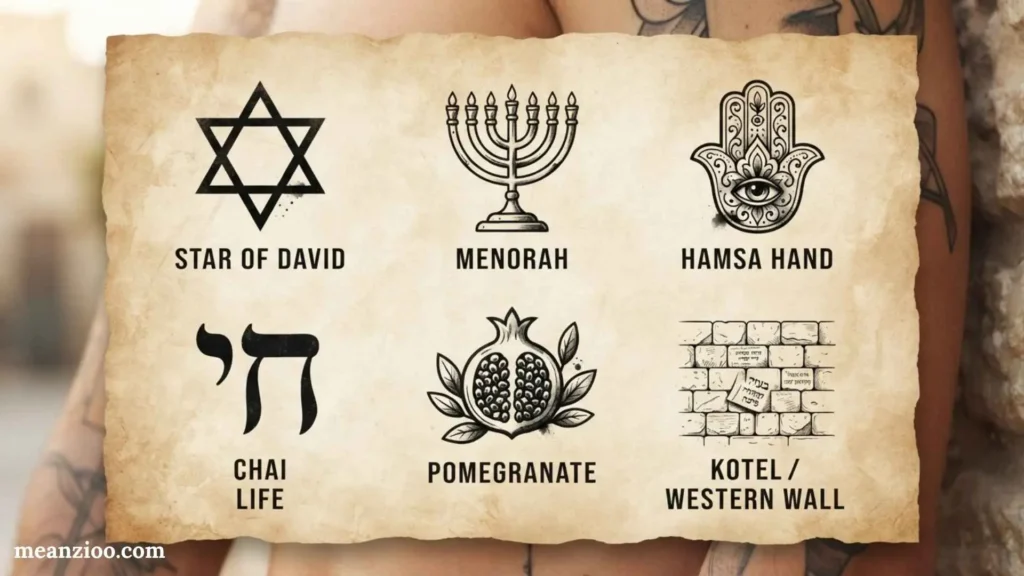
Israeli and Jewish symbols are sometimes used in tattoos to express religious faith, family heritage, cultural identity, or a personal connection with Israel.
Popular designs include:
- Star of David
- Israeli flag
- Menorah
- Hebrew words
- Hebrew names
- Jerusalem skyline
- Western Wall
- Lion of Judah
- Olive branch
- Shofar
The meaning of a tattoo is personal, so the same symbol can communicate different ideas for different people.
Israel Symbols for Jewelry
Common Israeli and Jewish-inspired jewelry designs include:
- Star of David necklaces
- Menorah pendants
- Hebrew-letter jewelry
- Hamsa designs
- Lion of Judah jewelry
- Jerusalem pendants
- Israeli flag designs
- Olive branches
The Star of David is particularly recognizable because of its connection with both Jewish identity and Israel’s national flag.
What Does Each Israel Symbol Mean?
Here is a quick reference guide:
| Symbol | Common Meaning |
| Israeli flag | National identity |
| Star of David | Jewish identity and Israel |
| Menorah | Jewish history and Temple heritage |
| Olive branches | Peace |
| Hatikvah | Hope and national renewal |
| Lion of Judah | Judah and biblical heritage |
| Shofar | Repentance and Jewish worship |
| Torah | Scripture, faith, and tradition |
| Western Wall | Jerusalem and Jewish history |
| Hebrew | Language and cultural continuity |
| Pomegranate | Jewish cultural heritage and abundance |
| Olive tree | Land, peace, and agriculture |
| Dove | Peace |
| Sabra | Israeli cultural identity |
| Hoopoe | Israeli nature and national bird |
| Gazelle | Native wildlife |
| Anemone | Israeli natural landscape |
Why Are Symbols Important in Israel?
Symbols help connect the present with history.
The Israeli flag combines a modern national identity with Jewish symbolism. The state emblem uses the ancient menorah and olive branches. Hatikvah expresses historical hope through music and words.
Jewish religious symbols such as the Torah and shofar connect people with religious tradition, while cultural symbols such as Hebrew and the sabra connect with modern Israeli life.
Natural symbols such as the gazelle and hoopoe provide another way of representing the country’s landscape and biodiversity.
Frequently Asked Questions About Israel Symbols
What are the three official symbols of Israel?
The three principal official national symbols are the Israeli flag, the state emblem, and Hatikvah, the national anthem.
What is the most famous symbol of Israel?
The Star of David is one of the most recognizable symbols associated with Israel. It appears in the center of the Israeli national flag.
What does the Star of David mean?
The Star of David is widely associated with Jewish identity and heritage. Its presence on the Israeli flag also gives it a strong association with the State of Israel.
What is Israel’s official emblem?
Israel’s state emblem features a seven-branched menorah surrounded by olive branches, with the Hebrew word for Israel beneath it.
What does the menorah symbolize in Israel?
The seven-branched menorah connects modern Israel with ancient Jewish history and the Temple in Jerusalem.
What do the olive branches on Israel’s emblem mean?
The olive branches are associated with peace and the aspiration for peace.
What do the colors of Israel’s flag mean?
The blue-and-white design is connected with Jewish tradition, particularly the tallit, or Jewish prayer shawl.
What is Israel’s national anthem?
Israel’s national anthem is Hatikvah, which means “The Hope.”
Is the Lion of Judah an official symbol of Israel?
No. The Lion of Judah is an important biblical and Jewish symbol, but it is not the official state emblem of Israel.
Is the Torah an Israeli symbol?
The Torah is a central Jewish religious symbol and is deeply connected with Jewish heritage in Israel, but it is not one of the official national symbols of the State of Israel.
Is the Western Wall a symbol of Israel?
The Western Wall is an important religious and historical symbol associated with Jerusalem and Jewish heritage, but it is not an official state symbol.
What is Israel’s national bird?
The hoopoe was selected as Israel’s national bird in 2008.
What is Israel’s national animal?
The Israeli gazelle is commonly identified as Israel’s national animal.
What is Israel’s national flower?
The anemone is commonly recognized as Israel’s national flower.
What plant represents Israel?
The olive tree is strongly associated with Israel because of its agricultural, cultural, biblical, and regional significance. Olive branches also appear in the official state emblem.
What symbol represents peace in Israel?
The olive branches in Israel’s state emblem are associated with peace. The olive branch is also a widely recognized symbol of peace in broader cultures.
What symbol represents Jewish identity?
The Star of David is one of the most widely recognized symbols of Jewish identity. Other important Jewish symbols include the menorah, Torah, shofar, and tallit.
Is the Star of David an Israeli or Jewish symbol?
It is both. The Star of David is a widely recognized Jewish symbol, and it is also an important Israeli national symbol because it appears on the country’s flag.
What is the difference between a menorah and a Hanukkah menorah?
The traditional menorah has seven branches and is associated with the ancient Temple. A Hanukkah menorah, or hanukkiah, has nine lights and is used during Hanukkah.
What does the sabra symbolize?
The sabra is associated with Israeli cultural identity. The term also became a cultural description for people born in Israel.
Why is Hebrew important to Israel?
Hebrew is an important language of Israeli public life and culture. It also creates a connection between modern Israeli society and ancient Jewish textual traditions.
Final Thoughts
The Israel symbols people recognize today come from several different sources. Official state symbols include the Israeli flag, state emblem, and national anthem Hatikvah. The flag features the Star of David, while the state emblem features a seven-branched menorah and olive branches.
Other symbols, including the Torah, shofar, Lion of Judah, Western Wall, Hebrew alphabet, pomegranate, olive tree, and Jerusalem, belong to broader Jewish, religious, historical, or cultural traditions.
Israel’s natural symbols add another dimension. The hoopoe, Israeli gazelle, anemone, olive tree, and sabra connect national and cultural identity with the country’s landscape and wildlife.
Understanding these differences makes it easier to explore Israeli symbols and meanings, Jewish symbols, Israel national symbols, symbols of Judaism, and cultural symbols of Israel accurately and with the proper historical context.

I’m Ryan Mitchell, and I write about modern English, trending slang, and online expressions. I enjoy explaining the meanings, origins, and real-life usage of popular words in a simple way. I believe learning slang is an important step toward understanding today’s English-speaking culture. Through my work, I aim to help readers speak more naturally and stay updated with the latest language trends.
 Charlotte Hayes