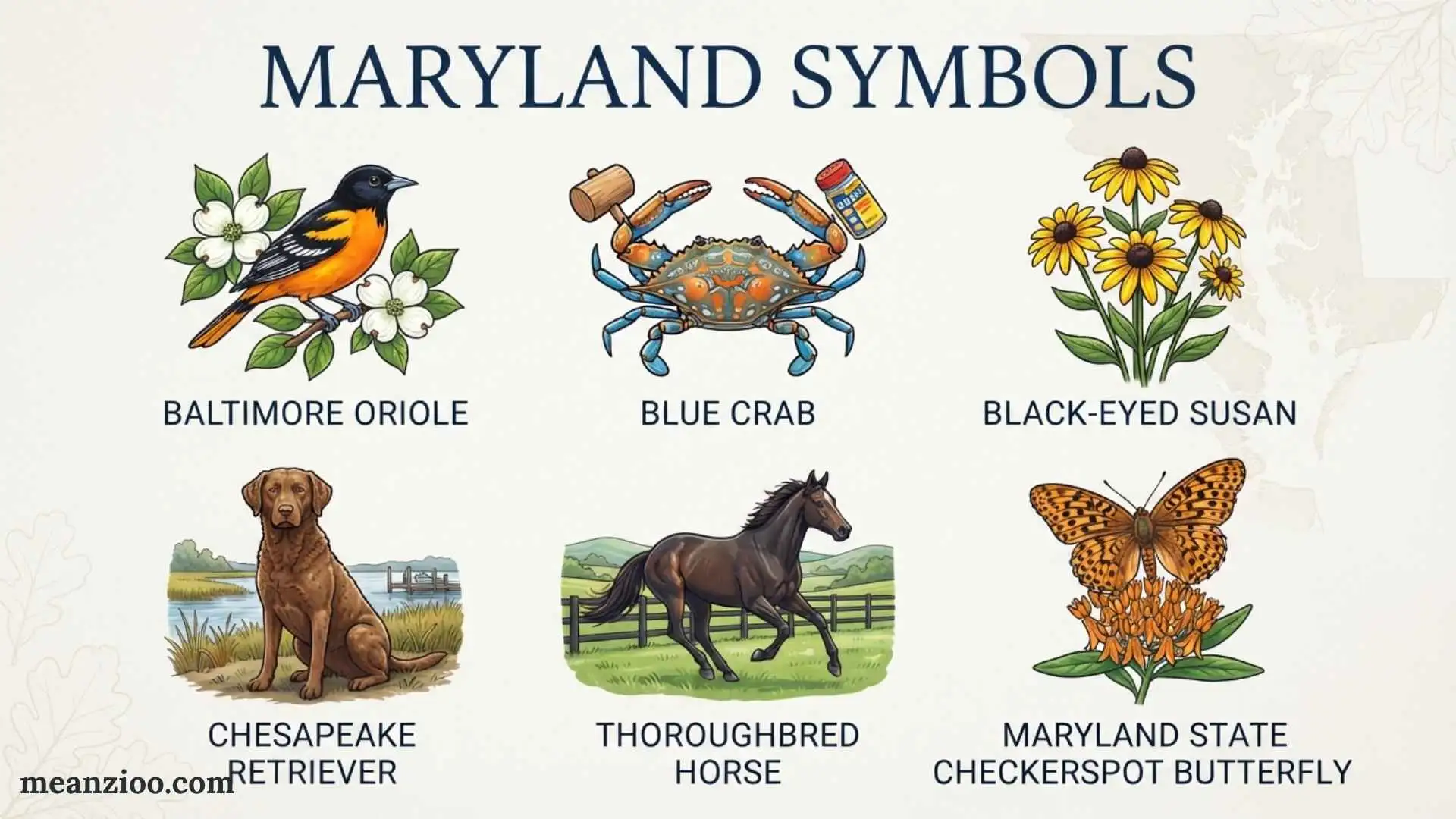
Maryland symbols represent the state’s history, natural environment, Chesapeake Bay culture, traditions, food, sports, wildlife, and heritage. From the colorful Maryland State Flag and Great Seal to the Baltimore Oriole, Black-Eyed Susan, Diamondback Terrapin, Chesapeake Bay Retriever, and Blue Crab, each official designation tells part of Maryland’s story.
Maryland has a wide range of official state symbols. The Maryland State Archives currently lists categories including the bird, boat, cat, cocktail, crustacean, dessert, dinosaur, dog, drink, exercise, fish, flag, flower, folk dance, fossil shell, gem, horse, insect, mineral, reptile, seal, song, spirit, sport, theaters, and tree.
This guide provides a detailed Maryland symbols list, explains what each symbol represents, and includes important updates so you do not confuse older information with Maryland’s current designations.
What Are Maryland Symbols?
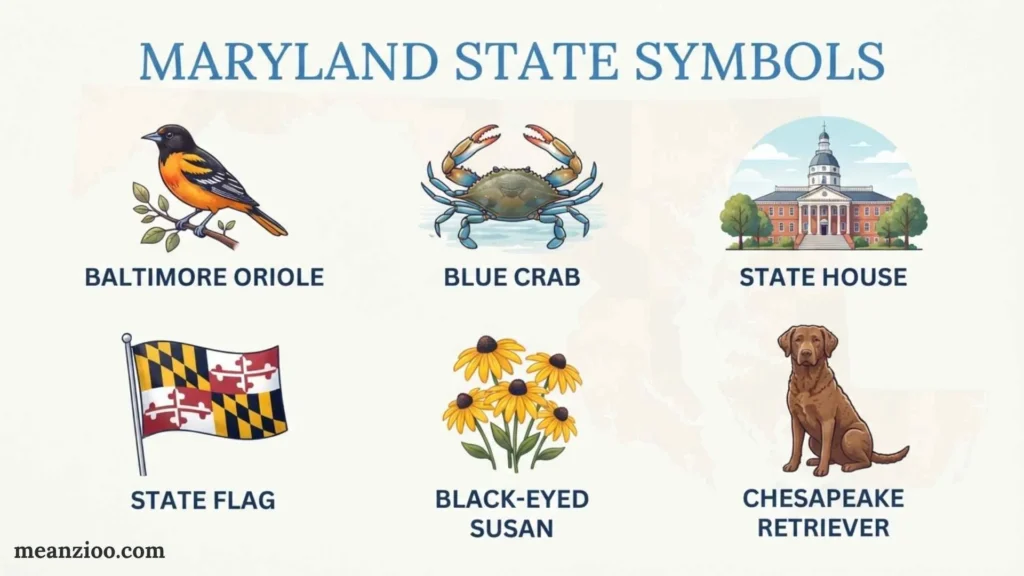
Maryland symbols are official designations established by state law to represent different aspects of Maryland.
They cover much more than animals and plants. Maryland has official symbols connected with:
- History
- Government
- Wildlife
- Chesapeake Bay
- Agriculture
- Food
- Drinks
- Sports
- Transportation
- Geology
- Music
- Dance
- Theater
- Natural history
The Maryland State Archives notes that these designations are found in Maryland law, primarily within the General Provisions Article.
Maryland State Symbols List
Here is a quick reference to major Maryland symbols and their designations.
| Category | Maryland Symbol | Designated |
| State Flag | Maryland State Flag | 1904 |
| State Flower | Black-Eyed Susan | 1918 |
| State Tree | White Oak | 1941 |
| State Bird | Baltimore Oriole | 1947 |
| State Dog | Chesapeake Bay Retriever | 1964 |
| State Fish | Rockfish / Striped Bass | 1965 |
| State Sport | Jousting | 1962 |
| State Insect | Baltimore Checkerspot Butterfly | 1973 |
| State Theaters | Center Stage & Olney Theatre | 1978 |
| State Fossil Shell | Ecphora | 1994 |
| State Folk Dance | Square Dance | 1994 |
| State Reptile | Diamondback Terrapin | 1994 |
| State Dinosaur | Astrodon johnstoni | 1998 |
| State Drink | Milk | 1998 |
| State Cat | Calico Cat | 2001 |
| State Gem | Patuxent River Stone | 2004 |
| State Team Sport | Lacrosse | 2004 |
| State Horse | Thoroughbred Horse | 2003 |
| State Dessert | Smith Island Cake | 2008 |
| State Exercise | Walking | 2008 |
| State Crustacean | Blue Crab | 1989 |
| State Spirit | Maryland Rye Whiskey | 2023 |
| State Mineral | Chromite | 2025 |
| State Cocktail | Maryland Orange Crush | 2025 |
The Maryland State Archives’ official symbol list includes these categories, while individual Maryland Manual pages provide the designation dates and background for the symbols.
Maryland State Flag
The Maryland State Flag is one of the state’s most recognizable symbols.
The flag combines the arms of two historic families: the Calvert and Crossland families. The gold-and-black pattern represents the Calvert family, while the red-and-white design with the cross bottony represents the Crossland family.
The Calverts were the family of the Lords Baltimore, who were closely connected with the founding and early history of Maryland.
The flag was officially adopted as Maryland’s state flag in 1904. It had appeared publicly before that, including at an 1880 Baltimore parade and at Gettysburg in 1888.
What Do the Maryland Flag Colors Mean?
The Maryland flag uses four major colors:
- Gold
- Black
- Red
- White
The gold and black portions come from the Calvert arms, while the red and white portions come from the Crossland arms. Therefore, the colors are connected to Maryland’s colonial and family history rather than being arbitrary color choices.
Great Seal of Maryland
The Great Seal of Maryland is an official government symbol used to authenticate official state documents and acts.
The seal incorporates the Calvert and Crossland arms and includes imagery associated with Maryland’s colonial history.
On the reverse, a farmer and fisherman support the shield. The Maryland State Archives explains that these figures represent Lord Baltimore’s two estates: Maryland and Avalon in Newfoundland.
The seal also includes the date 1632, referring to the year Charles I granted the Maryland charter to Cecilius Calvert, the second Lord Baltimore.
Maryland State Motto
The Calvert motto shown on the seal is:
“Fatti maschii parole femine”
It is generally translated as “strong deeds, gentle words.” Maryland law addressed the motto on the state seal in 2017.
This motto is an important part of Maryland’s historical symbolism.
Maryland State Bird
The Baltimore Oriole is Maryland’s official state bird.
It was designated in 1947. Its striking black and orange coloring also connects visually with the gold-and-black colors associated with Maryland’s Calvert heritage.
The Baltimore Oriole is also strongly associated with the city of Baltimore, which helped reinforce its place in Maryland’s identity.
Maryland State Flower
The Black-Eyed Susan is Maryland’s official state flower.
It became the state flower in 1918. Its scientific name is Rudbeckia hirta, and it belongs to the sunflower family.
The flower has bright yellow petals surrounding a dark central disk. It is commonly associated with fields, roadsides, gardens, and Maryland’s natural landscape.
For students, the Black-Eyed Susan is one of the easiest Maryland symbols to recognize.
Maryland State Tree
The White Oak is Maryland’s official state tree.
White oak trees are important native trees in the eastern United States and are associated with Maryland’s forests and natural environment.
As a state symbol, the White Oak represents Maryland’s woodland heritage and natural resources.
Maryland State Dog
The Chesapeake Bay Retriever is Maryland’s official state dog.
The breed has a particularly strong connection with the Chesapeake Bay. It was developed as a working water dog and became known for retrieving waterfowl in the region.
Its connection with the Bay makes it an especially appropriate symbol of Maryland’s outdoor and maritime traditions.
Maryland State Fish
Maryland’s state fish is the Rockfish, also known as the Striped Bass.
It was designated the state fish in 1965.
The species has a strong connection with the Chesapeake Bay and Maryland’s fishing culture. It is an important part of the state’s aquatic environment and recreational fishing traditions.
Maryland State Reptile
The Diamondback Terrapin is Maryland’s official state reptile.
It was designated in 1994.
This turtle is closely associated with the Chesapeake Bay and its surrounding coastal environment. Its distinctive diamond-shaped shell markings make it easy to recognize.
The terrapin is also closely connected with Maryland’s cultural identity through the University of Maryland’s Testudo mascot.
Maryland State Insect
The Baltimore Checkerspot Butterfly is Maryland’s official state insect.
It became the state’s official insect symbol in 1973.
The butterfly is recognizable for its dark wings marked with white and orange patterns. It represents Maryland’s native wildlife and natural ecosystems.
Maryland State Crustacean
The Blue Crab is Maryland’s official state crustacean.
The blue crab is one of the strongest symbols of Chesapeake Bay culture. It is associated with Maryland seafood, commercial fishing, recreational crabbing, and the state’s coastal heritage.
For many people, the blue crab is one of the first foods or animals they associate with Maryland.
Maryland State Boat
The Skipjack is Maryland’s official state boat.
It was designated in 1985.
Skipjacks are traditional Chesapeake Bay sailing vessels that became associated with oyster dredging. They represent Maryland’s maritime history and the important role the Chesapeake Bay has played in the state’s economy and culture.
The skipjack is therefore more than a boat—it is a symbol of Maryland’s working-waterfront heritage.
Maryland State Horse
The Thoroughbred Horse is Maryland’s official state horse.
Maryland has a long association with horse breeding and racing. Thoroughbred racing is an important part of the state’s equestrian tradition.
The state’s horse symbol connects Maryland with agriculture, rural history, breeding, racing, and equestrian culture.
Maryland State Sport
Jousting is Maryland’s official state sport.
It became the official sport in 1962. Maryland’s State Archives notes that Maryland was the first state to adopt an official sport.
Modern Maryland jousting is a mounted competition rooted in medieval equestrian traditions. Riders attempt to strike targets while riding horses.
The designation reflects Maryland’s distinctive historical and community traditions.
Maryland State Team Sport
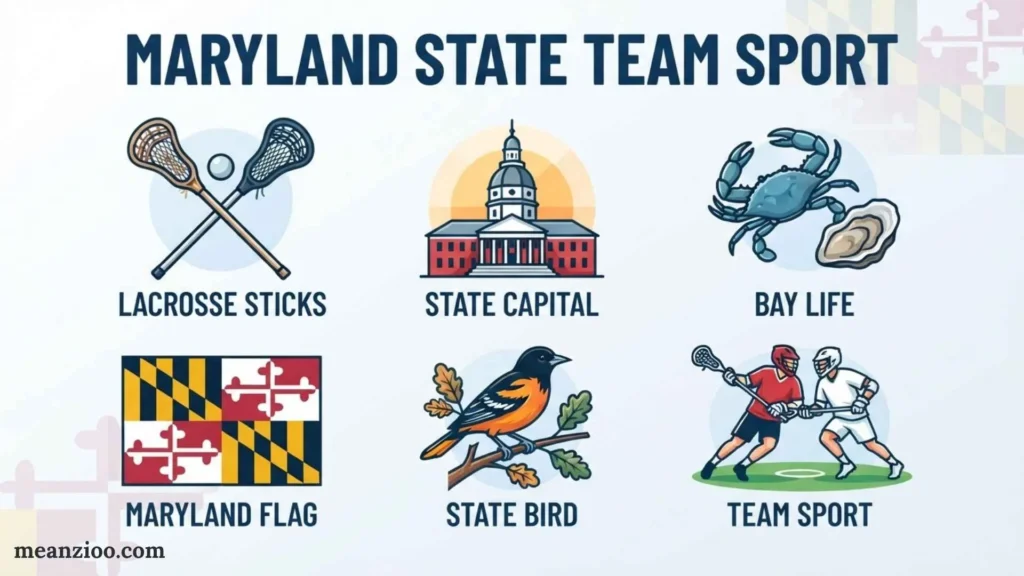
Lacrosse is Maryland’s official team sport.
It became the official team sport in 2004.
Lacrosse has deep Indigenous origins in North America and has a particularly strong modern sporting presence in Maryland. The state has longstanding connections with the sport through schools, colleges, clubs, and professional competition.
This makes lacrosse an important part of Maryland’s modern sports identity.
Maryland State Exercise
Walking is Maryland’s official state exercise.
It was designated in 2008. The Maryland State Archives notes that Maryland became the first state in the nation to designate an official state exercise.
Walking is accessible to people of many ages and can be enjoyed in neighborhoods, parks, trails, and public spaces.
Maryland State Folk Dance
The Square Dance is Maryland’s official state folk dance.
It was designated in 1994.
Square dancing developed from multiple folk-dance traditions and became an important form of community recreation.
Maryland’s designation recognizes the state’s connection with traditional dance and community culture.
Maryland State Dinosaur
The Astrodon johnstoni is Maryland’s official state dinosaur.
It was designated in 1998. The Astrodon lived in Maryland during the Early Cretaceous Period, roughly 95 to 130 million years ago.
The name Astrodon means “star tooth.” Fossils found in Maryland played an important role in the early scientific study of dinosaurs in the United States.
The Astrodon gives Maryland a connection to its prehistoric past.
Maryland State Fossil Shell
Maryland’s official state fossil shell is Ecphora, specifically Ecphora gardnerae gardnerae.
The fossil represents Maryland’s ancient marine environment and geological history.
The Ecphora is particularly interesting because Maryland’s coastal and Chesapeake region contains a rich record of ancient marine fossils.
Maryland State Gem
The Patuxent River Stone is Maryland’s official state gem.
It became the state gem in 2004. Although called a stone, it is actually an agate, a cryptocrystalline form of quartz. It is associated with Maryland and has red and yellow colors that reflect the colors of the Maryland State Flag.
This makes the Patuxent River Stone a symbol that connects geology with Maryland’s visual identity.
Maryland State Mineral
Chromite became Maryland’s official state mineral in 2025 through Chapter 487 of the Acts of 2025.
Chromite is a chromium-bearing mineral. Its designation adds another geological symbol to Maryland’s official collection.
This is an important update because older Maryland symbol lists may not include chromite.
Maryland State Dessert
Smith Island Cake is Maryland’s official state dessert.
It became the state dessert effective October 1, 2008. Traditionally, the cake contains multiple thin layers of yellow cake with chocolate frosting between the layers and over the outside.
Smith Island is Maryland’s last inhabited island and has a distinctive Chesapeake Bay island culture. The cake’s connection with the island helped establish it as a recognizable Maryland food tradition.
Maryland State Drink
Milk is Maryland’s official state drink.
It was designated in 1998.
The designation reflects Maryland’s agricultural and dairy traditions. Dairy farming has historically been an important part of Maryland agriculture, particularly in areas such as Frederick and Washington counties.
Maryland State Spirit
Maryland Rye Whiskey, also called Maryland Rye, is the state’s official spirit.
The General Assembly designated Maryland Rye or Maryland Rye Whiskey as the State Spirit in 2023.
Maryland has a longstanding distilling history, and the designation recognizes the state’s rye-whiskey heritage.
Maryland State Cocktail
The Maryland Orange Crush is Maryland’s official state cocktail.
The General Assembly designated the original Maryland Orange Crush as the State Cocktail in June 2025 under Chapter 487 of the Acts of 2025.
The drink is particularly associated with Maryland’s coastal and summer culture.
Maryland State Theaters
Maryland recognizes two official theater designations:
- Center Stage in Baltimore — State Theater
- Olney Theatre — State Summer Theater
The designations date to 1978.
These symbols show that Maryland’s official identity includes the performing arts as well as natural resources and historical objects.
Maryland State Song: An Important Update
One of the most important facts to understand about Maryland symbols is that Maryland currently has no official state song.
“Maryland, My Maryland” was adopted as the state song in 1939, but its designation was repealed effective July 1, 2021, and it was not replaced at that time.
Therefore, websites that still call “Maryland, My Maryland” the current official state song are relying on outdated information.
The song has historical importance, but it should be described as the former state song, not the current official state song.
Maryland State Seal and the Meaning of Its Symbols
The Great Seal contains several layers of historical symbolism.
The Calvert and Crossland arms connect Maryland with the Lords Baltimore and colonial Maryland. The farmer and fisherman on the reverse represent Lord Baltimore’s two estates. The date 1632 refers to the Maryland charter.
The seal therefore combines:
- Colonial history
- Family heraldry
- Agriculture
- Fishing
- Government
- Maryland’s founding charter
This makes the seal one of the most historically detailed Maryland symbols.
Maryland Symbols and the Chesapeake Bay
The Chesapeake Bay has influenced many Maryland symbols.
Several official symbols have direct connections to the Bay:
- Blue Crab
- Striped Bass
- Diamondback Terrapin
- Chesapeake Bay Retriever
- Skipjack
- Ecphora
- Smith Island Cake
Together, these symbols reflect Maryland’s relationship with water, fishing, boating, seafood, wildlife, island communities, and maritime traditions.
The Chesapeake Bay is therefore an important theme running through Maryland’s official identity.
Maryland Symbols and Their Meanings
For a quick understanding, these are some of the major symbolic connections:
| Maryland Symbol | What It Represents |
| Maryland Flag | Colonial and family history |
| Great Seal | Government and Maryland’s founding history |
| Baltimore Oriole | Wildlife and Maryland identity |
| Black-Eyed Susan | Natural beauty |
| White Oak | Forests and natural resources |
| Chesapeake Bay Retriever | Chesapeake Bay and outdoor heritage |
| Striped Bass | Chesapeake Bay fishing |
| Diamondback Terrapin | Bay wildlife |
| Blue Crab | Seafood and Chesapeake culture |
| Skipjack | Maritime history |
| Jousting | Maryland tradition |
| Lacrosse | Team sports and Native American heritage |
| Smith Island Cake | Island and food culture |
| Patuxent River Stone | Maryland geology |
| Chromite | Maryland mineral heritage |
| Astrodon | Prehistoric history |
| Maryland Rye Whiskey | Distilling heritage |
| Maryland Orange Crush | Contemporary food and beverage culture |
Maryland Nicknames: Are They Official Symbols?
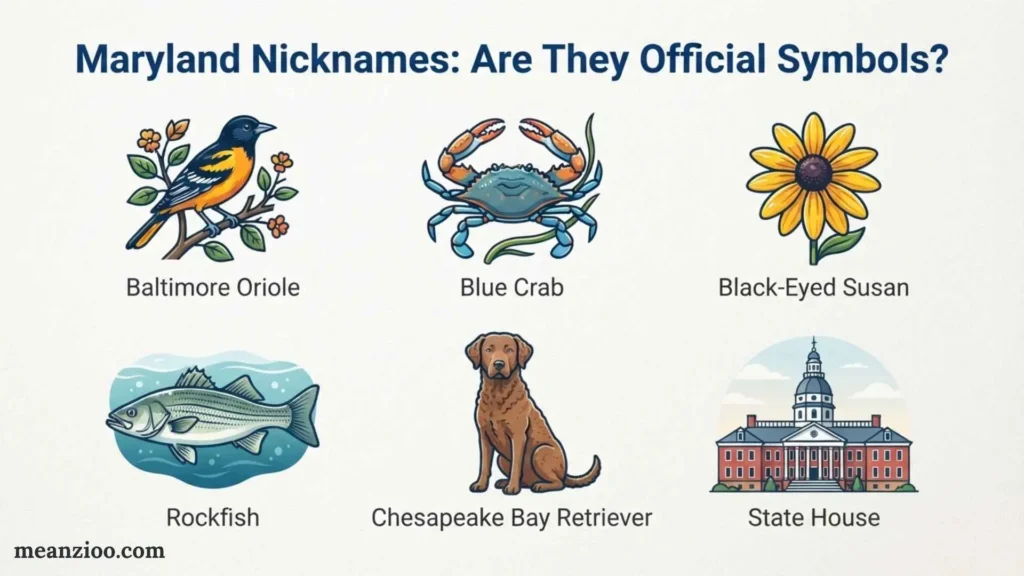
Maryland is commonly called:
- The Old Line State
- The Free State
These names are strongly associated with Maryland, but the Maryland State Archives distinguishes them as nicknames rather than official state symbols.
The “Old Line State” nickname is traditionally connected with Maryland troops who served during the American Revolutionary War. The “Free State” nickname became associated with Maryland in the twentieth century.
For an article about Maryland symbols, it is useful to include these names while clearly identifying them as nicknames.
Maryland Symbols for Kids and Students
If you need a simple list for a school project, these are some of the easiest Maryland symbols to remember:
- Flag: Maryland State Flag
- Bird: Baltimore Oriole
- Flower: Black-Eyed Susan
- Tree: White Oak
- Fish: Rockfish
- Reptile: Diamondback Terrapin
- Insect: Baltimore Checkerspot Butterfly
- Dog: Chesapeake Bay Retriever
- Cat: Calico Cat
- Crustacean: Blue Crab
- Boat: Skipjack
- Dinosaur: Astrodon johnstoni
- Gem: Patuxent River Stone
- Mineral: Chromite
- Dessert: Smith Island Cake
- Drink: Milk
- Sport: Jousting
- Team Sport: Lacrosse
- Exercise: Walking
- Folk Dance: Square Dance
- Spirit: Maryland Rye Whiskey
- Cocktail: Maryland Orange Crush
Frequently Asked Questions About Maryland Symbols
What are the official symbols of Maryland?
Maryland has official symbols covering categories such as the flag, seal, bird, flower, tree, fish, reptile, insect, dog, cat, boat, crustacean, dinosaur, fossil shell, gem, mineral, horse, sports, food, drinks, theater, and more. The Maryland State Archives maintains the official list.
What is Maryland’s most famous symbol?
The Maryland State Flag is one of the state’s most recognizable symbols. Its distinctive Calvert and Crossland design is closely connected to Maryland’s colonial history.
What is Maryland’s state flower?
The Black-Eyed Susan is Maryland’s state flower. It was designated in 1918.
What is Maryland’s state bird?
The Baltimore Oriole is Maryland’s official state bird.
What is Maryland’s state animal?
Maryland does not rely on a single broad “state animal” designation in its official symbol categories. Instead, it has several animal-related symbols, including the Baltimore Oriole, Chesapeake Bay Retriever, Calico Cat, Diamondback Terrapin, Blue Crab, and Baltimore Checkerspot Butterfly.
What is Maryland’s state reptile?
The Diamondback Terrapin is Maryland’s state reptile.
What is Maryland’s state fish?
The Rockfish, also known as the Striped Bass, is Maryland’s state fish.
What is Maryland’s state dessert?
Smith Island Cake is Maryland’s official state dessert. It became the state dessert in 2008.
What is Maryland’s state drink?
Milk is Maryland’s official state drink and was designated in 1998.
What is Maryland’s state mineral?
Chromite is Maryland’s state mineral. It was designated in 2025.
What is Maryland’s state gem?
The Patuxent River Stone is Maryland’s official state gem. It became the state gem in 2004 and is a type of agate.
What is Maryland’s state dinosaur?
The Astrodon johnstoni is Maryland’s state dinosaur. It was designated in 1998.
What is Maryland’s state sport?
Jousting is Maryland’s official state sport. Lacrosse is the official state team sport.
Does Maryland have a state song?
Not currently. “Maryland, My Maryland” was the former state song, but its official designation ended July 1, 2021.
What are Maryland’s nicknames?
Maryland is commonly called the Old Line State and the Free State. These are state nicknames rather than official state symbols.
Final Thoughts
Maryland symbols provide a detailed picture of the state’s identity. The Maryland State Flag and Great Seal connect the state to its colonial history, while the Baltimore Oriole, Black-Eyed Susan, White Oak, Diamondback Terrapin, and Chesapeake Bay Retriever represent its natural environment.
The Chesapeake Bay appears throughout Maryland’s symbolic identity through the Blue Crab, Rockfish, Skipjack, Terrapin, Ecphora, and Chesapeake Bay Retriever. Food and beverage symbols such as Smith Island Cake, milk, Maryland Rye Whiskey, and Maryland Orange Crush show how official designations also recognize local traditions.
There are also important recent updates. Chromite became Maryland’s state mineral in 2025, while Maryland Orange Crush became the state cocktail in 2025.
Finally, remember that “Maryland, My Maryland” is no longer the official state song. Its designation was repealed in 2021.
Taken together, Maryland’s official symbols cover history, wildlife, geology, food, sports, arts, agriculture, and Chesapeake Bay culture, making them a useful way to understand what makes Maryland distinctive.

Hi, I’m Charlotte Hayes. I love writing about the newest English slang, pop culture phrases, and digital communication. I spend my time exploring how language evolves across social media, gaming, and everyday conversations. I enjoy sharing easy-to-understand guides that help learners keep up with modern English. My goal is to make every article useful, accurate, and enjoyable for readers around the world.
Books:
- Everyday Slang Dictionary
- Fluent Through Informal English
 Ryan Mitchell