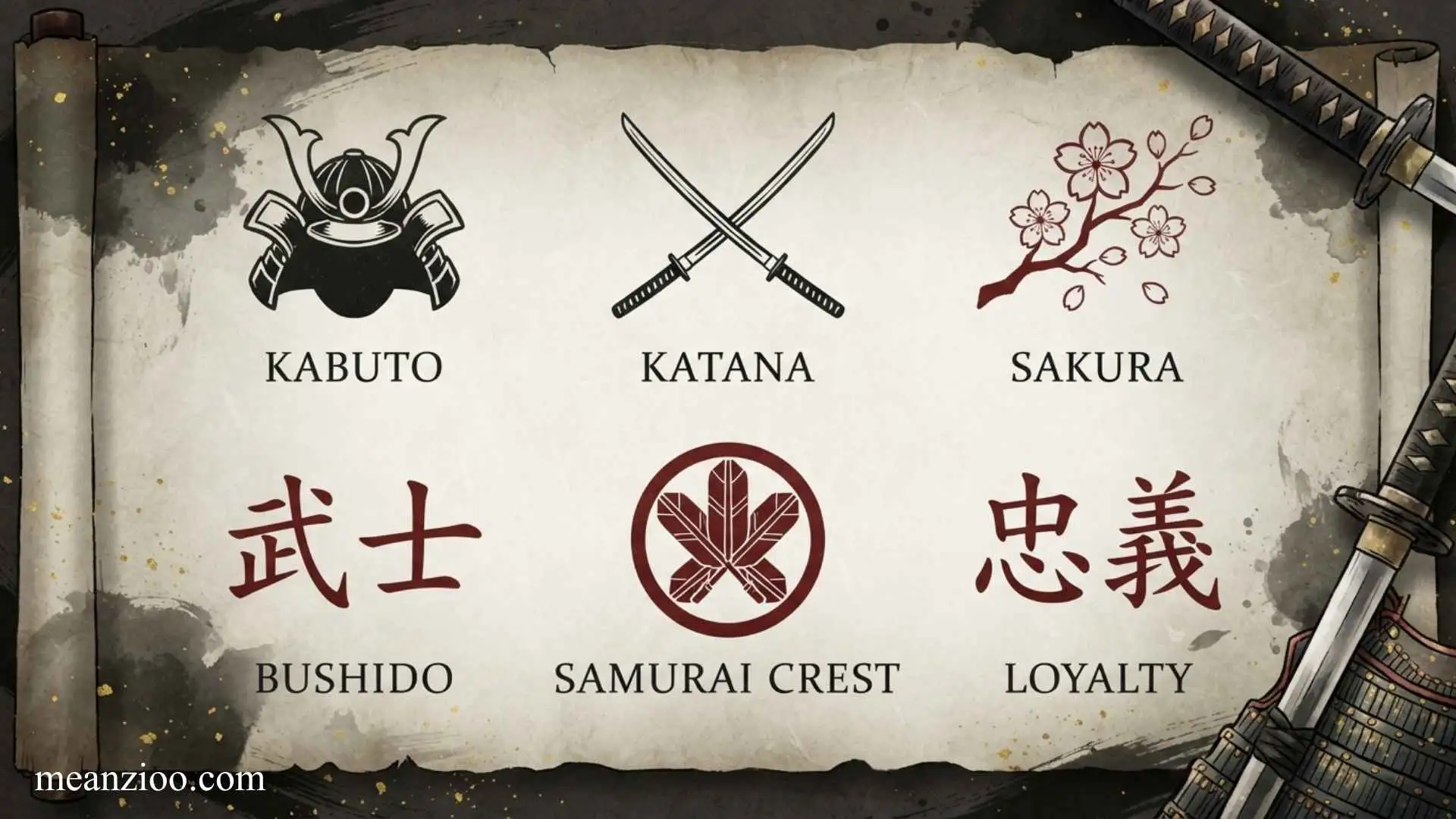
Samurai symbols are among the most recognizable elements of Japanese warrior culture. From distinctive family crests displayed on armor and banners to clan emblems associated with famous warrior families, these symbols communicated identity, ancestry, allegiance, status, and heritage.
However, there is no single symbol that represents every samurai. The term samurai symbols covers several types of imagery, with kamon (家紋), or Japanese family crests, being among the most important.
Kamon existed before the samurai era and were originally associated with Japan’s aristocracy. As warrior families gained political and military power, they adopted and developed these emblems for identification. Samurai displayed them on armor, flags, banners, clothing, and other objects.
Today, samurai symbols remain popular in Japanese history, art, tattoos, fashion, films, games, and graphic design. Understanding their historical context, however, reveals that these designs were much more than decoration.
What Are Samurai Symbols?
The phrase samurai symbols generally refers to visual designs associated with Japan’s warrior culture and samurai families. The most historically significant examples are kamon, Japanese family or household crests.
Kamon could feature flowers, plants, animals, birds, celestial objects, geometric patterns, tools, and other stylized motifs. Japanese crest traditions contain thousands of designs, with estimates varying depending on how different variations are counted.
This means that when people search for “samurai symbols,” they may actually be looking for several related things:
- Samurai family crests
- Samurai clan symbols
- Japanese warrior symbols
- Kamon
- Samurai armor symbols
- Samurai banners and flags
- Japanese symbols and their meanings
Understanding these terms makes it easier to distinguish authentic historical symbols from modern designs inspired by samurai culture.
What Is a Samurai Crest or Kamon?
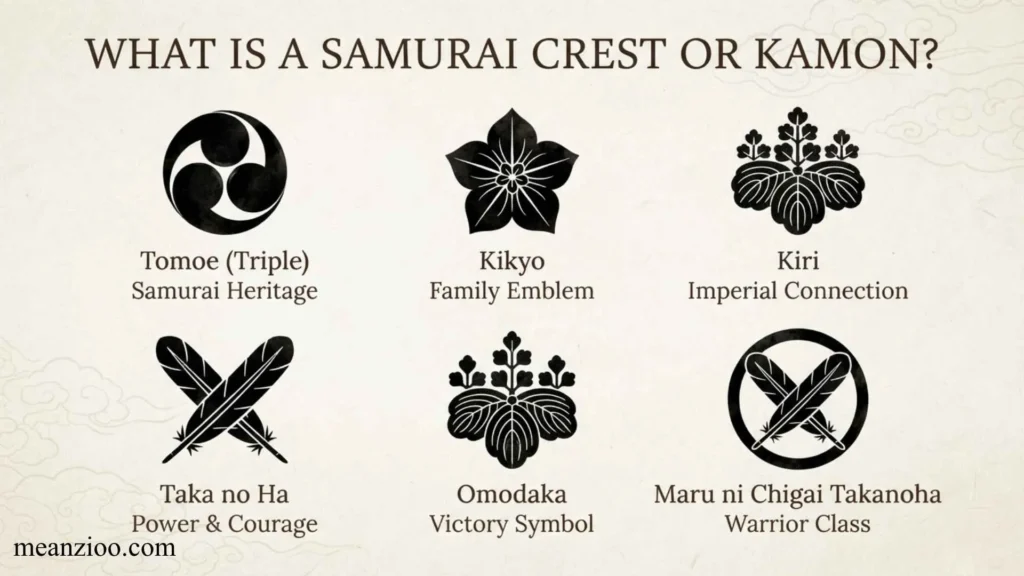
Kamon (家紋) is the Japanese term for a family crest. Although kamon are strongly associated with samurai today, they were never exclusively samurai symbols.
Their development can be traced to aristocratic society during the Heian period. Aristocratic families used distinctive designs on objects such as ox-drawn carriages to identify their households. Over time, these patterns appeared on clothing and other possessions.
As warrior families became increasingly powerful, samurai adopted family crests for practical and symbolic purposes.
During the medieval period, these designs became particularly valuable on the battlefield. A recognizable crest could help distinguish one warrior group from another, especially when displayed on armor, flags, banners, and camp structures.
How Kamon Differ From Modern Logos
A kamon may look surprisingly similar to a modern logo because both depend on simple, recognizable shapes.
The difference is historical purpose. A modern logo primarily identifies a company, product, or organization. A traditional kamon identified a family or household and its lineage.
For samurai families, the crest could therefore carry generations of history.
Why Samurai Crests Were So Simple
Many kamon use bold lines, symmetry, circles, repeated shapes, and easily recognizable motifs.
This was not accidental.
A symbol used on a battlefield needed to remain recognizable from a distance. Japanese government sources note that samurai crests were designed to be distinctive and visible because they helped identify groups during warfare.
Why Did Samurai Use Symbols?
Samurai symbols had both practical and cultural purposes.
Battlefield Identification
One of their most important functions was identification.
Medieval Japanese battles could involve large numbers of warriors belonging to different families and military groups. Distinctive crests on armor, banners, and flags helped warriors recognize their own forces.
A crest could therefore function as a visual statement of allegiance.
Family Identity and Lineage
A samurai represented more than himself.
He could also represent his household, ancestors, lord, and family reputation. A family crest made that connection visible.
For this reason, a kamon should not always be interpreted as a symbol of an individual warrior’s personality. Its primary function could simply be to identify the family or household.
Status and Reputation
A crest could also become associated with a family’s political or military reputation.
When a particular warrior house became powerful, its emblem could become recognizable far beyond the family’s immediate territory.
The symbol consequently became part of the family’s public identity.
Symbolic Associations
Some crest motifs also carried traditional associations with ideas such as longevity, prosperity, good fortune, nature, or status.
However, it is important not to assume that every individual crest has one fixed meaning. A motif may have a traditional association while the specific crest primarily functions as an identifier of a particular family.
History of Samurai Symbols in Japan
The history of samurai symbols developed alongside the changing role of warrior families in Japanese society.
Heian Period: The Origins of Family Crests
The roots of Japanese family crests extend back before the rise of the samurai.
During the Heian period, aristocratic families used distinctive patterns to identify their belongings and households. These designs gradually developed into recognizable family emblems.
Kamakura Period: Warrior Families Adopt Crests
As warrior governments emerged, samurai families increasingly adopted visual identifiers.
The practical value of a family emblem became particularly important in military situations. Crests could be displayed on armor and flags, helping distinguish different groups.
Sengoku Period: Clan Identity and Warfare
During the Sengoku period, Japan experienced prolonged political and military conflict.
Powerful warrior families developed recognizable identities, and banners and other battlefield markers became important tools for identifying military forces.
This period contributed strongly to the modern image of samurai clan symbols.
Edo Period: Crests Spread Beyond Samurai
The use of kamon did not remain restricted to warriors.
During the Edo period, family crests became increasingly widespread among different sections of Japanese society. Merchants, performers, and other groups also used them.
This is why a Japanese family crest should not automatically be described as proof of samurai ancestry.
Also Check This Post: Infinity Symbols: ∞ ♾️ and More Symbols to Copy, Paste, Type, and Understand
Famous Samurai Clan Symbols
Specific samurai families provide some of the best examples of how these symbols worked.
Tokugawa Clan: Three Hollyhock Leaves
The Tokugawa crest, commonly known as mitsuba-aoi, consists of three stylized hollyhock leaves.
It became strongly associated with the Tokugawa family and the Tokugawa shogunate. Japanese government sources identify the three-leaf hollyhock as the famous crest of the Tokugawa family.
Because the Tokugawa shogunate governed Japan during the Edo period, this crest became one of the most recognizable symbols connected with samurai-era political power.
Associated with: Tokugawa family
Motif: Three hollyhock leaves
Historical association: Tokugawa shogunate and political authority
Takeda Clan: Four Diamonds
The Takeda clan is famous in Japanese military history, particularly because of Takeda Shingen.
The clan’s well-known emblem consists of four diamond shapes arranged together and is commonly called takeda-bishi.
Its geometric simplicity demonstrates how samurai clan symbols could be both visually distinctive and easy to recognize.
Associated with: Takeda clan
Motif: Four diamonds
Historical association: Takeda warrior family
Hōjō Clan: Three Scales
The Hōjō clan used a design known as mitsuuroko, or three scales.
The emblem consists of three triangular forms arranged to resemble overlapping scales.
The Hōjō were an influential medieval warrior family associated with Kamakura and Japanese political history.
Associated with: Hōjō clan
Motif: Three scales
Historical association: Medieval warrior government and the Hōjō family
Date Clan: Bamboo and Sparrow
The Date clan, particularly associated with the famous warrior Date Masamune, used distinctive crest traditions involving bamboo and sparrows.
This design is a useful reminder that samurai symbols were not limited to weapons or aggressive imagery. Plants and animals were common components of Japanese family crest traditions.
Associated with: Date clan
Motifs: Bamboo and sparrow
Historical association: Date family
Matsumoto Castle Families
Japanese castles provide additional examples of samurai family crests.
The Japan Tourism Agency documents the crests associated with families who ruled Matsumoto Castle, including the Ishikawa, Ogasawara, Toda, Matsudaira, Hotta, and Mizuno families. Their crests included designs featuring flowers, diamonds, stars, hollyhock leaves, and other motifs.
These examples demonstrate that there was no single visual style for samurai clans.
Common Samurai Symbols and Their Meanings
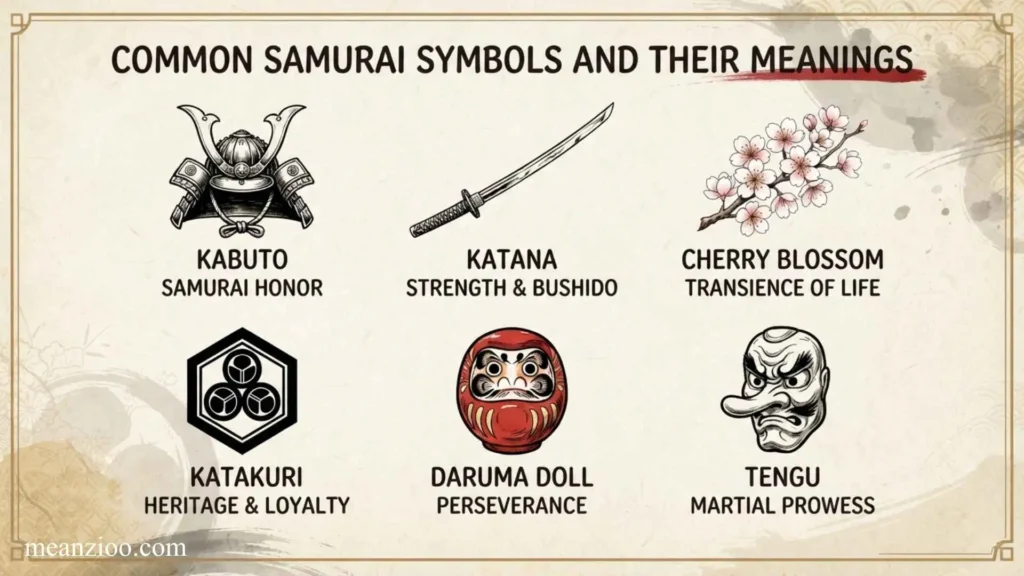
Many traditional motifs associated with samurai families came from nature. However, their meanings should be understood as cultural associations rather than universal definitions.
Hollyhock
The hollyhock is most famously associated with the Tokugawa family.
Its strongest historical significance comes from its connection to the Tokugawa house and shogunate rather than from a universal “samurai meaning.”
Main association: Tokugawa family and shogunate.
Paulownia
The paulownia is an important motif in Japanese crest traditions.
It appears in numerous variations and has a long history extending beyond the samurai class. Paulownia designs have been associated with status and prestige in Japanese heraldic traditions.
Common associations: Status, prestige, heritage.
Wisteria
Wisteria is another common motif in Japanese family crests.
It is among the frequently encountered plant-based designs in Japanese heraldry and appears in numerous variations.
Common associations: Beauty, status, prosperity.
Hawk Feathers
Hawk-feather designs are another important category of kamon.
The hawk had strong connections with hunting and warrior culture, making hawk imagery particularly appropriate within some warrior traditions.
Common associations: Warrior culture, hunting, status.
Crane
The crane is a well-known Japanese symbol associated with longevity.
Crane motifs appear in kamon and can express wishes for long life and prosperity.
Common associations: Longevity and prosperity.
Turtle
The turtle is similarly associated with longevity in Japanese symbolism.
Its presence in traditional designs can express wishes for a long and enduring life.
Common association: Longevity.
Plum Blossom
The plum blossom is another important botanical motif in Japanese visual culture.
Its stylized form works particularly well within the symmetrical structure of kamon.
Common associations: Beauty, seasonal change, resilience.
The meaning of a specific plum-based crest, however, depends on its historical context.
Flowering Quince
Flowering quince, commonly called mokko, is one of the prominent motifs found in Japanese crest traditions.
Its highly stylized form can appear in several variations.
Common association: Traditional family identity.
Creeping Woodsorrel
Creeping woodsorrel, or katabami, is another frequently encountered kamon motif. It belongs to the group traditionally identified among the major Japanese crest designs.
Common association: Family identity and traditional heraldic design.
Stars and Celestial Motifs
Japanese crests can also incorporate stars, moons, and other natural or celestial imagery.
These designs demonstrate that samurai-related symbolism was not limited to warfare. Nature and the wider universe provided an extensive visual vocabulary for Japanese heraldic traditions.
Samurai Symbols on Armor
Samurai armor is one of the most famous places where family crests could appear.
A warrior’s armor could display a clan or family emblem, helping identify his affiliation.
The practical purpose was particularly important during warfare. Japanese sources confirm that family crests were displayed on armor as well as flags and banners.
This is one reason traditional samurai imagery often features a highly visible emblem placed against a contrasting background.
The design needed to be recognizable rather than merely decorative.
Also Check This Post: Guatemala Symbols: National Symbols, Meanings, History, and Cultural Significance
Samurai Symbols on Flags and Banners
Flags and banners were essential parts of samurai battlefield culture.
A banner could identify a commander, family, or military group and help organize forces during combat.
Distinctive designs were especially valuable when hundreds or thousands of warriors were gathered together.
This explains why samurai clan symbols are so strongly associated with banners in historical paintings and modern depictions of Japanese warfare.
Samurai Symbols Were a Visual Language
A samurai crest can be thought of as part of a broader visual language.
Instead of communicating through words, a symbol could quickly communicate information about:
- Family
- Lineage
- Allegiance
- Military affiliation
- Social identity
- Heritage
This explains the remarkable simplicity of many kamon.
A viewer did not need to read a sentence. Recognition of the emblem could be enough.
How to Identify a Samurai Family Crest
Finding a Japanese crest does not automatically mean you have found a samurai symbol.
Historical identification requires more than recognizing a Japanese-looking design.
Identify the Main Motif
Start by examining the central image.
Ask whether it contains:
- Flowers
- Leaves
- Birds
- Animals
- Stars
- Geometric shapes
- Objects
- Natural elements
Examine the Arrangement
The arrangement is often just as important as the motif.
Look for:
- Repeated shapes
- Symmetry
- Circular borders
- Overlapping forms
- Number of leaves or petals
- Number of geometric elements
Two crests may contain similar motifs but represent completely different families.
Look for Historical Documentation
If you believe a crest belonged to a specific samurai family, compare it with reliable historical references.
Museum collections, Japanese government resources, castle histories, and specialist publications can help establish whether a design is genuinely associated with a particular family.
For example, the Japan Tourism Agency provides documented crest information for families connected with Matsumoto Castle.
Do Not Assume Every Kamon Is a Samurai Crest
This is one of the most important distinctions.
Kamon existed before the samurai and later became widespread throughout Japanese society. Therefore, finding a traditional Japanese family crest does not automatically establish samurai ancestry.
Samurai Symbols vs. Japanese Symbols
The terms samurai symbols and Japanese symbols are related but not interchangeable.
Japanese symbols can include an enormous range of imagery:
- Shinto symbols
- Buddhist symbols
- Imperial imagery
- Family crests
- Regional symbols
- Traditional patterns
- Nature imagery
- Religious objects
- Modern cultural symbols
Samurai symbols are a narrower category involving imagery connected with warrior families, military identity, samurai culture, and historical Japanese warfare.
Kamon sit somewhere between these categories because they are Japanese family crests that were widely used by samurai but were not exclusive to them.
Samurai Symbols and Bushido
Samurai imagery is often connected with bushido, or the “way of the warrior.”
Modern representations frequently associate samurai culture with:
- Honor
- Loyalty
- Courage
- Discipline
- Duty
- Strength
- Self-control
These concepts are important to discussions of samurai culture, but a particular family crest should not automatically be interpreted as a symbol of one specific virtue.
A kamon could primarily identify a family rather than directly symbolize “courage” or “honor.”
This distinction helps separate documented history from modern romanticized interpretations of the samurai.
Samurai Symbols in Modern Culture
Samurai symbols have survived long after the formal samurai class disappeared.
Kamon continue to appear on traditional clothing, ceremonial objects, family possessions, memorials, historical buildings, and cultural materials. Their visual style has also influenced contemporary graphic design and popular culture.
Modern samurai-inspired imagery appears in:
- Tattoos
- Anime
- Video games
- Films
- Martial arts
- Fashion
- Logos
- Graphic design
- Historical reenactments
However, modern artwork inspired by samurai culture should not automatically be considered an authentic historical crest.
Choosing a Samurai Symbol for a Tattoo or Design
If you are considering a samurai symbol for a tattoo, logo, artwork, or personal emblem, research its history first.
Ask these questions:
- Which family used this crest?
- What historical period is it associated with?
- Was it actually used by a samurai family?
- What does the motif traditionally represent?
- Is the design historically documented or modern?
This matters particularly when choosing a clan-specific symbol.
For example, selecting the Tokugawa hollyhock is not simply choosing a generic “samurai symbol.” It specifically evokes the Tokugawa family and its historical connection with the shogunate.
Similarly, choosing a Takeda, Hōjō, or Date crest connects the design with a particular historical family.
Did Every Samurai Have a Unique Symbol?
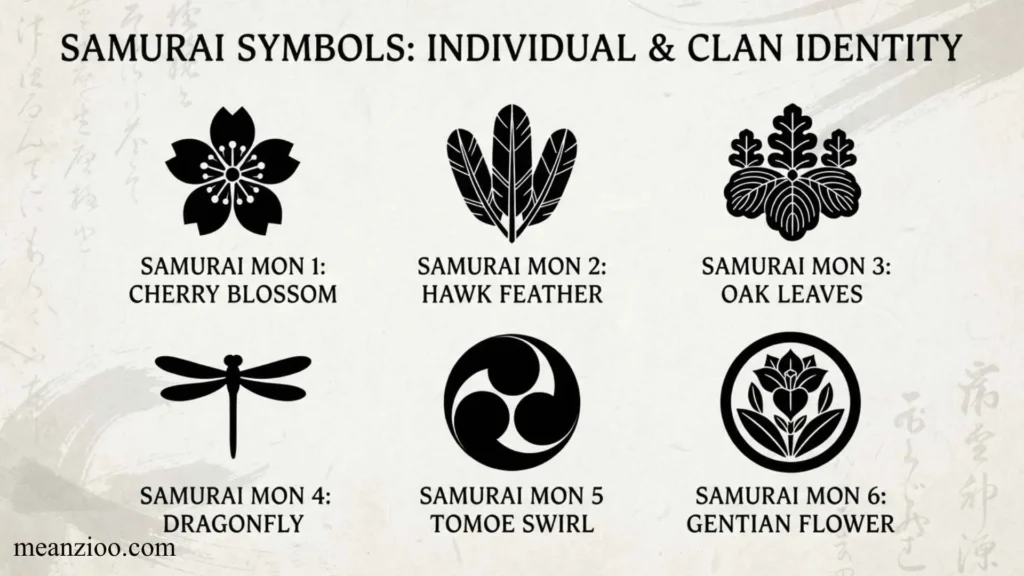
No.
There were thousands of Japanese family crest designs, but individual designs were not necessarily unique to one person. Families could use variations of established motifs, and related households could have modified versions of a crest.
This is why identifying a crest can sometimes be complicated.
The design must be considered together with its historical period, family, geographical location, and documented usage.
Did Samurai Symbols Have Fixed Meanings?
Not always.
A motif can have a traditional cultural association without having one universal meaning.
For example, cranes are traditionally associated with longevity, while certain plants and flowers have their own cultural associations. But an individual family crest may primarily function as an identifier rather than a coded statement about a particular virtue.
Therefore, it is more accurate to say that a symbol may be associated with a particular concept rather than claiming that every crest has one fixed translation.
Frequently Asked Questions About Samurai Symbols
What is the most famous samurai symbol?
The Tokugawa three-leaf hollyhock crest is one of the most famous symbols associated with samurai history. It was the crest of the Tokugawa family and became strongly connected with the Tokugawa shogunate.
What is a samurai family crest called?
A Japanese family crest is called a kamon (家紋). Samurai families used kamon extensively, although family crests were not exclusive to the samurai class.
What symbol represents the samurai?
There is no single universal symbol representing all samurai. Different families and clans used different kamon, banners, and military emblems.
What do samurai symbols mean?
Their meanings vary. They can represent family identity, lineage, allegiance, military affiliation, status, heritage, prosperity, longevity, or other cultural associations.
What are the most common Japanese family crest motifs?
Common motifs include flowers, plants, animals, birds, celestial imagery, geometric shapes, and objects. Frequently encountered designs include wisteria, paulownia, hawk feathers, flowering quince, and creeping woodsorrel.
Are samurai symbols the same as kamon?
Not exactly. Kamon are Japanese family crests, while “samurai symbols” is a broader term that can include clan crests, military banners, armor insignia, and other imagery associated with samurai culture.
Did samurai put symbols on their armor?
Yes. Family crests could be displayed on armor, flags, banners, and battlefield structures to help identify warriors and their affiliations.
Did samurai use symbols on flags?
Yes. Samurai families and military groups used distinctive crests and designs on flags and banners as visual identifiers during warfare.
Are all Japanese family crests samurai symbols?
No. Kamon existed before the samurai and eventually became widespread among different sections of Japanese society.
How many Japanese family crests are there?
There is no universally accepted exact number. Estimates vary considerably depending on whether variations of a design are counted separately. Japanese sources commonly describe the number as being in the tens of thousands.
Conclusion
Samurai symbols are much more than decorative images associated with Japanese warriors. They form part of a long tradition of family identity, heraldry, military recognition, and cultural symbolism.
The most important category is kamon, or Japanese family crests. These designs existed before the samurai but became especially important to warrior families, who displayed them on armor, flags, banners, clothing, and other objects. Their simple forms made them recognizable on the battlefield while also connecting warriors to their families and lineages.
Famous examples such as the Tokugawa hollyhock, Takeda diamonds, Hōjō scales, and Date bamboo-and-sparrow design show that there was no single “samurai symbol.” Instead, different families developed and inherited distinctive visual identities.
The most important thing to remember is that a samurai symbol should be understood through its historical context. A crest can represent a family, clan, lineage, or tradition rather than simply standing for a modern concept such as strength or honor.
That historical context is what makes samurai symbols so fascinating: a simple design could carry centuries of Japanese history within it.
I can also create a visual infographic of the major samurai clan symbols and their meanings to accompany this article.
Also Check This Post: Car Symbols and Meanings: Complete Guide to Dashboard Warning Lights

I’m Ryan Mitchell, and I write about modern English, trending slang, and online expressions. I enjoy explaining the meanings, origins, and real-life usage of popular words in a simple way. I believe learning slang is an important step toward understanding today’s English-speaking culture. Through my work, I aim to help readers speak more naturally and stay updated with the latest language trends.