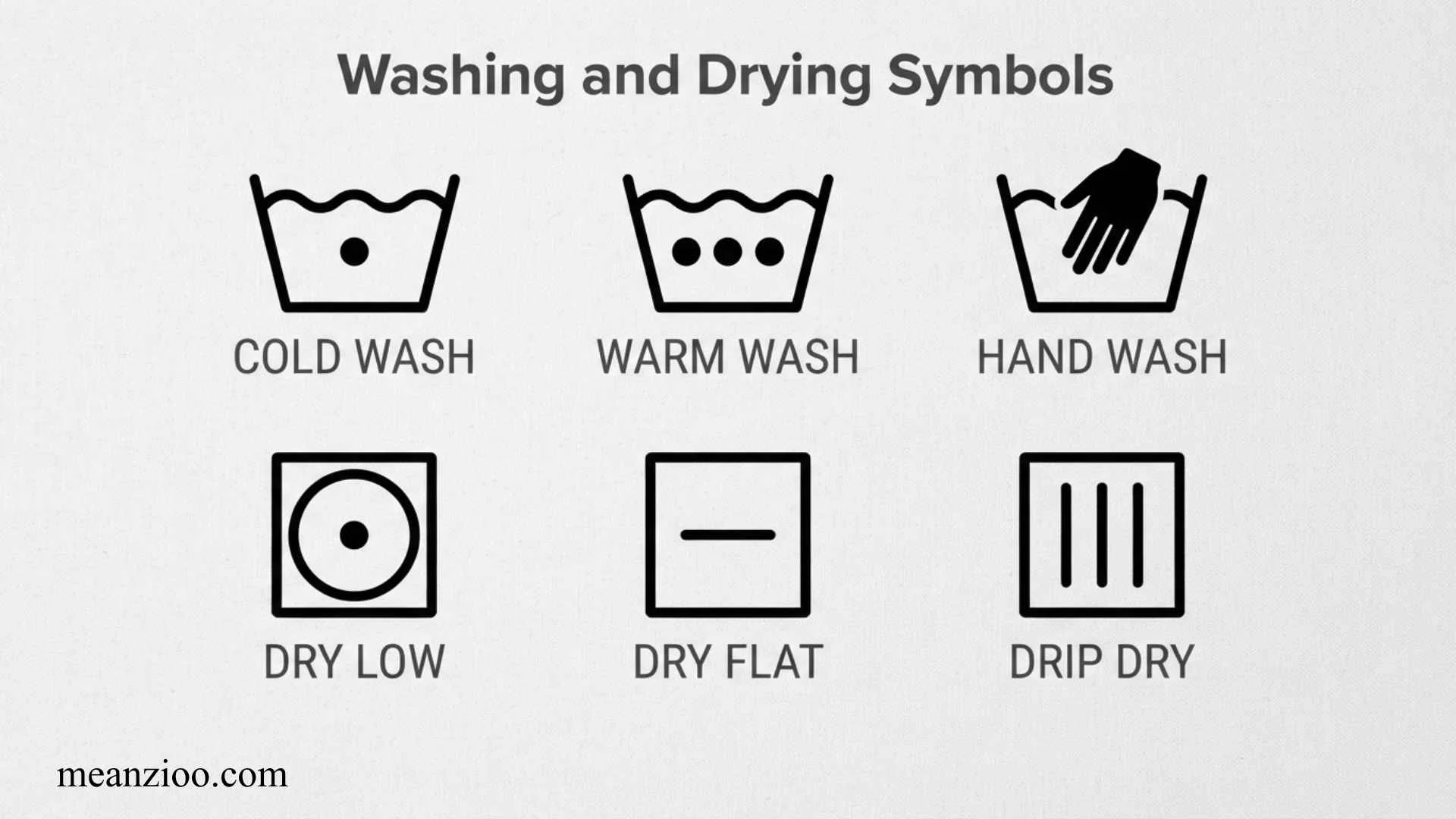
Washing and drying symbols are the small icons printed on clothing and textile care labels. They tell you how to wash, dry, and handle garments without unnecessarily damaging the fabric. Once you understand the basic shapes, numbers, dots, lines, and crossed-out symbols, reading a laundry label becomes much easier.
The international care-label system uses different symbols for washing, bleaching, drying, ironing, and professional textile care. Under ISO 3758:2023, the wash tub identifies washing instructions, while the square is used for drying instructions.
This guide focuses especially on washing and drying symbols, including temperature numbers, hand washing, gentle cycles, tumble drying, permanent press, delicate drying, no-heat drying, line drying, drip drying, flat drying, shade drying, and the do not wring instruction.
What Are Washing and Drying Symbols?
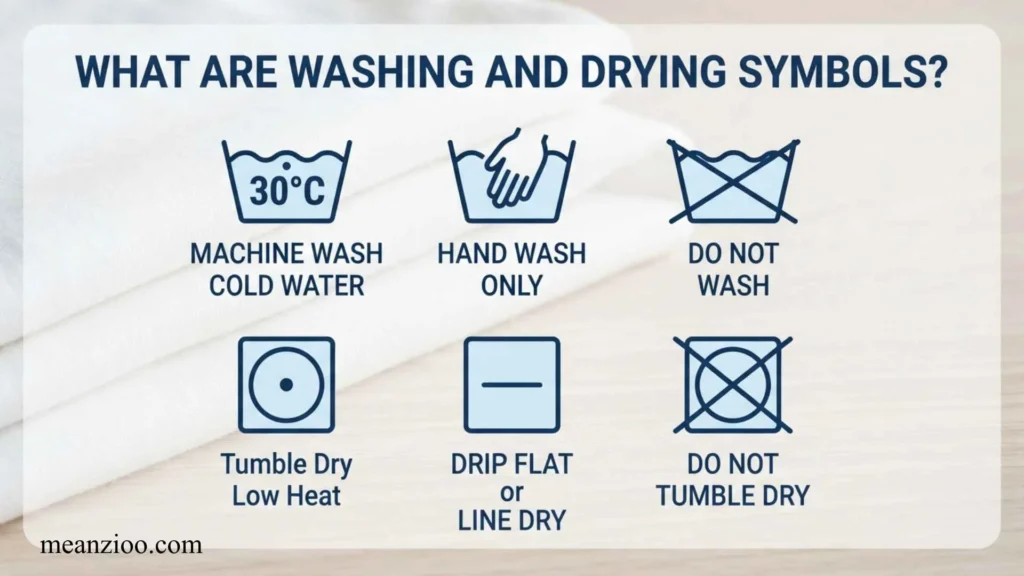
Washing and drying symbols are standardized pictograms designed to communicate textile-care instructions without relying entirely on written language.
The easiest way to remember the two main symbols is:
- Wash tub = washing
- Square = drying
- Square with a circle = tumble drying
- Lines inside a square = natural drying
- Cross through a symbol = do not use that treatment
Care labels generally communicate the maximum permitted treatment for a garment. A milder treatment or lower temperature than the maximum shown is generally permitted.
Washing Symbols and Their Meanings
Wash Tub With a Temperature Number
A wash tub containing a number such as 20, 30, 40, 60, or 95 indicates the maximum washing temperature in degrees Celsius.
For example:
| Washing symbol information | Meaning |
| 20°C | Maximum wash temperature of 20°C |
| 30°C | Maximum wash temperature of 30°C |
| 40°C | Maximum wash temperature of 40°C |
| 60°C | Maximum wash temperature of 60°C |
| 95°C | Maximum wash temperature of 95°C |
The number should be treated as a maximum, not necessarily a temperature you must use. If the garment can be adequately cleaned at a lower temperature, a lower temperature is a milder choice.
Hand Wash Symbol
A hand inside the wash tub means the garment should be washed by hand rather than using an ordinary machine-washing process.
Hand washing is commonly used for delicate textiles and garments that require reduced mechanical action.
When hand washing, avoid aggressive rubbing, pulling, twisting, or wringing. GINETEX specifically recommends careful agitation and pressing out excess water rather than wringing sensitive garments.
Ambient-Temperature Hand Wash
The current ISO 3758:2023 system includes a hand-wash symbol for ambient-temperature water, approximately 20–30°C.
This is particularly useful when a garment needs very gentle handling without a warm washing process.
One Bar Under the Wash Tub
One horizontal bar underneath the wash tub indicates a mild washing process with reduced mechanical action.
If you see this symbol, choose a mild or easy-care cycle rather than an aggressive normal cycle.
Two Bars Under the Wash Tub
Two horizontal bars indicate a very mild washing process.
This instruction is especially important for very sensitive garments, including some woollen textiles.
Crossed-Out Wash Tub
A crossed-out wash tub means do not wash.
Do not put the garment through a normal household washing process. The item may be unsuitable for wet treatment and may require professional care.
Washing Cycle Symbols: Normal, Permanent Press and Gentle
Not every washing symbol is simply about temperature. Some labels also indicate the type of machine cycle that should be used.
Normal Wash
A wash tub without an additional bar generally indicates the normal washing process at the stated maximum temperature.
Permanent Press
A permanent-press washing instruction indicates that the garment should use the permanent-press cycle.
This type of cycle is designed to reduce wrinkling and is commonly associated with garments that crease easily. However, permanent press should not automatically be treated as a substitute for a delicate cycle. Always follow the garment’s actual label.
Gentle or Delicate Wash
A gentle or delicate instruction means the garment needs reduced mechanical action.
A gentle cycle generally uses less agitation and/or slower spinning than a standard cycle. It can be useful for sensitive garments, but the specific care label should always take priority.
What Do the Bars Under Washing Symbols Mean?
The bars are easy to overlook, but they are important.
No bar: Normal washing process.
One bar: Mild process with reduced mechanical action.
Two bars: Very mild process with substantially reduced mechanical action.
This means two garments marked with the same temperature can still require different washing cycles. The temperature tells you how hot the water can be, while the bars tell you how gently the garment should be mechanically treated.
Complete Washing Symbols Quick Reference
| Symbol feature | Meaning | What you should do |
| Tub + number | Maximum wash temperature | Do not exceed the stated temperature |
| Hand in tub | Hand wash | Wash gently by hand |
| One bar | Mild wash | Select a mild/easy-care cycle |
| Two bars | Very mild wash | Use a very gentle cycle |
| Crossed tub | Do not wash | Avoid normal wet washing |
| Tub with normal process | Normal wash | Use an appropriate standard cycle |
| Permanent-press indication | Permanent-press cycle | Use the appropriate permanent-press setting |
| Gentle/delicate indication | Gentle cycle | Reduce agitation and mechanical stress |
Drying Symbols and Their Meanings
Drying symbols are based on a square.
The square tells you that the instruction concerns drying. A circle inside the square means tumble drying, while lines inside the square indicate natural drying methods.
Tumble Drying Symbols
Square With a Circle
A square containing a circle means tumble drying is permitted.
The dots inside the circle indicate the permitted temperature level in systems that use dots.
One Dot
One dot indicates a lower/milder tumble-drying temperature.
Use a low-heat or gentle drying setting when your machine provides one.
Two Dots
Two dots indicate a higher/normal tumble-drying temperature than the one-dot setting.
The exact machine program names can vary, so use the care label together with your dryer’s available settings.
Three Dots and Regional Differences
You may encounter drying symbols with different numbers of dots depending on the care-label system being used.
This is one reason it is important not to assume that every laundry symbol follows exactly the same graphical convention. GINETEX notes differences between the ISO/GINETEX system and U.S. care-symbol standards.
When a garment is manufactured for a particular market, follow the symbol system printed on that garment’s label.
No-Heat or Air-Only Drying
A no-heat drying instruction means the dryer may be used with tumbling but without added heat.
This can be useful for garments that tolerate mechanical tumbling but are sensitive to heat. Some appliance manufacturers describe this as an air-only or no-heat setting.
Do not confuse no heat with do not tumble dry. They are different instructions:
- No heat: Tumble drying may be allowed without heat.
- Do not tumble dry: Do not put the garment in a tumble dryer.
Do Not Tumble Dry Symbol
A crossed-out square containing a circle means do not tumble dry.
If you see this symbol, choose an appropriate natural-drying method instead. Heat and mechanical tumbling can be unsuitable for some delicate, heat-sensitive, or dimensionally sensitive garments.
Natural Drying Symbols
Natural drying symbols use lines inside a square to tell you how the garment should be air dried.
The main natural-drying methods include:
- Line drying
- Drip line drying
- Flat drying
- Drip flat drying
- The same methods performed in the shade
Line Drying
A square containing a vertical line indicates line drying.
Hang the garment on a suitable clothesline or drying support.
This is a common choice for washable, colorfast clothing that does not require flat drying.
Drip Line Drying
A square containing multiple vertical lines indicates drip line drying.
The garment should be hung and allowed to dry while retaining more water rather than being aggressively wrung or squeezed.
Drip drying can be useful for delicate textiles that should not be subjected to strong mechanical handling.
Flat Drying
A square containing a horizontal line indicates flat drying.
Instead of hanging the wet garment, lay it flat on an appropriate clean surface.
Flat drying is particularly useful for garments that could stretch or lose their shape when hung while wet. GINETEX gives woollen and other heavy or delicate textiles as examples where flat drying may be appropriate.
Drip Flat Drying
A square with multiple horizontal lines indicates drip flat drying.
The garment should be placed flat and allowed to dry naturally without excessive squeezing or wringing.
Drying in the Shade
A diagonal line added to a natural-drying symbol means the garment should be dried in the shade.
For example, a line-drying symbol with the shade indication means line dry in the shade, while a flat-drying symbol with the shade indication means dry flat in the shade.
Also Check This Post: Dishwasher Symbols: Complete Guide to Every Common Symbol and Meaning
Complete Drying Symbols Chart
| Drying symbol type | Meaning | What to do |
| Square + circle | Tumble dry | Dryer may be used |
| One-dot tumble symbol | Lower heat | Use a low-temperature setting |
| Two-dot tumble symbol | Higher/normal heat | Use the permitted normal temperature |
| No-heat symbol | Air/no-heat tumble drying | Use an air-only/no-heat setting |
| Crossed-out square + circle | Do not tumble dry | Air dry instead |
| Vertical line | Line dry | Hang to dry |
| Multiple vertical lines | Drip line dry | Hang while wet and allow to drip |
| Horizontal line | Flat dry | Dry while lying flat |
| Multiple horizontal lines | Drip flat dry | Dry flat without aggressive water removal |
| Diagonal shade line | Dry in shade | Keep away from direct sunlight |
Permanent Press Drying Symbols
Permanent-press drying settings are designed to help reduce wrinkles while drying.
A permanent-press dryer cycle may use moderate heat and a cool-down period. The exact operation differs between machines and manufacturers, so the garment’s care label remains the deciding factor.
Permanent Press With Low Heat
This is generally intended for garments that can tolerate some heat but benefit from a gentler drying process.
Permanent Press With Medium Heat
This may be suitable for certain everyday fabrics that wrinkle easily, provided the garment label permits it.
Permanent Press Without Heat
This combines the permanent-press tumbling action with no added heat.
It can be useful for garments that are sensitive to heat but can safely tolerate tumbling.
Gentle and Delicate Drying Symbols
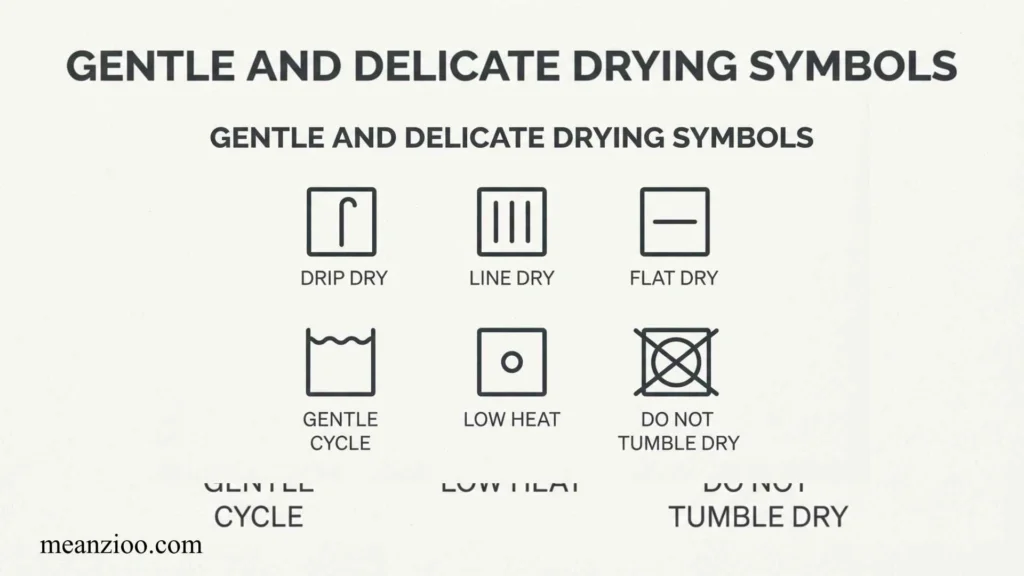
A gentle or delicate drying setting uses less aggressive treatment to reduce the stress placed on sensitive fabrics.
Depending on the appliance, gentle drying may combine:
- Lower heat
- Slower or gentler tumbling
- Shorter treatment
- More controlled drying
Whirlpool describes gentle drying as using low heat and slower tumbling to protect delicate fabrics.
However, a garment marked do not tumble dry should not be placed on a gentle dryer cycle. Gentle does not mean universally safe.
Do Not Wring Symbol and Why It Matters
The do not wring instruction tells you not to twist the garment aggressively to remove water.
This is particularly important for delicate textiles because twisting can stretch fibers, distort the garment, or change its shape.
When a garment needs gentle treatment, press excess water out carefully instead of twisting it. GINETEX specifically advises against rubbing, pulling, and wringing sensitive hand-wash garments.
If you do not see a separate do-not-wring symbol but the garment has very delicate washing or drying instructions, gentle handling is still a sensible approach.
Washing and Drying Symbols Are Not the Same
A common mistake is confusing the wash tub with the drying square.
Washing symbol
Shape: Tub
Tells you: Whether and how the garment may be washed.
It can indicate:
- Maximum temperature
- Hand washing
- Mild washing
- Very mild washing
- Do not wash
Drying symbol
Shape: Square
Tells you: How the garment should be dried.
It can indicate:
- Tumble drying
- Tumble-dry temperature
- No-heat drying
- Do not tumble dry
- Line drying
- Drip drying
- Flat drying
- Shade drying
Remembering tub = wash and square = dry makes the entire system easier to understand.
Washing, Bleaching, Drying, Ironing and Dry Cleaning Symbols
A complete clothing care label usually contains more than washing and drying instructions.
The standardized sequence is:
- Washing
- Bleaching
- Drying
- Ironing
- Professional textile care
Washing
The tub tells you how to wash the item.
Bleaching
The triangle tells you whether bleaching is permitted and, in some systems, what type of bleach may be used.
Drying
The square tells you whether and how the garment can be dried.
Ironing
The iron symbol tells you whether ironing is permitted and the appropriate temperature level.
Professional Textile Care
The circle provides information for professional dry-cleaning or wet-cleaning processes.
This means you should not interpret one symbol in isolation when making a laundry decision. The entire care label provides the complete treatment instructions.
How to Read a Clothing Care Label Step by Step
Step 1: Find the Washing Symbol
Look for the tub.
Check whether it contains a temperature number, a hand symbol, bars, or a cross.
Step 2: Check the Washing Temperature
If there is a number, treat it as the maximum temperature.
For example, 30 means do not exceed 30°C.
Step 3: Look for Bars
One bar means mild treatment.
Two bars mean very mild treatment.
Step 4: Find the Drying Symbol
Look for the square.
If it contains a circle, it concerns tumble drying.
If it contains lines, it concerns natural drying.
Step 5: Check Dots or Other Temperature Instructions
For tumble drying, check the temperature indication used by the care-label system.
Step 6: Look for a Cross
A crossed-out symbol means that treatment is prohibited.
For example:
- Crossed wash tub = do not wash.
- Crossed tumble symbol = do not tumble dry.
Step 7: Check the Other Care Symbols
Before washing the garment, also check the bleach, ironing, and professional-care symbols.
Real-Life Examples of Washing and Drying Symbols
Example 1: A Shirt Marked 30°C
If a shirt has a wash tub containing 30, its maximum washing temperature is 30°C.
A lower temperature may be used when suitable.
Example 2: A Shirt With 40°C and One Bar
The 40 indicates the maximum washing temperature, while the single bar indicates that the garment needs a mild process.
So choosing a normal, highly aggressive cycle just because the machine is set to 40°C would not fully follow the label.
Example 3: A Garment With a Crossed Tumble Symbol
The garment should not go into the tumble dryer.
Use an appropriate air-drying method instead.
Example 4: A Sweater Marked for Flat Drying
Place the sweater flat rather than hanging it from a hanger.
This helps avoid unnecessary stretching while the garment is wet.
Example 5: A Delicate Garment Marked Drip Dry
Hang it to dry without aggressive wringing or twisting.
Example 6: A Garment Marked Dry in the Shade
Avoid direct sunlight and choose a shaded drying location.
Common Washing and Drying Mistakes
Washing at a Higher Temperature
A higher temperature does not automatically mean cleaner clothes. If the label specifies a maximum of 30°C, regularly exceeding that temperature can increase the risk of textile damage.
Ignoring the Bars
A 40°C garment with a mild-cycle indication is not equivalent to every garment that simply says 40°C.
The bars communicate mechanical-treatment requirements.
Putting “Do Not Tumble Dry” Clothes in the Dryer
This is one of the easiest mistakes to avoid.
If the tumble symbol is crossed out, choose an appropriate natural-drying method.
Treating Gentle Dry as Universal
A gentle dryer cycle is not a replacement for a do-not-tumble instruction.
If the label says not to tumble dry, do not use even the gentlest tumble cycle.
Hanging Everything on a Clothesline
Some garments should be dried flat because hanging them while wet may stretch or distort their shape.
Wringing Delicate Clothes
Avoid twisting delicate garments to remove water. Press excess water out gently instead.
Drying Everything in Direct Sunlight
If the care label specifies shade drying, follow that instruction rather than leaving the garment in strong direct sunlight.
Do Lower Temperatures Cause Any Problem?
Usually, using a milder treatment than the maximum indicated is acceptable.
For example, if the label permits washing at 40°C, washing at 30°C is generally a milder treatment. GINETEX explicitly states that milder treatments and lower temperatures than those shown on the care label are permitted.
However, remember that lower temperatures may not remove every type of stain or soil as effectively. The care label is about protecting the textile; it is not a guarantee that every stain will disappear.
Why Care Labels Matter
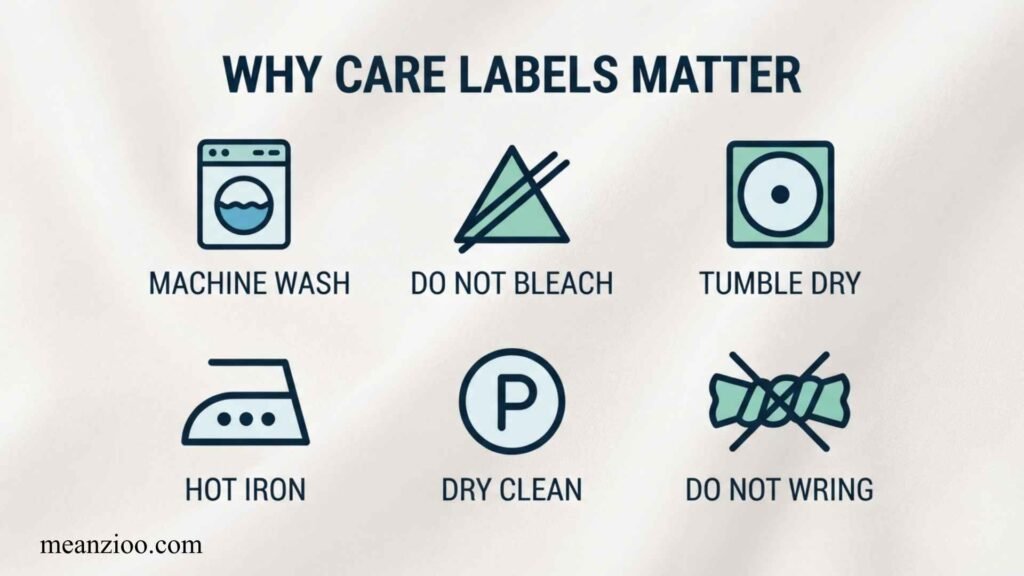
Following washing and drying symbols can help you:
- Reduce unnecessary fabric damage.
- Avoid avoidable shrinkage.
- Protect garment shape.
- Reduce excessive mechanical stress.
- Avoid inappropriate heat.
- Protect delicate textiles.
- Reduce color-fading risks.
- Extend the useful life of clothing.
Care labels are designed around the characteristics of the complete textile article, including factors such as coloring, finishing, accessories, and applications.
Washing and Drying Symbols FAQ
What is the symbol for washing clothes?
The wash tub is the basic washing symbol. A number inside it indicates the maximum washing temperature, while bars can indicate a milder or very mild process.
What is the symbol for drying clothes?
A square is the basic drying symbol. A circle inside the square means tumble drying, while lines inside the square describe natural drying.
What does a square with a circle mean?
It means tumble drying is permitted. Temperature information may be represented by dots depending on the care-label system.
What does a crossed-out square with a circle mean?
It means do not tumble dry the garment.
What does one bar under a wash symbol mean?
It means the garment requires a mild washing process with reduced mechanical action.
What do two bars under a washing symbol mean?
Two bars indicate a very mild washing process, with substantially reduced mechanical action.
What does a hand inside a washing tub mean?
It means hand wash rather than a normal machine-washing process.
What does a square with a vertical line mean?
It indicates line drying.
What does a square with several vertical lines mean?
It indicates drip line drying.
What does a square with a horizontal line mean?
It indicates flat drying.
What does a square with several horizontal lines mean?
It indicates drip flat drying.
What does a diagonal line on a drying symbol mean?
It indicates that the corresponding natural-drying method should be performed in the shade.
Can I use a lower temperature than the label says?
Generally, yes. Care labels specify maximum permitted treatments, and milder treatments and lower temperatures are permitted.
What is the difference between no heat and do not tumble dry?
No heat means the dryer may be used with an air-only/no-heat setting when permitted by the garment’s instructions.
Do not tumble dry means the garment should not be placed in a tumble dryer at all.
Can I use permanent press for delicate clothes?
Not automatically. Permanent press is generally gentler than some standard cycles, but it should not replace a delicate cycle when the garment specifically requires delicate treatment. Always follow the garment label.
Should I wring clothes before drying them?
For delicate garments, avoid aggressive wringing. Press out excess water gently and follow the specified drying method.
Final Takeaway
Washing and drying symbols are easier to understand once you learn the basic visual language:
- Tub = washing
- Number in tub = maximum wash temperature
- One bar = mild washing
- Two bars = very mild washing
- Hand in tub = hand wash
- Crossed tub = do not wash
- Square = drying
- Circle inside square = tumble dry
- Dots = dryer temperature indication
- Crossed tumble symbol = do not tumble dry
- Vertical lines = line or drip-line drying
- Horizontal lines = flat or drip-flat drying
- Diagonal shade line = dry in the shade
The most important rule is to read the entire care label, rather than focusing on just one symbol. Care labels communicate the maximum treatment the textile is designed to withstand, and choosing a gentler process is generally acceptable.
Once you understand these symbols, you can make better decisions about washing, drying, and caring for everything from everyday shirts to delicate sweaters and other specialty textiles.
Also Check This Post: Health Symbols: Meanings, Names, and What They Represent

I’m Ryan Mitchell, and I write about modern English, trending slang, and online expressions. I enjoy explaining the meanings, origins, and real-life usage of popular words in a simple way. I believe learning slang is an important step toward understanding today’s English-speaking culture. Through my work, I aim to help readers speak more naturally and stay updated with the latest language trends.