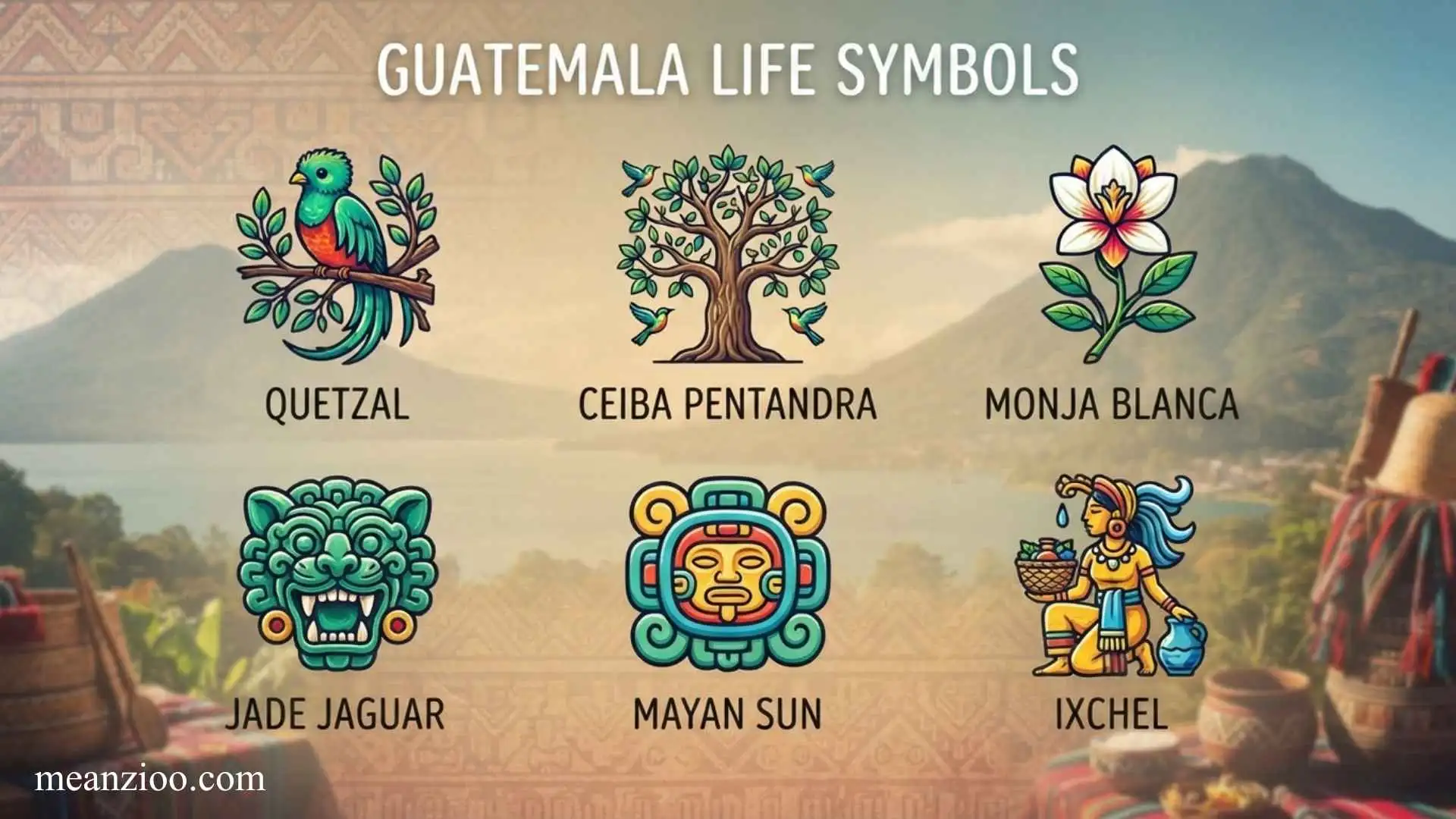
Guatemala symbols are powerful representations of the country’s history, culture, natural environment, independence, and national identity. From the blue-and-white national flag and the famous quetzal to the ceiba tree, Monja Blanca orchid, marimba, and the legacy of Tecún Umán, each symbol tells a different part of Guatemala’s story.
Some symbols represent the country’s natural beauty, while others connect modern Guatemala with its Maya heritage, colonial history, independence, and cultural traditions.
If you want to understand what Guatemala’s symbols mean, this guide explains the country’s major national symbols, their history, symbolism, and importance.
What Are the National Symbols of Guatemala?
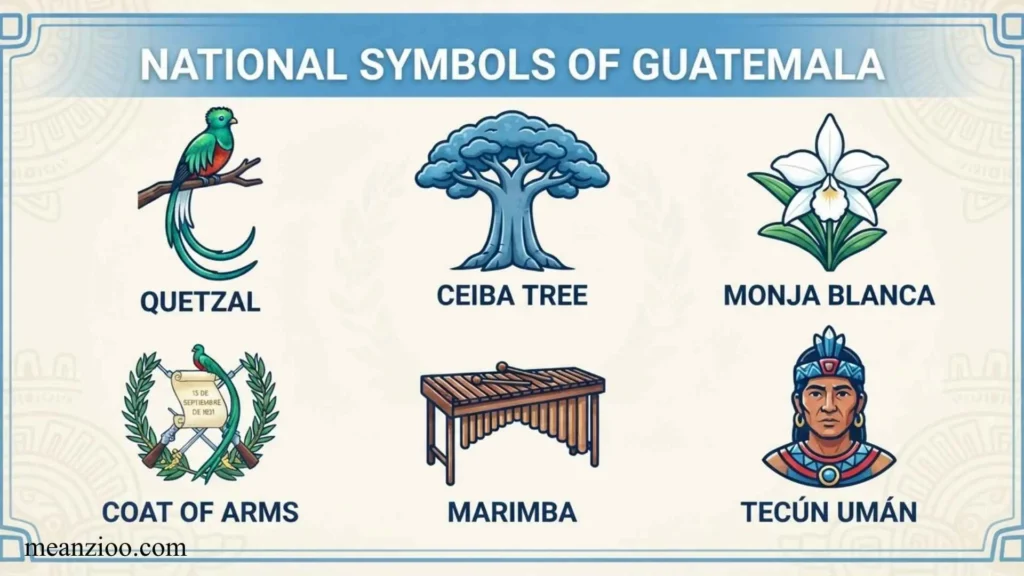
Guatemala’s major patriotic and national symbols include:
- The National Flag
- The Coat of Arms
- The Quetzal, national bird
- The Ceiba, national tree
- The Monja Blanca, national flower
- The Marimba, national instrument
- Tecún Umán, national hero
- The National Anthem
Guatemala’s Congress identifies the quetzal, flag, ceiba, Monja Blanca, coat of arms, Tecún Umán, and marimba as elements that strengthen national identity.
The National Anthem is also an important expression of patriotism and national identity.
Guatemala Symbols at a Glance
| Symbol | What it is | Main meaning |
| National Flag | National emblem | Identity, independence, peace |
| Coat of Arms | National emblem | Freedom, sovereignty, defense and victory |
| Quetzal | National bird | Freedom and independence |
| Ceiba | National tree | Maya heritage, wisdom and protection |
| Monja Blanca | National flower | Natural beauty and biodiversity |
| Marimba | National instrument | Cultural heritage and national music |
| Tecún Umán | National hero | Resistance, courage and defense |
| National Anthem | Patriotic song | National pride and history |
1. The National Flag of Guatemala
The flag of Guatemala is one of the country’s most recognizable national symbols.
Its design consists of three vertical stripes of equal width:
- A light-blue stripe on the left
- A white stripe in the center
- A light-blue stripe on the right
The national Coat of Arms appears in the middle of the white stripe. Under current regulations, the flag is regarded as the country’s supreme insignia.
What Do the Colors of the Guatemala Flag Mean?
The blue-and-white design is strongly associated with Guatemala’s national identity.
The blue is commonly interpreted in connection with the country’s sky and surrounding waters, while white is associated with peace and other positive national ideals.
The colors also have a historical connection to the Central American tradition of blue and white flags that developed after independence.
The current vertical design emerged during the Liberal Revolution of 1871. On August 17 of that year, President Miguel García Granados decreed a new flag featuring two blue vertical bands and a white center.
Why Is the Guatemala Flag Different From Other Central American Flags?
Several Central American countries use blue and white because these colors have a shared regional history. Guatemala’s vertical arrangement and central coat of arms, however, give it a distinctive appearance.
The design also separates Guatemala visually from flags that use the same colors in horizontal bands.
2. The Coat of Arms of Guatemala
The Coat of Arms of Guatemala is placed at the center of the national flag and is one of the country’s most meaningful symbols.
The modern design was created in 1871 by Swiss engraver Juan Bautista Frener. It was officially adopted during the government of Miguel García Granados.
Rather than being a simple decorative emblem, the coat of arms combines several objects that represent Guatemala’s independence, defense, sovereignty, and victory.
What Do the Symbols on Guatemala’s Coat of Arms Mean?
The Quetzal
A quetzal sits above the scroll and represents freedom. The bird is particularly appropriate because the quetzal itself became an important symbol of independence and autonomy.
The Scroll
The scroll bears the date:
15 de septiembre de 1821
This is the date associated with Central America’s declaration of independence from Spain.
The date makes the country’s independence a central part of the national emblem.
The Rifles
Two crossed rifles represent the country’s willingness and ability to defend itself.
They also reflect the historical context in which the emblem was created during the Liberal Revolution of 1871.
The Swords
Two crossed golden swords represent justice and sovereignty.
Together with the rifles, they give the emblem a strong connection to national defense and independence.
The Laurel Branches
Laurel branches surround the central design and symbolize victory and achievement.
The combination of weapons, laurel, the independence date, and the quetzal creates a visual summary of Guatemala’s struggle for sovereignty and national identity.
3. The Quetzal: Guatemala’s National Bird
The quetzal is perhaps the most famous of all Guatemala symbols.
Guatemala officially declared the quetzal its national bird on November 18, 1871, through Decree No. 33. It is associated with freedom, independence, and autonomy.
The bird is especially significant because its importance predates the modern Guatemalan state.
Why Is the Quetzal Important to Guatemala?
The quetzal held sacred status among pre-Columbian Mesoamerican cultures, including the Maya. Its brilliant green plumage and long tail feathers made it particularly valuable and symbolic.
The bird was associated with divine or elevated status, and quetzal feathers were used by rulers and members of the elite. Historical accounts also describe traditions of capturing birds to obtain feathers rather than killing them.
This ancient cultural significance eventually became part of modern Guatemala’s national identity.
The Quetzal and Freedom
The quetzal is strongly associated with freedom because of its place in Guatemalan symbolism and its representation in the national coat of arms.
It is also the bird that gives its name to Guatemala’s currency, the quetzal.
This makes the quetzal unusual among national symbols because its name connects Guatemala’s wildlife, history, economy, and national identity.
4. The Ceiba: Guatemala’s National Tree
The ceiba tree became Guatemala’s national tree on November 8, 1955.
The tree has deep roots in Maya culture. It was considered sacred and was associated with the structure of the universe. In traditional Maya cosmology, the ceiba could represent a connection between different levels of existence.
What Does the Ceiba Symbolize?
The ceiba is commonly associated with:
- Wisdom
- Protection
- Strength
- Nature
- Maya heritage
- The connection between the spiritual and physical worlds
Its status as a national symbol shows that Guatemala’s national identity is not limited to modern political history. It also incorporates the country’s ancient Indigenous heritage.
Why Is the Ceiba Important in Maya Culture?
The ceiba’s importance goes far beyond its size and appearance.
For Maya communities, the tree had profound cultural and cosmological significance. Its large trunk and branches made it a natural representation of a connection between earth and sky.
That ancient symbolism helps explain why the ceiba remains such an important national symbol today.
5. The Monja Blanca: Guatemala’s National Flower
The Monja Blanca is Guatemala’s national flower.
This beautiful white orchid was declared the national flower in 1934 during the presidency of Jorge Ubico. It is associated with Guatemala’s extraordinary plant diversity, particularly the country’s mountainous and humid regions.
Its scientific name is commonly given as Lycaste skinneri, with the white form identified as Lycaste skinneri forma alba in botanical sources.
Why Is It Called Monja Blanca?
The name Monja Blanca means “White Nun.”
The flower’s central structure can resemble the figure of a person in prayer, which helped inspire the popular name.
The plant also has Indigenous cultural associations. Guatemala.com notes that the Q’eqchi’ name Saqi ixq means “white woman.”
Why Is the Monja Blanca Important?
The flower represents:
- Guatemala’s natural beauty
- Biodiversity
- The country’s forests and mountains
- Cultural heritage
- The importance of conservation
The Monja Blanca has also become a symbol of environmental responsibility because its natural habitat has faced significant pressures.
6. The Marimba: Guatemala’s National Instrument
The marimba is Guatemala’s national instrument and one of the country’s most recognizable cultural symbols.
The Guatemalan Congress formally recognized the marimba as the national instrument through Decree 31-99 in 1999.
The instrument is made with wooden bars that are struck with mallets, producing distinctive musical notes.
Why Is the Marimba a Symbol of Guatemala?
The marimba is more than a musical instrument. It has become deeply embedded in Guatemalan cultural life.
It can be heard at:
- National celebrations
- Community events
- Cultural performances
- Festivals
- Civic ceremonies
- Family and social gatherings
Its history is complex, and scholars have debated its origins. The instrument developed in Guatemala through a mixture of cultural influences and local adaptations.
Today, the marimba represents the country’s musical traditions and cultural continuity.
7. Tecún Umán: National Hero of Guatemala
Tecún Umán occupies a different place among Guatemala symbols.
He is remembered as a K’iche’ leader associated with resistance to the Spanish invasion. Guatemala officially recognized him as a national hero in 1960.
His story has become an important part of Guatemalan national memory.
What Does Tecún Umán Represent?
Tecún Umán is associated with:
- Courage
- Resistance
- Defense of the homeland
- Indigenous heritage
- National pride
Unlike the flag or quetzal, Tecún Umán represents national identity through a historical figure.
His inclusion among Guatemala’s important patriotic symbols also highlights the role of Indigenous history in the country’s national story.
8. The National Anthem of Guatemala
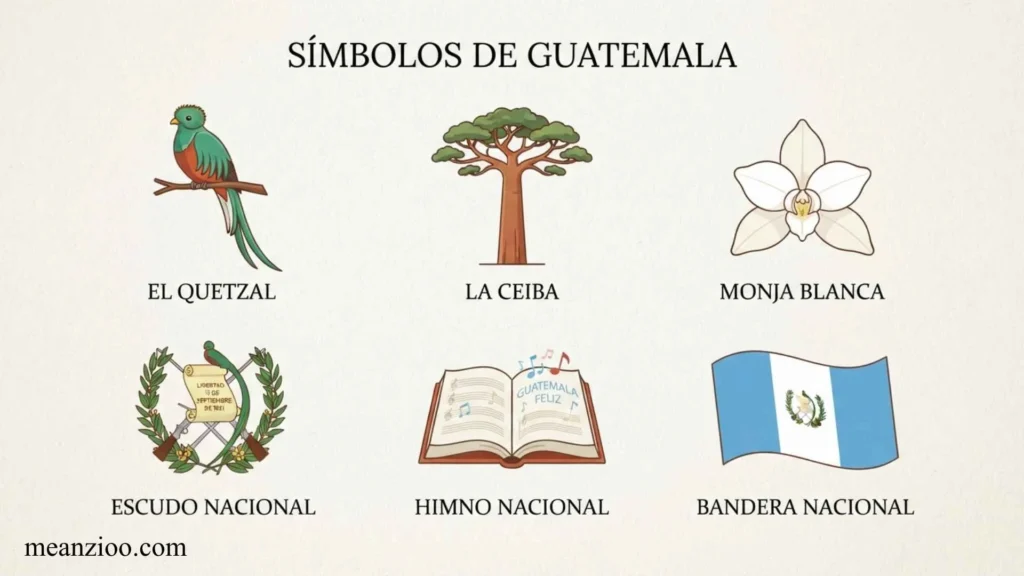
The National Anthem of Guatemala, or Himno Nacional de Guatemala, is another important expression of national identity.
The anthem’s music was composed by Rafael Álvarez Ovalle, while the original lyrics were written by Cuban poet José Joaquín Palma. The work was officially adopted in the late 1890s, and its first public performance took place in 1897.
The lyrics were revised in 1934 by José María Bonilla Ruano, resulting in a version with a more peaceful tone than the original.
What Does the National Anthem Represent?
The anthem expresses themes of:
- Freedom
- National sovereignty
- Courage
- Patriotism
- Love of country
- Historical struggle
It is performed during important civic and national occasions and remains an important part of Guatemala’s patriotic traditions.
Is “Guatemala Feliz” the Name of the National Anthem?
You may see the Guatemalan anthem referred to informally as “Guatemala Feliz” because those are its opening words.
However, the official name is simply Himno Nacional de Guatemala. “Guatemala Feliz” is commonly used as an informal reference rather than the official title.
9. Guatemala’s National Colors
The most recognizable national colors of Guatemala are blue and white.
They appear prominently on the national flag and are an important part of Guatemala’s visual identity.
The flag uses two blue vertical bands separated by a white central band containing the national coat of arms. Current regulations specify the colors and proportions of the flag.
What Do Blue and White Represent?
Interpretations vary somewhat depending on the source, but blue is commonly connected with Guatemala’s sky and surrounding waters, while white is associated with peace, purity, and related ideals.
For everyday purposes, the most important point is that blue and white have become strongly associated with Guatemalan national identity.
10. Maya Influence on Guatemala Symbols
One of the most important aspects of Guatemala’s national symbols is the connection between modern national identity and Maya culture.
This connection can be seen particularly clearly in the:
- Quetzal
- Ceiba
- Indigenous historical traditions
- Cultural heritage represented by Tecún Umán
The quetzal was considered sacred in pre-Columbian Mesoamerica, while the ceiba had an important place in Maya cosmology.
This means Guatemala’s national symbols do not simply tell the story of the modern republic. They also preserve references to civilizations and cultural traditions that existed long before independence.
Why Does Maya Heritage Matter?
Guatemala has one of the strongest living Maya cultural traditions in the Americas.
Consequently, understanding Guatemala symbols without considering Indigenous history gives an incomplete picture.
The country’s national identity is made up of many layers: ancient Maya traditions, Indigenous communities, Spanish colonial history, independence, modern political history, and contemporary Guatemalan culture.
11. History of Guatemala Symbols: A Simple Timeline
The symbols of Guatemala were not all created at the same time. They developed over many decades.
1821 — Independence
Central America declared independence from Spain on September 15, 1821.
That date later became a central element of Guatemala’s national identity and appears on the Coat of Arms.
1871 — Major Changes to National Symbols
The Liberal Revolution brought major changes to Guatemala’s national imagery.
A new national flag was introduced in August 1871, featuring the blue-white-blue vertical design.
The modern Coat of Arms was also developed in 1871, and the quetzal was officially designated the national bird that same year.
1896–1897 — National Anthem
A competition was held to establish a national anthem.
José Joaquín Palma wrote the lyrics, while Rafael Álvarez Ovalle composed the music. The anthem was adopted in the late 1890s and first performed publicly in 1897.
1934 — Monja Blanca
The Monja Blanca was declared Guatemala’s national flower in 1934.
1955 — Ceiba
The ceiba was declared Guatemala’s national tree on November 8, 1955.
1960 — Tecún Umán
Tecún Umán was officially recognized as a national hero in 1960.
1999 — Marimba
The marimba was formally recognized as Guatemala’s national instrument through Decree 31-99.
This timeline shows how Guatemala’s national identity has gradually incorporated political, natural, Indigenous, and cultural symbols.
12. Why Are Guatemala Symbols Important?
National symbols serve as visual, cultural, and historical reminders of a country’s identity.
In Guatemala, they connect different parts of the country’s story.
The flag represents the nation itself.
The coat of arms brings together independence, defense, sovereignty, victory, and freedom.
The quetzal represents freedom while connecting modern Guatemala with pre-Columbian traditions.
The ceiba represents nature and Maya heritage.
The Monja Blanca represents biodiversity and natural beauty.
The marimba represents music and cultural tradition.
Tecún Umán represents resistance and Indigenous historical memory.
The National Anthem expresses patriotism through music and words.
Together, these symbols create a much richer picture of Guatemala than any single emblem could provide.
Guatemala Symbols and National Identity
An interesting feature of Guatemala’s symbols is that they combine nature, history, culture, and patriotism.
Many countries have national birds, flowers, trees, flags, and anthems. Guatemala’s symbols are particularly meaningful because several of them have connections to Indigenous traditions that existed centuries before the modern country was established.
For example, the quetzal and ceiba are not simply modern government creations. They have much older cultural histories.
At the same time, the flag and coat of arms reflect the political history of the modern republic.
The marimba demonstrates how music can become a national symbol, while Tecún Umán represents the country’s Indigenous historical memory.
Guatemala Symbols in Everyday Life
These symbols are not confined to history books.
They can be found in many aspects of Guatemalan life, including:
- Schools
- Government buildings
- Civic ceremonies
- National celebrations
- Currency
- Music
- Public monuments
- Cultural events
- Tourism
- Art and handicrafts
The flag is especially visible around national holidays and civic events, while the marimba remains an important part of cultural celebrations.
The quetzal also has a particularly strong presence because it gives its name to Guatemala’s currency.
National Symbols vs. Cultural Symbols
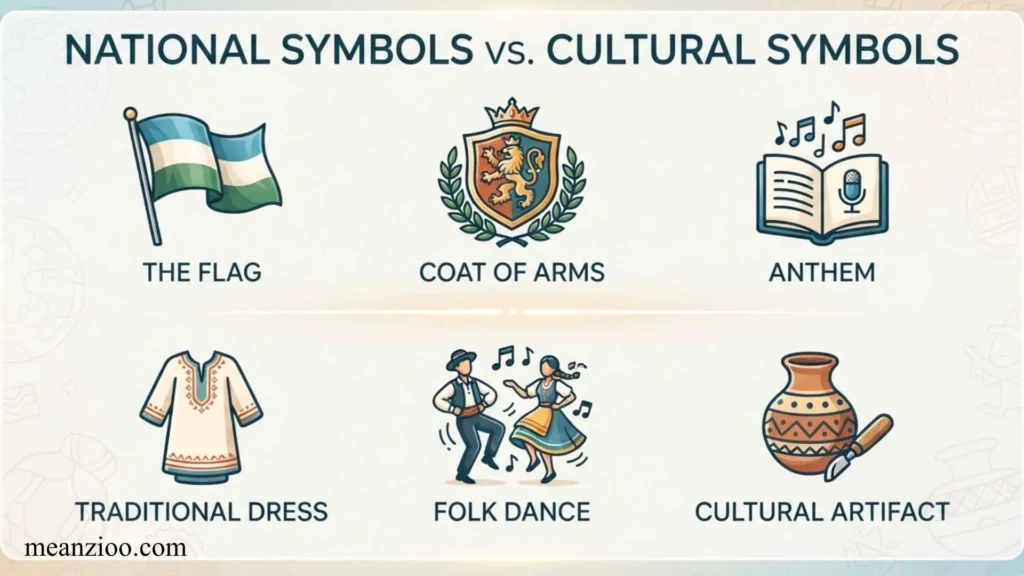
It is useful to distinguish between official national symbols and broader cultural symbols.
A national symbol generally has a formal legal or governmental designation. A cultural symbol may be deeply important to the country without having exactly the same legal status.
For example, the flag, coat of arms, quetzal, ceiba, Monja Blanca, and marimba have formal recognition associated with their national roles. Tecún Umán is recognized as a national hero.
Meanwhile, Guatemala has many other cultural symbols—including Maya textiles, traditional foods, dances, archaeological sites, and Indigenous languages—that are also essential to understanding Guatemalan identity.
This distinction prevents the term “Guatemala symbols” from becoming unnecessarily restrictive.
A Quick Comparison of Guatemala’s Major Symbols
| Symbol | Category | Recognized / adopted | Main association |
| Flag | National emblem | 1871 design | National identity |
| Coat of Arms | National emblem | 1871 | Freedom and sovereignty |
| Quetzal | National bird | 1871 | Freedom |
| National Anthem | Patriotic symbol | 1896–1897 | Patriotism |
| Monja Blanca | National flower | 1934 | Nature and beauty |
| Ceiba | National tree | 1955 | Maya heritage and protection |
| Tecún Umán | National hero | 1960 | Resistance and courage |
| Marimba | National instrument | 1999 | Music and culture |
Frequently Asked Questions About Guatemala Symbols
What are the main symbols of Guatemala?
The main Guatemala symbols include the national flag, Coat of Arms, quetzal, ceiba, Monja Blanca, marimba, and Tecún Umán. The National Anthem is also an important patriotic symbol. Guatemala’s Congress specifically identifies the flag, coat of arms, quetzal, ceiba, Monja Blanca, marimba, and Tecún Umán as elements that strengthen national identity.
What is the most famous symbol of Guatemala?
The quetzal is one of Guatemala’s most famous symbols. It is the national bird, appears on the Coat of Arms, and represents freedom and autonomy.
What does the Guatemala flag symbolize?
The blue-and-white flag is a major representation of Guatemala’s national identity. Its central Coat of Arms adds symbols of independence, freedom, defense, sovereignty, and victory. The current vertical design dates to 1871.
What do the colors of the Guatemala flag mean?
The blue and white colors are commonly associated with Guatemala’s sky, surrounding waters, peace, and national ideals. They also reflect the historical blue-and-white tradition shared by several Central American countries.
What is Guatemala’s national bird?
Guatemala’s national bird is the quetzal. It was officially declared the national bird on November 18, 1871.
What does the quetzal symbolize in Guatemala?
The quetzal symbolizes freedom, independence, and autonomy. It also has deep pre-Columbian cultural significance and was considered sacred by Mesoamerican civilizations.
What is Guatemala’s national flower?
The Monja Blanca, a white orchid, is Guatemala’s national flower. It was officially designated in 1934.
What is Guatemala’s national tree?
The ceiba is Guatemala’s national tree. It was declared the national tree in 1955 and has important connections to Maya culture and cosmology.
What is Guatemala’s national instrument?
The marimba is Guatemala’s national instrument. The Congress formally recognized it as the national instrument through Decree 31-99 in 1999.
Who is Tecún Umán?
Tecún Umán is a historical and cultural figure remembered as a K’iche’ leader associated with resistance to the Spanish invasion. Guatemala declared him a national hero in 1960.
What is shown on Guatemala’s Coat of Arms?
The Coat of Arms contains a quetzal, an independence scroll dated September 15, 1821, crossed rifles, crossed golden swords, and laurel branches. These elements symbolize freedom, independence, defense, sovereignty, and victory.
Why is the ceiba tree important to Guatemala?
The ceiba has strong connections to Maya culture. It was regarded as a sacred tree and associated with the structure of the universe, making it a powerful representation of Guatemala’s Indigenous heritage.
Why is the marimba important in Guatemala?
The marimba is an important part of Guatemalan musical and cultural life. Its use in celebrations and performances has helped make it a powerful expression of national culture, and it was formally recognized as the national instrument in 1999.
Final Thoughts on Guatemala Symbols
The symbols of Guatemala tell a story that stretches from ancient Maya traditions to the modern republic.
The quetzal represents freedom. The ceiba connects Guatemala with its Maya heritage. The Monja Blanca reflects the country’s extraordinary biodiversity. The marimba expresses its musical traditions. Tecún Umán represents courage and resistance. The flag and Coat of Arms represent the modern nation and its independence, while the National Anthem expresses patriotism through music.
Taken together, these symbols demonstrate that Guatemala’s identity is built from many different layers—Indigenous heritage, natural beauty, historical struggles, independence, music, and national pride.
Understanding Guatemala symbols is therefore more than memorizing a list of national emblems. It is a way to understand the history and cultural identity of Guatemala itself.
Also Check These Posts:
Infinity Symbols: ∞ ♾️ and More Symbols to Copy, Paste, Type, and Understand
WW1 Symbols: Complete Guide to World War I Symbols and Their Meanings
Logical Symbols: Complete List, Meanings, Names, and Examples

Hi, I’m Charlotte Hayes. I love writing about the newest English slang, pop culture phrases, and digital communication. I spend my time exploring how language evolves across social media, gaming, and everyday conversations. I enjoy sharing easy-to-understand guides that help learners keep up with modern English. My goal is to make every article useful, accurate, and enjoyable for readers around the world.
Books:
- Everyday Slang Dictionary
- Fluent Through Informal English
 Ryan Mitchell