
Logical symbols are special symbols used to represent statements, relationships, conditions, and forms of reasoning in mathematics, computer science, philosophy, Boolean algebra, set theory, and formal logic.
Instead of writing an entire logical statement in words, symbols such as ¬, ∧, ∨, →, ↔, ∀, and ∃ allow the same idea to be expressed precisely and compactly. More advanced logical notation includes ⊕ for XOR, ↑ for NAND, ↓ for NOR, ⊤ for true, ⊥ for false, and ∃! for “there exists exactly one.”
This guide explains the most important logical symbols, what they are called, how they work, where they are used, and how to read them.
What Are Logical Symbols?
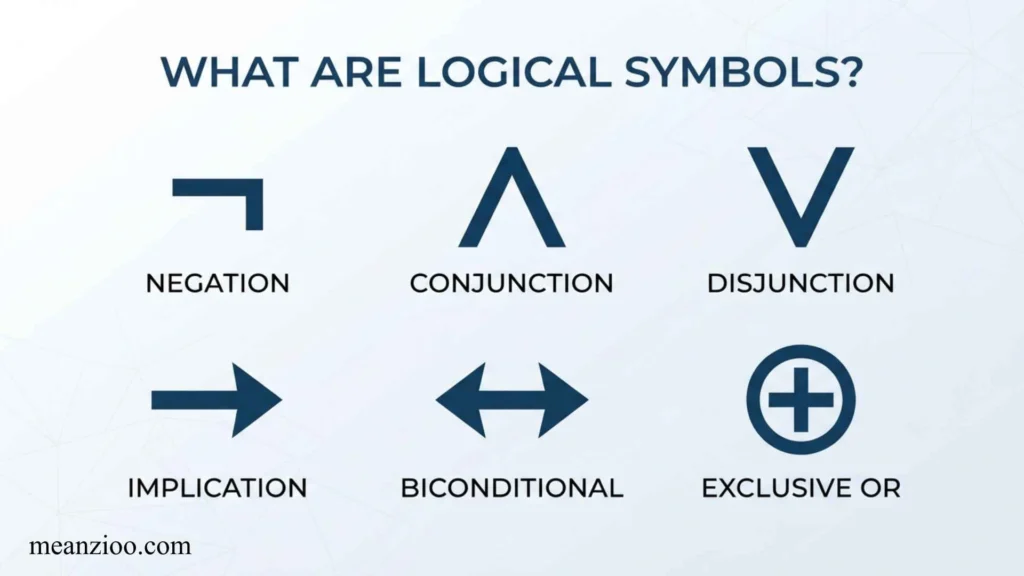
Logical symbols are standardized notations used to express operations and relationships between propositions.
A proposition is a statement that can be classified as either true or false. For example:
- P: “7 is greater than 3.”
- Q: “10 is an even number.”
Logical symbols can then combine these propositions.
For example:
P ∧ Q
means:
“P and Q.”
Logical notation is particularly useful because it removes unnecessary repetition and makes the structure of an argument easier to see. Standard introductory logic uses symbols for connectives such as conjunction, disjunction, negation, conditional statements, and biconditionals.
Logical Symbols List
Logical symbols represent ideas such as truth, falsehood, negation, conjunction, implication, and equivalence. They help you express complex statements in a shorter, more precise form. You will find these symbols in mathematics, philosophy, computer science, and formal logic.
Here is a useful logical symbols list with their names and meanings.
| Symbol | Name | Meaning |
| Negation | NOT | |
| Conjunction | AND | |
| Disjunction | OR | |
| Exclusive OR | Either one, but not both | |
| Implication | If…then | |
| Biconditional | If and only if | |
| Logical equivalence | Logically equivalent | |
| Tautology / True | Always true in the relevant system | |
| Contradiction / False | Always false in the relevant system | |
| Universal quantifier | For all | |
| Existential quantifier | There exists | |
| \(\nexists\) | Not exists | There does not exist |
| \(\therefore\) | Therefore | Conclusion follows |
| \(\because\) | Because | Gives a reason |
| Syntactic entailment | Can be derived formally | |
| \(\models\) | Semantic entailment | True in every relevant model |
| \(\Box\) | Necessity | Necessarily true |
| \(\Diamond\) | Possibility | Possibly true |
When should you use logical symbols?
- Use to express that a statement is false or denied.
- Use when both statements must be true.
- Use when at least one statement may be true.
- Use to represent a conditional relationship.
- Use and when reasoning about all objects or at least one object.
Remember that some symbols have different interpretations depending on the logical system. For example, implication in formal logic does not always mean cause and effect.
Logical Symbols With Examples
The easiest way to understand logical symbols is to see how they work in actual statements. In symbolic logic, letters such as P and Q usually represent propositions, which are statements that can be true or false.
Suppose:
- P: It is raining.
- Q: The road is wet.
The following examples show how logical operators combine or modify these statements.
| Symbol | Expression | Example meaning |
| P | It is not raining. | |
| PQ | It is raining and the road is wet. | |
| PQ | It is raining or the road is wet, or both. | |
| PQ | Exactly one of the two statements is true. | |
| PQ | If it is raining, then the road is wet. | |
| PQ | Both statements have the same truth value. |
Consider the statement PQ. In classical logic, this conditional is false only when P is true and Q is false. In every other truth-value combination, it is true.
More examples of logical notation
- Universal quantifier: xP(x) means that P(x) holds for every object in the specified domain.
- Existential quantifier: xP(x) means that at least one object satisfies P(x).
- Negated existential: xP(x) means that no object satisfies P(x).
- Logical equivalence: PQ means that P and Q are either both true or both false.
These examples are useful for students learning discrete mathematics, propositional logic, predicate logic, and mathematical reasoning.
Logical Symbols Copy Paste
If you need logical symbols for an assignment, article, presentation, research paper, or online discussion, you can copy them directly from the table below.
| Symbol | Name | Copy |
| ¬ | NOT / Negation | ¬ |
| ∧ | AND / Conjunction | ∧ |
| ∨ | OR / Disjunction | ∨ |
| ⊕ | Exclusive OR | ⊕ |
| → | Implication | → |
| ⇒ | Implies / Formal implication notation | ⇒ |
| ↔ | Biconditional | ↔ |
| ⇔ | If and only if / Equivalence notation | ⇔ |
| ≡ | Equivalence or identity, depending on context | ≡ |
| ∀ | For all | ∀ |
| ∃ | There exists | ∃ |
| ∄ | There does not exist | ∄ |
| ⊤ | True / Tautology notation | ⊤ |
| ⊥ | False / Contradiction notation | ⊥ |
| ∴ | Therefore | ∴ |
| ∵ | Because | ∵ |
| ⊢ | Derivability | ⊢ |
| ⊨ | Semantic entailment | ⊨ |
| □ | Necessity in modal logic | □ |
| ◇ | Possibility in modal logic | ◇ |
| ∩ | Intersection | ∩ |
| ∪ | Union | ∪ |
| ≠ | Not equal to | ≠ |
| ≤ | Less than or equal to | ≤ |
| ≥ | Greater than or equal to | ≥ |
Tips for copying logical symbols
- Copy the symbol and paste it into your document or text editor.
- Use a font that supports mathematical Unicode characters.
- For academic papers, check whether your institution requires a particular mathematical notation style.
- If a symbol appears as an empty square, your current font or application may not support that character.
Keep in mind that symbols such as , , and \(\models\) are related but are not interchangeable in every context.
Logical Symbols Philosophy
In philosophy, logical symbols help analyze arguments, identify valid conclusions, and clarify relationships between statements. They are especially useful in formal logic, where philosophers translate ordinary language into a structured symbolic form.
For example, consider this argument:
- If a person studies, they may pass an exam.
- Sara studies.
- Therefore, Sara may pass the exam.
A simplified symbolic structure can be written as:
PQ
P
\[ \therefore Q \]
This pattern is known as modus ponens. It is a valid inference rule when the premises have the stated logical form.
Common symbols used in philosophical logic
- — Negation: Denies a proposition.
- — Conjunction: Connects two propositions that must both hold.
- — Disjunction: Expresses an inclusive OR in standard classical logic.
- — Conditional: Represents an if-then relationship.
- — Biconditional: Connects statements that have the same truth value.
- — Universal quantifier: Refers to every member of a domain.
- — Existential quantifier: States that at least one member of a domain meets a condition.
- \(\Box\) — Necessity: Indicates that a proposition is necessarily true within a modal framework.
- \(\Diamond\) — Possibility: Indicates that a proposition is possibly true within a modal framework.
Philosophers use these symbols to study arguments about knowledge, existence, morality, identity, possibility, and necessity.
For example, the statement “All humans are mortal” can be represented as:
x(H(x)M(x))
Here, H(x) means that x is human, and M(x) means that x is mortal.
This notation makes the structure of the statement clear without repeating the full sentence.
Logical Symbols Math
Mathematical logic uses symbols to express propositions, relationships, quantifiers, proofs, and logical operations. These symbols are particularly important in set theory, discrete mathematics, computer science, and mathematical proofs.
Although some logical symbols resemble arithmetic operators, they perform different functions. For example, + adds numbers, while combines propositions using logical AND.
Important mathematical logic symbols
| Symbol | Meaning | Example |
| NOT | P | |
| AND | PQ | |
| OR | PQ | |
| Implies | PQ | |
| If and only if | PQ | |
| For every | xP(x) | |
| There exists | xP(x) | |
| Is an element of | xA | |
| Is not an element of | xA | |
| Is a subset of | AB | |
| \(\emptyset\) | Empty set | \(A=\emptyset\) |
| \(\therefore\) | Therefore | \(\therefore Q\) |
Example of mathematical reasoning
Suppose P means that a number is divisible by 2, and Q means that the number is even.
You could express the relationship as:
PQ
In this example, the two statements are equivalent under the usual definition of an even integer.
Mathematical logic also uses truth tables to examine whether a compound proposition is true or false for different combinations of truth values. These tables are valuable for checking logical equivalences, analyzing arguments, and simplifying Boolean expressions.
Logic Symbols and Meanings
Logic symbols provide a standard language for representing statements and reasoning. Each symbol has a specific role, although its exact interpretation may depend on the logical system and the context in which it appears.
Here are some of the most commonly used logic symbols and their meanings.
Negation (¬)
Negation reverses the truth value of a proposition. If P is true, P is false. If P is false, P is true.
Example: If P means “The light is on,” then P means “The light is not on.”
Conjunction (∧)
Conjunction represents AND. The compound statement PQ is true only when both P and Q are true.
Example: “The computer is on and the monitor is connected.”
Disjunction (∨)
Disjunction represents inclusive OR in classical logic. The expression PQ is true if at least one proposition is true, including when both are true.
Example: “You can submit the assignment online or in person.”
Implication (→)
Implication represents a conditional statement. The expression PQ reads “If P, then Q.”
Example: “If a number is divisible by 4, then it is even.”
Biconditional (↔)
A biconditional states that two propositions are equivalent in truth value. It reads “P if and only if Q.”
Example: “An integer is even if and only if it is divisible by 2.”
Universal quantifier (∀)
The universal quantifier means “for all” or “for every.” It applies a condition to every object in a specified domain.
Example:
\[ \forall x\in\mathbb{R},\quad x^2\geq 0 \]
This states that the square of every real number is greater than or equal to zero.
Existential quantifier (∃)
The existential quantifier means “there exists at least one.” It states that a condition is satisfied by one or more objects.
Example:
\[ \exists x\in\mathbb{Z},\quad x^2=9 \]
This statement is true because both x=3 and x=-3 are integers whose squares equal 9.
Understanding these symbols makes it easier to read proofs, follow mathematical arguments, and translate natural language into formal notation.
Logical Symbols Keyboard
Typing logical symbols can be challenging when your keyboard does not have dedicated keys for them. Fortunately, you can enter many symbols using copy-and-paste, character maps, Unicode input, or LaTeX commands.
Ways to type logical symbols
- Copy and paste: Copy symbols such as , , , and from a symbol list.
- Windows Character Map: Open Character Map, search for a supported character, and copy it into your document.
- Microsoft Word: Use the equation editor or insert a symbol through the application’s symbol menu.
- Mac: Open Character Viewer to search for mathematical and logical characters.
- LaTeX: Enter commands such as \land, \lor, \neg, and \forall inside math mode.
- HTML: Use appropriate HTML entities or Unicode characters when preparing web content.
Useful keyboard alternatives
If you cannot type a logical symbol, you can use a plain-text alternative when the context allows it.
| Logical symbol | Plain-text alternative |
| P | NOT P |
| PQ | P AND Q |
| PQ | P OR Q |
| PQ | IF P THEN Q |
| PQ | P IFF Q |
| x | FOR ALL x |
| x | THERE EXISTS x |
Plain-text alternatives are useful in programming notes, plain-text emails, and systems that do not support mathematical formatting. For formal academic writing, use the required mathematical symbols whenever possible.
Mathematical Logical Symbols
Mathematical logical symbols are used to describe truth values, logical operations, quantifiers, relations, and formal deductions. They make mathematical expressions more concise and help readers identify the structure of an argument.
Some symbols belong directly to formal logic, while others come from set theory or mathematical notation and are frequently used alongside logical operators.
| Symbol | Name | Common use |
| Negation | Denying a proposition | |
| Conjunction | Combining statements with AND | |
| Disjunction | Combining statements with OR | |
| Implication | Expressing a conditional | |
| Biconditional | Expressing an if-and-only-if relationship | |
| Universal quantifier | Applying a condition to every object | |
| Existential quantifier | Stating that at least one object exists | |
| Membership | Showing that an element belongs to a set | |
| Subset | Showing that one set is contained in another | |
| Union | Combining elements of sets | |
| Intersection | Finding shared elements of sets | |
| \(\emptyset\) | Empty set | Representing a set with no elements |
| \(\models\) | Semantic entailment | Indicating that a conclusion follows in every relevant model |
| Syntactic derivability | Indicating that a statement can be derived using formal rules |
Example: Combining logic and set theory
Suppose A is the set of even integers and B is the set of positive integers.
The expression
AB
represents the integers that belong to both sets. In this example, it contains the positive even integers.
Similarly, the statement
xA,P(x)
means that the property P(x) holds for every element of set A.
These symbols are widely used in discrete mathematics, proofs, algorithms, computer science, and advanced mathematical reasoning.
Logical Symbols LaTeX
LaTeX is a typesetting system commonly used to write mathematical equations, research papers, academic assignments, and technical documents. It provides commands for most standard logical symbols, allowing you to create consistent and readable mathematical notation.
The following table includes useful logical symbols and their LaTeX commands.
| Symbol | Meaning | LaTeX command |
| Negation | \neg | |
| Logical AND | \land | |
| Logical OR | \lor | |
| Exclusive OR | \oplus | |
| Implication arrow | \to | |
| Right arrow | \rightarrow | |
| Double-line right arrow | \Rightarrow | |
| Biconditional arrow | \leftrightarrow | |
| Double-line left-right arrow | \Leftrightarrow | |
| For all | \forall | |
| There exists | \exists | |
| \(\nexists\) | There does not exist | \nexists |
| Top / True | \top | |
| Bottom / False | \bot | |
| Derivability | \vdash | |
| \(\models\) | Semantic entailment | \models |
| \(\Box\) | Necessity operator | \Box |
| \(\Diamond\) | Possibility operator | \Diamond |
| \(\therefore\) | Therefore | \therefore |
| \(\because\) | Because | \because |
LaTeX examples
To write a logical conjunction, use:
P \land Q
To write an implication, use:
P \to Q
To express a statement that applies to every real number, use:
\forall x \in \mathbb{R},\; x^2 \geq 0
To express that at least one integer has a square equal to 4, use:
\exists x \in \mathbb{Z},\; x^2 = 4
For a complete equation, place the expression between \[ and \] to display it on a separate line:
\[
(P \land Q) \to P
\]
This last expression is a tautology in classical propositional logic because whenever PQ is true, P must also be true.
Modal Logical Symbols
Modal logic extends classical logic by allowing you to reason about necessity and possibility. It is used in philosophy, computer science, artificial intelligence, linguistics, and the study of knowledge and belief.
Two symbols are especially important in basic modal logic:
- \(\Box\) — Necessity: Reads “necessarily” or “it is necessary that.”
- \(\Diamond\) — Possibility: Reads “possibly” or “it is possible that.”
If P means “The statement is true,” the expressions below show how modal operators work.
| Symbol | Expression | Meaning |
| \(\Box P\) | Necessity | P is necessarily true. |
| \(\Diamond P\) | Possibility | P is possibly true. |
| \(\neg\Box P\) | Not necessary | P is not necessarily true. |
| \(\neg\Diamond P\) | Not possible | P is impossible in the relevant system. |
| \(\Box\neg P\) | Necessarily not | P is necessarily false. |
| \(\Diamond\neg P\) | Possibly not | There is a possibility that P is false. |
Examples of modal logic
Consider the statement “A triangle has three sides.”
In standard mathematical reasoning, this is necessarily true given the usual definition of a triangle. A modal representation could be written as:
\[ \Box P \]
Now consider the statement “It may rain tomorrow.” This expresses possibility rather than necessity:
\[ \Diamond Q \]
The exact interpretation of these operators depends on the modal system being used. In standard possible-world semantics, \(\Box P\) is true when P holds in every accessible world, while \(\Diamond P\) is true when P holds in at least one accessible world.
Modal logic also includes specialized systems for reasoning about knowledge, belief, time, obligations, and other forms of modality. The same symbols can therefore have different interpretations in different applications.
Symbol for Implication
The most common symbol for logical implication is . It represents a conditional statement and is read as “if P, then Q.”
For example:
PQ
This means that if proposition P is true, proposition Q must also be true under the conditional relationship.
Other arrow symbols are also used in logic and mathematics. Their meanings overlap in some contexts, but they are not always interchangeable.
| Symbol | Name | Typical use |
| Right arrow | Material implication in propositional logic | |
| Right arrow | Often used for implication or mappings | |
| Double-line right arrow | Often indicates implication or a derived conclusion | |
| Left-right arrow | Biconditional | |
| Double-line left-right arrow | Often indicates logical equivalence or equivalence of conditions |
Logical Symbols Chart
The following chart covers the most commonly encountered logical symbols.
| Symbol | Name | Meaning | Example |
| ¬ | Negation | Not | ¬P |
| ~ | Negation | Not | ~P |
| ∧ | Conjunction | And | P ∧ Q |
| ∨ | Disjunction | Or | P ∨ Q |
| ⊕ | Exclusive OR | Either P or Q, but not both | P ⊕ Q |
| → | Conditional | If P, then Q | P → Q |
| ⇒ | Implication | P implies Q | P ⇒ Q |
| ↔ | Biconditional | If and only if | P ↔ Q |
| ⇔ | Logical equivalence/iff | Equivalent or iff | P ⇔ Q |
| ↑ | NAND | Not AND | P ↑ Q |
| ↓ | NOR | Not OR | P ↓ Q |
| ⊤ | Tautology/true | Always true | P ∨ ¬P |
| ⊥ | Contradiction/false | Always false | P ∧ ¬P |
| ∀ | Universal quantifier | For all | ∀x |
| ∃ | Existential quantifier | There exists | ∃x |
| ∄ | Non-existence | There does not exist | ∄x |
| ∃! | Unique existential quantifier | There exists exactly one | ∃!x |
| ≡ | Logical equivalence | Logically equivalent | P ≡ Q |
| ∴ | Therefore | Conclusion follows | P, Q ∴ R |
| ∵ | Because | Reason or justification | ∵ P |
Different textbooks and fields may use alternative symbols for the same logical operation. For example, negation can appear as ¬P, ~P, or an overline, while implication may be written as → or ⇒.
Basic Logical Symbols
Negation Symbol: ¬
The symbol ¬ means “not.”
If:
P = “The light is on.”
then:
¬P = “The light is not on.”
Negation changes the truth value of a proposition. If P is true, ¬P is false; if P is false, ¬P is true.
You may also see negation written as:
- ~P
- −P in some contexts
- P̅ in Boolean algebra
The exact notation depends on the subject and convention.
AND Symbol: ∧
The symbol ∧ means AND and is called a conjunction.
P ∧ Q
is read:
“P and Q.”
The expression is true only when both P and Q are true.
For example:
- P = “5 is greater than 2.”
- Q = “5 is odd.”
Therefore:
P ∧ Q
is true because both statements are true.
OR Symbol: ∨
The symbol ∨ means OR and is called a disjunction.
P ∨ Q
means:
“P or Q.”
In formal logic, this normally means inclusive OR. Therefore, the expression is true if P is true, Q is true, or both are true.
This is important because everyday English sometimes uses “or” to mean one option but not the other.
NOT Symbol: ~
The tilde ~ is another common notation for negation.
For example:
~P
means:
“Not P.”
It has the same basic logical purpose as ¬P in systems that use the tilde for negation.
Conditional and Relationship Symbols
Implication Symbol: →
The symbol → represents a conditional statement.
P → Q
is read:
“If P, then Q.”
P is the antecedent or hypothesis, while Q is the consequent or conclusion.
For example:
If a number is divisible by 4, then it is even.
can be represented as:
P → Q
A conditional is false only when P is true and Q is false.
Implication Symbol: ⇒
The symbol ⇒ is also widely used to mean “implies” or “therefore leads to.”
For example:
P ⇒ Q
can be read:
“P implies Q.”
In many mathematical texts, → and ⇒ are used similarly, but authors may distinguish them depending on context. Always check the notation defined by the textbook or formal system you are using.
Biconditional Symbol: ↔
The symbol ↔ means “if and only if.”
P ↔ Q
means that P and Q imply each other.
In other words:
P ↔ Q
is equivalent to:
(P → Q) ∧ (Q → P)
A biconditional is true when P and Q have matching truth values.
Equivalent Symbol: ≡
The symbol ≡ is commonly used for logical equivalence.
For example:
¬(P → Q) ≡ P ∧ ¬Q
means that the two expressions have the same truth value under every possible assignment of P and Q. Logical equivalence can be established with a truth table.
Double-Arrow Symbol: ⇔
The symbol ⇔ is often read as:
“if and only if”
or:
“is logically equivalent to.”
It is frequently used in mathematical proofs and explanations.
Because notation varies, ↔, ⇔, and ≡ should not automatically be assumed to have exactly the same technical role in every formal system.
Also Check This Post: Georgia Symbols: Complete List of Georgia State Symbols, Meanings, and History
Quantifier Logical Symbols
Quantifiers are especially important in predicate logic because they describe how many objects satisfy a particular condition.
Universal Quantifier: ∀
The symbol ∀ means:
“for all,” “for every,” or “for any.”
For example:
∀x ∈ ℝ, x² ≥ 0
means:
“For every real number x, x² is greater than or equal to zero.”
The universal quantifier makes a statement about every member of a specified domain.
Existential Quantifier: ∃
The symbol ∃ means:
“there exists.”
For example:
∃x ∈ ℝ such that x² = 9
means:
“There exists a real number x whose square is 9.”
This statement is true because x can be 3 or −3.
Does Not Exist Symbol: ∄
The symbol ∄ means:
“there does not exist.”
For example:
∄x ∈ ℝ such that x² = −1
means:
“There is no real number x whose square is −1.”
This is another way of expressing the negation of an existential statement.
Unique Existential Quantifier: ∃!
The symbol ∃! means:
“There exists exactly one.”
For example:
∃!x ∈ ℝ such that x + 2 = 5
means:
“There exists exactly one real number x such that x + 2 = 5.”
That number is 3.
The unique existential quantifier is useful when a mathematical condition has one and only one solution.
XOR Symbol: ⊕
The symbol ⊕ commonly represents exclusive OR, or XOR.
Unlike ordinary logical OR, XOR is true when exactly one of the two propositions is true.
P ⊕ Q
means:
“P or Q, but not both.”
| P | Q | P ⊕ Q |
| T | T | F |
| T | F | T |
| F | T | T |
| F | F | F |
For example, imagine a system where a user can select either Option A or Option B, but not both. That condition can be represented with XOR.
XOR is particularly important in Boolean logic, programming, digital electronics, and computer science.
NAND Symbol: ↑
The symbol ↑ can represent NAND, meaning NOT AND.
It can be expressed as:
P ↑ Q = ¬(P ∧ Q)
NAND is false only when both P and Q are true.
| P | Q | P ∧ Q | P ↑ Q |
| T | T | T | F |
| T | F | F | T |
| F | T | F | T |
| F | F | F | T |
NAND is particularly important in digital electronics because NAND is a functionally complete operation: logical systems can be constructed using NAND alone.
NOR Symbol: ↓
The symbol ↓ commonly represents NOR, meaning NOT OR.
It can be written as:
P ↓ Q = ¬(P ∨ Q)
NOR is true only when both P and Q are false.
| P | Q | P ∨ Q | P ↓ Q |
| T | T | T | F |
| T | F | T | F |
| F | T | T | F |
| F | F | F | T |
Like NAND, NOR is functionally complete and is important in digital logic and electronic circuits.
True and False Symbols
True Symbol: ⊤
The symbol ⊤ represents a proposition that is always true, commonly called a tautology.
For example:
P ∨ ¬P
is always true in classical propositional logic.
Therefore:
P ∨ ¬P ≡ ⊤
False Symbol: ⊥
The symbol ⊥ represents a proposition that is always false, commonly called a contradiction.
For example:
P ∧ ¬P
can never be true because P cannot simultaneously be true and false under classical two-valued logic.
Therefore:
P ∧ ¬P ≡ ⊥
Therefore Symbol: ∴
The three-dot symbol ∴ means:
“therefore.”
It is commonly used to introduce a conclusion in mathematical writing.
For example:
x = 5, and x > 3; ∴ x > 3
The symbol is useful in informal mathematical reasoning, although formal proofs generally rely on clearly stated logical steps rather than depending solely on the symbol.
Because Symbol: ∵
The symbol ∵ means:
“because.”
It can be used to indicate a reason for a conclusion.
For example:
x = 4 ∵ x² = 16
The exact use of these proof-related symbols varies by textbook and mathematical tradition.
Logical Symbols and Truth Tables
A truth table lists every possible combination of truth values for the propositions in a logical expression.
For two propositions, P and Q, there are four possible combinations:
- True, True
- True, False
- False, True
- False, False
This is why a two-proposition truth table contains four rows.
Basic Truth Table
| P | Q | ¬P | P ∧ Q | P ∨ Q | P → Q | P ↔ Q |
| T | T | F | T | T | T | T |
| T | F | F | F | T | F | F |
| F | T | T | F | T | T | F |
| F | F | T | F | F | T | T |
This table demonstrates several important differences between the logical connectives.
For example, P ∧ Q requires both statements to be true, while P ∨ Q requires at least one to be true. The conditional P → Q is false only when P is true and Q is false. The biconditional P ↔ Q is true when P and Q have matching truth values.
Logical Operators and Their Truth Conditions
A quick way to remember the major operations is:
AND
P ∧ Q
True only when:
P = True AND Q = True
OR
P ∨ Q
True when:
P = True OR Q = True OR both
NOT
¬P
Reverses the truth value.
XOR
P ⊕ Q
True when:
Exactly one of P and Q is true.
NAND
P ↑ Q
True except when:
Both P and Q are true.
NOR
P ↓ Q
True only when:
Both P and Q are false.
Conditional
P → Q
False only when:
P is true and Q is false.
Biconditional
P ↔ Q
True when:
P and Q have the same truth value.
Also Check This Post: Mini Split Remote Symbols: Complete Guide to Every Icon, Button, and Setting
Order of Logical Operations
When an expression contains several logical symbols, the order in which they are interpreted matters.
A common introductory convention is:
- Parentheses
- Negation
- Conjunction and disjunction
- Conditional
- Biconditional
When operations have equal precedence, the expression may be evaluated from left to right, although adding parentheses is the safest way to make the intended meaning explicit.
Example
Consider:
¬P ∨ Q → R
Rather than trying to interpret the expression informally, apply the precedence rules.
First evaluate:
¬P
Then:
¬P ∨ Q
Then:
(¬P ∨ Q) → R
Using parentheses makes the structure much easier to understand.
Why Parentheses Matter
Compare:
P ∧ (Q ∨ R)
with:
(P ∧ Q) ∨ R
These are not generally equivalent. Parentheses tell the reader exactly which propositions are being combined first.
De Morgan’s Laws
De Morgan’s Laws are important logical equivalences involving negation, AND, and OR.
The first is:
¬(P ∧ Q) ≡ ¬P ∨ ¬Q
The second is:
¬(P ∨ Q) ≡ ¬P ∧ ¬Q
In words:
“Not (P and Q)” is equivalent to “not P or not Q.”
And:
“Not (P or Q)” is equivalent to “not P and not Q.”
These laws are widely used when simplifying logical expressions and are also important in Boolean algebra and computer science.
Logical Equivalence vs. Implication
One of the most common mistakes is treating implication and logical equivalence as the same thing.
Implication
P → Q
means:
If P is true, Q must be true.
It gives a one-directional relationship.
Biconditional
P ↔ Q
means:
P is true exactly when Q is true.
It represents a two-directional relationship and can be expressed as:
(P → Q) ∧ (Q → P)
Simple Example
Suppose:
P: “A number is divisible by 4.”
Q: “A number is even.”
Then:
P → Q
is true because every number divisible by 4 is even.
But:
Q → P
is not always true because an even number does not necessarily have to be divisible by 4.
Therefore, P → Q does not automatically mean P ↔ Q.
Logical Symbols in Mathematics
Logical notation is essential for mathematical definitions and proofs.
For example:
∀x ∈ ℝ, x² ≥ 0
states a property that applies to every real number.
Another example is:
∃x ∈ ℤ such that x > 100
which states that at least one integer greater than 100 exists.
Logical symbols make such statements concise and precise. Quantifiers and logical connectives are fundamental parts of formal mathematical reasoning.
Logical Symbols in Computer Science
Logical symbols are closely connected with Boolean logic, which underlies many areas of computer science.
Programming languages commonly use equivalent text or keyboard operators rather than mathematical symbols.
For example:
| Logical operation | Mathematical notation | Common programming notation | ||
| AND | ∧ | &&, and | ||
| OR | ∨ | ` | , or` | |
| NOT | ¬ | !, not | ||
| XOR | ⊕ | ^ in some languages | ||
| Equality | = / ≡ depending on context | == in many languages |
The exact programming syntax depends on the language.
Logical operations are used in:
- Conditional statements
- Search filters
- Algorithms
- Database queries
- Boolean expressions
- Digital circuits
- Software testing
- Computer architecture
Logical Symbols in Digital Electronics
Digital electronics uses Boolean logic to represent binary states, generally 0 and 1.
Common logic gates include:
- AND
- OR
- NOT
- NAND
- NOR
- XOR
- XNOR
For example, an AND gate produces a 1 only when both inputs are 1. A NAND gate is the inverse of AND, while NOR is the inverse of OR. NAND and NOR are especially significant because each can serve as a functionally complete basis for Boolean logic.
Logical Symbols in Set Theory
Some symbols frequently appear alongside logic when working with sets.
Examples include:
| Symbol | Meaning |
| ∈ | Is an element of |
| ∉ | Is not an element of |
| ⊆ | Is a subset of |
| ⊂ | Is a proper subset of |
| ∪ | Union |
| ∩ | Intersection |
| ∅ | Empty set |
These are primarily set-theory symbols, rather than logical connectives themselves, but they frequently appear in formal mathematical statements.
For example:
∀x ∈ A
means:
“For every x that belongs to set A.”
Logical quantifiers and set notation therefore often work together.
Logical Symbols in Formal Proofs
Logical notation helps organize mathematical arguments.
A simple argument might be represented as:
P → Q
P
∴ Q
This expresses the familiar reasoning pattern known as modus ponens:
- If P is true, Q is true.
- P is true.
- Therefore, Q is true.
Logical notation makes the relationship between premises and conclusions explicit.
Common Logical Symbols That Are Easy to Confuse
∧ vs. ∨
Remember:
∧ = AND
∨ = OR
AND requires both statements to be true. Inclusive OR requires at least one statement to be true.
∨ vs. ⊕
These are especially easy to confuse.
P ∨ Q allows both P and Q to be true.
P ⊕ Q requires exactly one of them to be true.
→ vs. ↔
→ represents a one-way conditional.
↔ represents a two-way relationship.
¬ vs. ∄
¬P means “not P.”
∄x means “there does not exist an x.”
The second is specifically related to quantification.
NAND vs. NOR
NAND = NOT AND
NOR = NOT OR
A useful memory trick is to look at the word after “NOT.”
Logical Symbols vs. Mathematical Symbols
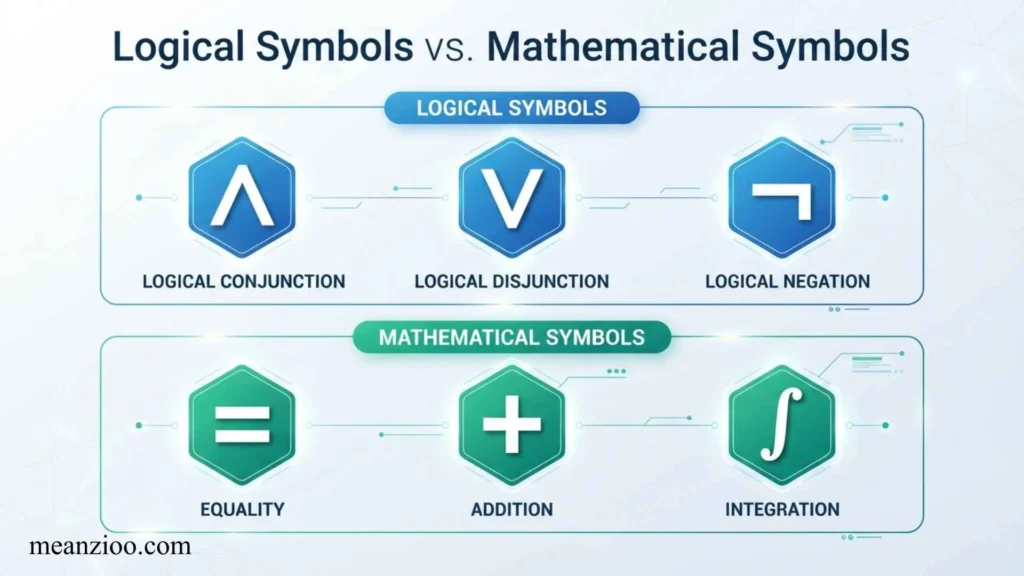
Not every symbol used in mathematics is technically a logical symbol.
For example:
+ = addition
− = subtraction
× = multiplication
= = equality
< = less than
> = greater than
These are mathematical or relational symbols.
Logical symbols more directly describe relationships between propositions or quantify over objects, such as:
¬, ∧, ∨, →, ↔, ∀, ∃
However, the boundary can depend on the formal logical system. Equality, membership, and other relational notation can appear inside formal logical formulas even though they are not logical connectives.
Logical Symbols Cheat Sheet
For quick reference:
| Symbol | Read as | Main use |
| ¬P | Not P | Negation |
| P ∧ Q | P and Q | Conjunction |
| P ∨ Q | P or Q | Inclusive disjunction |
| P ⊕ Q | P XOR Q | Exclusive disjunction |
| P → Q | If P, then Q | Conditional |
| P ⇒ Q | P implies Q | Implication |
| P ↔ Q | P iff Q | Biconditional |
| P ≡ Q | P is equivalent to Q | Logical equivalence |
| P ↑ Q | P NAND Q | Not AND |
| P ↓ Q | P NOR Q | Not OR |
| ⊤ | True | Tautology |
| ⊥ | False | Contradiction |
| ∀x | For every x | Universal quantifier |
| ∃x | There exists x | Existential quantifier |
| ∄x | No x exists | Negated existence |
| ∃!x | Exactly one x exists | Unique existence |
| ∴ | Therefore | Conclusion |
| ∵ | Because | Reason |
Frequently Asked Questions About Logical Symbols
What are the main logical symbols?
The main logical symbols include ¬, ∧, ∨, →, ↔, ∀, and ∃. They represent negation, conjunction, disjunction, conditional statements, biconditionals, universal quantification, and existential quantification.
What does ∧ mean?
∧ means AND, or conjunction. P ∧ Q is true only when both P and Q are true.
What does ∨ mean?
∨ means OR, or inclusive disjunction. It is true when at least one of P and Q is true, including the case where both are true.
What does ¬ mean?
¬ means NOT. It reverses the truth value of a proposition.
What does → mean?
→ means “if…then” and represents a conditional statement. P → Q is false only when P is true and Q is false.
What does ↔ mean?
↔ means “if and only if.” A biconditional is true when both propositions have the same truth value.
What does ∀ mean?
∀ means “for all” or “for every.” It is the universal quantifier.
What does ∃ mean?
∃ means “there exists.” It is the existential quantifier.
What does ⊕ mean?
⊕ commonly means XOR, or exclusive OR. It is true when exactly one of the two propositions is true.
What do ↑ and ↓ mean in logic?
↑ can represent NAND, while ↓ can represent NOR.
- P ↑ Q = ¬(P ∧ Q)
- P ↓ Q = ¬(P ∨ Q)
Both are important in Boolean logic and digital electronics.
What is the difference between OR and XOR?
OR (∨) is true if one or both statements are true.
XOR (⊕) is true only when exactly one statement is true.
What is a tautology?
A tautology is a logical statement that is always true.
For example:
P ∨ ¬P
is a tautology in classical propositional logic.
What is a contradiction?
A contradiction is a statement that is always false.
For example:
P ∧ ¬P
is a contradiction under classical two-valued logic.
Why are logical symbols important?
Logical symbols make reasoning more concise and precise. They are used in mathematics, proofs, computer programming, Boolean algebra, digital electronics, philosophy, set theory, and formal reasoning.
Final Takeaway
Logical symbols provide a compact language for expressing conditions, relationships, truth values, quantification, and reasoning.
The most important symbols to learn first are:
¬ = NOT
∧ = AND
∨ = OR
⊕ = XOR
→ = IF…THEN
↔ = IF AND ONLY IF
∀ = FOR ALL
∃ = THERE EXISTS
Once these are familiar, more advanced symbols such as ↑ (NAND), ↓ (NOR), ⊤ (true), ⊥ (false), ∄ (does not exist), and ∃! (exactly one exists) become much easier to understand.
The key is not simply memorizing the symbols. Understanding what each symbol means, when its expression is true or false, and how it combines with other symbols is what allows you to use logical notation correctly in mathematics, programming, proofs, and Boolean logic.
Also Check This Post: Louisiana State Symbols: Complete List, Meanings, History, and Facts

I’m Ryan Mitchell, and I write about modern English, trending slang, and online expressions. I enjoy explaining the meanings, origins, and real-life usage of popular words in a simple way. I believe learning slang is an important step toward understanding today’s English-speaking culture. Through my work, I aim to help readers speak more naturally and stay updated with the latest language trends.