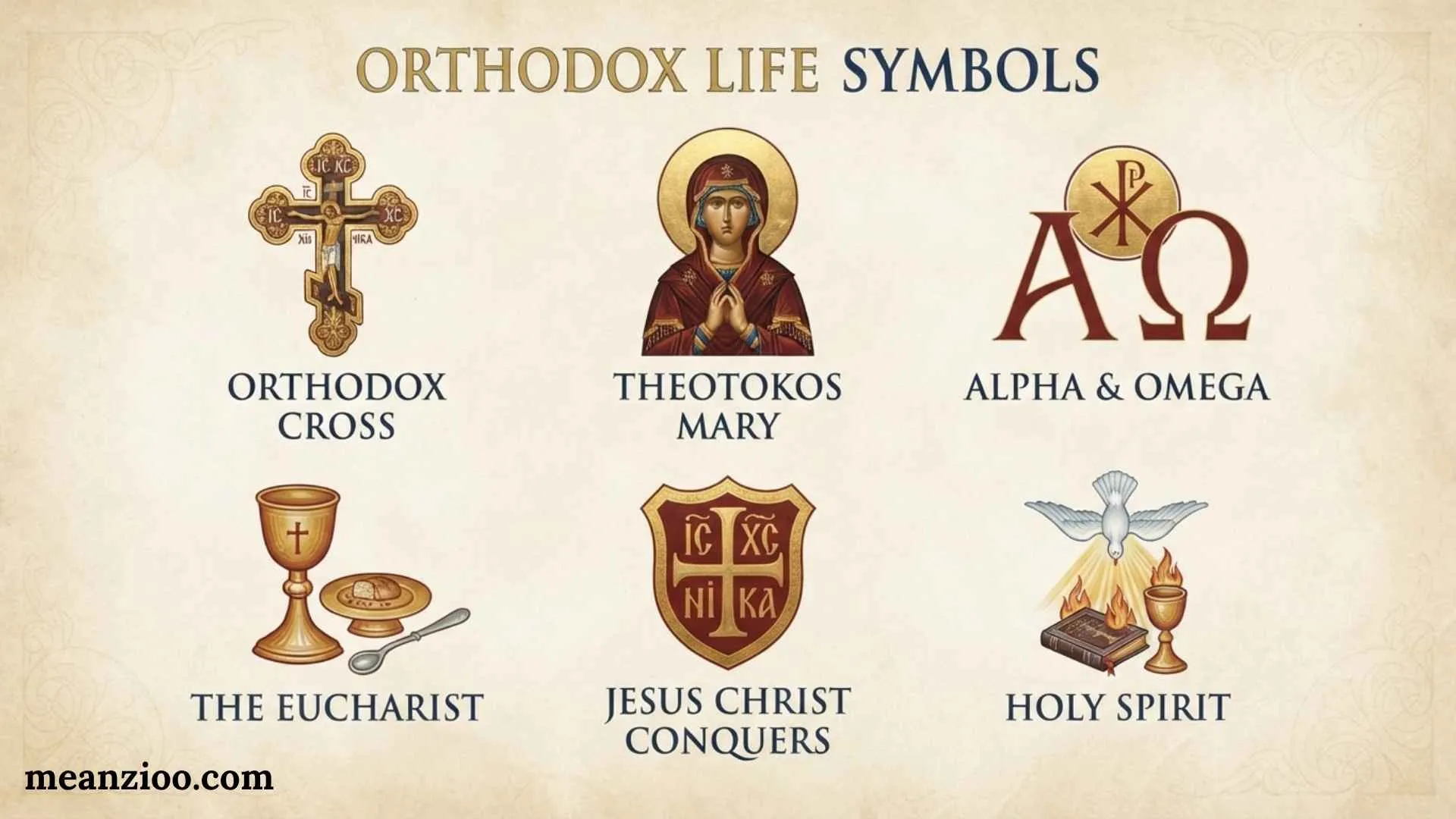
Orthodox symbols are an important part of Orthodox Christian worship, art, history, and daily religious life. From the familiar three-bar Orthodox cross to sacred icons, candles, incense, and Greek inscriptions, these symbols communicate ideas about Christ, salvation, faith, prayer, the saints, and the life of the Church. Some symbols have meanings that are clearly established in Christian tradition, while others have developed different interpretations across centuries and regions.
You may see Orthodox symbols inside churches, on icons, crosses, vestments, books, jewelry, gravestones, and household prayer corners. Understanding them can make Orthodox Christian art and worship much easier to appreciate. This guide explains the major orthodox symbols, their meanings, where they are used, and how to distinguish widely accepted teachings from popular interpretations.
What Are Orthodox Symbols?
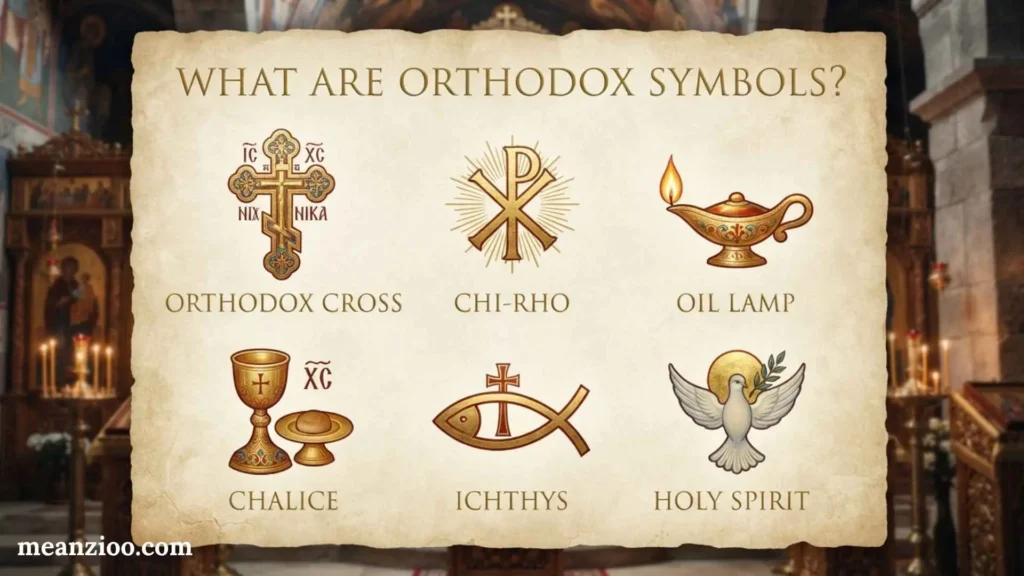
Orthodox symbols are visual signs, sacred images, objects, letters, and designs used within Orthodox Christian tradition to communicate or represent aspects of Christian faith.
Common examples include:
- The Orthodox cross
- Orthodox icons
- IC XC
- NIKA
- Alpha and Omega
- The Chi-Rho
- The fish
- The anchor
- The vine
- Candles
- Incense
- Bread and wine
- Water
- Wheat
- Oil
- Halos
- Crowns
- Sacred architectural features
The cross and icons have especially important places in Orthodox worship. The Orthodox Church in America explains that Christian symbols can point believers toward spiritual realities and that icons function within the worship and devotional life of the Church.
Quick Answer: What Is the Main Orthodox Symbol?
The cross is the central symbol of Orthodox Christianity. It represents the crucifixion of Jesus Christ and, together with the Resurrection, His victory over death. The distinctive three-bar cross commonly associated with Eastern and Slavic Orthodox traditions includes a central crossbeam, an upper inscription bar, and a lower footrest.
Orthodox Symbols and Meanings: Quick Reference Table
The following table provides a quick overview before exploring each symbol in detail.
| Orthodox Symbol | Common Meaning |
| Orthodox Cross | Christ’s crucifixion, salvation, and victory over death |
| Three-Bar Cross | Traditional Orthodox representation of Christ’s cross |
| IC | Abbreviation for Jesus |
| XC | Abbreviation for Christ |
| NIKA | Victory or conquers |
| IC XC NIKA | Christ is victorious |
| Alpha | Beginning |
| Omega | End |
| Alpha and Omega | Christ’s eternity and divine identity |
| Chi-Rho | Ancient Christogram |
| Fish | Jesus Christ and Christian faith |
| Anchor | Hope |
| Vine | Christ and His followers |
| Candle | Light, prayer, and Christ |
| Incense | Prayer rising to God |
| Halo | Holiness and divine glory |
| Icon | Sacred representation used in prayer and devotion |
| Iconostasis | Liturgical screen filled with sacred imagery |
| Royal Doors | Principal entrance through the iconostasis |
| Dome | Heavenly reality; often associated with Christ Pantocrator |
| Wheat | Life, harvest, bread, and resurrection imagery |
| Water | Life, cleansing, baptism, and renewal |
| Oil | Anointing, healing, mercy, and blessing |
| Bread and Wine | Eucharistic worship |
| Crown | Kingship, glory, or martyrdom depending on context |
Not every symbol has one single interpretation in every Orthodox culture. Context, historical period, and local tradition can affect meaning.
The Orthodox Cross
What Does the Orthodox Cross Mean?
The cross is at the heart of Orthodox Christianity.
It recalls Christ’s crucifixion, but Orthodox theology does not treat the cross only as a symbol of suffering. The crucifixion is understood together with Christ’s Resurrection and victory over death.
The cross can therefore represent:
- Sacrifice
- Salvation
- Christ’s victory
- Hope
- Resurrection
- Faithfulness
- The Christian life
- God’s saving work
The Orthodox Church in America describes the cross as the central Christian symbol and explains its widespread use in Orthodox churches, worship, vestments, and other religious objects.
Why Does the Orthodox Cross Have Three Bars?
The traditional Eastern or Slavic Orthodox cross often has three horizontal bars.
The structure usually consists of:
- Upper bar: Associated with the inscription placed above Christ.
- Middle bar: The main crossbeam on which Christ’s arms were extended.
- Lower bar: A footrest.
The exact appearance can differ between Orthodox traditions.
What Does the Slanted Bottom Bar Mean?
One of the most recognizable features of some Orthodox crosses is the tilted lower bar.
A popular traditional interpretation connects the two ends of the footrest with the two thieves crucified alongside Christ. One thief accepts Christ, while the other rejects Him. The upward and downward directions are therefore sometimes interpreted as a reminder of salvation and judgment.
However, it is important to distinguish traditional symbolic interpretations from claims about the exact historical origin of the design. Orthodox cross forms developed over time, and not every detail necessarily originated as a symbolic code.
Does Every Orthodox Cross Have a Slanted Bar?
No.
Orthodox cross designs vary according to:
- Historical period
- Geographic region
- Church tradition
- Artistic style
- Material
- Intended use
A Greek Orthodox cross may look different from a Russian, Serbian, Romanian, Georgian, or Bulgarian Orthodox cross while remaining part of the same broad Christian tradition.
The Sign of the Cross
Why Do Orthodox Christians Make the Sign of the Cross?
Making the sign of the cross is a physical expression of Christian faith.
It recalls Christ’s cross and the central Christian confession of the Holy Trinity.
The Orthodox Church in America describes the traditional Orthodox practice as moving from the forehead to the breast and then from the right shoulder to the left shoulder.
What Do the Fingers Represent?
In the traditional Orthodox hand position, three fingers are brought together.
These three fingers represent the Holy Trinity:
- Father
- Son
- Holy Spirit
The other two fingers are traditionally associated with Christ’s two natures:
- Divine
- Human
The hand gesture therefore functions as a compact physical expression of Orthodox Christian belief.
IC XC NIKA
What Does IC XC Mean?
IC XC is a traditional Greek abbreviation for Jesus Christ.
It is frequently seen in Orthodox icons and on crosses.
The letters come from the Greek forms of the names Jesus and Christ.
What Does NIKA Mean?
NIKA is a Greek word meaning “conquers” or “is victorious.”
When the letters appear together as:
IC XC NIKA
the phrase communicates the idea that Christ is victorious.
Where Can You See IC XC NIKA?
You may find the inscription on:
- Orthodox crosses
- Icons of Christ
- Church furnishings
- Liturgical objects
- Religious jewelry
- Banners
- Manuscripts
It is particularly recognizable on traditional Orthodox crosses.
Alpha and Omega
What Do Alpha and Omega Mean?
Alpha and Omega are the first and last letters of the Greek alphabet.
In Christian symbolism, they are associated with Christ’s eternal identity and the biblical description of God as the beginning and the end.
The symbolism communicates ideas such as:
- Eternity
- Divine authority
- Beginning and completion
- God’s sovereignty
The Orthodox Church in America includes Alpha and Omega among traditional Christian graphic symbols.
The Chi-Rho Symbol
What Is Chi-Rho?
The Chi-Rho is an ancient Christian Christogram formed by combining the Greek letters Chi and Rho.
These are associated with the beginning of the Greek word for Christ.
The symbol became widely recognized in early Christianity and can appear in:
- Manuscripts
- Church art
- Mosaics
- Religious objects
- Christian inscriptions
Although the Chi-Rho is not exclusive to modern Orthodox Christianity, it belongs to the ancient Christian symbolic tradition that influenced Eastern Christian art.
The Fish Symbol
What Does the Fish Mean?
The fish is an ancient Christian symbol associated with Jesus Christ.
Its importance comes from Greek Christian wordplay involving a phrase identifying Jesus as Christ, Son of God, Savior.
The fish can therefore represent:
- Jesus Christ
- Christian identity
- Faith
- Salvation
- The early Christian community
The fish is included among traditional Christian symbols in Orthodox sources.
The Anchor Symbol
What Does the Anchor Represent?
The anchor is traditionally associated with hope.
Its Christian meaning is connected with the biblical image of hope as an anchor for the soul.
An anchor can therefore symbolize:
- Hope
- Stability
- Faith
- Perseverance
- Trust in God
The anchor is also an important symbol in early Christian art.
The Vine Symbol
What Does the Vine Mean?
The vine is associated with Christ’s teaching about the vine and branches.
In Christian symbolism, it can represent:
- Christ
- His followers
- Spiritual growth
- Communion
- Fruitfulness
- Dependence on God
The Orthodox Church in America lists the vine among traditional Christian symbols.
Orthodox Icons
What Is an Orthodox Icon?
An Orthodox icon is a sacred image representing Christ, the Virgin Mary, angels, saints, biblical events, or other subjects connected with Christian faith.
Icons are among the most recognizable forms of Orthodox religious art.
They appear in:
- Churches
- Homes
- Prayer corners
- Processions
- Books
- Liturgical objects
Are Orthodox Icons Worshipped?
This is an important distinction.
Orthodox Christianity distinguishes worship owed to God from veneration or honor shown to sacred images.
An icon is not understood as a separate god or deity. The honor given to the image is connected to the person represented.
This distinction became particularly important during the theological controversies surrounding sacred images in Christian history.
Why Do Orthodox Icons Look Different From Realistic Paintings?
Orthodox iconography follows traditional artistic conventions.
The purpose is not simply to create a realistic portrait.
Artists may use:
- Symbolic perspective
- Stylized facial features
- Gold backgrounds
- Traditional colors
- Deliberate gestures
- Established compositions
These techniques help direct attention toward the sacred subject rather than ordinary physical realism.
Christ Pantocrator
What Does Christ Pantocrator Mean?
Christ Pantocrator is one of the best-known subjects in Orthodox iconography.
The Greek word Pantocrator is commonly translated as “Almighty” or “Ruler of All.”
Christ is frequently depicted holding a Gospel book and making a blessing gesture.
This image emphasizes Christ’s authority, divinity, and role as ruler and judge.
Where Is Christ Pantocrator Usually Found?
A famous placement is in the central area of an Orthodox church dome.
The image can visually direct the worshipper’s attention upward and toward Christ.
The Virgin Mary in Orthodox Icons
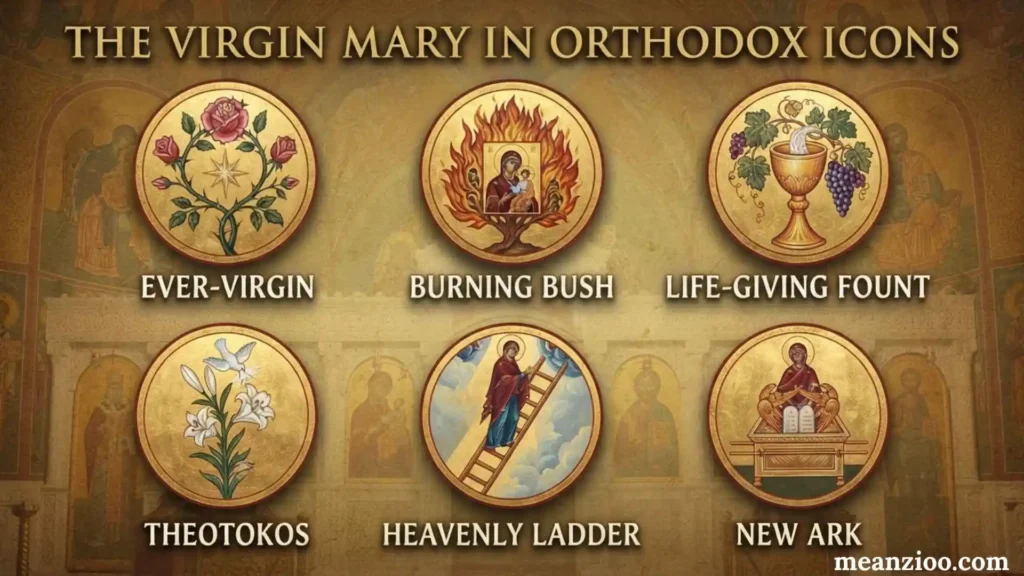
Why Is Mary So Commonly Depicted?
The Virgin Mary has a central place in Orthodox Christian theology and devotion.
Orthodox icons frequently depict Mary with Christ because her role is closely connected with the Incarnation.
Different icon types emphasize different aspects of her relationship with Jesus.
Some emphasize:
- Tenderness
- Intercession
- Majesty
- The Incarnation
- Christ as Savior
Saints and Their Symbols
Why Do Orthodox Icons Show Saints With Objects?
Objects can help identify saints and communicate important parts of their lives.
For example, a saint may be shown with:
- A cross
- A book
- A scroll
- A sword
- A staff
- A medical instrument
- A crown
- A particular garment
The object should be interpreted in connection with the saint’s story rather than treated as an isolated symbol.
The Halo
What Does the Halo Mean?
The halo is associated with holiness and divine glory.
In Christian art, it visually distinguishes sacred figures from ordinary people.
Christ’s halo often contains distinctive elements that identify Him as Christ.
In Orthodox iconography, saints commonly have halos representing their participation in divine holiness.
Candles and Light
What Do Candles Symbolize in Orthodoxy?
Candles have a major role in Orthodox worship.
Light can symbolize:
- Christ
- Divine presence
- Prayer
- Hope
- Spiritual illumination
Candles may be lit before icons as part of personal or communal prayer.
The Orthodox Church in America explains that light and candles have symbolic significance within Orthodox worship.
Why Do Orthodox Christians Light Candles Before Icons?
Lighting a candle can accompany prayer and serve as an outward expression of devotion.
The candle does not replace prayer. Instead, it forms part of the physical and visual environment in which prayer takes place.
Incense
What Does Incense Symbolize?
Incense is used extensively during Orthodox services.
Its rising smoke is traditionally associated with prayer ascending to God.
Incense can therefore represent:
- Prayer
- Worship
- Reverence
- Sacrifice
- God’s presence
The Orthodox Church in America explicitly connects incense with prayers rising to God.
Why Is Incense Used in Orthodox Churches?
Incense engages the senses and contributes to the solemn atmosphere of worship.
Its use also has biblical roots and historical continuity with ancient Christian worship.
Bread and Wine
What Do Bread and Wine Represent?
Bread and wine are central to the Divine Liturgy and the Eucharistic life of the Orthodox Church.
They should not be treated merely as decorative symbols.
Their significance is sacramental and is connected with Christ’s institution of the Eucharist.
This makes bread and wine among the most important elements of Orthodox Christian worship.
Water
What Does Water Symbolize?
Water has several important Christian associations.
It can represent:
- Life
- Cleansing
- Baptism
- Renewal
- Death and new life
In Orthodox Christianity, baptism involves water and has central importance in Christian initiation.
Wheat
What Does Wheat Mean in Christian Symbolism?
Wheat is connected with:
- Harvest
- Bread
- Life
- Death
- Resurrection
Because wheat becomes part of bread, it can also appear in Christian symbolism connected with the Eucharist.
Its meaning depends on the context.
Oil
What Does Oil Symbolize?
Oil has a long biblical and Christian history.
It can represent:
- Anointing
- Healing
- Mercy
- Blessing
- Consecration
Oil is used in various Orthodox liturgical and devotional practices.
Orthodox Church Architecture Symbols
What Is the Iconostasis?
The iconostasis is an important architectural feature in many Orthodox churches.
It is a screen or wall separating the nave from the altar area and contains rows of sacred icons.
The iconostasis helps create a visual and liturgical boundary while presenting images associated with Christ, Mary, saints, and salvation history.
What Are the Royal Doors?
The Royal Doors are the principal doors in the iconostasis leading into the altar area.
Their iconography commonly includes the Annunciation and the Evangelists, although arrangements can differ among traditions.
They have an important role during the Divine Liturgy.
What Does the Orthodox Church Dome Mean?
Many Orthodox churches feature a dome.
The dome can direct attention toward heaven, and it commonly contains an image of Christ Pantocrator.
The exact architectural symbolism differs between churches, but the dome often forms an important part of the visual theology of Orthodox worship.
Orthodox Symbols and Colors
Colors in Orthodox religious art and worship can carry symbolic or liturgical associations.
Gold
Gold commonly suggests:
- Divine glory
- Heavenly light
- Eternity
- Sacred majesty
Gold backgrounds are particularly common in iconography.
Red
Red may be associated with:
- Life
- Blood
- Sacrifice
- Martyrdom
- Royal authority
Its meaning depends on context.
Blue
Blue can suggest:
- Heaven
- Spiritual reality
- Mystery
It frequently appears in depictions of the Virgin Mary, although Orthodox iconography does not assign one universal meaning to every color.
Green
Green can be associated with:
- Life
- Growth
- Renewal
Purple
Purple and related shades can appear in particular liturgical settings and may be associated with penitence, royalty, or specific seasons depending on local tradition.
It is important not to claim that every color has one fixed meaning across all Orthodox churches.
Orthodox Crosses From Different Traditions
Greek Orthodox Cross
Greek Orthodox crosses can have a relatively simple cross design and may include Greek inscriptions.
They can differ from the familiar Slavic three-bar form.
Russian Orthodox Cross
Russian Orthodox crosses are often recognized by the three horizontal bars and the tilted lower footrest.
This is one of the designs most people associate with the phrase “Orthodox cross.”
Serbian Orthodox Cross
Serbian Orthodox symbolism is particularly associated with the Serbian cross, which features four fire-steel or stylized C-shaped elements around a central cross.
The four symbols are traditionally associated with the Serbian heraldic tradition and are often interpreted through the phrase “Only Unity Saves the Serbs”, although the historical relationship between the elements and this phrase requires careful treatment.
Georgian Orthodox Cross
Georgian Christian art has its own historical cross traditions and distinctive visual forms.
Georgian crosses can therefore look different from Russian or Greek examples.
Romanian and Bulgarian Traditions
Romanian and Bulgarian Orthodox churches also have distinctive artistic traditions.
Crosses, icons, vestments, and church decorations may reflect local history while remaining part of Orthodox Christianity.
Orthodox Cross vs. Other Christian Crosses
Orthodox Cross vs. Latin Cross
The Latin cross is typically formed from one vertical beam and one horizontal beam.
The Orthodox three-bar cross often contains additional horizontal elements.
Both are Christian symbols centered on Christ’s crucifixion.
Orthodox Cross vs. Celtic Cross
The Celtic cross generally features a circle around the intersection of the cross.
It is strongly associated with Celtic Christian artistic traditions.
A Celtic cross should not automatically be classified as an Orthodox symbol.
Orthodox Cross vs. Jerusalem Cross
The Jerusalem cross has a large central cross surrounded by four smaller crosses.
It has its own historical associations and should not be confused with the traditional Orthodox three-bar cross.
Orthodox Symbols in Jewelry and Clothing
Orthodox Cross Necklaces
Cross necklaces are common devotional objects in Orthodox Christian communities.
Some are connected with baptism and can have personal religious significance.
Orthodox Rings
Crosses, IC XC NIKA, and other Christian inscriptions can appear on rings.
The meaning depends on the wearer and the religious context.
Orthodox Embroidery
Orthodox symbols can also appear in:
- Vestments
- Church banners
- Cloths
- Books
- Household textiles
Traditional embroidery can communicate both religious and regional identity.
Orthodox Symbols in Homes
Many Orthodox Christians maintain a prayer space or icon corner in their homes.
It may include:
- Icons
- A cross
- Candles
- Incense
- Prayer books
The arrangement varies considerably by family and cultural tradition.
An icon corner is intended to support prayer rather than function simply as home decoration.
Common Misunderstandings About Orthodox Symbols
Is Every Orthodox Symbol Biblical?
Not necessarily.
Some symbols come directly from biblical imagery, while others developed within the historical and artistic tradition of Christianity.
Does Every Symbol Have One Official Meaning?
No.
Some meanings are widely established, but others can vary according to:
- Context
- Region
- Historical period
- Liturgical tradition
- Artistic convention
The Orthodox Church in America specifically notes that some symbolic explanations can be overstated and that not every architectural or artistic feature necessarily began with a symbolic purpose.
Are Orthodox Icons Idols?
Orthodox Christians reject the idea that icons are gods.
The theological distinction between worship of God and veneration of sacred images is fundamental to understanding Orthodox iconography.
Is the Three-Bar Cross the Only Orthodox Cross?
No.
Orthodox Christianity contains many cross designs.
The three-bar cross is especially recognizable in Slavic traditions, but Greek, Serbian, Georgian, Romanian, Bulgarian, and other traditions can have distinctive forms.
How to Identify an Orthodox Symbol
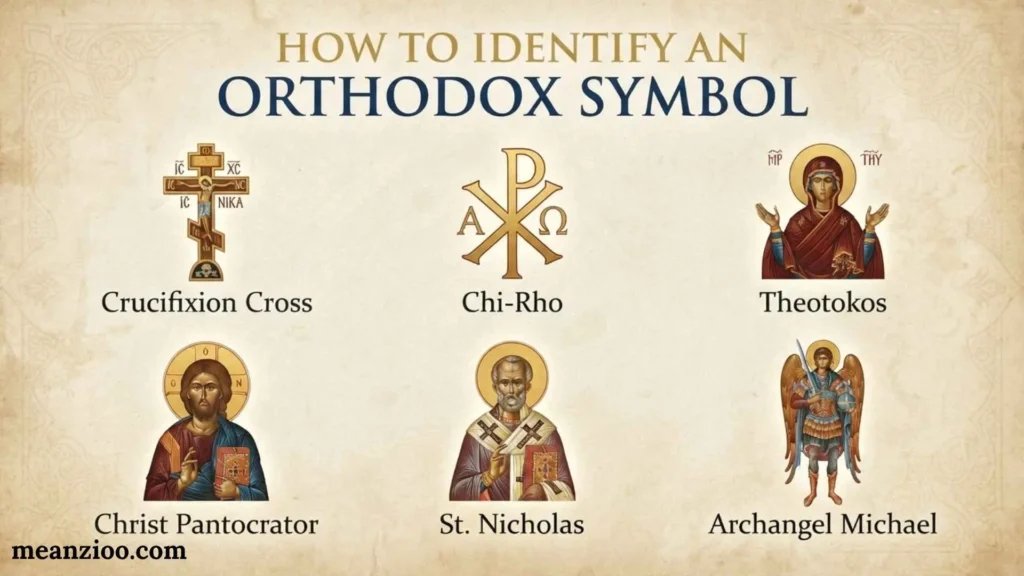
If you discover an unfamiliar symbol, look at several clues instead of relying on the shape alone.
Check the Inscription
Greek or Cyrillic letters can provide useful information.
For example:
- IC XC
- NIKA
- Alpha
- Omega
can identify Christian meanings.
Examine the Location
Ask where the symbol appears.
A symbol on an icon may have a different function from the same shape on a piece of jewelry.
Look at the Surrounding Images
Orthodox symbols are often part of larger compositions.
A cross surrounded by Greek letters, saints, or biblical scenes provides more information than the cross alone.
Consider the Regional Tradition
A Russian Orthodox church may use different artistic conventions from a Greek Orthodox church.
Regional context can therefore help identify the meaning.
Check Historical Context
An early Christian symbol may have a different historical background from a modern decorative version.
This is particularly important for symbols such as the Chi-Rho, fish, and anchor.
Why Orthodox Symbols Matter
Orthodox symbols make theological ideas visible.
A written explanation can describe salvation, resurrection, prayer, holiness, and hope. A symbol can communicate those ideas visually and repeatedly within worship.
This is why Orthodox churches often contain a rich combination of:
- Icons
- Crosses
- Candles
- Incense
- Sacred architecture
- Liturgical colors
- Inscriptions
- Gestures
Together, these elements create a visual and sensory environment centered on Christian worship.
Frequently Asked Questions
What is the most important Orthodox symbol?
The cross is the central symbol of Orthodox Christianity. It represents Christ’s crucifixion and His victory over death and is used throughout Orthodox worship and devotional life.
What does the Orthodox three-bar cross mean?
The three-bar cross commonly includes an upper inscription bar, a central crossbeam, and a lower footrest. The lower bar is often tilted in Slavic Orthodox designs. Its traditional interpretations connect the design with Christ’s crucifixion, although the historical development of the form is more complex.
What does IC XC NIKA mean?
IC XC is a traditional abbreviation for Jesus Christ in Greek, while NIKA means “conquers” or “is victorious.” Together, the inscription expresses the idea that Christ is victorious.
What do Orthodox icons represent?
Orthodox icons depict Christ, the Virgin Mary, saints, angels, biblical events, and other sacred subjects. They have a devotional and liturgical function and are used as aids to prayer and worship.
Why do Orthodox Christians use incense?
Incense has biblical and liturgical roots and traditionally represents prayers rising to God. It also contributes to the reverent atmosphere of Orthodox worship.
What does the fish symbol mean in Orthodox Christianity?
The fish is an ancient Christian symbol associated with Jesus Christ and Christian faith. Its symbolism comes from Greek Christian language identifying Jesus as Christ, Son of God, Savior.
What does the anchor mean in Orthodox Christianity?
The anchor traditionally represents hope and is associated with the biblical image of hope as an anchor for the soul.
Why do Orthodox Christians make the sign of the cross?
The sign of the cross expresses Christian faith and recalls Christ’s crucifixion and the Holy Trinity. Orthodox Christians traditionally make the sign from forehead to breast and from right shoulder to left shoulder.
What does IC XC mean on an Orthodox cross?
IC XC is a Greek abbreviation for the name Jesus Christ. It is commonly found on Orthodox crosses and icons and identifies Christ as the central subject of the image.
What is the difference between an Orthodox cross and a Catholic cross?
The most familiar Orthodox cross in Slavic traditions often has three horizontal bars, including a lower footrest, while the common Latin cross has one horizontal crossbeam. Both are Christian symbols of Christ’s crucifixion.
Conclusion
Orthodox symbols form a rich visual language that connects Christian belief with worship, art, history, and daily devotion. The cross is the central symbol, while the three-bar Orthodox cross provides one of the most recognizable forms. Inscriptions such as IC XC NIKA identify Christ and express His victory, while Alpha and Omega point toward eternity.
Other symbols have their own associations. The fish represents ancient Christian faith, the anchor points to hope, the vine recalls Christ’s teaching, candles represent light and prayer, and incense is traditionally associated with prayers rising to God. Icons, meanwhile, provide sacred representations of Christ, the Virgin Mary, saints, and biblical events and play an important role in Orthodox worship.
The meaning of orthodox symbols becomes clearer when each symbol is considered in its historical and liturgical context. Not every visual detail has one universal explanation, and different Orthodox cultures can use different artistic forms. Looking at the symbol, its inscription, surrounding imagery, location, and tradition gives a much more accurate understanding than relying on popular interpretations alone.

Hi, I’m Charlotte Hayes. I love writing about the newest English slang, pop culture phrases, and digital communication. I spend my time exploring how language evolves across social media, gaming, and everyday conversations. I enjoy sharing easy-to-understand guides that help learners keep up with modern English. My goal is to make every article useful, accurate, and enjoyable for readers around the world.
Books:
- Everyday Slang Dictionary
- Fluent Through Informal English
 Ryan Mitchell