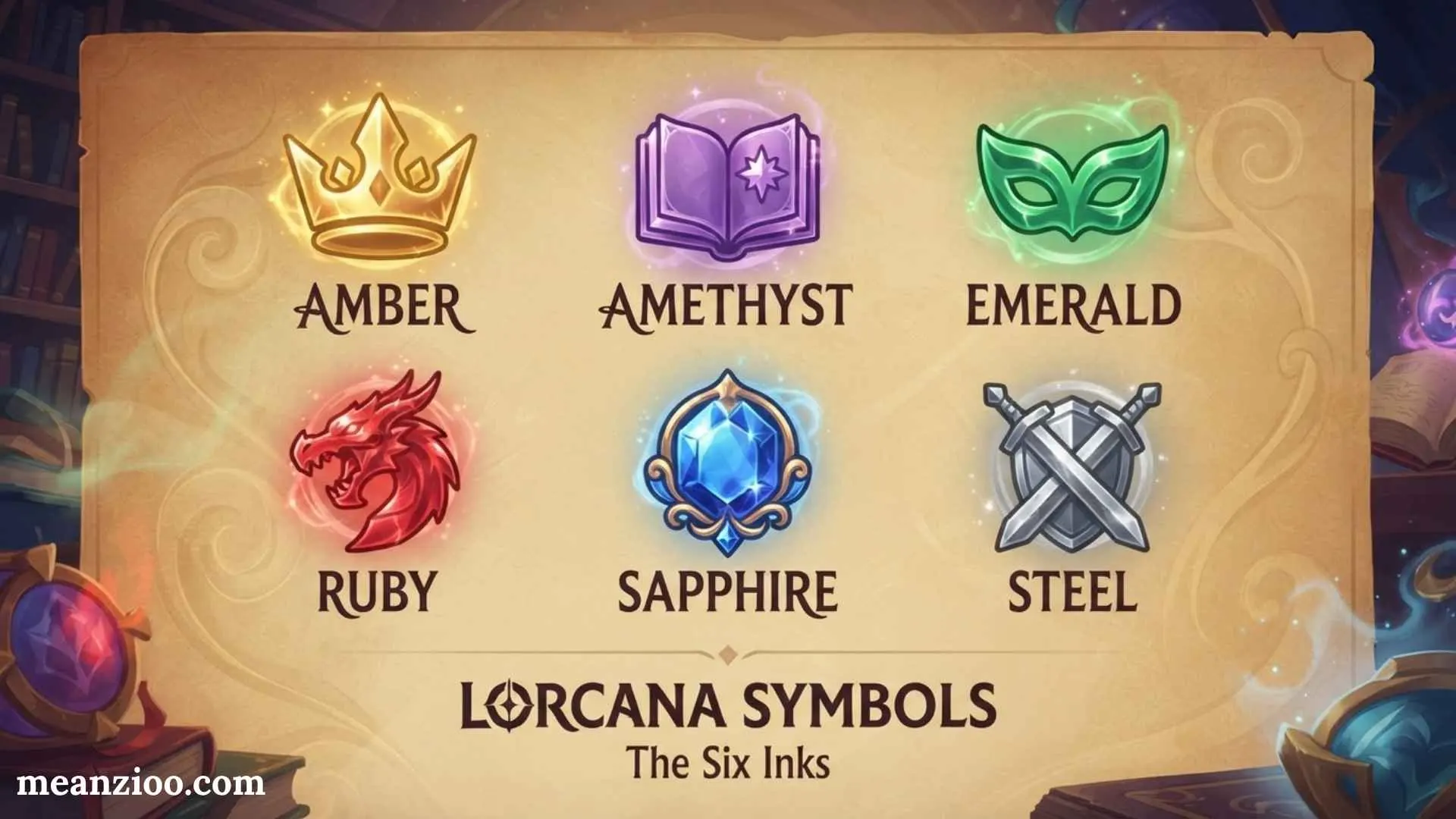
Lorcana symbols are the small icons and visual marks that help players understand Disney Lorcana cards at a glance. If you are new to the game, these symbols can look confusing because they identify different things, including ink types, card rarity, inkwell eligibility, costs, lore, and gameplay information.
Learning these symbols makes it easier to read cards, build legal decks, understand card abilities, identify rare pulls, and organize a Lorcana collection. The six main ink types are Amber, Amethyst, Emerald, Ruby, Sapphire, and Steel, while newer releases have also introduced dual-ink cards and additional visual treatments for higher rarities.
This guide breaks down Lorcana symbols one by one, explains where to find them on a card, shows how they affect gameplay and collecting, and provides a simple cheat sheet you can use whenever you open an unfamiliar card.
What Do Lorcana Symbols Mean?
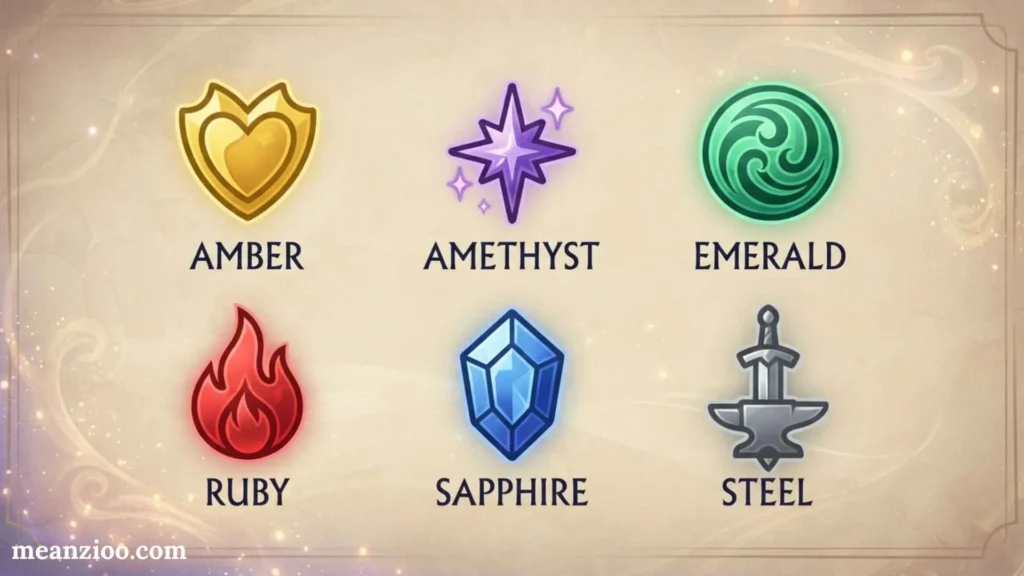
Lorcana symbols are visual indicators printed on Disney Lorcana trading cards. Different symbols communicate different types of information.
Some tell you the ink type of the card. Others show rarity, ink cost, inkwell eligibility, or gameplay values such as lore. Certain symbols are also used within card abilities to make game instructions shorter and easier to recognize.
A useful way to think about Lorcana card symbols is to divide them into four groups:
- Ink symbols identify the card’s ink type.
- Rarity symbols identify how rare the card is.
- Gameplay symbols communicate costs, lore, Strength, Willpower, exerting, and similar mechanics.
- Ability symbols and shorthand make card effects easier to read.
The official rules and release notes are periodically updated as new mechanics and cards are introduced, so the current official resources are the best reference for rules questions.
Lorcana Symbols Cheat Sheet
If you only need a quick reference, use this table.
| Symbol or visual element | Meaning | Why it matters |
| Amber ink symbol | Amber ink | Identifies the card’s ink type |
| Amethyst ink symbol | Amethyst ink | Identifies the card’s ink type |
| Emerald ink symbol | Emerald ink | Identifies the card’s ink type |
| Ruby ink symbol | Ruby ink | Identifies the card’s ink type |
| Sapphire ink symbol | Sapphire ink | Identifies the card’s ink type |
| Steel ink symbol | Steel ink | Identifies the card’s ink type |
| Two ink symbols | Dual-ink card | Card belongs to both listed inks |
| Inkwell indicator | Card can be inked | Helps identify cards usable as ink |
| Ink cost | Number by the ink-cost area | Shows the amount of ink needed to play the card |
| Lore value | Lore symbol/value | Shows lore gained when the relevant character quests |
| Strength | Strength value | Shows combat damage dealt |
| Willpower | Willpower value | Shows how much damage a character can take |
| Rarity symbol | Rarity indicator | Identifies card rarity |
| Shift symbol | Shift mechanic | Indicates a Shift-related play option |
| Exert symbol | Exert action | Shows when a card or effect requires exerting |
The exact meaning of an icon always depends on where and how it appears on the card. The official rules should be used when a new card introduces an unfamiliar interaction.
The Six Lorcana Ink Symbols
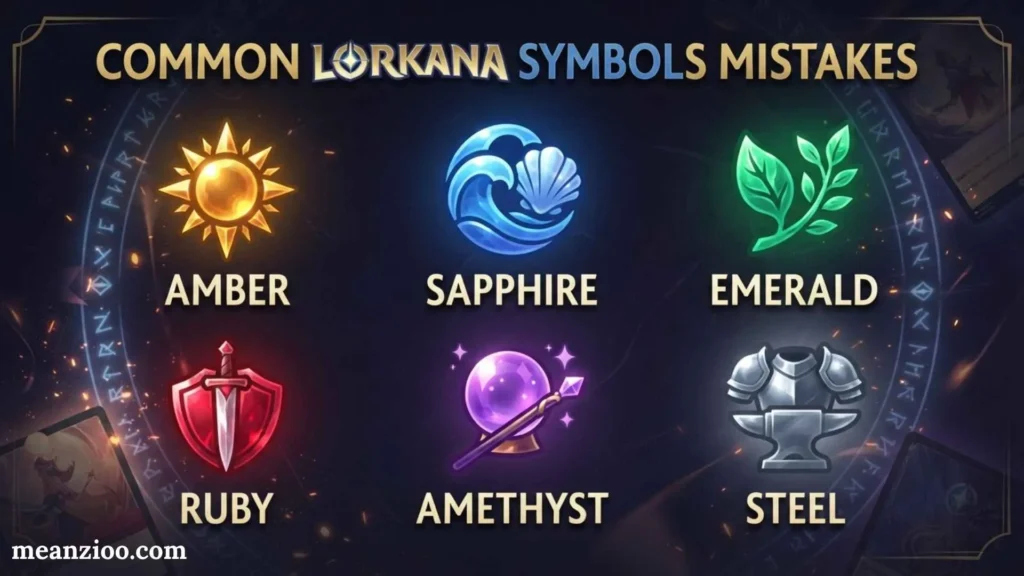
The six original Lorcana ink types are Amber, Amethyst, Emerald, Ruby, Sapphire, and Steel. Every standard single-ink card belongs to one of these six types, while dual-ink cards can belong to two.
The ink symbol normally appears on the left side of the card beneath the character or card name and version, alongside the card’s classifications. Official 2026 release notes specifically point players to this area when identifying a card’s ink type.
Amber Symbol
The Amber symbol identifies Amber cards.
Amber is associated with supportive, cooperative, and character-focused themes. Cards in this ink can reward players for building a board of characters and working with abilities that support their overall strategy.
For deck building, an Amber symbol means the card belongs to the Amber ink category.
Amethyst Symbol
The Amethyst symbol identifies Amethyst cards.
Amethyst is strongly associated with magical and unusual effects. Players who enjoy abilities that manipulate game situations may find Amethyst strategies appealing.
The important point for a beginner is simple: if a card displays the Amethyst ink symbol, it is an Amethyst card.
Emerald Symbol
The Emerald symbol identifies Emerald cards.
Emerald has a reputation for flexibility and tactical play. Its cards can reward players for reacting to changing board states and taking advantage of different situations.
Ruby Symbol
The Ruby symbol identifies Ruby cards.
Ruby is commonly associated with speed, aggression, and strong challenge-oriented strategies.
If you are building a Ruby deck, the Ruby symbol is one of the first things you should check when evaluating cards.
Sapphire Symbol
The Sapphire symbol identifies Sapphire cards.
Sapphire is associated with intelligence, invention, and resource-oriented strategies.
Cards with the Sapphire symbol can be especially interesting to players who prefer planning ahead and gaining advantages over several turns.
Steel Symbol
The Steel symbol identifies Steel cards.
Steel is associated with strength and powerful characters.
Steel strategies can appeal to players who prefer durable characters and direct board pressure.
Are the Ink Colors Good or Evil?
No.
This is an important beginner misconception.
Lorcana does not divide its six inks into simple “good” and “evil” categories. Disney’s official explanation states that no ink is inherently good or evil, and both heroes and villains can appear in all six inks.
So you should choose an ink based on the strategy and cards you want to play, not because you think one color represents heroes and another represents villains.
Lorcana Symbols Meaning
Disney Lorcana symbols are visual elements printed on cards to communicate important information quickly. Depending on where a symbol appears, it can identify a card’s rarity, ink color, card type, game function, or other collectible details.
For new players, these small icons may look confusing at first. Once you understand where they appear and what they represent, reading a Lorcana card becomes much easier. Symbols are especially useful when sorting a collection, checking card rarity, building a deck, or comparing different cards.
It is helpful to look at the symbol together with the card’s text and layout rather than assuming that every icon has a gameplay meaning.
Lorcana Symbols Rarity
Lorcana rarity symbols indicate how frequently a card is classified within the game’s card pool. Rarity is important for both players and collectors because some cards are easier to find in products than others.
The rarity indicator is typically found in the lower portion of the card. Different rarity levels use different symbols, allowing collectors to identify the classification without reading the entire card.
Rarity does not automatically determine how useful a card is in gameplay. A less rare card can still be valuable to a particular deck, while a highly collectible card may have limited competitive importance.
Lorcana Iconic Cards
Iconic is one of the special rarity classifications associated with Disney Lorcana. Iconic cards are designed to be particularly difficult to find and are often highly interesting to collectors.
Their rarity and distinctive presentation can make them stand out when opening booster packs. However, the value of an Iconic card can change over time depending on supply, demand, condition, popularity, and the broader collector market.
Collectors should distinguish rarity from monetary value. Being rare does not guarantee a particular market price.
Lorcana Rarity Pull Rates
Lorcana rarity pull rates describe how frequently particular rarity categories may appear when opening sealed products. Pull rates can vary according to the specific set and product configuration.
Collectors should avoid treating a single opening as evidence of an official pull rate. Random card distribution means that an individual booster can contain a different rarity combination from another booster.
When researching pull rates, always check information for the exact Lorcana set and product being discussed. Older sets and newer releases can have different distribution patterns.
Lorcana Card Rarity List
A Lorcana card rarity list helps players and collectors organize cards according to their official rarity categories. Common rarity classifications include:
- Common
- Uncommon
- Rare
- Super Rare
- Legendary
- Enchanted
- Epic
- Iconic
- Fabled
Not every set necessarily uses every rarity category in the same way. Special releases and newer sets can introduce additional classifications or collectible treatments.
The rarity symbol printed on the card is the most useful starting point when identifying a card’s official rarity.
Lorcana Rarity Epic
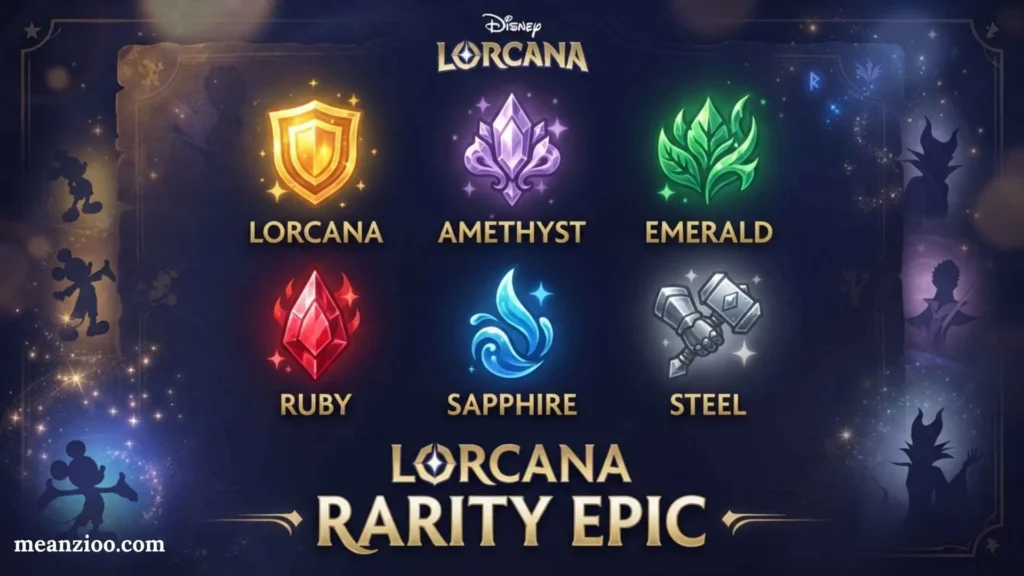
Epic is a higher rarity classification used in Disney Lorcana. Cards with this rarity are generally harder to obtain than cards from more frequently distributed rarity levels.
For collectors, Epic cards can be especially interesting because rarity is one factor that affects scarcity. For players, however, the practical value of an Epic card depends on what the card does and how it fits into a deck.
When identifying an Epic card, check the official rarity indicator rather than judging rarity from artwork, character popularity, or card price alone.
New Lorcana Symbols
New Lorcana symbols can appear as new sets, mechanics, products, and card classifications are introduced. This means an older guide may not explain every symbol found on newer cards.
Players updating their knowledge should pay attention to the exact set and release associated with a symbol. A newly introduced icon may represent a rarity, special treatment, card classification, or gameplay-related information.
Keeping symbols organized by function makes it easier to understand future Lorcana releases without confusing new icons with older ones.
Lorcana Symbols Explained
Lorcana symbols can generally be understood by looking at three areas: the card’s rarity information, its ink color, and its gameplay-related icons.
Some symbols tell you what kind of card you are holding, while others provide information about its rarity or game mechanics. The best way to learn them is to compare the symbol with the card’s surrounding text and layout.
For beginners, learning the most frequently encountered symbols first is more useful than trying to memorize every icon at once.
Lorcana Symbols on Bottom of Card
The symbols on the bottom of a Lorcana card can provide useful identification information. This area may contain the card’s rarity indicator along with other details associated with the card and its production.
Because the bottom section contains several small pieces of information, readers should examine the complete card rather than focusing on one icon in isolation.
If you are checking a card’s rarity, the rarity symbol is particularly important. Comparing it with an up-to-date rarity reference can help prevent identification mistakes.
Logo Lorcana Symbols
The Disney Lorcana logo is part of the game’s overall visual identity, while the symbols printed on individual cards serve more specific purposes. A logo primarily identifies the game or brand; a card symbol can communicate information about that particular card.
This distinction is useful when creating guides, graphics, or collection databases. A decorative element should not automatically be interpreted as a gameplay or rarity symbol.
The Lorcana visual design combines recognizable Disney artwork with a consistent card layout, making its symbols relatively easy to locate once players become familiar with the structure.
Fabled Lorcana Symbols
Fabled is a Lorcana rarity classification associated with particularly scarce cards. The Fabled symbol helps collectors identify cards belonging to this rarity category without relying only on the card’s artwork or character.
Because rarity classifications can differ between sets, collectors should verify the specific release when identifying a Fabled card. Set information is especially important when comparing cards from different generations of Lorcana products.
Rarity can influence collectibility, but condition, demand, availability, and other factors can also affect a card’s market interest.
Lorcana Color Meanings
Lorcana uses different ink colors as part of its deck-building system. The six main ink colors are Amber, Amethyst, Emerald, Ruby, Sapphire, and Steel.
Each color is associated with a distinct group of cards and strategic themes. For example, some colors commonly emphasize character support, while others may focus more heavily on challenging, resource management, movement, or other gameplay approaches.
The color itself does not tell you everything about a card. Individual card abilities and costs still determine how the card functions in an actual deck.
Lorcana Colors Explained
The six Lorcana ink colors provide the foundation for deck construction:
- Amber – often associated with support, teamwork, and character-focused strategies.
- Amethyst – commonly connected with abilities, effects, and magical or tactical play.
- Emerald – often supports flexible, evasive, or disruptive strategies.
- Ruby – commonly features aggressive actions and challenging-focused gameplay.
- Sapphire – frequently emphasizes resources, items, and strategic setup.
- Steel – often features strength, direct interaction, and powerful characters.
These are broad strategic themes rather than strict rules. A color can contain cards that behave differently, so players should evaluate the individual card text when building a deck.
Lorcana Willpower Symbol
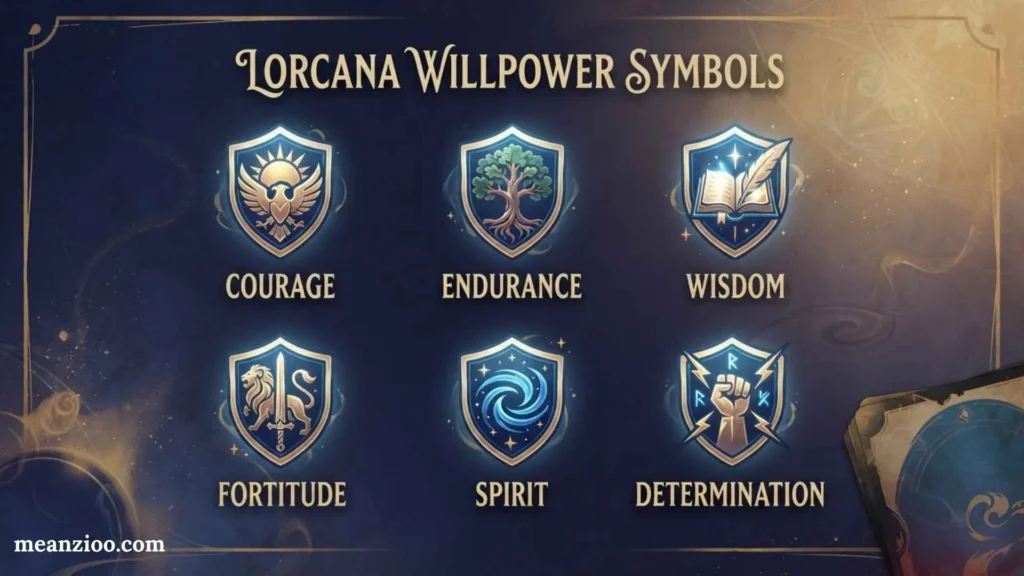
Willpower is represented by the number associated with a character’s ability to withstand damage. In a Lorcana game, a character’s willpower helps determine how much damage it can take before being banished.
The willpower value is therefore an important part of evaluating a character. A card with high willpower may be able to remain in play longer, while lower-willpower characters may require more careful positioning and support.
Remember that willpower is different from strength. Strength relates to how much damage a character can deal when challenging, while willpower relates to how much damage the character can withstand.
Lorcana Icons
Lorcana icons help players read card information quickly. Depending on the card and location, an icon can communicate information about rarity, ink, gameplay values, or other card characteristics.
For beginners, the most useful approach is to learn icons according to their purpose instead of memorizing their appearance without context. Once you know which part of the card contains rarity, cost, strength, willpower, and lore information, the symbols become much easier to interpret.
A well-organized Lorcana symbol guide can therefore work as a quick reference for both new players and experienced collectors.
What Do Two Lorcana Ink Symbols Mean?
A card displaying two ink symbols is a dual-ink card.
Dual-ink cards were introduced as a new card design that combines two ink identities. For example, a card could have two different ink symbols and therefore belong to both of those inks.
This matters greatly during deck construction.
How Dual-Ink Cards Work
Suppose a card has:
Amber + Ruby
That card belongs to both Amber and Ruby.
If your deck is built around those two inks, you can include the card.
If your deck uses Sapphire and Steel instead, the dual-ink Amber/Ruby card does not fit that standard two-ink deck.
Official Lorcana information states that dual-ink cards belong to two inks and require you to be playing those two colors to include them in your deck.
Why Dual-Ink Symbols Matter
Dual-ink cards are important because the symbols affect:
- Deck legality
- Card interactions
- Ink-type counting
- Deck-building choices
- Strategy
- Card evaluation
A 2026 release note provides an example where a dual-ink character has two ink types, but an ability counting “different ink types” counts each unique ink type rather than counting the number of symbols.
That distinction is important.
Two symbols do not automatically mean two copies of the same type. They represent two different ink identities.
Lorcana Card Anatomy: Where Are the Symbols?
Knowing the name of a symbol is useful, but knowing where to find it is even more helpful.
A Lorcana card contains several areas that provide different types of information.
Card Name and Version
The upper portion of a card identifies the character, item, action, location, or other card and its specific version.
For example, two cards may feature the same Disney character but have different versions and abilities.
Ink Symbols
The ink symbol or symbols appear on the left side below the name and version, alongside classifications. Official Lorcana release notes specifically identify this location as the place where players can determine a card’s ink type.
Classifications
Classifications describe what a character or other card is associated with.
Examples can include categories such as:
- Hero
- Villain
- Storyborn
- Floodborn
- Dreamborn
- Monster
- Toy
New classifications can be introduced through later sets. For example, the 2026 Wilds Unknown rules update added Monster and Toy classifications.
Classifications matter because card abilities can refer to them.
Ink Cost
The cost tells you how much ink is required to play the card.
This should not be confused with the ink symbol.
For example:
Sapphire symbol + 5 cost
means the card belongs to Sapphire, while its printed cost is five ink.
Card Type
The card’s type tells you what kind of card it is.
Common categories include:
- Character
- Action
- Item
- Location
Each type can interact differently with the rules and card abilities.
Ability Text
The center and lower sections contain the card’s abilities and rules text.
This is where you should look for special effects, keywords, costs, restrictions, and conditions.
Strength and Willpower
Character cards show combat-related values.
Strength relates to the damage a character deals during a challenge, while Willpower represents the amount of damage the character can take before being banished.
Lore
Lore represents the game’s victory resource.
Characters can quest to gain lore, and lore is one of the main ways a player progresses toward winning.
What Does the Lorcana Inkwell Symbol Mean?
The inkwell symbol tells you that a card is eligible to be put into your inkwell under the normal rules.
This is one of the most important symbols for new players because your inkwell provides the resources needed to pay card costs.
Why the Inkwell Symbol Matters
During a game, you often have to choose between:
- Playing a card now
- Keeping the card for later
- Putting the card into your inkwell
The inkwell symbol therefore affects your resource decisions.
A card without the appropriate inkwell indicator cannot simply be treated as an ink card just because you need more resources.
Inkable vs. Uninkable
You will often hear Lorcana players use the terms:
Inkable: The card can be put into your inkwell.
Uninkable: The card cannot normally be put into your inkwell.
This distinction is especially important when building a deck because a deck containing too many uninkable cards may become harder to operate smoothly.
What Does the Lorcana Ink Cost Mean?
The ink cost tells you how much ink is required to play a card.
Imagine a card has a cost of 3.
You generally need three available ink to pay its cost.
A card with a cost of 7 generally requires a much larger resource investment.
Ink Cost vs. Ink Symbol
These two pieces of information answer different questions.
Ink symbol: What ink type is this card?
Ink cost: How much ink does it cost to play?
For example:
| Card information | Meaning |
| Ruby symbol | The card is Ruby |
| 4 cost | It costs four ink to play |
| Inkwell indicator | It can be used as ink |
| Lore value | Shows its lore contribution |
| Strength/Willpower | Shows its combat statistics |
Keeping these concepts separate makes reading Lorcana cards much easier.
What Does the Lore Symbol Mean?
Lore is central to winning a standard Lorcana game.
A character’s lore value tells you how much lore that character can normally gain when it successfully quests.
For example, if a character has a lore value of 2, questing with that character normally contributes two lore.
Why Lore Matters
Lore should not be confused with Strength.
A character can have:
- High Strength but low lore
- Low Strength but high lore
- Balanced combat and lore values
This creates strategic choices.
A character with strong lore generation may be valuable even if it is not the best fighter.
What Do Strength and Willpower Mean?
Strength and Willpower are two of the most important character statistics.
Strength
Strength represents the amount of damage a character deals when it challenges another character.
A higher Strength value generally means the character can deal more damage in combat.
Willpower
Willpower represents how much damage a character can take before being banished.
For example, if a character has Willpower of 5 and accumulates enough damage to reach its Willpower threshold, it can be banished according to the game rules.
Why Both Values Matter
Never judge a character based on Strength alone.
A character with:
- 5 Strength
- 2 Willpower
plays very differently from one with:
- 2 Strength
- 5 Willpower
The first may hit hard but be easier to remove, while the second may survive longer.
Lorcana Rarity Symbols Explained
Rarity symbols are especially important to collectors.
They tell you how the card is classified in terms of rarity and help distinguish ordinary cards from harder-to-find versions.
The current Lorcana rarity system includes:
- Common
- Uncommon
- Rare
- Super Rare
- Legendary
- Enchanted
- Epic
- Iconic
The system expanded with the introduction of Epic and Iconic cards in Fabled. Official information describes Epic cards as rarer than Legendary but less rare than Enchanted, while Iconic cards are exceptionally rare.
Common
Common cards are among the easiest cards to obtain.
Do not assume that Common means useless. A common card can still be valuable in a particular deck or strategy.
Uncommon
Uncommon cards are less frequent than Common cards.
They can contain useful effects and can play important roles in deck construction.
Rare
Rare cards are harder to obtain than Common and Uncommon cards.
Some Rare cards can become highly desirable because of their gameplay or character popularity.
Super Rare
Super Rare cards are more difficult to find and can attract both players and collectors.
Legendary
Legendary cards are a higher rarity and can be particularly desirable.
However, rarity should not be treated as a guarantee of competitive strength or monetary value.
Enchanted
Enchanted cards are premium collectible versions with special artwork and foil treatment.
They are not automatically stronger versions of the standard cards.
Official Lorcana information explains that Enchanted cards can feature alternative artwork while retaining the same gameplay subjects and effects as their standard counterparts.
Epic
Epic is a newer rarity introduced with Fabled.
Official information describes Epic cards as featuring frameless art, rainbow foil finishes, holofoil symbols, and tinted text. They are rarer than Legendary cards but not as rare as Enchanted cards.
Iconic
Iconic is an extremely rare rarity introduced alongside Epic.
Official information says there are only two Iconic cards per Fabled set, making them exceptionally scarce compared with other rarities. They feature full-card artwork, a special lore-star foil pattern, and 3D hot stamping.
Does Rarity Mean a Lorcana Card Is Valuable?
Not necessarily.
This is one of the biggest mistakes new collectors make.
A high rarity can increase collector interest, but the market value of an individual card depends on many factors.
These include:
- Card condition
- Player demand
- Collector demand
- Character popularity
- Set availability
- Competitive usefulness
- Special artwork
- Foiling
- Supply and demand
- Current market trends
A lower-rarity card can sometimes be more useful or more sought after than a higher-rarity card.
So use the rarity symbol as one piece of information, not as a complete price guide.
Lorcana Symbols for Special Mechanics
Not every Lorcana symbol simply identifies an ink or rarity.
Some symbols are used as shorthand for gameplay mechanics.
Exert Symbol
The exert symbol represents the action of exerting a card.
An exerted character is turned sideways, which generally shows that it has performed an action or is otherwise exerted.
Some abilities require you to exert a character or another card as part of their cost or effect.
Shift Symbol
The Shift mechanic allows certain characters to be played in a special way involving another character.
Disney Lorcana updated Shift card wording in Fabled to include a dedicated symbol for improved readability. The official release notes give examples where the Shift cost is followed by the Shift symbol.
This is a good example of why Lorcana symbols can change or receive clearer visual treatment as the game develops.
Symbols Inside Card Abilities
You may also see symbols embedded directly into card text.
These can represent actions, costs, or game concepts.
Do not assume every symbol on every card has the same meaning. Its meaning depends on the rules and the context in which it is used.
Lorcana Symbols and Card Classifications
Symbols and card text are only part of how Lorcana identifies cards.
Classifications can also matter.
A character might have several classifications, such as:
Storyborn • Hero • Monster
Another card could specifically interact with Heroes, Monsters, or another classification.
This means you should not stop after identifying the ink symbol.
When reading a card, check:
- Name
- Version
- Ink
- Classifications
- Cost
- Card type
- Abilities
- Strength
- Willpower
- Lore
- Rarity
New classifications can be added as new sets release, so older guides may not contain every current classification. The 2026 Wilds Unknown update, for example, added Monster and Toy to the rules.
How Lorcana Symbols Affect Deck Building
Understanding symbols is essential for building a legal and functional deck.
Step 1: Check the Ink
First, identify the ink symbol.
If it is a Ruby card, you need to know if Ruby is one of the inks your deck uses.
Step 2: Check for Dual Ink
If there are two ink symbols, identify both.
A dual-ink card belongs to both listed inks.
Step 3: Check the Cost
Look at how much ink the card requires.
A deck containing too many expensive cards can struggle to develop quickly.
Step 4: Check Inkability
Look for the inkwell indicator.
Inkable cards provide flexibility because they can become resources when you need them.
Step 5: Evaluate the Ability
Read the complete ability rather than judging the card only by its stats.
Step 6: Compare Lore and Combat
If it is a character, compare its lore, Strength, and Willpower with its cost.
This gives you a much better idea of what role the character might play.
A Simple Lorcana Card Example
Imagine you find a fictional character card with these details:
Sapphire + Emerald
Cost: 4
Inkable
Strength: 3
Willpower: 5
Lore: 2
You can immediately understand several things:
- The card is a dual-ink card.
- Its two inks are Sapphire and Emerald.
- It costs four ink to play.
- It can be put into the inkwell.
- It has three Strength.
- It has five Willpower.
- It normally provides two lore when it quests.
Notice that none of these numbers automatically tells you if the card is good.
You still need to read its ability text and consider how it fits your deck.
Lorcana Symbols for Collectors
Collectors often use symbols to identify cards quickly.
When sorting a collection, you can organize cards by:
- Set
- Collector number
- Ink
- Rarity
- Character
- Card type
- Special treatment
Rarity is particularly useful when sorting booster pulls.
If you find an unusual foil treatment or a premium rarity, check the card’s full information rather than assuming it is valuable.
For example, Epic and Iconic cards have distinctive visual treatments that separate them from ordinary cards.
Lorcana Symbols and Enchanted Cards
Enchanted cards deserve special attention because their appearance can make them look different from standard versions.
They feature alternate artwork and special foil treatment.
Most importantly, an Enchanted version does not automatically provide a gameplay advantage. Official Lorcana information explains that the gameplay and subjects are identical to their standard counterparts.
So the distinction is primarily about collectible presentation rather than a stronger game effect.
How to Tell If a Lorcana Card Is Inkable
If you are unsure if a card can be used as ink, do not guess from the card’s color.
Instead, look for the official inkwell indicator associated with the card’s cost.
This is important because:
Card color does not automatically tell you if a card is inkable.
An uninkable card can still belong to a normal ink type.
Therefore, always check the appropriate indicator.
Common Lorcana Symbols Mistakes
Mistake 1: Confusing Ink With Rarity
The ink symbol tells you the card’s ink identity.
The rarity symbol tells you how the card is classified by rarity.
They are separate.
Mistake 2: Assuming a Rare Card Is Automatically Better
Rarity measures scarcity, not universal gameplay strength.
Mistake 3: Ignoring Dual-Ink Symbols
If a card has two ink symbols, both matter for deck construction.
Mistake 4: Confusing Cost With Ink Type
A card’s cost tells you how much ink it requires.
Its ink symbol tells you what ink type it belongs to.
Mistake 5: Confusing Lore With Strength
Lore helps you progress toward victory.
Strength relates to challenges.
They serve different purposes.
Mistake 6: Assuming Uninkable Means Unplayable
Uninkable only describes how the card interacts with the inkwell. It does not mean the card cannot be useful.
Mistake 7: Judging Cards Only by Symbols
Symbols provide useful information, but card abilities are often the most important part of understanding how a card functions.
How to Read Any Lorcana Card in 30 Seconds
If you are new to Disney Lorcana, use this quick process.
First: Identify the Card
Read its name and version.
Second: Identify Its Ink
Look beneath the name and check for one or two ink symbols.
Third: Check Its Cost
Determine how much ink you need to play it.
Fourth: Check the Inkwell Indicator
Determine if it can become ink.
Fifth: Read the Classifications
See if it is a Hero, Villain, Monster, Toy, or another classification.
Sixth: Read the Abilities
Look for costs, conditions, keywords, and effects.
Seventh: Check the Stats
For characters, look at Strength, Willpower, and lore.
Eighth: Check Rarity
Finally, identify the rarity if you are collecting or sorting cards.
This process gives you a complete first impression without requiring you to memorize every Lorcana rule.
Lorcana Symbols for New Players: What to Learn First
You do not need to memorize every symbol on your first day.
Start with these:
- The six ink symbols
- Dual-ink symbols
- The inkwell indicator
- Ink cost
- Lore
- Strength
- Willpower
- Rarity
- Exert
- Shift and other common ability symbols
Once these become familiar, you will be able to read most cards much faster.
Frequently Asked Questions About Lorcana Symbols
What are the six Lorcana symbols?
The six primary Lorcana ink symbols represent Amber, Amethyst, Emerald, Ruby, Sapphire, and Steel. These are the six magical inks used in the game.
What does the Lorcana symbol under the card name mean?
The symbol or symbols under the card’s name identify its ink type. A card can have one ink symbol or, if it is dual-ink, two symbols.
What does the Lorcana inkwell symbol mean?
The inkwell indicator shows that the card can be put into your inkwell under the normal rules and used as an ink resource.
What does two ink symbols on a Lorcana card mean?
Two ink symbols mean the card is dual-ink. It belongs to both listed ink types, and deck-building rules require you to use those two inks to include the card in a normal two-ink deck.
What are the Lorcana rarity symbols?
Lorcana currently has eight rarity categories: Common, Uncommon, Rare, Super Rare, Legendary, Enchanted, Epic, and Iconic. Epic and Iconic were introduced with Fabled.
What is the rarest Lorcana rarity?
Iconic is an exceptionally rare rarity introduced with Fabled. Official information states that there are only two Iconic cards per Fabled set.
Do Lorcana symbols affect deck building?
Yes. Ink symbols are particularly important because they determine a card’s ink identity and therefore whether it fits your deck’s allowed inks. Dual-ink symbols are especially important because both ink types must match the deck’s ink combination.
Final Thoughts
Lorcana symbols are much more than decorative icons. They form a visual system that helps players understand card identity, costs, rarity, resources, combat statistics, lore, and special mechanics.
The most important symbols to learn first are the six ink symbols: Amber, Amethyst, Emerald, Ruby, Sapphire, and Steel. After that, focus on the inkwell indicator, ink cost, lore, Strength, Willpower, and rarity symbols.
For collectors, rarity and special visual treatments are especially important. For players, ink identity, inkability, cost, abilities, and statistics are usually more important.
The game continues to evolve with new sets and rules updates. Official Lorcana resources currently include updated comprehensive rules and set-specific release notes, so they are the best place to verify a symbol or mechanic introduced in a newer expansion.
Once you understand the visual language of Lorcana cards, you can identify the important information on almost any card within seconds, making Lorcana symbols much easier to understand for both beginners and experienced collectors.

I’m Ryan Mitchell, and I write about modern English, trending slang, and online expressions. I enjoy explaining the meanings, origins, and real-life usage of popular words in a simple way. I believe learning slang is an important step toward understanding today’s English-speaking culture. Through my work, I aim to help readers speak more naturally and stay updated with the latest language trends.