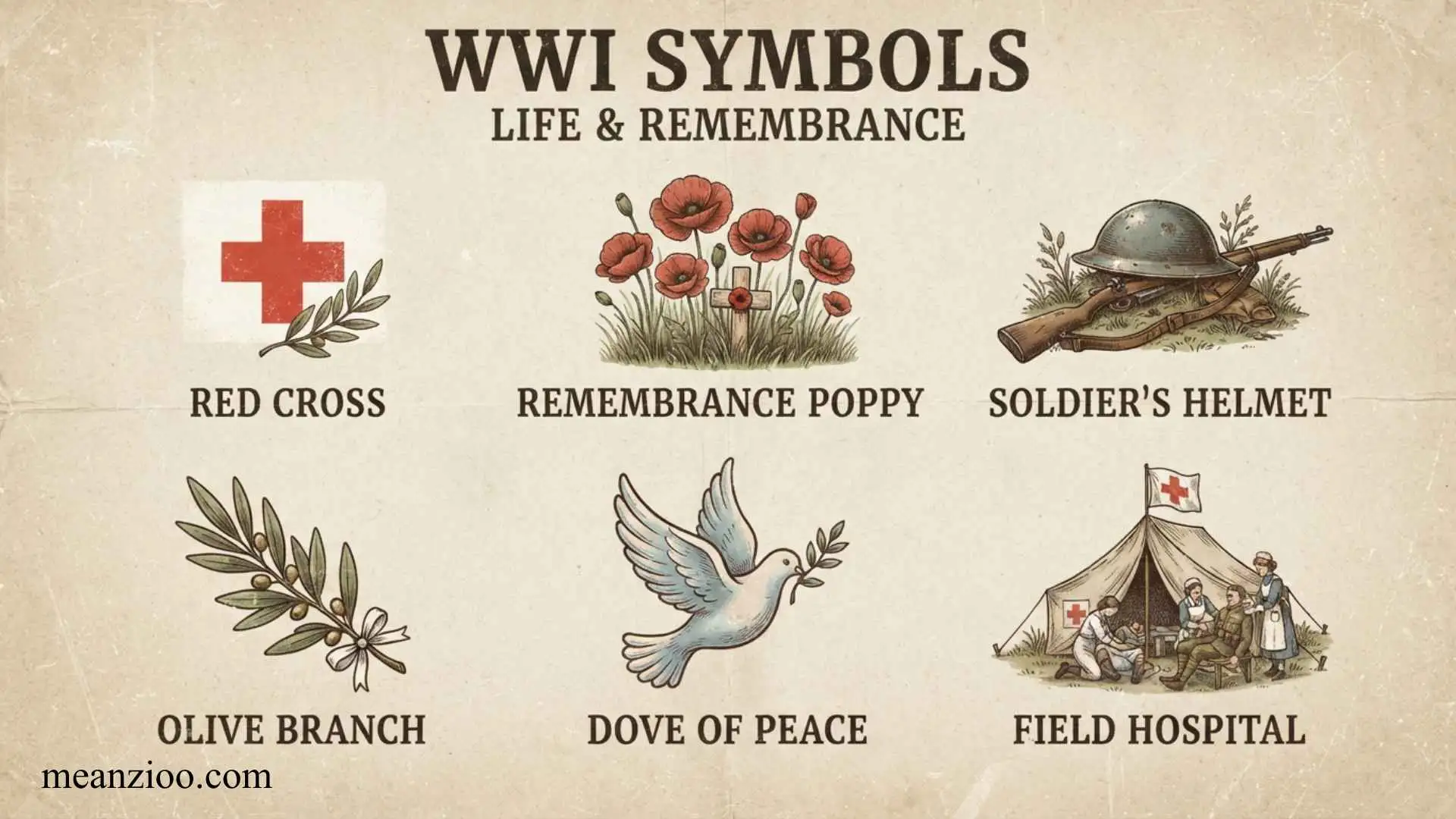
WW1 symbols are visual signs, objects, emblems, flowers, military decorations, national figures, and memorial images connected with World War I. They can represent patriotism, military service, sacrifice, remembrance, victory, mourning, freedom, or the experience of trench warfare.
However, there is no single official list of “WW1 symbols.” Some symbols were used during the war, particularly in propaganda and military settings, while others became important after 1918 as societies created memorials and remembrance traditions.
The distinction matters. The red poppy, for example, became one of the world’s best-known symbols of remembrance because of John McCrae’s In Flanders Fields, but the organized tradition of wearing poppies developed during and immediately after the war rather than functioning as a universal military emblem throughout 1914–1918.
What Are WW1 Symbols?
WW1 symbols are visual representations associated with the First World War, which lasted from 1914 to 1918.
They appeared in many different forms, including:
- National flags and coats of arms
- Military badges and decorations
- Recruitment posters
- War-bond advertisements
- Soldiers and military equipment
- Flowers and plants
- Religious imagery
- Memorial sculptures
- Crosses and wreaths
- National personifications
- Battlefield objects
- Victory and peace imagery
Some symbols communicated a message to people during the war. Others became meaningful because of how later generations remembered the conflict.
Two Important Categories of WW1 Symbols
It is useful to divide them into two broad categories:
Wartime symbols: Images actively used between 1914 and 1918 for military identification, propaganda, recruitment, fundraising, national identity, or morale.
Remembrance symbols: Images that became associated with commemorating the dead, honoring veterans, and remembering the war after it ended.
This distinction prevents a common historical mistake: assuming that every modern WW1-related symbol was an official symbol used by soldiers during the conflict.
WW1 Symbols PNG
WW1 symbols PNG images are useful for readers who want a quick visual reference to the symbols, insignia, flags, medals, military markings, and national emblems associated with World War I. Common visuals include national flags, military badges, aircraft markings, regimental insignia, naval symbols, and propaganda-era designs.
When using WW1 symbols in PNG format, it is important to understand what each image represents rather than treating every military marking as a general “WW1 symbol.” Some designs were official military insignia, while others appeared on uniforms, equipment, posters, aircraft, or national flags. Clear labels and historical context make these images much more useful for students, researchers, history enthusiasts, and designers.
WW1 Symbols Drawings
WW1 symbols drawings can include simplified sketches of military badges, aircraft insignia, flags, weapons, medals, helmets, ships, and other objects connected with the First World War. Historical drawings are especially helpful because many original symbols were printed, painted, embroidered, or engraved rather than produced as modern digital icons.
A good WW1 drawing should identify the country, organization, military branch, or historical purpose connected with the design. This prevents confusion between symbols from different armies and helps readers understand how visual identification worked during the war.
WW1 Symbols and Meanings
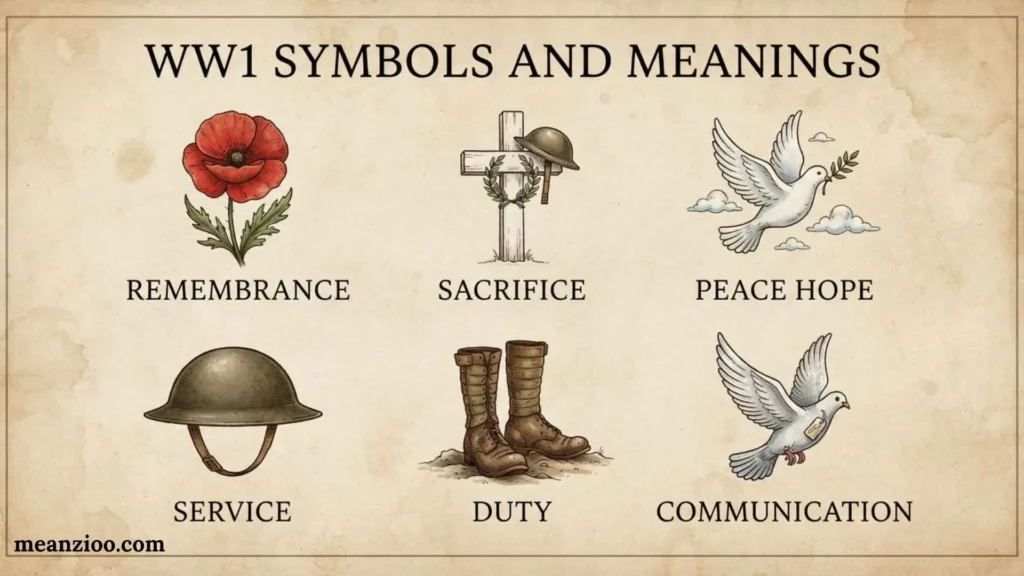
WW1 symbols and meanings vary greatly depending on the country, military branch, and historical context. National flags represented states, while military insignia could identify a regiment, unit, rank, branch, or organization. Aircraft markings helped distinguish friendly aircraft from enemy aircraft, and naval flags served communication and identification purposes.
Some symbols also appeared in propaganda and public communication. These designs could represent patriotism, military service, victory, sacrifice, or national identity. Because the same basic symbol could have different meanings in different settings, it is best to explain its historical use alongside the image.
WW2 Symbol
WW2 symbols belong to a later conflict and should not automatically be grouped with World War I symbols. World War II began in 1939, more than two decades after the end of World War I in 1918, and military insignia, national markings, propaganda imagery, and aircraft identification systems changed during that period.
For a historical article, separating WW1 and WW2 symbols is important. Some national emblems continued across both wars, but their military applications and surrounding historical circumstances could be different.
German WW1 Symbols
German WW1 symbols refer to the visual markings and insignia used by Imperial Germany and its armed forces during the First World War. One of the best-known examples is the Iron Cross, a military decoration with origins before WW1 that remained strongly associated with German military history.
German military identification could also include national colors, regimental insignia, rank markings, unit badges, and aircraft markings. The Imperial German period is particularly important when studying WW1 because Germany was a central member of the Central Powers.
Historical context matters when presenting German WW1 symbols. Some designs were military insignia, while others were national or political imagery, so they should not all be treated as having the same meaning.
WW1 Symbols USA
WW1 symbols from the United States often reflected American national identity, military service, and the country’s armed forces. The U.S. flag, eagle imagery, stars, shields, military insignia, and branch-specific markings appeared in different forms during the period.
The United States entered World War I in 1917, and American military organizations developed and used a variety of identifying insignia. Unit patches, shoulder insignia, aircraft markings, medals, and recruitment imagery can all be found in collections related to the American WW1 experience.
These symbols can help readers understand how the United States visually represented military service during the First World War.
British WW1 Symbols
British WW1 symbols include national emblems, military insignia, regimental badges, flags, medals, and markings associated with the British armed forces and the wider British Empire. The British Army relied heavily on distinctive regimental traditions, making badges an important part of military identity.
The Union Jack was a major national symbol, while individual regiments had their own badges and identifying designs. British military symbols can therefore look very different depending on whether the symbol represents the country, army, regiment, rank, or another organization.
Studying these markings provides insight into how soldiers and military units were identified during the First World War.
Aircraft Military WW1 Symbols
Aircraft military WW1 symbols were particularly important because military aviation was developing rapidly during the conflict. Aircraft often carried national markings or distinctive insignia that helped identify which side they belonged to.
The British Royal Flying Corps and later Royal Air Force used recognizable national markings, while French, German, American, and other air forces used their own systems. Aircraft symbols could appear on wings, fuselage sections, tails, or other visible surfaces.
These markings were not simply decorative. Identification was especially important during aerial combat, when pilots needed to distinguish friendly aircraft from enemy machines at a distance.
Military WW1 Symbols
Military WW1 symbols included a wide range of badges, insignia, flags, rank markings, medals, unit identifiers, and equipment markings. They helped communicate information about a soldier’s unit, military branch, rank, nationality, or service.
Military symbols were also used on maps and documents. Commanders needed standardized visual signs to represent troops, positions, artillery, fortifications, transportation, and other battlefield information.
Because military symbolism was used in many different ways, there is no single universal list of WW1 military symbols. Their meanings depend on the army, branch, period, and specific context in which they were used.
Allies WW1 Symbols
Allied WW1 symbols represent the countries and military forces that fought against the Central Powers during World War I. Major Allied powers included France, the British Empire, Russia, Italy, and later the United States, although the composition and military participation of the Allied side changed during the war.
Each country retained its own national symbols and military insignia. The French tricolor, British Union Jack, American flag, and Russian imperial symbols are examples of national imagery connected with different Allied powers during the conflict.
There were also many unit-level badges and military markings. For that reason, “Allied WW1 symbols” is a broad category rather than one single symbol.
WWI Logo
A WWI logo is usually a modern graphic created to represent World War I rather than an official logo used throughout the conflict. Contemporary museums, educational websites, exhibitions, documentaries, and historical projects may create their own WWI logos using period-inspired imagery.
Common design elements include dates such as 1914–1918, military helmets, aircraft, artillery, poppies, flags, medals, trenches, or historical typography. However, these modern designs should be distinguished from authentic symbols that were actually used during World War I.
For historical accuracy, a logo should not be presented as an original WW1 military insignia unless reliable evidence supports that claim.
World War I Logo
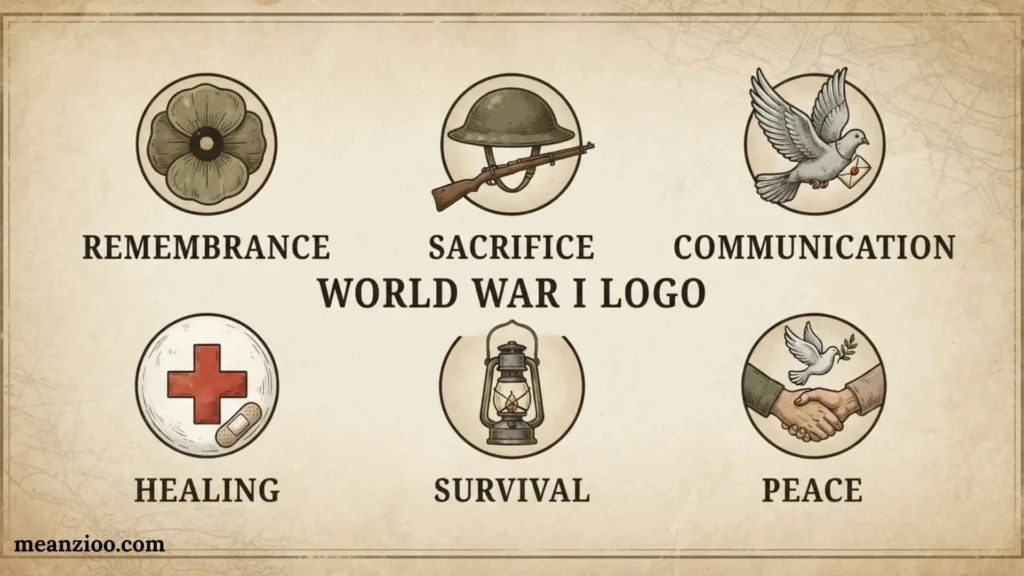
A World War I logo can serve as a visual identity for an educational project, museum exhibition, history article, documentary, or commemorative event. Modern logos often combine the dates 1914–1918 with recognizable historical imagery.
The red poppy is frequently associated with remembrance of the First World War, particularly in Commonwealth countries, while military badges, flags, aircraft, and trench-related imagery can provide additional historical context.
When creating or selecting a World War I logo, separating modern commemorative design from authentic wartime insignia helps readers understand what they are actually looking at.
WW1 Icons
WW1 icons are simplified visual representations of objects or concepts associated with the First World War. Examples may include soldiers, trenches, aircraft, tanks, warships, medals, helmets, flags, artillery, poppies, and military badges.
Icons are useful in educational graphics because they communicate an idea quickly. However, a modern icon is not necessarily a historical symbol. For example, a simplified tank icon may represent WW1 warfare without being an actual symbol used by soldiers during the period.
For accurate historical content, icons should ideally be accompanied by captions explaining the object or concept they represent.
World War 1 Symbols
World War 1 symbols cover a broad collection of national, military, commemorative, and cultural imagery connected with the conflict from 1914 to 1918. They include flags, military insignia, regimental badges, aircraft markings, medals, unit identifiers, maps, and remembrance symbols.
These symbols help explain how governments, armies, soldiers, and civilians communicated identity during a period of enormous social and military change. Some symbols were practical identification tools, while others represented national pride, military service, remembrance, or sacrifice.
Understanding the difference between an official wartime insignia, a national emblem, a propaganda image, and a modern commemorative icon makes WW1 symbolism much easier to research and interpret.
Red Poppy: The Most Recognizable WW1 Remembrance Symbol
The red poppy is perhaps the most famous symbol associated with World War I remembrance.
Its importance is closely connected to the battlefields of Belgium and France. Canadian physician and Lieutenant Colonel John McCrae observed poppies growing around battlefield graves and wrote In Flanders Fields in 1915. The poem helped establish the flower’s powerful connection with remembrance and sacrifice.
Moina Michael later promoted the red poppy as a memorial symbol. She began selling Flanders Fields memorial poppies in November 1918, and the tradition spread among veterans’ organizations and Allied countries. The American Legion adopted the Flanders Fields Memorial Poppy as its national emblem of remembrance in 1920.
What Does the Red Poppy Represent?
The poppy can symbolize:
- Remembrance
- Sacrifice
- Fallen soldiers
- Grief
- Resilience
- Hope
- The human cost of war
The poppy is therefore best understood as a remembrance symbol, rather than simply a military emblem.
The Cross
The cross appears frequently on WW1 graves, cemeteries, churches, plaques, and memorials.
For Christian communities, it could represent faith, death, resurrection, mourning, and hope. It was particularly significant on memorials created for communities whose fallen soldiers were commemorated through Christian religious traditions.
But the cross did not have one universal WW1 meaning. Its interpretation depends on the memorial’s location, denomination, inscription, and historical context.
The Imperial War Museums’ War Memorials Register documents many WW1 memorials incorporating crosses, including memorials that combine the cross with other symbols such as swords, names, and inscriptions.
Common Meanings of the Cross
- Faith
- Mourning
- Sacrifice
- Death
- Hope
- Eternal remembrance
National Flags
National flags were among the most important symbols of World War I.
A flag could identify a nation, army, military unit, or political cause. It also helped propaganda artists communicate patriotism quickly.
Flags appeared alongside soldiers, national personifications, weapons, women, children, and patriotic slogans.
In a WW1 context, a national flag might represent:
- National identity
- Patriotism
- Unity
- Loyalty
- Military service
- National sacrifice
- Victory
The meaning depends on the country and the specific historical setting.
Uncle Sam
Uncle Sam became one of the defining American symbols of World War I propaganda.
The famous image of Uncle Sam pointing toward the viewer was designed by James Montgomery Flagg and became strongly associated with U.S. Army recruitment.
The Library of Congress identifies Flagg’s imagery as part of America’s WW1 propaganda culture and notes that his work helped create some of the era’s most recognizable images.
What Did Uncle Sam Represent?
In WW1 imagery, Uncle Sam could represent:
- The United States
- American patriotism
- National duty
- Military recruitment
- Government authority
- Participation in the war
His direct gaze and pointing finger were especially effective because they made a national message feel personal: the viewer was being addressed directly.
Columbia
Before and alongside the growing popularity of Uncle Sam, Columbia was another personification of the United States.
WW1 artist James Montgomery Flagg used Columbia in patriotic imagery. One Library of Congress example shows Columbia as a personification of America and Liberty, wearing patriotic clothing and a Phrygian cap associated with freedom.
Columbia could symbolize:
- America
- Liberty
- Patriotism
- Civilization
- National ideals
Her presence demonstrates that WW1 propaganda did not rely exclusively on military figures.
Statue of Liberty
The Statue of Liberty was another powerful American symbol used in wartime imagery.
Because the monument already represented freedom and liberty, artists could use it to connect the American war effort with ideas of national ideals and defense.
WW1-era imagery sometimes combined the Statue of Liberty with recruitment or war-financing messages.
Statue of Liberty Symbolism
It could represent:
- Freedom
- Liberty
- America
- Hope
- Democratic ideals
- National responsibility
Liberty Bonds
Liberty Bonds were not simply financial instruments; they became an important part of American wartime visual culture.
The U.S. government used posters and advertisements to encourage citizens to purchase bonds and support the war financially.
This created an important symbolic message: people who were not fighting overseas could still participate in the national war effort.
Liberty Bond imagery could therefore represent:
- Civilian participation
- Patriotism
- Financial sacrifice
- National duty
- Support for soldiers
- The home-front war effort
The Library of Congress preserves numerous WW1 posters demonstrating how visual design was used to encourage American participation.
Also Check This Post: Georgia Symbols: Complete List of Georgia State Symbols, Meanings, and History
Britannia
Britannia was the traditional personification of Britain and appeared in British patriotic imagery.
During WW1, personifications allowed artists to turn an abstract country into a recognizable human figure.
Britannia could represent:
- Britain
- National strength
- Patriotism
- Military resistance
- Imperial identity
- National unity
She was part of a much older British symbolic tradition rather than a symbol created specifically for WW1.
Marianne
Marianne was the personification of the French Republic and appeared in French patriotic and political imagery.
During the First World War, she could symbolize:
- France
- The French Republic
- Liberty
- National identity
- Resistance
- Patriotism
Like Britannia and Uncle Sam, Marianne shows how countries used recognizable figures to communicate complicated political ideas visually.
The Iron Cross
The Iron Cross was a German military decoration with origins before World War I. It became strongly associated with Imperial Germany during the conflict.
In the WW1 context, it can represent:
- German military service
- Bravery
- Military achievement
- Honor
- Imperial German military culture
The Iron Cross should be interpreted according to its historical period and design. Not every later use of the symbol has the same meaning as its WW1 use.
The Pickelhaube
The Pickelhaube was the distinctive spiked helmet associated with German military forces before and during the early part of World War I.
It became particularly powerful in Allied propaganda because artists could use its recognizable silhouette to identify Germany or German soldiers quickly.
As a result, the Pickelhaube has two related meanings:
- Historical: German military equipment.
- Propaganda: A visual shorthand for the German enemy.
This is a useful example of how an actual military object can become a symbolic image.
The Eagle
The eagle was used by several countries and political institutions, so it should not automatically be labeled a German WW1 symbol.
Eagles traditionally communicate ideas such as:
- Power
- Strength
- Authority
- Sovereignty
- Empire
- National identity
The exact design matters. A German imperial eagle, American eagle, Russian imperial eagle, or another national eagle may have completely different historical meanings.
The Sword
The sword was an established military and heraldic symbol long before 1914.
In WW1 memorials and artwork, it could represent:
- Military service
- Courage
- Combat
- Honor
- Defense
- Victory
- Sacrifice
On memorials, a lowered sword can have a different emotional meaning from an upright sword.
For example, the Imperial War Museums documents memorials incorporating a “sword of sacrifice,” demonstrating how the weapon could be connected with remembrance rather than simply victory.
Laurel Wreath
The laurel wreath is another ancient symbol that continued into WW1-era memorial culture.
Historically connected with victory and achievement, the wreath could symbolize:
- Honor
- Victory
- Achievement
- Heroism
- Remembrance
Its presence on a WW1 memorial often communicates honor for those who served or died.
The Imperial War Museums documents WW1 memorials featuring laurel wreaths alongside names and dates.
Oak Leaves and Acorns
Oak leaves and acorns also appeared on some WW1 memorials and military imagery.
The oak traditionally suggests:
- Strength
- Endurance
- Courage
- Longevity
- Continuity
Because the oak can survive for generations, it works particularly well as memorial symbolism.
An IWM-recorded WW1 memorial in Northern Ireland, for example, incorporates carved oak leaves and acorns together with a laurel wreath and the dates 1914–1918.
Palm and Myrtle Branches
Religious and classical plant symbolism also appeared on WW1 memorials.
The Imperial War Museums documents a WW1 memorial featuring palm and myrtle branches, specifically identifying them as symbols of sacrifice and victory.
These branches demonstrate that WW1 memorial symbolism often combined several traditions rather than relying on a single wartime emblem.
Torch
The torch is an important symbol in WW1 remembrance and patriotic imagery.
It can represent:
- Liberty
- Hope
- Knowledge
- Continuity
- Memory
- Passing responsibility to future generations
The torch also has a direct literary connection with In Flanders Fields, where McCrae’s poem uses the image of passing a torch to the living.
Because of this, a torch can carry both patriotic and remembrance meanings.
The Soldier
The soldier was one of the most common visual representations of World War I.
A soldier could symbolize very different ideas depending on the image.
In a Recruitment Poster
A soldier might represent:
- Courage
- Duty
- Adventure
- Patriotism
- Masculinity
- National service
In a Memorial
The same soldier could represent:
- Sacrifice
- Death
- Mourning
- Honor
- Remembrance
This difference is important when interpreting historical imagery.
The Rifle
The rifle was a practical military weapon, but it also became a symbolic representation of military service.
A rifle could represent:
- Armed service
- Combat
- Soldiering
- Defense
- Military duty
A rifle shown with a soldier usually has a more direct military meaning than a flower, wreath, or allegorical figure.
Machine Guns and Artillery
WW1 introduced warfare on an enormous industrial scale.
Machine guns and artillery therefore became visual representations of the technological character of modern warfare.
They can symbolize:
- Industrial warfare
- Firepower
- Destruction
- Battlefield danger
- Military technology
- The changing nature of combat
Unlike a sword or laurel wreath, these symbols emphasize the modern and destructive character of the conflict.
Barbed Wire
Barbed wire is strongly associated with trench warfare.
It was used extensively as a defensive obstacle and became a familiar feature of the Western Front.
As a symbol, barbed wire can represent:
- Entrapment
- Danger
- Defensive warfare
- No man’s land
- Trench warfare
- Battlefield hardship
It is especially useful when interpreting photographs or artwork depicting the Western Front.
Trenches
The trench is perhaps the clearest visual symbol of the Western Front.
Trench imagery can communicate:
- Stalemate
- Poor living conditions
- Fear
- Exhaustion
- Disease
- Constant danger
- Separation between opposing armies
The trench therefore represents not merely a physical structure but the everyday experience of millions of soldiers.
Gas Masks and Chemical Warfare
The gas mask became an increasingly recognizable symbol of WW1 after chemical weapons were introduced on the battlefield.
A gas mask can represent:
- Chemical warfare
- Fear
- Technological warfare
- Battlefield survival
- The changing nature of modern combat
Because gas warfare became an important part of WW1’s history, the gas mask is now frequently used in historical imagery to identify the period.
Airplanes
The airplane represents another major technological development associated with WW1.
Aircraft were used for reconnaissance, observation, bombing, and aerial combat.
As a symbol, an airplane can represent:
- Military aviation
- Technological innovation
- Reconnaissance
- Aerial combat
- The modernization of warfare
It is important to remember that airplanes were not merely weapons; reconnaissance aircraft played a crucial role in gathering battlefield information.
Tanks
The tank became one of the most recognizable symbols of industrial warfare.
Tanks appeared during WW1 as a response to the challenges of trench warfare.
They can symbolize:
- Military innovation
- Mechanized warfare
- Industrial power
- Battlefield breakthrough
- Technological change
However, tanks were introduced relatively late in the conflict, so they should not be treated as representative of every year of WW1.
The Zeppelin
The zeppelin became associated with German aerial raids and the new threat of bombing from the air.
Its symbolic meanings can include:
- Air warfare
- Technological innovation
- Fear of civilian bombing
- German military power
The Zeppelin is particularly useful when discussing the changing relationship between war and civilian life.
WW1 Propaganda Symbols
Propaganda is essential to understanding WW1 symbolism.
Governments and organizations needed to communicate with millions of people quickly. Posters were particularly effective because they combined short messages with emotionally powerful images.
The Library of Congress describes WW1 posters as an important visual medium and preserves examples involving recruitment, national personifications, war bonds, and patriotic appeals.
Common Propaganda Symbols
WW1 propaganda frequently used:
- Flags
- National personifications
- Soldiers
- Mothers and children
- Women
- Weapons
- Enemy caricatures
- Money and bonds
- Victory figures
- Liberty imagery
- Animals
- Patriotic colors
The purpose was often to transform an abstract war into something emotionally understandable.
Why Were Symbols So Important in WW1 Propaganda?
Many people encountered wartime messages through posters, newspapers, postcards, advertisements, and public displays.
A good symbol could communicate an idea immediately.
For example:
A pointing Uncle Sam → “You have a national responsibility.”
A soldier → “Military service is honorable.”
A mother and child → “The war affects your family.”
A flag → “Your country needs your loyalty.”
A bond or coin → “You can contribute financially.”
This visual simplicity made symbols powerful communication tools.
Also Check This Post: Mini Split Remote Symbols: Complete Guide to Every Icon, Button, and Setting
WW1 Symbols by Country
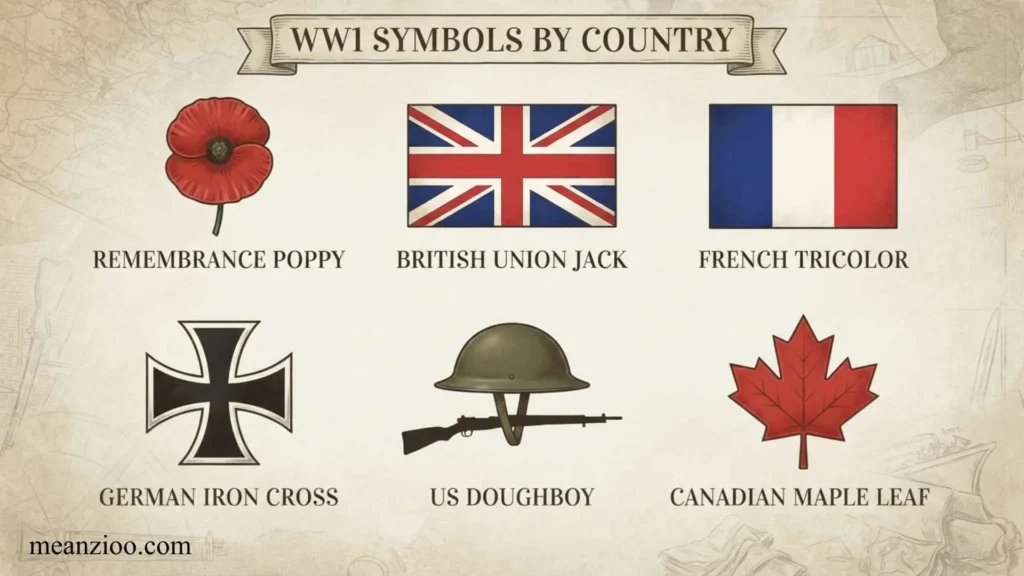
There was no single symbolic language shared identically by every country. Different nations used their own historical traditions.
United States
Important American WW1 imagery included:
- Uncle Sam
- Columbia
- Stars and Stripes
- Statue of Liberty
- Liberty Bonds
- American eagle
- Soldiers
- Patriotic shields
These symbols emphasized national identity, freedom, duty, and civilian participation.
Britain
British imagery commonly included:
- Britannia
- Union Flag
- British soldier
- Royal and military imagery
- Lions
- Naval imagery
Britannia was especially useful as a personification of Britain.
France
French imagery could feature:
- Marianne
- French tricolor
- Gallic imagery
- Soldiers
- Republican symbols
- Liberty imagery
Marianne was particularly important as a representation of the French Republic.
Germany
German WW1 imagery could include:
- Imperial eagle
- Iron Cross
- Pickelhaube
- German military uniforms
- Imperial symbols
- National colors
- Military decorations
The exact meaning depends on the object and its historical context.
Canada
Canadian WW1 symbolism often incorporated:
- Canadian soldiers
- Maple leaf imagery
- Canadian military insignia
- Poppies in later remembrance
- British imperial connections
Canada’s connection to the poppy tradition is particularly important because John McCrae was Canadian.
Russia
Imperial Russian WW1 imagery could include:
- Double-headed eagle
- Imperial symbols
- Orthodox Christian imagery
- Russian national colors
- Military figures
The Russian Empire’s symbols must be distinguished from later Soviet imagery, which belongs to a different political era.
WW1 Military Symbols vs. WW1 Remembrance Symbols
This is one of the most important distinctions when researching WW1 symbols.
| Type | Examples | Main Purpose |
| Military | Iron Cross, military badges, uniforms | Identify service, rank, achievement |
| National | Flags, eagles, personifications | Represent countries and identity |
| Propaganda | Uncle Sam, Britannia, soldiers | Influence public opinion |
| Battlefield | Trenches, barbed wire, gas masks | Represent combat experience |
| Remembrance | Poppy, cross, wreath | Honor and remember the dead |
| Memorial | Sword, torch, obelisk, names | Commemorate sacrifice |
| Victory | Laurel, Victory figures | Represent triumph and honor |
This classification helps explain why a symbol can have different meanings depending on where it appears.
WW1 Medals, Badges, and Insignia
Military decorations and insignia deserve special attention because they are sometimes incorrectly grouped together as general “symbols.”
A medal generally recognizes a particular achievement, service, campaign, or act of bravery.
A badge may identify:
- A military branch
- Regiment
- Unit
- Qualification
- Rank
- Role
An insignia can communicate institutional or organizational identity.
The Imperial War Museums’ memorial records demonstrate that decorations and military information were often included when documenting individuals commemorated on WW1 memorials.
Why Identification Matters
Two symbols may look similar but have completely different meanings.
For example:
- A national emblem is not necessarily a military decoration.
- A medal is not necessarily a rank insignia.
- A later remembrance symbol is not necessarily a WW1 battlefield symbol.
- A propaganda image is not necessarily an official government emblem.
Historical context is essential.
WW1 Memorial Symbols
After the war, communities built thousands of memorials to commemorate those who served and died.
Memorials could take the form of:
- Crosses
- Obelisks
- Statues
- Plaques
- Cenotaphs
- Church memorials
- Rolls of honor
- Gardens
- Dedicated buildings
The Imperial War Museums explains that war memorials can take many forms and may commemorate people who served, died, or were affected by war.
Common Memorial Symbols
WW1 memorials may feature:
- Names of the dead
- Crosses
- Poppies
- Wreaths
- Swords
- Victory figures
- Angels
- Soldiers
- Oak leaves
- Religious figures
- Flags
- Dates such as 1914–1918
A single memorial may combine several symbolic traditions.
Victory Figures
A Winged Victory figure is an example of classical imagery adapted to modern war memorials.
One memorial recorded by the Imperial War Museums shows a winged Victory figure holding a wreath while carrying a lowered sword.
The combination is significant:
- Wings can suggest triumph or transcendence.
- Wreath suggests victory and honor.
- Lowered sword can suggest sacrifice, mourning, or the end of fighting.
This shows why individual symbols should not always be interpreted in isolation.
Peace Symbols
WW1 remembrance culture also includes symbols of peace.
A dove, olive branch, or other peace imagery may represent:
- Peace
- Reconciliation
- Hope
- The end of conflict
- A desire to prevent another war
However, these are broader peace symbols rather than symbols unique to WW1.
“Lest We Forget”
The phrase “Lest We Forget” became strongly associated with remembrance ceremonies and war memorial culture.
Its purpose is straightforward: remembering those who died and preventing their sacrifice from being forgotten.
Similar remembrance language appears on WW1 memorials and related commemorative objects.
The phrase is especially relevant when interpreting memorial symbolism because the purpose of many monuments was not simply to celebrate military victory but to preserve collective memory.
“We Will Remember Them”
Another important remembrance phrase comes from Laurence Binyon’s poem For the Fallen.
The line “We will remember them” became part of remembrance culture and appears on numerous memorials.
The Imperial War Museums records WW1 memorials carrying remembrance inscriptions alongside crosses, names, and other symbols.
Symbols of Sacrifice
Many WW1 symbols communicate sacrifice rather than victory.
Examples include:
- Crosses
- Poppies
- Lowered swords
- Names of the dead
- Memorial plaques
- Empty graves or symbolic spaces
- Mourning figures
- Torches
These symbols help explain why WW1 remembrance can feel solemn even when memorials also contain victory imagery.
Symbols of Victory
Other images emphasize victory and achievement.
These include:
- Laurel wreaths
- Winged Victory
- Flags
- Crowns
- Raised swords
- Triumphal figures
The presence of victory symbolism does not necessarily mean that a memorial ignores loss. Many WW1 memorials deliberately combine victory, honor, grief, and remembrance.
Symbols of the Western Front
If you are trying to identify a symbol in a WW1 photograph or illustration, certain objects strongly suggest the Western Front.
Look for:
- Trenches
- Sandbags
- Barbed wire
- Helmets
- Rifles
- Artillery
- Machine guns
- Gas masks
- Shell craters
- Military uniforms
- Wooden trench structures
These objects are not all formal symbols, but together they form the visual language of trench warfare.
Symbols of the Home Front
WW1 symbolism was not limited to battlefields.
The home front also developed its own visual language.
Common imagery included:
- Women working
- Children
- Factories
- Food conservation
- War bonds
- National flags
- Soldiers returning home
- Red Cross workers
- Agricultural production
These symbols communicated that civilians were also part of the national war effort.
The Red Cross
The Red Cross became an important symbol of medical humanitarian work during WW1.
It could represent:
- Medical care
- Nursing
- Humanitarian assistance
- Ambulance services
- Relief work
- Protection of wounded people
The Red Cross should not be confused with the red poppy. The two are associated with wartime and remembrance, but their historical purposes are different.
Animals as WW1 Symbols
Animals also appeared in WW1 imagery.
Horses were particularly important because they were widely used for transportation, cavalry, artillery support, and logistics.
Dogs and other animals could represent service, loyalty, rescue, or companionship.
Animal imagery could therefore communicate both practical military roles and emotional messages.
How to Identify a WW1 Symbol
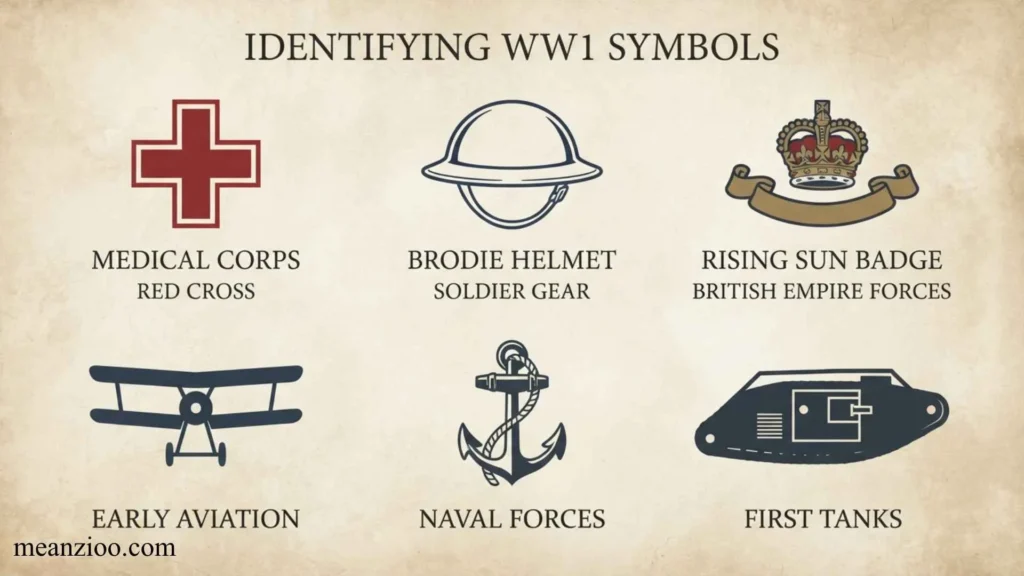
If you encounter an unfamiliar symbol, use a contextual approach.
Step 1: Identify the object
Is it a flower, flag, medal, weapon, animal, person, or architectural feature?
Step 2: Examine the design
Look at:
- Colors
- Shapes
- Letters
- Dates
- Crowns
- Crosses
- Wreaths
- Weapons
- National emblems
Step 3: Check the date
A symbol from 1914–1918 may have a different meaning from an identical-looking symbol used decades later.
Step 4: Identify the country
National symbolism is extremely important.
A German eagle, American eagle, British emblem, and Russian imperial eagle should not automatically be treated as the same symbol.
Step 5: Determine the setting
Ask where the symbol appears:
- Poster?
- Medal?
- Grave?
- Memorial?
- Uniform?
- Newspaper?
- Battlefield photograph?
- Recruitment advertisement?
The setting can completely change the interpretation.
WW1 Symbols vs. WWII Symbols
WW1 and WWII symbolism overlaps in some areas, but they should not be treated as identical.
Both wars used:
- National flags
- Soldiers
- Weapons
- Propaganda
- Patriotic imagery
- Memorial symbols
But each conflict developed its own political, technological, and cultural visual language.
When identifying a historical symbol, the date is therefore essential.
Are WW1 Symbols Always Official?
No.
This is an important point.
A symbol can become associated with WW1 without ever being an official government or military emblem.
For example:
- A poppy is a remembrance symbol.
- A trench is a battlefield symbol.
- Uncle Sam is a national personification.
- A recruitment poster may use several symbolic elements without any of them being an official military insignia.
- A cross may be a religious symbol on a memorial rather than a military emblem.
Calling every WW1-related image an “official WW1 symbol” would be historically inaccurate.
Why WW1 Symbols Still Matter Today
WW1 symbols remain relevant because the First World War fundamentally changed politics, society, technology, borders, and military warfare.
Symbols allow people to remember that history without reading an entire textbook.
A poppy immediately evokes remembrance.
A trench suggests the Western Front.
A Pickelhaube may suggest Imperial Germany.
Uncle Sam evokes American wartime recruitment.
A laurel wreath suggests honor or victory.
A cross can communicate mourning and faith.
Together, these symbols form a visual record of how people experienced and remembered the Great War.
WW1 Symbols and Their Meanings at a Glance
| Symbol | Meaning or Association | Context |
| Red poppy | Remembrance and sacrifice | Postwar remembrance |
| Cross | Faith, mourning, sacrifice | Graves and memorials |
| National flag | Patriotism and identity | Wartime and memorial |
| Uncle Sam | U.S. national identity and recruitment | American propaganda |
| Columbia | America and liberty | American propaganda |
| Statue of Liberty | Freedom and liberty | American imagery |
| Liberty Bond | Civilian financial support | U.S. home front |
| Britannia | Britain | British propaganda |
| Marianne | France and republican identity | French imagery |
| Iron Cross | German military honor | Military decoration |
| Pickelhaube | Imperial German military | Military/propaganda |
| Eagle | Power and national authority | Multiple countries |
| Laurel wreath | Victory and honor | Military/memorial |
| Oak leaves | Strength and endurance | Memorial imagery |
| Torch | Hope, liberty, remembrance | Propaganda/memorial |
| Sword | Military service and sacrifice | Military/memorial |
| Rifle | Soldiering and combat | Battlefield imagery |
| Barbed wire | Trench warfare | Western Front |
| Gas mask | Chemical warfare | Battlefield |
| Tank | Mechanized warfare | Late WW1 |
| Airplane | Military aviation | Wartime technology |
| Zeppelin | Air warfare | German aerial warfare |
| Red Cross | Medical and humanitarian service | Medical/humanitarian |
| Dove | Peace and reconciliation | Remembrance/postwar |
Frequently Asked Questions About WW1 Symbols
What is the main symbol of WW1?
The red poppy is the most widely recognized symbol of World War I remembrance. Its association with the war comes particularly from John McCrae’s In Flanders Fields and the remembrance tradition that developed afterward.
What does the WW1 poppy mean?
The red poppy represents remembrance, sacrifice, and the memory of soldiers who died during the war. The organized poppy remembrance tradition developed around the end of WW1 and expanded afterward.
What symbols were used in WW1 propaganda?
Common examples include national flags, soldiers, national personifications, Liberty Bond imagery, weapons, women and children, and patriotic figures such as Uncle Sam.
What does the Iron Cross mean in WW1?
In its WW1 context, the Iron Cross was a German military decoration associated with military service, bravery, and honor.
What does the cross represent in WW1 memorials?
The cross commonly represents Christian faith, mourning, sacrifice, death, and hope. Its precise meaning depends on the individual memorial and religious context.
What does a laurel wreath symbolize?
A laurel wreath traditionally represents victory, honor, and achievement. On WW1 memorials, it can honor those who served or died.
What does barbed wire symbolize in WW1?
Barbed wire is strongly associated with trench warfare, defensive positions, battlefield danger, and the Western Front.
What did Uncle Sam represent during WW1?
Uncle Sam represented the United States and was used extensively to communicate patriotism, national duty, and military recruitment. The famous pointing image became one of the most recognizable American WW1 propaganda designs.
What did Liberty Bonds symbolize?
Liberty Bonds represented civilian participation in the American war effort. Buying bonds allowed people at home to contribute financially to the national war effort.
Are poppies an official WW1 military symbol?
Not in the same sense as a military badge or decoration. The poppy is primarily a remembrance symbol that developed through the cultural memory of WW1.
What symbols represent WW1 soldiers?
Common visual representations include uniforms, helmets, rifles, military badges, medals, trenches, and national insignia. The specific meaning depends on the army and historical period.
What symbols represent WW1 sacrifice?
Common examples include the red poppy, cross, memorial names, lowered sword, wreath, torch, and mourning figures.
Final Thoughts
WW1 symbols provide a powerful way to understand both the First World War and the way later generations remembered it.
Some symbols belong directly to wartime life: rifles, trenches, barbed wire, gas masks, aircraft, tanks, uniforms, military decorations, and national insignia. Others belong more strongly to propaganda: Uncle Sam, Britannia, Marianne, flags, Liberty Bonds, and patriotic figures.
Then there are remembrance symbols such as the red poppy, cross, wreath, torch, memorial sword, and names of the fallen. These developed or gained greater significance as communities tried to preserve the memory of a devastating conflict.
The most important lesson is that context determines meaning. A sword on a military badge is not necessarily the same as a sword on a memorial. An eagle does not automatically mean Germany. A poppy is not a military rank insignia. And a propaganda image should not be confused with an official military emblem.
Understanding those distinctions makes WW1 symbols much easier to identify and interpret—and gives a more accurate picture of how the Great War was fought, represented, and remembered.
Also Check This Post: Logical Symbols: Complete List, Meanings, Names, and Examples

Hi, I’m Charlotte Hayes. I love writing about the newest English slang, pop culture phrases, and digital communication. I spend my time exploring how language evolves across social media, gaming, and everyday conversations. I enjoy sharing easy-to-understand guides that help learners keep up with modern English. My goal is to make every article useful, accurate, and enjoyable for readers around the world.
Books:
- Everyday Slang Dictionary
- Fluent Through Informal English
 Ryan Mitchell