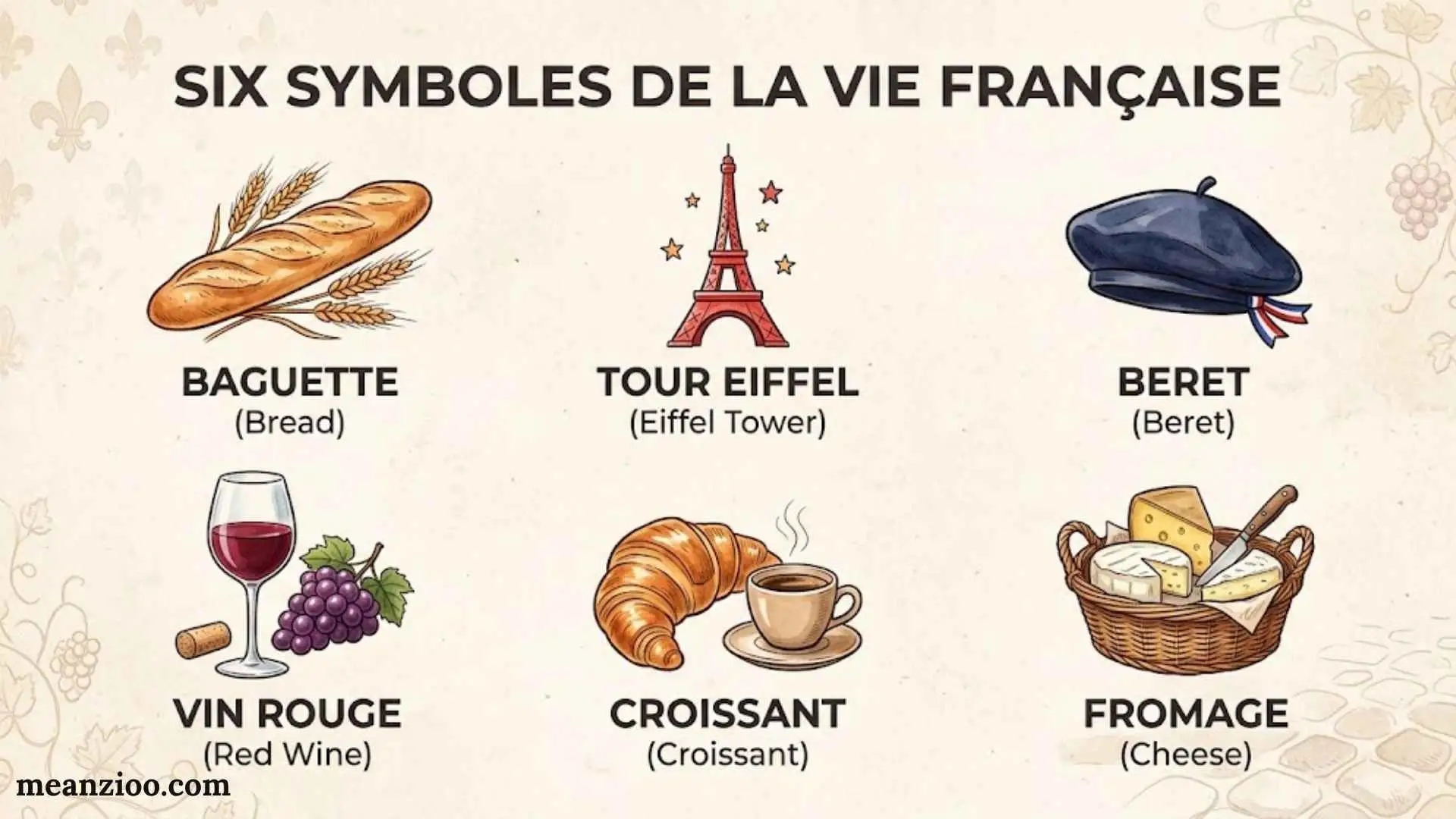
From the blue, white, and red French flag to the famous Eiffel Tower, French symbols tell fascinating stories about the country’s history, politics, art, and everyday life. Some represent the values of the French Republic, while others reflect centuries of royal traditions, revolutionary struggles, and cultural achievements.
France has several recognizable national icons, but they don’t all have the same official status. The French Constitution identifies the national flag, national anthem, and republican motto. Marianne, the Gallic Rooster, the fleur-de-lis, and the Phrygian cap carry different historical and cultural meanings.
Food also plays an important role in French identity. The baguette, regional dishes, and the traditions surrounding French dining reflect a culture that values craftsmanship, local ingredients, and shared meals.
Whether you’re exploring France for the first time or learning about its heritage, understanding these symbols offers a deeper look at what makes the country distinctive.
What Are the National Symbols of France?
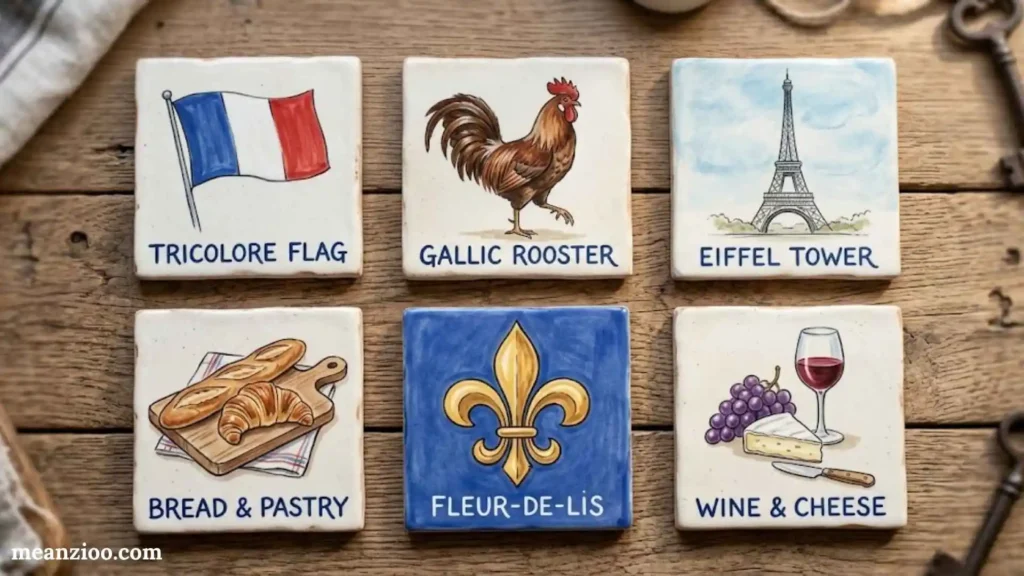
National symbols of France are objects, figures, songs, words, and traditions that represent the country’s identity and heritage. Some have a formal constitutional role, while others have become widely recognized through history, art, architecture, and popular culture.
The French Revolution of 1789 played a major role in shaping modern French symbolism. As revolutionaries challenged the monarchy, they developed and popularized symbols associated with liberty, citizenship, and popular sovereignty. These symbols helped express a new vision of France built around republican government rather than hereditary royal power.
However, France’s identity doesn’t begin with the Revolution. Medieval heraldry, classical Roman imagery, Catholic traditions, royal architecture, and regional customs also contribute to its cultural landscape.
The three constitutional symbols of France
Article 2 of the French Constitution of October 4, 1958, identifies the national flag, national anthem, and republican motto. It also states that the language of the Republic is French and that the Republic’s principle is government of the people, by the people, and for the people.
According to the official French legal text, these three symbols are:
- French national flag: The blue, white, and red Tricolor.
- French national anthem: La Marseillaise.
- French national motto: Liberté, Égalité, Fraternité, meaning Liberty, Equality, Fraternity.
Other familiar icons, including Marianne and the Gallic Rooster, have considerable national importance. However, they don’t all hold the same constitutional status.
Official National Symbols of France
The French Flag: The Blue, White, and Red Tricolor
The French national flag, commonly called the Tricolore or French Tricolor, is one of the world’s most recognizable national flags. It consists of three vertical bands of blue, white, and red.
The flag emerged during the French Revolution, when political change transformed the symbols associated with the country. Revolutionary supporters used a cockade combining blue and red, colors associated with Paris, with white traditionally linked to the monarchy. The resulting combination became a powerful emblem of the changing nation.
The flag’s design evolved during the revolutionary period, and France formally adopted the Tricolor as its national flag in 1794. Its position and use changed during later political upheavals, but it ultimately became the enduring emblem of the French Republic.
What do the colors of the French flag mean?
Popular explanations often assign a separate virtue to each color. Blue and red are frequently connected with Paris, while white is associated with the monarchy. Other interpretations link the colors to liberty, equality, and fraternity.
These explanations require historical context. The French Constitution identifies the colors but doesn’t assign each one a single official meaning. Their significance developed through political events and changing interpretations over time.
Today, the Tricolor represents French national identity, sovereignty, and the Republic. You’ll see it outside town halls, on government buildings, during national commemorations, and at international sporting events.
It also appears in classrooms, public ceremonies, and diplomatic settings. For many French citizens, the flag serves as a shared symbol that connects people across regional and political differences.
Marianne: The Personification of the French Republic
Marianne is the female personification of the French Republic. She represents republican ideals, especially liberty, citizenship, and the rejection of hereditary political authority.
Artists commonly portray Marianne wearing a Phrygian cap, a soft cap associated with freedom in classical and revolutionary imagery. Her appearance can vary: some representations show a calm, dignified woman, while others emphasize determination and revolutionary spirit.
Marianne became prominent during the French Revolution and grew into a lasting symbol of republican France during the nineteenth century. Her image appears on official busts, postage stamps, coins, and public monuments.
Many French town halls display a bust of Marianne. This placement connects the Republic’s ideals with local government and civic life.
Marianne also appears in official state branding. The French government’s official guide to republican symbols explains how the Marianne emblem forms part of the visual identity used by the French state.
What Marianne represents:
- Liberty: Freedom from arbitrary rule and political oppression.
- Republicanism: Government organized around the Republic rather than hereditary monarchy.
- Citizenship: The shared civic identity of the French people.
- Democratic ideals: Participation in public life and popular sovereignty.
Unlike the Tricolor, Marianne isn’t a flag or a constitutional motto. Her importance comes from her role as a national personification of the Republic.
Liberty, Equality, Fraternity: The French National Motto
The French motto, Liberté, Égalité, Fraternité, translates into English as Liberty, Equality, Fraternity. These three words summarize central ideals of French republicanism.
The motto developed through revolutionary debates and gained prominence during the French Revolution. Although its use changed under successive governments, it eventually became firmly established as a symbol of the French Republic.
Each word expresses a distinct but related principle.
Liberty refers to individual freedom and protection against arbitrary power. It includes the ability to express opinions, practice beliefs within the law, and participate in civic life.
Equality expresses the principle that citizens should enjoy equal rights under the law. It challenges hereditary privilege and supports the idea that public institutions should treat citizens according to common legal standards.
Fraternity emphasizes solidarity, mutual responsibility, and the bonds that connect members of a political community. It encourages people to see citizenship as more than a collection of individual rights.
Together, these values help explain the French Republic’s political identity. They also appear in civic education, public ceremonies, official buildings, and government communications.
The motto is particularly important because it connects the revolutionary past with the present constitutional system. It remains one of the most enduring expressions of French national identity.
La Marseillaise: The National Anthem of France
La Marseillaise is the national anthem of France and one of the best-known musical works associated with the French Revolution.
Claude Joseph Rouget de Lisle composed the song in 1792 in Strasbourg. Its original title was Chant de guerre pour l’Armée du Rhin, meaning “War Song for the Army of the Rhine.” It was written during a period of conflict when revolutionary France faced military threats from neighboring powers.
Volunteers from Marseille helped popularize the song as they traveled toward Paris. Their association with the music eventually gave it the name La Marseillaise.
The anthem became closely linked with revolutionary patriotism and the defense of the French nation. However, its official status changed during France’s turbulent political history. Governments sometimes suppressed or displaced it, particularly when revolutionary associations conflicted with their political aims.
France officially adopted La Marseillaise as its national anthem in 1795. It later regained official status after periods of political change and became firmly established under the modern Republic.
Today, the anthem accompanies national ceremonies, military commemorations, and major sporting events. Its opening words are widely recognized:
“Allons enfants de la Patrie”
These words mean “Arise, children of the Fatherland.” The anthem’s language reflects the urgency and intensity of its revolutionary origins.
Although its martial tone can sound forceful to modern listeners, its historical significance lies in its connection to national sovereignty, collective identity, and the struggle to defend revolutionary France.
The French Cockade: A Revolutionary Emblem
The French cockade is a circular ornament made from ribbons arranged in the national colors. It became an important political emblem during the French Revolution.
Early revolutionary cockades helped people identify with the movement and distinguish supporters of political change from defenders of the old order. The combination of Parisian blue and red with white became closely associated with the emerging national colors.
The cockade and the flag are related but different. A flag displays the colors across a larger fabric, while a cockade arranges them in a compact circular form.
Historically, cockades appeared on hats, military uniforms, and other clothing. They provided a visible sign of allegiance during a period when political identity could carry serious consequences.
Today, the cockade remains part of France’s historical imagery. Tricolor cockades also appear in certain ceremonial and aviation contexts, reflecting their continuing connection with national identity.
The Great Seal of France: A Symbol of State Authority
The Great Seal of France is a formal instrument used to authenticate certain official state documents. Unlike the national flag, which appears throughout public life, the seal has a more specialized constitutional and ceremonial role.
The modern republican seal dates to the Second Republic in the nineteenth century. Its design includes a seated female figure representing Liberty, along with imagery connected to the Republic, agriculture, and state authority.
The seal’s symbolism reflects the idea that government acts through established legal institutions rather than through the personal authority of a monarch. Its use on important constitutional documents gives it a direct connection to France’s legal and political traditions.
The Great Seal is not the same as a coat of arms. A seal authenticates documents, while an emblem identifies an institution or state.
Its use today is relatively limited. One notable application involves formal constitutional acts, such as certain constitutional amendments.
The Emblem of the French Republic
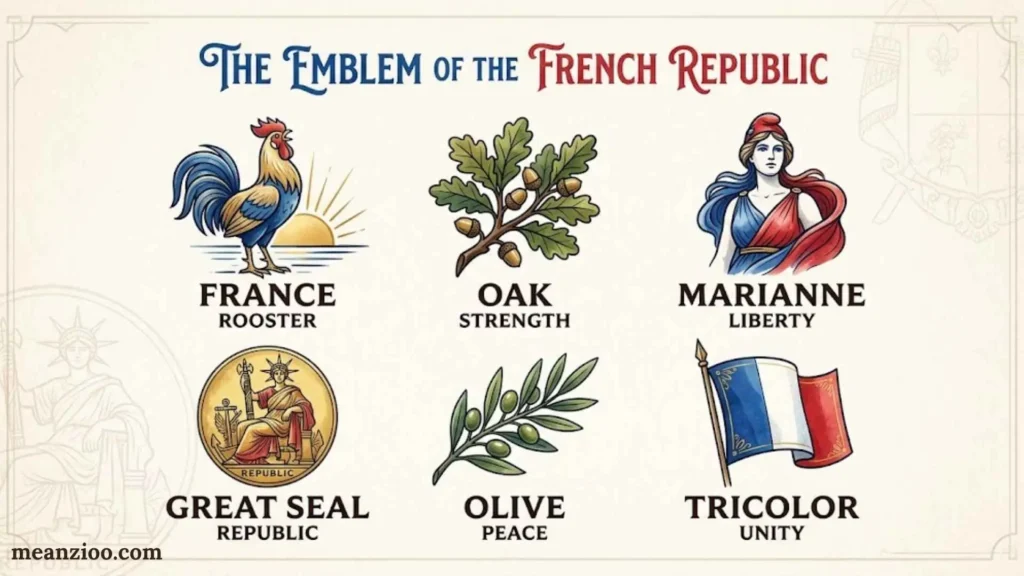
France has a republican emblem, but its heraldic situation differs from countries with a single, universally prescribed coat of arms.
The French republican emblem features a stylized fasces, oak and olive branches, and the letters RF, which stand for République Française, or French Republic.
The fasces consists of bound rods surrounding an axe. Its origins lie in ancient Rome, where fasces symbolized the authority of certain public officials. French republican imagery adapted the motif to represent collective strength and public authority.
The bound rods also offer a useful visual idea: separate elements become stronger when joined together. In French republican symbolism, the fasces can express national unity and the idea of citizens acting together under a common political framework.
The branches add further layers of meaning. Oak is commonly associated with strength and endurance, while olive branches traditionally suggest peace.
The emblem appears in official and diplomatic settings, including selected government publications and state representations abroad.
It shouldn’t be confused with France’s historical royal heraldry. The fleur-de-lis, for example, belongs primarily to the country’s monarchical and heraldic traditions rather than its modern republican emblem.
Historical and Traditional Symbols of France
The Gallic Rooster: A Traditional Symbol of French Identity
The Gallic Rooster, or coq gaulois, is one of France’s most distinctive traditional symbols. It appears in sports, historical imagery, and selected official settings, even though France doesn’t formally designate it as its constitutional national animal.
The association has an unusual linguistic origin. In Latin, gallus can mean both “Gaul” and “rooster.” This wordplay helped connect the bird with the people who inhabited ancient Gaul, the region that included much of present-day France.
The rooster appeared on some ancient Gallic coins. After a period when the association became less prominent, it reemerged in European imagery during the Middle Ages and later appeared in representations of French kings during the Renaissance.
Its popularity grew after the French Revolution. However, the rooster didn’t become the country’s dominant political emblem in every period.
According to the French presidency’s historical account, Napoleon I rejected a proposal to adopt the rooster as a national symbol because he considered it too weak to represent an empire. The bird later regained political prominence, particularly during the nineteenth century.
Today, the Gallic Rooster is especially familiar to sports fans. It appears in French sporting imagery and has become closely associated with national teams.
The rooster commonly evokes:
- Pride in French identity.
- Courage and determination.
- Perseverance in difficult circumstances.
- Sporting tradition and national representation.
Its cultural importance rests on historical association rather than a single official designation.
The Fleur-de-Lis: France’s Historic Royal Symbol
The fleur-de-lis is a stylized lily-like motif strongly associated with the French monarchy. Its name comes from French words meaning “flower of the lily,” although the design doesn’t necessarily represent a botanically accurate flower.
For centuries, the fleur-de-lis appeared in royal heraldry, religious art, architecture, and decorative objects. French kings used it as a recognizable emblem of dynastic authority and royal legitimacy.
The symbol also developed religious associations. Medieval Christian art connected lilies with purity and the Virgin Mary, although interpretations varied across periods and artistic traditions.
The fleur-de-lis became particularly prominent in the heraldic imagery of French kings. Its presence on royal banners, shields, and ceremonial objects helped distinguish the monarchy’s visual identity.
After the French Revolution challenged hereditary rule, the fleur-de-lis lost its central place in the official imagery of republican government. Nevertheless, it remained visible in historical buildings, art collections, family heraldry, and decorative traditions.
Its legacy is more complicated in some colonial contexts. French colonial authorities used the symbol in settings where it could carry associations with royal power, legal control, and punishment. These histories deserve careful treatment rather than a single universal interpretation.
Today, the fleur-de-lis represents a link to France’s medieval and royal past. It isn’t the official national flower of France.
The Phrygian Cap: A Symbol of Liberty
The Phrygian cap is a soft cap with a distinctive shape, often depicted with its tip bending forward. It became one of the most recognizable symbols of liberty in French revolutionary imagery.
Its association with freedom predates the French Revolution. In classical antiquity, the Phrygian cap became connected with ideas of liberation, including imagery associated with formerly enslaved people who had gained their freedom.
French revolutionaries adopted the cap as a sign of emancipation from oppressive authority. Supporters of the Revolution sometimes wore it, turning a historical image into a visible statement of political ideals.
The cap became closely associated with Marianne, who is frequently portrayed wearing it. This combination makes the meaning especially clear: Marianne personifies the Republic, while the cap reinforces the idea of liberty.
The Phrygian cap also appears in revolutionary prints, sculptures, commemorative imagery, and other representations of republican ideals.
Although it may resemble other types of headwear, its importance in French symbolism comes from its historical association with freedom and the revolutionary rejection of absolute monarchy.
The Eiffel Tower: An Icon of France
The Eiffel Tower is one of the world’s most recognizable landmarks and a powerful cultural symbol of France. Located in Paris, it represents French engineering, architecture, tourism, and the country’s international image.
Engineer Gustave Eiffel’s company built the tower for the 1889 Exposition Universelle, a world’s fair held to commemorate the centenary of the French Revolution. The structure demonstrated the possibilities of iron construction at a time when engineering was rapidly changing modern cities.
The tower wasn’t universally admired at first. Some artists and writers criticized its appearance, arguing that its industrial design clashed with Paris’s traditional architecture. Yet its engineering achievement and visual impact eventually won broad recognition.
Standing approximately 330 meters tall, including its current antenna, the Eiffel Tower became a defining feature of the Paris skyline. Its height has changed over time as antennas and other equipment have been added.
The landmark now attracts visitors from around the world. It appears in photographs, films, travel advertisements, souvenirs, and countless representations of French culture.
Unlike the national flag or anthem, the Eiffel Tower isn’t a constitutional symbol. Its status comes from its architectural significance and its powerful association with Paris and France.
The Bastille and Bastille Day
The Bastille was a fortress and state prison in Paris before revolutionaries stormed it on July 14, 1789. Although the prison held relatively few inmates at the time of its capture, the event became a defining moment in the French Revolution.
The Bastille represented royal authority and the possibility of imprisonment under the monarchy. Its fall therefore carried meaning beyond the military importance of the building itself.
The event became a symbol of resistance to arbitrary power and the growing political influence of ordinary citizens. Over time, it entered French national memory as a turning point in the struggle against absolute monarchy.
France celebrates its national holiday on July 14, commonly known in English as Bastille Day. The date also recalls the Festival of the Federation held on July 14, 1790, which celebrated national unity a year after the Bastille’s capture.
Modern celebrations include military parades, fireworks, concerts, public gatherings, and local festivities. The annual military parade along the Champs-Élysées in Paris is among the most prominent events.
Bastille Day therefore connects two important themes: the revolutionary challenge to royal authority and the later celebration of national unity.
Cultural Symbols and Traditions of France
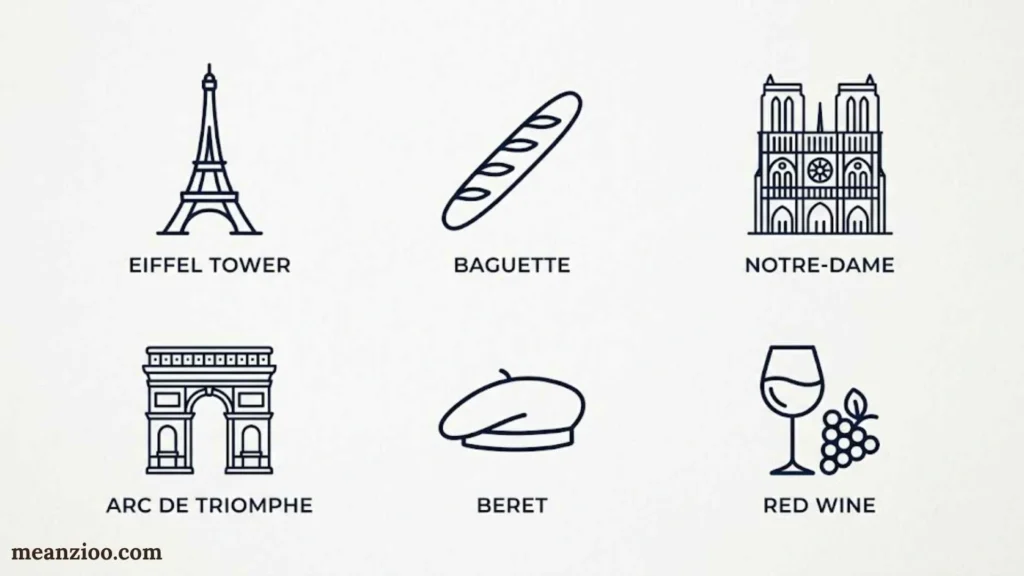
French Cuisine: A Symbol of Cultural Heritage
French cuisine represents much more than famous recipes. It reflects regional traditions, agricultural practices, artisanal skills, and social customs passed between generations.
France’s culinary identity varies considerably from one region to another. Normandy is known for dairy products and apples, Provence for Mediterranean ingredients, and Burgundy for dishes associated with wine and local agriculture. These regional differences make French food culture diverse rather than uniform.
UNESCO recognized the gastronomic meal of the French as intangible cultural heritage in 2010. The recognition concerns a social practice, not a single dish. It highlights the customs surrounding the preparation, presentation, sharing, and enjoyment of food.
A traditional gastronomic meal can involve selecting seasonal ingredients, pairing dishes with suitable drinks, arranging a welcoming table, and allowing time to appreciate each course. Family gatherings, weddings, birthdays, and other celebrations often bring these customs to life.
French culinary heritage includes many well-known foods:
| Food | Description | Cultural association |
| Pot-au-feu | A slow-cooked dish of meat, vegetables, and broth | Traditional home cooking |
| Ratatouille | A vegetable dish associated with southern France | Provençal cuisine |
| Coq au vin | Chicken braised with wine | Traditional regional cooking |
| Crêpes | Thin pancakes served with sweet or savory fillings | Everyday meals and celebrations |
| Croissant | A flaky, crescent-shaped pastry | French bakery culture |
| Baguette | A long loaf with a crisp crust | Daily bread and neighborhood bakeries |
These foods help express French cultural identity, but none should automatically be described as the country’s officially designated national dish.
The French Baguette: More Than Everyday Bread
The French baguette is a familiar part of daily life in France. Its long shape, crisp crust, and soft interior make it instantly recognizable, but its cultural importance goes beyond its appearance.
Baguettes are sold in bakeries throughout the country and eaten at breakfast, lunch, dinner, and as snacks. Many people visit local bakeries regularly, making the purchase of fresh bread part of an established neighborhood routine.
Traditional baguette production relies on a small number of ingredients: flour, water, salt, and yeast or a suitable leavening culture. The baker’s skill influences fermentation, shaping, scoring, and baking, which all affect the final texture and flavor.
In 2022, UNESCO inscribed the artisanal know-how and culture of baguette bread on its Representative List of the Intangible Cultural Heritage of Humanity. The recognition celebrates the skills of bakers and the social practices surrounding baguette production and consumption.
This distinction matters. UNESCO recognized the craft and culture associated with the baguette rather than designating the bread as an official national emblem.
Nevertheless, the baguette remains one of the clearest examples of how an everyday object can become a symbol of a country’s identity.
The Louvre Museum and the Palace of Versailles
France’s cultural symbols also include landmarks that preserve its artistic and political history. Two particularly important examples are the Louvre Museum and the Palace of Versailles.
The Louvre Museum in Paris houses one of the world’s major art collections. Its holdings span ancient civilizations, European painting, sculpture, decorative arts, and other fields. The Mona Lisa, painted by Leonardo da Vinci, is among its most famous works.
The Louvre’s history as a former royal palace also connects it with the development of the French state and the transformation of royal collections into a public cultural institution.
The Palace of Versailles, meanwhile, represents the grandeur of the French monarchy. King Louis XIV transformed Versailles into a major royal residence and a center of political power during the seventeenth century.
Its Hall of Mirrors, gardens, fountains, and elaborate interiors demonstrate the scale of royal patronage and the artistic ambitions of the French court. Versailles also helps explain the political tensions surrounding the monarchy before the French Revolution.
These landmarks aren’t constitutional symbols. Instead, they represent different chapters of French history through architecture, art, and cultural memory.
How the French Revolution Shaped National Symbols
The French Revolution transformed France’s political system and its visual language. Symbols that had once emphasized royal authority increasingly competed with images of citizenship, liberty, and popular sovereignty.
Before the Revolution, royal heraldry and dynastic imagery played a major role in representing the state. The fleur-de-lis, royal banners, and ceremonial insignia connected political authority with the monarchy.
Revolutionary movements introduced alternative symbols. The Tricolor and cockade offered recognizable signs of allegiance, while the Phrygian cap expressed liberation. Marianne developed into a personification of the Republic, and La Marseillaise gave revolutionary patriotism a musical voice.
The following milestones help explain the evolution of these symbols:
| Date | Event | Significance |
| 1789 | Storming of the Bastille | Became a symbol of resistance to royal authority |
| 1792 | Composition of La Marseillaise | Created a revolutionary song that became France’s national anthem |
| 1794 | Formal adoption of the Tricolor as the national flag | Established the flag as a national emblem |
| 1795 | Adoption of La Marseillaise as the national anthem | Gave the revolutionary song official status |
| 1830 | July Revolution | Helped restore the rooster’s political prominence |
| 1848 | Establishment of the Second Republic | Renewed republican symbolism |
| 1958 | Constitution of the Fifth Republic | Established the current constitutional framework and specified the flag, anthem, and motto |
The history wasn’t a straight line. France experienced several republics, monarchies, and empires, each of which influenced the status of different symbols.
That’s why modern French identity combines revolutionary ideals with older royal, religious, and regional traditions. The country didn’t erase its past; it reinterpreted parts of it.
Official Symbols vs. Cultural Symbols of France
Understanding the difference between official and cultural symbols helps prevent common misunderstandings. A symbol can be widely recognized without having a formal designation under French law.
| Symbol | Category | Main significance |
| French Tricolor | Constitutional national symbol | French sovereignty and national identity |
| La Marseillaise | Constitutional national symbol | Revolutionary history and national unity |
| Liberté, Égalité, Fraternité | Constitutional motto | Republican ideals |
| Marianne | National personification | Liberty and the French Republic |
| Great Seal of France | Formal state instrument | Authentication of certain official documents |
| Gallic Rooster | Traditional national symbol | French identity and sporting pride |
| Fleur-de-lis | Historical royal symbol | Monarchy and heraldic heritage |
| Phrygian cap | Revolutionary symbol | Liberty and emancipation |
| Eiffel Tower | Architectural and cultural icon | Paris, engineering, and modern France |
| French baguette | Culinary and cultural symbol | Baking traditions and everyday life |
| Bastille | Historical symbol | Resistance to absolute monarchy |
| Palace of Versailles | Historical and architectural landmark | Royal power and artistic heritage |
Article 2 of the Constitution explicitly names the Tricolor, La Marseillaise, and the republican motto. Other symbols may carry immense historical importance without sharing the same constitutional status.
This distinction also explains why claims about France’s national flower, tree, or dish require caution. Popular association isn’t the same as official designation.
Frequently Asked Questions About French Symbols
What is the most famous symbol of France?
The French flag and Eiffel Tower are among the country’s most recognizable symbols worldwide. Marianne is particularly important as the personification of the French Republic, while the Gallic Rooster represents a longstanding cultural tradition.
What are the three official symbols of France?
Article 2 of the French Constitution identifies the national flag, the national anthem, and the national motto. These are the blue, white, and red Tricolor; La Marseillaise; and Liberté, Égalité, Fraternité.
What do the colors of the French flag represent?
The blue, white, and red flag developed during the French Revolution. Blue and red are associated with Paris, while white has historical links to the monarchy. Other interpretations connect the colors with republican values, but France’s Constitution doesn’t assign each color a single official meaning.
Why is Marianne a symbol of France?
Marianne personifies the French Republic and its commitment to liberty and republican government. Artists often depict her wearing a Phrygian cap, which reinforces her association with freedom.
Why is the Gallic Rooster associated with France?
The association partly comes from the Latin word gallus, which means both “Gaul” and “rooster.” Over centuries, the bird became connected with French identity and later gained particular prominence in sports.
What does the fleur-de-lis symbolize?
The fleur-de-lis is historically associated with French royalty and heraldry. It also carries religious associations in European art, particularly connections with the Virgin Mary. It isn’t the official national flower of France.
What is France’s national anthem?
France’s national anthem is La Marseillaise. Claude Joseph Rouget de Lisle composed it in 1792 during the French Revolution, and the song became closely associated with revolutionary patriotism.
Does France have an official coat of arms?
France uses a republican emblem featuring a fasces, branches, and the letters RF. However, it doesn’t have a single universally used, constitutionally prescribed coat of arms comparable to those of some other countries. Historical royal heraldry and the Great Seal are separate matters.
What is France’s national flower?
France doesn’t have a universally established official national flower comparable to its constitutionally specified flag and anthem. The fleur-de-lis is often described as a French national flower, but it is a stylized heraldic motif with strong royal associations rather than a formal botanical designation.
What is France’s national dish?
France has no single universally established official national dish. Pot-au-feu, coq au vin, ratatouille, and many regional specialties form part of its culinary heritage. UNESCO’s recognition of French gastronomy celebrates a meal tradition rather than one particular recipe.
Why is July 14 important in France?
July 14 is France’s national holiday, commonly called Bastille Day in English. It recalls the storming of the Bastille in 1789 and the Festival of the Federation in 1790, linking revolutionary history with national unity.
Conclusion: What French Symbols Tell Us About France
French symbols reveal a country shaped by revolution, monarchy, republican government, artistic achievement, and regional traditions. Each emblem tells a different part of that story.
The Tricolor, La Marseillaise, and Liberté, Égalité, Fraternité express the constitutional identity of the French Republic. Marianne and the Phrygian cap reinforce the ideals of liberty and citizenship, while the Gallic Rooster preserves a distinctive historical association with French identity.
Meanwhile, the fleur-de-lis recalls the monarchy, the Bastille represents revolutionary resistance, and the Eiffel Tower showcases modern engineering. The baguette and French culinary traditions demonstrate how everyday practices can become powerful cultural markers.
Together, these French national symbols and cultural icons offer a richer understanding of France than any single emblem could provide. They connect the country’s past with its present, showing how national identity evolves while preserving meaningful links to history.

I’m Ryan Mitchell, and I write about modern English, trending slang, and online expressions. I enjoy explaining the meanings, origins, and real-life usage of popular words in a simple way. I believe learning slang is an important step toward understanding today’s English-speaking culture. Through my work, I aim to help readers speak more naturally and stay updated with the latest language trends.
 Charlotte Hayes