A skull wearing a straw hat, a crossed-out letter on a pirate’s arm, and a sun-shaped mark covering a painful past might look like simple designs. In One Piece, however, these details often connect to some of the story’s most memorable relationships, conflicts, and mysteries.
Created by Eiichiro Oda, the series uses visual details to help readers recognize pirate crews, understand character loyalties, and uncover pieces of a complicated world. Some symbols have straightforward meanings. Others, such as the mysterious Will of D., remain connected to larger questions about the world’s history.
Understanding these designs adds another layer to the story. A pirate flag can represent a captain’s ambitions, a tattoo can preserve the memory of a brother, and an ancient inscription can challenge everything people believe about the past.
This guide explores the most important One Piece symbols, their appearances, their confirmed meanings, and the themes they represent. It also covers popular tattoo designs, pirate flags, government emblems, and copy-and-paste symbols for anime fans.
Spoiler warning: Some sections discuss important events and mysteries from the One Piece manga and anime, including character backstories, the Sun Pirates, the Void Century, and the Will of D.
What Are One Piece Symbols?
One Piece symbols are visual designs, marks, letters, flags, and inscriptions associated with characters, organizations, families, and historical events throughout the series. They don’t all serve the same purpose. Some identify a crew, while others reveal a character’s past or point toward the world’s hidden history.
The easiest way to understand them is to separate them into a few categories.
| Type of symbol | Examples | Main purpose |
| Pirate flags | Straw Hat and Whitebeard Jolly Rogers | Identify a pirate crew and its allegiance |
| Character tattoos | Ace’s ASCE tattoo | Communicate personal history and relationships |
| Shared marks | Sun Pirates symbol and the Straw Hats’ X mark | Express belonging, solidarity, or a shared promise |
| Family crests | Kozuki family crest | Identify family heritage and affiliation |
| Government insignia | Marine justice symbol and World Government emblem | Represent institutions and political authority |
| Historical records | Poneglyphs | Preserve information about the past |
| Recurring story motifs | Straw hat and the D. initial | Connect characters, generations, and unresolved mysteries |
One important distinction matters: not every meaningful image is an official emblem, and not every symbol has a fully explained hidden meaning. The Straw Hat Jolly Roger is a recognizable crew flag. The D. initial, by contrast, is a recurring mystery within certain characters’ names.
That distinction helps separate established story details from interpretations and fan theories.
The Straw Hat Jolly Roger: The Symbol of Luffy’s Crew
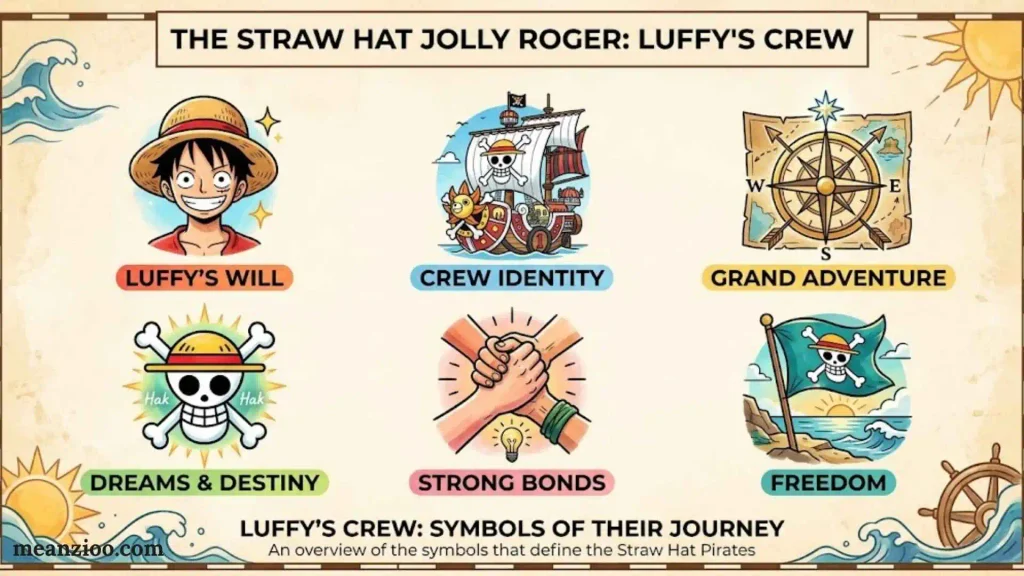
The Straw Hat Jolly Roger is one of the most recognizable designs in the entire series. Its skull-and-crossbones structure resembles a traditional pirate flag, but the straw hat placed on the skull makes it unmistakably associated with Monkey D. Luffy and his crew.
A Jolly Roger serves as a pirate crew’s identifying flag. In One Piece, crews customize these designs to reflect their captains, personalities, and identities. The Straw Hats’ flag follows that tradition while incorporating an object central to Luffy’s story.
What Does the Straw Hat Pirates Symbol Mean?
The flag’s most direct meaning is crew identity. When the Straw Hat Jolly Roger appears on a ship or flag, it identifies the group sailing under it.
However, its association with Luffy gives it additional significance.
- Freedom: Luffy pursues his dream of becoming King of the Pirates and refuses to surrender his personal independence.
- Adventure: The flag represents the journey shared by Luffy and his companions across the seas.
- Friendship: The crew’s emblem identifies a group whose members repeatedly risk their lives for one another.
- Inherited will: The straw hat connects Luffy to Shanks and the promise that helped inspire his journey.
These themes arise from the story rather than from a universal definition of skulls or hats. The design is meaningful because of the people, promises, and adventures attached to it.
Why Is Luffy’s Straw Hat So Important?
Luffy’s straw hat isn’t simply an accessory. It connects him to Shanks, who gave him the hat during their time together in the East Blue.
Luffy’s promise to return it after becoming a great pirate gives the object personal significance. As the story develops, the hat also becomes part of the series’ wider pattern of inherited aspirations and connections between generations.
The hat and the Jolly Roger serve related but distinct purposes. The hat is a personal object with a history. The flag is the crew’s public emblem.
Why Do Pirate Flags Matter in One Piece?
A Jolly Roger can communicate much more than a ship’s identity. Depending on the crew, it can signal danger, establish territory, or represent a promise of protection.
For this reason, defending a flag can become a statement about defending the people and ideals behind it. In One Piece, pirate flags often carry emotional weight because their owners invest them with meaning.
The Straw Hat symbol works so well because its design is easy to recognize while its story connections continue to grow.
Ace’s ASCE Tattoo: Brotherhood, Loss, and Remembrance
Portgas D. Ace has one of the most recognizable One Piece tattoo designs: the letters A, S, C, and E arranged vertically on his left arm, with the S crossed out.
At first glance, the design can look like a spelling mistake. It isn’t. The crossed-out letter connects Ace to Sabo, one of the three boys who formed a sworn-brother relationship with Ace and Luffy.
What Does Ace’s ASCE Tattoo Mean?
Each letter contributes to the design’s connection with Ace and his brothers. The crossed-out S refers to Sabo and his place in their childhood bond.
Sabo was believed to have died after an attack by a Celestial Dragon destroyed the boat on which he was traveling. Ace and Luffy grew up believing they had lost him.
The tattoo preserves Sabo’s place in Ace’s life, even during the period when his fate remained unknown to his brothers.
Its meaning comes from that relationship, not merely from the letters themselves.
Why Is the Crossed-Out S Significant?
The crossed-out S connects the tattoo to Sabo’s Jolly Roger and his place in the brothers’ shared history.
It also shows how a small visual detail can gain meaning as a story reveals more information. Readers who initially see an unusual spelling later learn about the relationship behind it.
This is one of the clearest examples of One Piece symbolism working through character backstory.
What Does Ace’s Whitebeard Tattoo Represent?
Ace has another important mark: the Whitebeard Pirates’ emblem tattooed across his back.
Unlike his ASCE tattoo, which connects him to his sworn brothers, the Whitebeard emblem identifies his allegiance to Edward Newgate’s crew. Ace regarded that affiliation as a source of pride.
The two tattoos therefore communicate different parts of Ace’s identity:
- The ASCE tattoo reflects his bond with Sabo and Luffy.
- The Whitebeard emblem reflects his loyalty to Whitebeard and the crew he considered family.
Together, they show how tattoos in One Piece can preserve personal relationships and identify the groups that shape a character’s life.
Whitebeard’s Jolly Roger: Family, Loyalty, and Protection
The Whitebeard Jolly Roger features a skull with Edward Newgate’s distinctive mustache and crossed bones. The mustache makes the emblem recognizable as the flag of the Whitebeard Pirates rather than a generic pirate design.
Like other crew flags, its primary function is identification. Its deeper significance comes from the character behind it.
What Does Whitebeard’s Flag Mean?
Edward Newgate, widely known as Whitebeard, treated many members of his crew as sons. His relationships with them helped establish the crew’s identity as a family rather than simply a group of pirates pursuing wealth.
That context gives the flag strong associations with:
- Family: The crew’s relationships extend beyond ordinary professional loyalty.
- Protection: Whitebeard’s position as captain carries responsibilities toward his crew.
- Belonging: The emblem identifies members of a group that shares a powerful bond.
- Legacy: The flag remains connected to Whitebeard’s reputation and the people who sailed under him.
These are thematic interpretations supported by the story’s portrayal of Whitebeard and his crew. They aren’t separate secret messages encoded in the artwork.
Why Does Ace Wear the Whitebeard Emblem?
Ace’s back tattoo identifies him with the Whitebeard Pirates. He takes pride in belonging to the crew and recognizes Whitebeard as an important father figure.
That makes the tattoo different from a decorative image chosen only for its appearance. It records an affiliation that matters deeply to Ace.
The emblem also illustrates a recurring idea in the series: family can be built through loyalty, shared experiences, and mutual protection rather than blood relations alone.
The Sun Pirates Symbol: Freedom From Slavery
The Sun Pirates symbol has one of the clearest and most significant backstories among the series’ emblems. Instead of using a conventional skull-and-crossbones design, the crew’s Jolly Roger features a red sun.
The symbol is associated with Fisher Tiger, the founder of the Sun Pirates, and a crew that included many Fish-Men who had escaped slavery. Its history directly connects the emblem to the discrimination and oppression explored throughout the story.
What Does the Sun Pirates Mark Look Like?
The design resembles a red sun and appears as a mark on the bodies of crew members. It functions both as the crew’s emblem and as a mark of shared identity.
Its meaning becomes clearer when readers learn why Fisher Tiger chose it.
Why Did Fisher Tiger Use the Sun Mark?
Many of the Sun Pirates’ founding members had been enslaved by the Celestial Dragons, who branded slaves with the Hoof of the Soaring Dragon.
After escaping captivity, Fisher Tiger freed other enslaved people and helped form the Sun Pirates. The sun mark covered the former slave brand. Applying the same mark to crew members who had never been slaves also made it difficult to distinguish former slaves from the rest of the group.
This decision gave the emblem a practical purpose. It concealed identifying marks associated with enslavement while creating a shared identity for the crew.
What Does the Sun Pirates Symbol Represent?
The red sun is connected to several themes:
- Liberation: It covers a mark imposed on people who had been enslaved.
- Solidarity: Crew members share the same mark regardless of their individual pasts.
- Resistance: The emblem challenges a system that treats certain people as property.
- Dignity: It allows former slaves to identify with a new group rather than remain defined by their captivity.
The Sun Pirates mark is especially powerful because its meaning comes from a concrete event in the story. It isn’t necessary to invent a hidden explanation for the sun itself.
The emblem shows how one design can transform a mark of oppression into a sign of shared identity.
The Straw Hats’ X Mark: A Silent Promise of Friendship
The X mark is one of the most emotionally meaningful One Piece symbols despite its simple design. It comes from the Alabasta storyline, when the Straw Hat Pirates help Princess Vivi protect her country from a civil war engineered by Crocodile.
During their journey, the crew faces a problem: Mr. 2 Bon Clay can imitate another person’s appearance. The Straw Hats use matching X marks on their forearms to confirm one another’s identities.
The mark later gains a more personal meaning during the crew’s farewell to Vivi.
What Does the X Mark Mean?
The X serves two purposes in the story.
First, it works as a practical identification mark. Because appearances can be copied, a shared mark helps the crew recognize its real members.
Second, it becomes a reminder of the friendship between the Straw Hats and Vivi. When they part ways, the matching marks communicate their connection without requiring a public declaration.
The crew cannot openly celebrate their friendship in that moment because of the political circumstances surrounding Vivi’s departure. The gesture allows them to acknowledge their bond while protecting her position.
Why Is the X Mark Popular With Fans?
Its appeal comes from the way the story connects a basic shape to a specific relationship. Fans may choose it to represent friendship, loyalty, a shared experience, or a promise between people.
Unlike a detailed pirate flag, the X mark is simple enough to reproduce easily. Yet its significance depends on knowing the story behind it.
This makes it a strong example of how One Piece hidden meanings can emerge from ordinary shapes when the narrative gives them context.
Other One Piece Pirate Flags and Crew Emblems
Not every crew uses the same skull-and-crossbones design. Different pirates customize their flags to reflect their identity, making One Piece pirate symbols useful for recognizing characters and understanding their affiliations.
The following examples illustrate the variety of designs found across the series.
Red Hair Pirates Jolly Roger
The Red Hair Pirates’ flag identifies the crew led by Shanks. Its skull bears three distinctive scars, making the design recognizable among the series’ many pirate emblems.
The flag’s established purpose is to identify Shanks’s crew. Its connection to the character’s visual identity makes it particularly memorable.
Shanks also has an important connection to Luffy’s straw hat and the promise that inspires Luffy’s journey. However, that relationship doesn’t establish that every detail of the Red Hair Pirates’ flag carries a separate hidden meaning.
Heart Pirates Emblem
The Heart Pirates use a heart-based Jolly Roger associated with Trafalgar D. Water Law and his crew.
The design distinguishes the crew from other pirates and connects its members to Law’s leadership. Its heart motif makes it easy to identify, although the shape alone shouldn’t be treated as proof of an undisclosed message.
For fans, the emblem offers a recognizable alternative to the more traditional skull-and-crossbones designs.
Blackbeard Pirates Jolly Roger
The Blackbeard Pirates’ flag features multiple skulls, creating a distinctive design associated with Marshall D. Teach and his crew.
The multiple skulls have attracted fan theories because the design differs from a conventional single-skull Jolly Roger. However, visual speculation shouldn’t be confused with a confirmed explanation.
The reliable interpretation is straightforward: the emblem identifies Blackbeard’s crew. Any proposed connection between its skulls and the mysteries surrounding Teach requires separate evidence from the story.
Kozuki Family Crest
The Kozuki family crest is different from a pirate flag. It is a family emblem, or kamon, associated with the Kozuki family of Wano.
The crest connects to family heritage and the country’s political history. Its role helps readers recognize an important family and the people connected to its legacy.
The Kozuki family also has a crucial connection to the Poneglyphs through its stone-carving tradition. That relationship gives the family historical significance beyond the crest itself.
Donquixote Pirates Jolly Roger
The Donquixote Pirates use a distinctive Jolly Roger associated with Donquixote Doflamingo and his organization.
As with other pirate flags, the design identifies the crew and its affiliation. Its story context connects it to Doflamingo’s activities, influence, and control over Dressrosa.
The emblem is a reminder that a pirate flag doesn’t automatically represent freedom or friendship. Its meaning depends on the crew’s actions and the history attached to it.
The Will of D.: The Mysterious Initial Behind One Piece’s Biggest Questions
The Will of D. is one of the series’ most important mysteries. Unlike a Jolly Roger or family crest, it isn’t a conventional logo. It is a recurring initial found in the names of several important characters.
Examples include Monkey D. Luffy, Gol D. Roger, Portgas D. Ace, Monkey D. Garp, Trafalgar D. Water Law, and Marshall D. Teach.
These characters have different backgrounds, goals, and personalities. The recurring initial connects them to a mystery that reaches beyond any single crew.
What Is the Will of D.?
The phrase refers to a mysterious legacy associated with people who carry the initial D. in their names. The story gradually reveals that this initial matters to the world’s hidden history and to the World Government’s concerns.
However, the initial’s full significance has not been completely explained. Readers should therefore distinguish what the story establishes from theories about its ultimate meaning.
What Does the D. Initial Symbolize?
The safest interpretation is that the initial marks an important connection among characters and the wider history of the world.
Its recurring presence invites questions about ancestry, inherited will, historical conflict, and the forces shaping the current era. Those connections make it central to the series’ long-running mysteries.
The following ideas are worth exploring, provided they’re labeled correctly:
- Inherited will: Characters can carry forward dreams or struggles that began before their own journeys.
- Defiance: Some characters associated with the initial challenge established powers or refuse to accept the world’s expectations.
- Historical legacy: The initial connects to questions about the past and its continuing influence.
- Unresolved identity: Its full meaning remains a major question in the narrative.
These themes help readers understand why the initial matters. They don’t establish a single definitive translation of the letter.
Is the Will of D. a Symbol of Freedom?
Freedom is an important theme in One Piece, and several characters bearing the initial D. pursue their goals despite powerful opposition. That makes freedom a reasonable thematic connection.
However, the initial’s complete meaning should not be reduced to a simple slogan. The mystery involves the series’ larger history, and its full explanation requires more than a list of character traits.
For SEO content, this distinction matters. A useful Will of D. explained section should answer what readers know, describe the unresolved questions, and avoid presenting popular fan theories as confirmed canon.
Poneglyphs: Ancient Stones That Preserve Forbidden History
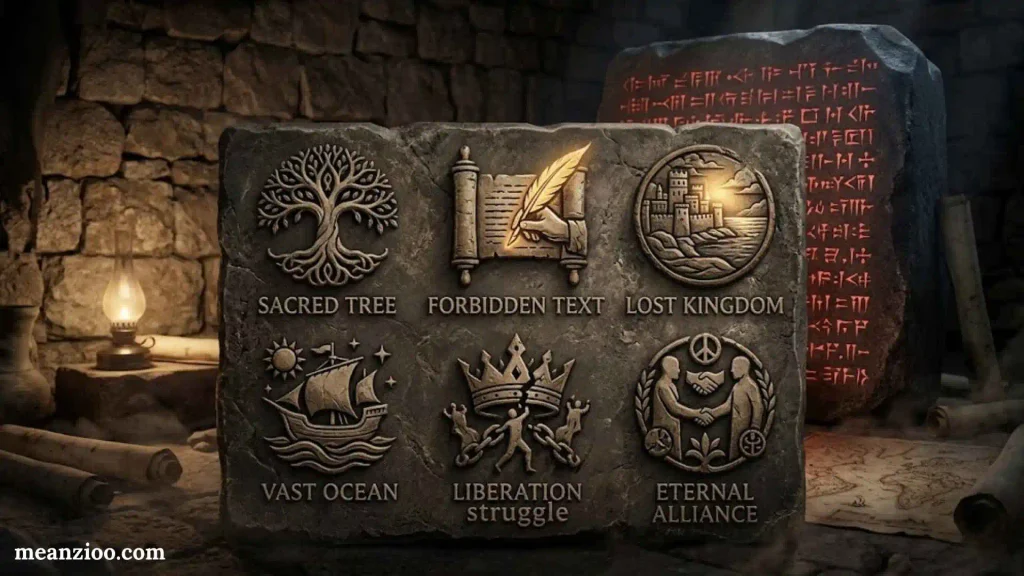
The Poneglyphs are among the most important historical objects in One Piece. These large, durable stone blocks carry inscriptions in an ancient language, preserving information that could otherwise disappear.
They differ from ordinary pirate symbols because their primary purpose is not to identify a crew. Instead, they preserve records connected to the world’s history and its major mysteries.
Nico Robin is especially important because she can read the ancient script. Her knowledge allows the Straw Hats to uncover information that most people in the world cannot access.
What Do Poneglyphs Reveal?
Different Poneglyphs contain different kinds of information. Some preserve historical accounts, while others provide information connected to important locations and the Ancient Weapons.
The Road Poneglyphs have a particularly important role. Together, their information helps identify the route to Laugh Tale, the island associated with the final destination of the Grand Line journey.
This makes the stones central to the search for the One Piece treasure.
Why Are Poneglyphs Connected to Forbidden History?
The World Government suppresses research into the ancient past, making the ability to read Poneglyphs politically dangerous.
The destruction of Ohara demonstrates the consequences of investigating forbidden history. The scholars’ work threatens the established narrative about the world, and the government’s response turns historical research into a matter of survival.
Robin’s journey therefore gives the Poneglyphs a human dimension. They’re not simply mysterious objects scattered across islands. They’re part of her effort to understand the past and preserve knowledge.
Do Poneglyphs Contain Hidden Symbols?
Poneglyphs contain ancient inscriptions, but that doesn’t mean every marking should be treated as a separate secret emblem.
A careful explanation distinguishes the written information on the stones from speculation about their appearance. Their established significance comes from the historical information they preserve and the role they play in the story.
For readers interested in One Piece lore explained, the Poneglyphs connect several major subjects: Ohara, the Void Century, Nico Robin, the Ancient Weapons, and the journey toward Laugh Tale.
Marine Justice and World Government Symbols
The Marines and World Government use symbols to represent their institutions. Unlike personal tattoos or pirate flags, these emblems communicate organizational identity and authority.
Their significance becomes more complicated when the story examines the difference between the ideals an institution claims to uphold and the actions its members take.
What Does the Marine Justice Symbol Mean?
The word 正義 appears on Marine coats and translates to “justice.” It expresses the institution’s stated ideal and helps identify its members.
However, the story doesn’t present every Marine as having the same understanding of justice.
Consider three important characters:
- Aokiji: His decisions raise questions about personal morality and how far someone should follow an institution.
- Akainu: He represents an uncompromising approach to justice, emphasizing strict enforcement.
- Smoker: His actions often reveal tension between official authority and his own judgment of right and wrong.
These differences show why the justice insignia shouldn’t be interpreted as proof that every Marine behaves justly. It represents the institution’s declared principle, while individual characters reveal the conflicts behind it.
What Does the World Government Emblem Represent?
The World Government emblem represents the global ruling organization. Its design and official explanations connect it to the world’s major seas and the Grand Line.
The organization uses its authority to maintain the established political order. Yet the story also reveals that this order includes restrictions on historical research and unequal treatment of different groups.
That contrast makes the emblem significant in context. It identifies an institution whose public authority doesn’t automatically settle questions about its morality.
The Celestial Dragons’ Mark and the Hoof of the Soaring Dragon
The Hoof of the Soaring Dragon is a slave brand associated with the Celestial Dragons. It identifies people whom they have treated as property.
Its connection to the Sun Pirates mark is especially important. Fisher Tiger and the Sun Pirates used the sun design to cover the slave brand and create a shared mark among crew members.
This contrast gives the two designs opposing meanings within the story:
| Mark | Story context | Significance |
| Hoof of the Soaring Dragon | Celestial Dragons and enslavement | Forced identification and oppression |
| Sun Pirates mark | Fisher Tiger and his crew | Shared identity and concealment of former slave brands |
| Marine justice insignia | Marines | Institutional identity and declared justice |
| World Government emblem | Global ruling organization | Political authority and the established order |
These symbols show how marks can identify people, enforce social divisions, or challenge those divisions.
One Piece Symbols Connected to the Void Century and Ancient History
The Void Century is a period of approximately 100 years whose history remains largely hidden from the world in One Piece. Its mysteries connect the Poneglyphs, the Ancient Weapons, Ohara, and the World Government’s restrictions on historical research.
It’s important to distinguish this historical period from a specific symbol. There is no single universally established “Void Century symbol” that represents every secret associated with that era.
What Is the Void Century?
The Void Century refers to a period about 800 to 900 years before the main storyline. Much of what happened during this era remains unknown to the general public within the world.
Researchers who investigate the period risk serious consequences. Ohara’s scholars attempted to uncover its history, and the government’s destruction of the island demonstrates how dangerous that research became.
The Poneglyphs preserve information that helps researchers investigate this lost period.
What Are the Ancient Weapons?
The three named Ancient Weapons are Pluton, Poseidon, and Uranus. They are associated with extraordinary power and have important implications for the world’s history and balance of power.
They are not one shared logo or emblem. Instead, they are separate elements of the story that connect to historical records, political conflict, and the mysteries of the ancient world.
Their importance helps explain why information preserved on Poneglyphs attracts so much attention.
How Do Symbols Help Reveal the Lost History?
Visual details, family traditions, inscriptions, and recurring names provide clues throughout the series. However, each clue needs to be interpreted within its actual context.
For example:
- The Poneglyphs preserve ancient information.
- The Kozuki family has a connection to carving the stones.
- Nico Robin’s ability to read the inscriptions allows the Straw Hats to investigate the past.
- The World Government’s restrictions reveal the political importance of that knowledge.
Together, these connections form a network of historical clues. The best explanations follow those established relationships instead of inventing meanings for unidentified marks.
One Piece Tattoos: Popular Designs and Their Meanings
One Piece tattoos appeal to fans because they can represent a favorite character, a meaningful relationship, or an idea that resonates beyond the series. Some designs are immediately recognizable, while others have deeper significance for readers who know their backstories.
The best choice depends on what you want the design to communicate.
Popular One Piece Tattoo Ideas
| Tattoo design | Story connection | Why fans may choose it |
| Straw Hat Jolly Roger | Luffy and his crew | Adventure, ambition, and freedom |
| Ace’s ASCE tattoo | Ace, Sabo, and Luffy | Brotherhood and remembrance |
| Whitebeard Pirates emblem | Edward Newgate’s crew | Loyalty and chosen family |
| Sun Pirates mark | Fisher Tiger and the Sun Pirates | Liberation and solidarity |
| Straw Hats’ X mark | The Alabasta farewell | Friendship and shared promises |
| Will of D. | Characters with the initial D. | Interest in the series’ central mystery |
| Heart Pirates emblem | Trafalgar Law’s crew | Connection to Law and his crew |
| Kozuki family crest | The Kozuki family of Wano | Heritage and Wano’s history |
Choosing a Tattoo That Matches Your Meaning
Before choosing a design, consider the story behind it.
If friendship matters most to you, the X mark may be a more direct choice than a large pirate flag. If you want a design associated with family and loyalty, Whitebeard’s emblem has a clear connection to those themes.
Fans who prefer subtle references may choose a small straw hat or the D. initial. Those designs are simple, although their deeper meanings depend on the viewer’s familiarity with the series.
A few practical points can help:
- Check the original reference. Small differences in a crew flag or tattoo can change the design.
- Consider size and placement. Detailed emblems may lose clarity when reproduced too small.
- Think about long-term meaning. Choose a design whose story connection still matters to you beyond the current arc.
- Understand the context. Some symbols refer to tragic events, oppression, or complicated relationships.
- Use clear artwork. Give your tattoo artist a reliable reference instead of relying on a low-resolution screenshot.
A tattoo can also carry a personal meaning that differs from its role in the series. Just distinguish your own interpretation from what the original story establishes.
One Piece Symbols Copy and Paste
Not every fan wants a tattoo or an image file. Some simply want One Piece symbols copy and paste options for a social media bio, Discord profile, username, or anime-themed message.
Unicode provides general-purpose characters and emojis that can help create a pirate-inspired look. However, these characters aren’t official reproductions of detailed One Piece crew flags.
Pirate and Anime Symbols You Can Copy
| Symbol | Name | Common use |
| ☠️ | Skull and crossbones | Pirate-themed profiles |
| 💀 | Skull | Dark or playful usernames |
| ⚓ | Anchor | Nautical themes |
| ⚔️ | Crossed swords | Battles and adventure |
| 🌊 | Ocean wave | Sea-themed bios |
| ☀️ | Sun | Sun-themed designs |
| 🔥 | Fire | Energy and intensity |
| 🌀 | Spiral | Decorative anime-style text |
| ⭐ | Star | Decorative accents |
To copy one, select the character in the table and use your device’s normal copy function. You can then paste it into a profile, caption, or message.
Are These Official One Piece Symbols?
No. These are general Unicode symbols or emojis, not official versions of the Straw Hat Jolly Roger, Ace’s tattoo, or the Sun Pirates emblem.
A detailed crew flag usually requires an image or custom artwork. An emoji can suggest a pirate theme, but it won’t reproduce the exact design.
Appearance can also vary across devices and platforms. A symbol that looks one way on a desktop may appear slightly different on a phone.
For a username or profile, the simplest approach is to combine a recognizable emoji with a short reference to your favorite character or crew. Keep the result readable, especially if people need to search for your account.
The Deeper Themes Behind One Piece Symbolism
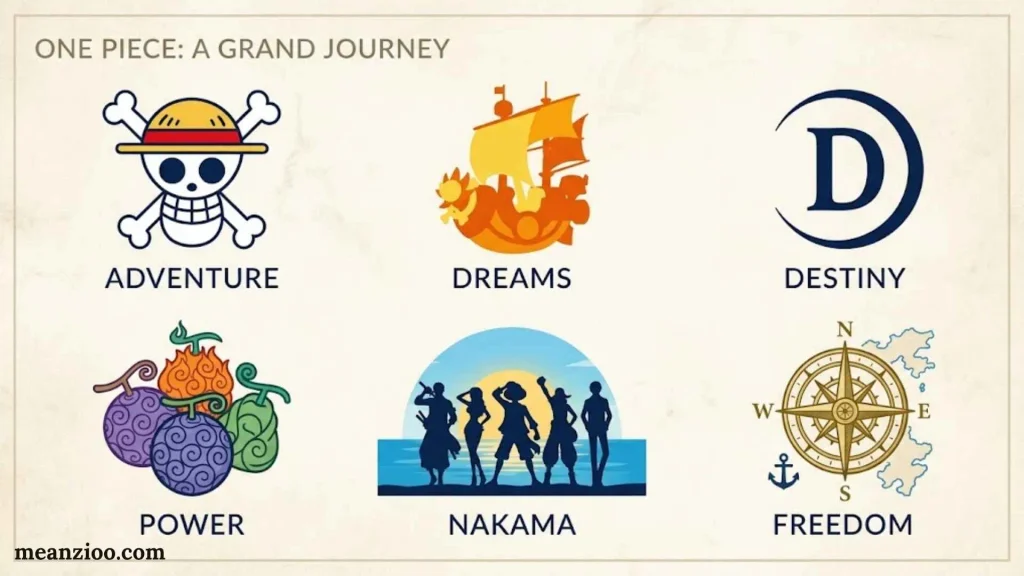
Individual symbols become more meaningful when you examine how they connect to the series as a whole. Across different story arcs, One Piece repeatedly explores freedom, inherited will, chosen family, historical truth, and the struggle against oppression.
These themes help explain why seemingly different symbols can feel connected without having identical meanings.
Freedom and Liberation
Freedom drives Luffy’s journey. He wants to become King of the Pirates because he associates that dream with the freedom to live on his own terms.
The Sun Pirates’ history presents another side of freedom. Their symbol emerged from a struggle against slavery and discrimination, giving it a more direct connection to liberation from oppression.
Both examples explore freedom, but their circumstances differ. Luffy pursues personal independence, while the Sun Pirates’ mark also confronts a system that denies people their dignity.
Inherited Will and Legacy
Inherited will connects people across generations through dreams, promises, and unfinished struggles. The straw hat, Ace’s tattoo, and the Will of D. all connect to this broader theme in different ways.
Luffy’s straw hat recalls his promise to Shanks. Ace’s tattoo preserves his relationship with his brothers. The D. initial raises questions about a legacy whose full meaning remains unresolved.
These examples show why One Piece symbolism often develops through relationships and events rather than through visual design alone.
Brotherhood and Chosen Family
The Straw Hat Pirates and Whitebeard Pirates illustrate how people can become family through loyalty and shared experiences.
Ace’s tattoos make that idea especially visible. One connects him to his sworn brothers, while the other identifies his allegiance to Whitebeard’s crew.
The symbols reinforce a central idea in the series: a person’s closest bonds aren’t always determined by blood.
Forbidden Knowledge and Historical Truth
The Poneglyphs represent the preservation of information that powerful institutions want to suppress. Nico Robin’s search for historical truth places her at the center of this conflict.
The destruction of Ohara demonstrates the cost of investigating forbidden history. In this context, the stones become more than ancient artifacts. They represent the possibility of recovering a past that the world has been prevented from understanding.
Authority, Justice, and Resistance
The Marines’ justice insignia represents an institution’s declared ideal, while the Sun Pirates’ history exposes the cruelty of another powerful group.
The contrast encourages readers to examine the difference between a symbol’s stated meaning and the actions of the people who use it.
In One Piece, symbols don’t always provide simple moral answers. Their meaning often depends on the events and choices attached to them.
How to Interpret One Piece Symbols Without Misreading Them
Not every design hides a secret, and not every popular fan theory reflects the creator’s intentions. A careful reading of One Piece hidden meanings starts with evidence from the story.
Use these principles when interpreting a symbol:
- Start with the original scene. Identify the character, crew, or event associated with the design.
- Separate appearance from meaning. A sun, skull, heart, or letter doesn’t automatically have one universal interpretation.
- Look for explicit explanations. When the story explains a tattoo or emblem, use that information as the foundation.
- Consider the broader context. A symbol can gain meaning through later events, character relationships, or historical revelations.
- Label theories honestly. If the story hasn’t confirmed an explanation, describe it as a theory rather than a fact.
- Avoid inventing official symbols. A recurring image or historical mystery isn’t necessarily an established logo.
This approach makes a symbol guide more useful because it gives readers both the relevant facts and the context needed to understand them.
Frequently Asked Questions About One Piece Symbols
What is the most recognizable One Piece symbol?
The Straw Hat Pirates’ Jolly Roger is among the most recognizable symbols in the series. It features a skull and crossed bones with Luffy’s straw hat placed on the skull. The design identifies the crew and connects to Luffy’s journey.
What does the Straw Hat Jolly Roger mean?
Its direct purpose is to identify the Straw Hat Pirates. The design also connects to Luffy’s straw hat, his promise to Shanks, and the crew’s shared adventures. Themes such as freedom and inherited will emerge from those story connections.
What does Ace’s ASCE tattoo mean?
Ace’s ASCE tattoo includes a crossed-out S associated with Sabo. It reflects the bond between Ace and his sworn brothers, Sabo and Luffy. Ace’s separate Whitebeard Pirates tattoo identifies his allegiance to Whitebeard’s crew.
What does the Sun Pirates symbol represent?
The Sun Pirates use a red sun as their Jolly Roger and shared mark. Fisher Tiger used the design to cover the slave brands carried by many former slaves. Applying the mark to other crew members made it harder to identify who had previously been enslaved.
What does the Will of D. mean in One Piece?
The Will of D. refers to a mystery associated with characters whose names contain the initial D. The story connects it to larger questions about the world’s history and legacy. Its complete meaning remains a major mystery, so specific fan theories shouldn’t be presented as established facts.
What are Poneglyphs, and what do they reveal?
Poneglyphs are durable stone blocks containing ancient inscriptions. They preserve historical information, including clues connected to the Void Century and the Ancient Weapons. The Road Poneglyphs help identify the route to Laugh Tale.
What does the Marine justice symbol mean?
The Japanese characters 正義 mean “justice.” The Marines display them on their coats as an institutional insignia. Different Marine characters interpret justice differently, which creates tension between the institution’s declared ideal and individual morality.
Which One Piece symbols are popular for tattoos?
Popular choices include the Straw Hat Jolly Roger, Ace’s ASCE tattoo, Whitebeard’s emblem, the Sun Pirates mark, the Straw Hats’ X mark, and the Will of D. Each has a different story connection, so the best choice depends on the meaning you want to express.
Can I copy and paste official One Piece symbols?
You can copy general symbols and emojis such as ☠️, ⚓, and ☀️. However, these are Unicode characters, not official reproductions of detailed One Piece emblems. For an accurate crew flag or tattoo design, use a reliable image reference.
Are the hidden meanings in One Piece confirmed?
Some meanings are explicitly explained in the story, including the purpose of Ace’s crossed-out S and the Sun Pirates’ mark. Other questions, such as the complete meaning of the D. initial, remain unresolved. A reliable guide distinguishes confirmed information from interpretation.
Why are pirate flags important in One Piece?
Pirate flags identify crews and can communicate their reputation, allegiance, and claims to territory. Their emotional importance depends on the people who sail under them. For many characters, protecting a flag also means protecting the ideals and relationships associated with it.
Conclusion: Every One Piece Symbol Tells Part of the Story
The most memorable One Piece symbols do more than decorate ships, clothing, or characters. They help tell the story.
The Straw Hat Jolly Roger identifies Luffy’s crew and connects to his journey. Ace’s tattoo preserves the bond between sworn brothers. The Sun Pirates mark turns a sign of oppression into a shared identity, while the Poneglyphs preserve historical information that powerful institutions want to suppress.
Other symbols, including the Marine justice insignia and the Will of D., raise questions about authority, inherited will, and the world’s hidden past.
Understanding these designs means looking beyond their appearance and examining the characters, relationships, and events that give them meaning. Some mysteries have clear answers, while others remain open to interpretation.
That’s what makes One Piece symbolism so compelling: a small design can connect to a much larger story.

I’m Ryan Mitchell, and I write about modern English, trending slang, and online expressions. I enjoy explaining the meanings, origins, and real-life usage of popular words in a simple way. I believe learning slang is an important step toward understanding today’s English-speaking culture. Through my work, I aim to help readers speak more naturally and stay updated with the latest language trends.
 Charlotte Hayes